 Unilateral fixation in the treatment of metastatic lesions of the spine
ABSTRACT
Objective: To evaluate the surgical outcome of patients with spinal metastases who underwent unilateral fixation using a pedicle fixation system. Methods: Seventeen patients with metastatic spinal lesions underwent surgical treatment for metastatic spinal lesions. Unilateral fixation of the affected vertebral segment was performed using a pedicle fixation system, as well as unilateral fixation of two vertebrae cranial and caudal to the affected vertebra. Decompression of the nerve structures and reconstruction of the anterior spine using vertebral spacers were performed according to the individual needs of each patient. Patients were evaluated using clinical and radiological parameters. Results: Pain, assessed using the visual analog scale (VAS), showed a statistically significant reduction in pre- and postoperative scores. Implant-related complications were observed in three patients, tumor recurrence in two patients, and postoperative infection in one patient. Conclusion: unilateral fixation of the spine using pedicle fixation systems provided mechanical stability and statistical reduction in pain scores, reduced the morbidity of the surgical procedure and presented a low rate of postoperative complications. Level of Evidence IV; Case Series.
Keywords:
Spinal Fusion; Spinal Neoplasms; Metastasis
RESUMO:
Objetivo: Avaliar o resultado do tratamento cirúrgico dos pacientes com metástase da coluna vertebral e submetidos à fixação unilateral utilizando sistema de fixação pedicular. Métodos: Dezessete pacientes com lesão metastática da coluna vertebral foram submetidos a tratamento cirúrgico devido a lesão metastática da coluna vertebral. Foi realizada a fixação unilateral do segmento vertebral acometido por meio de sistema de fixação pedicular e fixação unilateral de duas vértebras craniais e caudais à vertebra acometida pela lesão. A descompressão das estruturas nervosas e reconstrução da coluna anterior por meio da utilização dos espaçadores vertebrais foi realizada de acordo com a necessidade individual de cada paciente. Os pacientes foram avaliados por meio de parâmetros clínicos e radiológicos. Resultados: A dor avaliada por meio da escala visual analógica (VAS) apresentou redução estatística dos escores pré e pós-operatórios. Complicações relacionadas com os implantes foram observadas em três pacientes, recidiva da lesão tumoral em dois pacientes e infecção pós-operatória em um paciente. Conclusão: a fixação unilateral da coluna vertebral por meio dos sistemas de fixação pedicular proporcionou estabilidade mecânica e redução estatística dos escores da dor, reduziu a morbidade do procedimento cirúrgico e apresentou baixo índice de complicações pós-operatórias. Nivel de Evidencia IV; Série de Casos.
Descritores:
Fusão Vertebral; Neoplasias da Coluna Vertebral; Metástase
RESUMEN:
Objetivo: Evaluar el resultado quirúrgico de pacientes con metástasis espinales sometidos a fijación unilateral mediante un sistema de fijación pedicular. Métodos: Diecisiete pacientes con lesiones espinales metastásicas se sometieron a tratamiento quirúrgico por lesiones espinales metastásicas. Se realizó la fijación unilateral del segmento vertebral afectado mediante un sistema de fijación pedicular, así como la fijación unilateral de dos vértebras craneal y caudal a la vértebra afectada. Se realizó la descompresión de las estructuras nerviosas y la reconstrucción de la columna anterior mediante espaciadores vertebrales según las necesidades individuales de cada paciente. Los pacientes fueron evaluados mediante parámetros clínicos y radiológicos. Resultados: El dolor, evaluado mediante la escala visual analógica (EVA), mostró una reducción estadísticamente significativa en las puntuaciones pre y postoperatorias. Se observaron complicaciones relacionadas con el implante en tres pacientes, recurrencia tumoral en dos pacientes e infección postoperatoria en un paciente. Conclusión: la fijación unilateral de la columna mediante sistemas de fijación pedicular proporcionó estabilidad mecánica y reducción estadística en las puntuaciones de dolor, redujo la morbilidad del procedimiento quirúrgico y presentó una baja tasa de complicaciones postoperatorias. Nivel de Evidencia IV; Serie de Casos.
Descriptores:
Fusión Espinal; Neoplasias de la Columna Vertebral; Metástasis
INTRODUCTION
Vertebral metastases are a frequent complication in oncologic patients, affecting approximately 10% to 20% of cases and causing pain, mechanical instability of the vertebral segment, and neurological deficits in up to 20% of patients.1,2 Mechanical instability and spinal cord compression significantly impact quality of life, making it essential to adopt therapeutic strategies that combine control of tumor progression, pain relief, and maintenance of structural stability.3-5
The treatment of spinal metastases is multidisciplinary. In the presence of mechanical instability of the affected vertebral segment, surgical stabilization allows for restoration of weight-bearing capacity, ambulation, and patient mobility.5
Spinal fixation has traditionally been performed using bilateral fixation through pedicle screw systems. These systems offer biomechanical advantages over other fixation techniques and are widely used.6 In an effort to reduce the surgical morbidity associated with spinal fixation, unilateral fixation was developed for the surgical management of patients with degenerative spinal disease.6 Unilateral fixation has demonstrated clinical outcomes comparable to those of bilateral fixation, although it provides lower mechanical resistance due to the reduced number of implants used. 7
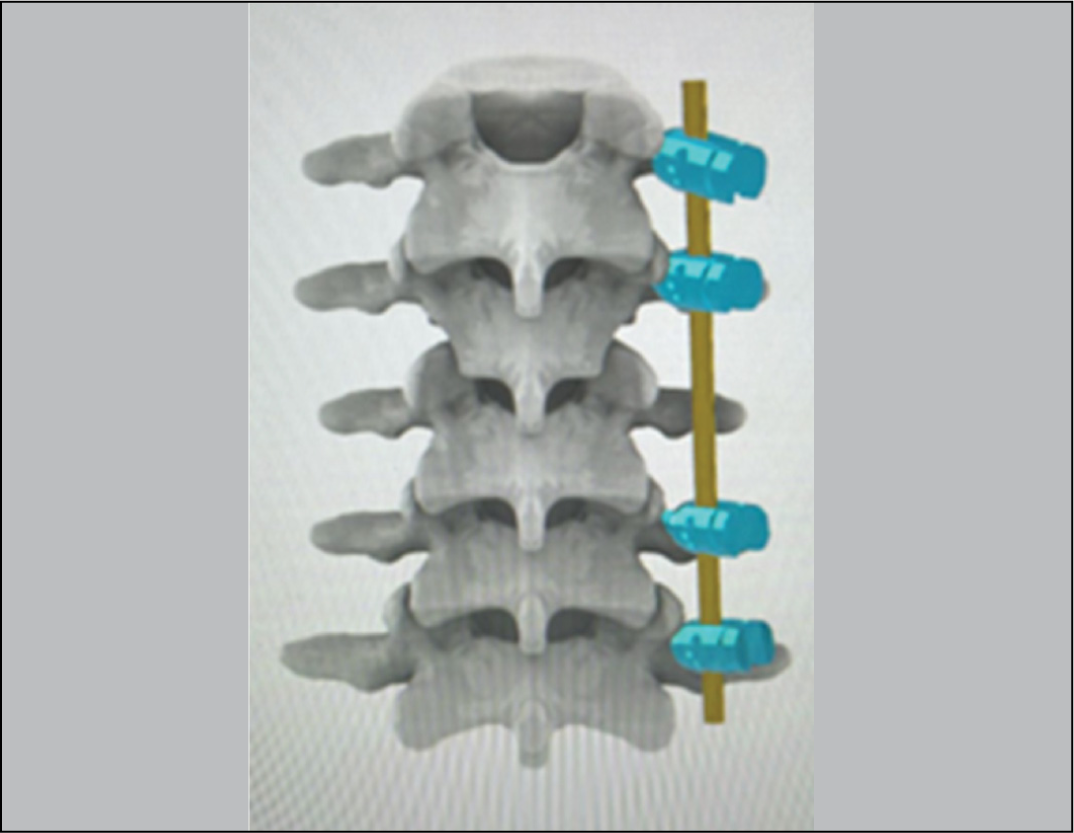
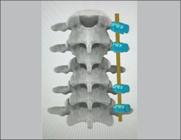
With the aim of minimizing surgical morbidity related to vertebral segment fixation in patients with spinal metastases—and based on reports of favorable clinical outcomes of unilateral fixation in degenerative spinal disease—we introduced unilateral fixation in the surgical treatment of patients with vertebral metastases. However, the same number of implants used in bilateral approaches was employed, with a broader fixation range extending two vertebrae cranially and two vertebrae caudally to the vertebra affected by the lesion. (Figure 1)
The objective of this study was to evaluate the clinical and radiographic outcomes of patients with spinal metastases who underwent surgical treatment using unilateral fixation with a pedicle screw system.
MATERIALS AND METHODS
his study was approved by the Local Research Ethics Committee (CAAE: 89219725.6.0000.5440). It was an observational, descriptive, and retrospective study conducted with patients who underwent unilateral fixation for the treatment of vertebral metastases.
Patients with a confirmed diagnosis of vertebral metastases who presented significant mechanical instability—assessed using the Spinal Instability Neoplastic Score (SINS)8 and who underwent unilateral fixation were included. Patients with incomplete medical records or inadequate postoperative follow-up were excluded.
The following data were analyzed: demographic information, oncologic characteristics (primary tumor diagnosis, anatomical location of metastases, and general tumor classification), Karnofsky Performance Status Index, pain assessment (Visual Analog Scale – VAS), instability score (SINS), levels of surgical fixation, type of surgery and implants used, functional performance (ECOG scale), and postoperative complications.
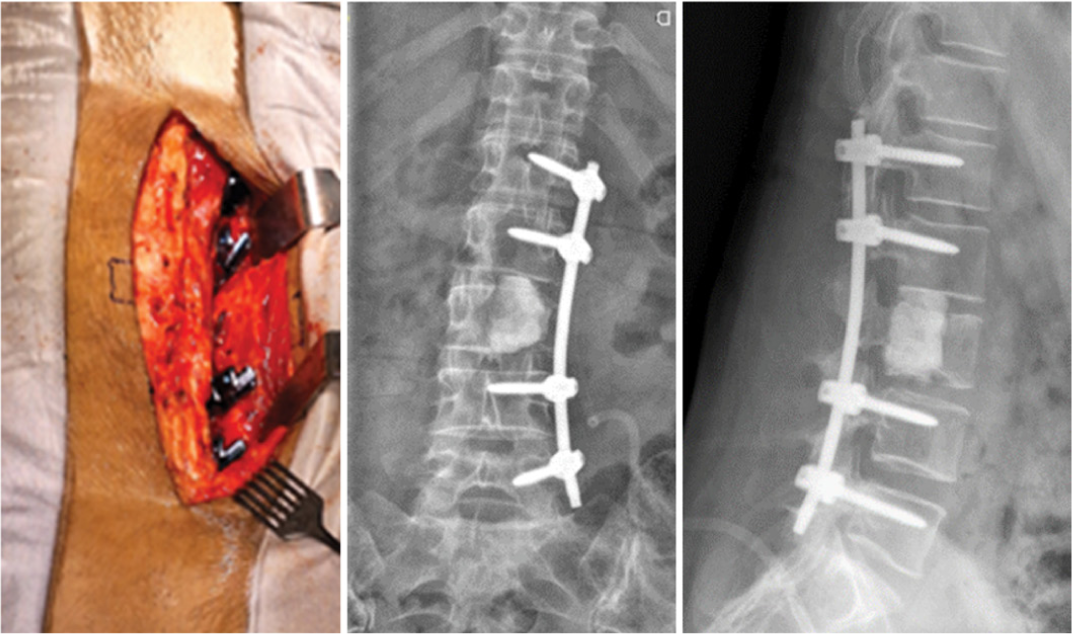
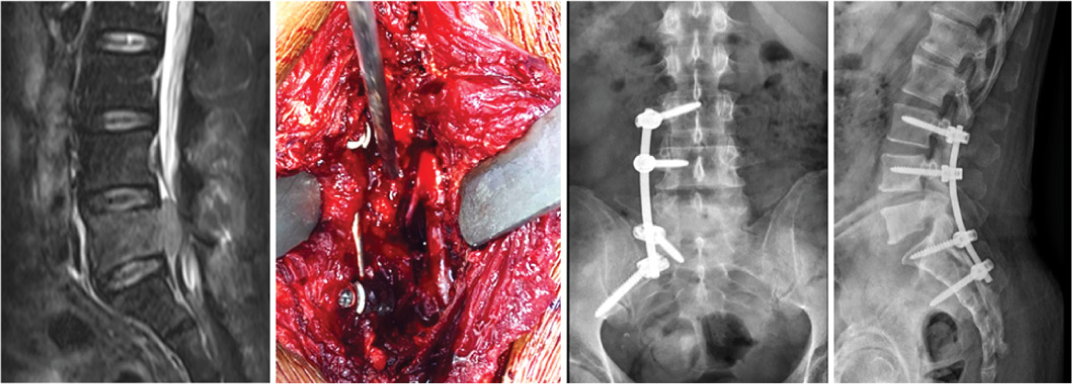
Surgical treatment was performed using the Wiltse approach with unilateral pedicle fixation involving two vertebrae above and two vertebrae below the affected vertebra (Figure 2). Decompression of the spinal canal, corpectomy, and anterior column reconstruction were performed according to the individual needs of each patient. Depending on the case, procedures included separation surgery, insertion of bone cement, or use of interbody spacers. (Figure 3)
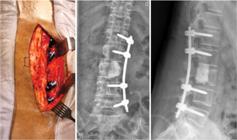
Intraoperative photograph illustrating the surgical approach for implant placement and postoperative radiographs showing unilateral fixation and orthopedic cement application in the lesion area.

Preoperative magnetic resonance imaging showing metastatic lesion from prostate carcinoma; intraoperative view illustrating surgical approach and nerve root decompression; anteroposterior and lateral radiographs at six-month follow-up.
Data were analyzed using descriptive statistics. Quantitative variables were expressed as means and standard deviations, whereas qualitative variables were presented as absolute and relative frequencies. The Kolmogorov–Smirnov test was used to assess sample normality, and the Wilcoxon test was applied to compare results. A significance level of p < 0.05 was adopted.
RESULTS
The general characteristics of the patients are summarized in Table 1.
A total of 17 patients were analyzed, including 9 men (52.9%) and 8 women (47.1%). Patient age ranged from 45 to 72 years, with a mean of 57.2 years. The predominant location of metastases was the lumbar spine (n = 13; 76.5%), while the thoracic spine was affected in four patients (23.5%).
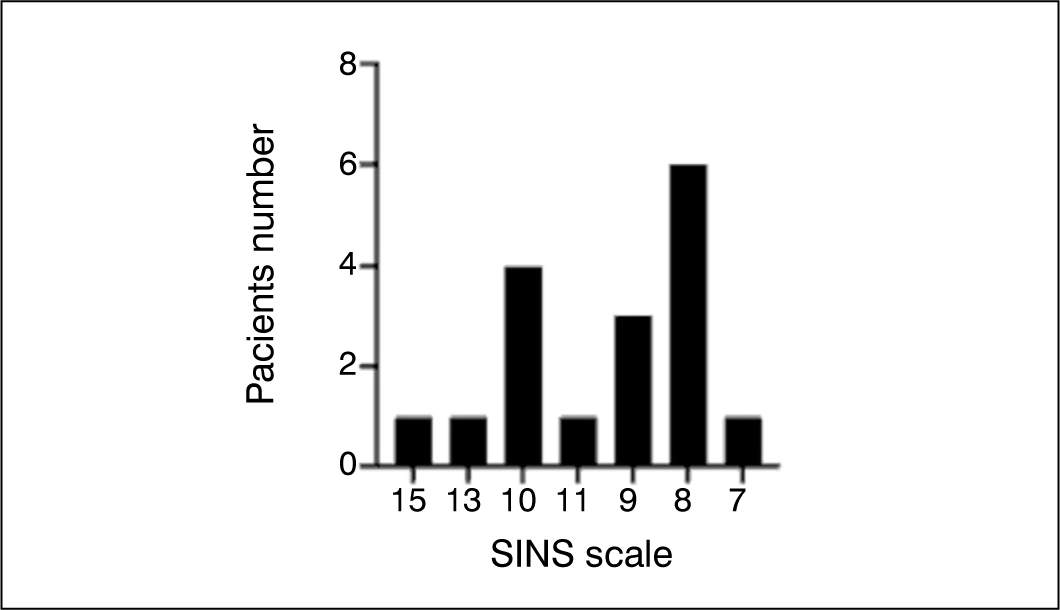
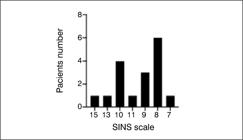
The mean Spinal Instability Neoplastic Score (SINS) was 9.47, ranging from 7 to 15. (Figure 4)
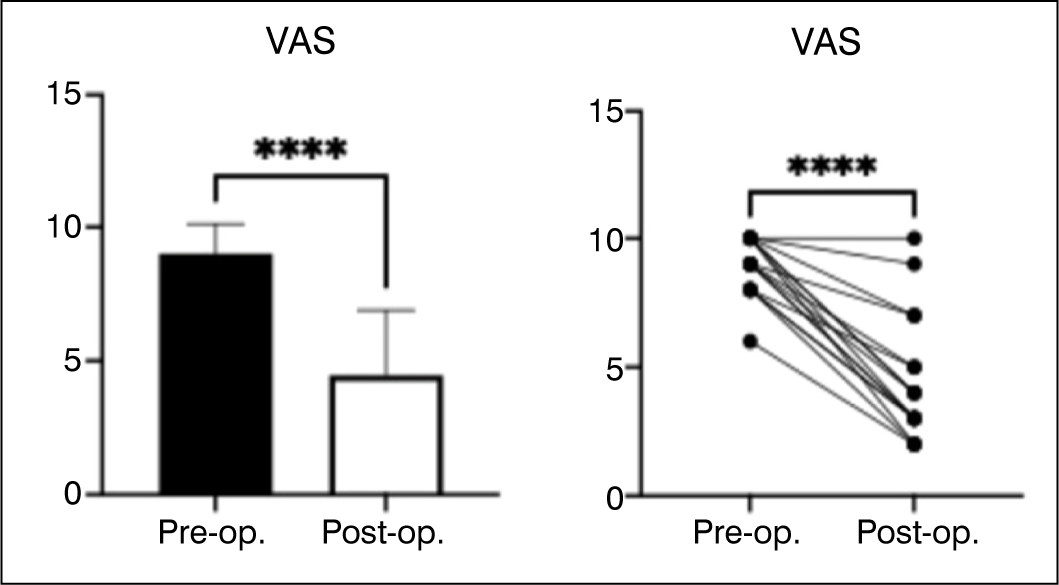
Preoperative Visual Analog Scale (VAS) pain scores ranged from 6 to 10 points (mean 9 ± 1.11), whereas postoperative scores ranged from 2 to 10 points (mean 4.47 ± 2.42). A statistically significant reduction was observed between pre- and postoperative scores (Wilcoxon test, p < 0.0001). (Figure 5)
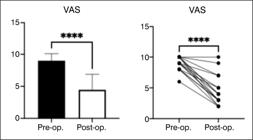
Comparison of preoperative and postoperative pain intensity using the Visual Analog Scale (VAS). Asterisks indicate statistical significance (Wilcoxon test, p < 0.0001).
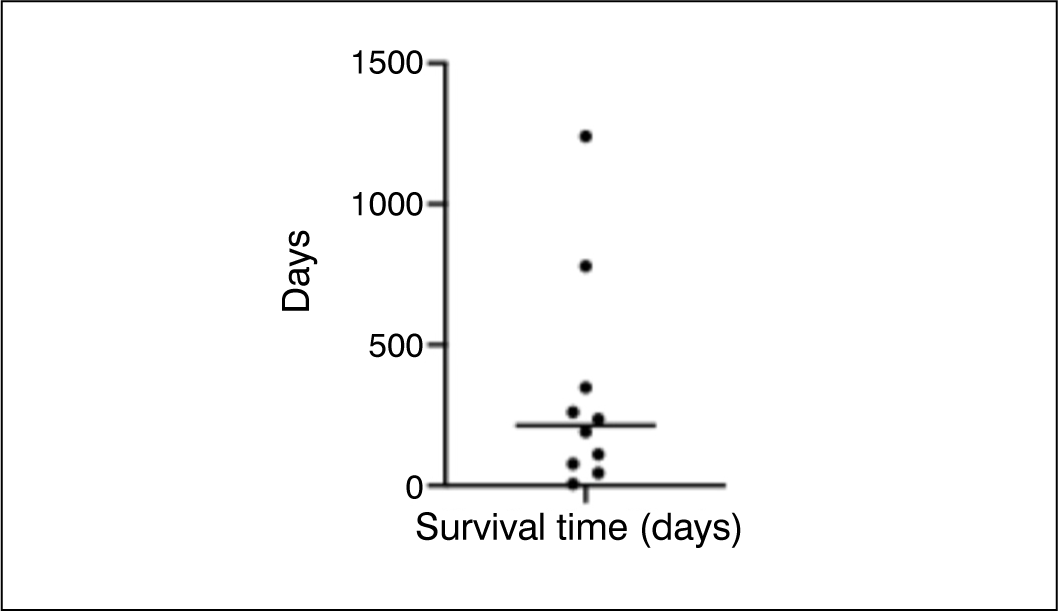
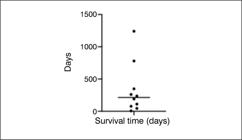
The survival period could be determined in 12 patients. Two patients were alive at the time of evaluation (283 and 1,133 days after surgery). The remaining 10 patients presented survival durations ranging from 5 to 1,240 days (mean 329.1 ± 389.10). (Figure 6)
Two patients experienced implant failure requiring revision surgery, two presented tumor recurrence, and one patient developed a postoperative infection.
DISCUSSION
Unilateral fixation in patients with metastatic spinal lesions allowed for a significant reduction in pain, demonstrated lower morbidity, and presented a low rate of complications among the evaluated patients.
The primary goal of surgical treatment in patients with spinal metastases is to improve quality of life by relieving pain and improving neurological function.9 Decompression of neural structures can be satisfactorily achieved through a unilateral approach, which does not present disadvantages compared with the bilateral approach for neural decompression. Functional recovery depends not only on the decompression performed but also on the capacity of the affected neural tissue to recover.10
Pain is one of the main symptoms associated with vertebral metastases and one of the factors that most strongly affect patients’ quality of life.1,2 In the present study, there was a mean reduction of 4.82 points in VAS scores (preoperative: 8.94; postoperative: 4.12), regardless of the location of the metastasis or type of bone lesion. These findings are consistent with previous studies demonstrating the efficacy of surgical stabilization in relieving pain.9 Unilateral fixation appears to achieve this benefit with lower surgical morbidity, making it a promising alternative for patients with limited physiological reserve.
The stability of the vertebral segment affected by metastatic disease is closely related to pain levels. The Spinal Instability Neoplastic Score (SINS) was developed to assist in the indication for surgical stabilization.8 The group of patients in this study presented a high mean SINS, and the postoperative reduction in pain highlights the mechanical effect of unilateral fixation.
Fixation of vertebral segments using pedicle screw systems has been widely employed for the treatment of mechanical instability due to various pathologies, including metastatic disease.9,10 Traditionally, bilateral fixation has been performed, as it provides substantial stability and allows early mobilization and ambulation without the need for external orthoses.4,5 Unilateral fixation was first proposed by Kabin et al. for the management of vertebral instability secondary to degenerative spinal disease.6 This technique is associated with lower morbidity and has shown clinical results comparable to those of bilateral fixation, although its biomechanical resistance is lower due to the smaller number of implants used.7 However, the potential risk of reduced mechanical stability remains controversial.7 In the present study, the unilateral fixation technique employed used the same number of implants as the bilateral approach, with a broader fixation range. Future biomechanical studies could compare the mechanical performance of using the same number of implants in unilateral versus bilateral configurations.
The reduced morbidity of unilateral fixation, particularly in patients with spinal metastases—who, in our series, had an average survival of approximately two years.11 combined with its lower cost, technical simplicity, and the possibility of anterior column decompression and reconstruction, when necessary, motivated its use. Pain relief was achieved with reduced surgical morbidity, consistent with the goals of palliative treatment aimed at improving quality of life in this patient population.4,9
General postoperative complications were observed in 23.5% of patients, a rate lower than those reported for bilateral fixation procedures, which range between 39% and 66%.12 Tumor recurrence was included among the complications, although it is not directly related to the surgical technique but rather to the biological behavior of the tumor and its response to adjuvant therapies.5,10 Mechanical failures occurred in the more distal spinal segments, which are subject to higher loading and may have contributed to implant failure. Reinforcement of unilateral fixation in distal levels could potentially prevent this type of complication.13 The two patients who experienced tumor recurrence had lesions resistant to adjuvant therapy (Ewing’s sarcoma and mesenchymal chondrosarcoma). The infiltrative nature and resistance of these tumors may compromise the effectiveness of surgical stabilization alone.9,14
Postoperative infection was observed in only one patient, representing a rate lower than that reported for bilateral fixation procedures, which can vary from 5.7% to 22%.14 This finding reinforces the advantage of unilateral fixation regarding reduced surgical exposure and morbidity, which is particularly relevant in oncologic patients, who often present immunosuppression and an increased risk of infectious complications.15
The present study has limitations related to the small sample size and heterogeneity of the patient population. Nevertheless, the initial results achieved the main objective—pain relief—through a less invasive procedure that does not require specialized equipment or a steep learning curve. Mechanical stability of the vertebral segment is only one component in the comprehensive management of metastatic spinal disease; other factors such as tumor biology, response to adjuvant treatments, and general patient condition must also be considered. Current treatment strategies integrate neurological, oncological, mechanical, and systemic aspects in therapeutic decision-making, leading to a more personalized approach.14
Unilateral spinal fixation in patients with metastatic lesions allows for a less invasive, lower-cost procedure that requires no special equipment, while achieving the goals of palliative treatment—pain relief and a low rate of complications—in this patient population.
CONCLUSION
Unilateral fixation proved to be an effective surgical option for the treatment of spinal metastases, providing significant pain reduction and demonstrating low complication rates. This technique was associated with lower morbidity while offering sufficient mechanical stability to reduce pain and improve patients’ quality of life.
DATA AVAILABILITY DECLARATION
The contents underlying the research are available in the manuscript.
REFERENCES
- 1 Choi D, Fox Z, Albert T, Arts M, Balabaud L, Bunger C, et al. Rapid improvements in pain and quality of life are sustained after surgery for spinal metastases in a large prospective cohort. Br J Neurosurg. 2016;30(3):337-44.
- 2 Dea N, Versteeg AL, Sahgal A, Verlaan JJ, Charest-Morin R, Rhines LD, et al. Metastatic spine disease: Should patients with short life expectancy be denied surgical care? Neurosurgery. 2020; 87(2):303-11.
-
3 Patchell RA, Tibbs PA, Regine WF, Payne R, Saris S, Kryscio RJ, et al. Direct decompressive surgical resection in the treatment of spinal cord compression caused by metastatic cancer: a randomised trial. Lancet. 2005;366(9486):643-8. doi: 10.1016/S0140-6736(05)66954-1. PMID: 16112300.
» https://doi.org/10.1016/S0140-6736(05)66954-1 -
4 Jaipanya P, Chanplakorn P. Spinal metastasis: narrative reviews of the current evidence and treatment modalities. J Int Med Res. 2022 Apr;50(4):3000605221091665. doi: 10.1177/03000605221091665. PMID: 35437050; PMCID: PMC9021485.
» https://doi.org/10.1177/03000605221091665 -
5 Kishore A, Piccioni A, Fiallos Vinueza IL, Younus Khan AR, Kasab M, Lakshminarasimhan D, Behbehani D, Bushnaq J, Ogunfunwa O, Bittu NV. Current Advancements in the Diagnosis and Treatment of Metastatic Spinal Cord Compression and Its Postintervention Care: A Comprehensive Review. Cureus. 2025 Jun 15;17(6):e86049. doi: 10.7759/cureus.86049. PMID: 40666548; PMCID: PMC12261808.
» https://doi.org/10.7759/cureus.86049 -
6 Kabins MB, Weinstein JN, Spratt KF, Found EM, Goel VK, Woody J, et al. Isolated L4-L5 fusions using the variable screw placement system: unilateral versus bilateral. J Spinal Disord. 1992;5(1):39-49. doi: 10.1097/00002517-199203000-00006. PMID: 1571614.
» https://doi.org/10.1097/00002517-199203000-00006 -
7 Yang K, Wu D, Kong J, Peng X, Wu H, Wang S, et al. Unilateral versus bilateral pedicle screw fixation for treating two-level lumbar degenerative diseases. Sci Rep. 2025;15(1):27340 https://doi.org/10.1038/s41598-025-13015-1
» https://doi.org/10.1038/s41598-025-13015-1 - 8 Fisher CG, DiPaola CP, Ryken TC, Bilsky MH, Shaffrey CI, Berven SH, et al. A novel classification system for spinal instability in neoplastic disease: an evidence-based approach and expert consensus from the Spine Oncology Study Group. Spine (Phila Pa 1976). 2010;35(22):E1221-9
-
9 MacLean MA, Touchette CJ, Georgiopoulos M, Brunette-Clément T, Abduljabbar FH, Ames CP, et al. AO Spine Knowledge Forum Tumor. Systemic considerations for the surgical treatment of spinal metastatic disease: a scoping literature review. Lancet Oncol. 2022;23(7):e321-e333. doi: 10.1016/S1470-2045(22)00126-7.
» https://doi.org/10.1016/S1470-2045(22)00126-7 - 10 Romiyo P, Ding K, Dejam D, Franks A, Ng E, Preet K, et al. Systematic review and evaluation of predictive modeling algorithms in spinal surgeries. J Neurol Sci. 2021;420:117184
- 11 Candido PBM, Peria FM, Pinheiro RP, Costa HRT, Defino HLA. Outcomes and survival of spinal metastasis with epidural compression. J Craniovertebr Junction Spine. 2021;12(3):287-293.
- 12 Igoumenou V, Mavrigenis AF, Angelini A, Barracco R, Benzakour A, Benzakou T, et al. Complications of spine surgery for metastasis. Eur J Orthop Surg Traumatol. 2019;30(1):37-56.
- 13 Pranata R, Lim MA, Vania R, Mahadewa TGB. Minimal Invasive Surgery Instrumented Fusion versus Conventional Open Surgical Instrumented Fusion for the Treatment of Spinal Metastases: A Systematic Review and Meta-analysis, World Neurosurg. 2021;148:e264-e274.
-
14 Xiang XB, Gao KY, Zhang WW, Li CP, Feng KK, Cao GR. Clinical efficacy analysis of surgical treatment for spinal metastasis under the multidisciplinary team using the NOMS decision system combined with the revised Tokuhashi scoring system: a randomized controlled study. J Orthop Surg Res. 2024;19(1):195. doi: 10.1186/s13018-024-04668-.
» https://doi.org/10.1186/s13018-024-04668- -
15 Zijlstra H, Te Velde JP, Striano BM, Groot OQ, de Groot TM, Raje N, et al. Remineralization Rate of Lytic Lesions of the Spine in Multiple Myeloma Patients Undergoing Radiation Therapy. Global Spine J. 2025;15(3):1712-24. doi: 10.1177/21925682241260651
» https://doi.org/10.1177/21925682241260651