 Multivariate analysis of sheep marketing characteristics at broadcast auctions in Southern Brazil
ABSTRACT:
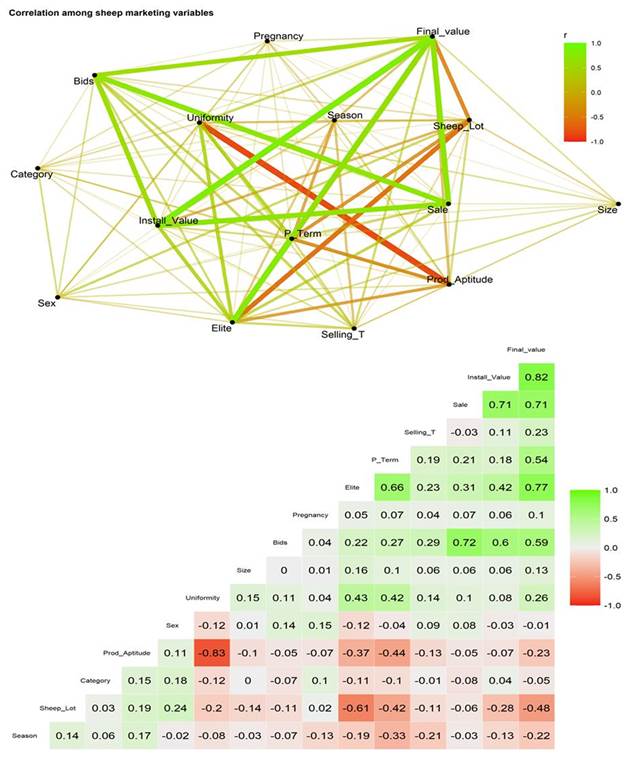
This study characterized and analyzed sheep marketing at broadcast auctions in the state of Rio Grande do Sul, Brazil. Auctions conducted between 2021 and 2024 were evaluated. Animal-level characteristics included sex, category, breed, genetic background, production aptitude, and, for females, reproductive status. At the lot level, the number of animals, uniformity, selling time, and number of bids were assessed. Auction-related variables included the season of sale, payment terms, and sale values. The variables were also analyzed using principal component analysis (PCA). A total of 1,384 sheep lots were analyzed, comprising 11,383 animals. The strongest correlations were observed between elite sheep and the payment term offered by the seller (r = 0.66), and between animal production aptitude and lot uniformity (r = -0.83). With respect to lot sales, genetic content showed the highest positive correlation (r = 0.33) and was strongly associated with the number of bids (r = 0.72) Principal components 1 and 2 explained 36.81% of the variability in sheep marketing; the first component was mainly associated with animal- and auction-related variables, while the second was associated with animal characteristics such as production aptitude, sex, and lot breed uniformity, as well as the number of bids per lot. These results indicated a strong demand for animals carrying flock-improving genetics and highlighted both breed- and lot-level uniformity as key factors in sheep sales.
Key words:
sheep; broadcast auctions; digital platforms; seasonality; lot uniformity
RESUMO:
Este estudo objetivou caracterizar e analisar a comercialização de ovinos em leilões com transmissão no Estado do Rio Grande do Sul. Para realizar o objetivo, foram avaliados leilões entre os anos de 2021 e 2024, sendo avaliados 1.384 lotes de ovinos, totalizando 11.383 animais. Nos animais foram avaliadas as características de sexo, categoria, raça, genética do animal, aptidão e de condição reprodutiva (no caso das fêmeas). Além disso, foram avaliados nos lotes o número de animais, a uniformidade, o tempo de venda e o número de lances. Em relação aos leilões foram avaliados a época da venda, as condições de pagamento e valores. As variáveis também foram analisadas pelos componentes principais (ACP). Os resultados mostram que as correlações mais altas foram verificados entre animais de elite e o prazo fornecido pelo vendedor para o pagamento dos animais (r = 0,66) e entre a aptidão dos animais e a uniformidade do lote (r = -0,83). Quanto a venda dos lotes, a variável com maior correlação positiva foi o conteúdo genético dos animais (r = 0,33), estando correlacionada positivamente com o número de lances (r = 0,72). Os componentes principais 1 (caracterizados por medidas relacionadas principalmente aos animais e aos leilões) e 2 (caracterizado por variáveis relacionadas aos animais como aptidão de produção, sexo e uniformidade racial do lote e quanto aos leilões pelo número de lances dado para o lote comercializado) explicaram 36,81% da venda de ovinos. Assim, avaliamos que existe uma procura por animais portadores de genética melhoradora dos rebanhos e a uniformidade racial e dos lotes são fundamentais nas vendas de ovinos.
Palavras-chave:
divulgação; época; plataformas digitais; prazo de comercialização; uniformidade
INTRODUCTION
The sale of animals through on-site or online auctions plays an important role in livestock production chains, facilitating the flow of sales and the acquisition of animals, while also generating tax revenue and direct and indirect employment. This marketing model enabled dynamic negotiation between buyers and sellers, ensuring fair prices and access to animals, including high-genetic-merit (elite) breeding stock, animals intended for commercial flocks, or those destined for slaughter (COSTA et al., 2020; VAZ et al., 2023). For elite auctions, regardless of species, the number of auctions increased by 14.6% in 2025 compared with 2024, with events scheduled earlier and less concentrated in the spring.
To reduce infrastructure- and transportation-related costs and minimize animal stress, traditional on-site auctions have increasingly been replaced by sales conducted via broadcast platforms or televised transmission (VAZ et al., 2023), a practice predominantly adopted for elite animals. However, the COVID-19 pandemic, together with social isolation and physical distancing measures, promoted changes throughout livestock production chains (VIANA et al., 2025). In livestock markets, these changes led to a rapid increase in the preference for broadcast auctions (remote participation), extending beyond elite animals to include those from commercial herds of different species. Additionally, broadcast auctions expand participation by including geographically distant buyers who might not attend on-site auctions (VAZ et al., 2023).
Auction-based analyses of livestock marketing are more commonly reported for cattle (SILVA FILHO & SANTOS, 2020; VAZ et al., 2023) and horses (KIBLER & THOMPSON, 2020); however, studies focusing on sheep remain limited. Assessing the strengths and weaknesses of sheep auctions in relation to livestock marketing outcomes is essential for producers and auction companies to better understand the demands of each segment of the production chain, a topic that remains underexplored in the literature. Because livestock marketing is influenced by multiple decision-making factors that determine whether a sale occurs, multivariate analyses (PCA) may provide a better understanding of how these variables influence purchasing decisions in sheep auctions.
Unlike cattle, whose individual market value is substantially higher, sheep commercialization is highly dependent on auctions (GASCH et al., 2025). Thus, the present study characterized sheep auctions in southern Brazil and to identify, through multivariate analysis, the main factors associated with sheep marketing.
MATERIALS AND METHODS
Database
A quantitative, exploratory, and descriptive approach was adopted to analyze sheep marketing at broadcast auctions conducted in the state of Rio Grande do Sul, Brazil. Sheep lots marketed at auctions held in different seasons of the year were included to compile a database comprising both elite animals and those from commercial herds. Data was collected across all months of the year and included a wide range of animal categories. Regardless of animal quality, data from 1,384 sheep lots were analyzed, comprising 615 male and 769 female lots, with a mean of 8.22 animals per lot (range: 1-119), totaling 11,383 animals.
Auction data were obtained from recorded broadcasts available on the YouTube platform, covering auctions conducted between 2021 and 2024. A total of 83 auctions were monitored via digital platforms. To minimize bias, auction events were selected across all months of the four-year period and included all characteristics considered potential influences on sheep marketing. Lots lacking complete information for any of the analyzed variables were excluded from the dataset.
Response and predictor variables
Variables analyzed as potential influences on sheep marketing (sold = 1; unsold = 2) were grouped into animal-, lot-, and auction-level variables. The dichotomous response variable was adopted to assess the frequency of sheep being sold or not at auctions as a function of the evaluated factors. However, since sheep marketing is a complex and multifactorial process, it is acknowledged that this approach may result in information loss or oversimplification.
Animal-level variables included
Sex: lots were classified as male, female, or mixed.
Animal category: categories included ewe and ram lambs, yearling ewes and rams, wethers, open or pregnant ewes, ewes with lambs, rams, and naturally colored sheep.
Genetic content: sheep were classified as elite or commercial herd animals. Elite animals were defined as breeding stock carrying additive genetic merit for flock improvement, whereas commercial herd animals were typically destined for rearing and finishing.
Production aptitude: sheep were classified as wool, meat, dual-purpose, sheepskin, or lacking a defined production aptitude, based on breed and phenotypic characteristics observed within each lot.
Reproductive status: females were classified as pregnant or non-pregnant.
Lot-level variables included
Number of animals: as declared by the auctioneer and visually confirmed during auction viewing.
Lot uniformity: assessed based on similarity in animal category, size, age, and wool color, and classified as uniform or non-uniform.
Lot breed uniformity: animals were evaluated phenotypically and classified as uniform when similar; lots composed predominantly of crossbred animals were classified as non-uniform.
Selling time: calculated as the time elapsed between the start of the lot sale, after animals entered the ring, and the hammer fall declaring the sale, and expressed in minutes. The number of bids per lot was recorded during this period.
Auction-level variables included
Season of sale: although auctions occurred in all months of the year, months were grouped into three four-month seasons across the four-year period: March-June (autumn; season 1), July-October (spring; season 2), and November-February (summer; season 3).
Payment terms and final sale price: sales were classified as installment-based or lump-sum payment. For installment sales, the maximum payment term offered by the seller was considered and the final sale price was calculated by multiplying the installment value by the number of installments.
Statistical analysis
Descriptive statistics were initially performed to characterize sheep marketing at auctions. Frequencies of selected characteristics were analyzed using the chi-square test at a 5% significance level.
Because the dichotomous approach considers only sold and unsold lots, some lots were excluded due to incomplete information on response or predictor variables, which could result in the loss of relevant observations. To minimize bias, only lots with complete data were retained, and a multivariate principal component analysis was conducted.
Principal component analysis (PCA) was performed using R software version 4.3.3. The Factoextra (version 1.0.7) and Gally packages (version 2.2.1) were used for PCA and graphical visualization, respectively. Spearman correlation coefficients were calculated to estimate phenotypic correlations among characteristics with a potential influence on sales. The PCA correlation matrix was constructed from data standardized to zero mean and unit variance.
To enhance interpretation of categorical and continuous variables, Factor Analysis of Mixed Data (FAMD) was applied. This method combines PCA and multiple correspondence analysis to identify latent factors explaining variability in both categorical and continuous data simultaneously (PAGÈS, 2004).
RESULTS AND DISCUSSION
Sheep auctions were characterized by objective transactions, with an average of approximately four bids per lot and a mean selling time of two minutes in the ring. When marketing outcomes were considered, male sheep lots exhibited higher sales rates than female lots (Table 1).
Animals intended for sheepskin production (sheepskins used for horse tack or handicrafts) also showed high market acceptance, representing the only production aptitude with a 100% sale rate (Table 1). This result is explained by the amount paid for sheepskins and the relatively limited supply of animals with this aptitude. Wool- and meat-oriented animals showed similar sales performance, suggesting a balance between these production systems. This pattern may reflect historical shifts following the wool crisis of the late 1980s, which led many producers to transition from wool breeds to meat breeds (VIANA & WAQUIL, 2013). However, renewed appreciation of wool in recent years has prompted producers to re-engage in wool production.
The importance of clearly specifying production aptitude was evident, since fewer than two-thirds of animals lacking a defined aptitude were sold. In addition, auction events held between November and February showed higher sales rates than those conducted in other seasons. In sheep production systems, mating typically occurs during summer, and although ewes are polyestrous, preferential mating in January and February aims to concentrate lambing in winter, when the incidence of myiasis is minimal, thereby reducing lamb losses. Consequently, increased purchasing activity from November onward reflects demand for animals intended for reproduction, including both elite breeding stock and animals for commercial herds. Notably, all elite sheep offered in the evaluated auctions were sold, regardless of sex, highlighting producers’ interest in genetic improvement of their flocks (Table 1). Breed- and size-level uniformity further influenced sales outcomes, with lots composed of sheep uniform in breed pattern or size achieving sales rates exceeding 80% (P < 0.05).
Female lots accounted for the largest proportion of animals offered at auctions (Table 1), indicating that male sheep trade is comparatively less frequent. This pattern contrasts with cattle production systems and is related to the feasibility of on-farm slaughter and the shorter finishing period of lambs compared with steers. In cattle auctions, calves are commonly marketed and sought by finishers or intermediate rearers.
The strong presence of commercial herds at auctions was reflected by the high proportion of sales involving animals with dual aptitude and those lacking a defined production aptitude. However, sheep lacking a defined aptitude also accounted for the highest proportions of unsold animals (Table 1). Consistently, uniformity analyses demonstrated that uniform lots achieved higher marketing success than non-uniform lots. These findings emphasized the importance of lot standardization prior to auction participation. When producers are unable to assemble uniform lots, auction companies should consider subdividing them to increase uniformity, thereby enhancing sheep value and sales performance.
Several moderate- to high-magnitude correlation coefficients were identified among the 15 evaluated characteristics (Figure 1). Positive correlations were observed between elite sheep and the payment terms offered by sellers, while negative correlations were detected between production aptitude and lot uniformity. Among variables associated with sheep lot marketing, genetic content showed the strongest positive correlation, and sales were positively associated with the number of bids per lot. These results underscore the demand for genetic improvement and for sheep with defined production aptitudes that meet market requirements. An integrated interpretation of these findings supports the development of marketing strategies that add value to sheep products and benefit both producers and auction companies.
Correlation network and Spearman correlation matrix of sheep marketing characteristics at auctions. Final value - final sale value of the lot; Install_value - installment value; Sale - sale outcome (sold or unsold); Selling_T - selling time in seconds; P_Term - payment terms; Elite - sheep carrying flock-improving genetics; Pregnancy - pregnancy status (pregnant or non-pregnant); Bids - Number of bids; Size- Body size; Uniformity -lot uniformity; Sex - males and females; Prod_Aptitude - production aptitude (wool, meat, dual-purpose, sheepskin); Category - Animal category; Sheep_Lot - number of sheep per lot; Season - season of sale.
Commercial sheep exhibited lower market values than those specifically intended for sheepskin, dual-purpose, meat, or wool production (Figure 1). Despite challenges faced by the wool sector, wool-producing animals showed relatively higher market value, likely reflecting limited supply. Similarly, an analysis of phenotypic characteristics of male lambs from three wool sheep breeds reported no price differences among breeds (KLEINÜBING et al., 2022). However, Corriedale lambs exhibited greater liquidity than Polwarth lambs, reinforcing the present findings regarding the market advantage of animals adaptable to diverse production systems.
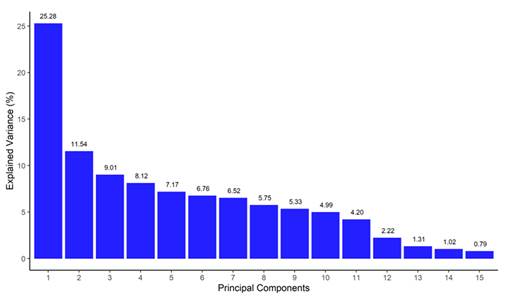
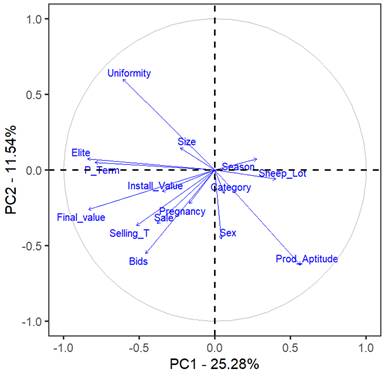
Principal component analysis (PCA), considering eigenvalues greater than 1.0, indicated that the first seven components (PC1-PC7) explained 74.40% of the total variability of sheep marketing characteristics in Rio Grande do Sul (Figure 2). The variables contributing to sheep marketing at broadcast auctions differed among the first five principal components (Figure 2). In PC1, animal-related variables included number of animals per lot, production aptitude, lot uniformity, and genetic content. Auction-related variables contributing to this component included number of bids per lot, selling time, payment terms, and final lot value (Table 2).
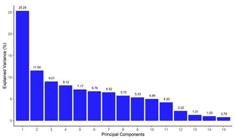
PC2 was defined by animal-related variables such as production aptitude, sex, and lot breed uniformity, and by the number of bids at the auction level. PC3 was associated with season of sale, lot size, and, for female lots, pregnancy status. Animal category and payment method were the main contributors to PC4, while PC5 was predominantly related to differences among animal categories. PC6 was associated with installment value, and PC7 included season of sale, animal categories, and lot-level size uniformity.
Within PC1, positive correlations were observed for production aptitude, and negative correlations for animal category and genetic content. These results indicate that the most frequently marketed lots consisted of commercial herd animals lacking a defined production aptitude. At the lot and auction levels, lot size showed a positive correlation, whereas lot uniformity, selling time, and payment terms were negatively correlated. These findings reinforce the importance of lot standardization, given that larger and more uniform lots play a key role in determining final sale price (GARCIA et al., 2023)
Lots that achieved successful sales were those in which animals remained in the ring longer and attracted a higher number of bids, reflecting greater competition among buyers (Figure 3). The number of bids was positively correlated with higher installment values, higher final lot prices, and longer payment terms. Price formation at sheep auctions is influenced by interactions among genetic attributes, ease of locating the desired animal, and transportation logistics-factors that collectively enhance marketing strategies (SCHIERENBECK et al., 2009). Accordingly, investments in animal presentation and quality are essential to stimulate buyer interest, increase competition, and promote higher sale values.
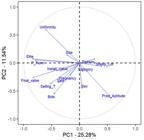
Correlation plot of measured characteristics and principal components associated with sheep marketing at broadcast auctions in Rio Grande do Sul, Brazil.
For female lots, pregnancy status facilitated marketing, likely because buyers acquiring these animals are breeders seeking to expand their productive herds by increasing the number of animals with reproductive potential (Figure 3).
Selecting the season of sale, with preference for warmer months, is a strategic factor in sheep marketing. In addition to seasonality, buyers place greater value on lots with higher size uniformity because this facilitates nutritional and animal health management and improves productive efficiency. The results indicated that sheep with wool or meat production aptitude were the most sought after. The high proportion of sheep with meat aptitude sold reflects demand for animals intended for meat-producing herds, despite the limited scale of the sheep meat market in Brazil. Per capita consumption in the country is approximately 700 g per year, compared with more than 20 kg per year in countries with smaller flocks. This disparity is largely attributed to the prevalence of informal marketing channels, the lack of an established consumption culture, and the absence of product standardization (VIANA & WAQUIL, 2013). Although, consumers generally prefer meat from younger animals due to its superior quality, this preference is not yet widespread in the market; nevertheless, the sector shows clear potential for growth in Brazil and internationally. In South Africa, experimental auctions assessing meat quality demonstrated that consumers are willing to pay higher prices for meat from younger animals (TROOST & KIRSTEN, 2022).
Although meat-oriented sheep production predominates, demand for naturally colored sheep was also evident. Naturally colored sheepskins, while considered by-products, have recognized market value for horse tack and handicrafts, contributing additional income to the sheep production sector.
CONCLUSION
Understanding sheep marketing at auctions is important for all stakeholders involved. Female sheep accounted for the largest share of animals offered, with supply concentrated from late spring through summer. Buyer remuneration declined for sheep lacking defined breed status, particularly in lots with low breed uniformity and heterogeneous body size. Within auctions, sheep carrying flock-improving genetics achieved the highest prices and were the most actively disputed, remaining in the ring longer and being associated with extended payment terms. Future studies should integrate marketing information with animal performance and productive indicators, such as estimated breeding values (EBVs), to better identify the traits most valued by buyers in sheep auctions.
ACKNOWLEDGMENTS
The Conselho Nacional de Desenvolvimento Científico e Tecnológico (CNPq) grant 308963/2021-0.
REFERENCES
-
COSTA, P. T. et al. Factors affecting the commercialization of calves in auctions in the southern region of the Rio Grande do Sul State, Brazil. Medicina Veterinária, v.13, n.2, p.244-250, 2020. Available from: <Available from: https://www.journals.ufrpe.br/index.php/medicinaveterinaria/article/view/3080 >. Accessed: Mar. 18, 2025. doi: 10.26605/medvet-v13n2-3080.
» https://doi.org/10.26605/medvet-v13n2-3080.» https://www.journals.ufrpe.br/index.php/medicinaveterinaria/article/view/3080 -
GASCH, A. et al. Financial analysis of agrivoltaic sheep: breeding and auction lamb business models. Applied Energy, v.381, n.1, p.125057, 2025. Available from: <Available from: https://www.sciencedirect.com/science/article/pii/S0306261924024413 >. Accessed: Sept. 10, 2025. doi: 10.1016/j.apenergy.2024.125057.
» https://doi.org/10.1016/j.apenergy.2024.125057.» https://www.sciencedirect.com/science/article/pii/S0306261924024413 -
GARCIA, L. J. et al. Innovation and marketing strategy: a systematic review. Revista Internacional de Inovação, v.3, n.1, p.e23150, 2023. Available from: <Available from: https://periodicos.uninove.br/innovation/article/view/23150 >. Accessed: Mar. 18, 2025. doi: 10.5585/2023.23150.
» https://doi.org/10.5585/2023.23150.» https://periodicos.uninove.br/innovation/article/view/23150 -
KIBLER, M. L.; THOMPSON, J. M. Price determinants of stock-type horses sold at public online auctions. Journal of Agricultural and Applied Economics, v.52, n.4, p.596-612, 2020. Available from: <Available from: https://ideas.repec.org/a/cup/jagaec/v52y2020i4p596-612_6.html >. Accessed: May, 02, 2025 doi: 10.1017/aae.2020.20.
» https://doi.org/10.1017/aae.2020.20.» https://ideas.repec.org/a/cup/jagaec/v52y2020i4p596-612_6.html -
KLEINÜBING, M. F. et al. Phenotypic characteristics of male lambs of woolen sheep breeds and their relationship with liquidity and price offered at auctions in Uruguaiana - Rio Grande do Sul. Revista Brasileira de Zootecnia, v.51, n.1, p.e20210007, 2022. Available from: <Available from: https://www.scielo.br/j/rbz/a/fcBC5Q4YPGBsZkcp4kyjRSB/abstract/?lang=en >. Accessed: May, 02, 2025. doi: 10.37496/rbz5120210007.
» https://doi.org/10.37496/rbz5120210007.» https://www.scielo.br/j/rbz/a/fcBC5Q4YPGBsZkcp4kyjRSB/abstract/?lang=en -
PAGÈS, J. Analyse factorielle de donnees mixtes: principe et exemple d’application. Revue de statistique appliquée, v.52, n.4, p.93-111, 2004. Available from: <https://www.numdam.org/item/RSA_2004__52_4_93_0/>. Accessed: Jul. 05, 2025.
» https://www.numdam.org/item/RSA_2004__52_4_93_0/ -
SANTOS, W. S. et al. Diagnosis of the productive chain of goats and sheep in Brazil and in the Northeast Region. Brazilian Journal of Development, v.9, n.7, p.21283-21303, 2023. Available from: <Available from: https://ojs.brazilianjournals.com.br/ojs/index.php/BRJD/article/view/57106 >. Accessed: Jul. 06, 2025. doi: 10.34117/bjdv9n7-006.
» https://doi.org/10.34117/bjdv9n7-006.» https://ojs.brazilianjournals.com.br/ojs/index.php/BRJD/article/view/57106 -
SCHIERENBECK, S. et al. Genetic and environmental impact on auction prices for Holstein cows. Livestock Science, v.121, n.2, p.327-334, 2009. Available from: <Available from: https://www.sciencedirect.com/science/article/pii/S1871141308002096 >. Accessed: Jul. 06, 2025. doi: 10.1016/j.livsci.2008.07.008.
» https://doi.org/10.1016/j.livsci.2008.07.008.» https://www.sciencedirect.com/science/article/pii/S1871141308002096 -
SILVA FILHO, J. A.; SANTOS, F. R. N. The practice of the auction as an efficient market proposal for the cattle fair: the case of Alagoas. Revista de Economia e Sociologia Rural, v.52, n.2, p.1-19, 2020. Available from: <Available from: https://www.scielo.br/j/resr/a/69TnjR4LMMZfD7jwjSwGbpt/?lang=pt >. Accessed: Jul. 06, 2025. doi: 10.1590/1806-9479.2020.177560.
» https://doi.org/10.1590/1806-9479.2020.177560.» https://www.scielo.br/j/resr/a/69TnjR4LMMZfD7jwjSwGbpt/?lang=pt -
TROOST, C.; KIRSTEN, J.F. Producer prices, carcass classification and consumers’ willingness to pay for different sheep meat grades: an experimental auction approach. Agrekon, v.61, n.2, p.121-137, 2022. Available from: <Available from: https://www.tandfonline.com/doi/full/10.1080/03031853.2022.2047079 >. Accessed: Jul. 12, 2025. doi: 10.1080/03031853.2022.2047079.
» https://doi.org/10.1080/03031853.2022.2047079.» https://www.tandfonline.com/doi/full/10.1080/03031853.2022.2047079 -
VAZ, F. N. et al. Season and geographic distribution of bulls sale at auctions in Rio Grande do Sul state, Brazil. Observatório de La Economía Latinoamericana, v.21, n.10, p.18044-18065, 2023. Available from: <Available from: https://ojs.observatoriolatinoamericano.com/ojs/index.php/olel/article/view/1733 >. Accessed: Jul. 20, 2025. doi: 10.55905/oelv21n10-190.
» https://doi.org/10.55905/oelv21n10-190.» https://ojs.observatoriolatinoamericano.com/ojs/index.php/olel/article/view/1733 -
VIANA, J. G. A. et al. Marketing margins in the beef supply chain in Rio Grande do Sul: COVID-19 pandemic impacts. Ciência Rural, v.55, n.5, p.e20240364, 2025. Available from: <Available from: https://www.scielo.br/j/cr/a/cmFwsnWCHqr6GmNvDXKqmgy/?format=html⟨=en >. Accessed: Aug. 03, 2025. doi: 10.1590/0103-8478cr20240364.
» https://doi.org/10.1590/0103-8478cr20240364.» https://www.scielo.br/j/cr/a/cmFwsnWCHqr6GmNvDXKqmgy/?format=html⟨=en -
VIANA, J. G. A.; WAQUIL, P. D. Evolution of sheep production in Rio Grande do Sul and Uruguay: comparative analysis of structural change. Ciência Rural, v.43, n.6, p.1134-1139, 2013. Available from: <Available from: https://www.scielo.br/j/cr/a/Jkbrr6WzLY7NKbcM9fxxrTf/?lang=en >. Accessed: Jul. 12, 2025. doi: 10.1590/S0103-84782013005000073.
» https://doi.org/10.1590/S0103-84782013005000073.» https://www.scielo.br/j/cr/a/Jkbrr6WzLY7NKbcM9fxxrTf/?lang=en
Edited by
-
ASSOCIATE EDITOR:
Leandro Souza da Silva (0000-0002-1636-6643)
-
SCIENTIFIC EDITOR:
Cristiano Ragagnin de Menezes (0000-0003-4523-8875)
Research data is only available upon request.