 In vitro cultivation of Amburana cearensis (Allemão) A.C. sm.
ABSTRACT:
Umburana is a woody plant from Caatinga with several medicinal uses. Anthropogenic interference in naturally occurring areas and extractivism has put this species at risk of extinction. This study optimizes the multiplication and rooting protocols for the in vitro cultivation of umburana. Two experiments were conducted in a completely randomized design using nodal segments as explants. During the multiplication phase, four culture media, four doses of BAP, and two doses of sucrose were tested, with six replicates. The second experiment focused on rooting, where the plant regulator IBA was tested on explants using three different doses and four durations of permanence, with four replicates. The highest dry biomass was achieved with 30 g. L-1 of sucrose, whereas the greatest fresh biomass, number of buds, and shoots were produced in MS medium with BAP concentrations between 0.5 - 0.6 mg. L-1. To achieve a greater number of roots, 30 days of exposure to IBA at 1 or 2 mg. L-1 is necessary, whereas for producing larger roots, 15 days of exposure to the same IBA concentrations is sufficient.
Key words:
micropropagation; medicinal plant; native species; Caatinga
RESUMO:
A umburana é uma lenhosa típica da Caatinga que apresenta múltiplos usos, principalmente o potencial medicinal. Interferências antrópicas em áreas de ocorrência natural, aliadas ao extrativismo, tem colocado a espécie em risco de extinção. O objetivo deste estudo foi otimizar o protocolo de multiplicação e enraizamento para o cultivo in vitro de umburana. Dois experimentos foram conduzidos em DIC e segmentos nodais foram utilizados como explantes. Na fase de multiplicação, foram testados quatro meios de cultura, quatro doses de BAP e duas doses de sacarose. No segundo experimento, relativo ao enraizamento, testou-se o regulador vegetal AIB sob os explantes em três doses e quatro períodos de permanência. Identificou-se que maior biomassa seca foi produzida com 30 g.L-1 de sacarose e maior biomassa fresca, número de gemas e brotos em meio MS com concentrações de BAP entre 0,5 - 0,6 mg. L-1. Para maior número de raízes, 30 dias de exposição ao AIB com 1 ou 2 mg. L-1 são necessários, e para a produção de raízes maiores, bastam 15 dias de exposição ao AIB com 1 ou 2 mg. L-1.
Palavras-chave:
micropropagação; planta medicinal; espécies nativas; Caatinga
INTRODUCTION
Amburana, amburana-de-cheiro, cerejeira, cerejeira-rajada, cumarú, cumarú-das-caatingas, cumarú-de-cheiro, imburana, imburana-de-cheiro, umburana de cheiro, and umburana are the common names given to Amburana cearensis (Allemão) A.C. Sm. (Fabaceae), a woody species native to Caatinga. It has great economic potential because of its diverse applications, particularly in carpentry and folk medicine. Tree bark and seeds have therapeutic effects and are used in the production of homemade medicines for the treatment of lung diseases, cough, asthma, bronchitis, whooping cough, fever, gastrointestinal disorders, inflammation, and inflammation pain (VERAS et al., 2023).
Owing to its diverse uses, anthropogenic activities have placed the species at risk. The Red List of Threatened Species compiled by the International Union for Conservation of Nature and Natural Resources (IUCN) has classified A. cearensis as endangered (EN) (IUCN, 2024).
In this context, given its local socioeconomic importance, developing techniques for large-scale seedling production is becoming increasingly essential, particularly since such information remains limited in the literature. Tissue culture through micropropagation is a viable alternative because it facilitates the rapid production of a large number of many seedlings in a small space and allows for precise control of environmental conditions during in vitro production process (PHILLIPS & GARDA, 2019).
A micropropagation protocol for umburana has already been established (CAMPOS et al., 2013). The study evaluated the influence of the plant regulator 6-benzylaminopurine (BAP) at different concentrations: 0.0; 2.22; 4.44; 8.88; and 17.76 µM on the in vitro multiplication of various explants: nodal segment, sprout apex, and cotyledonary segments. However, the results reported for the induction of multiple sprouts that more adequate and effective conditions are required to improve the in vitro seedling production process for this species, which could also contribute to its conservation (ALVIM et al., 2020).
Among the adjustable factors, the type and concentration of plant growth regulators and composition of the culture medium are essential factors in studies that seek in vitro cultivation of woody species. Its components are necessary for plant growth in vitro; however, they can also control plant development under these conditions (PHILLIPS & GARDA, 2019). This demonstrated the need for the ideal adjustment of macro- and micro-nutrients present in the medium, as well as the external source of carbohydrates, to successfully establish a micropropagation protocol.
Considering the above aspects, the objective of this study investigated the multiplication and rooting phases during the in vitro cultivation of A. cearensis (Allemão) A.C. by testing four culture media, four doses of BAP, two doses of sucrose, and four periods of permanence of explants in three doses of IAB.
MATERIALS AND METHODS
An exsiccata of this species was deposited in the Herbário Trópico Semiárido (HTS) 2709 (semi-arid tropical herbarium). The seeds used in this study were obtained from six populations located in the Caatinga biome of the following cities in the state of Pernambuco in Brazil: Jutaí, Rocinha, Lajedo, Barra Bonita, Caiçara, and Baixa do Juazeiro. The experiments were conducted at the Biotechnology Laboratory of Embrapa Semi-Arid, Petrolina, PE. Seeds used for in vitro establishment were washed in running water and immersed for two min in 70% alcohol (v/v). Subsequently, they were agitated for 15 min in a 2% sodium hypochlorite solution and supplemented with two drops of Tween®. The seeds were then washed thrice in distilled and autoclaved water in a laminar flow chamber.
For the in vitro establishment of seeds, flasks with a capacity of 200 mL were used, containing 40 mL of MS culture medium (MURASHIGE & SKOOG, 1962) and supplemented with 6.5 g L-1 agar and 2.0 g L-1 activated charcoal. The pH was adjusted to 5.7. The flasks with the culture medium were sealed with plastic caps and then autoclaved at a temperature of 121 ºC for 20 min.
The seeds from all experiments were placed in the flasks in the growth chamber (T-25 ± 1 ºC, 16-h photoperiod provided by cool white fluorescent lamps with a light intensity of 25 µmol m-2 s-1). After growing the plants for two months, they were used to obtain nodal segments, which were used in the multiplication experiments described below.
In the first experiment on multiple sprout induction, the objective was to test the effects of different culture media, cytokinin doses, and sucrose levels on sprout proliferation. Four different culture media were evaluated: MS (MURASHIGE & SKOOG, 1962), Wood Plant Medium (WPM; LLOYD & MCCOWN, 1981), MS culture medium with half the salts (MS/2), and WPM culture medium with half the salts (WPM/2). Four concentrations of 6-benzylaminopurine (BAP) were tested: 0.0, 0.25, 0.50, and 1.00 mg L-1 (CAMPOS et al., 2013) along with two sucrose concentrations: 15 and 30 g L-1. The experiment consisted of a triple-factorial design (four culture media × four concentrations of IBA × two sucrose concentrations) in a completely randomized design, comprising 32 treatments, six replicates, and five explants per plot. Evaluations were performed 40 days after the experimental setup to assess the following characteristics: fresh biomass (FB), dry biomass (DB), length of the longest sprout (LS), number of sprouts (NS), and number of stems (NG).
In the second experiment directed to test rooting, sprouts with a length of approximately 0.5 - 1.5 cm, obtained from in vitro-cultured plants, were placed in complete MS medium supplemented with 30 g L-1 sucrose and three concentrations of IBA (0.5, 1, and 2 mg L-1). The sprouts were maintained in the medium for 5, 10, 15, and 30 days. After each designated period, the sprouts were transferred to the same basic MS medium without auxin. This experiment was set up in a completely randomized design in a factorial arrangement (three concentrations of IBA × four periods of exposure), totaling 12 treatments with five replicates and four sprouts per plot. Sixty days after the experimental setup, the number (NR) and lengths of roots (LR) were evaluated.
The data obtained in both experiments were subjected to analysis of variance using the computational program R (R CORE TEAM). The means were compared using Tukey’s and Dunnett’s tests at 5% probability level. Prior to that, the normality of residuals and homogeneity of variances, with Shapiro-Wilk (α = 0.01) or Kolmogorov-Smirnov (α = 0.01) and Levene (α = 0.01) tests, were assessed using the same computational program.
RESULTS AND DISCUSSION
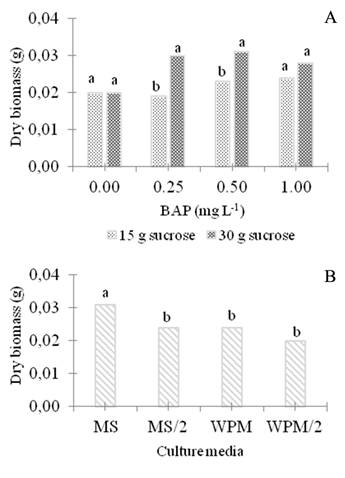
In the first experiment on sprout induction, the characteristics of dry biomass and their interactions were not significant. The MS medium outperformed the other media, providing superior nutritional conditions compared to the tested medium (Figure 1B).
Dry biomass of in vitro cultured Amburana cearensis plants under four concentrations of BAP plant growth regulators (A), two sucrose doses (g. L-1), and different culture media (B). Means followed by different letters, lowercase in the column and uppercase in the row, differ significantly according to the Tukey’s test at P ≤ 0.05 significance; KS, F: statistics for the Kolmogorov-Smirnov and Levene tests, respectively, for normality of residuals, homogeneity of variances, and significance set at P = 0.01. CV (%): coefficient of variation, SMD: significant mean difference.
The WPM as its name suggests, is used mainly for tree species and contains only 25% of the NH4NO3 and CaCl2 found in the MS medium. This observation is intriguing, given that amburana is native to Caatinga and has adapted to more restricted edaphic conditions for nutrient availability. Therefore, this medium was tested at lower concentrations of both macro- and micro-nutrients, in addition to sucrose. In this case, less concentrated MS medium or WPM was expected to exhibit the best responses for all the variables analyzed.
However, despite the adaptability of this species to restricted nutritional conditions, one of the remarkable characteristics of umburana under natural conditions is its slow growth and development. This may be related to nutritional conditions, among other factors. Thus, the use of a culture medium with a higher concentration of nitrogenous salts may benefit the in vitro growth and development of this species. ARARUNA et al. (2017) and ALBINO et al. (2019) also obtained better responses on using the MS medium for in vitro studies of Dipteryx alata Vogel (Barú) and Cariniana estrellensis (Raddi) Kuntze (Jequitibá).
Conversely, CAMPOS et al. (2013) found that umburana achieved favorable multiplication responses for the studied species with WPM. FERMINO JUNIOR & PEREIRA (2012) also assessed the effects of MS and WPM on the micropropagation of A. acreana and the best results for multiplication and rooting were obtained in the WPM medium.
In the present study, 30 g L-1 sucrose was added to the culture media containing BAP, which provided superior results for dry biomass (Figure 1A). Dry biomass is directly related to the carbon skeleton, which is an indispensable structure in its formation and requires a greater supply of an exogenous source of energy for the in vitro multiplication process (YOON et al., 2021). According to ALUKO et al. (2021), sucrose acts as a fuel source during plant tissue culture to sustain photomixotrophic metabolism, ensure optimal development, and support the maintenance of osmotic potential and water conservation in cells, in addition to other important roles such as carbon precursor or carbon metabolite signaling.
Positive results have also been reported with higher sucrose doses in micropropagation studies for the zygotic embryos of Acrocomia aculeata (BANDEIRA et al., 2013), Anacardium othonianum (SOUZA et al., 2017), and Salix viminalis, which are also woody species (GAGO et al., 2021). Considering the observations for A. cearensis, a dosage of 30 g L-1 of sucrose may favor the maximum performance of these species when cultured in vitro without reaching levels detrimental to their development.
Regarding the remaining characteristics (fresh biomass, number of sprouts, and number of gems), a significant interaction was observed among the three factors (Table 1 and Table 2). Complete MS medium without BAP and with 15 g L-1 sucrose yielded better results than the medium with 30 g L-1 sucrose for all three characteristics.
Fresh biomass of in vitro cultured Amburana cearensis plants under four concentrations of BAP plant growth regulators (mg. L-1), two sucrose doses (g. L-1), and different culture media. Means followed by different letters, lowercase in the column and uppercase in the row, differ significantly according to the Tukey’s test at P ≤ 0.05 significance; KS, F: statistics for the Kolmogorov-Smirnov and Levene tests, respectively, for normality of residuals, homogeneity of variances, and significance set at P ≤ 0.01. CV (%): coefficient of variation, SMD: significant mean difference.
Number of sprouts, and number of gems of in vitro cultured Amburana cearensis plants under four concentrations of BAP plant growth regulators (mg. L-1), two sucrose doses (g. L-1), and different culture media. Means followed by different letters, lowercase in the column and uppercase in the row, differ significantly according to the Tukey’s test at P ≤ 0.05 significance; KS, F: statistics for the Kolmogorov-Smirnov and Levene tests, respectively, for normality of residuals, homogeneity of variances, and significance set at P ≤ 0.01. CV (%): coefficient of variation, SMD: significant mean difference.
According to the responses for average fresh biomass, the complete MS medium yielded better results than MS/2, WPM, and WPM/2, and the distinct sucrose doses only affected the explants cultured in this medium. In the absence of BAP, a higher concentration (30 g L-1) did not promote an increase in fresh biomass gain; however, the addition of a lower dose of BAP was sufficient to modify the behavior of the explants in vitro. Specifically, in the presence of 0.25 mg L-1 BAP, the concentration of 30 g L-1 sucrose resulted in better development of these plants (Table 1).
During in vitro cultivation, the salt and sucrose solutions that constitute the culture media do not exert purely nutritional effects, but also influence cellular growth and morphogenesis through osmotic properties (YOON et al., 2021). The high osmotic pressure limits water absorption, and dilution increases water availability while reducing oxygenation (GAGO et al., 2020; ALUKO et al., 2021).
The use of sucrose at a dosage of 30 g L-1 optimized the effects of BAP. In this condition, a BAP concentration of 0.58 mg L-1 in MS medium was sufficient to achieve the maximum fresh biomass gain (0.19 g), compared to treatments with the same sucrose concentration on WPM medium, where the biomass increment was only 0.12 g (Figure 2).
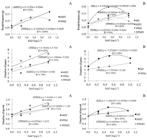
Fresh biomass, number of gems, and number of sprouts of in vitro cultured A. cearensis plants under different concentrations of BAP (mg. L-1) in different culture media supplemented with 15 g L-1 (A) or 30 g L-1 (B) of sucrose for multiplication stage of micropropagation. R2: R-squared value.
While evaluating the presence of different concentrations of cytokinins in the culture medium, an increase in the number of buds was observed, and the number of sprouts showed a linear increasing trend with increasing BAP doses in the presence of 15 g L-1 sucrose (Figure 2). However, at a higher dose of sucrose, these characteristics exhibited a linear increasing trend only in the WPM, WPM/2, and MS/2 media. For the MS medium, the maximum increase in the number of gems (7.0) and sprouts (1.7) occurred at the approximate dose of 0.65 mg L-1 BAP; concentrations higher than this became detrimental (Figure 2). CAMPOS et al. (2013) also observed the phytotoxic effects of BAP in a study on the same species.
Literature reports the effect of toxicity caused by high concentrations of BAP in micropropagation studies in some species, such as in woody species Cariniana estrellensis (ALBINO et al., 2019) with 1.0 and 2.0 mg L-1 concentrations and A. cearensis (VASCONCELOS et al., 2019) with 2.22, 4.44, 6.66 and 8.88 μM concentrations. Such toxicity leads to the formation of atypical sprouts with short internodes, vitrification, thick and brittle leaves, and reduced size. Shortening of the internodes and swelling of the sprouts were observed in A. cearensis (Figure 3E).
Cytokinins are plant growth regulators that can benefit in vitro cell elongation; however, their effects may be detrimental to adventitious rooting (VASCONCELOS et al., 2019). Therefore, one alternative is to supplement the culture medium with a higher dose of cytokinin, which promotes the induction of multiple sprouts, along with lower doses of auxin, which in this case may induce cell elongation.

Number of roots (A) and length of root (B) of in vitro cultured A. cearensis plants under three IBA (mg. L-1) concentrations and four exposure periods. Means followed by different letters in the column differ significantly according to the Tukey’s test at a significance level of P ≤ 0.05. Number of roots (C) and length of root (D) of in vitro cultured A. cearensis plants under four exposure periods at 1 and 2 mg L-1 IBA concentrations. R2: R-squared value. (E) Induction of multiple sprouts in A. cearensis explants at 1 mg L-1 BAP. (F) Rooted sprout of A. cearensis in 2.0 mg L-1 IBA with a 30-day exposure period.
In the second experiment (rooting), while assessing the in vitro rooting of A. cearensis, the number of roots and length of the longest root differed between auxin concentrations and exposure periods, showing an interaction between the studied factors (Figure 3A). The highest number of roots (3.0) was obtained with 2 mg L-1 IBA over the longest exposure period of 30 days. The exposure period of 15 days was sufficient to produce longer roots (1,29 cm) (Figure 3B).
Similar results with respect to auxin concentration during in vitro rooting of woody species were reported by SOUZA et al. (2017), and auxin was also responsive to in vitro adventitious root induction in Jequitibá sprouts (ALBINO et al., 2019). However, in studies conducted by FERMINO JÚNIOR & PEREIRA (2012) on A. acreana, the authors observed that in vitro adventitious root formation occurred regardless of the presence or absence of IBA.
In the present study conducted with A. cearensis, the results showed that the auxin exposure period was effective in promoting the induction and/or growth of adventitious roots in vitro (Figure 3F). When sprouts previously treated with 1 mg L-1 IBA were cultivated for 30 days, a greater number of roots was observed (3); however, when the sprouts were treated with 2 mg L-1 IBA, the highest number of roots was reached after 22 days of treatment with 3.34 roots (Figure 3C). Growing sprouts previously treated with 2 mg L-1 IBA for 25 days also resulted in a greater (2.6 cm) root length (Figure 3D).
Adventitious rooting involves interactions between endogenous and exogenous auxins. When the species has an adequate concentration of the endogenous auxin IAA, the conjugation with synthetic auxins such as IBA or NAA for periods of approximately 10 to 20 days is typically sufficient to induce root formation. However, the prolonged exposure of microcuttings to synthetic auxin for extended periods exceeding 30 days can hinder the growth of the induced roots (LIMA et al., 2016). Considering the results obtained in this study, A. cearensis probably has low concentrations of endogenous auxins because treatment in the absence of synthetic auxins did not produce roots.
CONCLUSION
For the multiplication phase of A. cearensis, greater dry biomass was produced with 30 g. L-1 of sucrose and greater fresh biomass, number of gems, and sprouts were produced in MS medium with BAP concentrations between 0.5 - 0.6 mg. L-1. To obtain a greater number of roots, 30 days of exposure to IBA (1 or 2 mg). L-1 is required. To produce larger roots, the plants require exposure to IBA (1 or 2 mg) for 15 days. L-1.
ACKNOWLEDGEMENTS
We are grateful to Conselho Nacional de Desenvolvimento Científico e Tecnológico (CNPq), Empresa Brasileira de Pesquisa Agropecuária (EMBRAPA) and Coordenação de Aperfeiçoamento de Pessoal de Nível Superior (CAPES), Brazil - Finance code 001 for the financial support.
REFERENCES
-
ALBINO, R. A. et al. In vitro propagation of jequitibá-branco (Cariniana estrellensis): an alternative for reforastation programs. Brazilian Journal of Biosystems Engineering, n.13, p.88-99, 2019. Available from: <Available from: http://seer.tupa.unesp.br/index.php/BIOENG/article/view/773/0 >. Accessed: Nov. 12, 2018. doi: 10.18011/bioeng2019v13n2p88-99.
» https://doi.org/10.18011/bioeng2019v13n2p88-99.» http://seer.tupa.unesp.br/index.php/BIOENG/article/view/773/0 -
ALUKO, O. O. et al. Sucrose utilization for improved crop yields: a review article. International Journal of Molecular Sciences, n.22, p.4704, 2021. Available from: <Available from: https://doi.org/10.3390/ijms22094704 >. Accessed: Feb. 06, 2024. doi: 10.3390/ijms22094704.
» https://doi.org/10.3390/ijms22094704.» https://doi.org/10.3390/ijms22094704 -
ALVIM, B. F. M. et al. In vitro conservation of Amburana cearensis Ciência Rural, n.50, p.7, 2020. Available from: <Available from: https://doi.org/10.1590/0103-8478cr20190729 >. Accessed: Jun 12, 2020. doi:10.1590/0103-8478cr20190729.
» https://doi.org/10.1590/0103-8478cr20190729» https://doi.org/10.1590/0103-8478cr20190729 -
ARARUNA, E. C. et al. Salt concentrations in culture media for the development of Dipteryx alata in vitro Pesquisa agropecuária brasileira, v.52, n.12, p.1295-1300, 2017. Available from: <Available from: https://doi.org/10.1590/S0100-204X2017001200020 >. Accessed: Nov 12, 2018. doi: 10.1590/s0100-204x2017001200020.
» https://doi.org/10.1590/s0100-204x2017001200020.» https://doi.org/10.1590/S0100-204X2017001200020 -
BANDEIRA, F. S. et al. In vitro germination of mature zygotic embryos of macaw palm influenced by storage temperature of the fruits and sucrose concentrations. Revista Árvore, v.37, n.4, p.91-700, 2013. Available from: <Available from: https://doi.org/10.1590/S010067622013000400012 >. Accessed: Nov. 12, 2018. doi: 10.1590/S0100-67622013000400012.
» https://doi.org/10.1590/S0100-67622013000400012.» https://doi.org/10.1590/S010067622013000400012 -
CAMPOS, V. C. A. et al. Micropropagation of umburana de cheiro. Ciência Rural, v.43, n.4, p.639-644, 2013. Available from: <Available from: https://doi.org/10.1590/S0103-84782013005000018 >. Accessed: Jun. 23, 2020. doi: 10.1590/S01038478201300018.
» https://doi.org/10.1590/S01038478201300018.» https://doi.org/10.1590/S0103-84782013005000018 -
FERMINO JUNIOR, P. C. P.; PEREIRA, J. E. S. In vitro germination and propagation of cerejeira (Amburana acreana (Ducke) A.C.Smith - Fabaceae) Ciência Florestal, v.22, n.1, p.1-9, 2012. Available from: <Available from: https://doi.org/10.5902/198050985074 >. Accessed: Aug. 15, 2020. doi: 10.5902/198050985074.
» https://doi.org/10.5902/198050985074.» https://doi.org/10.5902/198050985074 -
GAGO, D. et al. The effect of sucrose supplementation on the micropropagation of Salix viminalis L. sprouts in semisolid medium and temporary immersion bioreactors. Forests, v.12, n.10, p.1408, 2021. Available from: <Available from: https://doi.org/10.3390/f12101408 >. Accessed: Aug. 15, 2020. doi: 10.3390/f12101408.
» https://doi.org/10.3390/f12101408.» https://doi.org/10.3390/f12101408 -
INTERNATIONAL UNION FOR CONSERVATION OF NATURE AND NATURAL RESOURCES (IUCN). IUCN Red List of Threatened Species. 2024. Available from: <Available from: https://www.iucnredlist.org/species/32291/9687595 >. Accessed: Mar. 29, 2024.
» https://www.iucnredlist.org/species/32291/9687595 -
LIMA, D. M. et al. A. Cuttings of Langerstroemia indica with indolbutyric acid on different substrates. Pesquisa Florestal Brasileira, v.36, n.88, p.549-554, 2016. Available from: <Available from: https://pfb.cnpf.embrapa.br/pfb/index.php/pfb/article/view/1022 >. Accessed: Nov. 29, 2024. doi: 10.4336/2016.pfb.36.88.1022.
» https://doi.org/10.4336/2016.pfb.36.88.1022.» https://pfb.cnpf.embrapa.br/pfb/index.php/pfb/article/view/1022 -
LLOYD, G.; MCCOWN, B. Commercially feasible micropropagation of montain laurel, Kalmia latifolia, by use of sprout tip culture. Proceedings of the International Plant Propagator’s Society, n.30, p.421-327, 1981. Available from: <Available from: https://api.semanticscholar.org/CorpusID:83728629 >. Accessed: Aug. 06, 2020.
» https://api.semanticscholar.org/CorpusID:83728629 -
MURASHIGE, T.; SKOOG, F. A revised medium for rapid growth and bioassays with tobacco tissue cultures. Plant Physiology, v.15, p.473-97, 1962. Available from: <Available from: https://doi.org/10.1111/j.1399-3054.1962.tb08052.x >. Accessed: Mar. 20, 2021. doi: 10.1111/j.13993054.1962.tb08052.x.
» https://doi.org/10.1111/j.13993054.1962.tb08052.x.» https://doi.org/10.1111/j.1399-3054.1962.tb08052.x -
PHILLIPS, G. C.; GARDA, M. Plant tissue culture media and practices: an overview. In Vitro Cell Developmental Biology- Plant, n.55, p.242-257, 2019. Available from: <Available from: https://doi.org /10.1007/s11627-019-09983-5 > Accessed: May, 05, 2024. doi: 10.1007/s11627-019-09983-5.
» https://doi.org/10.1007/s11627-019-09983-5.» https://doi.org /10.1007/s11627-019-09983-5 - R CORE TEAM. R: A language and environment for statistical computing. R Foundation for Statistical Computing, Vienna, Austria, 2020.
-
SOUZA, I. D. et al. Composition of the cultivation medium for the production of microplants of Cerrado-tree cashew (Anacardium othonianum RIZZ.). Revista Científica, v.5, n.1, p.1-11, 2017. Available from: <Available from: https://revistas.unievangelica.edu.br/index.php/cientifica/article/view/2389/2045 >. Accessed: Nov. 25, 2024.
» https://revistas.unievangelica.edu.br/index.php/cientifica/article/view/2389/2045 -
VASCONCELOS, J. N. C. et al. Stimulation of 6-benzylaminopurine and meta-topolin-induced in vitro shoot organogenesis and production of flavonoids of Amburana cearensis (Allemão) AC Smith). Biocatálise e Biotecnologia Agrícola, n.22, 2019. Available from: <Available from: https://doi.org/10.1016/j.bcab.2019.101408 > Accessed: Nov. 12, 2018. doi: 10.1016/j.bcab.2019.101408.
» https://doi.org/10.1016/j.bcab.2019.101408.» https://doi.org/10.1016/j.bcab.2019.101408 -
VERAS, B. O. et al. Antinociceptive and anti-inflammatory activities of essential oil of the leaves of Amburana cearensis (Allemão) A.C. Smith. from the semi-arid region of Northeastern Brazil, Journal of Ethnopharmacology, 2023. Available from: <Available from: https://www.sciencedirect.com/science/article/pii/S0378874123007262?via%3Dihub >. Accessed: Nov. 12, 2024. doi: 10.1016/j.jep.2023.116858.
» https://doi.org/10.1016/j.jep.2023.116858.» https://www.sciencedirect.com/science/article/pii/S0378874123007262?via%3Dihub -
YOON, J. et al. Sucrose signaling in higher plants. Plant Science, n.302, p.110703, 2021. Available from: <Available from: https://www.sciencedirect.com/science/article/pii/S0168945220303095?via%3Dihub >. Accessed: Nov. 12, 2018. doi: 10.1016/j.plantsci.2020.110703.
» https://doi.org/10.1016/j.plantsci.2020.110703.» https://www.sciencedirect.com/science/article/pii/S0168945220303095?via%3Dihub
Edited by
-
Editors
Alessandro Dal’Col Lúcio (0000-0003-0761-4200)Ana da Silva Lédo (0000-0002-4353-4788)