 Body weight prediction and genetic evaluation in sheep: a review
ABSTRACT:
This study addresses the importance of weight prediction in sheep (Ovis aries) as a crucial tool for efficient herd management and genetic improvement. Sheep production, which plays a significant role in the economy, faces challenges in body weight monitoring due to limited access to adequate weighing resources. Linear body measurements, such as chest perimeter and withers height, represent effective alternatives for weight estimation, enabling more accurate management practices and enhanced genetic selection. This literature review is structured as follows: it begins with an introduction highlighting the relevance of sheep farming and the prediction of productive traits; subsequently, it discusses the importance of body weight recording and linear body measurements; next, it presents the main weight prediction tools based on regression models and machine learning approaches; thereafter, it addresses the methods used for genetic evaluation and the estimation of genetic parameters; and finally, it proposes the integration of phenotypic prediction and genetic evaluation within the context of meat sheep breeding programs. The research employed data from linear body measurements of sheep, applying different regression models to estimate body weight. The results indicated that the inclusion of multiple traits improved prediction accuracy, emphasizing the importance of integrated approaches to optimize productivity and sustainability in sheep production systems. The study concluded that the use of advanced weighing technologies and genetic evaluation methods has the potential to transform herd management, promoting substantial gains in productivity and animal welfare.
Key words:
genetic parameters; linear measurements; regression models; statistical modeling
RESUMO:
O presente estudo aborda a importância da predição de peso em ovinos (Ovis aries) como ferramenta crucial para o manejo eficiente e a melhoria genética dos rebanhos. A criação de ovinos, significativa para a economia, enfrenta desafios no monitoramento de peso devido à falta de recursos adequados. Medidas corporais lineares, como perímetro torácico e altura na cernelha, são alternativas eficazes para prever o peso, permitindo uma gestão mais precisa e melhorias na seleção genética. Esta revisão de literatura está organizada em: a) introduzir ao tema, destacando a relevância da ovinocultura e da predição de características produtivas; b) discutir a importância da pesagem e das medidas corporais; c) apresentar as principais ferramentas de predição de peso com base em modelos de regressão e aprendizado de máquina; d) abordar os métodos utilizados na avaliação e estimação de parâmetros genéticos; e, por fim, e) propor a integração entre predição fenotípica e avaliação genética no contexto do melhoramento de ovinos de corte. A pesquisa utilizou dados de medidas lineares de ovinos, empregando diferentes modelos de regressão para estimar o peso corporal. Os resultados indicam que a inclusão de múltiplas características melhora a precisão das predições, evidenciando a importância de abordagens integradas para otimizar a produtividade e a sustentabilidade da ovinocultura. Portanto, o estudo conclui que a utilização de tecnologias de pesagem e avaliação genética avançadas pode revolucionar a gestão de rebanhos, promovendo ganhos significativos em produtividade e bem-estar animal.
Palavras-chave:
parâmetros genéticos; medidas lineares; modelos de regressão; modelagem estatística
INTRODUCTION
The production of small ruminants represents an essential activity for the economy and the livelihood of numerous families worldwide, with sheep (Ovis aries) contributing significantly to the production of meat, milk, wool, and hides (ROESSLER, 2019). This activity is widely distributed due to the remarkable adaptability of the species, which can thrive in diverse environments ranging from arid regions to cold mountainous areas (ABIED et al., 2020). In 2022, the global sheep population was estimated at approximately 1.2 billion head, representing a growth of 5.5% compared with 2016 (FAO, 2022). Asia leads global production, accounting for 43.34% of the world’s sheep population, driven by a strong cultural tradition of sheep farming and meat consumption (FAO, 2022). In Brazil, sheep production reached 21.8 million animals in 2024, with the Northeast region concentrating 73.7% of the national herd, highlighting the socioeconomic importance of this activity in that region (IBGE, 2025).
Brazilian sheep farming is characterized by its versatility and high reproductive efficiency, serving as an important source of food and raw materials for the industry (FARRAG, 2019; AL-THUWAINI, 2021). However, its expansion is often constrained by challenges related to animal performance monitoring, particularly among small-scale producers who lack access to appropriate weighing equipment (SOUZA et al., 2009; CASTRO et al., 2012). Regular weighing is a fundamental component of zootechnical control, allowing for growth assessment, nutritional planning, and informed reproductive and health-related decisions. Nevertheless, the use of scales is frequently limited by economic and logistical constraints, leading to the adoption of alternative methods such as measuring tapes or visual estimation, which reduced the accuracy of managerial decisions.
In this context, linear body measurements have emerged as practical and effective alternatives for estimating body weight in sheep. Traits such as chest perimeter (CP), withers height (WH), and body length (BL) are directly proportional to body weight and can be easily and non-invasively obtained (SOUZA et al., 2009; CASTRO et al., 2012; GRANDIS et al., 2018). The use of these measurements has proven promising for the development of regression models aimed at weight prediction, assisting producers in the selection of animals with superior zootechnical merit and improving herd management efficiency (SOUZA et al., 2019).
For weight predictions to be useful within the context of animal breeding, it is essential that they exhibit genetic variability and allow for the accurate estimation of individuals’ additive genetic values. According to SARMENTO et al. (2016), the identification and selection of genetically superior animals can be achieved through genetic evaluations based on growth-related traits. These evaluations observed variation into environmental components (fixed effects) and genetic components (random effects), with the latter being fundamental for selection programs. The accuracy of genetic estimates depends on data quality, the statistical model applied, and the estimation methods used (OLASEGE et al., 2019).
Once genetic values are estimated, animals can be ranked, and those with superior merit can be selected as breeding stock, thereby promoting genetic gains across generations. The implementation of systematic genetic improvement programs based on statistical models such as BLUP (Best Linear Unbiased Prediction) enables not only increased productivity but also the long-term sustainability of animal production systems (ALVES et al., 2020; KOSGEY & OKEYO, 2006; SIMM et al., 2021).
Given this context, the objective of this article was to review the main approaches used for predicting body weight in sheep based on morphometric measurements, as well as to discuss the methods employed in the evaluation and estimation of genetic parameters, with emphasis on their application in breeding programs for meat sheep.
Development
Weighing sheep emerges as a vital practice for the efficient management of meat production systems, directly influencing productivity and the quality of ovine products. The following sections discuss the sheep production chain and the importance of body weight recording in optimizing productive efficiency and ensuring the sustainability of sheep farming. In addition, the main tools for weight prediction in sheep are addressed, along with the methods used for the evaluation and estimation of genetic parameters, and genetic evaluation in meat sheep.
Sheep production chain and the importance of weighing in meat production systems
The sheep production chain, both in Brazil and worldwide, is a complex structure that encompasses all stages from animal rearing and management to the processing and commercialization of derived products such as meat, wool, milk, and hides. Globally, sheep farming is an activity of considerable economic relevance, particularly in countries such as Australia, New Zealand, and China, which are major producers and exporters of sheep meat and wool (FAO, 2023). In Brazil, sheep production has shown significant growth, especially in the Southern and Northeastern regions, which benefit from favorable climatic conditions and a strong tradition in sheep farming. The Brazilian sheep production chain is largely supported by small- and medium-scale rural properties and plays a crucial role in employment generation and income diversification in rural communities (IBGE, 2022).
The sheep production chain comprises several stages, ranging from animal husbandry and management to the commercialization of derived products. Sheep play a central role in the production of meat, milk, wool, and hides, providing a versatile resource base for multiple sectors of the livestock industry. In Brazil, sheep farming is fundamental to the economic and nutritional sustainability of many families (SORIO, 2017). Given its importance, the country has experienced increasing demand for sheep-derived products, consolidating its position both as a relevant producer and as a significant importer. This trend is evidenced by the substantial volume of animals and sheep products entering the country since the 1990s (VIANA et al., 2015; EMBRAPA, 2015).
When herd management is directed toward meat production, the production cycle varies according to the specific objective, such as the production of weaned lambs, slaughter for meat production, or the breeding of replacement ewes and rams (MARTINS, 2010). The main destinations for sheep-derived products include slaughterhouses, meat processing plants, and processing units (CODEVASF, 2011). Within these segments, a wide range of products is generated, including sausages, fresh meat cuts, salted and dried meats, among others (SIDERSKY, 2018).
It is essential to highlight the inequality in access to weighing technologies among producers of different scales. As observed by BANDA & TANGANYIKA (2021), small-scale farmers face substantial challenges related to economic and infrastructural constraints, underscoring the urgent need for more accessible and practical methods for body weight estimation. This disparity emphasized the necessity for adaptive strategies, particularly for smallholders who often lack the resources required to acquire specialized weighing equipment.
The implications of the absence of regular weighing practices are extensive, affecting the understanding of production system dynamics, reducing herd efficiency, and resulting in significant economic losses. According to CHANDRA & COLLIS (2021), small-scale producers in low- and middle-income countries face unique challenges in adopting advanced digital technologies. In addition, EBEL (2020) highlighted the importance of effective management for the sustainability of small farms, emphasizing the critical need for context-specific and sustainable management strategies.
The integration of weighing and monitoring technologies into sheep production systems can yield substantial benefits. The use of electronic scales and automated data recording systems has been shown to enhance management accuracy and efficiency, improving productivity and meat quality. These technologies enable continuous and detailed monitoring of animal development, facilitating timely and informed decisions regarding nutrition, health, and reproduction (GONZÁLEZ-GARCÍA et al., 2013; GONZÁLEZ-GARCÍA et al., 2018).
Advanced weighing technologies also contributed to traceability and certification of sheep meat, attributes that are increasingly valued by consumer markets. Traceability allows consumers to access information regarding the origin and production conditions of the meat they consume, thereby increasing confidence and adding market value to the product. Consequently, the integration of weighing systems with traceability technologies and data management platforms represents a significant advancement for the sheep production chain, promoting transparency and efficiency across all stages of the production process (DI STASIO et al., 2017).
Regular monitoring of sheep’s body weight is likewise essential for the implementation of precise feeding strategies. Continuous assessment of weight gain enables rapid dietary adjustments, ensuring that animals receive adequate nutrient intake for healthy and efficient growth. This practice not only improves feed conversion efficiency but also reduces feed waste, contributing to both economic and environmental sustainability (BROWN, 2015; TAYLOR, 1954).
Finally, the implementation of regular weighing programs is crucial for the early detection of diseases and subclinical conditions in sheep herds. According to CAJA et al. (2020), unexplained weight loss is often one of the earliest indicators of health disorders in sheep. Early identification of such changes allows for prompt and effective interventions, minimizing disease impact and improving animal welfare. Thus, regular weighing not only optimizes production performance but also promotes animal health and longevity (CAJA et al., 2020).
Description of linear body measurements and weight prediction
In livestock production, the measurement of body dimensions and body weight is widely used for selection processes and research in production animals. As stated by REIS et al. (2008), the evaluation of body weight is essential for monitoring animal growth and nutritional status, administering medications, determining slaughter value, and adjusting feeding strategies.
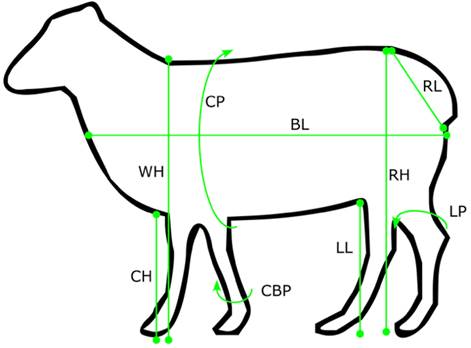
The measurement of body dimensions in sheep is generally performed with animals restrained in a standing position, using measuring tapes and zoometric calipers, depending on the structure being evaluated. To ensure data accuracy, animals should be calm and positioned on a flat surface, and all measurements should be taken by a trained evaluator using standardized criteria and calibrated equipment (SOUZA et al., 2009; ROESSLER et al., 2019). The main linear measurements include leg perimeter (LP), withers height (WH), rump height (RH), body length (BL), chest depth (CD), cannon bone perimeter (CBP), chest perimeter (CP), rump length (RL), and leg length (LL) (MONTOYA-SANTIYANES et al., 2022). Figure 1 illustrates the main linear body measurements obtained in sheep. Among the most collected variables, body length is measured from the point of the shoulder to the base of the tail, withers height is measured from the ground to the withers, and chest perimeter corresponds to the thoracic circumference immediately behind the scapulae.
Representation of linear body measurements in sheep: leg perimeter (LP), withers height (WH), rump height (RH), body length (BL), chest height (CH), cannon bone perimeter (CBP), chest perimeter (CP), rump length (RL), and leg length (LL).
ATTA et al. (2023) reported regression models successfully fitted for weight prediction in sheep and goats under field conditions, reinforcing the applicability of simple and accurate measurements in extensive production systems.
Under extensive production conditions and in poorly structured facilities, obtaining animal body weight can be challenging. This has led researchers to explore alternative approaches, particularly in situations where zootechnical records are unavailable and the collection of body measurements is limited. Several studies have demonstrated that the body weight of small ruminant animals can be estimated from body measurements (YILMAZ et al., 2012).
Numerous studies have applied regression models to data obtained using measuring tapes to estimate body weight in production animals. Table 1 presents a comprehensive overview of key studies in the literature investigating weight prediction in small ruminants based on linear body measurements. Different regression techniques have been employed, including simple, multiple, and polynomial linear regression, as well as more advanced methods such as regression trees, random forests, and support vector machines.
Main studies in the literature aimed body weight prediction in small ruminants using linear body measurements. Withers height (WH), rump height (RH), body length (BL), chest height (CH), chest perimeter (CP), chest width (CW), scrotal circumference (SC), rump width (RW), chest depth (CD), coefficient of determination (R²), and mean absolute error (MAE).
The coefficients of determination (R²) reported across studies vary widely, reflecting the effectiveness of different methodological approaches and the selected morphometric traits. For instance, TAYE et al. (2011) obtained an R² of 0.89 using simple, multiple, and nonlinear regression models in Farta sheep. In contrast, CONRADO et al. (2015) achieved an R² of 0.53 in Canindé goats using linear, quadratic, and polynomial regression models, indicating lower predictive accuracy compared with other studies.
SHIRZEYLI et al. (2013) reported a coefficient of determination of 0.99 for the Mehrbani, Zandi, and Shaal breeds using a combination of simple, multiple, and polynomial regression models, suggesting that prediction accuracy can be substantially improved through the appropriate selection of morphometric traits and regression techniques. HUMA et al. (2019) demonstrated the effectiveness of advanced machine learning methods, such as regression trees, random forests, and support vector machines, achieving an R² of 0.916 and a mean absolute error (MAE) of 1.242 in Balochi sheep. These findings highlight the potential of machine learning approaches to provide more accurate predictions compared with traditional regression methods.
GURGEL et al. (2021) and KUMAR et al. (2021) reported R² values of 0.82 and 0.88, respectively, using linear regression models in Santa Inês and Malpura sheep. Table 1 also highlights the importance of trait selection. The inclusion of multiple measurements, such as withers height (WH), rump height (RH), body length (BL), and chest perimeter (CP), is consistently associated with higher coefficients of determination. This pattern suggested that incorporating multiple morphometric dimensions is crucial for improving prediction accuracy. This trend is supported by several studies demonstrating that the combination of skeletal and thoracic volume-related traits results in more accurate body weight estimates, as it more reliably reflects the physiological condition and developmental status of the animal (ATTA et al., 2023).
Recent studies have reinforced the effectiveness of predicting body weight in sheep using morphometric measurements. ATTA et al. (2023) and MEGERSA et al. (2025) demonstrated that chest perimeter, body length, and withers height are reliable predictors, particularly when combined with regression models and machine learning algorithms. These modern approaches provided practical and cost-effective alternatives to traditional methods, as evidenced by KOZAKLI et al. (2024) and CHAY-CANUL et al. (2024).
Regression tools for body weight prediction in sheep
The prediction of body weight in sheep has evolved from simple linear models to more complex and hybrid approaches. MEGERSA et al. (2025) developed machine learning models based on morphometric measurements, demonstrating that techniques such as Random Forest, support vector regression (SVR), and XGBoost outperformed traditional linear models in terms of prediction accuracy. In a study involving Corriedale sheep, machine learning approaches were applied to estimate body weight using 14 biometric variables, yielding promising results compared with classical methods.
KOZAKLI et al. (2024) compared multiple linear regression with several machine learning algorithms to estimate post-weaning weight in Akkaraman lambs and found that ML techniques, including Random Forest and SVR, provided superior performance, with lower prediction errors than traditional regression models.
For tropical breeds, the use of neural networks has also shown high effectiveness. In Pelibuey sheep, neural network modeling using seven biometric variables achieved an R² of 0.81 and a root mean square error (RMSE) of approximately 9.91, indicating that nonlinear approaches are capable of capturing more complex relationships between morphometric traits and body weight (CHAY-CANUL et al., 2024).
In addition, studies combining machine learning and regression models have been applied to crossbred meat sheep, demonstrating that Random Forest and SVR effectively handle interactions among biometric variables such as body weight, chest perimeter, and body length. This was evidenced in the study by ROJAS et al. (2024), which evaluated different morphometric combinations to optimize predictive performance in Andean lambs.
Regarding more robust linear modeling approaches, CHURATA-HUACANI et al. (2024) applied Ridge regression and stepwise selection to predict body weight in Corriedale sheep and observed high goodness of fit, particularly when including variables such as abdominal perimeter, body length, and rump width. Finally, CAMACHO-PÉREZ et al. (2022) proposed polynomial equations calibrated using metaheuristic algorithms, achieving prediction errors below 5% when estimating body weight from biometric parameters in sheep.
Linear regressor
The linear regressor is a machine learning algorithm commonly used to predict numerical values. It is based on linear regression, which estimates a linear relationship between a set of input variables (X) and an output variable (y). The general form of the linear regression model can be expressed as:
y = β 0 +β 1 X 1 +β 2 X 2 +⋯+β n X n +ε, (1)
where β 0 is the intercept (or cutoff point), β 1 to β n are the coefficients for each of the p input variables, X 1 to X n are the values of these traits and ε it is the error term (or residual) that represents the variation not explained by the model.
This regressor aims to estimate the values of the coefficients β 1 to β n that minimize the sum of squared errors, that is, the difference between the values predicted by the model and the observed values in the dataset. This is typically achieved using the ordinary least squares (OLS) method (MONTGOMERY et al., 2006). The linear regression model is particularly useful when there is a clear linear relationship between the input features and the response variable (MONTGOMERY et al., 2006). However, when this relationship is non-linear, model performance may be compromised, and more complex approaches should be considered.
Although, classified as a simple algorithm, the linear regressor can be used to predict numerical values based on a linear relationship between the input features and the response variable. However, for the model to achieve good predictive performance, the relationship between the independent variables and the dependent variable must be approximately linear (MONTGOMERY et al., 2006).
Ridge regressor
Ridge regressor is a linear regression algorithm used to predict numerical values. It is particularly useful when the dataset contains many features that are highly correlated (HOERL & KENNARD, 1970). The objective of ridge regression is to minimize the sum of squared errors while incorporating a regularization term that penalizes the magnitude of the model coefficients. This penalty helps prevent overfitting and improves the generalization ability of the model (BISHOP, 2006).
One of the main advantages of ridge regressor is its ability to address multicollinearity issues, which arise when predictor variables are highly correlated. In addition, Ridge regressor is relatively straightforward to interpret and implement (HOERL & KENNARD, 1970). However, like any machine learning algorithm, Ridge regressor also has limitations. It may not achieve the same level of accuracy as more complex models, particularly when large datasets are available. Furthermore, it requires the tuning of an additional hyperparameter, which can be challenging in some cases (BISHOP, 2006).
Multilayer perceptron
The multilayer perceptron (MLP) regressor is a supervised learning algorithm used for regression tasks. It consists of an artificial neural network with one or more hidden layers capable of performing nonlinear transformations on the input data. The objective of the MLP is to learn a function that maps input features to the desired output value (HAYKIN, 2009).
MLP is trained using a labeled training dataset and an optimization method, such as gradient descent, to adjust the neural network weights. The mean squared error loss function is commonly employed to quantify the difference between model predictions and the observed output values (HAYKIN, 2009). One of the main advantages of the MLP is its ability to model complex nonlinear relationships in regression problems (GOODFELLOW et al., 2016). However, training an MLP can be computationally demanding and often requires large training datasets. In addition, MLPs are sensitive to weight initialization and may be prone to overfitting if not properly regularized (HAYKIN, 2009).
Random forest
Random Forest is a machine learning algorithm that can be applied to regression tasks. It is based on an ensemble of decision trees that are constructed in a randomized manner and combined to generate a final prediction. During the training process, each tree is built using a random subset of input features and a bootstrap sample of the training data. This strategy reduces correlation among trees and helps prevent overfitting. One of the main advantages of Random Forest is its ability to handle complex and high-dimensional regression problems, capturing nonlinear relationships and interactions among variables, as well as dealing effectively with missing or incomplete data (BREIMAN, 2001).
Random Forest is relatively easy to configure and can be implemented with a limited number of hyperparameters. It also provides measures of feature importance, allowing users to better understand the contribution of individual predictors to model performance. On the other hand, Random Forest models can be computationally more intensive than simpler regression approaches and are generally less interpretable than traditional linear models (BREIMAN, 2001).
Recently, MEGERSA et al. (2025) applied Random Forest, SVR, and classification and regression tree (CART) algorithms to predict body weight in sheep, demonstrating superior accuracy compared with traditional models under different environmental conditions.
Evaluation and estimation of genetic parameters
Genetic evaluation plays a fundamental role in livestock production, as it enables the identification and selection of animals with superior genetic potential for economically important traits, such as body weight, in sheep farming. Therefore, understanding and improving genetic evaluation for body weight in sheep is essential to enhance the efficiency and productivity of the sheep industry (MEDRADO et al., 2021).
The estimation of genetic parameters in sheep is a key process for understanding the genetic variation underlying traits of interest, such as body weight, prolificacy, and disease resistance (ABEBE et al., 2020). The animal model (Equation 2) is a statistical approach commonly used to estimate these parameters, as it accounts for additive genetic effects as well as environmental and residual effects.
y = Xb + Za + e, (2)
where y is the vector of phenotypic observations. X and Z are incidence matrices for fixed and Random effects, respectively. b is the vector of fixed effect. a is the vector of additive genetic effects. e is the vector of random errors.
From the solution of the system in Equation 1, it is possible to estimate the variance components and, consequently, to calculate heritability (h 2), which is the proportion of phenotypic variance explained by genetic variance (HENDERSON, 1984). Equation 3 shows the calculation of heritability.
(3)
where σa 2 is the additive genetic variance and σn 2 is the total phenotypic variance. In addition, the genetic correlation between two traits can be estimated from the genetic covariance (cov g ) and from the genetic variance of the traits involved. Equation 4 presents the calculation of the genetic correlation (rg).
(4)
Genetic parameters, including heritability and genetic correlations, are essential for understanding the potential for improvement through selection. These parameters indicated the extent to which the observed variation in animal traits can be attributed to genetic factors. Recent studies, such as that of QIN et al. (2024), reported high heritability estimates for growth traits in Ujumqin sheep, reinforcing the strong genetic influence on body weight performance.
Among the methodologies based on the animal model for estimating genetic parameters, Restricted Maximum Likelihood (REML) and Bayesian Inference are the most prominent. The REML method is widely used due to its ability to provide unbiased estimates of variance components, even in complex models with multiple random effects (MEYER, 2019). This approach has been successfully applied in animal genetics, where it plays a crucial role in genetic selection and breeding programs (MISZTAL, 2020b). GHAFOURI-KESBI et al. (2025) proposed the inclusion of dominance effects in genetic models for sheep, which resulted in improved predictive accuracy for the evaluation of quantitative traits.
Bayesian Inference offers a flexible framework for estimating genetic parameters by explicitly incorporating prior information and uncertainty in the estimates. This approach has proven particularly useful in the analysis of complex genomic data, where population structure and pedigree relationships must be properly accounted for. The ability to incorporate prior knowledge makes Bayesian methods especially advantageous in situations with limited data or highly complex model structures (RADJABALIZADEH et al., 2022).
Comparative studies between REML and Bayesian Inference suggested that both methodologies have distinct advantages depending on the specific context and data structure. RADJABALIZADEH et al. (2022) demonstrated that Bayesian Inference can provide superior performance in the analysis of growth curves in sheep, indicating that the choice of method should be guided by the characteristics of the data and the objectives of the study.
Genetic evaluation in meat sheep
Genetic evaluation in meat sheep is a vital area of research for improving productive efficiency and sustainability in sheep meat production. This process enables the estimation of genetic values, allowing effective selection of animals with superior genetic merit for economically important traits such as higher growth rates, improved meat quality, and enhanced disease resistance, which are essential for genetic progress within a flock (OYIENG et al., 2022; MUCHA et al., 2022). Genetic evaluation involves the analysis of phenotypic and pedigree information from animals within a population to estimate the genetic values of individual animals (MCLAREN et al., 2023).
The use of integrated approaches and advanced statistical models provides new opportunities to better understand the complexity of biological systems and to optimize sheep meat production. Successful genetic evaluation relies on robust statistical methodologies, such as Best Linear Unbiased Prediction (BLUP), which accounts for both genetic and environmental effects to estimate animal breeding values in an unbiased manner (REN et al., 2021). BLUP uses pedigree and phenotypic information to efficiently and accurately estimate additive genetic values, even in populations with unbalanced data structures (HENDERSON, 1975). Furthermore, the incorporation of genomic technologies, particularly single-nucleotide polymorphisms (SNPs), has revolutionized genetic evaluation by enabling a more precise and detailed characterization of animals’ genetic profiles (MISZTAL et al., 2020a). These tools provided sheep producers with a more comprehensive understanding of the genetic potential of their flocks and support the development of more effective and sustainable selection strategies.
Genetic evaluation of sheep using BLUP-based methodologies has been an active field of research, with studies addressing issues ranging from prediction accuracy to the integration of genomic information. MACEDO et al. (2020) evaluated bias and accuracy in genetic evaluations of sheep using both BLUP and Single-Step Genomic BLUP (ssGBLUP), incorporating meta founders and groups of unknown parents. The ssGBLUP approach simultaneously integrates genomic, pedigree, and phenotypic information in a single step, allowing the inclusion of both genotyped and non-genotyped animals in a unified relationship matrix (H matrix), thereby improving the accuracy of breeding value predictions (AGUILAR et al., 2010; LEGARRA et al., 2009). Meta founders represent theoretical individuals that describe distinct genetic groups in the base population and are particularly useful for addressing missing pedigree information (LEGARRA et al., 2015). This study highlighted the importance of properly accounting for pedigree gaps to ensure fair and accurate genetic evaluations (MACEDO et al., 2020).
Similarly, a study conducted in South Africa compared the predictive ability, bias, and dispersion of BLUP and ssGBLUP for production and reproductive traits in Merino sheep. The results demonstrated the potential to increase genomic prediction accuracy despite a relatively small reference population, thereby validating the benefits of incorporating genomic information into genetic improvement programs for South African Merinos (NEL et al., 2024).
VAN MARLE-KÖSTER et al. (2021) investigated genetic diversity and inbreeding levels in local cattle and sheep populations in South Africa, aiming to provide insights into the sustainable use of genetic resources adapted to the country’s diverse climatic conditions. Using SNP genotyping arrays, the authors assessed genetic diversity and inbreeding status across indigenous and commercial breeds. The results indicated moderate genetic diversity among the studied populations, with heterozygosity indices ranging from 0.296 to 0.403 in cattle and from 0.327 to 0.367 in sheep. Slightly higher levels of inbreeding were observed in cattle compared with sheep. The analysis also revealed significant genetic admixture within certain cattle breeds and clear genetic differentiation among dual-purpose, meat, and indigenous sheep breeds. These findings underscore the importance of genomic information for the effective management and conservation of local genetic resources, highlighting the need for well-designed strategies to preserve genetic diversity and enhance adaptation to environmental changes.
These studies demonstrated the continuous evolution of genetic evaluation in sheep, emphasizing the critical role of modern genomic technologies and advanced statistical methods, such as BLUP, in optimizing selection strategies and animal breeding.
CONCLUSION
The prediction of body weight in sheep using morphometric measurements has proven to be a practical, accurate, and low-cost alternative, particularly in production systems that lack access to electronic scales. The application of regression models combined with body traits such as chest perimeter, body length, and withers height allows for reliable and accessible weight estimation. In parallel, genetic evaluation using methodologies such as Bayesian inference and Restricted Maximum Likelihood (REML) enables the estimation of key genetic parameters, including heritability and genetic correlations, which are fundamental for the selection of superior animals. The integration of phenotypic weight prediction and genetic evaluation enhances the efficiency of breeding programs, contributing to increased productivity, sustainability, and competitiveness of sheep production systems.
ACKNOWLEDGMENTS
This study was financed in part by the Coordenação de Aperfeiçoamento de Pessoal de Nível Superior (CAPES), Brazil - Finance Code 001.
REFERENCES
-
ABEBE, A. S. et al. Breeding practices and trait preferences of smallholder farmers for indigenous sheep in the northwest highlands of Ethiopia: Inputs to design a breeding program. PLoS ONE, v.15, p.1-18, 2020. Available from: <Available from: https://doi.org/10.1371/journal.pone.0233040 >. Accessed: Feb. 12, 2024. doi: 10.1371/journal.pone.0233040.
» https://doi.org/10.1371/journal.pone.0233040.» https://doi.org/10.1371/journal.pone.0233040 -
ABIED, A. et al. Genomic Diversity, Population Structure, and Signature of Selection in Five Chinese Native Sheep Breeds Adapted to Extreme Environments. Genes, v.11, p.494, 2020. Available from: <Available from: https://doi.org/10.3390/genes11050494 >. Accessed: Mar. 15, 2023. doi: 10.3390/genes11050494.
» https://doi.org/10.3390/genes11050494.» https://doi.org/10.3390/genes11050494 -
AGUILAR, I. et al. Hot topic: A unified approach to utilize phenotypic, full pedigree, and genomic information for genetic evaluation of Holstein final score. Journal of Dairy Science, v.93, n.2, p.743-752, 2010. Available from: <Available from: https://doi.org/10.3168/jds.2009-2730 >. Accessed: Sept. 14, 2025. doi: 10.3168/jds.2009-2730.
» https://doi.org/10.3168/jds.2009-2730.» https://doi.org/10.3168/jds.2009-2730 -
AL-THUWAINI, T. M. The relationship of hematological parameters with adaptation and reproduction in sheep; A review study. Iraqi Journal of Veterinary Sciences, v.35, n.3, p.575-580, 2021. Available from: <Available from: https://doi.org/10.33899/ijvs.2020.127253.1490 > Accessed: Mar. 14, 2023. doi: 10.33899/ijvs.2020.127253.1490.
» https://doi.org/10.33899/ijvs.2020.127253.1490.» https://doi.org/10.33899/ijvs.2020.127253.1490 -
ALVES, K. et al. Estimation of additive and non-additive genetic effects for fertility and reproduction traits in North American Holstein cattle using genomic information. Journal of Animal Breeding and Genetics, v.137, n.3, p.316-330, 2020. Available from: <Available from: https://doi.org/10.1111/jbg.12466 >. Accessed: Mar. 15, 2023. doi: 10.1111/jbg.12466.
» https://doi.org/10.1111/jbg.12466.» https://doi.org/10.1111/jbg.12466 -
ATTA, M. et al. Prediction of body weight using body measurements in sheep and goats under field conditions. Journal of Animal Physiology and Animal Nutrition, v.108, n.1, p.55-63, 2023. Available from: <Available from: https://doi.org/10.1080/09712119.2023.2288917 >. Accessed: Aug. 10, 2025. doi: 10.1080/09712119.2023.2288917.
» https://doi.org/10.1080/09712119.2023.2288917.» https://doi.org/10.1080/09712119.2023.2288917 -
BANDA, L. J.; TANGANYIKA, J. Livestock provide more than food in smallholder production systems of developing countries. Animal Frontiers, v.11, n.2, p.7-14, 2021. Available from: <Available from: https://doi.org/10.1093/af/vfab001 >. Accessed: Mar. 15, 2023. doi: 10.1093/af/vfab001.
» https://doi.org/10.1093/af/vfab001.» https://doi.org/10.1093/af/vfab001 - BISHOP, C. Pattern Recognition and Machine Learning. Springer. 2006.
-
BREIMAN, L. Random Forests. Machine Learning, v.45, n.1, p.5-32, 2001. Available from: <Available from: https://doi.org/10.1023/A:1010933404324 >. Accessed: Mar. 15, 2023. doi: 10.1023/A:1010933404324.
» https://doi.org/10.1023/A:1010933404324.» https://doi.org/10.1023/A:1010933404324 -
BROWN, D. et al. Monitoring liveweight in sheep is a valuable management strategy: a review of available technologies. Animal Production Science, v.55, n.4, p.427-436, 2015. Available from: <Available from: https://connectsci.au/an/article-abstract/55/4/427/110176/Monitoring-liveweight-in-sheep-is-a-valuable?redirectedFrom=fulltext >. Accessed: Mar. 15, 2023. doi: 10.1071/AN13274.
» https://doi.org/10.1071/AN13274.» https://connectsci.au/an/article-abstract/55/4/427/110176/Monitoring-liveweight-in-sheep-is-a-valuable?redirectedFrom=fulltext -
CAJA, G. et al. Sensing solutions for improving the performance, health and wellbeing of small ruminants. Journal of Dairy Res., v.87, n.S1, p.34-46, 2020. Available from: <Available from: https://www.cambridge.org/core/journals/journal-of-dairy-research/article/sensing-solutions-for-improving-the-performance-health-and-wellbeing-of-small-ruminants/27931C4E696F45D282D8DE8C8F1194F0 >. Accessed: Mar. 15, 2023. doi:10.1017/S0022029920000667. Epub 2020 Jul 30. PMID: 33213578.
» https://doi.org/10.1017/S0022029920000667» https://www.cambridge.org/core/journals/journal-of-dairy-research/article/sensing-solutions-for-improving-the-performance-health-and-wellbeing-of-small-ruminants/27931C4E696F45D282D8DE8C8F1194F0 -
CASTRO, F. A. B. et al. Desempenho de cordeiros Santa Inês do nascimento ao desmame filhos de ovelhas alimentadas com diferentes níveis de energia. Semina: Ciências Agrárias, v.33, n.6Supl2, p.3379-3388, 2012. Available from: <Available from: https://ojs.uel.br/revistas/uel/index.php/semagrarias/article/view/13626 >. Accessed: Mar. 15, 2023. doi: 10.5433/1679-0359.2012v33Supl2p3379.
» https://doi.org/10.5433/1679-0359.2012v33Supl2p3379.» https://ojs.uel.br/revistas/uel/index.php/semagrarias/article/view/13626 -
CONRADO, V. et al. Modelos de regressão para predição do peso da raça canindé através de medidas morfométricas. Archivos de Zootecnia. v,64, p.277-280, 2015. Available from: <Available from: https://doi.org/10.21071/az.v64i247.400 >. Accessed: Mar. 15, 2023.: doi: 10.21071/az.v64i247.400.
» https://doi.org/10.21071/az.v64i247.400» https://doi.org/10.21071/az.v64i247.400 -
CHANDRA, R.; COLLIS, S. Digital agriculture for small-scale producers: challenges and opportunities. Communications of the ACM, v.64, n.12, p.75-84, 2021. Available from: <Available from: https://doi.org/10.1145/3454008 > Accessed: Mar. 15, 2023. doi: 10.1145/3454008.
» https://doi.org/10.1145/3454008.» https://doi.org/10.1145/3454008 -
CHAY-CANUL, A. J. et al. Neural network-based body weight prediction in Pelibuey sheep using biometric parameters. Technologies, v.12, n.5, p.59, 2024. Available from: <Available from: https://www.mdpi.com/2227-7080/12/5/59 >. Accessed: Oct. 01, 2025.
» https://www.mdpi.com/2227-7080/12/5/59 -
CODEVASF. Companhia de Desenvolvimento dos Vales do São Francisco e do Parnaíba. Manual de criação de caprinos e ovinos. 2011. Available from: <Available from: https://www.codevasf.gov.br/acesso-a-informacao/institucional/biblioteca-geraldo-rocha/publicacoes/manuais/manual-de-criacao-de-caprinos-e-ovinos.pdf/view >. Accessed: Jul. 23,2023.
» https://www.codevasf.gov.br/acesso-a-informacao/institucional/biblioteca-geraldo-rocha/publicacoes/manuais/manual-de-criacao-de-caprinos-e-ovinos.pdf/view -
DIGE, M. et al. Estimates of genetic parameters for linear body measurements and prediction of body weight in goat. Journal of Animal Breeding and Genetics, v.139, p.1-11, 2022. Available from: <Available from: https://doi.org/10.1111/jbg.12677 >. Accessed: Jul. 23, 2023. doi: 10.1111/jbg.12677.
» https://doi.org/10.1111/jbg.12677.» https://doi.org/10.1111/jbg.12677 -
DI STASIO, L. et al. Lamb meat traceability: The case of Sambucana sheep. Small Ruminant Research, v.149, p.85-90, 2017. Available from: <Available from: https://doi.org/10.1016/j.smallrumres.2017.01.013 >. Accessed: Jul. 18, 2024. doi: 10.1016/j.smallrumres.2017.01.013.
» https://doi.org/10.1016/j.smallrumres.2017.01.013.» https://doi.org/10.1016/j.smallrumres.2017.01.013 -
EBEL, R. Are small farms sustainable by nature?-Review of an ongoing misunderstanding in agroecology. Challenges In Sustainability, v.8, n.1, p.17-29, 2020. Available from: <Available from: https://doi.org/10.12924/cis2020.08010017 >. Accessed: Mar. 15, 2023. doi: 10.12924/cis2020.08010017.
» https://doi.org/10.12924/cis2020.08010017.» https://doi.org/10.12924/cis2020.08010017 -
FAO. Food and agriculture organization of the United Nations. Meat Market Review - Overview of market and policy developments in 2021. 2022. Available from: <Available from: https://www.fao.org/3/cc0984en/cc0984en.pdf >. Accessed: Sept. 10, 2023.
» https://www.fao.org/3/cc0984en/cc0984en.pdf -
FAO. Food and Agriculture Organization of the United Nations, FAO statistical yearbook 2023. 2023. Available from: <Available from: https://doi.org/10.4060/cc8166en >. Accessed: Mar. 03, 2023. doi: 10.4060/cc8166en.
» https://doi.org/10.4060/cc8166en.» https://doi.org/10.4060/cc8166en -
FARRAG, B. Productive characteristics and reproductive responses to estrus synchronization and flushing in Abou-Delik ewes grazing in Arid Rangelands in Halaieb-Shalateen-Abouramad Triangle of Egypt. World’s Veterinary Journal, v.9, n.3, p.201-210, 2019. Available from: <Available from: https://doi.org/10.36380/scil.2019.wvj26 >. Accessed: Mar. 15, 2023. doi: 10.36380/scil.2019.wvj26.
» https://doi.org/10.36380/scil.2019.wvj26.» https://doi.org/10.36380/scil.2019.wvj26 -
HENDERSON, C. R. Best linear unbiased estimation and prediction under a selection model. Biometrics, v.31, n.2, p.423-447, 1975. Available from: <Available from: https://pubmed.ncbi.nlm.nih.gov/1174616/ >. Accessed: Oct. 11, 2025.
» https://pubmed.ncbi.nlm.nih.gov/1174616/ -
HOERL, A.; KENNARD, R. Ridge regression: Biased estimation for nonorthogonal problems. Technometrics, v.12, n.1, p.55-67, 1970. Available from: <Available from: https://doi.org/10.2307/126735 >. Accessed: Mar. 15, 2023. doi: 10.2307/126735.
» https://doi.org/10.2307/126735.» https://doi.org/10.2307/126735 -
GHAFOURI-KESBI, F. et al. Improvement in genetic evaluation of quantitative traits in sheep by enriching genetic model with dominance effects. Scientific Reports, v.15, n.1, p.1-12, 2025. Available from: <Available from: https://doi.org/10.1038/s41598-025-16005-5 >. Accessed: Sept. 19, 2025. doi: 10.1038/s41598-025-16005-5.
» https://doi.org/10.1038/s41598-025-16005-5.» https://doi.org/10.1038/s41598-025-16005-5 -
GONZÁLEZ-GARCÍA, E.; et al. Measuring liveweight changes in lactating dairy ewes with an automated walk-over-weighing system. Journal of Dairy Science, 2013. Available from: <Available from: https://doi.org/10.3168/jds.2020-19075 >. Accessed: Jul. 15, 2024. doi: 10.3168/jds.2020-19075.
» https://doi.org/10.3168/jds.2020-19075.» https://doi.org/10.3168/jds.2020-19075 -
GONZÁLEZ-GARCÍA, E. et al. An assessment of Walk-over-Weighing to estimate short-term individual forage intake in sheep. Animal, 2018. Available from: <Available from: https://doi.org/10.1017/S1751731117002609 >. Accessed: Jul. 15, 2024. doi: 10.1017/S1751731117002609.
» https://doi.org/10.1017/S1751731117002609.» https://doi.org/10.1017/S1751731117002609 - GOODFELLOW, I. et al. Deep Learning. 2016. MIT Press.
-
GRANDIS, F. A. et al. Relação entre medidas biométricas e peso corporal em ovinos da raça Texel. Veterinária e Zootecnia, v.25, n.2, p.1-8, 2018. Available from: <Available from: https://doi.org/10.35172/rvz.2018.v25.57 >. Accessed: Mar. 15, 2023. doi: 10.35172/rvz.2018.v25.57.
» https://doi.org/10.35172/rvz.2018.v25.57.» https://doi.org/10.35172/rvz.2018.v25.57 -
GURGEL, A. L. C. et al. Use of biometrics in the prediction of body weight in crossbred lambs. Arquivo Brasileiro de Medicina Veterinária e Zootecnia. v.73, p.261-264, 2021. Available from <Available from https://doi.org/10.1590/1678-4162-12087 >. Accessed: Mar. 15, 2023. doi: 10.1590/1678-4162-12087.
» https://doi.org/10.1590/1678-4162-12087.» https://doi.org/10.1590/1678-4162-12087 - HAYKIN, S. Neural Networks and Learning Machines. 2009. Pearson Education.
-
HENDERSON, C. R. Applications of linear models in animal breeding. 1984. Available from <Available from http://lib.ugent.be/catalog/rug01:000162616 >. Accessed: Mar. 15, 2023.
» http://lib.ugent.be/catalog/rug01:000162616 -
HUMA, Z. E.; IQBAL, F. Predicting the body weight of Balochi sheep using a machine learning approach. Turkish Journal of Veterinary and Animal Sciences, v.43, p.500-506, 2019. Available from <Available from https://doi.org/10.3906/vet-1812-23 >. Accessed: Mar. 15, 2023. doi: 10.3906/vet-1812-23.
» https://doi.org/10.3906/vet-1812-23.» https://doi.org/10.3906/vet-1812-23 -
IBGE. Instituto Brasileiro de Geografia e Estatística. Censo agropecuário: Rebanho de Ovinos (Ovelhas e Carneiros). Rio de Janeiro: IBGE, 2025. Available from: <Available from: https://www.ibge.gov.br/explica/producao-agropecuaria/ovino/br >. Accessed: Oct. 10, 2025.
» https://www.ibge.gov.br/explica/producao-agropecuaria/ovino/br -
KOSGEY, I. S.; OKEYO, A. M. Genetic improvement of small ruminants in low-input smallholder production systems: Technical and infrastructural issues. Small Ruminant Research, [s.l.], 2006. Interbull Bulletin, n.33, 2005. SLU, Uppsala, Sweden. Available from: <Available from: http://www.interbull.org >. Accessed: Jun. 17, 2024.
» http://www.interbull.org -
KOZAKLI, Ö. et al. Comparison of machine learning algorithms and multiple linear regression for post-weaning weight prediction in Akkaraman lambs. Veterinary World, v.17, n.6, p.1354-1362, 2024. Available from: <Available from: https://www.ncbi.nlm.nih.gov/pmc/articles/PMC11371844 >. Accessed: Oct. 10, 2025.
» https://www.ncbi.nlm.nih.gov/pmc/articles/PMC11371844 -
LEGARRA, A. et al. A relationship matrix including full pedigree and genomic information. Journal of Dairy Science, v.92, n.9, p.4656-4663, 2009. Available from: <Available from: https://doi.org/10.3168/jds.2009-2061 >. Accessed: Sept. 18, 2025. doi: 10.3168/jds.2009-2061.
» https://doi.org/10.3168/jds.2009-2061.» https://doi.org/10.3168/jds.2009-2061 -
LEGARRA, A. et al. Ancestral Relationships Using Metafounders: Finite Ancestral Populations and Across Population Relationships. Genetics, v.200, n.2, p.455-468, 2015. Available from: <Available from: https://doi.org/10.1534/genetics.115.177014 >. Accessed: Sept. 18, 2025. doi: 10.1534/genetics.115.177014.
» https://doi.org/10.1534/genetics.115.177014.» https://doi.org/10.1534/genetics.115.177014 -
MACEDO, F. L. et al. Bias and accuracy of dairy sheep evaluations using BLUP and SSGBLUP with metafounders and unknown parent groups. Genetics Selection Evolution, v.52, n.47, p.1-10, 2020. Available from: <Available from: https://doi.org/10.1186/s12711-020-00567-1 >. Accessed: Jan. 18, 2024. doi: 10.1186/s12711-020-00567-1.
» https://doi.org/10.1186/s12711-020-00567-1.» https://doi.org/10.1186/s12711-020-00567-1 -
MARTINS, E. C. Custos de produção de ovinos e caprinos. Página Rural. 2010. Available from: <Available from: https://www.paginarural.com.br/artigo/2144/custos-de-producao-de-ovinos-e-caprinos >. Accessed: Jul. 23, 2020.
» https://www.paginarural.com.br/artigo/2144/custos-de-producao-de-ovinos-e-caprinos -
MCLAREN, A. et al. Genetic associations of ewe body condition score and lamb rearing performance in extensively managed meat sheep. Livestock Science, v.277, p.105336, 2023. Available from: <Available from: https://doi.org/10.1016/j.livsci.2023.105336 >. Accessed: Aug. 29, 2023. doi: 10.1016/j.livsci.2023.105336.
» https://doi.org/10.1016/j.livsci.2023.105336.» https://doi.org/10.1016/j.livsci.2023.105336 -
MEDRADO, B. D. et al. Meta-analysis of genetic parameters for economic traits in sheep. Livestock Science, v.247, p.1-10, 2021. Available from: <Available from: https://doi.org/10.1016/j.livsci.2021.104477 >. Accessed: Aug. 29, 2023. doi: 10.1016/j.livsci.2021.104477.
» https://doi.org/10.1016/j.livsci.2021.104477.» https://doi.org/10.1016/j.livsci.2021.104477 -
MEGERSA, A. G. et al. Prediction of body weight in indigenous sheep using Random Forest, SVR and CART models. Animals, v.15, n.3, p.234-247, 2025. Available from: <Available from: https://doi.org/10.1016/j.animal.2025.101234 >. Accessed: Aug. 10, 2025. doi: 10.1016/j.animal.2025.101234.
» https://doi.org/10.1016/j.animal.2025.101234.» https://doi.org/10.1016/j.animal.2025.101234 -
MEYER, K. “Bending” and beyond: Better estimates of quantitative genetic parameters?. Journal of Animal Breeding and Genetics, v.136, p.243-251, 2019. Available from: <Available from: https://doi.org/10.1111/jbg.12386 > Accessed: Mar. 15, 2023. doi: 10.1111/jbg.12386.
» https://doi.org/10.1111/jbg.12386» https://doi.org/10.1111/jbg.12386 -
MISZTAL, I. et al. Current status of genomic evaluation. Journal of Animal Science, v.98, n.4, p.1-14, 2020a. Available from: <Available from: https://doi.org/10.1093/jas/skaa101 >. Accessed: Aug. 29, 2023. doi: 10.1093/jas/skaa101.
» https://doi.org/10.1093/jas/skaa101.» https://doi.org/10.1093/jas/skaa101 -
MISZTAL I. 295 Parameter estimation under genomic selection. Journal of Animal Science, v.98, p.31-32, 2020b. Available from: <Available from: https://doi.org/10.1093/jas/skaa278.056 >. Accessed: Mar. 15, 2023. doi: 10.1093/jas/skaa278.056.
» https://doi.org/10.1093/jas/skaa278.056.» https://doi.org/10.1093/jas/skaa278.056 - MONTGOMERY, D. et al. Introduction to Linear Regression Analysis. 4 ed. 2006. Wiley & Sons.
-
MONTOYA-SANTIYANES, L. A. et al. A novel model for estimating the body weight of Pelibuey sheep through Gray Wolf Optimizer algorithm. Journal of Applied Animal Research, v.50, n.1, p.635-642, 2022. Available from: <Available from: https://doi.org/10.1080/09712119.2022.2123812 >. Accessed: Mar. 15, 2023. doi: 10.1080/09712119.2022.2123812.
» https://doi.org/10.1080/09712119.2022.2123812.» https://doi.org/10.1080/09712119.2022.2123812 -
MUCHA, S. et al. Animal Board Invited Review: Meta-analysis of genetic parameters for resilience and efficiency traits in goats and sheep. Animal, v.16, n.3, p.1-11, 2022. Available from: <Available from: https://doi.org/10.1016/j.animal.2022.100456 >. Accessed: Mar. 15, 2023. doi: 10.1016/j.animal.2022.100456.
» https://doi.org/10.1016/j.animal.2022.100456.» https://doi.org/10.1016/j.animal.2022.100456 -
NEL, C. et al. Including genomic information in the genetic evaluation of production and reproduction traits in South African Merino sheep. Journal of Animal Breeding and Genetics, v.141, n.1, p.65-82, 2024. Available from: <Available from: https://doi.org/10.1111/jbg.12826 >. Accessed: Mar. 15, 2023. doi: 10.1111/jbg.12826.
» https://doi.org/10.1111/jbg.12826.» https://doi.org/10.1111/jbg.12826 -
OLASEGE, B. S. et al. Genetic parameter estimates for body conformation traits using composite index, principal component, and factor analysis. Journal of Dairy Science, v.102, n.6, p.5219-5229, 2019. Available from: <Available from: https://doi.org/10.3168/jds.2018-15561 >. Accessed: Mar. 15, 2023. doi: 10.3168/jds.2018-15561.
» https://doi.org/10.3168/jds.2018-15561.» https://doi.org/10.3168/jds.2018-15561 -
OYIENG, E. et al. Genetic parameters and genetic trends for growth traits of the Red Maasai sheep and its crosses to Dorper sheep under extensive production system in Kenya. Small Ruminant Research, v.206, n.1, p.1-7, 2022. Available from <Available from https://doi.org/10.1016/j.smallrumres.2021.106588 >. Accessed: Mar. 15, 2023. doi: 10.1016/j.smallrumres.2021.106588.
» https://doi.org/10.1016/j.smallrumres.2021.106588.» https://doi.org/10.1016/j.smallrumres.2021.106588 -
QIN, Q. et al. Estimation of the genetic parameters of growth traits in Ujumqin sheep. Livestock Science, v.268, p.105275, 2024. Available from: <Available from: https://doi.org/10.1016/j.livsci.2024.105275 >. Accessed: Aug. 15, 2025. doi: 10.1016/j.livsci.2024.105275.
» https://doi.org/10.1016/j.livsci.2024.105275.» https://doi.org/10.1016/j.livsci.2024.105275 -
RADJABALIZADEH, K. et al. Estimation of genetic parameters of Wood’s lactation curve parameters using Bayesian and REML methods for milk production trait of Holstein dairy cattle. Journal of Applied Animal Research, v.50, p.363-368, 2022. Available from: <Available from: https://doi.org/10.1080/09712119.2022.2080211 >. Accessed: Mar. 15, 2023. doi: 10.1080/09712119.2022.2080211.
» https://doi.org/10.1080/09712119.2022.2080211.» https://doi.org/10.1080/09712119.2022.2080211 -
REIS, G. L. et al. Predição do peso vivo a partir de medidas corporais em animais mestiços holandês/gir. Ciência Rural, v.38, n.3, p.778-783, 2008. Available from: <Available from: https://doi.org/10.1590/S0103-84782008000300029 >. Accessed: Mar. 15, 2023. doi: 10.1590/S0103-84782008000300029.
» https://doi.org/10.1590/S0103-84782008000300029.» https://doi.org/10.1590/S0103-84782008000300029 -
REN, D. et al. Efficient weighting methods for genomic best linear-unbiased prediction (BLUP) adapted to the genetic architectures of quantitative traits. Heredity, v.126, p.320-334, 2021. Available from: <Available from: https://doi.org/10.1038/s41437-020-00372-y >. Accessed: Mar. 15, 2023. doi: 10.1038/s41437-020-00372-y.
» https://doi.org/10.1038/s41437-020-00372-y.» https://doi.org/10.1038/s41437-020-00372-y -
ROESSLER, R. Selection decisions and trait preferences for local and imported cattle and sheep breeds in Peri-/Urban livestock production systems in Ouagadougou, Burkina Faso. Animals, v.9, n.5, p.1-24, 2019. Available from: <Available from: https://doi.org/10.3390/ani9050207 >. Accessed: Mar. 15, 2023. doi: 10.3390/ani9050207.
» https://doi.org/10.3390/ani9050207.» https://doi.org/10.3390/ani9050207 -
SABBIONI, A. et al. Body weight estimation from body measures in cornigliese sheep breed. Italian Journal of Animal Science, v.19, n.1, p.25-30, 2020. Available from: <Available from: https://www.tandfonline.com/doi/full/10.1080/1828051X.2019.1689189 >. Accessed: Mar. 15, 2023. doi: 10.1080/1828051X.2019.1689189.
» https://doi.org/10.1080/1828051X.2019.1689189.» https://www.tandfonline.com/doi/full/10.1080/1828051X.2019.1689189 -
SARMENTO, J. L. R. et al. Random regression models for the estimation of genetic and environmental covariance functions for growth traits in Santa Ines sheep. Genetics and Molecular Research, v.15, p.1-13, 2016. Available from: <Available from: http://dx.doi.org/10.4238/gmr.15025749 >. Accessed: Mar. 15, 2023. doi: 10.4238/gmr.15025749.
» https://doi.org/10.4238/gmr.15025749.» http://dx.doi.org/10.4238/gmr.15025749 - SIMM, G. et al. Genetic improvement of farmed animals. Wallingford, U.K: CABI, 2021.
-
SHIRZEYLI, F. H. et al. Estimation of body weight from body measurements in four breeds of Iranian sheep. Songklanakarin Journal of Science and Technology, v.35, p.507-511, 2013. Available from: <Available from: https://www.semanticscholar.org/paper/Estimation-of-body-weight-from-body-measurements-in-Shirzeyli-Lavvaf/f9f26f0b850034712cba825ab933026da4d0d94f >. Accessed: Mar. 15, 2023.
» https://www.semanticscholar.org/paper/Estimation-of-body-weight-from-body-measurements-in-Shirzeyli-Lavvaf/f9f26f0b850034712cba825ab933026da4d0d94f -
SORIO, A. Diagnóstico da oferta e demanda de ovinos e caprinos para processamento de carne, pele e leite na região central do Tocantins. Tocantins: Triunfal, 2017. Available from <Available from https://central3.to.gov.br/arquivo/405313/ >. Accessed: Mar. 15, 2023.
» https://central3.to.gov.br/arquivo/405313/ -
SOUZA, J. S. et al. Biometric measurements of Santa Inês meat sheep reared on Brachiaria brizantha pastures in Northeast Brazil. Plos One, v.14, n.7, p.1-16, 2019. Available from <Available from https://doi.org/10.1371/journal.pone.0219343 >. Accessed: Mar. 15, 2023. doi: 10.1371/journal.pone.0219343.
» https://doi.org/10.1371/journal.pone.0219343.» https://doi.org/10.1371/journal.pone.0219343 -
SOUZA, S. et al. Utilização de medidas biométricas para estimar peso vivo em ovinos. Archivos Latinoamericanos de Producción Animal, v.17, n.3, p.61-66, 2009. Available from <Available from http://www.bioline.org.br/pdf?la09009 >. Accessed: Mar. 15, 2023.
» http://www.bioline.org.br/pdf?la09009 -
TAYE, M. et al. Estimation of live body weight from linear body measurements for farta sheep. Online Journal of Animal and Feed Research, v.2, n.1, p.98-103, 2011. Available from: <Available from: http://www.ojafr.ir/main/index.php?option=com_content&view=article&id=82&Itemid=78 >. Accessed: Mar. 15, 2023.
» http://www.ojafr.ir/main/index.php?option=com_content&view=article&id=82&Itemid=78 -
VAN MARLE-KÖSTER, E. et al. Whole-Genome SNP Characterisation Provides Insight for Sustainable Use of Local South African Livestock Populations. Frontiers in Genetics, v.12, p.714194, 2021. Available from: <Available from: https://doi.org/10.3389/fgene.2021.714194 >. Accessed: Jul. 18, 2024. doi: 10.3389/fgene.2021.714194.
» https://doi.org/10.3389/fgene.2021.714194.» https://doi.org/10.3389/fgene.2021.714194 -
VIANA, J. G. A. et al. Dynamics of imports of sheep meat in Brazil: analysis of temporal components. Semina: Ciências Agrárias, v.36, n.3, Supl. 1, p.2223-2234, 2015. Available from: <Available from: https://doi.org/10.5433/1679-0359.2015v36n3Supl1p2223 >. Accessed: Mar. 22, 2026. doi: 10.5433/1679-0359.2015v36n3Supl1p2223.
» https://doi.org/10.5433/1679-0359.2015v36n3Supl1p2223.» https://doi.org/10.5433/1679-0359.2015v36n3Supl1p2223 -
YILMAZ, O. et al. Estimation of mature live weight using some body measurements in karya sheep. Tropical Animal Health and Production, v.45, n.2, p.397-403, 2012. Available from: <Available from: https://doi.org/10.1007/s11250-012-0229-7 >. Accessed: Mar. 15, 2023. doi: 10.1007/s11250-012-0229-7.
» https://doi.org/10.1007/s11250-012-0229-7.» https://doi.org/10.1007/s11250-012-0229-7
-
CR-2025-0267.R1
-
DATA AVAILABILITY STATEMENT
This study is a review article and does not report original datasets. All information supporting the findings of this study is available in the cited references.
-
DECLARATION OF USE OF ARTIFICIAL INTELLIGENCE
Artificial intelligence tools were used solely for grammatical and orthographic revision of the manuscript. The authors carefully reviewed all suggested changes to ensure that the scientific content, interpretation of results, and conclusions remained unaltered.
Edited by
-
ASSOCIATE EDITOR:
Rudi Weiblen (0000-0002-1737-9817)
-
SCIENTIFIC EDITOR:
Magda Vieira Benavides (0000-0002-0219-3163)
This study is a review article and does not report original datasets. All information supporting the findings of this study is available in the cited references.