 Agronomic performance and silage characteristics of corn hybrids grown at varying plant populations in a subtropical climate
ABSTRACT:
The agronomic performance and silage characteristics of corn hybrids at varying plant populations (PP) in a subtropical climate were assessed. Agronomic performance was evaluated using a randomized block design with a 3×4 factorial treatment arrangement, including 4 replications during both the harvest and off-season. Whole-plant corn silage was evaluated using a completely randomized design with a 3×4 factorial treatment arrangement, including five replications (silos) per harvest. The hybrids B2410, B2433 and B2688 were evaluated at PP of 65, 82, 100, and 118 × 103 plants/ha. Ear insertion height (EIH) increased (P < 0.001), while stem diameter (SD) decreased (P < 0.001) with increasing PP. Dry matter production (DMP) and grain yield (GY) both increased (P < 0.001) with higher PP. Increasing PP elevated the proportion of leaves (P = 0.01) and neutral detergent fiber content (P < 0.001) in the silage. Plant height was higher (P = 0.027) in hybrid B2410 compared to B2433. Hybrid B2410 exhibited a lower (P = 0.003) EIH than the other hybrids. Stem diameter was greater (P = 0.004) in hybrid B2410 compared to B2433. Dry matter production and GY were not altered by the hybrid variations. Hybrid B2688 had a higher (P < 0.001) proportion of leaves compared to hybrid B2410. The proportions of stem, cob and straw were not altered by PP and hybrid type. Whole-plant corn silage characteristics remained unchanged across hybrids, except for of pH. Increasing plant density from 65 to 118 × 103 plants/ha increases silage production.
Key words:
forage production; grain production; yield components; pH
RESUMO:
Avaliou-se o desempenho agronômico e características da silagem de híbridos de milho com diferentes populações de plantas (PP) em clima subtropical. O desempenho agronômico foi avaliado usando o delineamento de blocos ao acaso com tratamentos em arranjo fatorial (3×4), com quatro repetições na safra e safrinha. A silagem foi avaliada usando delineamento inteiramente casualisado com tratamentos em arranjo fatorial (3×4), com cinco repetições (silos)/safra. Foram avaliados os híbridos B2410, B2433 e B2688 nas PP de 65, 82, 100 e 118 ×103 plantas/ha. A altura de inserção de espiga (AIE) aumentou (P < 0,001) e o diâmetro de colmo (DC) reduziu (P < 0,001) com avanço da PP. A produção de forragem (PF) e grãos (PG) aumentou (P < 0,001) com avanço da PP. O aumento da PP elevou a proporção de folhas (P = 0,01) e a fibra em detergente neutro (P < 0.001) da silagem. A altura de planta foi maior (P = 0,027) no B2410 em relação ao B2433. O híbrido 2410 apresentou menor AIE (P = 0,003). O DC foi maior (P = 0,004) no B2410 em relação ao B2433. A PF e PG não foram alteradas pelos híbridos. O B2688 apresentou maior (P < 0,001) proporção de folhas em relação ao B2410. A proporção de colmo, sabugo e palha não foram alteradas pela PP e híbridos. As características da silagem não foram alteradas pelos híbridos, exceto o pH. O aumento da densidade de 65 para 118 × 103 plantas/ha aumenta a produção de silagem.
Palavras-chave:
componentes de rendimento; pH; produção de forragem; produção de grãos
INTRODUCTION
A well-developed canopy structure is essential for optimal corn (Zea mays L.) production (LI et al., 2018). The amount and distribution of leaf area and leaf angles in a crop canopy determine how photo synthetically active radiation is intercepted and; consequently, influences canopy photo synthesis and yield (STEWART et al., 2003). Factors such as corn hybrids, plant populations (PP), and row width will influence leaf distributions (STEWART et al., 2003; LI et al., 2018) and can vary in an almost infinite number of combinations (LI et al., 2018). In corn canopies, factors such as plant shape, PP, and row width affect leaf distribution, light interception and overall productivity (STEWART et al., 2003). Plant population also impacts the productivity, as maximum dry matter (DM) accumulation is achieved when plant density supports rapid leaf growth and effective interception of solar radiation during the vegetative stage (LOBELL et al., 2009). Researchers (DUAN et al., 2024) evaluated different corn plant densities (33, 42, and 83 × 103 plants/ha) and found the highest grain yield (9,428 kg/ha) with a density of 83 × 103 plants/ha.
Hybrids with varying plant heights, leaf numbers, individual leaf areas, leaf angles, and leaf area density along the main stem exhibit different canopy structures (TORRES et al., 2017). Genetic improvement can modify plant structure to optimize the balance and coordination between the upper and lower leaf layers, reducing overlaps and thereby enhancing crop canopy structure (LI et al., 2021). Studies have demonstrated that genetic improvement positively affects crop structure by enhancing light distribution within the canopy (DUAN et al., 2016) and increasing photosynthetic capacity (CURIN et al., 2020).
Genetic advances in selecting corn genotypes with higher yield potential, shorter growth cycles, and improved architecture (such as straighter leaf angle, better distribution of leaves above the ear, and larger leaf area) have required new studies on plant arrangements (SKONIESKI et al., 2014). Some studies have shown that adjusting plant density with modern corn hybrids can lead to higher grain and forage yields (FAN et al., 2024). Authors suggested that this response is due to the increased efficiency of solar radiation interception achieved with optimal plant arrangements (FAN et al., 2024).
The key variables characterizing crop canopy structure include plant height, ear height, leaf area index, leaf angle, and leaf orientation (STEWART et al., 2003). These variables are influenced by various agricultural practices. For example, hybrids with differing plant height, leaf numbers, individual leaf areas, leaf angles, and leaf area density along the main stem exhibit variations in canopy structure (TORRES et al., 2017). Furthermore, plant height and ear height increase significantly with higher plant density (LI et al., 2015). Reducing row spacing at a constant plant density leads to more uniform plant spacing, which can theoretically reduce plant-to-plant competition, enhance plant resource capture and utilization (BARBIERI et al., 2008), and decrease weed competition through earlier canopy closure (BULLOCK et al., 1988).
The hypothesis of this study is that increasing the PP of modern corn hybrids enhances agronomic performance and characteristics of whole-plant corn silage. This study evaluated both the agronomic performance and the characteristics of whole-plant corn silage of corn hybrids grown at different PP in subtropical climate.
MATERIALS AND METHODS
Local conditions and experimental period
The present study was conducted from October 2019 to July 2020 at the Universidade Tecnológica Federal do Paraná, Paraná - Brazil (26°10’33.9“S 52°41’23.8” W). The climate of the region is classified as Cfa according to Köppen’s classification (MAACK, 1968). The soil is characterized as a typical red latosol (EMBRAPA, 2006). Climate data for the experimental period are presented in table 1.
Experimental design and treatments
Agronomic performance was evaluated using a randomized block design with a 3×4 factorial treatment arrangement (three corn hybrids (Table 2) and four PP), with four replicates per treatment area (15.75 m2) during both the first and second summer harvests. Whole-plant corn silage characteristics were evaluated using a completely randomized design, with five replicates (experimental silos) per harvest. Hybrids B2410, B2433, and B2688 were assessed at PP of 65, 82, 100, and 118 × 103 plants/ha.
Experimental procedures and evaluations
Before the beginning of the study, soil samples (0-20 cm) were collected for chemical analysis, revealing the following characteristics: pH (CaCl2): 4.80; P: 4.45 mg/dm3; K+: 0.26 mg/dm3, H+Al: 5.76 cmolc/dm3; total exchangeable bases: 6.66 cmolc/dm3; cation exchange capacity: 12.42 cmolc/dm3; base saturation: 53.62g/kg; and organic matter: 48.25 g/dm3.
Corn sowing for the first crop was conducted on October 9, 2019, while sowing for the second summer crop occurred on February 19, 2020, in accordance with the region’s agricultural zoning. Sowing was performed manually at a depth of 3-4 cm with a row spacing of 45 cm, using two seeds per hole. Both sowing events occurred 30 days after the desiccation of the previous crop (Avena strigosa), which was used for soil cover. After 15 days, the plants were thinned to one plant per hole.
The base fertilizer applied was 670 kg/ha of NPK (5-25-15) formulation. Top dressing consisted of 140 kg/ha of N, divided into two applications: one at the V4 stage and the other at V8 stage of the corn plant growth according to SBCS (2017). When weeds and insect pests were present, chemical control was implemented using herbicides and insecticides, respectively. Pest populations were monitored continuously, and chemical treatments were applied when pest densities reached stablished control thresholds to prevent economic losses. Insecticide applications were made with Klorpan at a dose of 120 ml, and herbicide applications were made with glyphosate at a dose of 400 ml. All applications were calibrated to a spray volume of 200 L/ha.
Prior to harvest, the final plant stand (FPS) was determined by visually counting the number of plants in the three central rows of each plot. Biometric measurements were then taken from eight representative plants in these rows. Plant height (PH) was measured from the ground to the tip of the tassel using a graduated tape measure, while ear insertion height (EIH) was measured from the ground to the peduncle of the female flower. Stem diameter (SD) was measured between the first and second nodes using a digital caliper. Plants were also assessed for late blight severity (LBS) on a scale from 1 to 9, where a score of 1 indicates a severe late blight (necrotic lesions) on the first leaf below the ear, and a score of 9 indicates no late blight on the leaf below the ear down to the plant base.
Corn plants were manually harvested 15 cm above ground level. In the first agricultural crop, harvesting occurred when the corn reached the flint stage, with timing varying by hybrid. Plants were harvested 112, 118, and 126 d after seeding for hybrids B2410, B2433, and B2688, respectively. In the second agricultural crop, corn was harvested at the milky-dough stage, 141 d after seeding, due to the onset of frost. All plants from the three central rows (2 m per row) of each plot were harvested, while plants from the plot borders (2 m) were excluded from harvesting.
Eight plants per plot were weighed to estimate fresh matter yield (FMY), which was calculated by multiplying the weight of each plant by the FPS. Forage dry matter productivity (DMP) was determined based on the DM content of the plants. For this analysis, five plants from each plot were assessed for their DM content according to the (BAUR et al., 1977).
Morphological composition and yield components were assessed using three plants from each plot. The plants were divided into leaf, stem, cob, and straw. Morphological components were evaluated according to MENDES et al. (2015). Yield components were measured by counting the number of rows per ear (NRE) and the number of kernels per row (NKR). The number of kernels per ear (NKE) was calculated by multiplying NKR by NRE. Grain yield (GY) was determined by multiplying FPS by the grain weight per plant, which was obtained by drying grains in an oven with forced air circulation at 60 ºC for 72 hours.
For each treatment, ten silos were prepared using 1 kg plastic bags (21 microns), which were sealed with an industrial vacuum packaging machine. For this purpose, two plants per plot from each treatment were collected and chopped to a particle length of 2-3 cm using a stationary cutter. Five silos per treatment were used to evaluate DM losses (JOBIM et al., 2007). The remaining five experimental silos were analyzed for pH (SILVA & QUEIROZ, 2002), crude protein (CP) (AOAC, 1995), neutral detergent fiber (NDF) (VAN SOEST et al., 1991), and acid detergent fiber (ADF) (VAN SOEST, 1994).
Statistical analysis
Data were submitted to analysis of variance using the mixed model method, considering the agricultural crop as a random effect. The Tukey’s test was used to compare treatment means, and effect of PP was evaluated using polynomial regression. The significance level was set at P ≤ 0.05. All statistical procedures were performed using R software (R CORE TEAM, 2021).
RESULTS
Agronomic performance
The DM content and LBS of the plants were similar (P > 0.05) across the variation factors evaluated (Table 3). Ear insertion height increased linearly (P < 0.001), and SD decreased linearly (P < 0.001) with increasing PP. Plant height was not altered (P > 0.05) by PP. The NKR and NKE decreased (P < 0.05) as PP increased. The FMY, DMP, GY, and leaf proportion increased (P = 0.01) with increasing PP. The proportions of stem, cob, and straw were not affected (P > 0.05) by PP. The pH was higher (P = 0.027) for hybrid B2410 compared to B2433, with intermediate values for B2688. Hybrid B2410 also exhibited a lower (P = 0.003) EIH than the other hybrids. Stem diameter was greater (P = 0.004) for hybrid B2410 compared to B2433, with B2688 having intermediate values. The FMY, DMP, GY, and NKR were not affected (P < 0.05) by hybrids. The NRE (P < 0.001) and NKE (P = 0.005) were lower for hybrid B2410 compared to the others, which did not differ from each other. Hybrid B2688 had a higher (P < 0.001) leaf proportion than B2410, with B2433 showing intermediate values. The proportion of stem, cob, and straw were not altered (P < 0.05) by hybrid type.
Characteristics whole-plant corn silage
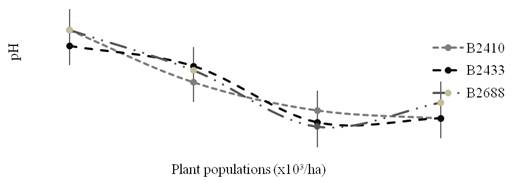
An interaction between PP and hybrid was observed (P = 0.019) for silage pH (Table 4). Silage pH decreased with increasing PP, with hybrid B2688 showing higher pH than the other hybrids only at the highest PP (Figure 1). The CP content showed quadratic response (P < 0.001) with increasing PP, reaching higher values at 82 × 103 plants/ha. The contents of NDF and ADF contents were not altered (P > 0.05) by PP. The DML varied quadratically (P < 0.001) with increasing PP, with the highest values observed at 100 × 103 plants/ha. The contents CP, NDF, and ADF, and DML were not altered (P > 0.05) by hybrids.
DISCUSSION
Modern hybrids are noted for their ability to tolerate stresses caused by increased plant density (SCHWALBERT et al., 2018). As plant density increases, plant-to-plant competition increases, potentially limiting yield potential (ASSEFA et al., 2016). This competition can lead to a reduction in the number of ears, kernels per ear, or kernel weight (ASSEFA et al., 2016), increase ova abortion, and decrease grains per row (CICCHINO et al., 2010). Such effects are attributed to the increased asynchrony between the pollination process and stigma exposure (ASSEFA et al., 2016), as well as disruption in floral development and assimilate distribution to seeds (BORRÁS et al., 2003).
The increase in productivity with higher PP is linked to enhanced water use efficiency, improved nutrient absorption, and better photosynthetic performance of the crop (BARBIERI et al., 2008; FAN et al., 2024). Research indicates that increasing PP can lead to either linear or quadratic increases in biomass and grain productivity (FERREIRA et al., 2017; SHER et al., 2017). However, productivity may decline at certain thresholds due to intensified competition for resources such as solar radiation, water, and soil nutrients, which can alter plant development (TESTA et al., 2016; ZHANG et al., 2017). It is crucial to note that increasing productivity through higher plant populations or more productive hybrids must be balanced with soil conservation strategies, such as crop rotation, to mitigate the impacts of high nutrient extraction, particularly N, P, and K (UENO et al., 2013). Variations in plant populations can alter the morphological composition of plants due to competition for light, leading to stem elongation and a reduction in SD (NETO et al., 2003). This often results in a proportional increase in the leaf mass within the ensiled material. Conversely, differences among the evaluated hybrids are primarily attributed to their genetic improvement objectives. Corn producers typically select hybrids based on grain yield, while livestock producers focus on feed efficiency or production per ton (OWENS, 2005). The B2410 hybrid’s greater plant height, larger SD, and lower ear insertion, along with fewer rows per ear and kernels per ear, align with its recommendation for silage production. In contrast, other hybrids are recommended for both grain and silage production. The lower leaf proportion in hybrid B2410 may be linked to its larger size and stem diameter, which dilutes the leaf proportion in the silage.
As PP increased, silage pH decreased from 3.84 to 3.64. Silage pH is inversely related to the concentration and availability of water-soluble carbohydrates in the ensiled material, particularly from starch in corn kernels (MCDONALD et al., 1991). The highest grain productivity was observed at the highest PP (100 and 118 ×103 plants/ha), which may help explain the observed decrease in silage pH. It is important to note that the pH of all silages fell within the range (3.5 to 4.3) for optimal fermentation (BRAR et al., 2020). In the current study, silage CP concentration had a positive quadratic effect as PP was increased. The reasons for increased silage CP concentration observed at PP of 80 or 100×103 plants/ha are not entirely clear but may be related to reduced proteolysis during the fermentation or higher initial CP concentration in the ensiled material. FERREIRA & TEETS (2017) did not observe differences in silage CP concentration with increasing plant density; however, the authors reported a linear increase in silage NDF concentration and a quadratic positive effect on silage starch concentration. In this study, the contents of NDF and ADF in silage increased with higher plant densities. These increased in NDF and ADF can be attributed to the higher leaf proportion in corn plants at greater densities. The corn hybrids evaluated did not affect silage contents of CP, NDF, and ADF, or DM losses. Consistent with these findings, other studies have also reported no differences in silage quality among different corn hybrids (ARAÚJO et al., 2012; BUSO et al., 2018).
Dry matter losses in corn silage arise from gas and effluent losses, which often correlate with a decrease in silage nutritive value. Fermentation losses primarily result from carbon dioxide production and typically account for 2 to 4% of total DM (ZIMMER et al., 1980). Effluent losses generally range from 0.2 to 0.5% (PAHLOW et al., 2003), although these were not measured in this study due to the type of silo used. Fermentation losses can be minimized by achieving a rapid drop in silage pH, which inhibits the activity of Enterobacter and clostridia (BORREANI et al., 2018). In the current study, the lowest DM losses were observed at plant densities of 65 and 118 ×103 plants/ha. Although, it was anticipated that higher grain production (at 100 and 118 ×103 plants/ha) would lead to reduced DM losses due to a rapid decrease in s pH, the results suggests that the lower CP at these densities may have contributed to the observed lower DM losses, potentially due to reduced buffering capacity.
CONCLUSION
Increasing plant density from 65 to 118 ×103 plants/ha significantly increases forage production from corn hybrids in subtropical climates, without compromising silage conservation and characteristics. The corn hybrids B2401, B2433, and B2688 exhibited comparable forage production silage characteristics in a subtropical climate.
ACKNOWLEDGMENTS
This study was financed in part by the Fundação Coordenação de Aperfeiçoamento de Pessoal de Nível Superior (CAPES, Brasília, Brazil) - Finance Code 001. Thanks to Brevant/Corteva seeds for providing the maize hybrids.
REFERENCES
- AOAC. ASSOCIATION OF OFFICIAL ANALYTICAL CHEMISTS. Official methods of analysis. 16.ed. Washington; 1995.
-
ARAÚJO, K. G. et al. Yield and quality of silage of maize hybrids. Revista Brasileira de Zootecnia, v.41, p.1539-1544, 2012. Available from: <Available from: https://www.scielo.br/j/rbz/a/brjqbGWHYMpdBK5LwGDvWdL/?lang=en&format=html >. Accessed: Oct. 25, 2023. doi: 10.1590/S1516-35982012000600031.
» https://doi.org/10.1590/S1516-35982012000600031.» https://www.scielo.br/j/rbz/a/brjqbGWHYMpdBK5LwGDvWdL/?lang=en&format=html -
ASSEFA, Y. et al. Yield responses to planting density for US modern corn hybrids: A synthesis-analysis. Crop Science, v.56, p.2802-2817, 2016. Available from: <Available from: https://acsess.onlinelibrary.wiley.com/doi/full/10.2135/cropsci2016.04.0215 >. Accessed: Nov. 14, 2023. doi: 10.2135/cropsci2016.04.0215.
» https://doi.org/10.2135/cropsci2016.04.0215.» https://acsess.onlinelibrary.wiley.com/doi/full/10.2135/cropsci2016.04.0215 -
BARBIERI, P. A. et al. Nitrogen use efficiency in maize as affected by nitrogen availability and row spacing. Agronomy Journal, v.100, p.1094-1100, 2008. Available from: <Available from: https://acsess.onlinelibrary.wiley.com/doi/full/10.2134/agronj2006.0057?casa_token=9EItFKSNIssAAAAA%3ABySxcZTsl4zp5tPcR8fIC96HPMZts1H-TaksiMepTx86PsnlFw1vcXuNyPS1k1V6gQgX2Rszhhqdnqg >. Accessed: Oct. 15, 2023. doi: 10.2134/agronj2006.0057.
» https://doi.org/10.2134/agronj2006.0057.» https://acsess.onlinelibrary.wiley.com/doi/full/10.2134/agronj2006.0057?casa_token=9EItFKSNIssAAAAA%3ABySxcZTsl4zp5tPcR8fIC96HPMZts1H-TaksiMepTx86PsnlFw1vcXuNyPS1k1V6gQgX2Rszhhqdnqg -
BAUR, F. J.; ENSMINGER, L. G. The association of official analytical chemists (AOAC). Journal of the American Oil Chemists’ Society, v.54, n.4, p.171-172, 1977. Available from: <Available from: https://link.springer.com/article/10.1007/bf02670789 >. Accessed: Dec. 11, 2024. doi: 10.1007/BF02670789.
» https://doi.org/10.1007/BF02670789.» https://link.springer.com/article/10.1007/bf02670789 -
BORRÁS, L. et al. Control of kernel weight and kernel water relations by post-flowering source-sink ratio in maize. Annals of Botany, v.91, p.857-867, 2003. Available from: <Available from: https://academic.oup.com/aob/article/91/7/857/178116?login=false >. Accessed: Nov. 20, 2023. doi: 10.1093/aob/mcg090.
» https://doi.org/10.1093/aob/mcg090.» https://academic.oup.com/aob/article/91/7/857/178116?login=false -
BORREANI, G. et al. Silage review: Factors affecting dry matter and quality losses in silages. Journal of Dairy Science, v.101, p.3952-3979, 2018. Available from: <Available from: https://www.sciencedirect.com/science/article/pii/S0022030218303205 >. Accessed: Jan. 03, 2024. doi: 10.3168/jds.2017-13837.
» https://doi.org/10.3168/jds.2017-13837.» https://www.sciencedirect.com/science/article/pii/S0022030218303205 -
BRAR, N. S. et al. Qualitative study of corn silage of cattle farms in subtropical conditions of Indo-Gangetic plains. Range Management and Agroforestry, v.40, p.306-312, 2020. Available from: <Available from: https://www.indianjournals.com/ijor.aspx?target=ijor:rma&volume=40&issue=2&article=019 >. Accessed: Dec. 22, 2023.
» https://www.indianjournals.com/ijor.aspx?target=ijor:rma&volume=40&issue=2&article=019 -
BULLOCK, D. G. et al. A growth analysis comparison of corn grown in conventional and equidistant plant spacing. Crop Science, v.28, p.254-258, 1988. Available from: <Available from: https://acsess.onlinelibrary.wiley.com/doi/abs/10.2135/cropsci1988.0011183X002800020015x >. Accessed: Nov. 12, 2022. doi: 10.2135/cropsci1988.0011183X002800020015x.
» https://doi.org/10.2135/cropsci1988.0011183X002800020015x.» https://acsess.onlinelibrary.wiley.com/doi/abs/10.2135/cropsci1988.0011183X002800020015x -
BUSO, W. H. D. et al. Produção e composição bromatológica da silagem de híbridos de milho sob duas alturas de corte. Revista de Agricultura Neotropical, v.5, p.74-80, 2018. Available from: <Available from: https://periodicosonline.uems.br/index.php/agrineo/article/view/2682 >. Accessed: Dec. 15, 2023. doi: 10.32404/rean.v5i4.2682.
» https://doi.org/10.32404/rean.v5i4.2682.» https://periodicosonline.uems.br/index.php/agrineo/article/view/2682 -
CICCHINO, M. et al. Heat stress in field-grown maize: response of physiological determinants of grain yield. Crop Science, v.4, p.1438-1448, 2010. Available from: <Available from: https://acsess.onlinelibrary.wiley.com/doi/10.2135/cropsci2009.10.0574# >. Accessed: Dec. 20, 2023. doi: 10.2135/cropsci2009.10.0574.
» https://doi.org/10.2135/cropsci2009.10.0574.» https://acsess.onlinelibrary.wiley.com/doi/10.2135/cropsci2009.10.0574# -
CURIN, F. et al. Water and radiation use efficiencies in maize: Breeding effects on single-cross Argentine hybrids released between 1980 and 2012. Field Crops Research, v.246, p.107683, 2020. Available from: <Available from: https://www.sciencedirect.com/science/article/abs/pii/S0378429019316211 >. Accessed: Dec. 20, 2023. doi: 10.1016/j.fcr.2019.107683.
» https://doi.org/10.1016/j.fcr.2019.107683.» https://www.sciencedirect.com/science/article/abs/pii/S0378429019316211 -
DUAN, M. et al. Effect of Maize Canopy Structure on Light Interception and Radiation Use Efficiency at Different Canopy Layers. Agronomy, v.14, n.7, p.1511, 2024. Available from: <Available from: https://onlinelibrary.wiley.com/doi/full/10.1002/fes3.312 >. Accessed: Aug. 26, 2024. doi: 10.1002/fes3.312.
» https://doi.org/10.1002/fes3.312.» https://onlinelibrary.wiley.com/doi/full/10.1002/fes3.312 - EMBRAPA. Empresa Brasileira de Pesquisa Agropecuária . Centro Nacional de Pesquisa de Solos. Sistema Brasileiro de Classificação de Solos. 2. Ed., Sistemas de Produção, Rio de Janeiro, 2006.
-
FAN, P. et al. Higher yields of modern maize cultivars are not associated with coordinated light and N distribution within the canopy. Field Crops Research, v.305, p.109182, 2024. Available from: <Available from: https://www.sciencedirect.com/science/article/pii/S0378429023003751?casa_token=L5GDTnluXoAAAAAA:VAu1i15Z8ckcuCwtd2Wc3-UbCNVVG7yHiIL39lfqUgJ46XFMYukjRSaeN8rNQSrLozxSmzTwoI0 >. Accessed: Oct. 25, 2022. doi: 10.1016/j.fcr.2023.109182.
» https://doi.org/10.1016/j.fcr.2023.109182.» https://www.sciencedirect.com/science/article/pii/S0378429023003751?casa_token=L5GDTnluXoAAAAAA:VAu1i15Z8ckcuCwtd2Wc3-UbCNVVG7yHiIL39lfqUgJ46XFMYukjRSaeN8rNQSrLozxSmzTwoI0 -
FERREIRA, G.; TEETS, C. L. Effect of planting density on yield, nutritional quality, and ruminal in vitro digestibility of corn for silage grown under on-farm conditions. The Professional Animal Scientist, v.33, p.420-425, 2017. Available from: <Available from: https://www.sciencedirect.com/science/article/pii/S108074461730089X >. Accessed: Aug. 15, 2023. doi: 10.15232/pas.2017-01621.
» https://doi.org/10.15232/pas.2017-01621.» https://www.sciencedirect.com/science/article/pii/S108074461730089X -
JOBIM, C. C. et al. Avanços metodológicos na avaliação da qualidade da forragem conservada. Revista Brasileira de Zootecnia, v.36, p.101-119, 2007. Available from: <Available from: https://www.scielo.br/j/rbz/a/cGcwzhYPxNb5mwmw9SJgZgm/?format=html >. Accessed: Aug. 20, 2023. doi: 1590/S1516-35982007001000013.
» https://doi.org/1590/S1516-35982007001000013.» https://www.scielo.br/j/rbz/a/cGcwzhYPxNb5mwmw9SJgZgm/?format=html -
LI, R. et al. Improving the yield potential in maize by constructing the ideal plant type and optimizing the maize canopy structure. Food and Energy Security, v.10, n.4, p.e312, 2021. Available from: <Available from: https://onlinelibrary.wiley.com/doi/full/10.1002/fes3.312 >. Accessed: Sept. 20, 2023. doi: 10.1002/fes3.312.
» https://doi.org/10.1002/fes3.312.» https://onlinelibrary.wiley.com/doi/full/10.1002/fes3.312 -
LOBELL, D. B. et al. Crop yield gaps: their importance, magnitudes, and causes. Annual review of environment and resources, v.34, n.1, p.179-204, 2009. Available from: <Available from: https://www.annualreviews.org/content/journals/10.1146/annurev.environ.041008.093740 >. Accessed: Jan, 15, 2024. doi: 10.1146/annurev.environ.041008.093740.
» https://doi.org/10.1146/annurev.environ.041008.093740.» https://www.annualreviews.org/content/journals/10.1146/annurev.environ.041008.093740 - MAACK, R. Geografia física do Estado do Paraná. Universidade Federal do Paraná e Instituto de Geologia e Pesquisas Tecnológicas, Curitiba: Banco de Desenvolvimento do Estado do Paraná; 1968.
- MCDONALD, P. J. et al. The Biochemistry of Silage. 2.ed. Marlow. ChalcombePublications; 1991.
-
MENDES, M. et al. Época de semeadura de híbridos de milho forrageiro colhidos em diferentes estádios de maturação. RevistaAgro@mbiente On-line, v.9, p.136-142, 2015. Available from: <Available from: https://www.researchgate.net/publication/283178810 >. Accessed: Jan. 14, 2024. doi: 10.18227/1982-8470ragro.v9i2.2316.
» https://doi.org/10.18227/1982-8470ragro.v9i2.2316.» https://www.researchgate.net/publication/283178810 -
NASAPOWER. The Power Project [Internet]. US Government. Hampton, VA (USA). Available from: <Available from: https://power.larc.nasa.gov/ >. Accessed: Oct. 10, 2023.
» https://power.larc.nasa.gov/ -
NETO, D. D. D. et al. Distribuition and population of plants and maize grainyield. Revista Brasileira de Milho e Sorgo, v.2, p.63-77, 2003. Available from: <Available from: https://rbms.abms.org.br/index.php/ojs/article/view/72 >. Accessed: Oct. 25, 2023. doi: 10.18512/1980-6477/rbms.v2n03p%25p.
» https://doi.org/10.18512/1980-6477/rbms.v2n03p%25p.» https://rbms.abms.org.br/index.php/ojs/article/view/72 -
OWENS, F. Corn genetics and animal feeding value. Presented at the 66th Minnesota Nutrition Conf., St. Paul, MN. 24p, 2005. Available from: <Available from: https://biofuelscoproducts.umn.edu/sites/biofuelscoproducts.umn.edu/files/2021-09/ddgs-techinfo-pro-16.pdf >. Accessed: Oct. 10, 2023.
» https://biofuelscoproducts.umn.edu/sites/biofuelscoproducts.umn.edu/files/2021-09/ddgs-techinfo-pro-16.pdf - PAHLOW, G. et al. Silage science and technology. Edited by Buxton DR, Munk RE and Harrison JH; 2003.
-
R CORE TEAM. R: A Language and Environment for Statistical Computing; R Foundation for Statistical Computing: Vienna, Austria, 2021; Available from: <Available from: https://www.R-project.org/ >. Accessed: Jan, 12, 2023.
» https://www.R-project.org/ -
SCHWALBERT, R. et al. Corn yield response to plant density and nitrogen: spatial models and yield distribution. Agronomy Journal, v.110, p.970-982, 2018. Available from: <Available from: https://acsess.onlinelibrary.wiley.com/doi/full/10.2134/agronj2017.07.0425 >. Accessed: Jan. 03, 2024. doi: 10.2134/ agronj2017.07.0425.
» https://doi.org/10.2134/ agronj2017.07.0425.» https://acsess.onlinelibrary.wiley.com/doi/full/10.2134/agronj2017.07.0425 -
SHER, A. et al. Response of maize grown under high plant density; performance, issues and management-a critical review. Advances in Crop Science and Technology, v.5, p.1-8, 2017. Available from: <Available from: https://www.researchgate.net/publication/318519925 >. Accessed: Dec. 19, 2023.
» https://www.researchgate.net/publication/318519925 - SILVA, D. J.; QUEIROZ, A. C. Análise de alimentos: métodos químicos e biológicos. 3.ed. Editora UFV:Viçosa (MG); 2002.
-
SKONIESKI, F. R. et al. Corn plant arrangement and its effect on silage quality. Revista Brasileira de Zootecnia, v.43, p.114-119, 2014. Available from: <Available from: https://www.scielo.br/j/rbz/a/nwJSLvs5ZFsGjhNWYQNGRgD/?format=html⟨=en >. Accessed: Nov. 24, 2023. doi: 10.1590/S1516-35982014000300002.
» https://doi.org/10.1590/S1516-35982014000300002.» https://www.scielo.br/j/rbz/a/nwJSLvs5ZFsGjhNWYQNGRgD/?format=html⟨=en - SBCS. Sociedade brasileira de ciência do solo. Núcleo Estadual Paraná. Manual de adubação e calagem para o estado do Paraná. Curitiba: SBCS/NEPAR, p.428, 2017.
-
STEWART, D. W. et al. Canopy structure, light interception, and photosynthesis in maize. Agronomy Journal, v.95, p.1465-1474, 2003. Available from: <Available from: https://acsess.onlinelibrary.wiley.com/doi/10.2134/agronj2003.1465 >. Accessed: Nov. 24, 2023. doi: 10.2134/agronj2003.1465.
» https://doi.org/10.2134/agronj2003.1465.» https://acsess.onlinelibrary.wiley.com/doi/10.2134/agronj2003.1465 -
TESTA, G. et al. Maize grain yield enhancement through high plant density cultivation with different inter-row and intra-row spacings. European Journal of Agronomy, v.72, p.28-37, 2016. Available from: <Available from: https://www.sciencedirect.com/science/article/pii/S1161030115300277?casa_token=5T8Bit2vRYgAAAAA:dtNxUc_yFJnLVB4Qn4u2VfShrDnoR6wW7a7r9YtCl2r5bfKk-JLn97zBkZD9xhiwyi0L8E5qS_Oo >. Accessed: Nov. 10, 2023. doi: 10.1016/j.eja.2015.09.006.
» https://doi.org/10.1016/j.eja.2015.09.006.» https://www.sciencedirect.com/science/article/pii/S1161030115300277?casa_token=5T8Bit2vRYgAAAAA:dtNxUc_yFJnLVB4Qn4u2VfShrDnoR6wW7a7r9YtCl2r5bfKk-JLn97zBkZD9xhiwyi0L8E5qS_Oo -
TORRES, G. M. et al. Seed-oriented planting improves light interception, radiation use efficiency and grain yield of maize. Experimental Agriculture, v.53, p.210-225, 2017. Available from: <Available from: https://www.cambridge.org/core/journals/experimental-agriculture/article/seedoriented-planting-improves-light-interception-radiation-use-efficiency-and-grain-yield-of-maize-zea-mays-l/4455D42E1AA370CAA2888586A2B7BC2C >. Accessed: Oct. 25, 2023. doi: 10.1017/S0014479716000326.
» https://doi.org/10.1017/S0014479716000326.» https://www.cambridge.org/core/journals/experimental-agriculture/article/seedoriented-planting-improves-light-interception-radiation-use-efficiency-and-grain-yield-of-maize-zea-mays-l/4455D42E1AA370CAA2888586A2B7BC2C - UENO, R. K. et al. Exportação de macronutrientes do solo em área cultivada com milho para alimentação de bovinos confinados. Semina: Ciências Agrárias, v.34, n.6, p.3001-3018, 2013.
-
VAN SOEST, P. J. et al. Methods for dietary fiber, neutral detergent fiber, and non-starch polysaccharides in relation to animal nutrition. Journal of Dairy Science, v.74, p.3583-3597, 1991. Available from: <Available from: https://www.sciencedirect.com/science/article/pii/S0022030291785512 >. Accessed: Feb. 14, 2024. doi: 10.3168/jds.S0022-0302(91)78551-2.
» https://doi.org/10.3168/jds.S0022-0302(91)78551-2.» https://www.sciencedirect.com/science/article/pii/S0022030291785512 - VAN SOEST, P. J. Nutritional ecology of the ruminant. 2.ed. New York: Cornell University Press; 1994.
-
ZHANG, W. et al. Plant growth regulator and its interactions with environment and genotype affect maize optimal plant density and yield. European Journal of Agronomy, v.91, p.34-43, 2017. Available from: <https://www.sciencedirect.com/science/article/pii/S1161030117301387?via%3Dihub>. doi: 10.1016/j.eja.2017.09.008.
» https://doi.org/10.1016/j.eja.2017.09.008.» https://www.sciencedirect.com/science/article/pii/S1161030117301387?via%3Dihub - ZIMMER, E. Efficient silage systems. p.176-194 in - Forage Conservation in the ‘80s - Occasional Symposium, British Grassland Society Conference, No. 11, Brighton, UK; 1980.
Edited by
-
Editors
Alessandro Dal’Col Lúcio (0000-0003-0761-4200)Diego Follman (0000-0002-7351-7022)