 Lasiodiplodia iraniensis associated with Bahia bark scaling in grapefruit plants
ABSTRACT:
Bahia Bark Scaling (BBS) is a disease that affects citrus and its etiology remains unknown. This study investigated the association of a fungal agent with BBS symptoms in grapefruit plants. Eight fungal isolates were recovered from the field and identified at the genus level by morphological methods, of which two were used in inoculations on healthy plants to fulfill Koch’s postulate. The Internal Transcribed Spacer (ITS) region was used in phylogenetic analyses for species identification. The inoculated plants showed typical symptoms of BBS. Lasiodiplodia iraniensis was the species associated with symptomatic grapefruit trees in the field, as well as the species recovered from plants that developed symptoms in the pathogenicity tests.
Key words:
BBS; citrus diseases; Botryosphaeriaceae; trunk diseases
RESUMO:
O Descamamento Eruptivo dos Citros (DEC) é uma doença que afeta plantas cítricas e sua etiologia permanece desconhecida. Este estudo teve como objetivo investigar a associação de um agente fúngico com sintomas de DEC em plantas de pomelo. Oito isolados foram recuperados de campo e identificados em nível de gênero por métodos morfológicos, dos quais dois foram utilizados em inoculações em plantas saudáveis para cumprir os postulados de Koch. A região do espaçador transcrito interno do DNA ribossomal (ITS) foi utilizada em análises filogenéticas para identificação das espécies. As plantas inoculadas apresentaram sintomas característicos de DEC. Lasiodiplodia iraniensis foi a espécie associada aos pomeleiros com sintomas em campo, assim como a espécie recuperada de plantas que desenvolveram sintomas nos testes de patogenicidade.
Palavras-chave:
DEC; doenças dos citros; Botryosphaeriaceae; doenças de tronco
Bahia Bark Scaling (BBS) is an endemic disease that affects citrus orchards in Bahia and Sergipe states of Brazil (NICKEL et al., 2007). Adult plants affected by this disease exhibit intense bark scaling on the trunk and old branches, which might also present gum exudation. This disease affects mainly sweet oranges (Citrus sinensis L. Osbeck), mandarins (C. reticulata Blanco), and, with greater severity, grapefruit (C. paradise Macfadyen) (NICKEL, 1989; SANTOS-FILHO et al., 1990; BARBOSA et al., 1999). The dissemination of BBS in commercial orchards may affect up to 98% of cultivated plants, leading to a progressive decrease in longevity and yield (LARANJEIRA et al., 2006).
BBS was firstly reported in Brazil affecting sweet orange of nucellar origin (PASSOS et al., 1974). Initially, this disease was nominated as Psorosis type Bahia (tBA) due to its similarity with Psorosis A symptoms caused by Citrus psorosis virus (CPsV), such as bark lesions on the trunk. However, MARTÍN et al. (2004), by using molecular hybridization and RT-PCR analyses, were not able to detect the CPsV in young leaves of trees affected by BBS. Therefore, until now, the BBS etiology remains unknown.
The similarity of symptoms to those caused by the fungus Lasiodiplodia sp. in citrus (SANTOS-FILHO & OLIVEIRA, 2009; BAUTISTA-CRUZ et al., 2019) raised the hypothesis that BBS could be a disease caused by these fungi. In this regard, this study aimed to investigate the association of a fungal agent with BBS symptoms observed in grapefruits. Eight grapefruit trees ‘Flame’, from Citrus Embrapa Germplasm, affected by BBS were selected, and samples of lesioned tissues were used for fungal isolations on potato dextrose agar (PDA) medium. Then, the isolates were transferred to the oatmeal agar (OMA) medium in order to enhance the pycnidia production (ADESEMOYE et al., 2014). The cultures were incubated in the B.O.D. chamber at 25 ± 1 ºC with a 12 h photoperiod. The identification at the genus level of the isolates was performed through the characterization of colonies and aspects of the pycnidia, conidiogenous cells, and conidia; using a light microscopy (PHILIPS et al., 2013). Aiming to fulfill Koch’s postulate, two isolates were used for the pathogenicity tests carried out in healthy grapefruit ‘Duncan’, under growth chamber conditions (26 ± 1 ºC with a 12 h photoperiod), using three replicates per isolate. The inoculations were made using three culture medium disks (5 mm diameter) containing fungal mycelium, which were inserted in wounds previously made on the trunk using cork borer, allowing the contact between the inoculum and the wood. The control treatments consisted of sterilized culture medium disks inserted as described above into three healthy grapefruits ‘Duncan’. The evaluation of symptoms began at 7 DAI (days after inoculation) and stopped after symptoms onset. Isolations were performed in the plants that showed symptoms.
For species identification of the isolates associated with BBS, we performed genomic DNA extraction from aerial mycelium obtained of monosporic cultures following the CTAB method (ZOLAN & PUKKILA, 1986). The ribosomal internal transcribed spacer (ITS) region was amplified by polymerase chain reaction (PCR), with the primers ITS1/ITS4 (WHITE et al., 1990). The PCR reaction was performed in a final volume of 60 µL containing 1X amplification buffer, 1.5mM of each dNTP, 1.5 mM MgCl2, 1U of Taq DNA polymerase, 0.2 µM of each primer, and 30 ng of DNA. Reaction cycles consisted of an initial denaturation at 94 ºC for 2 min, followed by 40 cycles composed of denaturation at 94 ºC for 30 s, annealing at 55 ºC for 30 s, extension at 72ºC for 45 s and 5 min at 72 °C for final extension. PCR products were separated by electrophoresis in 1.5% (w/v) agarose gel stained with ethidium bromide, using TBE (Tris-borate-EDTA) 1X buffer. PCR products were purified by precipitation with 1mL of cold Isopropanol, followed by two washes with 1mL of 80% cold Ethanol, and then resuspended in 50 µL of ultra-pure water. The purified PCR products were sequenced following Sanger method at the Instituto Gonçalo Moniz - Fiocruz, BA.
The consensus sequences of the rDNA ITS region were obtained using the software SeqAssem 07/2008 <https://www.sequentix.de/software_seqassem.php>. The sequences generated in this study were deposited on the GenBank database (https://www.ncbi.nlm.nih.gov/; accession numbers: MK948433, MK948523, MK953678, MK953679, MN044885, MN044886, MN046791, and MN046825). In addition, 26 sequences correspondent to the identified genus were obtained in the GenBank database, and the species Diplodia mutila (Fr.) Mont. was used as outgroup. The sequences were aligned through multiple alignment ClustalW (THOMPSON et al., 1994), coupled to software BioEdit 7.2. (HALL, 1999), and the resulted matrix was submitted to manual editing. The phylogenetic analysis based on Maximum Likelihood criterion (ML) was performed using the software RAxM (STAMATAKIS, 2014), adopting the GTR+GAMMA substitution model and 1000 replications on the Bootstrap Support (BS). For the Bayesian Inference (BI), the GTR+I+G substitution model was used, which was defined according to Akaike Information Criterion (AIC) through the software jModelTest2 (DARRIBA at al., 2012). The 25% of the initial trees was discarded as burn-in, the Posterior Probability (PP) of each clade was estimated, and the majority consensus tree was generated. Both ML and BI analyses were executed through the CIPRES platform (MILLER et al., 2019), and resultant trees were visualized on the software FigTree v1.4.3 <http://tree.bio.ed.ac.uk/software/figtree/>.
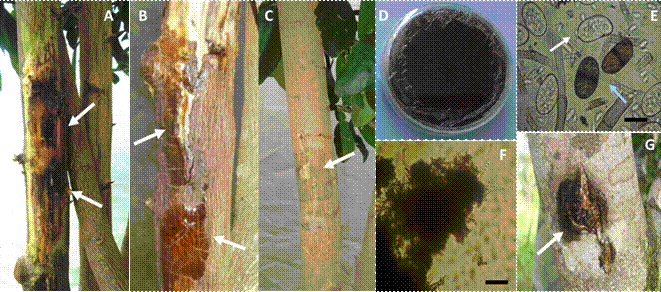
We recovered eight fungal isolates from the grapefruit, whose colonies presented a black abundant aerial mycelium and conidial production. The conidial dimensions were (18 - 30) x (10 - 15) μm, with the presence of paraphyses, a morphological characteristic of Lasiodiplodia spp. (PHILIPS et al., 2013). All the grapefruit plants used in pathogenicity tests showed bark scaling on the trunk at 21 DAI (Figure 1A), and gum exudation at 8 DAI (Figure 1B), which are typical of the BBS. The re-isolations made from all plants submitted to inoculation assays showed colonies and spores typical of Lasiodiplodia spp. (Figure 1D-F). Moreover, the control treatments did not show any symptom (Figure 1C).
Symptoms observed after the inoculation of Lasiodiplodia sp. in grapefruit trees ‘Duncan’. A. Trunk lesions observed at 21 DAI (days after inoculation); B. Gum exudation observed at 8 DAI; C. Non-inoculated plants without symptoms; D. Colony morphology on PDA medium; E. Mature and immature conidia (blue and white arrows, respectively) of the isolates recovered from pathogenicity tests, with diameters of (18 - 30) x (10 - 15) μm (scale bar = 10 μm); F. Pycnidia formed on OMA medium (scale bar = 20 μm); G. Bark scaling and gum exudation symptoms observed on grapefruits in the field.
All sequences of the ITS region presented an approximate length of 550 base pairs (bp). The phylogenetic analyses provided highly similar topologies. Thus, the tree inferred from the ML method was shown. The eight isolates were grouped in an only clade together with sequences of the species L. iraniensis Abdollahzadeh, Zare & A.J.L. Phillips (KY052971 and KY052956), with BS 72% and PP 0.98 (Figure 2).

Phylogenetic tree derived from the Maximum Likelihood analysis based on the rDNA ITS sequences of Lasiodiplodia species. The sequences (Genbank ID´s) generated in this study are in bold. Bootstrap and Posterior Probability values were disposed on the nodes, respectively. Values below 50% (0.50) were indicated as (--). The species Diplodia mutila was used as outgroup. The scale bar represents the number of substitutions per site.
The symptoms of trunk canker, dieback and gummosis were extensively associated with Lasiodiplodia theobromae (Pat.) Griffon & Maubl. (PHILLIPS et al., 2013). Furthermore, by implementing phylogenetic analyses, new species of the genus have been associated with symptoms related to L. theobromae (BURGESS et al., 2006). Among these species, L. iraniensis was firstly described affecting Citrus sp., Mangifera indica L., Eucalyptus sp., Salvadora persica L., Juglans sp., and Terminalia catappa L. (ABDOULLAHZADEH et al., 2010). In this study, we provide the first evidence that L. iraniensis can induce BBS symptoms, improving our comprehension concerning the causal agent involved in this pathosystem. Until then, this species has been related to symptoms including gummosis, trunk canker, and dieback in Tahiti-lemon trees in Oman, United Arab Emirates, and Mexico (BAUTISTA-CRUZ et al., 2019), as well as in mandarin trees on Pakistan (AL-SADI et al., 2013), showing similar symptoms pattern described for the BBS. Our results showed a consistent association of a species of the genus Lasiodiplodia with BBS in grapefruit, reinforcing the possibility of a fungus as the causal agent of this important citrus disease.
ACKNOWLEDGEMENTS
We wish to thank Epaminondas do Patrocínio for his technical assistance. Our study was supported by the Embrapa Mandioca e Fruticultura, Centro Tecnológico Agropecuário da Bahia (CETAB), and Coordenação de Aperfeiçoamento de Pessoal de Nível Superior (CAPES) (Finance Code 001).
REFERENCES
-
ABDOLLAHZADEH, J. et. al. Phylogeny and morphology of four new species of Lasiodiplodia from Iran. Persoonia, v.25, p.1-10, 2010. Available from:<Available from:https://www.ingentaconnect.com/content/nhn/pimj/2010/00000025/00000001/art00001 >. Accessed: Jul. 28, 2022. doi: 10.3767/003158510X524150.
» https://doi.org/10.3767/003158510X524150.» https://www.ingentaconnect.com/content/nhn/pimj/2010/00000025/00000001/art00001 -
ADESEMOYE, A. O. et al. Identification of species of Botryosphaeriaceae causing bot gummosis in citrus in California. Plant Disease, v.98, n.1, p.55-61, 2014. Available from:<Available from:https://apsjournals.apsnet.org/doi/pdf/10.1094/PDIS-05-13-0492-RE >. Accessed: Jul. 28, 2022. doi: 10.1094/PDIS-05-13-0492-RE.
» https://doi.org/10.1094/PDIS-05-13-0492-RE.» https://apsjournals.apsnet.org/doi/pdf/10.1094/PDIS-05-13-0492-RE -
AL-SADI, A. M. et al. Population genetic analysis reveals diversity in Lasiodiplodia species infecting date palm, citrus, and mango in Oman and the UAE. Plant Disease, v.97, n.10, p.1363-1369, 2013. Available from: <Available from: https://apsjournals.apsnet.org/doi/10.1094/PDIS-03-13-0245-RE >. Accessed: Jul. 28, 2022. doi: 10.1094/PDIS-03-13-0245-RE.
» https://doi.org/10.1094/PDIS-03-13-0245-RE.» https://apsjournals.apsnet.org/doi/10.1094/PDIS-03-13-0245-RE - BARBOSA, C. J. et al. Incidência e severidade de sintomas de sorose tipo Bahia em variedades de laranjas doces. Revista Brasileira de Fruticultura, v.21, n.3, p.382-384, 1999.
-
BAUTISTA-CRUZ, M. A. et al. Phylogeny, distribution and pathogenicity of Lasiodiplodia species associated with cankers and dieback symptoms of persian lime in Mexico. Plant Disease, v.103, n.6, p.1156-1165, 2019. Available from: <Available from: https://apsjournals.apsnet.org/doi/full/10.1094/PDIS-06-18-1036-RE >. Accessed: Jul. 28, 2022. doi: 10.1094/PDIS-06-18-1036-RE.
» https://doi.org/10.1094/PDIS-06-18-1036-RE.» https://apsjournals.apsnet.org/doi/full/10.1094/PDIS-06-18-1036-RE -
BURGESS, T. I. et al. Three new Lasiodiplodia spp. from the tropics, recognized based on DNA sequence comparisons and morphology. Mycologia, v.98, n.3, p.423-435, 2006. Available from: <Available from: https://pubmed.ncbi.nlm.nih.gov/17040071/ >. Accessed: Jul. 28, 2022. doi: 10.3852/mycologia.98.3.423.
» https://doi.org/10.3852/mycologia.98.3.423.» https://pubmed.ncbi.nlm.nih.gov/17040071/ -
DARRIBA, D. et al. jModelTest2: more models, new heuristics and parallel computing. Nature Methods, v.9, n.8, p.772-772, 2012. Available from: <Available from: https://www.nature.com/articles/nmeth.2109 >. Accessed: Jul. 28, 2022.
» https://www.nature.com/articles/nmeth.2109 - HALL, T. A. BioEdit: A User-Friendly Biological Sequence Alignment Editor Program for Windows 95/98/NT. Nucleic Acids Symposium Series, n.41, p.95-98, 1999.
-
LARANJEIRA, F. F. et al. Progress, spread and natural transmission of Bahia bark scaling of citrus in Brazil. Annals of Applied Biology, v.148, n.3, p.187-195, 2006. Available from: <Available from: https://onlinelibrary.wiley.com/doi/abs/10.1111/j.1744-7348.2006.00057.x >. Accessed: Jul. 28, 2022. doi: 10.1111/j.1744-7348.2006.00057.x.
» https://doi.org/10.1111/j.1744-7348.2006.00057.x.» https://onlinelibrary.wiley.com/doi/abs/10.1111/j.1744-7348.2006.00057.x -
MARTÍN, S. et al. Detection of Citrus psorosis virus by ELISA, molecular hybridization, RT-PCR and immunosorbent electron microscopy and its association with citrus psorosis disease. European Journal of Plant Pathology, v.110, n.7, p.747-757, 2004. Available from: <Available from: https://link.springer.com/article/10.1023/B:EJPP.0000041570.28825.29 >. Accessed: Jul. 28, 2022. doi: 10.1023/B:EJPP.0000041570.28825.29.
» https://doi.org/10.1023/B:EJPP.0000041570.28825.29.» https://link.springer.com/article/10.1023/B:EJPP.0000041570.28825.29 -
MILLER, M. A. et al. Creating the CIPRES Science Gateway for inference of large phylogenetic trees. 2010 Gateway Computing Environments Workshop (GCE), p.1-8, 2010, New Orleans. Available from: <Available from: https://ieeexplore.ieee.org/document/5676129 >. Accessed: Jan. 23, 2019.
» https://ieeexplore.ieee.org/document/5676129 - NICKEL, O. Transmissibilidade da sorose tipo Bahia por enxertia. Fitopatologia Brasileira, v.14, n.314, p.272-275, 1989.
-
NICKEL, O. et al. Bahia bark scaling of citrus: A disease of unknown etiology. Pest Technology, v.1, n.1, p.70-75, 2007. Available from: <Available from: http://www.globalsciencebooks.info/Online/GSBOnline/images/0706/PT_1(1)/PT_1(1)70-75o.pdf >. Accessed: Jul. 28, 2022.
» http://www.globalsciencebooks.info/Online/GSBOnline/images/0706/PT_1(1)/PT_1(1)70-75o.pdf - PASSOS, O. S. et al. More information on psorosis disease in Bahia, Brazil. In: International Organization of Citrus Virologists Conference, Riverside, p.135-138, 1974.
-
PHILLIPS, A. J. L. et al. The Botryosphaeriaceae: genera and species known from culture. Studies in Mycology, v.76, n.1, p.151-167, 2013. Available from: <Available from: https://www.ingentaconnect.com/content/wfbi/sim/2013/00000076/00000001/art00007;jsessionid=9sr2gof36q7g6.x-ic-live-02 >. Accessed: Jul. 28, 2022. doi: 0.3114/sim0021.
» https://doi.org/0.3114/sim0021.» https://www.ingentaconnect.com/content/wfbi/sim/2013/00000076/00000001/art00007;jsessionid=9sr2gof36q7g6.x-ic-live-02 - SANTOS-FILHO, H. P. et al. Transmissão comparativa de sorose A e sorose tipo Bahia. Revista Brasileira de Fruticultura, v.12, n.3, p.69-73, 1990.
-
SANTOS-FILHO, H. P.; OLIVEIRA, A. A. R. Cancro do tronco da lima ácida tahiti. Comunicado Técnico: Citros em Foco. Embrapa Mandioca e Fruticultura. 2p. 2009. Available from: <Available from: http://www.infoteca.cnptia.embrapa.br/infoteca/handle/doc/737068 >. Accessed: Jul. 28, 2022.
» http://www.infoteca.cnptia.embrapa.br/infoteca/handle/doc/737068 -
STAMATAKIS, A. RaxML version 8: a tool for phylogenetic analysis and post-analysis of large phylogenies. Bioinformatics, v.30, n.9, p.1312-1313, 2014. Available from: <Available from: https://academic.oup.com/bioinformatics/article/30/9/1312/238053?login=false >. Accessed: Jul. 28, 2022. doi: 10.1093/bioinformatics/btu033.
» https://doi.org/10.1093/bioinformatics/btu033.» https://academic.oup.com/bioinformatics/article/30/9/1312/238053?login=false -
THOMPSON, J. D. et al. Clustal W. Improving the sensitivity of progressive multiple sequence alignment through sequence weighting, position-specific gap penalties and weight matrix choice. Nucleic Acids Research, v.22, n.22, p.4673-4680, 1994. Available from: <Available from: https://academic.oup.com/nar/article-abstract/22/22/4673/2400290?redirectedFrom=fulltext&login=false >. Accessed: Jul. 28, 2022. doi: 10.1093/nar/22.22.4673.
» https://doi.org/10.1093/nar/22.22.4673.» https://academic.oup.com/nar/article-abstract/22/22/4673/2400290?redirectedFrom=fulltext&login=false - WHITE, T. J. et al. Amplification and direct sequencing of fungal ribosomal RNA genes for phylogenetics. In: INNIS, M.A. et al. (Ed.). PCR protocols: a guide to methods and applications. California: Academic Press, 1990. v.1, cap.38, p.315-322.
-
ZOLAN, M. E.; PUKKILA, P. J. Inheritance of DNA methylation in Coprinus cinereus Molecular and Cellular Biology. v.6, p.195-200, 1986. Available from: <Available from: https://www.ncbi.nlm.nih.gov/pmc/articles/PMC367498/?page=1 >. Accessed: Jul. 28, 2022.
» https://www.ncbi.nlm.nih.gov/pmc/articles/PMC367498/?page=1
Edited by
-
Editors
Alessandro Dal’Col Lúcio (0000-0003-0761-4200) Leonardo Araujo (0000-0003-4793-4751)