 In situ digestibility method as an input-source in the context of the Pampa Corte model: predicting average daily gain by free-ranging cattle
ABSTRACT:
This study evaluated the adequacy of using digestibility values obtained by the in situ (ISOMD) method for predicting the average daily gain (ADG, g day-1) of free-ranging cattle through the Pampa Corte model. The evaluation was based on a data set compiled from two independent trials conducted with growing beef cattle grazing native grasslands of southern Brazil. Values of digestibility obtained through the N fecal method (FNOMD) were used as comparative reference in the present study. The predictions of ADG were performed at both individual (n= 41) and group (i.e. diet treatment within trials, n= 10) levels. Parameters generated from regression analyses between observed versus estimated values of ADG (i.e. determination coefficient (R2), root mean square error (RMSE), root mean square error of prediction (RMSEP), concordance correlation coefficient (CCC) and mean bias) were used to evaluate the predictive adequacy. The observed values of ADG were linearly related to those predicted by the Pampa Corte at both individual (R2= 0.52; RMSE= 148.9, CCC = 0.72, P < 0.05) and group levels (R2= 0.67; RMSE= 108.8, CCC = 0.81, P < 0.05), without effect of the method used to estimate herbage digestibility. However, compared to the FNOMD, the ISOMD resulted in higher mean bias of predictions (i.e. - 4.3 vs 61.6 g day-1). The ADG of free-ranging cattle grazing native grasslands of Southern Brazil can be adequately predicted by the Pampa Corte model using herbage digestibility values obtained through the ISOMD method. However, constraints associated with herbage sampling in heterogenous swards should be considered.
Key words:
average daily gain; digestible cell wall; growing beef cattle; native grasslands; nutrition model
RESUMO:
Este estudo teve como objetivo avaliar a adequabilidade do uso de valores de digestibilidade da forragem obtidos pela técnica de incubação in situ (ISOMD) para estimar o ganho médio de peso (ADG, g dia-1) de bovinos de corte, mantidos em campo natural, através do modelo Pampa Corte, utilizando dados compilados de dois ensaios independentes conduzidos com bovinos de corte em crescimento mantidos em pastagens nativas do sul do Brasil. Valores de digestibilidade da forragem obtidos a partir da excreção fecal individual de N (FNOMD) foram usados como referência de comparação no presente estudo. As predições de ADG foram realizadas tanto em nível individual (n= 41) quanto em grupos (i.e grupo de animais por tratamento dentro de cada experimento (n= 10). Parâmetros da regressão linear entre valores de GMD observados e preditos pelo modelo (i.e. coeficiente de determinação (R2), raiz quadrada do erro médio (RMSE), raiz quadrada do erro médio de predição (RMSEP), coeficiente de concordância (CCC) e desvio médio) foram utilizados para avaliar a adequação da predição. Os valores observados de ADG foram linearmente relacionados aos preditos pelo modelo Pampa Corte a nível individual (R2= 0.52; RMSE= 148.9, CCC = 0.72, P < 0.05) ou grupal (R2= 0.67; RMSE= 108.8, CCC = 0.81, P < 0.05), sem efeito significativo do método utilizado para estimar a digestibilidade da forragem. Contudo, comparado com FNOMD, o método ISOMD resultou em maior desvio médio de predição (i.e. - 4.3 vs 61.6 g dia-1). O ADG de bovinos mantidos em pastagens nativas do sul do Brasil pode ser adequadamente estimado pelo modelo Pampa Corte utilizando valores de digestibilidade da forragem obtidos através da técnica ISOMD. No entanto, limitações associadas à amostragem da forragem em uma pastagem heterogênea devem ser consideradas.
Palavras-chave:
gado de corte em crescimento; ganho de peso médio diário; modelo nutricional; parede celular digestível; pastagens nativas
INTRODUCTION
The Pampa Corte is a mechanistic dynamic model developed to predict the average daily gain (ADG) of free-ranging cattle (SILVEIRA, 2002) using animals, weather, and herbage attributes as inputs. This model is based on AFRC (1993) and CSIRO (2007) equations, coupled with the dynamic sub-model of digestion proposed by ILLIUS & GORDON (1991). The content of digestible cell wall (DCW) in herbage dry matter (DM) is among the relevant inputs and this attribute is calculated from neutral detergent fiber (NDF) content and dry matter (DM) or organic matter (OM) digestibility. The latter is originally obtained with the conventional in vitro method of TILLEY & TERRY (1963). However, the in vitro method is laborious and time-consuming, which limits its use in routine feed analysis. Alternatively, digestibility values can be obtained using the less laborious 48-hour in situ incubation (ISOMD) method (MEHREZ & ØRSKOV, 1977; ØRSKOV & MCDONALD, 1979). However, the adequacy of this last method within the Pampa Corte model was still not evaluated.
In free-ranging systems, where the sward is heterogeneous and a high level of individual and temporal grazing selectivity is expected, obtaining representative samples of the actual diet ingested by animals is a challenge (CARVALHO et al., 2007; CARAM et al., 2024). In general, to measure herbage attributes, a sample is collected by simulating the ingestive behavior of animals kept in the same pasture plot, with the assumption that all animals in the plot ingested the same type of pasture. This assumption is probably false and represents a limitation when the herbage attributes are used as inputs in the model to simulate individual animal performance. The Pampa Corte uses a stochastic procedure of simulation where, based on the same inputs, five values of estimated ADG are generated following a normal distribution where 68% of animals are between the average and one standard deviation, 27% between two and three standard deviations and the remainder greater than three standard deviations. This procedure showed the potential, at least partially, of simulating the individual variability of a group of animals kept in the same pasture conditions. However, it was still not evaluated how much the level of simulation (i.e. individual or by group of animals) impacts the predictive potential of the Pampa Corte model.
This study evaluated the adequacy of using digestibility values of herbage samples obtained through the ISOMD method as input to predict the ADG gain of free-ranging cattle through the Pampa Corte model at either level, individual, or by groups of animals.
MATERIALS AND METHODS
Trials description and data collection
A data set of individual observations was compiled from two independent trials conducted with growing cattle grazing native grasslands of southern Brazil. Studies were carried out at the Universidade Federal de Santa Maria (Trial 1), Santa Maria, RS (29°4′ S, 53°5′ W, 151 m alt.) and the Centro de Pesquisa Pecuária Sul (EMBRAPA- CPPSUL; Trial 2), Bagé, RS (31°2′ S, 54°1′ W, 212 m alt.). Trial 1 was conducted with 12 growing Angus heifers throughout four experimental periods (i.e., summer, autumn, winter, and spring), and the average value of two heifers in the same paddock was considered as the experimental unit. Trial 2 was conducted with 18 Hereford steers throughout two experimental periods (i.e., autumn and winter), in which each animal was the experimental unit. Due to missing data and issues associated with the sampling protocol, some experimental units were excluded from the analysis, finalizing 18 and 23 individual observations for Trial 1 and Trial 2, respectively. The periods in both trials varied from 22 to 50 days long. The body weight (BW) was recorded at the beginning and the end of each experimental period, and the ADG (g day-1) was calculated as the BW difference divided by the number of days between BW measurements. In each experimental period of both trials, an external marker was used to estimate total fecal excretion. The chromium oxide (Cr2O3) was used in the trial with heifers and C32 alkane in the trial with steers. In addition, in each experimental period, feces and herbage samples were also collected, dried in a forced-air oven at 55 °C, and ground for analysis. The herbage samples were collected using the hand-clipping procedure (T’MANNETJE & JONES, 2000). A detailed description of the marker and sampling procedure was previously reported by KOZLOSKI et al. (2018). Samples were ashed at 600 ºC to obtain the OM content and also analyzed for NDF (SENGER et al., 2008) and crude protein (CP; Kjeldahl method 984.13; AOAC, 1997). The N fractions (i.e. A (soluble N), B (insoluble and potentially degradable N), and C (insoluble and undegradable N)) were obtained from the feed tables of AFRC (1993), using values of fresh forage for pastures of spring and summer, and values of grass hays for pastures of autumn and winter. The procedure for obtaining the degradation rate (kd) of the insoluble fraction of herbage samples, which is also an input in the Pampa Corte model, was previously described by POZO et al. (2023).
For obtaining the ISOMD, herbage samples were ground to pass a 2-mm screen, weighed in polyester bags with 40 μ of porosity, and incubated for 48 hours into the rumen of a cannulated steer grazing a native grassland and receiving daily supplementation with 2 kg (as feed basis) of concentrate feedstuffs. After incubation, the bags were rinsed with tap water, oven-dried at 110 °C overnight, weighed, ashed at 600 °C for 3 hours, and then weighed again. The ISOMD was calculated as:
ISOMD (%) = ((incubated OM (g) - residual OM (g))/incubated OM (g)) × 100
The soluble cell content (CC) of herbage samples was calculated as:
CC (% of DM ) = 100 - NDF (% of DM)
By assuming that the CC is 100% digestible (SILVEIRA, 2002), the DCW content was then calculated as:
DCW (% of DM) = ISOMD - CC.
Alternatively, the DCW content was also obtained using values of herbage digestibility estimated through the fecal N method (FNOMD, KOZLOSKI et al., 2014). This technique presents advantages over the in situ method once knowledge about herbage attributes is not required and accounts for individual variability in selectivity and digestion processes. The individual fecal OM excretion was calculated as:
Fecal OM (kg day-1) = Cr or C32 n-alkane dose (mg day-1)/Cr or C32 n-alkane concentration in feces (mg kg-1 OM.
The fecal N excretion was then calculated as:
Fecal N (mg day-1 BW-1) = (fecal OM × N concentration in feces (mg kg-1 OM))/ BW (kg).
The OM intake was then calculated using the equation reported by KOZLOSKI et al. (2018) as:
OM intake (g day-1) = (1.10 + (101.2 × fecal N)) × BW (kg)
The individual OM digestibility was then calculated as:
FNOMD (%) = ((OM intake - fecal OM)/OM intake) × 100
A general description of the animals and diet variables used as inputs in the model, as well as the observed values of ADG, are presented in table 1. Also used as inputs in the model, the daily values of temperature and precipitation throughout the experimental periods, were obtained from the Banco de Dados Meteorológicos para Ensino e Pesquisa of the Instituto Nacional de Meteorologia (INMET of Brazil <https://bdmep.inmet.gov.br/>, considering the date and location of each trial. A general description of the climatic variables used as inputs in the model is presented in table 2.
Animal and herbage attributes in trials carried out with growing free-ranging cattle on native grasslands of southern Brazil.
Model simulation
Data used as inputs in the Pampa Corte model were BW and herbage attributes (i.e., NDF, CP, N fractions, CC, DCW, kd (% h-1) and biomass availability (kg ha-1), which were averaged by diet treatment within each period and trial, and climate variables (i.e., daily average, minimum and maximum temperature, and precipitation) throughout each experimental period in each trial. Briefly, the model predicts the BW gain based on AFRC (1993) and CSIRO (2007) equations coupled with the dynamic sub-model of ILLIUS & GORDON (1991), which predicts herbage intake and digestibility based on rumen fill capacity and kinetic parameters (i.e., degradation and passage) of digesta. The impact of herbage biomass availability (kg DM ha-1) and climatic variables on herbage intake are also accounted for assuming that herbage intake is under restriction either when herbage mass is below 1200 kg DM ha-1 and when the animals are out of their thermoneutral zone. A detailed description of the intake and digestion model can also be found in HERRERO (1997) and SILVEIRA (2002).
Statistical analysis
Data of individual FNOMD values were averaged by diet treatment within trials and then compared through linear relationship with those of ISOMD method using the MIXED procedure of the SAS software (SAS Institute Inc., Cary, NC, USA) by including trial as a random effect in the model. The adequacy of the Pampa Corte model in predicting ADG was evaluated at both individual (n= 41) and group (i.e. average of animals by diet treatment within trials; n= 10) levels. The relationship between observed and predicted values was evaluated using the MIXED procedure of the SAS software, with the digestibility method (i.e. ISOMD or FNOMD) included as a class fixed effect and the trial as a random effect in the model. Significance was declared at P < 0.05 and the adequacy of model predictions was evaluated through the determination coefficient (R2), root mean square error (RMSE), root mean square error of prediction (RMSEP), concordance correlation coefficient (CCC), and mean bias (TEDESCHI, 2006). In addition, the confidence interval (95%) of the linear parameters was calculated based on standard error (SE) values (i.e., ±2 SE) and was used to evaluate the deviation of either the slope from 1 or the intercept from 0.
RESULTS AND DISCUSSION
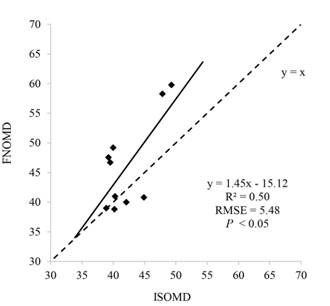
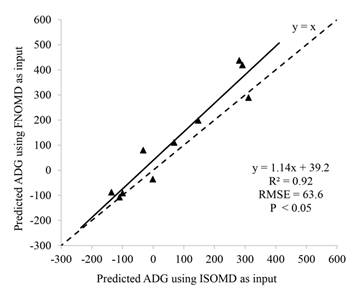
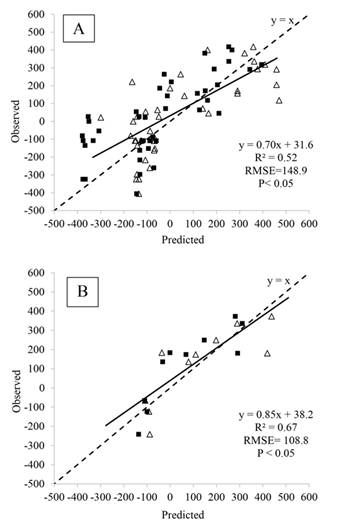
The values of herbage OM digestibility estimated by the fecal N method were related linearly to those estimated by the in situ method with a relatively low coefficient of determination (P < 0.05; R2 = 0.50; Figure 1). The herbage OM digestibility was on average underestimated by the in situ method when compared to the fecal N method (i.e. slope of the linear regression was higher than 1 (P < 0.05). Anyway, the difference between methods was not enough high to impact ADG values predicted by the Pampa Corte model. Indeed, the predictions of ADG through the Pampa Corte model by using digestibility values estimated from fecal N were linearly related to those predicted using the in situ method, showing a high coefficient of determination (R2 = 0.92; P < 0.05; Figure 2). Moreover, the intercept and slope of this linear relationship were not different from 0 (±2 SE between -4.6 and 12.6) and 1 (± 2 SE between 0.9 and 1.9), respectively. Also, the observed values of ADG were linearly related to those predicted by the Pampa Corte at both individual (R2 = 0.52; RMSE = 148.9; P < 0.05) or group level (R2 = 0.67; RMSE = 108.8; P < 0.05), without a significant effect (P > 0.05) of the method to estimate herbage digestibility (Figure 3).
Relationship between values of dietary organic matter digestibility (%) estimated by in situ (ISOMD) or fecal N (FNOMD) method (n =10). Individual values of FNOMD were averaged by diet treatment within trials.
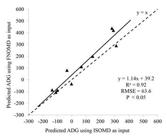
Relationship between values of average daily gain (ADG, g day-1) of growing free-ranging cattle, grazing native grasslands of southern Brazil, predicted by the Pampa Corte model using as input the dietary organic matter digestibility estimated from in situ (ISOMD) or fecal N (FNOMD) method (n = 10). Individual values of FNOMD were averaged by diet treatment within trials.
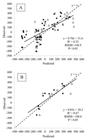
Relationship between observed values of average daily gain (g day-1) of growing free-ranging cattle on native grasslands of southern Brazil with those predicted by the Pampa Corte model using as input dietary OM digestibility estimated by in situ (■) or fecal N method (∆). Regressions were performed by using individual (A; n= 41) or the average values of animals by diet treatment within trials (B; n = 10).
In general, the use of either FNOMD or ISOMD values in the calculation of DCW of herbage resulted in acceptable predictions of individual ADG (i.e., CCC ≥ 0.70) by the Pampa Corte model, even though showing a relatively high RMSEP (i.e. ≥ 109 g day-1) (Table 3). However, as expected, the precision and accuracy of the Pampa Corte model in predicting the ADG improved when performed at the group level (i.e., CCC ≥ 0.80). In fact, all models are under inherent limitations for estimating natural phenomena (TEDESCHI, 2006). In the present study, it is probable that the performance of the Pampa Corte on estimating ADG was greatly associated with limitations on obtaining reliable values of herbage attributes, which are used as inputs in the model. The OM digestibility estimated by the in situ method as well as all other forage attributes were obtained from herbage samples collected through the hand-clipping procedure and pooled by pasture plot and diet treatment within trials, which is limited to represent the individual selectivity and the true diet ingested by free-ranging cattle. Even though the fecal N was used as a reference due to be considered a more reliable method than the in situ method for obtaining herbage digestibility values, it is also subject to error due to the inherent constraints associated with the use of external markers for estimating fecal excretion by grazing animals. These constraints include variable marker excretion throughout the day, incomplete marker recovery, and fecal sampling protocol (KOZLOSKI et al., 2014).
Fitting statistics comparing the performance of the Pampa Corte model in predicting the average daily gain (g day-1) of growing free-ranging cattle on native grasslands of southern Brazil when using as inputs the dietary organic matter digestibility estimated from in situ (ISOMD) and fecal N (FNOMD) methods.
Regardless of the level of evaluation (i.e., individual or group), the mean bias of prediction, which accounts for how far the slope of the regression line deviates from the unity, was lower (-7.3 and -1.3 g day-1) for FNOMD than for ISOMD (75.4 and 47.8 g day-1), at individual and group level of prediction, respectively. Anyway, regardless of the digestibility method, the bias was in general of small relevance considering that the observed ADG ranged from -405 to 418 and -242 to 373 g day-1 at individual and group level, respectively.
In conclusion, the ADG of a group of free-ranging cattle grazing native grasslands of southern Brazil can be adequately predicted by the Pampa Corte model using the ISOMD digestibility values for obtaining the DCW input. However, limitations associated with herbage sampling representativity must be considered, which remains a challenge for researchers and field technicians.
ACKNOWLEDGEMENTS
The authors thank the Coordenação de Aperfeiçoamento de Pessoal de Nível Superior (CAPES, Brazil) for scholarship support. We also thank the Highlands.3 Project (Marie Skłodowska-Curie grant agreement No 872328) for supporting a short-term research stay.
REFERENCES
- AGRICULTURAL FOOD AND RESEARCH COUNCIL - AFRC. Energy and protein requirements of ruminants. An advisory manual prepared by the AFRC Technical Committee on Responses to Nutrients. Wallingford: CAB International, 1993. 159p.
- ASSOCIATION OF OFFICIAL ANALYTICAL CHEMISTS - AOAC. Official Methods of Analysis. 16. ed. Washington: AOAC, 1997. p.1141.
-
CARAM, N. et al. Grazing intensity controls the seasonal utilization of functionally diverse patches by mediating herbivore selectivity. Rangeland Ecology & Management, In Press, 2024. Available from: <Available from: https://www.sciencedirect.com/science/article/abs/pii/S1550742424000940 >. Accessed: Jun. 11, 2024. doi: 10.1016/j.rama.2024.06.006
» https://doi.org/10.1016/j.rama.2024.06.006» https://www.sciencedirect.com/science/article/abs/pii/S1550742424000940 -
CARVALHO, P. C. de F. et al. Avanços metodológicos na determinação do consumo de ruminantes em pastejo. Revista Brasileira de Zootecnia, v.36, p.151-170, 2007. Available from: <Available from: https://www.scielo.br/j/rbz/a/zMgR6dRHJx7jpg7TdZvXNtP/ >. Accessed: Aug. 16, 2024. doi: 10.1590/S1516-35982007001000016.
» https://doi.org/10.1590/S1516-35982007001000016.» https://www.scielo.br/j/rbz/a/zMgR6dRHJx7jpg7TdZvXNtP/ - COMMONWEALTH SCIENTIFIC AND INDUSTRIAL RESEARCH ORGANIZATION - CSIRO. Nutrient requirements of domesticated ruminants. Melbourne: CSIRO Publishing, 2007. 270p.
- HERRERO, M. Modelling dairy grazing systems: an integrated approach. 1997. 360f. Thesis (PhD in Resource Management) - Institute of Ecology and Resource Management, University of Edinburgh.
-
ILLIUS, A. W.; GORDON, I. J. Prediction of intake and digestion in ruminants by a model of rumen kinetics integrating animal size and plant characteristics. Journal of Agricultural Science, v.116, p.145-157, 1991. Available from: <Available from: https://www.cambridge.org/core/journals/journal-of-agricultural-science/article/abs/prediction-of-intake-and-digestion-in-ruminants-by-a-model-of-rumen-kinetics-integrating-animal-size-and-plant-characteristics/77CAA3DA3D74D8EE298D7736F51E6B80 >. Accessed: Jun. 11, 2023. doi: 10.1017/S0021859600076255.
» https://doi.org/10.1017/S0021859600076255.» https://www.cambridge.org/core/journals/journal-of-agricultural-science/article/abs/prediction-of-intake-and-digestion-in-ruminants-by-a-model-of-rumen-kinetics-integrating-animal-size-and-plant-characteristics/77CAA3DA3D74D8EE298D7736F51E6B80 -
KOZLOSKI, G. V. et al. Faecal nitrogen excretion as an approach to estimate forage intake of wethers. Journal of Animal Physiology and Animal Nutrition, v.98, p.659-666, 2014. Available from: <Available from: https://pubmed.ncbi.nlm.nih.gov/23931613/ >. Accessed: Jul. 12, 2023. doi: 10.1111/jpn.12118.
» https://doi.org/10.1111/jpn.12118.» https://pubmed.ncbi.nlm.nih.gov/23931613/ -
KOZLOSKI, G. V. et al. Faecal N excretion as an approach for estimating organic matter intake by free-ranging sheep and cattle. The Journal of Agricultural Science, v.156, p.443-449, 2018. Available from: <Available from: https://www.cambridge.org/core/journals/journal-of-agricultural-science/article/abs/faecal-n-excretion-as-an-approach-for-estimating-organic-matter-intake-by-freeranging-sheep-and-cattle/CBAC6BFADAB02E46896A8EF7E793FAA7 >. Accessed: Jul. 12, 2023. doi: 10.1017/S0021859618000412.
» https://doi.org/10.1017/S0021859618000412.» https://www.cambridge.org/core/journals/journal-of-agricultural-science/article/abs/faecal-n-excretion-as-an-approach-for-estimating-organic-matter-intake-by-freeranging-sheep-and-cattle/CBAC6BFADAB02E46896A8EF7E793FAA7 -
KUINCHTNER, B. C. et al. Thermal sum (degrees-days) rest period as a grazing management tool in natural grasslands: Effects on animal performance and forage production. Environmental and Sustainability Indicators, v.10, 100125, 2021. Available from: <Available from: https://linkinghub.elsevier.com/retrieve/pii/S266597272100026X >. Accessed: Jan. 10, 2024. doi: 10.1016/j.indic.2021.100125.
» https://doi.org/10.1016/j.indic.2021.100125.» https://linkinghub.elsevier.com/retrieve/pii/S266597272100026X -
MEHREZ, A. Z.; ØRSKOV, E.R. A study of artificial fibre bag technique for determining the digestibility of feeds in the rumen. The Journal of Agricultural Science, v.88, p.645-650, 1977. Available from: <Available from: https://www.cambridge.org/core/journals/journal-of-agricultural-science/article/abs/study-of-artificial-fibre-bag-technique-for-determining-the-dig-estibility-of-feeds-in-therumen/3232D1FFED03A4584731602DAEA504DE >. Accessed: Jun. 21, 2023. doi:10.1017/S0021859600037321.
» https://doi.org/0.1017/S0021859600037321.» https://www.cambridge.org/core/journals/journal-of-agricultural-science/article/abs/study-of-artificial-fibre-bag-technique-for-determining-the-dig-estibility-of-feeds-in-therumen/3232D1FFED03A4584731602DAEA504DE -
ØRSKOV, E. R.; MCDONALD, I. The estimation of protein degradability in the rumen from incubation measurements weighted according to rate of passage. The Journal of Agricultural Science, v.92, p.499-503, 1979. Available from: <Available from: https://www.cambridge.org/core/journals/journal-of-agricultural-science/article/estimation-of-protein-degradability-in-the-rumen-from-incubation-measurements-weighted-according-to-rate-of-passage/E2DB4F2290E374E10E9800E512D127A7 >. Accessed: Aug. 03, 2023. doi: 10.1017/S0021859600063048.
» https://doi.org/10.1017/S0021859600063048.» https://www.cambridge.org/core/journals/journal-of-agricultural-science/article/estimation-of-protein-degradability-in-the-rumen-from-incubation-measurements-weighted-according-to-rate-of-passage/E2DB4F2290E374E10E9800E512D127A7 -
POZO, C. A. et al. Evaluation of the Pampa Corte model for predicting dry matter intake and digestibility by sheep fed tropical forages. Livestock Science, v.267, p.105147, 2023. Available from: <Available from: https://www.sciencedirect.com/journal/livestock-science >. Accessed: Aug. 01, 2023. doi: 10.1016/j.livsci.2022.105147.
» https://doi.org/10.1016/j.livsci.2022.105147.» https://www.sciencedirect.com/journal/livestock-science -
SENGER, C. D. et al. Evaluation of autoclave procedures for fibre analysis in forage and concentrate feedstuffs. Animal Feed Science and Technology, v.146, p.169-174, 2008. Available from: <Available from: https://www.sciencedirect.com/science/article/pii/S0377840107005445 >. Accessed: Jan. 22, 2023. doi: 10.1016/j.anifeedsci.2007.12.008.
» https://doi.org/10.1016/j.anifeedsci.2007.12.008.» https://www.sciencedirect.com/science/article/pii/S0377840107005445 -
SILVEIRA, V. C. P. Pampa Corte: a model that simulates beef cattle growing and fattening process. Ciência Rural, v.32, p.543-552, 2002. Available from: <Available from: https://www.scielo.br/j/cr/a/JVyY8qhxbxr4KzM9ctJhMzy/?lang=pt >. Accessed: Jun. 05, 2023. doi: 10.1590/S0103-84782002000300029.
» https://doi.org/10.1590/S0103-84782002000300029.» https://www.scielo.br/j/cr/a/JVyY8qhxbxr4KzM9ctJhMzy/?lang=pt -
TEDESCHI, L. O. Assessment of the adequacy of mathematical models. Agricultural Systems, v.89, p.225-247, 2006. Available from: <Available from: https://www.sciencedirect.com/science/article/abs/pii/S0308521X05002568?via%3Dihub >. Accessed: Aug. 02, 2023. doi: 10.1016/j.agsy.2005.11.004.
» https://doi.org/10.1016/j.agsy.2005.11.004.» https://www.sciencedirect.com/science/article/abs/pii/S0308521X05002568?via%3Dihub -
TILLEY, J. M. A.; TERRY, R. A. A two-stage technique for the in vitro digestion of forage crop. Journal of British Grassland Society, v.18, p.104-111, 1963. Available from: <Available from: https://onlinelibrary.wiley.com/doi/10.1111/j.1365-2494.1963.tb00335.x >. Accessed: Aug. 08, 2023. doi/10.1111/j.1365-2494.1963.tb00335.x.
» https://doi.org//10.1111/j.1365-2494.1963.tb00335.x» https://onlinelibrary.wiley.com/doi/10.1111/j.1365-2494.1963.tb00335.x - T’MANNETJE, L.; JONES, R. M. Field and laboratory methods for grassland and animal research. Wallingford: CABI Publishing. 2000.
Edited by
-
Editors: Rudi Weiblen (0000-0002-1737-9817) Márcia Helena Machado da Rocha Fernandes (0000-0001-8787-9668)