 The white oat forage dehydration method alters the carbohydrate concentration and degradation kinetics of haylage
ABSTRACT:
This study assessed the effect of three oat forage dehydration methods on carbohydrate composition, rumen dry matter (DM) and neutral detergent fiber (NDF) degradation, and the degradation kinetics of carbohydrates via gas production from haylage. The dehydration methods tested were Mechanical (MEC); Mechanical + Bacterial chemical compound (M+BCC), composed of Bacillus amyloliquefaciens (7799) 1.0 x 10⁹ CFU, Bacillus subtilis (CCT 0089) 1.0 x 10⁹ CFU, Propionibacterium acidipropionici (7751) 1.0 x 10⁹ CFU, potassium sulfate, and cellulase; and Chemical (CHEM), applied with glyphosate. The haylage obtained by M+BCC dehydration exhibited lower fibrous carbohydrate content (21.2% hemicellulose, 27.3% cellulose) and 3.2% lignin. The haylageobtained by the CHEM method had higher total carbohydrate content and fractions B2 and C (74.2, 47.1, and 13.7%, respectively). Gas production from the degradation of fibrous and non-fibrous carbohydrates was higher for the M+BCC method (196.9 mL g-1 of DM), followed by the MEC method (164.3 mL g-1 of DM) and CHEM (151.7 mL g-1 of DM). We recommended that haylage can be prepared from forage dehydrated using the M+BCC method, since it showed a lower proportion of structural carbohydrates, and higher DM and fibrous fraction degradation.
Key words:
non-fibrous carbohydrates; rumen fermentation; effective degradability; gas production
RESUMO:
O presente estudo teve por objetivo avaliar o efeito de três métodos de desidratação da forragem de aveia sobre a composição dos carboidratos, degradação ruminal da matéria seca (MS) e fibra em detergente neutro (FDN), assim como a cinética de degradação de carboidratos por meio de produção de gases das silagens pré-secadas. Os métodos de desidratação testados foram: Mecânico (MEC); Mecânico + Composto químico bacteriano (M+CQB), o qual é constituído por Bacillus amyloliquefaciens (7799) 1,0 x 10⁹ UFC, Bacillus subtilis (CCT 0089) 1,0 x 10⁹ UFC, Propionibacterium acidipropionici (7751) 1,0 x 10⁹ UFC, sulfato de potássio e celulase; e Químico (QUIM) que foi realizado com a aplicação de Glifosato. A silagem pré-secada obtida pelo método de desidratação M+CQB apresentou menor teor de carboidratos fibrosos (hemicelulose 21,2%, celulose 27,3%) e lignina 3,2%. A silagem pré-secada obtida pelo método QUIM possui maior teor de carboidratos totais e das frações B2 e C (74,2%, 47,1% e 13,7% respectivamente). A produção de gases oriunda da degradação dos carboidratos fibrosos e não fibrosos foi superior para o método de desidratação M+CQB (196,95 mL g-1 de MS) seguido do método MEC (164,3 mL g-1 de MS) e QUIM (151,7 mL g-1 de MS). É recomendado a confecção de silagem pré-secada a partir da forragem desidratada pelo método M+CQB, pois esta apresenta menor proporção de carboidratos estruturais, maior degradação da MS e de sua fração fibrosa.
Palavras-chave:
carboidratos não fibrosos; fermentação ruminal; degradabilidade efetiva; produção de gases
INTRODUCTION
Haylage, like conventional silage, is a way to preserve forages and ensure a constant supply in both amount and quality for animals, which helps maintain the efficiency of production systems, however, the production of haylage has a particularity, which is the need to dehydrate the forage to ensure a stable environment after silo sealing those favors preserving its nutritional quality (SOUNDHARRAJAN et al., 2017; COSTA et al., 2019).
Mechanical dehydration method is the most common method, albeit highly dependent on climatic factors, therefore, when the glyphosate herbicide is used in haylage production, the process becomes less dependent on climatic factors, given that glyphosate is a systemic herbicide that promotes physiological changes in plants (ZOBIOLE et al., 2010; MESCHEDE et al., 2011).
In addition to the methods, a promising and innovative technique is to combine the mechanical dehydration with the application of a bacterial chemical compound, aiming to intensify forage dehydration after cutting, degrade fibrous compounds, and increase animal intake of haylage.
The bacterial chemical compound is produced by Bacillus bacteria (responsible for reducing water surface tension and disintegrating leaf cutin), Propionibacterium acidipropionici (producer of propionic acid, which helps control fungal proliferation), potassium sulfate (responsible for keeping the leaf stomata open after forage cutting), and cellulase (responsible for breaking down cellulose into oligosaccharides) (SHAO et al., 2005; FRACCHIA et al., 2015; PIWOWAREK et al., 2018).
The hypothesis of this study is that the use of a bacterial chemical compound in haylage would reduce fibrous carbohydrate content and improve its degradation. Thus, we assessed the effect of three white oat forage dehydration methods (Mechanical, Mechanical + Bacterial Chemical Compound, and Chemical) on hemicellulose, cellulose, and lignin concentrations in haylage, the kinetics of rumen DM and NDF degradation, and carbohydrate degradation kinetics in vitro.
MATERIALS AND METHODS
Experimental site
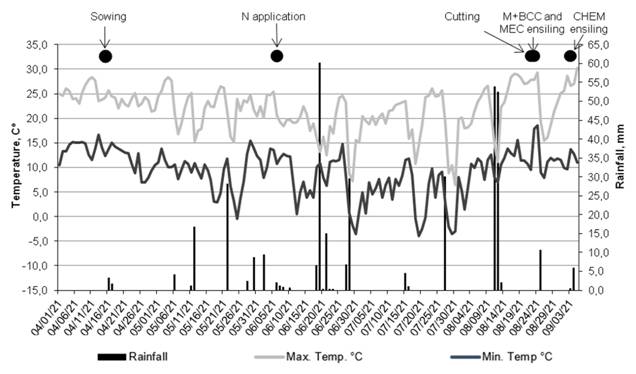
The study was conducted at the Center for Animal Production (NUPRAN) of the Agrarian and Environmental Sciences Department at the Universidade Estadual do Centro Oeste (UNICENTRO), in Guarapuava, Parana state (PR), and at the Animal Nutrition Laboratory of the Universidade Estadual de Londrina (UEL), in Londrina, PR. The climate in Guarapuava is humid subtropical mesothermal (Cfb), with no dry season, mild summers, and moderate winters. The climate data for the experimental period are shown in figure 1.
Maximum and minimum temperatures (ºC) and average rainfall in mm at the Universidade Estadual do Centro-Oeste, Guarapuava, PR, in 2021, during the experimental period.
Materials and experimental design
White oat (Avena sativa), GMX Tambo cultivar, was used as the experimental material. The forage was sown on April 15, 2021, using a no-till system with row spacing of 0.17 m and average depth of 0.02 m in plots measuring 5 x 5 m, totaling an area of 25 m² per plot. The experimental design was completely randomized, consisting of three treatments, and three forage dehydration methods: Mechanical (MEC), Mechanical + Bacterial Chemical Compound (M+BCC), and Chemical (CHEM), with five replications each, and each replication represented by a plot.
For MEC dehydration, the forage was cut and turned using rakes until the desired dry matter (DM) content for ensiling (45%) was reached. For the M+BCC method, a compound consisting of Bacillus amyloliquefaciens (7799) 1.0 x 10⁹ CFU g-1, Bacillus subtilis (CCT 0089) 1.0 x 10⁹ CFU g-1, Propionibacterium acidipropionici (7751) 1.0 x 10⁹ CFU g-1, potassium sulfate, and cellulase (technology held by SLO Biotecnologia e Agropecuária) was applied at a dose of 5 g-1 of commercial product for each 1 L of non-chlorinated water, according to the manufacturer’s recommendation, reaching an application rate of 22.50 mL of solution per kg of forage DM. The bacterial chemical compound was sprayed onto the forage using a sprayer, and the forage was then cut and turned using rakes until the desired DM content for ensiling (45%) was achieved.
In the CHEM method, the herbicide glyphosate was applied at a dose of 0.5 L ha-1, and the plants were cut only when they reached the desired 45% DM content. The product in question is authorized by the Ministry of Agriculture, Livestock, and Supply (MAPA) at this dosage as an oat dehydration agent for haylage production.
When the materials have reached the desired dry matter content, they were chopped using a stationary silage cutter and stored in PVC laboratory silos, measuring 50 cm high and 10 cm in diameter, with a compaction of 240 kg DM m³, and sealed with PVC caps and adhesive tape.
After silo opening, haylage samples from each treatment were collected and placed in a forced air oven at 55 ºC to determine ash-free dry matter (AFDM), and then ground in a Willey-type mill with a 1 mm sieve. These samples were used to sequentially determine NDF content, using thermostable amylase, and acid detergent fiber (ADF) content, as proposed by VAN SOEST et al. (1991). Crude protein (CP) was quantified using the micro-Kjeldahl method, and neutral detergent insoluble protein (NDIP), acid detergent insoluble protein (ADIP), ether extract (EE), mineral matter (MM), and total dry matter (TDM) according to AOAC (2000) methodologies (Table 1).
Carbohydrates
The samples were analyzed to determine acid detergent lignin (ADL) content using sulfuric acid at a concentration of 72%. Based on NDF, ADF, and ADL values, hemicellulose (Hemicellulose = NDF - ADF) and cellulose content (Cellulose = ADF - ADL) were calculated.
Carbohydrate fractionation was performed according to SNIFFEN et al. (1992), with total carbohydrates (TC) estimated by the equation: TC = 100 - (CP + EE +MM). Fraction B2, with a slow rumen degradation rate, was determined by the equation: B2 = NDFcp fraction c. Fraction C, representing the indigestible fraction of the cell wall, was calculated by multiplying the lignin percentage by 2.4. Fraction A + B1, corresponding to the rapidly and moderately degradable fractions in the rumen, was estimated by the equation: A + B1 = 100 - (C+B2).
Rumen degradation
The rumen degradation rate of the DM of haylagewas estimated by the in situ technique using 12 cm x 8 cm nylon bags with 50 μm pores, containing 5 g of dried samples ground to 1 mm (NOCEK, 1988). These were incubated in reverse chronological order for 0, 2, 4, 6, 12, 24, 36, 48, 72, and 96 hours. Two bulls, equipped with rumen cannulas, adapted for 20 days before assessment with an exclusive diet of haylageoat, were used for the experiment.
After the samples were removed from the rumen, they were washed and dried in a forced air oven and then weighed to determine the amount of degraded material. From the incubated material residue, NDF content was determined following the methodology proposed by VAN SOEST et al. (1991) with thermostable α-amylase.
A first-order kinetic model was applied to estimate rumen degradation parameters from DM and NDF degradation rates at different incubation times, using non-linear regression with the Gauss-Newton method. DM degradation parameters were estimated using the exponential equation proposed by ORSKOV & MCDONALD (1979).
Equation: :
Where DegMS = fraction degraded at time “t” (%), “a” is the intercept representing the fraction that disappears instantly at t = 0, “b” the potentially degradable fraction (%), and “c” the degradation rate (h-1). For NDF, there should be no intercept; in this particular case, parameter “a” was excluded from the model (DI MARCO et al., 2002).
The effective degradability (ED) of DM and NDF in the rumen was calculated as suggested by ORSKOV & MCDONALD (1979):
Equation:
Equation:
Where k is the rumen passage rate, with values of 2, 5, and 8% h-1, representing low, medium, and high concentrate intake, respectively.
Carbohydrate degradation kinetics by gas production
Rumen fluid used for the in vitro gas production technique was manually collected via a rumen cannula from a castrated sheep with a body weight (BW) of approximately 75 kg, fed for seven days with a 50:50 forage-to-concentrate diet. The fluid was collected before morning feeding, filtered through fine cotton cloth, and placed in a pre-warmed thermos at 39 ºC for transport to the laboratory. The time between collection and incubation was approximately 30 minutes.
The kinetic parameters of rumen degradation were estimated using the semi-automated in vitro cumulative gas production technique described by SCHOFIELD et al. (1994). To that end, 300 mg of pre-dried sample were ground to 1 mm samples, weighed, and placed in 50 mL flasks. All flasks received 24 mL of buffer solution, previously reduced with CO2 until a pH of 6.9 was reached (McDOUGALL, 1949). Next, 6 mL of rumen inoculum was added to each flask under CO2. For adjustments, flasks without substrate (blanks) were incubated to subtract the gas volume from the rumef fluid and buffer solution.
The glass flasks were hermetically sealed with rubber stoppers and immediately placed in an orbital incubator (Tecnal®, TE 421) at 39 ºC with 80 rpm stirring. Before starting the incubation time count, the flasks were depressurized with needles to ensure that all flasks were under the same initial pressure. From this point, gas pressure produced by the fermentation of the substrate and accumulated in the flasks was measured with a pressure gauge (model MPD-79; Instrutherm®) at 1, 2, 3, 4, 5, 6, 9, 12, 18, 24, 30, 36, 48, 60, 72, 84, 96, and 144 hours. The flasks were depressurized after each measurement.
The pressure measured was converted into volume according to a pre-established equation for local conditions at the UEL Animal Nutrition Laboratory:
Equation: V
Where V = gas volume in mL; Psi = gas pressure in psi. The volume was corrected for one gram of DM, subtracting the values obtained from the blank flasks.
To estimate the parameters of carbohydrate degradation kinetics and gas production, the data were adjusted using the bicompartmental statistical model described by SCHOFIELD et al. (1994):
Equation:
Where V = accumulated gas volume at time t, in mL; Vnfc = maximum gas volume formed by the non-fibrous carbohydrate fraction, in mL; Knfc = degradation rate of non-fibrous carbohydrates, in mL h-1; L = lag time, in hours; t = incubation time, in hours; Vfc = maximum gas volume formed by the fibrous carbohydrate fraction, in mL; Kfc = degradation rate of fibrous carbohydrates, in mL hour-1.
Statistical analysis
Each variable was analyzed following the statistical model:
Where Yi = dependent variables; µ = overall mean of all observations; Di = effect of forage dehydration methods of order “i”; and εi = random residual effect.
The parameters of carbohydrate degradation kinetics through gas production were generated using the R statistical program (2015) with the Gauss-Newton algorithm. Other data were submitted to Shapiro-Wilk and Bartlett tests to verify normality and homogeneity of variance assumptions, respectively. Once these assumptions were met, the F-test was applied at a 5% probability through analysis of variance (ANOVA), followed by Tukey’s test for multiple means comparison at 5% significance, using the SAS program (1993).
RESULTS AND DISCUSSION
Haylage with the highest hemicellulose content was produced from forage dehydrated using the CHEM method (24.7%). Cellulose and lignin contents were higher for haylage produced from forage dehydrated by the CHEM and MEC methods, which did not differ from each other, with cellulose contents of 29.7 and 28.9%, and lignin contents of 4.2 and 3.9%, respectively (Table 2).
Higher hemicellulose, cellulose, and lignin contents are associated with the forage dehydration phase. When forage is desiccated with glyphosate, there is a change in the permeability of plant cell membranes, compromising the functionality of aquaporins, which are essential proteins for water transport and proper stomatal function, making water loss slower and consequently reducing the dehydration rate (ZOBIOLE et al., 2010; NGUYEN et al., 2013). During this period, the plant’s soluble compounds are required to produce energy and maintain cellular functions to keep the plant alive.
When dehydration occurred only by the MEC method, forage remained in the field longer than with the M + BCC method (Table 1). According to BERNARDES et al. (2018) and GUAN et al. (2018), the time the plant remains exposed in the field after cutting directly influences the concentration of its soluble compounds, since these are used in chemical reactions inside the plant cells.
Table 1 shows that forage desiccated with glyphosate and untreated forage remained exposed to environmental conditions for longer before ensiling (276 and 33 hours, respectively), and possibly, a large amount of the plant’s soluble compounds was consumed. When this occurs, fibrous carbohydrates concentrate, increasing the fiber content of the haylage.
When the fibrous carbohydrate content in haylageincreases, as reported in table 2, the action of rumen microorganisms and their degradation is compromised. One of the main components in hemicellulose is xylan, which requires specialized systems such as xylanolytic enzymes for its degradation (SARATALE et al., 2012). Cellulose exhibits a high degree of polymerization, hindering its fermentation, and large proportions of this fraction are negatively correlated with food quality (GIGER-REVERDIN, 1995; VAN SOEST, 1994). Lignin, a phenolic compound with a high degree of polymerization, restricts the action of digestive enzymes produced by rumen microorganisms (KIR, 2020).
Total carbohydrates in haylages were higher when the forage was desiccated using the CHEM method (74.2%) compared to M+BCC and MEC dehydration (70.5 and 71.2%, respectively). By contrast, the A+B1 fractions of haylageswere higher for forage dehydrated using the M+BCC and MEC methods, with no difference between them (45.5 and 45.9%, respectively) (Table 2).
Higher concentrations of the A+B1 fractions reflect the forage dehydration time (Table 1). The forage dehydration period changes the soluble carbohydrate content, that is, the less efficient this process, the lower the concentration of these carbohydrates, since they are consumed in intracellular reactions after the plant is cut (RIBAS et al., 2021). It is also important to note that higher soluble fraction contents are desirable in haylage because they are important substrate sources for rumen microorganisms and are quickly fermented (GAYER et al., 2019).
Fraction B2 was larger in haylageobtained from CHEMdesiccated forage (47.1%), followed by the M+BCC (43.6%) and MEC (40.7%) methods, which showed higher cellulose and hemicellulose contents (Table 2). A higher concentration of this fraction does not indicate poor quality forage; however, its use depends on its passage rate and the potentially digestible carbohydrate content. If the passage rate is high, use will be lower, while a low rate results in higher use (SNIFFEN et al., 1992; GAYER et al., 2019).
The lowest fraction C content occurred in haylage obtained from forage dehydrated using the M+BCC method (10.9%), followed by the MEC and CHEM methods (13.4 and 13.7%, respectively), which did not differ from each other. This carbohydrate fraction is directly related to fibrous carbohydrate and lignin contents, that is, the higher the contents of these components, the greater the fraction C proportions in the feed.
Degradation of the “a” fraction was higher in haylages obtained from forages dehydrated using the M+BCC and MEC methods (39.5 and 38.4%, respectively) (Table 3). Thus, “b” fraction degradation was geater in haylages obtained from CHEM and M+BCC-dehydrated forage (46.9 and 46.8%, respectively), a behavior justified by the B2 carbohydrate fraction concentration of these silages (Table 2), which exhibits partial degradation.
Regardless of passage rate, the effective degradability of haylages was higher when forage was dehydrated using the M+BCC method, followed by the MEC and CHEM methods. Consistent with the results of the present study (Tables 2 and 3), HORST et al. (2017), assessed the rumen degradation of the haylage of two white oat cultivars, and reported lower degradation for the cultivar with higher cellulose and lignin contents.
Degradation of the “a,” “b,” i fractions and effective degradability are closely related to non-fibrous carbohydrate and structural carbohydrate contents. Higher soluble carbohydrate contents with rapid fermentation in the cell content and middle lamella increase fraction “a” degradation and the effective degradability of the feed, while higher structural carbohydrate contents reduce degradability (HARPER et al., 2017; RIBAS et al., 2021).
Analysis of the rumen degradation kinetics of NDF from haylages (Table 3) indicates that M+BCC dehydration increased fraction “b” degradation (77.1%) and reduced the indigestible portion (22.8%). The higher mean fraction “b” degradation of NDF is related to cellulase present in the bacterial chemical compound, which breaks down cellulose into beta-glucose and short-chain polysaccharides, thereby improving cell wall digestibility and the nutritional value of the feed (MUCK et al., 2018; BUREENOK et al., 2019).
The degradation rate of fraction “b” and the effective NDF degradability of haylages obtained using MEC and M+BCC dehydration were higher in the methods assessed, but did not differ from each other. Greater NDF degradation in forage indicates better fibrous quality, and when this forage category comprises a larger portion of ruminant diets, the digestibility of its fibrous portion becomes very important, given that most of the available energy comes from the digestion of this fraction (HARPER et al., 2017).
The hydration methods tested significantly affected (P < 0.05) Vnfc, Knfc, Vfc, Kfc, and final volume (Vfinal) (Table 4). Vnfc was higher in haylageobtained from forage dehydrated using the M+BCC and MEC methods, which did not differ from each other (117.9 and 107.4 mL g-1 of DM, respectively). Knfc showed the highest value for M+BCC dehydration (0.07% h-1), but did not differ from the MEC method (0.06% h-1).
The gas volume produced and the non-fibrous carbohydrate degradation rate reflect the degree of microbial fermentation, determined by the concentration of available substrate and its degradation rate (ZHENG et al., 2021). Thus, it can be inferred that the bacterial chemical compound effectively preserved rumen microorganisms and provided them with a higher concentration of soluble carbohydrates (Table 2).
Haylage obtained from forage dehydrated by M+BCC showed higher Vfc (78.3 mL g-1 DM) and mean Kfc values (0.01% h-1) (Table 4), which are related to the lower cellulose and hemicellulose contents of this haylage (Table 2).
The Vfinal (mL g-1 of DM) from fibrous and non-fibrous carbohydrate degradation was higher in haylage obtained from M+BCC-dehydrated forage (196.9 mL g-1 of DM), followed by the MEC method (164.3 mL g-1 of DM) and CHEM (151.7 mL g-1 of DM). The gas volume produced during fermentation is a consequence of the extent of carbohydrate digestion. ABD EL TAWAB et al. (2016) inferred that exogenous cellulase addition improves feed digestion. In addition to exogenous enzyme, another factor influencing feed digestibility is its ADF content, and according to IQBAL et al. (2018), feeds with higher ADF contents result in lower in vitro gas production, a behavior observed in this study (Tables 1, 2, and 4).
CONCLUSION
The use of a bacterial chemical compound combined with the mechanical dehydration method in white oats is recommended, given that haylage produced from forage dehydrated using this method had lower fibrous carbohydrate content and higher rumen degradation of its fibrous and non-fibrous carbohydrates.
ACKNOWLEDGMENTS
The Conselho Nacional de Desenvolvimento Científico e Tecnológico (CNPq) for providing the grant.
REFERENCES
-
ABD EL TAWAB, A. M. et al. Effect of cellulase and tannase enzymes supplementation on the productive performance of lactating buffaloes fed diets contains date palm fronds. Asian Journal Animal Science, v.10, p.307-331, 2016. Available from: <Available from: https://doi.org/10.3923/ajas.2016.307.312 >. Accessed: Sept. 27, 2023. doi: 10.3923/ajas.2016.307.312.
» https://doi.org/10.3923/ajas.2016.307.312.» https://doi.org/10.3923/ajas.2016.307.312 - ASSOCIATION OF OFFICIAL ANALYTICAL CHEMISTS - AOAC. Official methods of analysis. Gaithersburg: AOAC International, 2000. 17.ed.
-
BERNARDES, T. F. et al. Silage review: Unique challenges of silages made in hot and cold regions. Journal of Dairy Science, v.101, p.4001-4019, 2018. Available from: <Available from: https://doi.org/10.3168/jds.2017-13703 >. Accessed: Apr. 12, 2024. doi: 10.3168/jds.2017-13703.
» https://doi.org/10.3168/jds.2017-13703.» https://doi.org/10.3168/jds.2017-13703 -
BUREENOK, S. et al. Effects of fibrolytic enzymes and lactic acid bacteria on fermentation quality and in vitro digestibility of Napier grass silage. Italian of Journal Animal Science, v.18, p.1438-1444, 2019. Available from: <Available from: https://doi.org/10.1080/1828051X.2019.1681910 >. Accessed: Sept. 27, 2023. doi: 10.1080/1828051X.2019.1681910.
» https://doi.org/10.1080/1828051X.2019.1681910.» https://doi.org/10.1080/1828051X.2019.1681910 -
COSTA, M. L. L. et al. Valor nutricional da silagem pré-secada de capim Tifton-85. Revista Brasileira de Meio Ambiente, v.6, p.26-33, 2019. Available from: <Available from: https://revistabrasileirademeioambiente.com/index.php/RVBMA/article/view/192/167 >. Accessed: Sept. 24, 2023.
» https://revistabrasileirademeioambiente.com/index.php/RVBMA/article/view/192/167 -
DI MARCO, O. et al. Effect of maize crop maturity on silage chemical composition and digestibility (in vivo, in situ and in vitro). Animal Feed Science and Technology, v.99, p.37-43, 2002. Available from: <Available from: https://doi.org/10.1016/S0377-8401(02)00077-9 >. Accessed: Sept. 27, 2023. doi: 10.1016/S0377-8401(02)00077-9.
» https://doi.org/10.1016/S0377-8401(02)00077-9.» https://doi.org/10.1016/S0377-8401(02)00077-9 -
FRACCHIA, L. et al. Potential therapeutic applications of microbial surface-active compounds. AIMS Bioengineering, v.2, p.144-162, 2015. Available from: <Available from: https://doi.org/10.3934/bioeng.2015.3.144 >. Accessed: Sept. 27, 2023. doi: 10.3934/bioeng.2015.3.144.
» https://doi.org/10.3934/bioeng.2015.3.144.» https://doi.org/10.3934/bioeng.2015.3.144 -
GAYER, T. O. et al. Different dry matters content used for the conservation of annual ryegrass (Lolium multiflorum Lam.) in anaerobic environment. African Journal of Agricultural Research, v.14, p.369-378, 2019. Available from: <Available from: https://doi.org/10.5897/AJAR2018.13675 >. Accessed: Sept. 27, 2023. doi: 10.5897/AJAR2018.13675.
» https://doi.org/10.5897/AJAR2018.13675.» https://doi.org/10.5897/AJAR2018.13675 -
GIGER-REVERDIN, S. Review of the main methods of cell wall estimation: interest and limits for ruminants. Animal Feed Science and Technology, v.55, p.295-334, 1995. Available from: <Available from: https://doi.org/10.1016/0377-8401(95)00791-K >. Accessed: Sept. 17, 2023. doi: 10.1016/0377-8401(95)00791-K.
» https://doi.org/10.1016/0377-8401(95)00791-K.» https://doi.org/10.1016/0377-8401(95)00791-K -
GUAN, H. et al. Microbial communities and natural fermentation of corn silages prepared with farm bunker-silo in Southwest China. Bioresource Technology, v.265, p.282-290, 2018. Available from: https://doi.org/10.1016/j.biortech.2018.06.018. Accessed: April 12, 2024. doi: 10.1016/j.biortech.2018.06.018.
» https://doi.org/https://doi.org/10.1016/j.biortech.2018.06.018» https://doi.org/10.1016/j.biortech.2018.06.018. -
HARPER, M. T. et al. Inclusion of wheat and triticale silage in the diet of lactating dairy cows. Journal of Dairy Science, v.100, p.6151-6163, 2017. Available from: <Available from: https://doi.org/10.3168/jds.2017-12553 >. Accessed: Sept. 17, 2023. doi: 10.3168/jds.2017-12553.
» https://doi.org/10.3168/jds.2017-12553.» https://doi.org/10.3168/jds.2017-12553 -
HORST, E. H. et al. Fiber composition and degradability of cold season green forage and pre-dried silage harvested at pre-flowering. Semina: Ciências Agrárias, v.38, p.2041-2049, 2017. Available from: <Available from: https://doi.org/10.5433/1679-0359.2017v38n4p2041 >. Accessed: Aug 29, 2023. doi: 10.5433/1679-0359.2017v38n4p2041.
» https://doi.org/10.5433/1679-0359.2017v38n4p2041.» https://doi.org/10.5433/1679-0359.2017v38n4p2041 -
IQBAL, M. W. et al. Ruminal fermentation and microbial community differently influenced by four typical subtropical forages in vitro. Animal Nutrition, v.4, p.100-108, 2018. Available from: <Available from: https://doi.org/10.1016/j.aninu.2017.10.005 >. Accessed: Sept. 27, 2023. doi: 10.1016/j.aninu.2017.10.005.
» https://doi.org/10.1016/j.aninu.2017.10.005.» https://doi.org/10.1016/j.aninu.2017.10.005 -
KIR, H. Yield and quality traits of some silage maize cultivars. Fresenius Environmental Bulletin, v.20, p.2843-2849, 2020. Available from: <Available from: https://www.researchgate.net/publication/340101896_YIELD_AND_QUALITY_TRAITS_OF_SOME_SILAGE_MAIZE_CULTIVARS >. Accessed: Sept. 27, 2023.
» https://www.researchgate.net/publication/340101896_YIELD_AND_QUALITY_TRAITS_OF_SOME_SILAGE_MAIZE_CULTIVARS -
MESCHEDE, D. K. et al. Efeitos do glyphosate nos teores de lignina, celulose e fibra em Brachiaria decumbens. Revista Brasileira de Herbicidas, v.10, p.57-63, 2011. Available from: <Available from: https://doi.org/10.7824/rbh.v10i1.77 >. Accessed: Oct. 13, 2023. doi: 10.7824/rbh.v10i1.77.
» https://doi.org/10.7824/rbh.v10i1.77.» https://doi.org/10.7824/rbh.v10i1.77 -
MUCK, R. E. et al. Silage review: Recent advances and future uses of silage aditives. Journal of Dairy Science, v.101, p.3980-4000, 2018. Available from: <Available from: https://doi.org/10.3168/jds.2017-13839 >. Accessed: Oct. 13, 2023. doi: 10.3168/jds.2017-13839.
» https://doi.org/10.3168/jds.2017-13839.» https://doi.org/10.3168/jds.2017-13839 -
MCDOUGAL, E. I. Studies on ruminant saliva. The composition and output of sheep’s saliva. Biochemical Journal, v.43, p.99-109, 1949. Available from: <Available from: https://www.ncbi.nlm.nih.gov/pmc/articles/PMC1274641/ >. Accessed: Sept. 27, 2023.
» https://www.ncbi.nlm.nih.gov/pmc/articles/PMC1274641/ -
NGUYEN, M. X. et al. Genome-wide expression analysis of rice aquaporin genes and development of a functional gene network mediated by aquaporin expression in roots. Planta, v.238, p.669-681, 2013. Available from: <Available from: https://doi.org/10.1007/s00425-013-1918-9 >. Accessed: Mar. 10, 2024. doi: 10.1007/s00425-013-1918-9.
» https://doi.org/10.1007/s00425-013-1918-9.» https://doi.org/10.1007/s00425-013-1918-9 -
NOCEK, J. E. In situ and other methods to estimate ruminal protein and energy digestibility: a review. Journal of Dairy Science, v.71, p.2051-2069, 1988. Available from: <Available from: https://doi.org/10.3168/jds.S0022-0302(88)79781-7 >. Accessed: Sept. 27, 2023. doi: 10.3168/jds.S0022-0302(88)79781-7.
» https://doi.org/10.3168/jds.S0022-0302(88)79781-7.» https://doi.org/10.3168/jds.S0022-0302(88)79781-7 -
ORSKOV, E. R.; MCDONALD, I. The estimation of protein degradability in the rumen from incubation measurements weighted according to rate of passage. Journal of Agricultural Science, v.92, p.499-503, 1979. Available from: <Available from: https://doi.org/10.1017/S0021859600063048 >. Accessed: Sept. 27, 2023. doi: 10.1017/S0021859600063048.
» https://doi.org/10.1017/S0021859600063048.» https://doi.org/10.1017/S0021859600063048 -
PIWOWAREK, K. et al. Propionibacterium spp.-source of propionic acid, vitamin B12, and other metabolites important for the industry. Applied Microbiology and Biotechnology, v.102, p.515-538, 2018. Available from: <Available from: https://doi.org/10.1007/s00253-017-8616-7 >. Accessed: Sept. 27, 2023. doi: 10.1007/s00253-017-8616-7.
» https://doi.org/10.1007/s00253-017-8616-7.» https://doi.org/10.1007/s00253-017-8616-7 -
RIBAS, W. F. G. et al. Effect of wilting time and enzymatic-bacterial inoculant on the fermentative profile, aerobic stability, and nutritional value of BRS capiaçu grass silage. Revista Brasileira de Zootecnia, v.50, p.1-13, 2021. Available from: <Available from: https://doi.org/10.37496/rbz5020200207 >. Accessed: Sept. 27, 2023. doi: 10.37496/rbz5020200207.
» https://doi.org/10.37496/rbz5020200207.» https://doi.org/10.37496/rbz5020200207 -
SARATALE, G. D. et al. Production and characterization of multiple cellulolytic enzymes by isolated Streptomyces sp. MDS. Biomass and Bioenergy, v.47, p.302-315, 2012. Available from: <Available from: https://doi.org/10.1016/j.biombioe.2012.09.030 >. Accessed: Sept. 27, 2023. doi: 0.1016/j.biombioe.2012.09.030.
» https://doi.org/0.1016/j.biombioe.2012.09.030.» https://doi.org/10.1016/j.biombioe.2012.09.030 -
SOUNDHARRAJAN, I. et al. Application of customised bacterial inoculants for grass haylage production and its effectiveness on nutrient composition and fermentation quality of haylage. Biotech, v.7, p.321-330, 2017. Available from: <Available from: https://doi.org/10.1007/s13205-017-0965-5 >. Accessed: Sept. 12, 2023. doi: 10.1007/s13205-017-0965-5.
» https://doi.org/10.1007/s13205-017-0965-5.» https://doi.org/10.1007/s13205-017-0965-5 -
SCHOFIELD, P. et al. Kinetic of fiber digestion from in vitro gas production. Journal of Animal Science, v.72, p.2980-2991, 1994. Available from: <Available from: https://doi.org/ 10.2527/1994.72112980x >. Accessed: Sept. 12, 2023. doi: 10.2527/1994.72112980x.
» https://doi.org/10.2527/1994.72112980x.» https://doi.org/ 10.2527/1994.72112980x -
SHAO, T. et al. Effect of additives on the fermentation quality and residual mono-and disaccharides compositions of forage oats (Avena sativa L.) and Italian ryegrass (Lolium multiflorum Lam.) silages. Asian-australasian journal of animal sciences, v.18, p.1582-1588, 2005. Available from: <Available from: https://doi.org/10.5713/ajas.2005.1582 >. Accessed: Nov. 18, 2024. doi: 10.5713/ajas.2005.1582.
» https://doi.org/10.5713/ajas.2005.1582.» https://doi.org/10.5713/ajas.2005.1582 -
SNIFFEN, C. J. et al. A net carbohydrate and protein system for evaluating cattle diets: II. Carbohydrate and protein availability. Journal of Animal Science, v.70, p.3562-3577, 1992. Available from: <Available from: https://doi.org/10.2527/1992.70113562x >. Accessed: Sept. 12, 2023. doi: 10.2527/1992.70113562x.
» https://doi.org/10.2527/1992.70113562x.» https://doi.org/10.2527/1992.70113562x - VAN SOEST, P. J. Nutritional ecology of the ruminant. 2nd Edition, Cornell University Press, Ithaca, 1994.
-
VAN SOEST, P. J. et al. A Methods for dietary fiber, neutral detergent fiber, and nonstarch polysaccharides in relation to animal nutrition. Journal of Dairy Science, v.74, p.3583-3597, 1991. Available from: <Available from: https://doi.org/10.3168/jds.S0022-0302(91)78551-2 >. Accessed: Sept. 12, 2023. doi: 10.3168/jds.S0022-0302(91)78551-2.
» https://doi.org/10.3168/jds.S0022-0302(91)78551-2.» https://doi.org/10.3168/jds.S0022-0302(91)78551-2 -
ZHENG, Y. et al. Feeding value assessment of substituting cassava (Manihot esculenta) residue for concentrate of dairy cows using an in vitro gas test. Animals, v.11, p.307, 2021. Available from: <Available from: https://doi.org/10.3390/ani11020307 >. Accessed: Sept. 27, 2023. doi: 10.3390/ani11020307.
» https://doi.org/10.3390/ani11020307.» https://doi.org/10.3390/ani11020307 -
ZOBIOLE, L. H. S. et al. Water use efficiency and photosynthesis of glyphosate-resistant soybean as affected by glyphosate. Pesticide biochemistry and physiology, v.97, p.182-193, 2010. Available from: <Available from: https://doi.org/10.1016/j.pestbp.2010.01.004 >. Accessed: Sept. 24, 2023. doi: 10.1016/j.pestbp.2010.01.004.
» https://doi.org/10.1016/j.pestbp.2010.01.004.» https://doi.org/10.1016/j.pestbp.2010.01.004
BIOETHICS AND BIOSECURITY COMMITTEE APPROVAL
Edited by
-
Editors
Rudi Weiblen (0000-0002-1737-9817) Eduardo Bohrer Azevedo (0000-0002-4541-8043)