 Artificial intelligence applied to animal production
ABSTRACT:
This research provided a systematic review of the application of artificial intelligence in production systems, combined with precision livestock farming and animal breeding. The data was collected through a bibliometric study to map academic production on the topic of the Use of Artificial Intelligence Applied to Animal Breeding, based on the Web of Science (WoS) platform and the Bibliometrix package in the R software. A total of 60 publications were found over the last 24 years. The United States and the Netherlands were the countries with the highest number of scientific records, accounting for 49% of the publications. The keywords artificial intelligence, deep learning, precision livestock farming and animal welfare were the most frequent. The first publication citing the use of computer intelligence in livestock farming was in 1998, and with the advance of automation systems, there has been an increase in the number of publications since 2015, with the year 2021 standing out. The use of artificial intelligence in livestock farming has proven to be efficient for predicting production characteristics and individualizing animals, and can be used in breeding programs, especially in the process of phenotyping and identifying animals for selection and herd management, which enhances decision-making in production systems.
Key words:
genetics; precision livestock farming; computer vision
RESUMO:
Objetivou-se com esta pesquisa fornecer uma revisão sistemática sobre a aplicação da inteligência artificial nos sistemas de produção, aliada a pecuária de precisão e ao melhoramento genético animal. Os dados foram coletados a partir de estudo bibliométrico para mapear a produção acadêmica, abordando o tema Uso da Inteligência Artificial Aplicada ao Melhoramento Genético Animal, utilizando-se como base a plataforma Web of Science (WoS) e o pacote Bibliometrix do software R. Foram encontradas 60 publicações nos últimos 24 anos. Os Estados Unidos e a Holanda foram os países com maiores números de registros científicos, contendo 49% das publicações. As palavras-chave inteligência artificial, aprendizado profundo, pecuária de precisão e bem-estar animal foram as mais frequentes. A primeira publicação que cita o uso da inteligência computacional na pecuária foi em 1998, e com o avanço dos sistemas de automação, a partir do ano de 2015, houve aumento no número de publicações, com destaque para o ano de 2021. O uso de inteligência artificial na pecuária tem-se mostrado eficiente para a predição das características de produção e individualização dos animais podendo serem utilizados, nos programas de melhoramento, principalmente no processo de fenotipagem e identificação de animais para seleção e gestão de rebanhos, o que potencializa as tomadas de decisões nos sistemas produtivos.
Palavras-chave:
genética; pecuária de precisão; visão computacional
INTRODUCTION
Artificial intelligence (AI) technology plays an important role in helping livestock farming to improve production, health and animal welfare, achieving environmental and economic benefits. With the advancement of knowledge and technology, along with expectations of meeting the demands for high-quality animal protein, there is a growing need for more precise monitoring of production systems. Several studies have shown how these technologies can help in the behavioral observation of animals (MASELYNE et al., 2014).
AI applied to agriculture deals with the implementation and integration of data, sensors and digital tools, seeking to solve the main concerns of farmers and maximize the efficiency of animal production. Implementation should not only benefit high-tech systems, but also conventional production systems that seek to increase competitiveness. The integration of different sources of information requires data processing through new and emerging technologies, such as computer vision (FUENTES et al., 2020).
Digital image processing methods, comprised of computer vision systems, involve two procedures: recognizing and measuring characteristics. From segmentation, attributes are extracted, and measurements of interest can be predicted. Applications of these methodologies can be found in different areas of animal production, such as animal behavior (ALVES et al., 2021; NEETHIRAJAN, 2022), evaluation of live animal carcass quality and post-mortem inspection (MASFERRER et al., 2018; PHILIPSEN et al., 2018; BONINI NETO et al., 2019; SHAHINFAR et al., 2019) and growth prediction (TAYLOR et al., 2022).
Thus, the objective of this research was to provide a systematic review of the application of artificial intelligence in production systems, combined with precision livestock farming and animal breeding.
For this study, it was opted for a bibliometric research method capable of mapping academic production about the use of artificial intelligence applied to animal breeding. The study’s approach is based on statistical techniques that allow for a clear visualization of the scientific field, as well as the production of bibliometric maps. The methodological approach consists of five stages described below (ZUPIC & CATER, 2015; DONTHU et al., 2021).
Study design
For the bibliometric analysis, it was used the Bibliometrix package from the R software, which is considered comprehensive for scientific mapping (ARIA & CUCCURULLO, 2017). The database was extracted from the Web of Science (WoS) Core Collection from 1998 to September 2022.
Data collection
The WoS platform was used because it has favorable features, such as being a multidisciplinary database that indexes multidisciplinary information from almost 9,000 of the most relevant and influential research journals in the world, as well as organizing publications from more than 12,000 multidisciplinary academic conferences (ADRIAANSE & RENSLEIGH, 2013).
WoS also contains information dating back to the beginning of the 20th century and updated weekly, as well as providing two special features for reference tracking and citation reporting, which make it possible to help classify literature citation source resources. This offers the possibility of identifying critical points and trends in each field of research (ADRIAANSE & RENSLEIGH, 2013).
The online search was carried out by accessing the “advanced search” option on the WoS database. A sequence of keywords was then adopted, including the acronyms TS = (LIVESTOCK AND ARTIFICIAL INTELLIGENCE AND ANIMAL) in order. The acronym “TS” indicates that the research was carried out in the abstract, keywords and title. The term “AND” was used so that the words were searched together.
In the review, priority was given to the address provided by the first author’s research institution, including the geographical field of the countries included in the approach. In cases where the address of the first author was not identified, the institution of the second author was used.
However, when the authors presented different addresses, the one indicated for correspondence was considered in this study. The specific purpose of this device was to standardize and organize the data by country of origin of the researcher’s institution. In addition, the first and second authors were the main researchers on the publication.
Data analysis
Following the methodological path, the results referring to the publications collected in WoS were initially added to the marked list and exported to a file in the “BibTex” format (ARIA & CUCCURULLO, 2017).
Data visualization
A bibliometric analysis was carried out using the R software (version 4.0.5). For this stage of the method, the bibliometrix package was used, which allows access to the total number of publications. Emphasis was placed on analyzing the first publication records, the number of publications per year, and the main countries involved in scientific production on the subject (ARIA & CUCCURULLO, 2017; FIGUEREDO et al., 2020). The frequency of keywords relating to the main topics involving livestock and artificial intelligence was recorded.
Organization and presentation of the data collected
To organize and present the results, which was the last stage of the bibliometric method, it was chosen to use the figures generated by Bibliometrix R (Biblioshiny) and adapted in Excel. Due to the large number of documents, the ten terms (Top 10 ranking) with the highest prevalence were presented (ARIA & CUCCURULLO, 2017; FIGUEREDO et al., 2020).
Research results
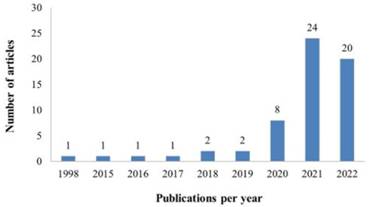
The search on the WoS platform found 60 publications on the subject of Artificial Intelligence in animals over the last 24 years (Figure 1). In 1998, there was one publication, and until 2014, no records were found on this platform. From 2015 onwards, the number of records grew slowly, with the highlight being 2021, with a jump of 24 publications. This high number compared to previous years can be explained by the automation that artificial intelligence has brought to data collection in livestock farming.
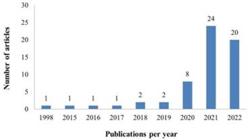
Number of publications based on the use of artificial intelligence applied to livestock by year of publication.
The information extracted from the bibliometric analysis of the articles is shown in the Supplementary Material, sorted by year of publication.
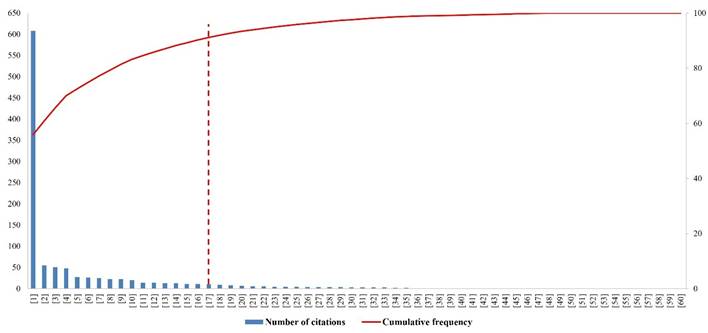
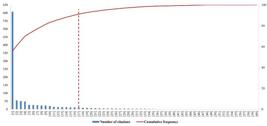
Based on this data, one of the aspects analyzed was the number of citations attributed to the articles, together with their cumulative frequency, as illustrated in figure 2. There are articles, twelve (12) in total, with no citations and at least ten (10) articles with a number of citations ranging from 1 to 4. Although, these are not expressive numbers, it was decided to keep them in the review because they are recent publications. It should be noted that 91% of the citations are concentrated in just 17 of the 60 articles, corresponding to 28.33% of the total.
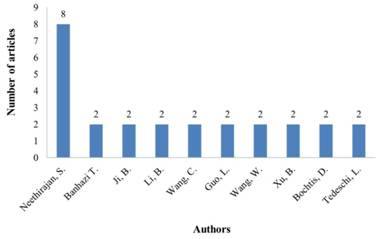
Regarding the authors, one of the aspects checked was the number of articles per researcher (Figure 3). Among the total of 248 researchers, ten authors stood out for having a greater number of papers, some of which were collaborative. It should be noted that authors with only one publication were not considered in this analysis.
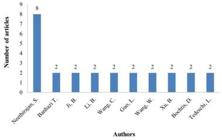
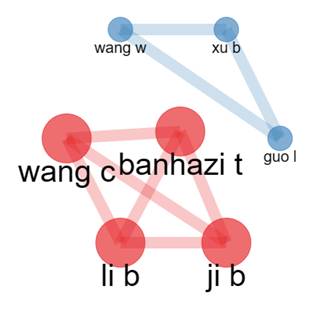
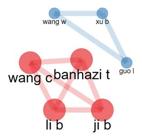
Figure 4 shows the collaboration networks between the 7 authors who have at least two collaborations with each other, covering all the years of production. When analyzing the main grouping identified by the red color, four collaborating authors were found. From these, two belong to the University of Southern Queensland (Banhazi T. and Ti, B.), based in Toowoomba, Australia, while the others are affiliated with China Agricultural University, located in the city of Beijing (China). As for the grouping identified by blue, all three authors are affiliated to the same institution, the Chinese Academy of Agricultural Sciences, in Beijing (China).
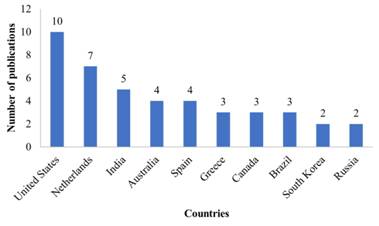
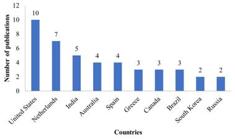
The 10 countries that have published the most on the subject have 43 publications. From these, the United States (10) and the Netherlands (7) recorded the highest numbers (Figure 5), which corresponds to 49% of impact publications, according to the survey.
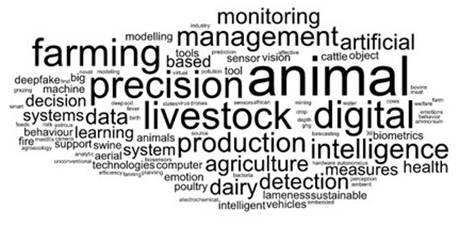
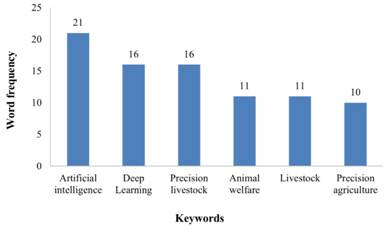
A total of 360 keywords were found in the selected publications. The words “artificial intelligence” (21 times), “deep learning” (16 times), “precision livestock farming” (16 times) and “animal welfare” (11 times) were the most frequent (Figure 6 and Figure 7). These words are strictly related to the use of Artificial Intelligence in the visual recognition of animals to predict phenotypes and study animal behavior. In precision livestock farming, studies on cattle were the most frequent, possibly due to the importance of this production chain in the United States, which is the country that has published the most (BRITT et al., 2021).
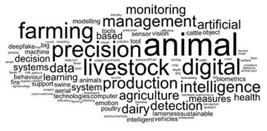
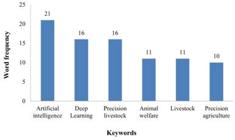
Main keywords found that involve artificial intelligence in animal production studies and the frequencies with which they appeared.
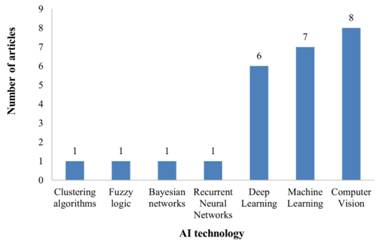
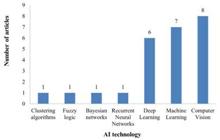
To obtain information on the most widely used AI techniques in the field of animal production, a filter was applied on the 60 articles in question, where 35 articles were excluded because they were review studies. Of the remaining 25 studies, eight (8) used computer vision, seven (7) applied machine learning techniques and six (6) used deep learning (Figure 8). In addition, other approaches were applied only once, such as: clustering algorithms, fuzzy logic, Bayesian networks and recurrent neural networks.
The first paper, based on WoS research, addresses the importance of machine learning for the study of animal behavior (WATTS, 1998). It deals with the role of artificial intelligence for future studies in the most diverse areas of knowledge, as well as the use of simulators to study how some species of animals can behave in specific situations under stress.
The 2015 publication used a machine learning tool to predict the weight of cattle as a replacement strategy for random regression models. In it, the authors concluded that, based on a set of images and cattle weights, it is possible to anticipate the animals’ subsequent weights using a few measurements, making the tool more efficient than the individual regression model (ALONSO et al., 2015).
Studies have evolved to include the tool as a predictor of several qualitative and quantitative characteristics, such as: studying animal behavior (VALLETTA et al., 2017) marbling and meat quality (FABBRI et al., 2021); disease prediction (STAŃSKI et al., 2021; OEHM et al., 2022); animal identification (COWTON et al., 2019; LI et al., 2021; SIMANUNGKALIT et al., 2021) and animal breeding (RASCHIA et al., 2022).
In the most recent publication (JACOBS et al., 2022), the authors reported that the emergence of new data streams and the exponential increase in computing power has allowed the emergence of ‘new’ modeling methodologies, under the advancement of artificial intelligence (AI), capable of simulating solutions to scientific problems, developing statistical models and designing computer codes to obtain solutions.
Applications of computer vision in livestock farming
Alternatives aiming the care and quality of animal welfare are considered effective means of achieving optimal and sustainable livestock farming, but these factors related to animal welfare are not easy to achieve (HEMSWORTH et al., 2015). Therefore, emerging AI technology is expected to have the potential to address and improve animal welfare to enhance production performance in livestock farming (ALVES et al., 2021).
Computer vision is a growing area in precision livestock farming, which allows for the identification of individual animals and the subsequent assignment of phenotypic records to each individual (VENTURA et al., 2020). Using systems to monitor individual feeding behavior and water intake in dairy cattle, OLIVEIRA et al. (2018) obtained high correlations between actual data (obtained through video observation and manual weights) and predicted parameters, which ranged from 0.96 to 0.97, indicating the high accuracy of using AI in animal phenotyping.
Frequent measurements of body weight, morphometric measurements, animal behavior and other phenotypes that require animal restraint to collect, end up becoming laborious, contribute to higher costs and increase animal stress, as they require changes to the management routine and the day-to-day running of farms. This is why computer vision applications in livestock farming have become so attractive, due to its ability to generate real-time, non-invasive and accurate information, as it makes it possible to measure characteristics of interest without the need to interact directly with the animals, ensuring minimal stress.
Studies developed with beef cattle have reported that automated computer vision systems developed and evaluated for extracting body measurements are efficient for predicting growth characteristics, which is also done in pigs (FERNANDES et al., 2019; COMINOTTE et al., 2020; OLIVEIRA et al., 2021).
Most of the animal’s carcass characteristics are difficult to measure, which can interfere with their genetic evaluation. Therefore, it should be noted that there is still a need for more accurate evaluations of carcass yield and meat quality characteristics (VENTURA et al., 2020). In this context, image analysis and computer vision can be promising tools for predicting these characteristics (GOMES et al., 2016).
The use of artificial intelligence in the study of animal behavior, with a view to animal welfare, is in the development phase (NEETHIRAJAN, 2022). Precise methodologies are being improved, as invasive methods (blood and urine collection, monitoring heart and respiratory rates) are impractical at farm level, as they are time-consuming and make routine management difficult. They can only be carried out sporadically and produce small data sets, making it difficult to draw accurate inferences about the animal’s behavior and affective state (NEETHIRAJAN, 2022).
When the objective is to measure the nutritional state of the animals and the health conditions of the herd, weight has been the most widely used measure on the farm. It is a direct indicator of animal growth and health status. Accurate estimation using images, which consist of the use of algorithms that associate the animal’s image with its body weight, is essential for research and livestock production. Applying image analysis to determine body weight is a suitable technique, since it is possible to automatically measure the dimensions of an animal’s images and use prediction equations to establish the relationship between them and live weight (NEETHIRAJAN, 2022). Thus, the images captured by cameras are analyzed using specific computer algorithms.
The information collected, in specific software, “translating” the image as information, through previously programmed algorithms is called Machine learning. It works using statistical models, regression methods, Bayesian methods and also cloud computing devices and software programming.
WEBER et al. (2020) used artificial intelligence computational tools to identify Pantaneiros cattle using images. The authors used a conventional system of cameras installed in the field, in troughs, or even on drones to capture images and identify each animal in a few seconds, using a system of convolutional neural networks (CNN), achieving 99.96% accuracy in identifying the animal. Neural network models can be the basis of a computer vision system, so that animals can be identified automatically.
A Convolutional Neural Network (CNN) is a deep learning algorithm that can take an input image, assign importance (weights and biases that can be learned) to various aspects or objects in the image and be able to differentiate one from another (DEEP LEARNING BOOK, 2022). The aim is to train an image classification algorithm, which selects a neural network, removes the main image from the other images in the environment and, from the selected object, estimates the parameter desired by the observer. These advances have enabled the development of systems that capture animal phenotypes such as body condition, weight, behavioral characteristics and others (WEBER et al., 2020; FERNANDES et al., 2020).
One of the implications for CNN systems is that the approach requires animals to have different coat patterns, so they probably would not be able to differentiate between animals with similar colors. An alternative to this problem would be to use 3D images to classify objects, along with CNNs (FERREIRA et al., 2022).
FERREIRA et al. (2022) compared different algorithms and neural network architectures, using 3D images, to identify individual animals using the dorsal surface of dairy calves, and concluded that it was possible to use computer vision to identify individual animals using their backs.
WEBER et al. (2020) used a computer vision system on Pantanal cattle, aiming to identify the animals individually, and found that it was able to recognize the cattle with an accuracy of 99.55%.
Combined with artificial intelligence, the use of sensors to monitor the emotional conditions of animals will allow producers to study behavioral changes, detect diseases and easily adjust care to promote animal welfare and increase the yield of their products (NEETHIRAJAN et al., 2021). They form a significant part of the solution for automating the process of monitoring animals on farms (NEETHIRAJAN, 2017), in this context, referring to devices that collect data on a specific physical, chemical, biological or biochemical parameter that can then be measured and analyzed in real time.
In animal breeding, the biggest challenges are the reliability and quantity of phenotypes for different economically important traits, since traditional individual identification tools (earrings, fire marks and chips) generate costs for farms participating in breeding programs. Implementing identification systems manually generates large-scale operations and can be prone to human error and fraud, as well as being expensive and invasive for the animals (FERREIRA et al., 2022). Such errors can lead to underestimating or overestimating the genetic values obtained in animals participating in breeding programs, which reduces the reliability of genetic prediction. Advances in computer vision techniques have enabled the development of systems that capture animal phenotypes, such as weight, body score, behavior, and others (FERNANDES et al., 2020).
The growing skills shortage and the maintenance of the IT workforce represent recurring problems. The technology-related job market has undergone significant changes in recent years, mainly due to technological advances that have pushed the industry towards new demands for qualified professionals. In a future based on artificial intelligence decision-making, experienced professionals are increasingly valued (GOULART et al., 2021).
The development of computational tools depends on trained professionals who can interpret and understand the biological processes involved in animal production. As digital technologies replace working methods, they transform previously clearly defined activities into more collaborative and complex tasks. The development of digital skills is key to the effective use of human resources in the new digital age, so that workers can adapt to changes in work and processes (KELCHEVSKAYA & SHIRINKINA, 2019).
Such processes only become possible with the non-exclusive actions of all the professionals involved in the production process, integrating IT professionals with animal production technicians, converging the animal’s behavior, production and physiology into machine language.
CONCLUSION
The use of bibliometric analysis in this research provided a survey of scientific records from the use of WoS on the use of artificial intelligence, as well as being a replicable methodology for various areas. Regarding the artificial intelligence, based on the results obtained in this research, its growth in recent years is undeniable and its contribution to livestock farming will grow exponentially, since automation in phenotyping procedures allows for a reduction in costs, an increase in precision and, because it is a non-invasive method, it enables welfare on farms, whether or not they are aimed at animal genetic improvement. This is a fast-growing, promising area that still lacks qualified agricultural science professionals.
ACKNOWLEDGEMENTS
The authors thank the Universidade Federal do Piauí and was financed in part by the Coordenação de Aperfeiçoamento de Pessoal de Nível Superior (CAPES) , Brasil - Finance code 001.
REFERENCES
-
ADRIAANSE. L.; RENSLEIGH, C. Web of Science, Scopus and Google Scholar: A content comprehensiveness comparison. The Electronic Library, v.31, n.6, p.727-744, 2013. Available from: <Available from: https://www.emerald.com/insight/content/doi/10.1108/EL-12-2011-0174/full/html >. Accessed: Sept. 05, 2023. doi: 10.1108/EL-12-2011-0174.
» https://doi.org/10.1108/EL-12-2011-0174.» https://www.emerald.com/insight/content/doi/10.1108/EL-12-2011-0174/full/html -
ALVES, V. M. et al. Curated Data In: Trustworthy In Silico Models Out: The impact of data quality on the reliability of artificial intelligence models as alternatives to animal testing. Alternative to Laboratory Animals, v.49, n.3, p.73-82, 2021. Available from: <Available from: https://pubmed.ncbi.nlm.nih.gov/34233495/ >. Accessed: Sept. 05, 2023. doi: 10.1177/02611929211029635.
» https://doi.org/10.1177/02611929211029635.» https://pubmed.ncbi.nlm.nih.gov/34233495/ -
ALVES, A. A. C. et al. Genome-enabled prediction of reproductive traits in Nellore cattle using parametric models and machine learning methods. Animal. Genetics, v.52, n.1, p.32-46, 2021. Available from: <Available from: https://pubmed.ncbi.nlm.nih.gov/33191532/ >. Accessed: Sept. 05, 2023. doi: 10.1111/age.13021.
» https://doi.org/10.1111/age.13021.» https://pubmed.ncbi.nlm.nih.gov/33191532/ -
ALONSO, J. et al. Improve estimation of bovine weigh trajectories using Support Vector Machine Classification. Computers and Electronics in Agriculture, v.110, p.36-41, 2015. Available from: <Available from: https://www.sciencedirect.com/science/article/abs/pii/S0168169914002488?via%3Dihub >. Accessed: Sept. 05, 2023. doi: 10.1016/j.compag.2014.10.001.
» https://doi.org/10.1016/j.compag.2014.10.001.» https://www.sciencedirect.com/science/article/abs/pii/S0168169914002488?via%3Dihub -
ARIA, M.; CUCCURULLO, C. Bibliometrix: An R-tool for comprehensive science mapping analysis. Journal of Informetrics, v.11, n.4, p.959-975, 2017. Available from: <Available from: https://www.sciencedirect.com/science/article/abs/pii/S1751157717300500?via%3Dihub >. Accessed: Sept. 05, 2023. doi: 10.1016/j.joi.2017.08.007.
» https://doi.org/10.1016/j.joi.2017.08.007.» https://www.sciencedirect.com/science/article/abs/pii/S1751157717300500?via%3Dihub -
BONINI NETO, A. et al. Automatic classification model for livestock slaughtering via artificial neural networks. Brazilian Journal of Biosystems Engineering, v.13, n.1, p.1-11, 2019.Available from: <Available from: https://seer.tupa.unesp.br/index.php/BIOENG/article/view/755 >. Accessed: Sept. 05, 2023. doi: 10.18011/bioeng2019v13n1p1-11.
» https://doi.org/10.18011/bioeng2019v13n1p1-11.» https://seer.tupa.unesp.br/index.php/BIOENG/article/view/755 -
BRITT, J. H. et al. Review: Perspective on high-performing dairy cows and herds. Animal, v.15, s.1, p.1-11, 2021. Available from: <Available from: https://www.sciencedirect.com/science/article/pii/S1751731121001415 >. Accessed: Sept. 05, 2023. doi: 10.1016/j.animal.2021.100298.
» https://doi.org/10.1016/j.animal.2021.100298.» https://www.sciencedirect.com/science/article/pii/S1751731121001415 -
COMINOTTE, A. et al. Automated computer vision system to predict body weight and average daily gain in beef cattle during growing and finishing phases. Livestock Science, v.232, p.1-10, 2020. Available from: <Available from: https://www.sciencedirect.com/science/article/pii/S1871141319310856 >. Accessed: Sept. 05, 2023. doi: 10.1016/j.livsci.2019.103904.
» https://doi.org/10.1016/j.livsci.2019.103904.» https://www.sciencedirect.com/science/article/pii/S1871141319310856 -
COWTON, J. et al. Automated individual pig localisation, tracking and behaviour metric extraction using Deep Learning, IEEE Access, v.7, p.108049-108060, 2019. Available from: <Available from: https://ieeexplore.ieee.org/abstract/document/8787792 >. Accessed: Sept. 05, 2023. doi: 10.1109/ACCESS.2019.2933060.
» https://doi.org/10.1109/ACCESS.2019.2933060.» https://ieeexplore.ieee.org/abstract/document/8787792 -
DEEP LEARNING BOOK, Introdução as redes neurais convolucionais, chap.40, 2022. Available from: <Available from: https://www.deeplearningbook.com.br/introducao-as-redes-neurais-convolucionais/ >. Accessed: Sept. 01, 2022.
» https://www.deeplearningbook.com.br/introducao-as-redes-neurais-convolucionais/ -
DONTHU, N. et al. How to conduct a bibliometric analysis: An overview and guidelines. Journal of Business Research, v.133, p.285-296, 2021. Available from: <Available from: https://linkinghub.elsevier.com/retrieve/pii/S0148296321003155 >. Accessed: Sept. 01, 2022. doi: 10.1016/j.jbusres.2021.04.070.
» https://doi.org/10.1016/j.jbusres.2021.04.070.» https://linkinghub.elsevier.com/retrieve/pii/S0148296321003155 -
FABBRI, G. et al. Application of ultrasound images texture analysis for the estimation of intramuscular fat content in the Longissimus Thoracis Muscle of beef cattle after slaughter: A methodological study. Animals, v.11, n.4, p.11-17, 2021. Available from: <Available from: https://pubmed.ncbi.nlm.nih.gov/33924697/ >. Accessed: Sept. 05, 2023. doi: 10.3390/ani11041117.
» https://doi.org/10.3390/ani11041117.» https://pubmed.ncbi.nlm.nih.gov/33924697/ -
FERREIRA, R. E. P. et al. Using dorsal surface for individual identification of dairy calves through 3D deep learning algorithms. Computers and Electronics in Agriculture, v.201, p.10, 2022. Available from: <Available from: https://www.sciencedirect.com/science/article/abs/pii/S0168169922005841?via%3Dihub >. Accessed: Sept. 05, 2023. doi: 10.1016/j.compag.2022.107272.
» https://doi.org/10.1016/j.compag.2022.107272.» https://www.sciencedirect.com/science/article/abs/pii/S0168169922005841?via%3Dihub -
FERNANDES, A. F. A. et al. A novel automated system to acquire biometric and morfological measurement sand predict body weight of pigs via 3D computer vision. Journal of Animal Science, v.97, n.1, p.496-508, 2019. Available from: <Available from: https://academic.oup.com/jas/article-abstract/97/1/496/5146045?redirectedFrom=fulltext&login=false >. Accessed: Sept. 05, 2023. doi: 10.1093/jas/sky418.
» https://doi.org/10.1093/jas/sky418.» https://academic.oup.com/jas/article-abstract/97/1/496/5146045?redirectedFrom=fulltext&login=false -
FERNANDES, A. F. A. et al. Image analysis and computer vision applications in animal sciences: an overview. Frontiers in Veterinary Science, v.7, n.551269, p.1-18, 2020. Available from: <Available from: https://pubmed.ncbi.nlm.nih.gov/33195522/ >. Accessed: Sept. 05, 2023. doi: 10.3389/fvets.2020.551269.
» https://doi.org/10.3389/fvets.2020.551269.» https://pubmed.ncbi.nlm.nih.gov/33195522/ -
FIGUEREDO, W. N. et al. Análise bibliométrica da produção brasileira sobre a COVID-19. Revista Baiana de Enfermagem, v.34, n.0, p.1-10, 2020. Available from: <Available from: https://periodicos.ufba.br/index.php/enfermagem/article/view/37107 >. Accessed: Sept. 05, 2023. doi: 10.18471/rbe.v34.37107.
» https://doi.org/10.18471/rbe.v34.37107.» https://periodicos.ufba.br/index.php/enfermagem/article/view/37107 -
FUENTES, S. et al. Artificial intelligence applied to a robotic dairy farm to model milk productivity and quality based on cow data and daily environmental parameters. Sensors, v.20, n.10, p.1-11, 2020. Available from: <Available from: https://www.mdpi.com/1424-8220/20/10/2975 >. Accessed: Sept. 05, 2023. doi: 10.3390/s20102975.
» https://doi.org/10.3390/s20102975.» https://www.mdpi.com/1424-8220/20/10/2975 -
GOMES, R. A. et al. Technical note: Estimating body weight and body composition of beef cattle trough digital image analysis. Journal of Animal Science, v.94, n.12, p.5414-5422, 2016. Available from: <Available from: https://academic.oup.com/jas/article-abstract/94/12/5414/4703558?redirectedFrom=fulltext >. Accessed: Sept. 05, 2023. doi: 10.2527/jas.2016-0797.
» https://doi.org/10.2527/jas.2016-0797.» https://academic.oup.com/jas/article-abstract/94/12/5414/4703558?redirectedFrom=fulltext -
GOULART, V. G. et al. Balancing skills in the digital transformation era: the future of jobs and the role of higher education. Industry and Higher Education, v.36, n.2, p.118-127, 2021. Available from: <Available from: https://journals.sagepub.com/doi/abs/10.1177/09504222211029796?journalCode=ihea >. Accessed: Sept. 05, 2023. doi: 10.1177/09504222211029796.
» https://doi.org/10.1177/09504222211029796.» https://journals.sagepub.com/doi/abs/10.1177/09504222211029796?journalCode=ihea -
HEMSWORTH, P. et al. Scientific assessment of animal welfare. New Zealand Veterinary Journal, v.63, n.1, p.24-30, 2015. Available from: <Available from: https://pubmed.ncbi.nlm.nih.gov/25263963/ >. Accessed: Sept. 05, 2023. doi: 10.1080/00480169.2014.966167.
» https://doi.org/10.1080/00480169.2014.966167.» https://pubmed.ncbi.nlm.nih.gov/25263963/ -
JACOBS, M. et al. ASAS-NANP symposium: mathematical modeling in animal nutrition: limitations and potential next steps for modeling and modelers in the animal sciences. Journal of Animal Science, v.100, n.6, p.1-19, 2022. Available from: <Available from: https://pubmed.ncbi.nlm.nih.gov/35419602/ >. Accessed: Sept. 05, 2023. doi: 10.1093/jas/skac132.
» https://doi.org/10.1093/jas/skac132.» https://pubmed.ncbi.nlm.nih.gov/35419602/ -
KELCHEVSKAYA, N. R.; SHIRINKINA, E. V. Regional determinants of effective use of human capital in the digital economy. Economy of Regions, v.15, n.2, p.465-482, 2019. Available from: <Available from: https://core.ac.uk/works/67825001 >. Accessed: Sept. 05, 2023. doi: 10.17059/2019-2-12.
» https://doi.org/10.17059/2019-2-12.» https://core.ac.uk/works/67825001 -
LI, S. et al. Individual dairy cow identification based on lightweight convolutional neural network. PlosOne, v.16, n.11, p.1-13, 2021. Available from: <Available from: https://journals.plos.org/plosone/article?id=10.1371/journal.pone.0260510 >. Accessed: Sept. 05, 2023. doi: 10.1371/journal.pone.0260510.
» https://doi.org/10.1371/journal.pone.0260510.» https://journals.plos.org/plosone/article?id=10.1371/journal.pone.0260510 -
MASFERRER, G. et al. On-line Ham Grading using pattern recognition models based on available data in commercial pig slaughterhouses. Meat Science, v.143, p.39-45, 2018. Available from: <Available from: https://www.sciencedirect.com/science/article/abs/pii/S0309174017314614 >. Accessed: Sept. 05, 2023. doi: 10.1016/j.meatsci.2018.04.011.
» https://doi.org/10.1016/j.meatsci.2018.04.011.» https://www.sciencedirect.com/science/article/abs/pii/S0309174017314614 -
MASELYNE, J. et al. Range measurements of a High Frequency Radio Frequency Identification (HF RFID) system for registering feeding patterns of growing-finishing pigs. Computers and Electronics in Agriculture, v.108, p.209-220, 2014. Available from: <Available from: https://www.sciencedirect.com/science/article/abs/pii/S0168169914002051 >. Accessed: Sept. 05, 2023. doi: 10.1016/j.compag.2014.08.006.
» https://doi.org/10.1016/j.compag.2014.08.006.» https://www.sciencedirect.com/science/article/abs/pii/S0168169914002051 -
NEETHIRAJAN, S. Recent advances in wearable sensors for animal health management. Sensing and Bio-Sensing Research, v.12, p.15-29, 2017. Available from: <Available from: https://www.sciencedirect.com/science/article/pii/S2214180416301350 >. Accessed: Sept. 05, 2023. doi: 10.1016/j.sbsr.2016.11.004.
» https://doi.org/10.1016/j.sbsr.2016.11.004.» https://www.sciencedirect.com/science/article/pii/S2214180416301350 -
NEETHIRAJAN, S. et al. Measuring Farm Animal Emotions-Sensor-Based Approaches. Sensors, v.21, n.2, p.1-22, 2021. Available from: <Available from: https://pubmed.ncbi.nlm.nih.gov/33466737/ >. Accessed: Sept. 05, 2023. doi: 10.3390/s21020553.
» https://doi.org/10.3390/s21020553.» https://pubmed.ncbi.nlm.nih.gov/33466737/ -
NEETHIRAJAN, S. Affective state recognition in livestock -artificial intelligence approaches. Animals, v.12, n.6, p.1-23, 2022. Available from: <Available from: https://pubmed.ncbi.nlm.nih.gov/35327156/ >. Accessed: Sept. 05, 2023. doi: 10.3390/ani12060759.
» https://doi.org/10.3390/ani12060759.» https://pubmed.ncbi.nlm.nih.gov/35327156/ -
OEHM, A. W. et al. A machine learning approach using partitioning around medoids clustering and random forest classification to model groups of farms in regard to production parameters and bulk tank milk antibody status of two major internal parasites in dairy cows. PlosOne, v.17, n.7, p.1-25, 2022. Available from: <Available from: https://pubmed.ncbi.nlm.nih.gov/35816512/ >. Accessed: Sept. 05, 2023. doi: 10.1371/journal.pone.0271413.
» https://doi.org/10.1371/journal.pone.0271413» https://pubmed.ncbi.nlm.nih.gov/35816512/ -
OLIVEIRA, B. R. et al. Validation of a system for monitoring individual feeding and drinking behaviour and intake in young cattle. Animal, v.12, n.3, p.634-639, 2018. Available from: <Available from: https://pubmed.ncbi.nlm.nih.gov/28820079/ >. Accessed: Sept. 05, 2023. doi: 10.1017/S1751731117002002.
» https://doi.org/10.1017/S1751731117002002.» https://pubmed.ncbi.nlm.nih.gov/28820079/ -
OLIVEIRA, D. A. B. et al. A review of deep learning algorithms for computer vision systems in livestock. Livestock Science, v.253, n.1, p.1-15, 2021. Available from: <Available from: https://www.sciencedirect.com/science/article/abs/pii/S1871141321003085 >. Accessed: Sept. 05, 2023. doi: 10.1016/j.livsci.2021.104700.
» https://doi.org/10.1016/j.livsci.2021.104700.» https://www.sciencedirect.com/science/article/abs/pii/S1871141321003085 -
PHILIPSEN, M. P. et al. Organ segmentation in poultry viscera using RGB-D. Sensors, v.18, n.1, p.1-15, 2018. Available from: <Available from: https://pubmed.ncbi.nlm.nih.gov/29301337/ >. Accessed: Sept. 05, 2023. doi: 10.3390/s18010117.
» https://doi.org/10.3390/s18010117.» https://pubmed.ncbi.nlm.nih.gov/29301337/ -
RASCHIA, M. A. et al. Methodology for the identification of relevant loci for milk traits in dairy cattle, using machine learning algorithms. MethodsX, v.9, n.1, p.1-6, 2022. Available from: <Available from: https://pubmed.ncbi.nlm.nih.gov/35637693/ >. Accessed: Sept. 05, 2023. doi: 10.1016/j.mex.2022.101733.
» https://doi.org/10.1016/j.mex.2022.101733.» https://pubmed.ncbi.nlm.nih.gov/35637693/ -
SIMANUNGKALIT, G. et al. Use of an ear-tag accelerometer and a radio-frequency identification (RFID) system for monitoring the licking behaviour in grazing cattle. Applied Animal Behaviour Science, v.244, p.1-9, 2021. Available from: <Available from: https://www.sciencedirect.com/science/article/abs/pii/S0168159121002781 >. Accessed: Sept. 05, 2023. doi: 10.1016/j.applanim.2021.105491.
» https://doi.org/10.1016/j.applanim.2021.105491.» https://www.sciencedirect.com/science/article/abs/pii/S0168159121002781 -
STAŃSKI, K. et al. Using machine learning improves predictions of herd-level bovine tuberculosis breakdowns in Great Britain. Scientific Reports, v.11, n.2208, p.1-10, 2021. Available from: <Available from: https://www.nature.com/articles/s41598-021-81716-4 >. Accessed: Sept. 05, 2023. doi: 10.1038/s41598-021-81716-4.
» https://doi.org/10.1038/s41598-021-81716-4.» https://www.nature.com/articles/s41598-021-81716-4 -
SHAHINFAR, S. et al. Prediction of sheep carcass traits from early-life records using machine learning. Computers and Electronics in Agriculture, v.156, p.159-177, 2019. Available from: <Available from: https://www.sciencedirect.com/science/article/abs/pii/S0168169918309736 >. Accessed: Sept. 05, 2023. doi: 10.1016/j.compag.2018.11.021.
» https://doi.org/10.1016/j.compag.2018.11.021.» https://www.sciencedirect.com/science/article/abs/pii/S0168169918309736 -
TAYLOR, C. et al. Prediction of growth in grower-finisher pigs using recurrent neural networks. Biosystems Engineering, v.220, n.1, p.114-134, 2022. Available from: <Available from: https://www.sciencedirect.com/science/article/pii/S1537511022001283 >. Accessed: Sept. 05, 2023. doi: 10.1016/j.biosystemseng.2022.05.016.
» https://doi.org/10.1016/j.biosystemseng.2022.05.016» https://www.sciencedirect.com/science/article/pii/S1537511022001283 -
VALLETTA, J. J. et al. Applications of machine learning in animal behaviour studies. Animal Behaviour, v.124, n.16, p.203-220, 2017. Available from: <Available from: https://www.sciencedirect.com/science/article/pii/S0003347216303360?via%3Dihub >. Accessed: Sept. 05, 2023. doi: 10.1016/j.anbehav.2016.12.005.
» https://doi.org/10.1016/j.anbehav.2016.12.005.» https://www.sciencedirect.com/science/article/pii/S0003347216303360?via%3Dihub -
VENTURA, R. V. et al. Opportunities and challenges of phenomics applied to livestock and aquaculture breeding in South America. Animal Frontiers, v.10, n.2, p.45-52, 2020. Available from: <Available from: https://academic.oup.com/af/article/10/2/45/5814666 >. Accessed: Sept. 05, 2023. doi: 10.1093/af/vfaa008.
» https://doi.org/10.1093/af/vfaa008.» https://academic.oup.com/af/article/10/2/45/5814666 -
WATTS, J. M. Animats: computer-simulated animals in behavior al research. Journal of Animal Science, v.76, n.10, p.25-96, 1998. Available from: <Available from: https://europepmc.org/article/MED/9814899 >. Accessed: Sept. 05, 2023. doi: 10.2527/1998.76102596x.
» https://doi.org/10.2527/1998.76102596x.» https://europepmc.org/article/MED/9814899 -
WEBER, F. de L. et al. Recognition of Pantaneira cattle breed using computer vision and convolutional neural networks. Computers and Electronics in Agriculture, v.175, p.1-9, 2020. Available from: <Available from: https://www.sciencedirect.com/science/article/abs/pii/S0168169919321490?via%3Dihub >. Accessed: Sept. 05, 2023. doi: 10.1016/j.compag.2020.105548.
» https://doi.org/10.1016/j.compag.2020.105548.» https://www.sciencedirect.com/science/article/abs/pii/S0168169919321490?via%3Dihub -
ZUPIC, I.; CATER, T. Bibliometric methods in management and organization. Organizational Research Methods, v.18, n.3, p.429-472, 2015. Available from: <Available from: https://journals.sagepub.com/doi/10.1177/1094428114562629 >. Accessed: Sept. 05, 2023. doi: 10.1177/1094428114562629.
» https://doi.org/10.1177/1094428114562629.» https://journals.sagepub.com/doi/10.1177/1094428114562629
-
CR-2023-0520.R1
-
DATA AVAILABILITY STATEMENT
The supplementary material cited in this article can be accessed at the following link: <https://docs.google.com/document/u/0/d/1RqrwKXFyXR6DU_LjmiqbEcv9QosFpjcg/mobilebasic>. The authors are fully responsible for the permanence of the information in the database.
-
USE OF ARTIFICIAL INTELLIGENCE
No artificial intelligence (AI) tools were used in the writing, revision, or any part of the research process of this study. All activities, including the development of the manuscript, abstract, keywords, hypotheses, and conclusions, were solely conducted by the authors, and no AI tools were involved in the analysis or generation of content.
Edited by
-
Editors: Rudi Weiblen (0000-0002-1737-9817) Magda Benavides (0000-0002-0219-3163)
The supplementary material cited in this article can be accessed at the following link: <https://docs.google.com/document/u/0/d/1RqrwKXFyXR6DU_LjmiqbEcv9QosFpjcg/mobilebasic>. The authors are fully responsible for the permanence of the information in the database.