| Sex |
Male/female |
| Age group (years) |
Categorized by age group: 18-29, 30-39, 40-49, 50-59, ≥60. |
| Skin color |
Collected as white, black, brown, yellow, indigenous, and dichotomized into white and others. |
| Marital status |
Collected as single, married, separated, widow/widower and categorized in single, married, and separated/widow (combination of the last two categories). |
| Schooling |
Elementary school, high school, and university education. |
| Wealth index |
Built using the analysis of main components, using the variables: number of rooms, number of bathrooms, freezer, clothes dryer, computer, air conditioning, internet, and number of cars in the household. The result was categorized as tertiles. |
| Living alone |
Identify by the question “Counting you, how many people live in this household?”. Individuals who responded that they lived alone were categorized as “yes” and those who did not live alone as “no”. |
| Got unemployed |
The question “How did social distancing due to the COVID-19 pandemic affect your occupation/work?”, with answers options: “I did not work before and I continued without working”, “I continued working normally”, “I continued working, but at home (home office), “I started working during the pandemic” and “I lost my job or stopped working”, was asked. Those who responded that they lost their jobs or stopped working were categorized as “yes” and the others as “no”. |
| Started working from home |
The same question of the previous variable was used. Individuals who responded “I continued working, but at home (home office)” were categorized as “yes” and the others as “no”. |
| Adherence to social distance |
The following question was used: “During the period of social distancing, when only essential services were open, did you leave home?” considering the answers options no and yes. |
| Infodemic |
Assessed using the question: “How many times a day do you search for or receive information about COVID-19?” with the answer options many times a day, a few times a day, few times a day, only once a day, and a few times a week. Infodemic was considered to occur when an individual searched for or received information about COVID-19 many times a day66. |
| Fear of COVID |
Assessed by Fear of COVID-19 scale, which is a screening tool developed by Ahorsu et al.67 and validated for use in Brazil68. The score was divided into quintiles and those individuals in the highest quintile were classified as having higher fear of COVID-19. |
| Going to bars or restaurants |
Identify by the question “Did you go to bars, restaurants, and malls?”, with answer options: No, yes. |
| Go out for physical activity |
Identify through the question “Did you go out to do activities of leisure/physical activity?”, with answer options: No, yes. |
| Contact with someone infected |
Identify by the question: “Have you had close personal contact with someone diagnosed with COVID-19?”. Categorized as: No, yes. |
| Presence of COVID-19 symptoms |
The presence of the symptoms of cough, sore throat, fever, difficulty breathing, tiredness, diarrhea, loss of taste/smell, chills, and headache were asked and summed. The presence of any reported symptoms was considered “yes” and negative responses for all symptoms as “no”. |
| Tested positive for COVID-19 |
Identify using the question “What was the test result?”, with answer options: negative, positive, do not know, ignored. An affirmative response for the positive result was considered “yes”. |
| Using online tools to talk to friends and family |
Identify through the question “Did you interact with your friends and/or family using online tools?”, with answer options: No, yes. |
| Excess weight |
Classified by body mass index (BMI) ≥25 Kg/m² for adults69 and ≥27 Kg/m² for elderly people70. The BMI was calculated with self-reported data on weight and height. Categorized in no, yes. |
| Physical activity |
Assessed using the International Physical Activity Questionnaire (IPAQ) long version, which evaluates commuting, as well as moderate and vigorous physical activities71. Classified in “<150 minutes/week” and “≥150 minutes/week” according to the World Health Organization72. |
| Sleep quality |
Self-reported by the question: “How do you consider the quality of your sleep?”, with answers options: very good, good, regular, poor, very poor. |
| Sleep duration |
It was calculated using the information of the following questions: “What time do you usually sleep during the week (Monday to Friday)?” and “What time do you usually wake up during the week (Monday to Friday)?”. The sleep duration was classified as inadequate when <7 or ≥9 hours per day, and as adequate when between 7 and 8 hours per day)73. Data on weekend sleep duration were unavailable since there were no corresponding questions in the baseline survey questionnaire. Typically, when evaluating self-reported sleep duration, questions focus on weekdays to capture usual patterns, considering that routines often change on weekends. |
| Food insecurity |
Assessed by the short version of the Brazilian Food Insecurity Scale74. It is a scale of five questions corresponding to the last three months, used to screen households in food insecurity. Households with at least one affirmative answer to any of the five questions were categorized as having food insecurity (“yes”). Households with negative responses to all questions were considered to have no food insecurity (“no”). |
| Self-reported sadness |
Assessed through the faces scale75, composed of seven faces ranging from very happy (face 1) to very sad (face 7). Individuals who chose faces 5, 6, or 7 were categorized as having feelings of sadness (“yes”), while the ones who chose faces 1, 2, 3, and 4 were classified as not having such feelings (“no”). |
| Depressive symptoms |
Assessed using the Patient Health Questionnaire-9 (PHQ-9)76. It is a questionnaire with nine questions that assess symptoms for major depressive episodes, such as anhedonia, lack of energy, depressed mood, sleep problems, weight and appetite changes, worthlessness, guilt and restless feelings, and suicidal thoughts, in the previous two weeks. Each question has a Likert-type scale, varying from 0 (never) to 3 (almost every day) points. Individuals who choose as answers “once or more a week” (2 points) or “almost every day” (3 points) for any question, and “less than once a week” (1 point) or “once or more a week” (2 points) or “almost every day” (3 points) for the question on suicidal thoughts, were considered to have a positive response. After, the score was added up and those who presented ≥9 points were considered as having a positive screening for depressive symptoms76. |

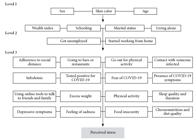
 Chrononutrition, diet quality and perceived stress: results from two population-based studies in Brazil
 Thumbnail
 Source: Authors.