
 Convergences between promotion of health, public health education, educommunication and health literacy
In Brazil, studies and practices around the concept of health literacy are recent and linked to the application of internationally validated instruments. From this perspective, a more conservative emphasis on the adoption of health literacy practices can be observed. This article explores possibilities for a Brazilian model of health literacy, considering the marked presence of the Brazilian community in public health in the promotion of health, popular education and educommunication, by linking timelines of these four areas of knowledge and practices. Having established these timelines, it seeks to highlight the main national and international historical, academic and political milestones, of each of these areas, over a specific period (1970-2023), against the backdrop of four political scenarios: “military governments,” “redemocratization and neoliberalism,” “progressive governments” and “conservatism.” Based on the identification of significant national and international milestones and the confluence between the fields of health promotion, popular health education, and educommunication, the possibility of a Brazilian model is postulated for promoting health literacy.
Key words:
Health promotion; Education communication; Popular education; Health literacy; Brazil
 Thumbnail
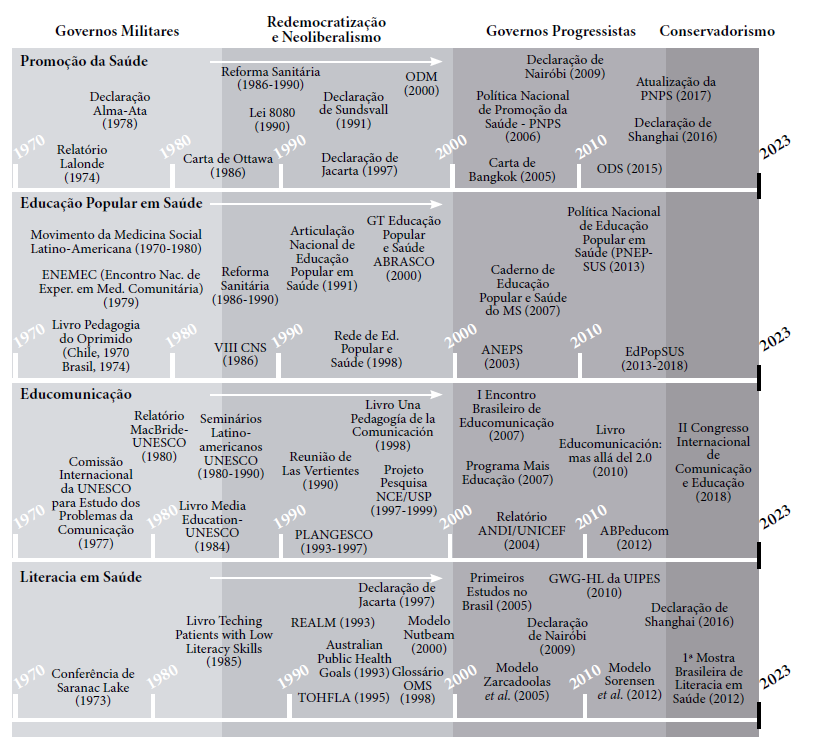 Fonte: Autores.