
 Relationship between salt and blood pressure in indigenous and non-indigenous populations
Objective: to compare the effect of salt consumption on blood pressure (BP) of an indigenous and of a non-indigenous population in Brazil.
Design: the studies were carried out in the years of 1999-2004 in an urban population of Vitória (n = 1,663), the capital of Espírito Santo State, and in an indigenous population settled in a reserve of Aracruz (n = 663). Salt consumption was evaluated by a 12-hour overnight urine collect.
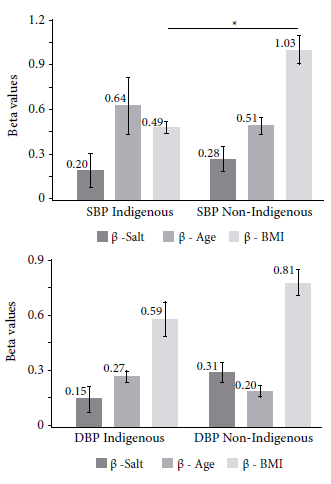
Results: salt consumption (mean ± sd) was very high (12.8 ± 5.7 g/day vs 11.8 ± 5.9 g/day; P < 0.001), respectively, in indigenous and non-indigenous population. Systolic and diastolic BP was lower in the indigenous population (118/75 mmHg). In multivariate analysis the contribution of fat accumulation evaluated by body mass index (BMI) was the main component contributing to elevate blood pressure in indigenous. The slope of the systolic BP in the indigenous in the multivariate analysis, salt intake, age and BMI explained 27% of systolic BP and 21% of the diastolic BP in the indigenous group, while these variables explained 17% and 15% in the non-indigenous population.
Conclusion: blood pressure itself did not show a statistically significant change with salt intake alone, highlighting BMI as a key factor in to explain the BP variability in indigenous population.
Key words:
Salt; Urine; Blood pressure; Indigenous population; Urban
 Thumbnail
 Source: Authors.