 Mental Health Clothesline and Dialogue Circles: active techniques in qualitative research in health and education
Abstract
This article aims to present and describe the techniques of the mental health clothesline and the dialogue circle, as participatory, dialogical and meaningful strategies of qualitative research in health and education. Considering the importance of allowing the inclusion of diversity and plurality of voices and experiences, active methods represent a broad and contextualized approach for this purpose. This is a qualitative study, using two active and participatory research techniques on the mental health of educators in a school community. The “Mental Health Clothesline” aims to understand negative and positive experiences related to people’s mental health. The “Dialogue Circles” are used as formative techniques, promoting the expression of feelings, thoughts and behaviors related to health and education. The main cores of meaning related to the negative experiences of educators were the experiences of illness and conflicts at work and personal life. The positive ones were personal and professional relationships and hope. The dialogic experience led participants to work on meanings from a deeper focus on mental health, producing sensitive knowledge with acceptance.
Key words:
Problem-Based Learning; Mental Health; Schools; Education; Qualitative Research
Resumo
Este artigo objetiva apresentar e descrever as técnicas do varal da saúde mental e da roda de diálogos, como estratégias participativas, dialógicas e significativas da investigação qualitativa em saúde e educação. Considerando a importância de inclusão da diversidade e pluralidade de vozes e experiências, os métodos e técnicas ativas representam uma abordagem ampla e contextualizada para este fim. Trata-se de uma pesquisa qualitativa, que utilizou as duas técnicas ativas e participativas para indagar sobre a saúde mental de educadores de uma comunidade escolar. O “Varal da Saúde Mental” objetiva a compreensão de experiências negativas e positivas relacionadas à saúde mental das pessoas. As “Rodas de Diálogo” são utilizadas como técnicas formativas, promovendo a expressão de sentimentos, pensamentos e comportamentos relacionados à saúde e educação. Os principais núcleos de sentido relacionados às experiências negativas dos educadores foram as vivências de enfermidades e conflitos no trabalho e pessoais. Os positivos foram os relacionamentos pessoais e profissionais e a esperança. A vivência dialógica, levou os participantes a trabalharem os significados a partir de um enfoque mais profundo de saúde mental, produzindo conhecimento sensível com acolhimento.
Palavras-chave:
Aprendizagem Ativa; Saúde mental; Escolas; Educação; Pesquisa Qualitativa
Resumen
Este artículo tiene como objetivo presentar y describir las técnicas del tendedero de salud mental y del círculo de diálogo, como estrategias participativas, dialógicas y significativas de investigación cualitativa en salud y educación. Considerando la importancia de incluir la diversidad y pluralidad de voces y experiencias, los métodos y técnicas activos representan un enfoque amplio y contextualizado para este fin. Se trata de una investigación cualitativa, en la que se utilizaron técnicas activas y participativas para indagar sobre la salud mental de los educadores de una comunidad escolar. El “Tendedero de Salud Mental” tiene como objetivo comprender las experiencias negativas y positivas relacionadas con la salud mental de las personas. Los “Círculos de Diálogo” se utilizan como técnicas de formación, promoviendo la expresión de sentimientos, pensamientos y conductas relacionadas con la salud y la educación. Los principales núcleos de significado relacionados con las experiencias negativas de los educadores fueron las vivencias de enfermedad y los conflictos en el trabajo y en la vida personal. Lo positivo fueron las relaciones personales y profesionales y la esperanza. La experiencia dialógica llevó a los participantes a trabajar significados desde un enfoque más profundo de salud mental, produciendo conocimientos sensibles y de aceptación.
Palabras clave:
Aprendizaje Activo; Salud mental; Escuelas; Educación; Investigación cualitativa
Introduction
There is much discussion in national and international literature about the increase in mental illness in today’s society, highlighting a significant bottleneck in the morbidity and mortality of people with these disorders1,2. Aiming to reduce these obstacles, the United Nations highlighted this problem in the context of the millennium development goals3. To this end, governments were urged to reduce the stigma of mental health, increase people’s access to health services and specifically link them to mental health services2.
The American Psychological Association4 defines mental health as a state of mind that involves behavioral state, emotional well-being, freedom from anxiety and other disabling symptoms, as well as the ability to establish constructive relationships. The World Health Organization (WHO) emphasizes that mental health is not limited to individual feelings, but rather to a network of several interrelated factors that are influenced by the surrounding environment, involving biological, psychological and social factors5.
In this context, the importance of discussing well-being and mental health in the school environment is highlighted, since the period of childhood and adolescence is considered the most vulnerable to factors that contribute to the emergence of physical and mental health problems, which can be reflected throughout life6,7. Therefore, the assessment of mental health in this period requires care, attention, preparation and standardized instruments, covering all those involved in this context8.
Considering these factors, schools are in a favorable scenario for promoting general emotional well-being and socio-emotional development by identifying and supporting students who are experiencing emotional and behavioral difficulties9. However, it isn’t only the emotional health of students that should be considered, but also that of all stakeholders in the school community (students, teachers, administrators, other professionals working in schools, parents and guardians). Therefore, it is important to address the well-being of educators, administrators and other professionals working in schools, since feelings such as anxiety, stress, low performance and excessive fatigue are frequently reported among them10. If these individuals are not well prepared and trained to deal with their own well-being, they will not be able to assist with these demands for the benefit of the school community.
Therefore, considering that mental health and general well-being must be achieved by the entire school community, it follows that mental health care in schools must be carried out through an integrated and comprehensive approach11. In this sense, it is important to welcome all stakeholders and establish a dialogic scenario of active listening, which requires strategies to train and empower those involved in this process. Therefore, it is essential to prepare the school community to participate in focus groups, dialogue circles and other active and participatory methods with the aim of producing knowledge about their situations experienced in daily school life and their health needs.
Thus, “Dialogue Circles”, as participatory techniques, aim to exchange experiences, feelings and ideas, in an interactive way, among people from a given community who have common interests, promoting discussion and the collaborative construction of strategies to face a given problem12,13. The “Mental Health Clothesline” technique, on the other hand, aims to work on people’s negative and positive experiences related to mental health in schools in order to generate knowledge, welcome participants and their stories in the direction of always integrating research and care, contributing to scientific rigor in the use of group and collective practices in qualitative research in health and education14,15.
In this sense, the objectives of this study are to present and describe the use of mental health clothesline and dialogue circle techniques in public and private schools in the Antônio Pereira community, a historic district of the city of Ouro Preto, in Minas Gerais, Brazil, as participatory strategies for dialogic and meaningful learning encounters between people, sharing knowledge about qualitative research in health and education.
Methods
Study design
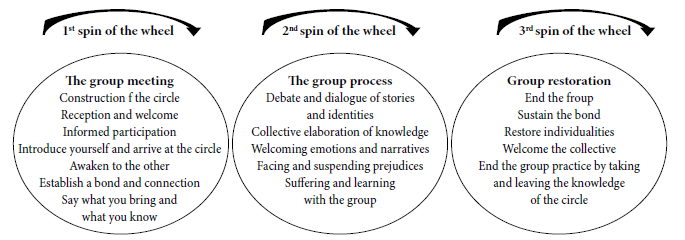
This is a qualitative research study, with the application of two active and participatory techniques: the dialogue circle and the mental health clothesline. The records made (positive and negative facts and marks) by the mental health clothesline technique form a set of information about the mental health of the participants14,15. Regarding the dialogue circle, the three turns of the wheel technique13 was used to build the mental health clothesline and analyze the contents and cores of meaning related to the theme.
Study location
Both techniques were used in the development of the extension and research project “Mental health in schools and beyond” carried out in Antônio Pereira, a historic district of Ouro Preto, Minas Gerais, Brazil, a community that is within the area of direct influence of mining and suffers its impacts16. The mental health training course for educators and the school community is part of the project and is integrated into the calendar and activities of the schools in the district. The Mental Health in Schools Manual12 was prepared as teaching material for the project, in which the contents and description of the techniques are made available. The e-book of the manual can be accessed at the link: https://drive.google.com/file/d/19c-HWcQTF47s0d28jXeNEzLcSkTO2-e0/view?usp=sharing.
Study participants
The school where the research was conducted has 134 elementary and early childhood education students and has 27 professionals (teachers, staff and administrator). Twenty-six people participated in the discussion group, 15 of whom were school professionals and 11 were project members and guests.
Data collection
To begin the activities, a clothesline was first hung in the area where the activity was taking place, similar to a clothesline. Then, participants were welcomed through presentation activities. After that, the first turn of the circle began with the following command: “Remember a NEGATIVE experience related to your Mental Health that significantly affected you” and write down on a sheet: 1) THE FACT (the negative experience) and 2) THE MARK (that this experience left on you).
At this point, each participant, individually and alone, recorded their experience by reporting the fact itself, and then the mark with one or two words/feelings. In this way, the first turn of the circle began, with the reading of the individual reports, and at the end, the participant hung their sheet with the fact and the mark on the clothesline.
Then came the second turn of the wheel, this time recording the POSITIVE experience, following the same previous guidelines: “Remember a POSITIVE experience related to your Mental Health that significantly affected you” and record it on a sheet of paper: 1) THE FACT (the positive experience) and 2) THE MARK (that this experience left on you). Then, the same dynamic highlighted previously followed. In these two moments (recording and sharing the negative and positive experiences) many emotions surfaced, and the feelings were worked on by the team duly trained to welcome the anxieties, anguish and joys that emerged from the reports.
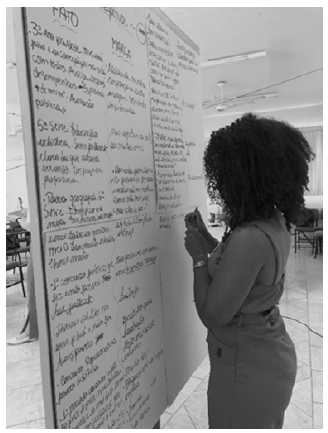
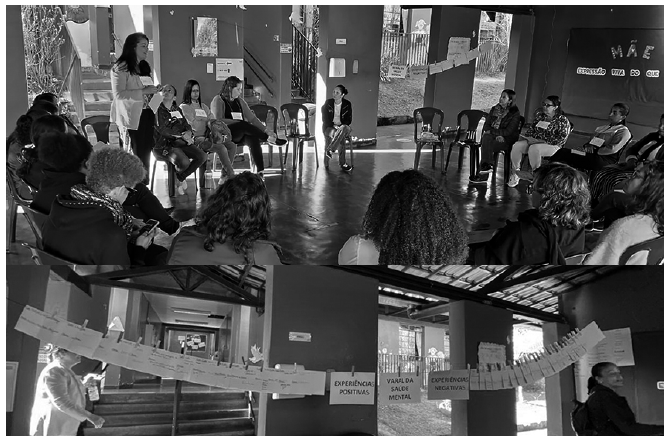
While the clothesline technique was being performed, a member of the coordination team systematized the process from a reserved area in the room, recording the facts and marks, as well as significant statements about positive and negative experiences. During the systematization process, the rapporteur organized the content and themes addressed by the participants, sharing his or her vision with the participants in a dialogic manner at the end (Figure 1).

Finally, on the third and final spin of the wheel, participants were asked to evaluate their experience based on the following guiding questions: “What did I feel today? How did I arrive and how am I leaving?”, providing an opportunity for free expression and sharing of feelings and emotions15,17. Thus, the aim was to generate knowledge, welcome people and their stories, with the aim of always integrating research and care, with scientific rigor in the use of group and collective practices in qualitative research in health and education14,15.
Data processing
The data were analyzed by identifying the core meanings of the participant’s reports, taking into account their verbal and body language when presenting the facts and brands, and when posting the negative and positive experiences on the clothesline. The dynamics and evaluations of the experiences lived by the participants were also systematized based on guiding questions. With an emphasis on feelings and perceptions, the way in which each participant arrived and left the dialogue circle was worked on17.
It is important to highlight the richness of the data collection material, the reading of this material by the participants, and the path between the response given and the recording of positive and negative experiences on the “Mental Health Clothesline”. The record of this entire process, both written (systematization), recorded on video and in notes made by the process rapporteur, was extremely rich in enabling the content analysis18.
Ethical aspects
This study was approved by the Human Research Ethics Committee of the Federal University of Viçosa (UFV), under opinion no. 2.230.939.
Results
The construction of the dialogue circle was contemplated by the construction of a circle, where the participants sat next to each other, sharing conversations, expressions and gestures freely and collectively. It is important to highlight that the construction of a protected space between the participants, generating security and tranquility, in which everyone could participate and affect each other (including respecting those who chose to participate in the circle without sharing their experiences in written or oral form) (Figure 2).
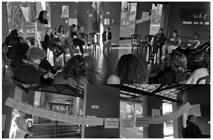
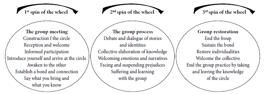
The moment of constructing the circle was facilitated by the use of welcoming as a posture and policy of humanizing relationships and encounters between people19,20. To stimulate dialogue and construct the mental health clothesline, the technique of three turns of the circle was used. In the first turn, a light and fun group technique was used to allow participants to present themselves in the way they preferred and to be able, in their own way and manner, to approach and connect with others. In the second turn, participants were invited to construct the mental health clothesline and analyze it. The third turn aimed to finalize the circle in order to help participants synthesize the knowledge produced, gather and recompose individuality enriched by the shared stories, and especially to ensure the bond developed in the group practice13. Figure 3 illustrates how the technique was used.
Regarding the mental health clothesline, Chart 1 highlights the core meanings of negative and positive experiences (facts) and the respective marks left by them.
It is worth noting that most of the signs related to the facts of negative experiences are related to anxiety and panic attacks, sadness and fear. While the signs of positive experiences embody faith, overcoming, happiness and confidence.
Closing the activities with the participant’s evaluation of their experiences allowed for free expression and the sharing of feelings and emotions. At this moment, the following core meanings emerged: the opportunity to speak and interact, the importance of being heard and being able to share one’s experiences, the welcoming and affectionate way in which the dynamics were conducted, the gratitude for being able to participate in the circle, and the need for the school to provide more experiences like this.
Discussion
Mental health is one of the most complex areas of health, being multidisciplinary, not restricted to pathologies and needing to be worked directly in the territories21. The present study addressed the importance of using the techniques of the dialogue circle and the mental health clothesline, as participatory strategies, in schools of a community located in mining areas and, therefore, impacted by disasters and constant threats.
Mental health care addresses different audiences, but is usually provided in times of emergency, whether for self-care, for a group or for a community22. This care changes and adapts according to the new realities presented.
For this reason, the findings of this study enabled greater accessibility in health, reception and understanding of the motivations and feelings that move each educator and other school professionals, which is in line with the studies developed by Silva et al.22, Guan et al.23, Hamoda et al.24 and Abdullah et al.25, which highlight the importance of community participation for greater universalization and comprehensiveness of care, as well as for preventing and coping with the most common illness conditions during disasters, such as anxiety, stress and depression. All of these conditions were highlighted by the participants in the dialogue circle and on the mental health clothesline.
Addressing mental health in schools is not an easy task, but the use of participatory techniques, led by trained and experienced professionals, has proven effective in developing reflective practices in the school community. Meetings between people focused on dialogue and learning through action can improve relationships in the school environment, encompassing people’s learning about themselves and their peers, producing knowledge to promote a welcoming school and spaces for well-being. This finding coincides with what the WHO recommends in defining what mental health is3.
The school environment is considered a space of excellence when thinking about relationships, development and strengthening of critical and reflective thinking, since the guidelines of educational policies advocate the construction of personal values, feelings, beliefs and ways of directly interfering in the social production of health25.
It is known that adult’s mental health begins to be built in early childhood, so it is extremely important that everyone involved in the school community learns to listen to their own voice and the voice of others. This strengthens the bond and makes health promotion practices more effective.
Thus, a strong point of this research was the listening and welcoming of the school community and the use of active and participatory strategies that allowed the collective experience and sharing of personal experiences related to mental health. Oliveira et al.26, highlight the fundamental role of qualitative research in understanding complex themes, raised and deepened in a dynamic field. This type of approach allows us to glimpse infinite challenges, feelings and opportunities that shape the practices of different areas13. The active and collaborative strategies developed in this study are powerful and expansive ways of producing qualitative knowledge in health13,15.
Finally, the dialogic experience provided by the mental health clothesline in the context of the dialogue circle allows participants to share feelings and emotions collectively. After all, it is by interacting with the world that people learn and change their conceptions about the phenomena that afflict them.
The dialogue circles and the mental health clothesline, coordinated by a member from outside the school community, also showed the potential to revive positive emotional experiences that affect the resolution of problems that arise. Thus, it can be inferred that the two techniques (the mental health clothesline and the dialogue circle), focusing on interaction through group work, demonstrate that healthy learning occurs when there is a meaningful and welcoming space for it.
Conclusion
It is understood that the objectives proposed for this work were achieved. It was possible to obtain a general and initial understanding of the main challenges related to the mental health and well-being of educators and other workers in the school environment, according to their own vision. The main negative facts and marks raised in the participatory activities were: depression, disappointments, crises at work, illnesses and suffering due to death in the family. These lasting marks are reflected in the well-being itself, such as fear, pain, sadness and lack of support. Facts and marks left by positive experiences also stand out, such as professional growth, new or first job, motherhood, family support and overcoming difficulties. These experiences left important marks that are reflected in faith, trust, feelings of happiness and belonging.
From a collective perspective, the active techniques of the dialogue circle and the mental health clothesline provided a positive and dynamic bond between the participants, an understanding of each person’s motivations, and acceptance and listening. These elements have a direct influence on the well-being of the community, and more specifically, on the school community.
The results of this study intensely revealed, the relevance of the movements facilitated by active and participatory action-reflection-action techniques, aimed at the mental health and well-being of the school community, highlighting the importance of qualitative research in health and education. Therefore, establishing spaces for listening and welcoming educators and staff working in schools is of fundamental importance to mitigate and support communities that are within the area of direct influence of mining and suffer its impacts.
Regarding the limitations of the present study, it is worth highlighting that the period of data collection may have influenced the organizational climate, as it occurred in the post-pandemic context and, consequently, of restructuring of the entire school life, doubly affected by the damage caused by the pandemic.
However, the importance of these two techniques, which can be used in other school contexts, is highlighted. The results found can support managers in promoting strategies aimed at the mental health of people involved in education, and improving the environment and unhealthy working conditions.
References
- 1 Cook JA, Razzano LA, Swarbrick MA, Jonikas JA, Yost C, Burke L, Steigman PJ, Santos A. Health risks and changes in self-efficacy following community health screening of adults with serious mental illnesses. PLoS One 2015; 13(10):4.
- 2 Onocko-Campos R, Vianna D, Diaz AV, Emerich B, Trapé TL, Gama C, Amaral CEM, Poderoso BE, Ferrer AL, Miranda L, Pereira MB, Surjus LT. Estudos de Saúde Mental publicados nos últimos 25 anos na Revista Ciência e Saúde Coletiva. Cien Saude Colet 2020; 25(12):4771-4790.
- 3 World Health Organization (WHO). Mental Health Gap Action Programme. MhGAP intervention guide for mental, neurological and substance use disorders in non-specialized health settings: version 1.0. Geneva: WHO; 2010.
- 4 Associação Americana de Psicologia (AAP). Dicionário APA de psicologia. Porto Alegre: Artmed; 2022.
- 5 World Health Organization (WHO). World mental health report: transforming mental health for all. Geneva: WHO; 2022.
- 6 Sapienza G, Pedromônico MRM. Risco, proteção e resiliência no desenvolvimento da criança e do adolescente. Psicol Estudo 2005; 10(2):209-216.
- 7 Halpern R, Figueiras AC. Environmental influences on child mental health. J Pediatr 2004; 80(Supl. 2):104-110.
- 8 Matos MB, Cruz ACN, Dumith SC, Dias NC, Carret RBP, Quevedo LA. Eventos estressores na família e indicativos de problemas de saúde mental em crianças com idade escolar. Cien Saude Colet 2015; 20(7):2157-2163.
- 9 Pan-American Health Organization (PAHO). Promoting Wellbeing and Mental Health in Schools. Geneva: PAHO; 2022.
-
10 Escola N. Projeto que ensina sobre aquecimento global é premiado pela ONU [Internet]. [acessadp 2024 jun 10]. Disponível em: https://novaescola.org.br/conteudo/21359
» https://novaescola.org.br/conteudo/21359 - 11 Corrêa MMN, Ferreira ES, Silva TL, Figueiredo AMCAR, Aguiar TCG, Silva SA, Érica AC, Reis IS, Rosa JAM, Cotta RMM, Assis AD. Saúde mental nas escolas e fora delas: Acolhimento, cuidado e formação para educadores de Antônio Pereira, Ouro Preto-MG. ALEMUR-RECAT 2024; 9(2):112-126.
- 12 Assis AD, Figueiredo AM, Cotta RMM, Silva AS, coordenação. Manual Saúde mental nas Escolas e fora delas. Ouro Preto: UFOP; 2023.
- 13 Assis AD. Os sentidos da roda: práticas grupais na investigação qualitativa em saúde. New Trends Qualit Res 2023; 18:e842.
- 14 Cotta RMM, Campos AA, Silva LS, Silva LS, Cotta FM, Cotta RM, Silveira LMC, Afonso DH. Panorama Sobe-Desce e Varal do SUS: o que motiva e o que desmotiva a utilização do Sistema Único de Saúde? J Manag Prim Health Care 2018; 9:1-16.
- 15 Cotta RMM. Métodos Ativos de Ensino, Aprendizagem e Avaliação: da Teoria à Prática. Viçosa: Editora UFV; 2023.
- 16 Assis AD, Vieira SM, Figueiredo AM, Silva AS, Silva NA, Moura SAL, Silva AL, Silva CLTF, Lobo GF, Almeida SGM, Gomes HRN, Silva VVP, Adreoli CS, Cotta RMM, Corrêa MMN, Corado AR, Reis M, Ferreira MHR, Coleta ECD, Dias CDM, Quintino SH, Faria AS, Paula RA, Corrêa UV, Rosa JAM. "De mãos dadas com Antônio Pereira": Acolhimento e empoderamento dos moradores e moradoras para alcance dos Objetivos do Desenvolvimento Sustentável no distrito de Antônio Pereira, Ouro Preto, Minas Gerais. Além dos Muros da Universidade 2024; 9(2):137-156.
- 17 Costa GD, Cotta RMM. O aprender fazendo: representações sociais de estudantes da saúde sobre o portfólio reflexivo como método de ensino, aprendizagem e avaliação. Interface (Botucatu) 2014; 18(51):771-784.
- 18 Bardin L. Análise de conteúdo. Lisboa: Edições 70; 2015 [1977].
- 19 Berthoz A, Petit JL. Phénoménologie et physiologie de l'action. Paris: Odile Jacob; 2006.
- 20 Abed ALZ. O desenvolvimento das habilidades socioemocionais como caminho para a aprendizagem e o sucesso escolar de alunos da educação básica. Constr Psicopedag 2014; 24(25):8-27.
- 21 Amarante P. Saúde mental e atenção psicossocial. Rio de Janeiro: Editora Fiocruz; 2013.
- 22 Silva ASCP, Furtado LAC, Tofani LFN, Bigal AL, Bragagnolo LM, Vieira ACS, Lima CL, Oliveira LB, Chioro A. Arranjos e inovações para o cuidado em saúde mental no enfrentamento da COVID-19: revisão integrativa. Cien Saude Colet 2023; 29(8):e06532023.
- 23 Guan I, Kirwan N, Beder M, Levy M, Law S. Adaptations and innovations to minimize service disruption for patients with severe mental illness during COVID-19: perspectives and reflections from an assertive community psychiatry program. Community Ment Health J 2021; 57(1):10-17.
- 24 Hamoda HM, Chiumento A, Alonge O, Hamdani SU, Saeed K, Wissow L, Rahman A. Addressing the consequences of the COVID-19 lockdown for children's mental health: investing in school mental health programs. Psychiatr Serv 2021; 72(6):729-731.
- 25 Abdullah H, Lynch S, Aftab S, Shahar S, Klepacz L, Cristofano P, Rahmat S, Save-Mundra J, Dornbush R, Lerman A, Berger K, Bartell A, Ferrando SJ. Characteristics of calls to a COVID-19 mental health hotline in the first wave of the pandemic in New York. Community Ment Health J 2021; 57(7):1252-1254.
- 26 Oliveira ESF, Brasil CCP, Higa EFR. Pesquisa qualitativa no contexto da formação ao cuidado em saúde: perspectivas interdisciplinares. Cien Saude Colet 2024; 29(8):e06122024.

 Source: Authors.
 Source: Authors.
 Source: Authors.