
 Influence of extreme heat waves as an aggravating factor in the cause of death from cardiovascular diseases in Southeast Brazil
Abstract
Extreme heat waves (HW) have intensified with climate change and represent a growing threat to cardiovascular health. Brazil, particularly the Southeast region, concentrates densely populated metropolitan areas and is highly vulnerable to the health impacts of rising temperatures. This study aimed to estimate excess mortality from cardiovascular causes associated with HW events in Southeast Brazil between 2014 and 2023. We conducted a time-series analysis using aggregated mortality data from the Brazilian Informatics Health Department and meteorological data from Brazilian National Institute of Meteorology. HW intensity was classified via the Excess Heat Factor (EHF), and excess mortality was estimated using observed-to-expected ratios. Correlation analyses between temperature and mortality from hypertension and ischemic heart disease were performed. Eleven extreme HW were identified during the study period. Mortality from cardiovascular causes coincided with HW episodes, particularly among older adults and in the largest metropolitan areas. Results indicated excess deaths during specific events, with an unusual increase observed in the winter of 2022. The correlations between mean temperature and monthly mortality were weak or negative, reinforcing the need for robust indices such as the EHF to capture health impacts of extreme heat. HW events in Southeast Brazil were associated with higher cardiovascular mortality. The findings highlight extreme heat as a relevant public health risk and reinforce the need for early warning systems, targeted mitigation strategies, and policies for urban and occupational adaptation. These results demonstrate that HW significantly aggravates cardiovascular mortality in Brazil’s most populous region.
Keywords:
Climate Change; Cause of Death; Cardiovascular Diseases
Resumo
As ondas de calor extremo se intensificaram com as mudanças climáticas e representam uma ameaça crescente à saúde cardiovascular. O Brasil, particularmente a Região Sudeste do país, concentra áreas metropolitanas densamente povoadas e é altamente vulnerável aos impactos do aumento das temperaturas na saúde. Este estudo teve como objetivo estimar o excesso de mortalidade por causas cardiovasculares associadas às ondas de calor extremo no Sudeste do Brasil entre 2014 e 2023. Realizou-se uma análise de séries temporais utilizando dados agregados de mortalidade do Departamento de Informação e Informática do SUS e dados meteorológicos do Instituto Nacional de Metereologia. Classificou-se a intensidade da onda de calor por meio do Fator de Calor Excesso e estimou-se o excesso de mortalidade usando razões observadas/esperadas. Realizaram-se análises de correlação entre a temperatura e a mortalidade por hipertensão e doença isquêmica do coração. Onze ondas de calor extremo foram identificadas durante o período do estudo. A mortalidade por causas cardiovasculares coincidiu com as ondas de calor, particularmente entre os idosos e nas maiores regiões metropolitanas. Os resultados indicaram excesso de mortes durante eventos específicos, com um aumento incomum observado no inverno de 2022. As correlações entre a temperatura média e a mortalidade mensal foram fracas ou negativas, reforçando a necessidade de índices robustos, como o Fator de Calor Excessivo, para capturar os impactos dos extremos de calor na saúde. Eventos de ondas de calor no Sudeste do Brasil foram associados a maior mortalidade cardiovascular. Os resultados destacam o calor extremo como um risco relevante para a saúde pública e reforçam a necessidade de sistemas de alerta precoce, estratégias de mitigação direcionadas e políticas de adaptação urbana e ocupacional. Esses resultados demonstram que as ondas de calor extremo agravam significativamente a mortalidade cardiovascular na região mais populosa do Brasil.
Palavras-chave:
Mudança Climática; Causas de Morte; Doenças Cardiovasculares
Resumen
Las olas de calor extremo se han intensificado con el cambio climático y representan una amenaza creciente para la salud cardiovascular. Brasil, en particular la Región Sudeste, concentra áreas metropolitanas densamente pobladas y es muy vulnerable a los efectos del aumento de las temperaturas sobre la salud. El objetivo de este estudio fue estimar el exceso de mortalidad por causas cardiovasculares asociadas a episodios de calor extremo en el sudeste de Brasil entre 2014 y 2023. Realizamos un análisis de series temporales utilizando datos agregados de mortalidad de Departamento de Informática de SUS y datos meteorológicos del Instituto Nacional de Metereología. La intensidad de las olas de calor se clasificó mediante el Factor de Exceso de Calor, y la mortalidad excesiva se estimó utilizando ratios observados-esperados. Se realizaron análisis de correlación entre la temperatura y la mortalidad por hipertensión y cardiopatía isquémica. Se identificaron once olas de calor extremas durante el periodo de estudio. La mortalidad por causas cardiovasculares coincidió con los episodios de olas de calor, especialmente entre la población de edad avanzada y en las áreas metropolitanas más grandes. Los resultados indicaron un exceso de muertes durante eventos específicos, con un aumento inusual observado en el invierno de 2022. Las correlaciones entre la temperatura media y la mortalidad mensual fueron débiles o negativas, lo que refuerza la necesidad de índices sólidos, como el Factor de Exceso de Calor, para captar los efectos de las olas de calor extremas en la salud. Las olas de calor en el Sudeste de Brasil se asociaron con una mayor mortalidad cardiovascular. Los resultados destacan el calor extremo como un riesgo relevante para la salud pública y refuerzan la necesidad de sistemas tempranos de alerta, estrategias específicas de mitigación y políticas de adaptación urbana y laboral. Estos resultados demuestran que el calor extremo agrava significativamente la mortalidad cardiovascular en la región más poblada de Brasil.
Palabras-clave:
Cambio Climático; Causas de Muerte; Enfermedades Cardiovasculares
Introduction
Global mortality has increased in line with the increase in global temperature 1, and part of this is due to cardiovascular events caused by high temperatures 2. In different regions of the world, whether hot or milder, many climate events characterize the increase in global temperature to levels never recorded before 3. Hot regions such as South America 4, Africa 5, and Australia 6 have been severely impacted by rising temperatures over the years. Moreover, countries with mild climates have suffered heat waves (HW) with temperatures above 40ºC 7. Effects on the environment have directly affected people’s way of life concerning behavior 8, fluid consumption 9, tolerance to heat 10, biological functioning, and the body’s ability to endure this type of stress 11. In response to this phenomenon, the scientific community has been seeking answers to improve the population’s quality of life. Numerous studies on thermoregulation 12,13,14 and thermoregulation during physical exercise 15,16,17,18 have clarified some questions regarding the organic capacity to adapt to extreme climatic environments, including under intense heat. Cardiovascular diseases and mortality from cardiovascular diseases are greatly relevant, as they are the leading cause of death in the world 19 and in Brazil 1. Among the deaths from cardiovascular causes documented in Brazil, the occurrences in the Southeast Region contributed greatly to the high numbers in the country.
HW have been documented worldwide 3,4,5,6,7,11,20,21,22,23,24 and are not exclusively related to an increase in cardiovascular events but also to diabetes 1 and respiratory diseases 22. HW have impacted mortality in countries such as the United States 21, as well as regions such as Europe 25, Asia 26, and Oceania 27. Brazil houses the hottest areas in South America 4, as it represents 47.3% of the total South American territory 28,29. Cardiovascular and respiratory events are responsible for increasing mortality among older adults by 5.7% 30. In Brazil, around 1,800 excess deaths were related to four HW events in 2010, and 2012 in Rio de Janeiro, most linked to circulatory illnesses 1. Notably, projections indicate an even greater increase in the coming years 4.
Given this scenario, it is necessary to consider the most affected groups by HW, which are older adults 31 and children in early childhood 20, as well as the most vulnerable regions, not only due to climate change, but also due to the state of adaptation of their population to this phenomenon. Organic adaptation to climate events is when the individual faces the stress caused by HW with the least possible impact on their health. Adaptation and acclimation strategies are widely used in the sports environment in search of performance 15,18,32,33,34,35, but they have also been widely debated as a strategy to promote quality of life 36,37,38,39,40,41.
The originality of this study lies in its combination of a metric still rarely used in Brazilian research, focusing on densely populated tropical urban areas, and directing the analysis to specific causes of cardiovascular mortality in a recent and comprehensive historical series (2014-2023). We seek to contribute to a broader understanding of the impacts of heat waves in the Brazilian context, as well as with comparable evidence from the international scenario.
Based on the above considerations, this study shows an analysis of the impact of HW on mortality from cardiovascular complications in the Southeastern region of Brazil from 2014 to 2023, based on data from the four most populous metropolitan areas. This study aimed to estimate excess mortality from cardiovascular causes during heat waves in the Southeast Region of Brazil. By characterizing these events and their health effects, the results may contribute to guiding public health strategies and policies for climate adaptation.
Methods
This study’s design does not enable causal inference. The analyses are based on aggregate mortality and meteorological data, combined with descriptive methods, which are appropriate for identifying temporal patterns and associations, but not for establishing direct cause-and-effect relationships. The results should be interpreted as indicative of correlations between extreme heat events and cardiovascular mortality, rather than as evidence of causal mechanisms at the individual level.
Target population
Brazil has a population of 203,080,756 inhabitants 28. The Southeast Region corresponds to 42% of the Brazilian population and has an area of 924,558,381km2, with three of the most populous states in the country, São Paulo, Minas Gerais, and Rio de Janeiro. The Southeast Region has 84,840,113 inhabitants, and is in an area with a predominantly tropical climate. This region also faces, year after year, the climate changes to which the world is currently subjected. Life expectancy, which in 2022 was 75.5 years 42, may suffer a reduction after so many extraordinary and extreme climate events. In this study, we considered the four metropolises of the Southeast Region, namely: Rio de Janeiro, São Paulo, Belo Horizonte, and Vitória.
The population of each state is 44,112,238 (São Paulo), 20,539,989 (Minas Gerais), 16,055,174 (Rio de Janeiro), and 3,833,712 (Espírito Santo).
Data analyzed
Table 1 shows the average daily temperature data between 2014 and 2023 that were obtained from the meteorological stations made available by the Brazilian National Institute of Meteorology (INMET, acronym in Portuguese; https://portal.inmet.gov.br/). Regarding temporal scale, note that the study relies on observational data from meteorological stations, which limits the available time series. The choice of the 2014-2023 period was based on data consistency and availability across the metropolitan areas analyzed. All meteorological stations are located inside the urban core of each metropolitan area. The World Meteorological Organization (WMO) 43 recommends a threshold of 20% for missing data. The meteorological stations selected in the metropolitan areas were Mirante (SP-A701), Vila Militar (RJ-A621), Pampulha (BH-A521), and Vitória (ES-A621). Stations were chosen based on those metropolitan areas with complete data records in the selected period. No significant differences were observed in missingness between cold and warm months, and missing data are spread throughout the entire historical series.
Monthly mortality data from the Brazilian Health Informatics Department (DATASUS, acronym in Portuguese) for the 2014-2023 period were provided by the Tabnet database of the DATASUS platform (https://datasus.saude.gov.br/informacoes-de-saude-tabnet/). Mortality data categorized by ICD-10 (International Classification of Disease - 10th revision) chapter included death by diseases of the circulatory system (Chapter IX). Those data were disaggregated by year/month of death, metropolitan area/RIDE, deaths by residence, and all municipalities within each metropolitan area were included, adding up to 9,357,684 deaths analyzed (2014-2023). Population data were obtained via the 2022 Demographic Census, released on June 28, 2023, by the Brazilian Institute of Geography and Statistics (IBGE, acronym in Portuguese) 44. A second analysis was performed by changing the search argument “ICD-10 Chapter” to “ICD-10 Group” hypertensive diseases and ischemic heart diseases.
Risk analysis
A correlation analysis between the variables was conducted to verify how much the abrupt increases in temperature in each period have been influencing the population’s mortality rate and whether cardiovascular causes were impacted by HW, thus directly influencing overall mortality. The GraphPad Prism program, version 10.3.1 (https://www.graphpad.com/) was used to conduct the analysis. The test choice was based on data distribution. When normality and linearity were assumed, Pearson’s correlation coefficient was used. When data distribution was not normal, Spearman’s correlation coefficient was used.
Characterization of HW
There is no global consensus on a definition of a HW, although it is generally considered simply a prolonged period of extreme heat, which leads research institutions (U.S. National Weather Service, U.S. National Oceanic and Atmospheric Administration, U.K. Met Office, and the WMO) to describe these events in similar but distinct ways 45. Generally, heat waves are a period of excessively hot weather, which may be accompanied by high humidity 6. Climate scientists define heat waves as prolonged episodes of abnormally high temperatures 46.
We classify the intensity according to the metric used previously 47. This methodology is based on the average temperature of three consecutive days to determine an index (Excess Heat Factor - EHF) that represents the intensity of a HW. If the daily mean temperature (DMT) averaged over the three-day period (TDP) is higher than the climatological 95th percentile for DMT (hereafter T95), then the TDP and each day within it are deemed to be in HW conditions. Hence, Ti denote the DMT calculated in this way as the average of the maximum and the minimum that occur in 24 hours. Further, T95 denote the 95th percentile of this DMT calculated across 2014-2023. The two variables that make up the EHF calculation are EHIsig and EHIaccl.
EHIsig = (Ti + Ti+1 + Ti+2) / 3 - T95(1)
and:
EHIaccl = (Ti + Ti+1 + Ti+2) / 3 - (Ti-1 + ... + Ti-30) / 30 (2)
EHF is calculated as a product of these two indices:
EHF = EHIsig x max (1, EHIaccl) (3)
The duration of the HW comprises those days for which the significance index is positive, whether those days individually exceed T95 in their DMT. If a TDP has a positive EHF, then all the days within the TDP are HW days. When EHIaccl is positive, there is a deficit in acclimatization to the average temperature of the previous 30 days. An isolated hot day with DMT > T95 is not sufficient for a HW. The classification of HW intensity was obtained by considering the 85th percentile of all the positive EHF values (EHF85) as a threshold. Days with negative EHF are not considered for calculating EHF85. According to Nairn & Fawcett 47, HW can be classified as low intensity HW (LIHW: EHF < EHF85), severe HW (SHW: EHF > EHF85), and extreme HW (EHW: EHF > 3x EHF85).
Excess mortality estimates
HW-related excess mortality was estimated based on a method previously used 1,30 to estimate the burden of heat-related mortality, the observed-to-expected deaths (O/E) ratio. This method enables one to compare directly the number of deaths observed during short periods, with the average number of deaths in similar periods, so values higher than 1 mean excess mortality, as follows:
(O/E)ij = Mij/(Mi1 + Mi2 + ... + Mij +1 ... + Mi,k-1 + Mi,k/(k - 1)) (4)
Considering the ith HW that occurred in the jth year, Mij is the observed number of deaths over all HW days. Expected mortality is calculated considering the average number of deaths over periods of the same duration using the same consecutive days of the year in the previous (Mi1, Mi2, ..., Mi,j-1) and subsequent (Mi,j+1, ..., Mi,k-1, Mi,k) years, ranging from 1 (in this case representing the year 2014) to k (2023).
Statistics
The relationship between season and the observed number of deaths was examined using scatter plots between monthly mean temperature and monthly mortality levels. To determine a possible correlation between seasons and mortality from cardiovascular causes, we selected deaths from circulatory system problems and, to be more specific, deaths from arterial hypertension and from ischemia. Data were analyzed based on the average monthly temperature, thus seeking to verify whether there was a correlation between monthly mortality and the cause.
We performed the correlation analysis of EHF with daily deaths due to arterial hypertension (HBP) and ischemia (IQ). Considering that conditions tend to exacerbate the health conditions of vulnerable individuals suffering from circulatory illnesses, we conducted a regression analysis, also considering the mortality associated with this group of diseases.
Results
Relationship between mortality and season
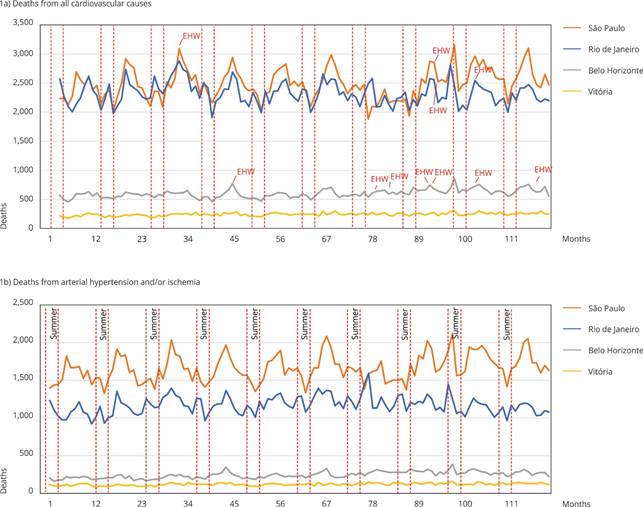
Data on total deaths (RTD) and deaths by hypertension and ischemia (RHBP and IQ) showed low correlation between number of deaths and high temperatures in the four capitals (São Paulo: RTD = -0.624, RHBP and IQ = -0.687; Rio de Janeiro: RTD = -0.418, RHBP and IQ = -0.322; Belo Horizonte: RTD = -0.418, RHBP and IQ = -0.490; Vitória: RTD = -0.423, RHBP and IQ = -0.397). Figure 1 shows that the mortality values are lower compared to the remaining months of each year, except for the summer of 2022, in which the highest mortality rates were observed.
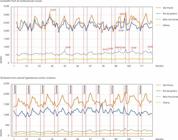
Except for the summer of 2022, the other nine years analyzed had lower mortality rates in absolute values. The correlation between the monthly average temperatures and total monthly mortality, mortality due to HBP or IQ was moderate and negative in São Paulo (total deaths: R = -0.6245; HBP and IQ deaths: R = -0.6862). The other metropolitan areas had a negative and very weak correlation. Therefore, different criterion is needed to assess the occurrence of HW. High temperature for a single day is not enough to determine a HW. According to what we can observe in this model, the relationship between EHIsig and EHIaccl will determine this phenomenon.
According to the determination method of HW 47, we could observe the occurrence of 11 EHW in the Southeast Region between 2014 and 2023. Table 1 describes these data in detail.
From 2014-2023, considering the four metropolitan areas, 11 EHW were determined. The observed HW were in 2016 (São Paulo, June 9-13), 2017 (Belo Horizonte, June 2-7), 2020 (Belo Horizonte, May 27-29 and August 21-23), 2021 (Rio de Janeiro, August 18-20 and August 27 to September 1; São Paulo, August 27 to September 1; Belo Horizonte, August 1-4 and 28 to 30), 2022 (Rio de Janeiro, June 13-15; Belo Horizonte, May 17-20), 2023 (Belo Horizonte, July 3-6).
The results describe temporal patterns between EHW events and cardiovascular mortality in Southeast Brazil. Periods of excess heat coincided with higher mortality, particularly among older adults and in metropolitan areas with greater population density. The analysis of observed versus expected mortality (O/E) indicates an increase during specific heatwave episodes, suggesting an association rather than a direct causal effect.
Discussion
HW have been recognized as one of the most critical health threats related to climate change, with a consistent increase in cardiovascular mortality on a global scale 2. Studies indicate that each 1ºC increase in temperature is associated with a ~2% increase in cardiovascular mortality 2. Furthermore, global projections indicate that tropical and subtropical countries, such as Brazil, are among the most vulnerable to mortality from extreme heat 3.
EHF has been increasingly adopted as a practical indicator to identify and classify HW for public health surveillance, since it is based on thermal deviations and population acclimatization over recent periods 47. The use is justified by the growing evidence linking heat exposure to increased cardiovascular morbidity and mortality 22,48,49, including recent findings in Rio de Janeiro and other Brazilian urban areas 1,22,30. However, EHF has important limitations, as it assumes homogeneous acclimatization and does not incorporate physiological or biometeorological responses that are critical for assessing vulnerability, particularly among older adults and chronically ill populations 10,12,13,14. Thus, although EHF is a valuable population-level tool, its application should be accompanied by cautious interpretation and complemented with alternative approaches that integrate human physiology to better guide adaptive health policies.
The increase in global temperatures resulting from climate change 50 constitutes a serious threat to public health. Analysis of causes of death based on data from DATASUS demonstrates underreporting of problems related to heat stress (HS), since the cause of death are defined based on events observed when medical care is provided. When there is underreporting of the primary cause, the problem is underestimated. According to previous studies, environmental conditions and high temperatures already compromise the productivity and health of thousands of workers 51.
The HS concept should be applied with greater precision, since it represents a well-defined physiological condition characterized by the imbalance between heat production and heat dissipation 10,12,17. This imbalance can lead to thermal overload and compromise thermoregulatory mechanisms, which increases health risks. Importantly, HS does not affect only occupational groups exposed to high temperatures, but also children, older adults, pregnant women, and people with preexisting comorbidities, who have limited physiological reserve to cope with thermal extremes 2,22,52. During HW, the intensity and duration of HS are amplified, which increases the vulnerability of these groups and underscores the importance of using the term accurately in public health and epidemiological contexts 1,30,52.
Many studies have described climate change around the world 10,25,26,27,53,54,55. In Brazil, specifically in the Southeast Region, previous studies have shown higher mortality rates during HW periods 1,19,22. These studies described the occurrences mainly in the first 15 years of the 2000s. We found that the increase in global temperatures also affected Brazil and brought thermal discomfort as an aggravating factor in the quality of life of the population in the Southeast. According to our analysis, 11 more significant HW occurred between 2014 and 2023. In January, February, and March 2022, we observed an exponential increase in deaths in São Paulo, Belo Horizonte, and Rio de Janeiro, but not in Vitória. This was a period immediately following the COVID-19 pandemic, and we were unable to isolate the post-pandemic effect in our analysis. The high mortality observed in winter is not related to temperatures above the normal range. These HW episodes were defined as periods of three or more consecutive days with EHF positive values. Nine EHW events were correlated with mortality in this same period. Deaths from cardiovascular causes were the leading cause of death, and within this category, HBP and IQ led the specific causes.
Analysis of population subgroups suggests a greater impact of HW on older adults and individuals with chronic conditions 48,56. This pattern has also been described in Asian megacities, where mortality among older adults increased significantly during HW 31. Furthermore, in the Brazilian context, social inequalities accentuate vulnerability to HW, with a higher risk in peripheral urban areas with less infrastructure 30.
The highest total mortality rates were observed in winter. Although summer have records of higher temperatures, a decisive analysis to correlate deaths and high temperatures is not possible without considering the level of acclimatization of the population and the history of temperature records before a specific period of mortality.
An initial analysis was not sufficient to determine the cause-and-effect relationship in the causes of death. Although the highest temperatures are recorded in the summer, mortality in the Southeast Region was higher in the winter. Therefore, it was not possible to analyze whether heat waves affect population mortality. The results showed that mortality incidence levels tend to increase significantly when these conditions are reached. The best fit of the model was obtained using the EHF as a predictor, considering only deaths caused by cardiovascular diseases.
The EHF is a useful tool for public health surveillance because it enables the identification of HW events based on thermal deviations and population acclimatization over recent weeks. It is useful for monitoring and alerting systems due to its ease of use and reliance on publicly accessible meteorological data. The index does not include clinical responses or direct physiological indicators, which are essential for comprehending health risks at the individual level, so it has inherent limitations. EHF may understate vulnerability in particular groups, especially older adults or people with preexisting conditions, in contrast to indices like the Heat Index, WBGT (wet-bulb globe temperature), or UTCI (universal thermal climate index), which incorporate biometeorological or physiological parameters.
Although this short series (2014-2023) is adequate to capture interannual variations and extreme events, it is insufficient to assess long-term trends associated with climate change. For this reason, the results should be interpreted within the scope of short-term variability rather than as evidence of long-term climatic shifts. A relevant aspect was the observation of high mortality rates during winter. This result highlights the complexity of the phenomenon, which may be related to the population’s thermal acclimatization and seasonal interactions with respiratory diseases 52,57,58. Studies highlight that acclimatization has fixed physiological limits, which restrict human adaptation to temperature extremes 10. Additionally, defining HW using robust metrics, such as the EHF, has been proposed to better characterize the intensity and severity of these events 47.
Looking at this problem in the future creates an expectation of increased exposure to HS due to climate change, which tends to increase average temperatures 50, especially in tropical regions such as Brazil. In addition to the increase in average temperatures, climate change generates an expectation of increased frequency and intensity of HW 55 and directly impacts the worsening of working conditions, increasing the time spent working in unhealthy conditions, especially in external and internal environments where there is no control over environmental conditions. In addition to constantly changing climate conditions 55, population growth and disorderly urbanization in large urban centers can increase the number of workers in informal and vulnerable sectors, such as construction and street trading. In these sectors, the lack of monitoring, adequate infrastructure, and public policies to mitigate the effects of heat exposure tends to aggravate the problem. Disorderly population growth creates an unhealthy environment in homes in the most vulnerable areas.
The causes of the impacts on public health are multifactorial; among the most severe are the projected increase in heat-related diseases such as heat stroke 49, dehydration 59, cardiovascular diseases 2,49, and kidney diseases 59. The public health system may be overloaded in the most affected regions, especially in HW events.
The impact on public health is due to the direct effect of the population’s exposure to heat, but also directly to economic productivity, which will also be reflected in increased spending on health systems. Previous studies indicate that extreme heat can reduce workers’ physical productivity in different work activities 60. The most affected areas include agriculture 54, mining 61, and construction 53.
The predicted greater demand for health care from the population in the face of adverse weather events also increases the demand for adaptations in labor laws to include updated heat exposure limits, mandatory breaks between work sessions, structural adaptations in the work environment, and personal protective equipment. In this sense, advances in technology enable the development of equipment that facilitates heat exchange with the environment 62, body temperature monitoring 62, and artificial microclimates 63. Depending on the labor need, strategies such as teleworking and process automation are alternatives that favor work in environments with lower levels of HS 63.
From an economic point of view, municipalities located in regions with high temperatures and less public investment tend to suffer more from the effects of climate change. Groups of workers with lower incomes and worse working conditions will be less predisposed to acclimatization and protection, exacerbating differences between social and public health groups. The political consequences of prospects resulting from environmental HS will influence the formulation of public policies.
The authorities responsible for decision-making must work to update labor legislation to address the issue of HS and create specific and appropriate standards to the reality of the population. In extreme cases, HS can be considered an occupational risk, and the possibility of adding labor rights for possible unhealthiness should be considered. Considerations such as expanding worker health surveillance programs to address HS, increasing the financial resources of the public health system for application in more vulnerable regions, and including specific procedures for treating cardiovascular events resulting from HS should be part of the repertoire of tools to combat deaths caused by this phenomenon. The possibility of creating specific indicators that point to the primary cause of a cardiovascular event can contribute to reducing vulnerability to extreme HS.
Conclusion
Our study characterized extreme heat in the capitals of Southeastern Brazil between 2014 and 2023 and investigated its impact on cardiovascular mortality. Eleven extreme heat events were identified, with a consistent increase in mortality, including in winter months, reinforcing the complexity of the phenomenon and the influence of factors such as thermal acclimatization and seasonal conditions. The findings confirm that extreme heat constitutes a significant public health risk, with a greater impact on vulnerable groups, such as older adults and individuals with chronic diseases. Furthermore, social and urban inequalities stand out, intensifying the effects of extreme heat on the population. From a public health perspective, the results reinforce the need to implement early warning systems, mitigation measures targeting vulnerable groups, and urban and occupational adaptation policies to reduce the adverse effects of extreme heat. Understanding the possibilities for protection against HS depends on multidisciplinary efforts that involve everything from strategic political planning of public policies to infrastructure supporting the population, and the delivery of care by healthcare professionals. Considering the projections of increased frequency, duration, and intensity of HW in the coming decades, a seemingly inevitable problem, the results of this study can serve as a basis for local epidemiological surveillance strategies, prevention of avoidable deaths, and formulation of public policies that integrate health and climate change.
Limitations
The use of the EHF as the primary metric for identifying heat waves and analyzing observed/expected excess mortality (O/E) is consistent with the study’s aim. However, EHF assumes homogeneous acclimation based on the previous 30 days, which may underestimate risks in vulnerable groups such as older adults or individuals with chronic diseases. Furthermore, while the EHF are independent of more complex meteorological variables (e.g., humidity, solar radiation), it does not directly incorporate physiological or biometeorological factors. Recent literature highlights the potential of more health-sensitive indices, such as UTCI, WBGT, or the Heat Index, and these approaches could be considered in future research, as well as inserting a description such as age and sex data to better characterize the most affected groups.
Although issues related to informal work and labor legislation are highly relevant in the context of heat exposure, they were not directly addressed by the data analyzed in this study. These aspects should therefore be interpreted as broader perspectives for future research and policy development, particularly in exploring how labor regulations and working conditions may influence population vulnerability during extreme heat events.
Acknowledgments
This study was supported by grants from Vice-Rectorate for Research and Graduate Studies of the Rio de Janeiro Rural Federal University and the Brazilian National Research Council (CNPq; 132072/2021-1).
References
- 1 Geirinhas JL, Russo A, Libonati R, Trigo RM, Castro LCO, Peres LF, et al. Heat-related mortality at the beginning of the twenty-first century in Rio de Janeiro, Brazil. Int J Biometeorol 2020; 64:1319-32.
- 2 Liu J, Varghese BM, Hansen A, Zhang Y, Driscoll T, Morgan G, et al. Heat exposure and cardiovascular health outcomes: a systematic review and meta-analysis. Lancet Planet Health 2022; 6:e484-95.
- 3 Mora C, Dousset B, Caldwell IR, Powell FE, Geronimo RC, Bielecki CR, et al. Global risk of deadly heat. Nat Clim Chang 2017; 7:501-6.
- 4 Feron S, Cordero RR, Damiani A, Llanillo PJ, Jorquera J, Sepulveda E, et al. Observations and projections of heat waves in South America. Sci Rep 2019; 9:8173.
- 5 Varela R, Rodríguez-Díaz L, de Castro M. Persistent heat waves projected for Middle East and North Africa by the end of the 21st century. PLOS One 2020; 15:e0242477.
- 6 Marx W, Haunschild R, Bornmann L. Heat waves: a hot topic in climate change research. Theor Appl Climatol 2021; 146:781-800.
- 7 Ward K, Lauf S, Kleinschmit B, Endlicher W. Heat waves and urban heat islands in Europe: a review of relevant drivers. Sci Total Environ 2016; 569-570:527-39.
- 8 Ban J, Shi W, Cui L, Liu X, Jiang C, Han L, et al. Health-risk perception and its mediating effect on protective behavioral adaptation to heat waves. Environ Res 2019; 172:27-33.
- 9 Lin Y, Zhang N, Zhang J, Lu J, Liu S, Ma G. Seasonality affects fluid intake behaviors among young adults in Hebei, China. Nutrients 2024; 16:1542.
- 10 Hanna EG, Tait PW. Limitations to thermoregulation and acclimatization challenge human adaptation to global warming. Int J Environ Res Public Health 2015; 12:8034-74.
- 11 Skevaki C, Nadeau KC, Rothenberg ME, Alahmad B, Mmbaga BT, Masenga GG, et al. Impact of climate change on immune responses and barrier defense. J Allergy Clin Immunol 2024; 153:1194-205.
- 12 Romanovsky AA. The thermoregulation system and how it works. Handb Clin Neurol 2018; 156:3-43.
- 13 Tan CL, Knight ZA. Regulation of body temperature by the nervous system. Neuron 2018; 98:31-48.
- 14 Romanovsky AA. Skin temperature: its role in thermoregulation. Acta Physiol (Oxf) 2014; 210:498-507.
- 15 Wilson MG, Périard JD, Adamuz C, Farooq A, Watt V, Racinais S. Does passive heat acclimation impact the athlete's heart continuum? Eur J Prev Cardiol 2020; 27:553-5.
- 16 Racinais S, Wilson MG, Gaoua N, Périard JD. Heat acclimation has a protective effect on the central but not peripheral nervous system. J Appl Physiol (1985) 2017; 123:816-24.
- 17 Sawka MN, Leon LR, Montain SJ, Sonna LA. Integrated physiological mechanisms of exercise performance, adaptation, and maladaptation to heat stress. Compr Physiol 2011; 1:1883-928.
- 18 Périard JD, Travers GJS, Racinais S, Sawka MN. Cardiovascular adaptations supporting human exercise-heat acclimation. Auton Neurosci 2016; 196:52-62.
- 19 Kim SJ, Mesquita FCP, Hochman-Mendez C. New biomarkers for cardiovascular disease. Tex Heart Inst J 2023; 50:e238178.
- 20 Kalhoff H, Sinningen K, Belgardt A, Kersting M, Luecke T. Climate change and fluid status in children: early education as one response to an emerging public health problem. Public Health Nutr 2023; 26:2891-4.
- 21 Barnett AG, Hajat S, Gasparrini A, Rocklöv J. Cold and heat waves in the United States. Environ Res 2012; 112:218-24.
- 22 Silveira IH, Cortes TR, Bell ML, Junger WL. Effects of heat waves on cardiovascular and respiratory mortality in Rio de Janeiro, Brazil. PLOS One 2023; 18:e0283899.
- 23 Liu W, Sun F, Feng Y, Li C, Chen J, Sang YF, et al. Increasing population exposure to global warm-season concurrent dry and hot extremes under different warming levels. Environ Res Lett 2021; 16:094002.
- 24 Horowitz M, Kenny GP, McAllen RM, van Marken Lichtenbelt WD. Thermal physiology in a changing thermal world. Temperature (Austin) 2015; 2:22-6.
-
25 Relvas H, Monjo R, Coelho S, Ferreira J. Rising temperatures, rising risks: heat-related mortality in Europe under climate change. Earth Syst Environ 2025; https://doi.org/10.1007/s41748-025-00692-1
» https://doi.org/10.1007/s41748-025-00692-1 - 26 Dong Z, Wang L, Sun Y, Hu T, Limsakul A, Singhruck P, et al. Heatwaves in Southeast Asia and their changes in a warmer world. Earths Future 2021; 9:e2021EF00199.
- 27 Amoatey P, Xu Z, Odebeatu CC, Singh N, Osborne NJ, Phung D. Impact of extreme heat on health in Australia: a scoping review. BMC Public Health 2025; 25:522.
-
28 Insituto Brasileiro de Geografia e Estatística. IBGE apresenta nova a´rea territorial brasileira: 8.515.767,049 km2. Agência IBGE de Notícias 2012; 27 nov. https://agenciadenoticias.ibge.gov.br/agencia-sala-de-imprensa/2013-agencia-de-noticias/releases/14318-asi-ibge-apresenta-nova-area-territorial-brasileira-8515767049-km
» https://agenciadenoticias.ibge.gov.br/agencia-sala-de-imprensa/2013-agencia-de-noticias/releases/14318-asi-ibge-apresenta-nova-area-territorial-brasileira-8515767049-km -
29 Ministério das Relações Exteriores. Geografia. https://www.gov.br/mre/pt-br/embaixada-bogota/o-brasil/geografia (accessed on 15/Aug/2025).
» https://www.gov.br/mre/pt-br/embaixada-bogota/o-brasil/geografia - 30 Monteiro Dos Santos DM, Libonati R, Garcia BN, Geirinhas JL, Salvi BB, Lima e Silva E, et al. Twenty-first-century demographic and social inequalities of heat-related deaths in Brazilian urban areas. PLOS One 2024; 19:e0295766.
- 31 Varquez ACG, Darmanto NS, Honda Y, Ihara T, Kanda M. Future increase in elderly heat-related mortality of a rapidly growing Asian megacity. Sci Rep 2020; 10:9304.
- 32 Garrett AT, Creasy R, Rehrer NJ, Patterson MJ, Cotter JD. Effectiveness of short-term heat acclimation for highly trained athletes. Eur J Appl Physiol 2012; 112:1827-37.
- 33 Garrett AT, Rehrer NJ, Patterson MJ. Induction and decay of short-term heat acclimation in moderately and highly trained athletes. Sports Med 2011; 41:757-71.
- 34 Travers G, González-Alonso J, Riding N, Nichols D, Shaw A, Périard JD. Exercise heat acclimation has minimal effects on left ventricular volumes, function and systemic hemodynamics in euhydrated and dehydrated trained humans. Am J Physiol Heart Circ Physiol 2020; 319:H965-79.
- 35 James CA, Richardson AJ, Watt PW, Willmott AG, Gibson OR, Maxwell NS. Short-term heat acclimation improves the determinants of endurance performance and 5-km running performance in the heat. Appl Physiol Nutr Metab 2017; 42:285-94.
- 36 Horowitz M. Heat acclimation, epigenetics, and cytoprotection memory. Compr Physiol 2014; 4:199-230.
- 37 Horowitz M, Assadi H. Heat acclimation-mediated cross-tolerance in cardioprotection: do HSP70 and HIF-1alpha play a role? Ann N Y Acad Sci 2010; 1188:199-206.
- 38 Maloyan A, Eli-Berchoer L, Semenza GL, Gerstenblith G, Stern MD, Horowitz M. HIF-1alpha-targeted pathways are activated by heat acclimation and contribute to acclimation-ischemic cross-tolerance in the heart. Physiol Genomics 2005; 23:79-88.
- 39 Horowitz M. Genomics and proteomics of heat acclimation. Front Biosci (Schol Ed) 2010; 2:1068-80.
- 40 Horowitz M. Epigenetics and cytoprotection with heat acclimation. J Appl Physiol (1985) 2016; 120:702-10.
- 41 Tetievsky A, Cohen O, Eli-Berchoer L, Gerstenblith G, Stern MD, Wapinski I, et al. Physiological and molecular evidence of heat acclimation memory: a lesson from thermal responses and ischemic cross-tolerance in the heart. Physiol Genomics 2008; 34:78-87.
-
42 Instituto Brasileiro de Geografia e Estatística. Em 2022, expectativa de vida era de 75,5 anos. Agência IBGE de Notícias 2023; 29 nov. https://agenciadenoticias.ibge.gov.br/agencia-sala-de-imprensa/2013-agencia-de-noticias/releases/38455-em-2022-expectativa-de-vida-era-de-75-5-anos
» https://agenciadenoticias.ibge.gov.br/agencia-sala-de-imprensa/2013-agencia-de-noticias/releases/38455-em-2022-expectativa-de-vida-era-de-75-5-anos - 43 World Meteorological Organization. Guide to climatological practices. WMO-No. 100. Geneva: World Meteorological Organization; 2023.
-
44 Instituto Brasileiro de Geografia e Estatística. Censo demográfico. https://www.ibge.gov.br/estatisticas/sociais/trabalho/22827-censo-demografico-2022.html (accessed on 21/Sep/2024).
» https://www.ibge.gov.br/estatisticas/sociais/trabalho/22827-censo-demografico-2022.html - 45 Bunting EL, Tolmanov V, Keellings D. What is a heat wave: a survey and literature synthesis of heat wave definitions across the United States. PLOS Clim 2024; 3:e0000468.
- 46 Boni Z, Bienkowska Z, Chwalczyk F, Jancewicz B, Marginean I, Serrano PY. What is a heat(wave)? An interdisciplinary perspective. Clim Change 2023; 176:129.
- 47 Nairn JR, Fawcett RJB. The excess heat factor: a metric for heatwave intensity and its use in classifying heatwave severity. Int J Environ Res Public Health 2014; 12:227-53.
- 48 Li M, Gu S, Bi P, Yang J, Liu Q. Heat waves and morbidity: current knowledge and further direction-a comprehensive literature review. Int J Environ Res Public Health 2015; 12:5256-83.
- 49 Desai Y, Khraishah H, Alahmad B, Chan HTH. Heat and the heart. Yale J Biol Med 2023; 96:197-203.
- 50 Atwoli L, Baqui AH, Benfield T, Bosurgi R, Godlee F, Hancocks S, et al. Call for emergency action to limit global temperature increases, restore biodiversity, and protect health. Med J Aust 2021; 215:210-2.
- 51 Burke M, Hsiang SM, Miguel E. Global non-linear effect of temperature on economic production. Nature 2015; 527:235-9.
- 52 Kinney PL, Schwartz J, Pascal M, Petkova E, Le Tertre A, Medina S, et al. Winter season mortality: will climate warming bring benefits? Environ Res Lett 2015; 10:064016.
- 53 Acharya P, Boggess B, Zhang K. Assessing heat stress and health among construction workers in a changing climate: a review. Int J Environ Res Public Health 2018; 15:247.
- 54 Sun Q, Miao C, Hanel M, Borthwick AGL, Duan Q, Ji D, et al. Global heat stress on health, wildfires, and agricultural crops under different levels of climate warming. Environ Int 2019; 128:125-36.
- 55 Stillman JH. Heat waves, the new normal: summertime temperature extremes will impact animals, ecosystems, and human communities. Physiology (Bethesda) 2019; 34:86-100.
- 56 Xu Z, Yi W, Bach A, Tong S, Ebi KL, Su H, et al. Multimorbidity and emergency hospitalisations during hot weather. EBioMedicine 2024; 104:105148.
- 57 Son J-Y, Gouveia N, Bravo MA, Freitas CU, Bell ML. The impact of temperature on mortality in a subtropical city: effects of cold, heat, and heat waves in São Paulo, Brazil. Int J Biometeorol 2016; 60:113-21.
- 58 Lee M, Nordio F, Zanobetti A, Kinney P, Vautard R, Schwartz J. Acclimatization across space and time in the effects of temperature on mortality: a time-series analysis. Environ Health 2014; 13:89.
- 59 Johnson RJ, Sánchez-Lozada LG, Newman LS, Lanaspa MA, Diaz HF, Lemery J, et al. Climate change and the kidney. Ann Nutr Metab 2019; 74 Suppl 3:38-44.
- 60 Picchio M, van Ours JC. The impact of high temperatures on performance in work-related activities. Labour Econ 2024; 87:102509.
- 61 Maurya T, Karena K, Vardhan H, Aruna M, Raj MG. Potential sources of heat in underground mines: a review. Procedia Earth and Planetary Science 2015; 11:463-8.
- 62 Gao C, Kuklane K, Östergren PO, Kjellstrom T. Occupational heat stress assessment and protective strategies in the context of climate change. Int J Biometeorol 2018; 62:359-71.
- 63 Zou M, Zhang H. Cooling strategies for thermal comfort in cities: a review of key methods in landscape design. Environ Sci Pollut Res Int 2021; 28:62640-50.
The research data are available upon request to the corresponding author.

 Source: prepared by the authors, based on mortality data from the Brazilian Mortality Information System (SIM).