 Combined therapy for Alzheimer’s disease and mild cognitive impairment: a systematic review of randomized clinical trials
ABSTRACT.
The use of combined interventions for the treatment of Alzheimer’s disease (AD) has become increasingly popular in research, but inconsistencies remain regarding the optimal combinations.
Objective: To conduct a systematic review of randomized controlled trials (RCTs) that applied combined or personalized interventions in individuals with mild cognitive impairment (MCI) or AD.
Methods: Searches were conducted following predefined selection criteria in accordance with the Preferred Reporting Items for Systematic Reviews and Meta-Analyses (PRISMA) guidelines.
Results: Eighteen studies met the inclusion criteria. The analysis demonstrated that ten of the 18 studies had a low risk of bias. The results showed that, compared to different control or sham groups, there were improvements in scores on various neurocognitive tests, and in biochemical and imaging parameters in some studies.
Conclusion: Treatments that combined dietary changes or physical exercise demonstrated greater benefits for individuals with AD or MCI when compared to other combinations.
Keywords:
Alzheimer Disease; Cognitive Dysfunction; Combined Modality Therapy; Memory; Dementia; Review
RESUMO.
O uso de intervenções combinadas para o tratamento da doença de Alzheimer (DA) tem sido popularizado em pesquisas, mas as inconsistências sobre quais as melhores combinações permanecem.
Objetivo: Realizar uma revisão sistemática de estudos clínicos randomizados (ECR) que aplicaram intervenções combinadas ou personalizadas em indivíduos com comprometimento cognitivo leve (CCL) ou DA.
Métodos: As buscas foram realizadas seguindo critérios de seleção predefinidos, conforme as recomendações do Preferred Reporting Items for Systematic Reviews and Meta-Analyses (PRISMA).
Resultados: Dezoito estudos atenderam aos critérios de inclusão. A análise demonstrou que dez dos 18 estudos apresentaram baixo risco de viés. Os resultados mostraram que, em comparação com diferentes grupos controle ou simulado, houve melhoras nas pontuações de diferentes testes neurocognitivos, bem como em parâmetros de exames bioquímicos e de imagem em alguns estudos.
Conclusão: Tratamentos que combinaram mudanças na dieta ou exercícios físicos apresentaram maiores benefícios aos indivíduos com DA ou CCL quando comparados com outras combinações.
Palavras-chave:
Doença de Alzheimer; Disfunção Cognitiva; Terapia Combinada; Memória; Demência; Revisão
INTRODUCTION
Mild cognitive impairment (MCI) is clinically known to be an intermediate condition between normal aging and Alzheimer’s disease (AD), often representing a prodromal stage of AD, though it can also stem from other etiologies1. Globally, around 50 million people live with some form of dementia. This number is estimated to exceed 70 million by 20302,3. AD was considered a senile disease with a clinically syndromic pattern; however, recent updates have reclassified it as a clinically biological disease due to the possibility of using biomarkers for disease diagnosis and differentiation from other dementias4.
AD presents 14 identified risk and protective factors that extend beyond genetic predispositions, encompassing environmental and lifestyle influences4,5. However, recent reviews suggest up to 20 risk factors6. Regarding the neuropathology of AD, the presence of cerebral amyloidosis and tau protein tangles is considered a biological marker that can be identified through both imaging exams and biochemical analysis7. At the molecular level of the disease, hypotheses involve the cholinergic and glutamatergic neurotransmission systems (the latter known as the excitotoxicity hypothesis), the amyloid hypothesis (deposition of Aβ peptide) (the prominent amyloid-β cascade hypothesis involving the deposition of Aβ peptide), metal accumulation, chronic neuroinflammation and oxidative stress8,9.
Emerging research further suggests the involvement of other intricate molecular mechanisms in AD pathophysiology, such as metabolic dysfunction leading to a “brain diabetes” hypothesis and alterations in lipid metabolism. Understanding these multifaceted etiological pathways is crucial for developing comprehensive therapeutic strategies, particularly combined approaches that can target multiple pathological processes concurrently10,11,12,13.
Despite recent approvals, anti-amyloid treatments for AD have faced challenges in demonstrating significant advances in preventing disease progression in terms of quality of life or social independence. While these pharmacological approaches aim to modify disease pathology, their impact on the recovery of cognitive function and daily living activities remains a subject of ongoing research. Given the multifactorial nature of AD, arising from the intricate interplay of genetics, environment, and lifestyle, combined therapies rooted in precision medicine have gained prominence in recent clinical studies. These approaches seek to expand the clinical and social perspective of AD management. Recent reviews highlight robust clinical and observational studies employing multicenter combined or personalized interventions, showing promising results in mitigating cognitive decline and enhancing patients’ quality of life. These interventions can be implemented either independently or synergistically with pharmacological therapy, thereby supporting greater patient independence and fostering lifestyle habits compatible with reducing disease progression14,15.
This systematic review aims to comprehensively evaluate combined or personalized therapeutic strategies that support the thesis that AD is a multifactorial disease. By identifying and synthesizing evidence from randomized controlled trials, this review seeks to determine the efficacy of multimodal treatments in addressing multiple risk factors, mitigating cognitive decline, and improving quality of life for individuals with AD or MCI.
METHODS
Search strategy and data extraction
This systematic review was conducted following the guidelines of the Preferred Reporting Items for Systematic Reviews and Meta-Analyses (PRISMA-2020)16. The protocol of this study was registered in the International Prospective Register of Systematic Reviews (PROSPERO; number CRD42024519664). Systematic searches were conducted in the United States National Library of Medicine (PubMed), Embase, and Web of Science databases by two independent reviewers following the recommendations of the Peer Review of Electronic Search Strategies (PRESS)17. Health Sciences Descriptors/ Medical Subject Headings (DeCS/MeSH) combined with keywords and Boolean operators (AND, OR, and NOT) were used. The EndNote software was used to manage the publications found in the databases, and the Cochrane RoB 2.0 tool was used to conduct the risk of bias analysis of the included publications. The inclusion and exclusion criteria are available in the mentioned protocol. Table 1 shows the eligibility criteria and Table 2 shows the search strategies.
RESULTS
Study selection
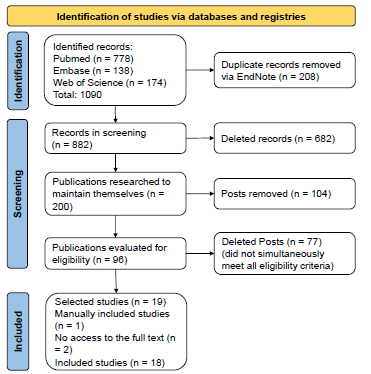
The flowchart detailing the study selection process is presented in Figure 1. The search identified 1,090 publications. After excluding duplicate publications and irrelevant studies, 96 studies remained. Of these, only 19 met all inclusion criteria. Full-text access was not possible for two studies, and one study was manually included, totaling 18 publications for the qualitative synthesis.
Preferred Reporting Items for Systematic Reviews and Meta-Analyses (PRISMA) flow diagram of the selection procedure.
Study characteristics
Supplementary Material Table 1 (available at https://www.demneuropsy.org/wp-content/uploads/2025/11/DN-2025.0346-Supplementary-Material.docx) presents the data on the interventions used by the studies and the main outcomes of the 18 included studies. All studies were published in the English language. The studies included 796 individuals allocated to the intervention groups and 586 to the control or comparison groups, totaling 1,382 participants. Only two studies evaluated both MCI and AD at different stages of the disease. Eight studies evaluated AD only, while another eight studies evaluated MCI only.
Outcome characteristics
The studies evaluated different outcomes; however, we focused on outcomes directly related to cognitive functions. All instruments and measurement tools used in the studies are described in Supplementary Material Table 1.
Risk of bias
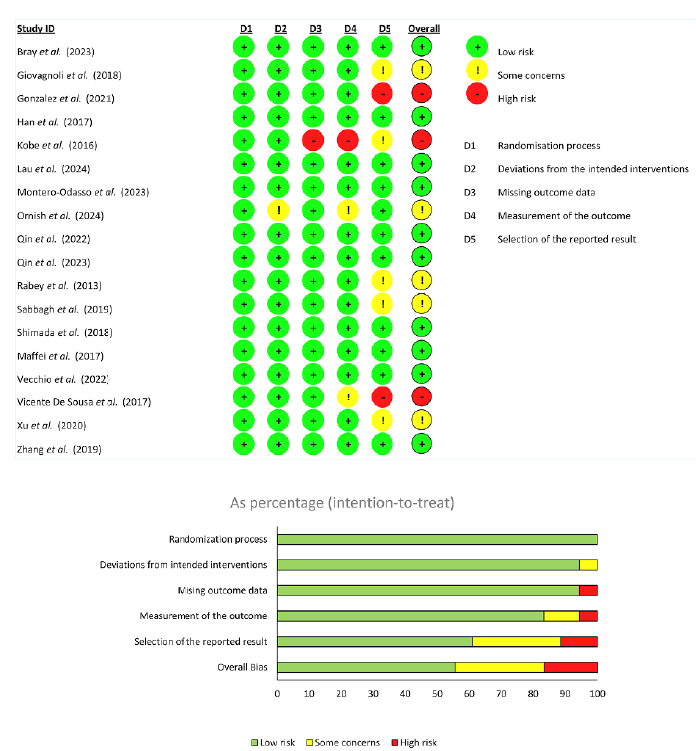
The Cochrane RoB 2.0 tool was used to assess the risk of bias18. As a result, three studies were classified as ‘high risk’, five studies as ‘some concerns’, and ten studies as ‘low risk’. The randomization process was described in all included studies (Figure 2).
Risk of bias in every study evaluated by researchers (left) and risk of bias based on Cochrane’s Handbook (right).
DISCUSSION
The primary objective of this systematic review was to comprehensively evaluate the effectiveness of combined and personalized interventions for the treatment of AD and MCI. In line with this objective, this section synthesizes the key findings of our review, placing them in the context of current literature and discussing the clinical implications and limitations of the included studies. The effects of these interventions were observed across various cognitive and non-cognitive domains, all of which directly influence the progression of the patients’ clinical status and their quality of life. Of the 18 studies included in this review, four did not observe a significant improvement with the interventions used in the cognitive outcome assessed by performance on neurocognitive tests: Bray et al.19, Giovagnoli et al.20, Lau et al.21, Vecchio et al.22. On the other hand, 12 studies presented results with a significant improvement of the interventions used in the cognitive outcome: Gonzalez et al.23, Han et al.24, Montero-Odasso et al.25, Ornish et al.26, Qin et al.27, Rabey et al.28, Sabbagh et al.29, Shimada et al.30, Train the Brain Consortium31, Vicente de Sousa et al.32, Xu et al.33, Zhang et al.34. Additionally, two studies did not use neurocognitive tests as tools related to the primary outcome: Köbe et al.35, Qin et al.36; however, they reported an improvement in other brain characteristics on which cognition depends. A major challenge in synthesizing these results is the heterogeneity of the tools used to estimate cognitive abilities, which precludes a direct equivalence or meta-analysis. This limitation underscores the need for cautious interpretation of the collective findings and highlights the importance of discussing the effects of each intervention type separately.
Non-invasive electromagnetic stimulation: transcranial magnetic stimulation (TMS) and repetitive TMS (rTMS) are non-invasive techniques used in clinical practice to monitor the behavior of neuroplasticity and cortical excitability in AD. Since the neurodegenerative process induces changes in cortical excitability and, as a consequence, changes in brain plasticity and connectivity, rTMS may help improve cognitive performance in individuals with AD and MCI37. A systematic review and meta-analysis by Yang et al.38 concluded that TMS was able to improve overall cognition when compared to sham groups. However, there was no significant improvement when cognitive training was added to the treatment. Li et al.39 concluded that rTMS is a safe and effective technique to help improve memory and global cognition in individuals with AD, with the most effective treatment plan being the one that combines a frequency of 20 Hz with 20 or more sessions over three or more weeks. With this strategy, the effect of rTMS is prolonged for at least six weeks. In agreement, a systematic review and meta-analysis conducted by Wei et al.40 concluded that rTMS has been shown to be effective in improving cognitive function, representing a complementary approach in the treatment of AD. In addition, a systematic review and meta-analysis by Chou et al.41 concluded that the beneficial effects on cognition induced by five to 30 sessions of rTMS can last between four and 12 weeks.
Physical Exercise: Physical exercise is capable of alleviating neuropsychiatric symptoms and promoting functional independence in individuals with AD, and, furthermore, aerobic exercise seems to be an effective strategy to improve cognition in these individuals42. Zhang et al.43, in a systematic review and meta-analysis, concluded that 30-minute sessions with a frequency of up to three sessions per week represent an effective strategy to improve cognitive function in individuals with AD. An RCT conducted by Haghighi et al.44 evaluated the effect of multimodal training in individuals with mild to moderate AD. The results obtained revealed that individuals in the treated group improved agility, dynamic balance, depressive symptoms, and upper and lower limb strength (p<0.05), but there was no significant effect on cognition and aerobic capacity (p>0.05). Regarding cognition, this RCT contradicts the results of Shimada et al.30 and Train the Brain Consortium31, both included in this review, who applied a combination of exercise/physical training with cognitive training and observed a significant improvement in cognition in the treated individuals compared to their controls. However, there are differences between the treatment programs used in these three studies, and, in the latter two, individuals with MCI, not AD, were evaluated.
Music Therapy: Regarding the use of music therapy, Bleibel et al.45 conducted a systematic review of RCTs and concluded that music therapy was more effective in improving cognitive performance when active music intervention (AMI) was applied, in which patients participated in music creation and not just as listeners. In the study by Giovagnoli et al.20, included in this review, the association of music therapy with memantine treatment did not promote additional benefits in cognition beyond those observed with memantine alone. This result may be a consequence of the use of passive music therapy in which individuals only participate as listeners in the sessions. Regarding music therapy in clinical studies, it is important to highlight the importance of the choice of musical genres by researchers and volunteers, since musical preference may indicate an important bias that can directly affect the results of studies, making it difficult to interpret the real potential of this therapy for AD.
Non-Invasive Electrical Stimulation: Transcranial direct current stimulation (tDCS) is a non-invasive technique that has become a major target for clinical research to improve cognitive symptoms in recent years. Nonetheless, there is a great deal of disagreement in the results reported in various clinical studies. A systematic review and meta-analysis conducted by Saleh et al.46 concluded that there is no significant effect of tDCS on cognitive functions in individuals with MCI. In contrast, Li et al.47 concluded that tDCS was able to significantly improve cognitive performance in elderly individuals with and without MCI. In addition, Wang and Tian48 were more cautious in concluding that tDCS can attenuate cognitive impairments in individuals with MCI in the short term after intervention, highlighting the need for cautious interpretation when evaluating the use of this technique in RCT and clinical practice.
Cognitive Training (CT): Regarding computerized cognitive training (CCT), we highlight in this work the scarcity of systematic reviews involving CCT in the treatment of AD or MCI. The systematic review and meta-analysis by Hill et al.49 indicated that CCT is effective on psychosocial functioning, global cognition, and selected cognitive domains in patients with MCI, even if evidence on the efficacy of this technique in individuals with dementia is limited and weak, requiring more studies with higher methodological quality.
Diet and Oral Supplementation: Diet and oral supplementation with bioactive compounds are valuable strategies in the management of neurodegenerative diseases50. However, there is still no consensus on which dietary modifications and supplementation strategies are most suitable for individuals with MCI or AD. In the systematic review and meta-analysis by Kocatürk et al.51, which included 48 clinical studies totaling 7,009 individuals with AD, it was reported that nutritional strategies showed efficacy in improving cognition, biomarker concentration, and increasing protection against malnutrition in individuals with AD. In this review, some studies used some type of supplementation or diet combined with other interventions: Bray et al.19, Köbe et al.35, Montero-Odasso et al.25, Ornish et al.26, Vicente De Sousa et al.32, Xu et al.33. Only the study by Köbe et al.35, which used oral supplementation (OS) of omega-3 fatty acids, and the study by Bray et al.19, which used OS of vitamin D3, did not report a significant improvement in cognition in individuals. However, caution is needed when interpreting these findings, as the results did not depend exclusively on supplementation in these studies.
Clinical Interpretation and Study Limitations: This review highlights a critical need to distinguish between statistically significant and clinically meaningful effects. While many studies reported a statistically significant improvement, a discussion of minimal clinically important differences (MCIDs) for tools like the ADAS-Cog or MMSE is essential to understand the real-world impact of these interventions. A limitation of this review is the substantial heterogeneity in outcome measures, both in the choice of assessment tools and their definitions, which limits the comparability of results across studies. Future research should prioritize the use of standardized outcome measures to facilitate more robust comparisons and meta-analyses. Furthermore, the absence of a detailed subgroup analysis based on AD and MCI populations in many of the included studies limits our ability to draw definitive conclusions about the differential effects of these interventions on distinct stages of cognitive decline. Addressing these limitations in future research will be crucial for developing evidence-based guidelines for combined therapies in AD and MCI.
In conclusion, this review included 18 clinical studies with different combinations of interventions for AD and MCI. Notably, interventions that combined lifestyle changes, such as dietary changes and physical exercise, demonstrated more significant results in cognitive function for treated individuals. In contrast, interventions that used some type of brain stimulation showed more modest results. The successful implementation of these combined therapies underscores the potential of a precision medicine approach for AD and MCI, wherein interventions are personalized to target multiple pathological pathways simultaneously. In the future, new research should develop comprehensive interventions that combine as many treatments as possible and, when applicable, in a personalized manner, with standardized outcome measures to facilitate more robust comparisons and the development of clearer clinical guidelines.
Limitations
Some limitations of this review include the heterogeneity among the combinations of interventions, which precluded the performance of a meta-analysis, the use of different neurocognitive tests as primary outcome measures (cognition), and the presence of both AD and MCI in the studies. This heterogeneity is a significant challenge, making it difficult to draw definitive conclusions about the comparative effectiveness of different combined therapies. For instance, the variety of neurocognitive tests used, with their distinct cutoffs and metrics, prevents a direct comparison of cognitive outcomes and their clinical significance. Additionally, the lack of detailed subgroup analyses in many studies, which would distinguish the effects of interventions on AD versus MCI populations, limits our ability to determine if a specific therapy is more effective at a particular stage of cognitive decline. Finally, the relatively small sample sizes and the short-term follow-up periods in some of the included trials mean that the long-term efficacy and sustainability of these interventions remain unclear.
DATA AVAILABILITY STATEMENT
The datasets generated and/or analyzed during the current study are available from the corresponding author upon reasonable request.
Supplementary Material
Supplementary information are available at https://www.demneuropsy.org/wp-content/uploads/2025/11/DN-2025.0346-Supplementary-Material.docx
Supplementary PDF
REFERENCES
-
1. Smid J, Studart-Neto A, César-Freitas KG, Dourado MCN, Kochhann R, Barbosa BJAP, et al. Subjective cognitive decline, mild cognitive impairment, and dementia - syndromic approach: recommendations of the Scientific Department of Cognitive Neurology and Aging of the Brazilian Academy of Neurology. Dement Neuropsychol. 2022;16(3 Suppl. 1):1-24. https://doi.org/10.1590/1980-5764-DN-2022-S101PT
» https://doi.org/https://doi.org/10.1590/1980-5764-DN-2022-S101PT -
2. 2024 Alzheimer’s disease facts and figures. Alzheimers Dement. 2024;20(5):3708-821. https://doi.org/10.1002/alz.13809
» https://doi.org/https://doi.org/10.1002/alz.13809 -
3. Bertola L, Suemoto CK, Aliberti MJR, Gomes Gonçalves N, Pinho PJMR, Castro-Costa E, et al. Prevalence of dementia and cognitive impairment no dementia in a large and diverse nationally representative sample: The ELSI-Brazil Study. J Gerontol A Biol Sci Med Sci. 2023;78(6):1060-8. https://doi.org/10.1093/gerona/glad025
» https://doi.org/https://doi.org/10.1093/gerona/glad025 -
4. Jack CR Jr, Bennett DA, Blennow K, Carrillo MC, Dunn B, Haeberlein SB, et al. NIA-AA Research Framework: Toward a biological definition of Alzheimer’s disease. Alzheimers Dement. 2018;14(4):535-62. https://doi.org/10.1016/j.jalz.2018.02.018
» https://doi.org/https://doi.org/10.1016/j.jalz.2018.02.018 -
5. Zhang XX, Tian Y, Wang ZT, Ma YH, Tan L, Yu JT. The epidemiology of Alzheimer’s disease modifiable risk factors and prevention. J Prev Alzheimers Dis. 2021;8(3):313-21. https://doi.org/10.14283/jpad.2021.15
» https://doi.org/https://doi.org/10.14283/jpad.2021.15 -
6. A Armstrong R. Risk factors for Alzheimer’s disease. Folia Neuropathol. 2019;57(2):87-105. https://doi.org/10.5114/fn.2019.85929
» https://doi.org/https://doi.org/10.5114/fn.2019.85929 -
7. Schilling LP, Zimmer ER, Shin M, Leuzy A, Pascoal TA, Benedet AL, et al. Imaging Alzheimer’s disease pathophysiology with PET. Dement Neuropsychol. 2016;10(2):79-90. https://doi.org/10.1590/S1980-5764-2016DN1002003
» https://doi.org/https://doi.org/10.1590/S1980-5764-2016DN1002003 -
8. De Falco A, Cukierman DS, Hauser-Davis RA, Rey NA. Alzheimer’s disease: etiological hypotheses and treatment perspectives. Quimica Nova. 2016;39(1):63-80. https://doi.org/10.5935/0100-4042.20150152
» https://doi.org/https://doi.org/10.5935/0100-4042.20150152 -
9. Calsolaro V, Edison P. Neuroinflammation in Alzheimer’s disease: Current evidence and future directions. Alzheimers Dement. 2016;12(6):719-32. https://doi.org/10.1016/j.jalz.2016.02.010
» https://doi.org/https://doi.org/10.1016/j.jalz.2016.02.010 -
10. Rudge JD. A new hypothesis for Alzheimer’s disease: the lipid invasion model. J Alzheimers Dis Rep. 2022;6(1):129-61. https://doi.org/10.3233/ADR-210299
» https://doi.org/https://doi.org/10.3233/ADR-210299 -
11. de la Monte SM, Wands JR. Alzheimer’s disease is type 3 diabetes-evidence reviewed. J Diabetes Sci Technol. 2008;2(6):1101-13. https://doi.org/10.1177/193229680800200619
» https://doi.org/https://doi.org/10.1177/193229680800200619 -
12. Patel VN, Chorawala MR, Shah MB, Shah KC, Dave BP, Shah MP, et al. Emerging pathophysiological mechanisms linking diabetes mellitus and Alzheimer’s disease: an old wine in a new bottle. J Alzheimers Dis Rep. 2022;6(1):349-57. https://doi.org/10.3233/ADR-220021
» https://doi.org/https://doi.org/10.3233/ADR-220021 -
13. Steen E, Terry BM, Rivera EJ, Cannon JL, Neely TR, Tavares R, et al. Impaired insulin and insulin-like growth factor expression and signaling mechanisms in Alzheimer’s disease--is this type 3 diabetes? J Alzheimers Dis. 2005;7(1):63-80. https://doi.org/10.3233/jad-2005-7107
» https://doi.org/https://doi.org/10.3233/jad-2005-7107 -
14. Rao RV, Subramaniam KG, Gregory J, Bredesen AL, Coward C, Okada S, et al. Rationale for a multi-factorial approach for the reversal of cognitive decline in Alzheimer’s disease and MCI: a review. Int J Mol Sci. 2023;24(2):1659. https://doi.org/10.3390/ijms24021659
» https://doi.org/https://doi.org/10.3390/ijms24021659 -
15. Rahman MA, Rahman MS, Uddin MJ, Mamum-Or-Rashid ANM, Pang MG, Rhim H. Emerging risk of environmental factors: insight mechanisms of Alzheimer’s diseases. Environ Sci Pollut Res Int. 2020;27(36):44659-72. https://doi.org/10.1007/s11356-020-08243-z
» https://doi.org/https://doi.org/10.1007/s11356-020-08243-z -
16. Page MJ, McKenzie JE, Bossuyt PM, Boutron I, Hoffmann TC, Mulrow CD, et al. The PRISMA 2020 statement: an updated guideline for reporting systematic reviews. BMJ. 2021;372:n71. https://doi.org/10.1136/bmj.n71
» https://doi.org/https://doi.org/10.1136/bmj.n71 -
17. McGowan J, Sampson M, Salzwedel DM, Cogo E, Foerster V, Lefebvre C. PRESS Peer Review of Electronic Search Strategies: 2015 Guideline Statement. J Clin Epidemiol. 2016;75:40-6. https://doi.org/10.1016/j.jclinepi.2016.01.021
» https://doi.org/https://doi.org/10.1016/j.jclinepi.2016.01.021 -
18. Sterne JAC, Savović J, Page MJ, Elbers RG, Blencowe NS, Boutron I, et al. RoB 2: a revised tool for assessing risk of bias in randomised trials. BMJ. 2019;366:l4898. https://doi.org/10.1136/bmj.l4898
» https://doi.org/https://doi.org/10.1136/bmj.l4898 -
19. Bray NW, Pieruccini-Faria F, Witt ST, Bartha R, Doherty TJ, Nagamatsu LS, et al. Combining exercise with cognitive training and vitamin D3 to improve functional brain connectivity (FBC) in older adults with mild cognitive impairment (MCI). Results from the SYNERGIC trial. Geroscience. 2023;45(3):1967-85. https://doi.org/10.1007/s11357-023-00805-6
» https://doi.org/https://doi.org/10.1007/s11357-023-00805-6 -
20. Giovagnoli AR, Manfredi V, Schifano L, Paterlini C, Parente A, Tagliavini F. Combining drug and music therapy in patients with moderate Alzheimer’s disease: a randomized study. Neurol Sci. 2018;39(6):1021-8. https://doi.org/10.1007/s10072-018-3316-3
» https://doi.org/https://doi.org/10.1007/s10072-018-3316-3 -
21. Lau CI, Liu MN, Cheng FY, Wang HC, Walsh V, Liao YY. Can transcranial direct current stimulation combined with interactive computerized cognitive training boost cognition and gait performance in older adults with mild cognitive impairment? a randomized controlled trial. J Neuroeng Rehabil. 2024;21(1):26. https://doi.org/10.1186/s12984-024-01313-0
» https://doi.org/https://doi.org/10.1186/s12984-024-01313-0 -
22. Vecchio F, Quaranta D, Miraglia F, Pappalettera C, Di Iorio R, L’Abbate F, et al. Neuronavigated Magnetic Stimulation combined with cognitive training for Alzheimer’s patients: an EEG graph study. Geroscience. 2022;44(1):159-72. https://doi.org/10.1007/s11357-021-00508-w
» https://doi.org/https://doi.org/10.1007/s11357-021-00508-w -
23. Gonzalez PC, Fong KNK, Brown T. Transcranial direct current stimulation as an adjunct to cognitive training for older adults with mild cognitive impairment: A randomized controlled trial. Ann Phys Rehabil Med. 2021;64(5):101536. https://doi.org/10.1016/j.rehab.2021.101536
» https://doi.org/https://doi.org/10.1016/j.rehab.2021.101536 -
24. Han JW, Lee H, Hong JW, Kim K, Kim T, Byun HJ, et al. Multimodal cognitive enhancement therapy for patients with mild cognitive impairment and mild dementia: a multi-center, randomized, controlled, double-blind, crossover trial. J Alzheimers Dis. 2017;55(2):787-96. https://doi.org/10.3233/JAD-160619
» https://doi.org/https://doi.org/10.3233/JAD-160619 -
25. Montero-Odasso M, Zou G, Speechley M, Almeida QJ, Liu-Ambrose T, Middleton LE, et al. Effects of exercise alone or combined with cognitive training and vitamin d supplementation to improve cognition in adults with mild cognitive impairment: a randomized clinical trial. JAMA Netw Open. 2023;6(7):e2324465. https://doi.org/10.1001/jamanetworkopen.2023.24465
» https://doi.org/https://doi.org/10.1001/jamanetworkopen.2023.24465 -
26. Ornish D, Madison C, Kivipelto M, Kemp C, McCulloch CE, Galasko D, et al. Effects of intensive lifestyle changes on the progression of mild cognitive impairment or early dementia due to Alzheimer’s disease: a randomized, controlled clinical trial. Alzheimers Res Ther. 2024;16(1):122. https://doi.org/10.1186/s13195-024-01482-z
» https://doi.org/https://doi.org/10.1186/s13195-024-01482-z -
27. Qin Y, Ba L, Zhang F, Jian S, Tian T, Zhang M, et al. Multisite rTMS combined with cognitive training modulates effective connectivity in patients with Alzheimer’s disease. Front Neural Circuits. 2023;17:1202671. https://doi.org/10.3389/fncir.2023.1202671
» https://doi.org/https://doi.org/10.3389/fncir.2023.1202671 -
28. Rabey JM, Dobronevsky E, Aichenbaum S, Gonen O, Marton RG, Khaigrekht M. Repetitive transcranial magnetic stimulation combined with cognitive training is a safe and effective modality for the treatment of Alzheimer’s disease: a randomized, double-blind study. J Neural Transm (Vienna). 2013;120(5):813-9. https://doi.org/10.1007/s00702-012-0902-z
» https://doi.org/https://doi.org/10.1007/s00702-012-0902-z -
29. Sabbagh M, Sadowsky C, Tousi B, Agronin ME, Alva G, Armon C, et al. Effects of a combined transcranial magnetic stimulation (TMS) and cognitive training intervention in patients with Alzheimer’s disease. Alzheimers Dement. 2020;16(4):641-50. https://doi.org/10.1016/j.jalz.2019.08.197
» https://doi.org/https://doi.org/10.1016/j.jalz.2019.08.197 -
30. Shimada H, Makizako H, Doi T, Park H, Tsutsumimoto K, Verghese J, et al. Effects of combined physical and cognitive exercises on cognition and mobility in patients with mild cognitive impairment: a randomized clinical trial. J Am Med Dir Assoc. 2018;19(7):584-91. https://doi.org/10.1016/j.jamda.2017.09.019
» https://doi.org/https://doi.org/10.1016/j.jamda.2017.09.019 -
31. Train the Brain Consortium. Randomized trial on the effects of a combined physical/cognitive training in aged MCI subjects: the Train the Brain study. Sci Rep. 2017;7:39471. https://doi.org/10.1038/srep39471
» https://doi.org/https://doi.org/10.1038/srep39471 -
32. Vicente de Sousa O, Soares Guerra R, Sousa AS, Pais Henriques B, Pereira Monteiro A, Amaral TF. Impact of nutritional supplementation and a psychomotor program on patients with Alzheimer’s Disease. Am J Alzheimers Dis Other Demen. 2017;32(6):329-41. https://doi.org/10.1177/1533317517705221
» https://doi.org/https://doi.org/10.1177/1533317517705221 -
33. Xu Z, Zhang D, Lee ATC, Sit RWS, Wong C, Lee EKP, et al. A pilot feasibility randomized controlled trial on combining mind-body physical exercise, cognitive training, and nurse-led risk factor modification to reduce cognitive decline among older adults with mild cognitive impairment in primary care. PeerJ. 2020;8:e9845. https://doi.org/10.7717/peerj.9845
» https://doi.org/https://doi.org/10.7717/peerj.9845 -
34. Zhang F, Qin Y, Xie L, Zheng C, Huang X, Zhang M. High-frequency repetitive transcranial magnetic stimulation combined with cognitive training improves cognitive function and cortical metabolic ratios in Alzheimer’s disease. J Neural Transm (Vienna). 2019;126(8):1081-94. https://doi.org/10.1007/s00702-019-02022-y
» https://doi.org/https://doi.org/10.1007/s00702-019-02022-y -
35. Köbe T, Witte AV, Schnelle A, Lesemann A, Fabian S, Tesky VA, et al. Combined omega-3 fatty acids, aerobic exercise and cognitive stimulation prevents decline in gray matter volume of the frontal, parietal and cingulate cortex in patients with mild cognitive impairment. Neuroimage. 2016;131:226-38. https://doi.org/10.1016/j.neuroimage.2015.09.050
» https://doi.org/https://doi.org/10.1016/j.neuroimage.2015.09.050 -
36. Qin Y, Zhang F, Zhang M, Zhu W. Effects of repetitive transcranial magnetic stimulation combined with cognitive training on resting-state brain activity in Alzheimer’s disease. Neuroradiol J. 2022;35(5):566-72. https://doi.org/10.1177/19714009211067409
» https://doi.org/https://doi.org/10.1177/19714009211067409 -
37. Nardone R, Tezzon F, Höller Y, Golaszewski S, Trinka E, Brigo F. Transcranial magnetic stimulation (TMS)/repetitive TMS in mild cognitive impairment and Alzheimer’s disease. Acta Neurol Scand. 2014;129(6):351-66. https://doi.org/10.1111/ane.12223
» https://doi.org/https://doi.org/10.1111/ane.12223 -
38. Yang T, Liu W, He J, Gui C, Meng L, Xu L, et al. The cognitive effect of non-invasive brain stimulation combined with cognitive training in Alzheimer’s disease and mild cognitive impairment: a systematic review and meta-analysis. Alzheimers Res Ther. 2024;16(1):140. https://doi.org/10.1186/s13195-024-01505-9
» https://doi.org/https://doi.org/10.1186/s13195-024-01505-9 -
39. Li S, Lan X, Liu Y, Zhou J, Pei Z, Su X, et al. Unlocking the potential of repetitive transcranial magnetic stimulation in Alzheimer’s disease: a meta-analysis of randomized clinical trials to optimize intervention strategies. J Alzheimers Dis. 2024;98(2):481-503. https://doi.org/10.3233/JAD-231031
» https://doi.org/https://doi.org/10.3233/JAD-231031 -
40. Wei N, Liu H, Ye W, Xu S, Lu C, Dai A, et al. Repetitive transcranial magnetic stimulation may be superior to drug therapy in the treatment of Alzheimer’s disease: A systematic review and Bayesian network meta-analysis. CNS Neurosci Ther. 2023;29(10):2912-24. https://doi.org/10.1111/cns.14228
» https://doi.org/https://doi.org/10.1111/cns.14228 -
41. Chou YH, Ton That V, Sundman M. A systematic review and meta-analysis of rTMS effects on cognitive enhancement in mild cognitive impairment and Alzheimer’s disease. Neurobiol Aging. 2020;86:1-10. https://doi.org/10.1016/j.neurobiolaging.2019.08.020
» https://doi.org/https://doi.org/10.1016/j.neurobiolaging.2019.08.020 -
42. López-Ortiz S, Valenzuela PL, Seisdedos MM, Morales JS, Vega T, Castillo-García A, et al. Exercise interventions in Alzheimer’s disease: A systematic review and meta-analysis of randomized controlled trials. Ageing Res Rev. 2021;72:101479. https://doi.org/10.1016/j.arr.2021.101479
» https://doi.org/https://doi.org/10.1016/j.arr.2021.101479 -
43. Zhang S, Zhen K, Su Q, Chen Y, Lv Y, Yu L. The effect of aerobic exercise on cognitive function in people with Alzheimer’s disease: a systematic review and meta-analysis of randomized controlled trials. Int J Environ Res Public Health. 2022;19(23):15700. https://doi.org/10.3390/ijerph192315700
» https://doi.org/https://doi.org/10.3390/ijerph192315700 -
44. Haghighi AH, Barzoei M, Kakhak SAH, Budini F, Shahrabadi H. Effect of multimodal exercise training on physical fitness indices, cognitive status, and depressive symptoms in Alzheimer’s disease. Dement Neuropsychol. 2023;17:e20220008. https://doi.org/10.1590/1980-5764-DN-2022-0008
» https://doi.org/https://doi.org/10.1590/1980-5764-DN-2022-0008 -
45. Bleibel M, El Cheikh A, Sadier NS, Abou-Abbas L. The effect of music therapy on cognitive functions in patients with Alzheimer’s disease: a systematic review of randomized controlled trials. Alzheimers Res Ther. 2023;15(1):65. https://doi.org/10.1186/s13195-023-01214-9
» https://doi.org/https://doi.org/10.1186/s13195-023-01214-9 -
46. Saleh O, Assaf M, Alzoubi A, Anshase A, Tarkhan H, Ayoub M, et al. The effects of transcranial direct current stimulation on cognitive function for mild cognitive impairment: a systematic review and meta-analysis of randomized controlled trials. Aging Clin Exp Res. 2023;35(11):2293-306. https://doi.org/10.1007/s40520-023-02528-2
» https://doi.org/https://doi.org/10.1007/s40520-023-02528-2 -
47. Li S, Tang Y, Zhou Y, Ni Y. Effects of transcranial direct current stimulation on cognitive function in older adults with and without mild cognitive impairment: a systematic review and meta-analysis of randomized controlled trials. Gerontology. 2024;70(5):544-60. https://doi.org/10.1159/000537848
» https://doi.org/https://doi.org/10.1159/000537848 -
48. Wang X, Tian L. Transcranial direct current stimulation for global cognition in Alzheimer’s disease: a systemic review and meta-analysis. Neurol Sci. 2024;45(3):883-95. https://doi.org/10.1007/s10072-023-07162-4
» https://doi.org/https://doi.org/10.1007/s10072-023-07162-4 -
49. Hill NT, Mowszowski L, Naismith SL, Chadwick VL, Valenzuela M, Lampit A. Computerized cognitive training in older adults with mild cognitive impairment or dementia: a systematic review and meta-analysis. Am J Psychiatry. 2017;174(4):329-40. https://doi.org/10.1176/appi.ajp.2016.16030360
» https://doi.org/https://doi.org/10.1176/appi.ajp.2016.16030360 -
50. Bianchi VE, Herrera PF, Laura R. Effect of nutrition on neurodegenerative diseases. A systematic review. Nutr Neurosci. 2021;24(10):810-34. https://doi.org/10.1080/1028415X.2019.1681088
» https://doi.org/https://doi.org/10.1080/1028415X.2019.1681088 -
51. Kocatürk RR, Temizyürek A, Özcan ÖÖ, Ergüzel TT, Karahan M, Konuk M, et al. Effect of nutritional supports on malnutrition, cognition, function and biomarkers of Alzheimer’s disease: a systematic review. Int J Neurosci. 2023;133(12):1355-73. https://doi.org/10.1080/00207454.2022.2079506
» https://doi.org/https://doi.org/10.1080/00207454.2022.2079506
Edited by
-
Editor-in-Chief:
Sonia M. D. Brucki. http://orcid.org/0000-0002-8303-6732
-
Associate Editor:
Claudia Kimie Suemoto. http://orcid.org/0000-0002-5942-4778