FITTING MODELS TO DETERMINE EXTERNAL PRESSURE COEFFICIENTS USING HARMONIC REGRESSION
ABSTRACT
Mathematical models to determine external pressure coefficients (Cpe) in conical silo roofs are scarce in silo design standards and scientific papers. These coefficients are dimensionless and are influenced by Reynolds number, air viscosity, geometry, and surface roughness of the material used in the structure. Pressure coefficients in conical roofs vary in the circumferential and meridional directions. Cpe values are essential in designing these structures to determine the pressures that arise from wind action. However, the scarcity of mathematical models for calculating external pressure coefficients in conical silo roofs made us conduct harmonic regression analyses to fit mathematical models based on experimental data developed in wind tunnels. Model fitting to experimental data had coefficients of variation lower than 10% in 87.5% (7/8) of the analyzed levels. These models are recommended for cases where wind gust duration does not exceed 3 seconds.
external pressure coefficients; wind action; conical roofs; silos
INTRODUCTION
Conical roofs are structures widely used in cylindrical steel silos. These structures are important to protect the product from the elements of nature, providing support for temperature monitoring cables, vent pipes, and grain spreaders.
Steel silos with circular sections and conical roofs have been designed for many years without the aid of accurate design information regarding wind pressure distribution. This is especially true in the case of conical roofs (Sabransky & Melbourne, 1987).
The actions acting on conical silo roofs and the mathematical models to estimate them need to be known during their project development. Conical roofs can be exposed to various actions depending on the conditions in which the silos are used, such as the action of temperature monitoring cables, walkway supports, and snow and wind actions (Gallego et al., 2018; Casada et al., 2019).
Studies on actions in temperature monitoring cables have been carried out to evaluate the influence of cable arrangement in the radial direction, geometric shape, type of material, and grain flow rate on the magnitude of forces in temperature monitoring cables (Reimbert & Reimbert, 1976; Atkinson et al., 1983; Thompson et al., 1986; Schwab et al., 1991; Schwab et al., 1992; Martins & Calil Júnior, 2011; Casada et al., 2019).
The values of external and internal pressure coefficients need to be known to determine the effect of wind action around cylindrical silos with conical roofs. These coefficients are dimensionless and vary depending on the geometric characteristics of the structure, such as the roof angle, silo slenderness ratio, and surface roughness, as well as the gust duration and air properties.
Sabransky & Melbourne (1987), Macdonald et al. (1988), Kebeli (2002), Portela & Godoy (2005), Andrade Júnior & Calil Júnior (2004), Andrade Júnior & Calil Júnior (2007), Burgos et al. (2014), and Fouad et al. (2018) tested experimentally models of silos and tanks with small-scale conical roofs in a wind tunnel. These authors analyzed the cylindrical body and observed that the behavior of the distribution of external pressure coefficients in conical roofs is non-uniform in the circumferential direction, varying along the meridional direction of the roof.
Studies on wind action in silos and tanks with conical roofs are scarce in the literature. Only Gorenc et al. (1986), Greiner (1998), Pircher et al. (1998), and Portela & Godoy (2005) reported mathematical models to determine the external pressure coefficients on silo walls. Therefore, studies are required to develop models to determine the external pressure coefficients of conical roofs of silos or tanks.
Existing standards for silo design contain models for estimating the external pressure coefficients of spherical and conical roofs. The European normative code EN 1991-1-4:2005 provides external pressure coefficients developed for spherical roofs, while the Australian standard AS 1170.2-1989 uses pressure coefficients developed for conical roofs, which were based on wind tunnel tests developed by Sabransky & Melbourne (1987) and Macdonald et al. (1988), and other foreign standards adopt this model.
In this study, fitting to mathematical models were developed using the Fourier series based on experimental data collected by Kebeli (2002) to determine the pressure coefficients of conical silo roofs.
MATERIAL AND METHODS
Experimental data (Kebeli (2002))
Kebeli (2002) analyzed the effect of wind action on cylindrical silos with conical roofs in two situations, that is, a wind tunnel with small-scale models (cross-section 3 m wide, 2 m high, and 30 m in length) and full-scale silos.
The small-scale models of the analyzed silos with conical roofs have a scale of 1:60 and are composed of two parts: the first is the cylindrical body manufactured with a diameter of 15.24 cm and h/d ratio of 1, 1.5, and 2.5, and the second part corresponds to the conical roof, which has angles of 25, 30, 35, and 40° (Kebeli, 2002). In total, eight models were tested; among them, four with h/d ratio = 1 and angles varying from 25 to 40°, with smooth and rough surfaces being evaluated for each angle. A rough surface, roof angle of 25°, and h/d ratios ranging from 1 to 2.5 were used to analyze the interference of the h/d ratio.
A total of 177 pressure taps were installed on each conical roof at eight different levels (from A to H) along the southern direction of the roof and 36 pressure taps were installed in half of the cylindrical body distributed every 10°. The established levels have coordinates in the radial direction and along the height of the conical roof.
External pressure coefficients (Cpe)
Data on the external pressure coefficients (Cpe) of the small-scale silo model with an h/d ratio equal to 1, roof angle equal to 30°, and a rough surface were used to carry out the harmonic analysis adjustments. The external pressure coefficients are dimensionless and relate the dynamic wind pressures with the pressures on the surface of the structure, being determined by [eq. (1)].
Where:
Cpe is the external pressure coefficient (dimensionless);
p̄ is the static pressure on the body surface (Pa);
p0 is the static wind reference pressure (Pa);
ρ is the air density (kg m3), and
Vh is the average wind speed experimentally determined by Kebeli (2002) in a wind tunnel (m s1).
Harmonic regression
The fitting of the models to the experimental data was conducted using harmonic regression from Equations (2) to (5). The number of harmonics needed to be increased until the models converged to the expected results so that the models generated from harmonic regression had better precision and described the behavior of the distribution of experimental pressure coefficients.
in which
α0, αn, and bn are Fourier series coefficients (dimensionless),
θ is the circumferential angle of the conical roof (rad.), and
n is the number of harmonics (dimensionless).
Fourier series coefficients (α0, αn, and bn) are defined by eqs (3), (4) and (5).
Where:
Т is the period of the function (cycle – 2𝜋).
RESULTS AND DISCUSSION
External pressure coefficient (Cpe)
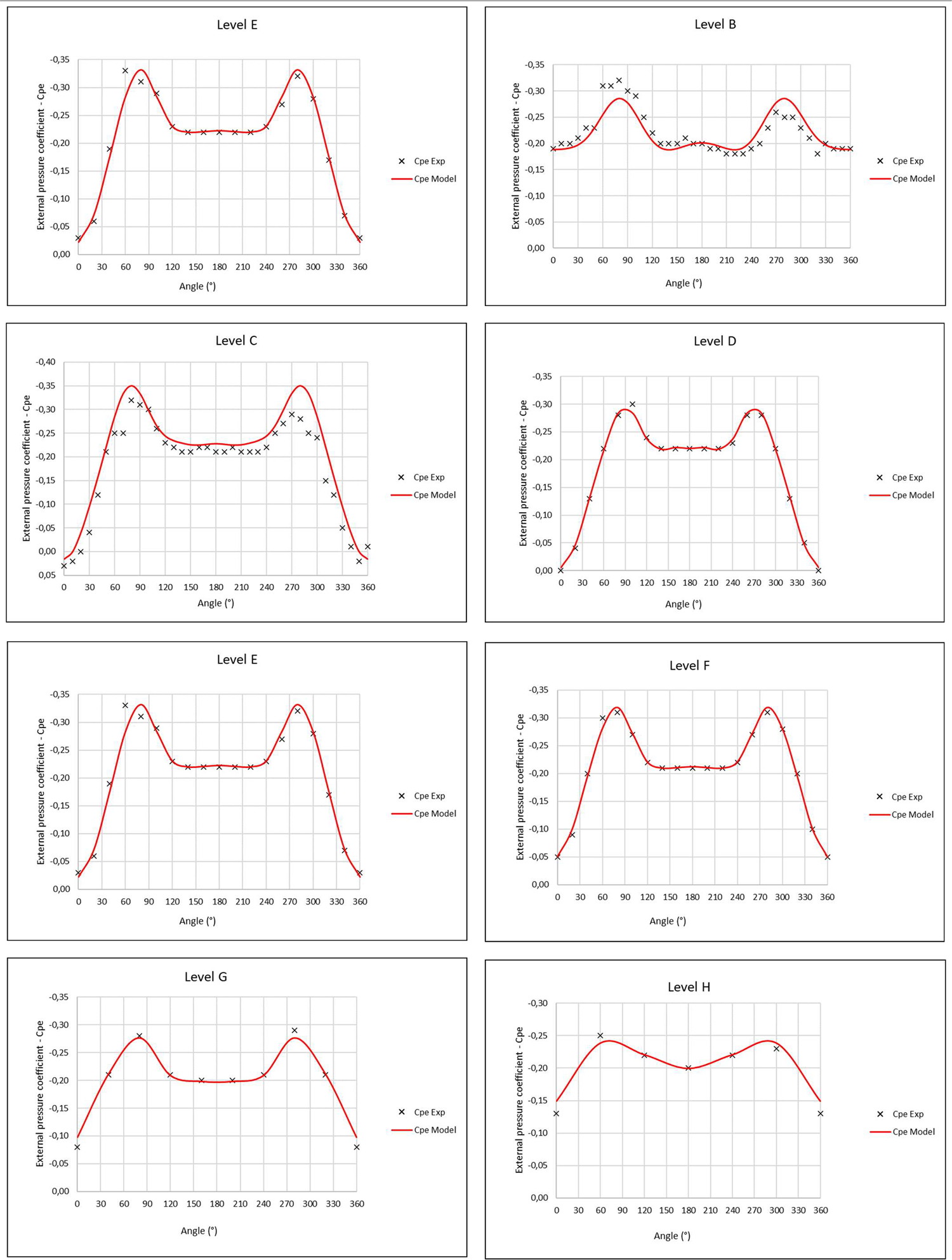
The external pressure coefficients (Cpe) for conical roofs of cylindrical silos have as their main characteristic the variability both in the meridional and circumferential directions (Table 1). The distribution of these coefficients around the roof in the circumferential direction has periodic behavior in the form of trigonometric functions (sines and cosines) (Fig. 1), justifying the use of harmonic regression.
The series coefficients α0 and αn were calculated for a period of 2π and the number of harmonics equal to 8 (Tables 1 and 2).
Figure 2 shows the external pressure coefficients of the roof with an angle equal to 30° calculated with eqs (3), (4), and (5), as well as the experimental data produced by Kebeli (2002).

The distribution of coefficients described by models fitted with the Fourier series describes a periodic behavior of an even function. For this reason, the Cpe distribution is symmetrical relative to the axis in the same direction as the wind action. However, the experimental values at A, B, and C levels do not have the same behavior as described by [eq. (3)]. The behavior at these levels was not corresponding but the other levels showed symmetry between the results. Liu et al. (2022) used wind tunnel tests to analyze the effect of the Reynolds number on the distribution of pressure coefficients on the cylindrical walls of tanks and observed that this symmetry was found in all analyzed cases, corroborating the results of the present study.
There is data homogeneity according to the coefficients of variation found. The CV was equal to 11.67% in 87.5% (7/8) of the analyzed levels, with a value of 30.69% (1/8) at level C.
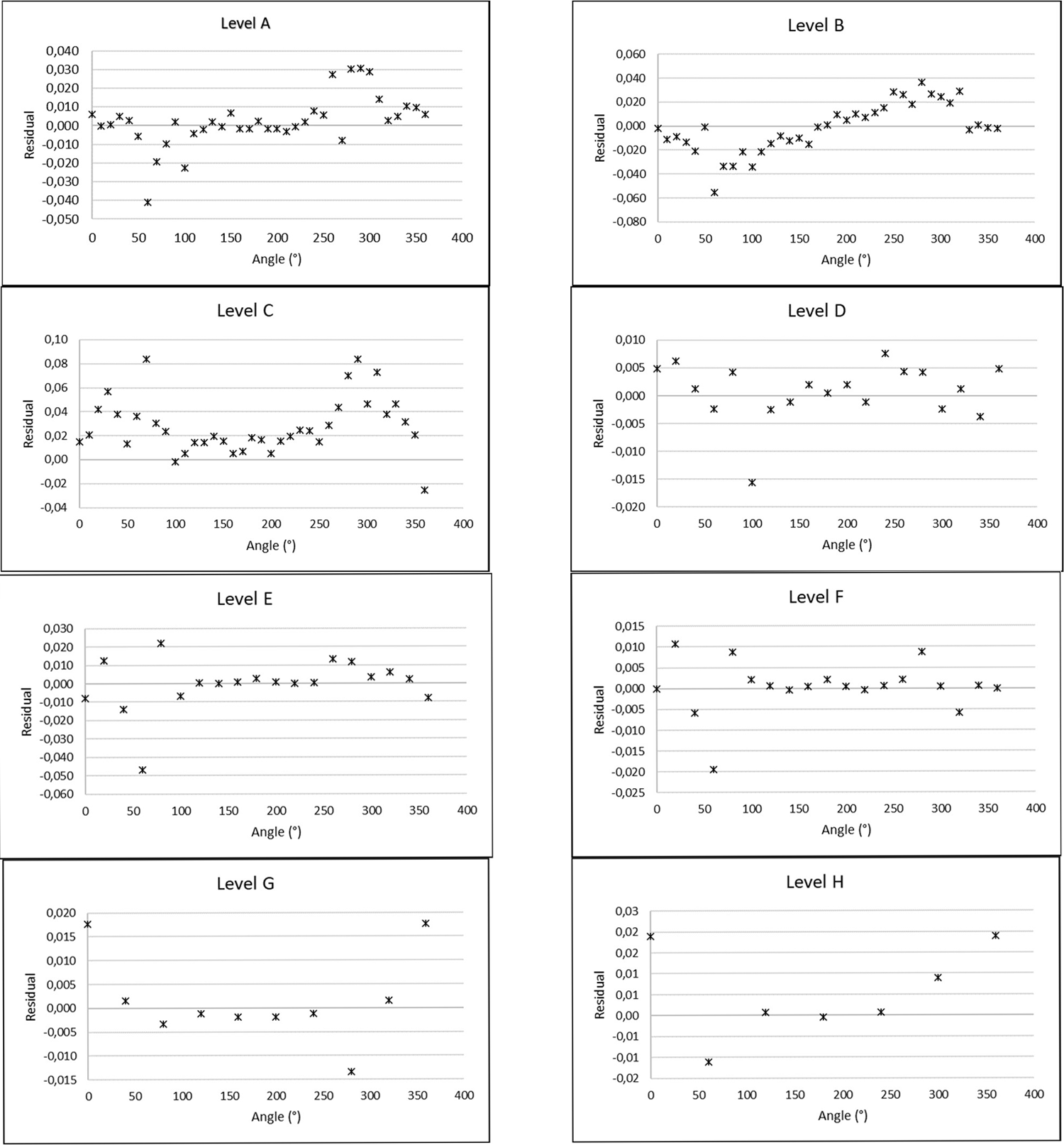
Figure 2 shows the residual generated when fitting the models for each analyzed roof level. It shows that the residuals between 70 and 270° underwent higher variations than in other angular positions. Airflow separation occurs on the side of the silo at these specific positions, generating turbulent flow.
CONCLUSIONS
The developed models described the behavior of the pressure coefficients with data dispersion varying between 11.67 and 30.69% at all levels of the conical roof. In the leeward region, at levels A, B, and C, the fitted models were not homogeneous, as the behavior of the experimental data by Kebeli (2002). Therefore, the use of mathematical models developed from harmonic regression must be used under conditions of wind gusts of up to 3 seconds in duration, following recommendations from the Brazilian standard NBR 6123 (1988) “Forces due to wind in buildings.”
REFERENCES
- ABNT - Associação Brasileira de Normas Técnicas (2022) ABNT NBR 6123: Forças devidas ao vento em edificações. Rio de Janeiro, ABNT, 1988.
- Andrade Júnior LJ, Júnior CC (2004) Comportamento aerodinâmico e efeito de enrijecimento externo em silos cilíndricos sob a ação do vento. Engenharia Agrícola 24(3): 512-526.
- Andrade Junior LJ, Calil Junior C (2007) A ação do vento em silos cilíndricos de baixa relação altura/diâmetro. Cadernos de Engenharia de Estruturas 9(41): 129-155.
- Atkinson TD, Butcher JC, Izard MJ, Nedderman RM (1983) The forces on obstacles suspended in flowing granular materials. Chemical Engineering Science 38(1): 91-105.
- Australian Standard (1989) AS 1170.2 - SAA Loading Code. Sydney.
- Burgos CA, Jaca RC, Lassig J L, Godoy LA (2014) Wind buckling of tanks with conical roof considering shielding by another tank. Thin-Walled Structures 84:226-240.
- Casada ME, Thompson SA, Armstrong PR, McNeill SG, Maghirang RG, Monstross MD, Turner AP (2019) Forces on monitoring cables during grain bin filling and emptying. American Society of Agricultural and Biological Engineers 35(1992): 409-415.
- Martins GCA, Junior CC (2011) Ações devidas a cabos de termometria em estruturas de coberturas de silos. Cadernos de Engenharia de Estruturas 13(61): 19-32.
- European Committee of Standardization. Eurocode 1: Actions on structures - Part 1-4: General actions - Wind Actions. Brussels, CEN, 2005b.
- Gallego E, Fuentes JM, Ramírez-Gómez A, Ayuga F (2018) Effects of different snow load arrangements on steel silo roof structures. Advances in Structural Engineering 21(16):2507-2517.
- Gorenc BE, Hogan TJ, Rotter JM (1986) “Guidelines for the assessment of loads on bulk solid containers”. Canberra, Institution of Engineers Australia.
- Greiner R (1998) Cylindrical shells: wind loading. London, EFN Spon, p 378-379.
- Kebeli HV (2002) Determining pressure coefficients due to wind loading on grain bins. Gainesville, University of Florida.
- Liu L, Sun Y, Su N, Wu Y, Peng S (2022) Three-dimensional reynolds number effects and wind load models for cylindrical storage tanks with low aspect ratios. Journal of Wind Engineering and Industrial Aerodynamics 227:105080.
- Macdonald PA, Kwok KCS, Holmes JD (1988) Wind loads on circular storage bins, silos and tanks: I. Point pressure measurements on isolated structures. Journal of Wind Engineering and Industrial Aerodynamics 31(2-3):165-187.
- Pircher M, Guggenberger W, Greiner R, Bridge R (1998) Stresses in elastic cylindrical shells under wind load. Nepean, University of Western Sydney, p 663-669.
- Portela G, Godoy LA (2005) Wind pressures and buckling of cylindrical steel tanks with a conical roof, Journal of Constructional Steel Research 61(6):786-807.
- Sabransky IJ, Melbourne WH (1987) Design pressure distribution on circular silos with conical roofs. Journal of Wind Engineering and Industrial Aerodynamics 26(1): 65-84.
- Schwab CV, Curtis S, Thompson S, Ross IJ (1991) Vertical loading of temperature cables. Transactions of the American Society of Agricultural Engineers 34(1):269-274.
- Schwab CV, Thompson SA, Williams RA, Ross IJ (1992) Temperature cable load comparison between model and full-scale grain bins. Transactions of the American Society of Agricultural Engineers 35(1): 297-302.
Edited by
-
Area Editor:
Gizele Ingrid Gadotti