DESIGN AND OPTIMIZATION OF A LOW-DAMAGE APPLE BIN FILLING DEVICE
Abstract
To address the problem of high rates of damage during automated apple harvesting, caused by uneven distribution in the filling of the apple bin, a device was designed with a bin that could rotate and move up and down autonomously. By analyzing the state of motion and the impact forces during the bin filling process, three factors influencing the rate of damage and the uniform distribution coefficient were identified: the conveyor belt speed, the rotational speed of the bin, and the angle of contact between the soft leather curtain and the bin. EDEM was used to simulate the process and to analyze the individual factors affecting the apple bin filling device, and to determine suitable value ranges for the influencing factors. The Box-Behnken response surface methodology was applied to study the interactive effects of these factors on the damage rate and uniform distribution coefficient. A quadratic regression model was established, in which the damage rate and uniform distribution coefficient were used as response variables, and the optimized values of the influencing factors were obtained as follows: a conveyor belt speed of 0.33 m/s, a rotational speed for the bin of 0.35 rad/s, and a contact angle between the soft leather curtain and bin of 30°. After optimization, the damage rate j was 4.07% and the uniform distribution coefficient S was 0.393. Bin filling experiments in an apple orchard yielded an average damage rate of 5.67% and an average uniform distribution coefficient of 0.408. The deviation between the experimental values and the optimized values was less than 5%. This study can provide a pertinent reference for the design of mechanized and automated bin filling equipment.
Keywords:
apple; bin filling device; EDEM; damage rate; uniform distribution coefficient; response surface analysis
Introduction
Apples are one of the most popular fruits in the world, and represent an important crop in economic terms. The global area used for apple cultivation exceeds 472.82 ha (Li et al., 2022; Musacchi & Serra, 2018). There is a problem with labor shortages for apple harvesting, and the replacement of manual harvesting with apple-picking robots can address this issue (Shang et al., 2023; Zhang et al., 2020; Zhang et al., 2021; Zheng et al., 2020). However, apples are highly susceptible to mechanical damage during picking, collection, and transportation. Mechanical damage to a fresh fruit can lead to accelerated decay of the entire fruit, which is very inconvenient for storage, and can impact its quality and economic value. Most of the damage to apples arises from collisions during the collection container process after picking (Dunno et al., 2021; Li et al., 2017), and the need to reduce the damage rate during the collection process is an important technological challenge that hinders the practical application of apple-picking robots.
In recent years, researchers have developed various collection container platforms for post-harvest apples; for example, the DBR apple harvester in the United States uses a windmill composed of four soft cushions to evenly distribute apples into the apple bin (Lehnert, 2010; Luo et al., 2012). A set of linear motors is employed to raise and lower the windmill, thereby achieving automatic bin filling. The Pluk-O-Trak apple harvester from the Netherlands is composed of a vertical finger conveyor belt, a cylindrical brush, and a soft pad plate (Zhang et al., 2018). The finger conveyor belt transports apples downwards, and after the apples have fallen onto the inclined soft pad below the conveyor belt, the cylindrical brush pushes them away from the pad to prevent clogging at the panel. The Revo apple harvester from Italy was designed with single-strip partitions to eliminate the transitional stage at which apples can fall between conveyor belts (Zhang et al., 2016), thus preventing the collision damage that can occur at this stage. The spring-loaded apple bin is based on the principle that the weight of apples in the bin is linearly related to the vertical height of their drop as they are stacked layer by layer (Yang, 2018). This design ensures that the drop height of the apples during bin filling remains within a low-damage range, thereby effectively controlling the collision damage from falls. Screening baffles of varying heights have been used to sort apples into different grades, and brush rollers were then employed to ensure an even distribution of apples within the bin (Chen et al., 2023); parameter optimization experiments were performed using a second-order orthogonal rotational regression experiment on an apple harvesting platform to ensure low-damage transportation of the apples. Another study of an automatic apple picking and collection platform was conducted by Wang et al. (2022). Through a kinematic analysis, they identified the factors affecting the damage rate and used Design-Expert software to optimize the operational parameters of the harvesting and conveying device, thereby reducing damage during operation.
Existing research indicates that mechanical damage to apples is not only related to the drop height during the bin filling process but is also closely tied to the distribution of bin filling. Controlling the drop height of apples (Chen et al., 2023; Li et al., 2023; Yang, 2018) and improving the uniformity of bin filling can reduce collisions, both between apples and between apples and the bin, consequently lowering the damage rate (Huang et al., 2019; Miao et al., 2022; Wu et al., 2021; Yu et al., 2021). However, current apple bin filling devices still suffer from limitations in terms of simultaneously controlling the drop height and enhancing the uniformity of bin filling, and further improvements could be made to both the structure and the parameters.
To address the issue of significant damage during filling of the bin, a novel filling device was designed in this study. The device controls the drop of apples to within a lower height range, and improves the uniformity of bin filling. It features a conveyor belt with an L-shaped design, equipped with a soft leather curtain at the end, and a bin platform that can rotate and move up and down. The centrifugal force generated by rotation of the bin ensures a uniform distribution of apples during the bin filling process, and this uniform distribution, together with the cushioning effect of the soft leather curtain, reduce the drop heights of the apples. The gradual lowering of the bin allows the drop height to be controlled during the filling process. A simulation of the bin filling process was performed with EDEM, and a three-level, three-factor orthogonal experiment was conducted to determine the optimal bin filling parameters, in order to achieve low damage rates and well-distributed filling of the apple bin.
Material and Methods
Overall structure and workflow
Overall structure
With the aim of achieving a reduced damage rate and a uniform filling process, a bin filling device was designed for an apple-picking robot. The overall structure of the picking robot is shown in Figure 1. It mainly consists of a frame, an RGB-D camera, a picking manipulator, conveying components (gathering dish, conveyor belt, soft leather curtain), a lifting component, a rotating component, an industrial control computer, and a chassis cart.

Overall structure of the apple harvesting platform(1. frame; 2. picking manipulator; 3. RGB-D camera; 4. apple bin; 5. industrial computer; 6. chassis cart; 7. rotating component; 8. lifting component; 9. soft leather curtain; 10. conveyor belt; 11. gathering dish).
Operational workflow
A schematic diagram of the working process of the apple bin filling device is shown in Figure 2.
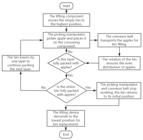
Before apple-picking begins, the chassis cart moves to the picking position. During operation, the RGB-D camera identifies and locates the apples, and the control system directs the robotic arm to pick them. The picked apples are continuously placed into the gathering tray. Due to the 30° downward slope of the tray, the apples roll in an orderly manner onto the corresponding slots of the conveyor belt. In the vertical section of the conveyor, the apples are closely positioned against the soft leather curtain for transport. At the end of the soft leather curtain, the apples separate from the conveyor and roll down into the apple bin, and then roll evenly into the vacant spaces as the bin rotates. Once a layer of apples has been fully packed, the lifting component is lowered by the height of one layer of apples to begin packing the next layer. This ensures that subsequent apples roll into the bin from the same height. When the bin is full, the picking robotic arm and conveyor belt pause, and the bin returns to the lowest position and stops rotating. The bin is then lowered to a preset minimum height for unloading and loading. After completing the loading process, the lifting component starts again, raising the bin to the preset highest position to begin a new cycle of picking and collecting apples.
The improved bin filling device has the following features. Unlike the windmill blade structure that is often used for uniform bin filling (Lehnert, 2010), the rotating bin avoids collisions between apples and the windmill blade. In addition, unlike the method of using a cylindrical brush to evenly distribute the apples (Chen et al., 2023; Zhang et al., 2018), the rotating bin achieves uniform bin filling through its own rotation, thereby preventing the issue of the brush occupying part of the bin space and causing gaps in the bin filling process, and enhancing the uniform distribution effect. Compared to a scheme with a conveying component descending layer by layer (Lehnert, 2010; Luo et al., 2012), the self-lifting bin design allows for a more compact structure, while improving the stability of the conveyor belt. Moreover, unlike a design where the bin is linearly lowered based on the weight of the apples (Yang, 2018), the proposed layer-by-layer descending and rotating bin design not only controls the drop height of the apples but also helps improve the uniform distribution effect, which further reduces the drop height.
Main components
Conveying component
The conveying component mainly consists of an L-shaped conveyor belt, a motor, rollers, baffles, the frame of the conveying component, and a gathering tray, as shown in Figure 3. The conveyor belt smoothly transports the picked apples to the bin.

Diagram showing the structure of the conveying component (1. soft leather curtain; 2. baffle; 3. L-shaped conveyor belt; 4. gathering tray; 5. motor; 6. proximity sensor; 7. roller; 8. frame of conveying component).
To minimize damage to the apples from dropping and collisions during transport, the conveyor belt has a cushioning function. The conveyor belt is made of PVC with a width of 312 mm and thickness of 2 mm, and the driving roller has a diameter of 80 mm. The distance between the roller axes at the two ends of the upper plane is 653 mm, and the vertical distance between the upper and lower rollers is 160 mm. The conveyor belt has an incline of 4°. To prevent apples from colliding with each other on the belt, there are partitions on the belt with a height of 60 mm, a spacing of 134 mm, and a thickness of 2 mm, along with wavy side baffles 2 mm in thickness on both sides of the belt.
A soft leather curtain is attached to the outer side of the vertical section of the conveyor belt to prevent apples from sliding off the side. When the apples reach the bottom of the conveyor belt, they fall through the soft leather curtain into the bin.
Lifting component
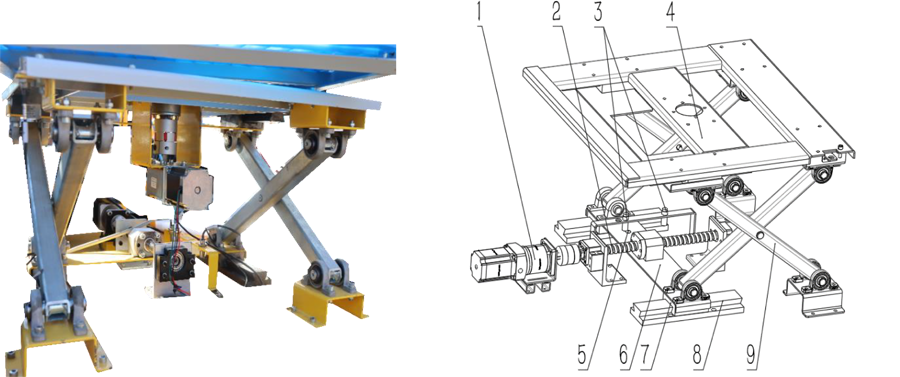
The lifting component mainly consists of a motor, a lead screw, a sliding plate Hall sensor, an upper platform, limitation magnets, a sliding plate, a slider, a linear guide rail, and scissor arms, as shown in Figure 4. Its function is to control the height of the bin so that apples enter with a constant drop height, which is set to the average height of a single layer of apples. Based on the average size of the apples considered in this study, the drop height was set to 8 cm. When the bin is full, the upper platform is lowered to facilitate bin replacement.

Diagram showing the structure of the lifting component (1. motor; 2. lead screw; 3. sliding plate Hall sensor; 4. upper platform; 5. limitation magnet; 6. sliding plate; 7. slider; 8. linear guide rail; 9. scissor arm).
The design of the lifting component relies on a scissor mechanism driven by a horizontally positioned push rod, and a schematic diagram showing the motion of the mechanism is presented in Figure 5.

Point A is fixed and hinged to the base, and rod AD is only able to rotate around point A. Point C has a slidable connection to the base, allowing C to move along the base while rod BC can rotate around point C. Rods AD and BC are of equal length, and the upper platform only moves vertically. Point B is always directly above point A, and point D is always directly above point C at the same height as point B. During the i-th descent of the upper platform, point B' descends to point B, and the descent height is:
The retraction length of the push rod corresponding to the i-th descent is:
Where:
L - length of rod AB;
θi - angle between rod AB and the base after the i-th descent;
θi+1 - angle between rod AB and the base after the i+1-th descent.
The apple bin descends by five layers during the bin filling process, where the height of each layer is 8 cm. The length of the scissor arm is 100 cm, and the minimum angle between the scissor arm and the base is 20°. According to eqs (1) and (2), The lengths by which the push rod descends are 58 mm, 64 mm, 52 mm, 42 mm, and 33 mm, respectively. The maximum angle between the scissor arm and the base is 46°.
The motor drives the lead screw to rotate, causing the sliding plate to move horizontally along the linear guide rail. The sliding plate drives the scissor arm to lift or lower the upper platform. Limit magnets are installed on the sliding plate, and two sliding plate Hall sensors detect these magnets to restrict the highest and lowest points of the lifting mechanism. The distance between the two Hall sensors corresponds to the full travel of the push rod. When the three proximity sensors mounted on the conveying component are triggered, this indicates that a layer of apples has filled the bin. The push rod motor is then activated, and the lifting mechanism lowers the platform by a preset amount to continue packing the next layer of apples. This process continues until the lowest point is reached; the sliding plate Hall sensor detects the magnet, and then stops the movement of the lifting mechanism as the bin reaches its preset position. The layout of the three proximity sensors is shown in Figure 6.

Sensor distribution, top view (1. apple bin; 2. L-shaped conveyor belt; 3. proximity sensor).
Rotating component
The rotating component consists of a rotating base, an upper platform, the platform Hall sensor, the limit magnet, and a rotating motor, coupling, shaft, and motor connection frame, as shown in Figure 7. The function of the rotation mechanism is to ensure that the dropped apples roll toward the edges of the bin for uniform distribution through rotation.

Diagram showing the structure of the rotating component (1. rotating base; 2. upper platform; 3. platform Hall sensor; 4. limitation magnet; 5. rotating motor; 6. coupling; 7. shaft; 8. motor connection frame).
The apple bin is fixed onto the rotating base, and the motor connection frame is secured to the upper platform. The rotating motor is bolted to the motor connection frame. The shaft of the rotating base is connected to the rotating motor via a coupling, which drives the bin to rotate around its central axis on the base.
When the lifting component has moved the bin to its highest point, the rotation motor drives it to rotate and the bin filling process begins. As this process continues, the bin descends layer by layer until it is filled and reaches the lowest position. The platform Hall sensor is installed on the upper platform, and a limit magnet is attached to the underside of the rotating base. When the Hall sensor detects the limit magnet, this indicates that the bin has been correctly aligned for replacement. The rotation motor then stops, and the bin replacement process begins.
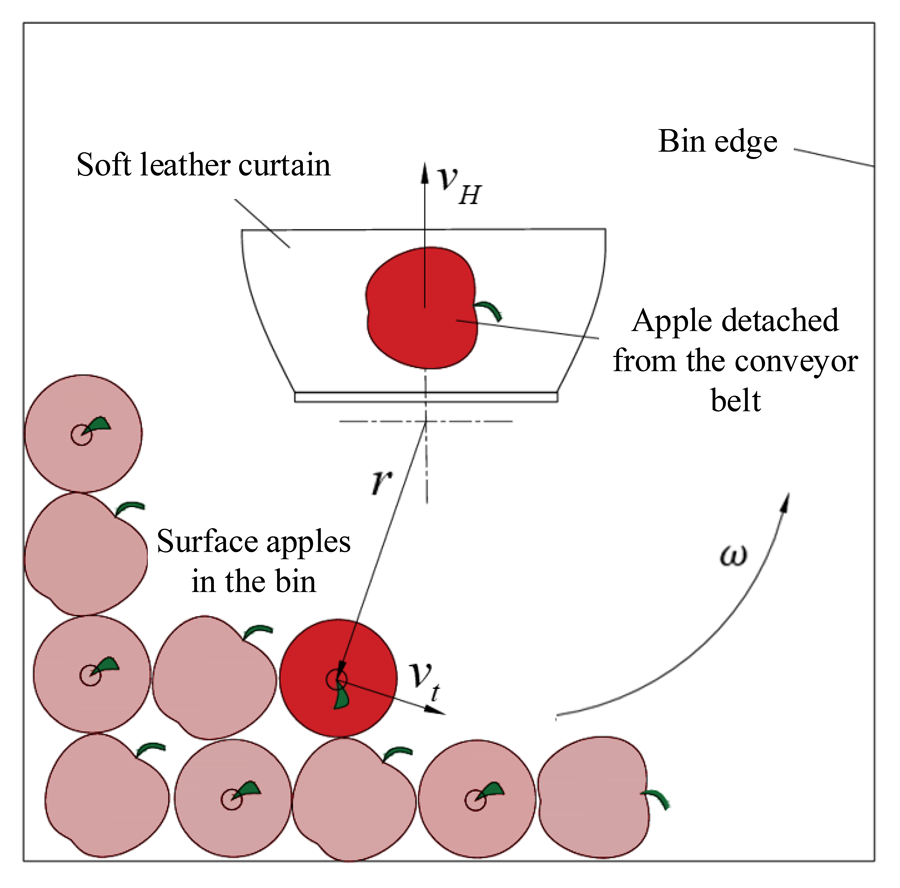
The principle of uniform distribution via bin rotation can be summarized as follows. When an apple rolls along the soft leather curtain after leaving the conveyor belt, the initial velocity of the apple (v0) will have two components, as shown in Figure 8 one in the horizontal direction (vH) and one in the vertical direction (vN). The component of the speed in the horizontal direction causes the apple to move towards the edge of the bin.

A diagram showing apples rolling along the soft leather curtain after leaving the conveyor belt, from a top view, is shown in Figure 9. After an apple falls into the rotating bin, it is affected by the centrifugal force, which generates a tangential velocity that is perpendicular to both the radial (horizontal) direction and the rotation axis and causes the apple to move around the bin.

The velocity of a rolling apple in three directions relative to the rotating coordinate system of the bin can be determined by the following equations:
Where:
v0 - initial rolling velocity of the apple;
vH - horizontal component of the initial velocity of the apple rolling along the soft leather curtain;
vN - vertical component of the initial velocity of the apple rolling along the soft leather curtain;
vt - tangential vertical velocity after the apple falls into the bin;
ω - rotational speed of the bin;
β - angle between the soft leather curtain and bin at the point of contact;
r - distance between the apple and the center of rotation O.
Under the combined action of horizontal and tangential velocities, the apples gradually fill the vacant spaces in the bin, thus achieving uniform bin filling. To prevent apples from accumulating in the central area of the bin and to ensure an even distribution, the relative speed of the falling apples must be sufficient for them to roll over the top layer of apples in the bin. According to eqs (3) and (4), whether the apples can be evenly distributed in the bin mainly depends on three factors: the initial falling speed of the apples, the angle between the soft leather curtain and bin, and the rotational speed of the bin.
Evaluation metric
According to the operational standards for damage to apples during mechanical harvesting, the damage rate and uniform distribution coefficient are used as metrics to evaluate the effectiveness of bin filling.
Damage rate
After the bin filling experiments, the apples were placed in an indoor environment at room temperature. After 24 h, the apples were halved to observe and assess the impact damage. Any apple with a surface depression or flesh discoloration was classified as damaged (Dobrzañski et al., 2006; Fu, 2017; Li & Thomas, 2014), as shown in Figure 10. However, in the simulation, it was not possible to observe whether an apple exhibited phenomena such as softening of the surface flesh or internal discoloration.

According to experimental results in the literature (Li et al., 2018), when an apple is subjected to an impact force greater than 15 N, the contact stress at the impact site exceeds its maximum yield stress, resulting in mechanical damage. Hence, in our simulation experiments, apples subjected to forces greater than 15 N were defined as damaged.
The equation used to calculate the damage rate during filling of the apple bin is:
Where:
j - damage rate during bin filling;
NF - number of damaged apples after the experiment (or number of apples subjected to a force greater than 15 N in the simulation);
NA - total number of apples in the bin.
Uniform distribution coefficient
To evaluate the uniformity of filling, the bin is divided into five layers; each layer is then evenly divided into four areas, and the number of apples in each area is counted. If an apple is on the boundary line between areas, it is counted as being in the area where more than half of the apple is located. The uniform distribution coefficient is calculated using eqs (6) and (7). The smaller the value of this coefficient, the smaller the difference in the number of apples between grid units in each layer, representing better uniformity of bin filling.
Where:
Sn - uniform distribution coefficient for a specific layer;
n - layer number, from bottom to top;
a1~4 - number of apples in each area of each layer;
bn - one quarter of the total number of apples in a given layer;
S - uniform distribution coefficient.
Factors influencing apple damage
The extent of mechanical damage to apples is closely related to their material properties. According to studies of the mechanical characteristics of apples (Stropek & Gołacki, 2022), they undergo various stages of deformation, involving elasticity, yielding, and then plasticity, during the application of force. During the filling process of the apple bin, collisions between apples, as well as between apples and the inner surfaces of the bin, lead to excessive contact stress on the apples, which is a primary cause of mechanical damage.
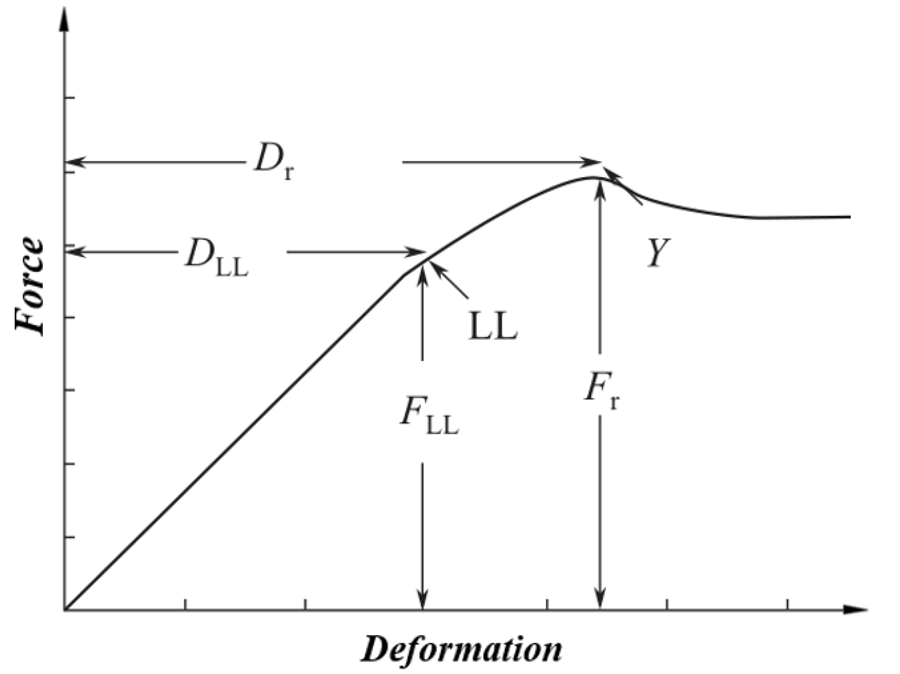
The force–deformation curve for an apple is shown in Figure 11. Point LL represents the elastic limit; when the force applied to the apple is less than FLL, the apple is in the elastic stage, whereas when the force exceeds FLL, the apple starts to enter the plastic stage. Point Y is the yield point. When the applied force exceeds Fr, the force–deformation curve passes through point Y, indicating that the contact stress at the force application point surpasses the yield stress of the apple. At this point, the microstructure of the flesh of the fruit begins to be damaged, leading to softening and browning, which can be identified as mechanical damage to the apple (Fu, 2017; Li & Thomas, 2014).

The contact stress experienced by an apple during the collection process is primarily related to the magnitude of the collision force, which depends on several factors including the masses of the colliding objects, their velocity, the location of the collision, and the elastic properties of the objects involved.
According to a study by Fu (2017), in the elastic contact stage of an apple, the maximum elastic collision force that can be applied before damage occurs can be expressed using Hertz’s contact theory, as follows:
Where:
Fc - elastic collision force;
E - equivalent elastic modulus for two colliding objects;
R - equivalent radius of curvature for two colliding objects;
m - equivalent mass of the two colliding objects;
v - relative velocity of the two colliding objects.
E1 and Eobj are the elastic moduli of the apple and the colliding object, respectively; µ1 and µobj are the values of Poisson's ratio for the apple and the colliding object; R1 and Robj are the radii of curvature at the collision points of the apple and the colliding object; and m1 and mobj are the masses of the apple and the colliding object. When apples collide with each other, the colliding object is an apple, whereas when an apple collides with the bin, the colliding object is the bin.
The magnitude of the impact force is determined primarily by the mechanical properties, shape, mass, and speed of the colliding objects, according to eqs (8)–(11). The mechanical properties of apples are available from the literature (Yang, 2018). Since the shape and mass of an apple are random variables, a sample of 30 fruits (Japanese Fuji variety) were randomly selected from those used in the experiment. The diameter (equatorial diameter), height (vertical height), and mass of each apple were measured using a vernier caliper and an electronic scale.
By setting the shape and mass to the average measured values (diameter 81.29 mm, height 71.97 mm, and mass 220 g), the main factor affecting the damage rate was determined to be the relative velocity during collisions. From eqs (3) and (4), it was found that the relative velocity is primarily influenced by the conveyor belt speed, the rotational speed of the bin, and the angle between the soft leather curtain and the bin.
Estimation of the range of influencing factors
The material properties of the apples were defined based on experimental methods and results from the literature (Hou et al., 2024; Li et al., 2018; Zhang et al., 2022). The elastic modulus of the apple was set to a compressive elastic modulus. The material parameters of the fruits are shown in Table 1.
The bin was a PE plastic crate, and its material parameters were taken from the literature (Yang, 2018). The values of these parameters are shown in Table 2.
Using Equations (8)–(11) and the material parameters in Tables 1 and 2, the relative collision velocity of the apples was estimated. To ensure that the maximum elastic collision force did not exceed 15 N, the maximum relative collision velocity of the apples needed to be controlled to less than 0.43 m/s.
The collisions between the falling apples and those in the bin can be categorized into three main types, as shown in Figure 12 (where images (a) and (b) show side views, and (c) shows a top view).

Three collision scenarios during bin filling: (a) collisions dominated by the vertical velocity; (b) collisions dominated by the horizontal velocity; (c) collisions dominated by the rotational speed of the bin.
Figure 12(a) shows a falling apple colliding with an apple on the bottom layer, where the collision force is mainly related to the vertical velocity (vN). Figure 12(b) shows a falling apple colliding with an apple in the same layer, where the collision force is mainly related to the horizontal velocity (vH). Figure 12(c) shows apple in the same layer colliding with a falling apple, where the collision force is mainly related to the speed of the apples already in the bin (vt); in other words, the speed is related to the rotational speed of the bin.
For the collision scenarios in Figure 12(a) and (b), we use [eq. (3)] and consider both the conveyor belt speed and the contact angle between the soft leather curtain and the bin, and find that the estimated reasonable conveyor belt speed should not exceed 0.6 m/s. A value of 0.35 m/s was used for the single-factor analysis. In addition, the contact angle between the soft leather curtain and the bin should be controlled to within 60°, with a value of 30° used in the single-factor analysis. For the collision scenario in Figure 12(c), we can use [eq. (4)] and consider the rotational speed and the dimensions of the bin to estimate that the rotational speed of the bin should not exceed 0.8 rad/s, with a value of 0.4 rad/s used in the single-factor analysis.
Value ranges for factors influencing the effectiveness of bin filling
EDEM Simulation Setup
To validate the performance of the proposed scheme and identify the optimal ranges for the operating parameters for the bin filling device, a single-factor simulation analysis was conducted using EDEM.
As shown in Figure 13, the 3D model of the apple was created based on the average measured dimensions of the apples, and was imported into EDEM. The apple model was filled using spherical particles. The radius and positional relationships were specified for each spherical particle, and several of the particles overlapped at the outer contours of the model to fill it, as shown in Figure 13(c).

Apple model used for EDEM simulations: (a) 3D model of the apple; (b) unfilled apple model in EDEM; (c) filled apple model in EDEM.
In EDEM, the simulation parameters for the apples and the fruit bin were defined according to Tables 1 and 2. The model was assigned with drives and constraints, and the gravitational acceleration for the material was set. The contact parameters between materials were then configured, with specific values obtained from measurement methods and results in the literature (Yang, 2018), as shown in Table 3.
The filled apple model was imported into the Particle Factory, and the area generated by the Particle Factory was set based on its positional relationship at the discharge outlet of the soft leather curtain. Based on the actual bin filling process, the Particle Factory was configured to generate a total of 180 apple particles, with a generation rate of one per second.
The time step represents the time interval between each iteration of the simulation. The size of the time step is typically set between 10% and 40%. Since the particles representing the apples are relatively large and the generation rate is low, a time step size of 30% was chosen. The minimum radius of the particles making up the apples was 10 mm, so the simulation mesh size was set to 20 mm.
The descent speed of each layer of the bin was set to 0.3 m/s. The bin descends after every 36 apples have been generated by the particle factory. The values of the conveyor belt speed, the angle between the soft leather curtain and the bin, and the rotational speed of the bin were then set.
After the simulation parameters had been configured, the simulation was started. By selecting 'auto-update' in the control window, the bin filling process was simulated as shown in Figure 14.

Effect of conveyor belt speed on filling efficiency
The conveyor belt speed was set to values of 0.1, 0.2, 0.3, 0.4, 0.5, and 0.6 m/s. The rotational speed of the bin was set to 0.4 rad/s, and the angle between the soft leather curtain and the bin was set to 30°. A simulation of the movement process of the apples was conducted, and the results are shown in Figure 15.

From Figure 15, it can be seen that when the conveyor belt speed is low, the initial velocity of the apples is insufficient, causing them to accumulate at the outlet and leading to higher damage rates and poorer distribution. When the conveyor belt speed exceeds a certain range, the initial velocity increases, reducing congestion and maintaining a lower damage rate with better distribution. However, further increases in speed raise the collision forces, causing higher damage rates. The optimal range for the conveyor belt speed is 0.2–0.5 m/s.
Effect of the bin’s rotational speed on filling efficiency
The rotational speed of the bin was set to 0.1, 0.2, 0.3, 0.4, 0.5, 0.6, 0.7, and 0.8 rad/s. The initial speed of the conveyor belt was set to 0.35 m/s, and the angle between the soft leather curtain and the bin was set to 30°. A simulation of the movement of an apple was conducted, and the results are shown in Figure 16.

From Figure 16, it can be observed that when the rotational speed is low, the speed of an apple relative to the bin is insufficient, causing difficulty in rolling over the top layer and achieving an even distribution, leading to local congestion and higher damage rates. When the rotational speed is within a certain range, apples can be distributed evenly, reducing congestion; however, further increases in speed raise the collision forces, causing higher damage rates. The optimal range for the rotational speed of the bin is 0.2–0.6 rad/s.
Effect of the Angle Between the Soft Leather Curtain and Apple Bin on Filling Efficiency
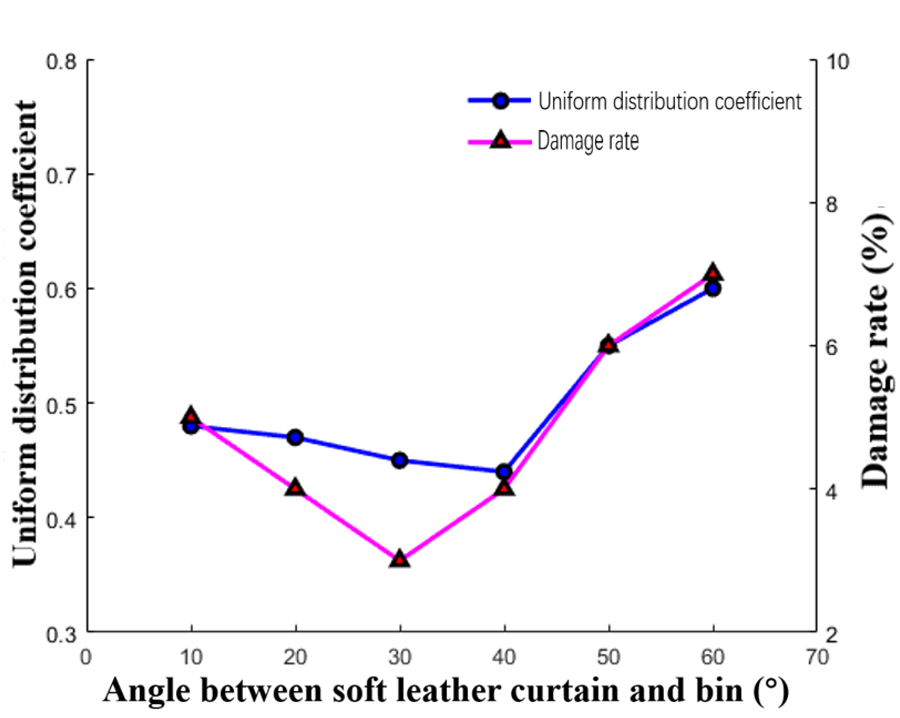
The angle between the soft leather curtain and the bin was set to 10°, 20°, 30°, 40°, 50°, and 60°. The initial speed of the conveyor belt was set to 0.35 m/s, and the rotational speed of the bin was set to 0.4 rad/s. The motion of the apple in this process was simulated, and the results are shown in Figure 17.

Effect on the bin filling efficiency of the angle between the soft leather curtain and the bin.
From Figure 17, it can be seen that a small angle between the soft leather curtain and bin increases the horizontal velocity component of the apple, while a large angle boosts the vertical velocity component. Both of these have the potential to cause damage. As the angle increases, the horizontal velocity decreases, leading to an insufficient rolling distance and congestion. An overly large vertical velocity also causes direct collisions with the bottom of the bin or the apples inside it, raising the damage rate. Thus, the optimal angle range is 20–40°.
Results and Discussion
Experimental design and results
The simulation revealed that the effectiveness of apple bin filling is influenced by the conveyor belt speed, the rotational speed of the bin, and the angle between the soft leather curtain and the bin.
To investigate the effects of the conveyor belt speed (factor A), the rotational speed of the bin (factor B), and the angle between the soft leather curtain and the bin (factor C) on the damage rate and uniformity coefficient, an orthogonal experimental method was used. Design-Expert 13.0 software was used to conduct a three-factor, three-level response surface experiment based on the Box-Behnken design. The coding levels for the experimental factors are shown in Table 4.
This experiment was conducted using the bin filling device. According to the requirements, 17 groups of experiments were performed, with each group consisting of 180 apples. The damage rate and uniform distribution coefficient for each group were recorded.
To minimize errors, five trials were conducted under the same conditions for each group, and the average of the results from these five trials was recorded.
The experimental results are shown in Table 5.
Establishment and validation of a regression model for damage rate
Using Design-Expert 13.0 software to process the experimental data, a regression equation for the effect of the conveyor belt speed, the rotational speed of the bin, and the angle between the soft leather curtain and the bin on the damage rate j was obtained as follows:
The results of a variance analysis are shown in Table 6, where * indicates a significant effect (0.01 ≤ P < 0.05) and ** indicates a highly significant effect (P < 0.01). From Table 5, it can be seen that the model determination coefficient R2 is 0.9779, indicating that only 2.21% of the variation in the response value cannot be explained. This suggests that the model has a high degree of fit, and that the error between the predicted and actual values is small, demonstrating the feasibility of the regression model.
The analysis shows that there is an interactive effect between the conveyor belt speed, the bin rotational speed, and the angle between soft leather curtain and bin on the damage rate of the apples during bin filling. To intuitively understand the impact of each factor on the damage rate, the non-significant interaction factors were ignored. In the variance analysis of the damage rate regression equation, since the P-value for the interaction between factors A and B is 0.0364, their influence on the damage rate j is significant. A response surface plot of the interactive effect between the conveyor speed (factor A) and bin rotational speed (factor B) on the damage rate was drawn, as shown in Figure 18

From Figure 18, it can be seen that there is an interaction effect between the conveyor belt speed and rotational speed of the bin. When the conveyor belt speed is fixed, the damage rate initially decreases and then increases as the rotational speed of the bin increases. Similarly, when the rotational speed of the bin is fixed, the damage rate first decreases and then increases as the conveyor belt speed increases.
The P-value for the interaction between factors B and C is 0.0003, indicating a highly significant effect on the damage rate j. A response surface plot of the interactive effect between the rotational speed of the bin (factor B) and the angle between the soft leather curtain and the bin (factor C) on the damage rate is shown in Figure 19.

From Figure 19, the interaction effect between the rotational speed of the bin and the angle between the soft leather curtain and bin is evident. When the rotational speed of the bin is fixed, the apple damage rate initially decreases and then increases as the angle between the soft leather curtain and the bin increases. Similarly, when the angle is fixed, the damage rate initially decreases and then increases as the rotational speed of the bin increases.
Establishment and validation of the regression model for the uniform distribution coefficient
Design-Expert 13.0 software was used to process the experimental data, and the regression equation for the effect of the conveyor belt speed, the rotational speed of the bin, and the angle between the soft leather curtain and the bin on the uniform distribution coefficient S was obtained as follows:
The results of the variance analysis are shown in Table 7, where * indicates a significant effect (0.01 ≤ P < 0.05) and ** indicates a highly significant effect (P < 0.01). It can be seen from the table that the coefficient of determination R2 for the model is 0.9975, meaning that only 0.25% of the variation in the response values is unexplained, indicating a high degree of fit for the model. In addition, the error between the predicted and actual values is small, thus demonstrating the feasibility of the regression model.
Variance analysis of the regression equation for the apple uniform distribution coefficient.
The P-value obtained for the regression model for the uniform distribution coefficient S is 0.0001, indicating that the model is highly significant. Factors A, B, A2, B2, and C2 have a highly significant effect on S, while the interaction between A and B has a significant effect, suggesting that there is an interactive effect between the conveyor belt speed, rotational speed of the bin, and the angle between the soft leather curtain and the bin on the uniform distribution coefficient.
The results of this analysis indicate that there is an interaction between the conveyor belt speed, rotational speed of the bin, and the angle between the soft leather curtain and the bin. To enable an intuitive understanding the impact of these factors on the uniform distribution coefficient, the non-significant interaction effects are ignored. In a variance analysis of the regression equation for the uniform distribution coefficient, the P-value for the interaction between factors A and B is obtained as 0.0439, representing a significant effect on the uniform distribution coefficient S. The interaction effect between the conveyor belt speed (factor A) and the rotational speed of the bin (factor B) on the uniform distribution coefficient was plotted as the response surface diagram in Figure 20.

Response surface for interactions between factors A and B on the uniform distribution coefficient.
The interaction effect between the conveyor belt speed and the bin rotational speed is evident from Figure 20. When the conveyor speed is fixed, the distribution coefficient initially decreases and then increases as rotational speed of the bin increases. Conversely, when the rotational speed of the bin is fixed, the distribution coefficient initially decreases and then increases as the conveyor speed increases.
Parameter optimization and experimental validation
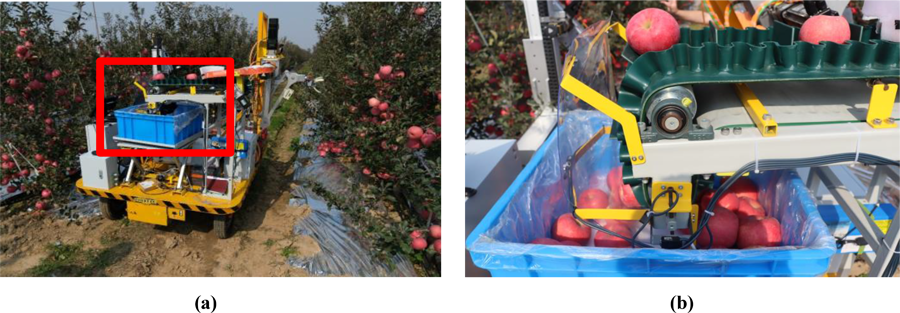
The optimization function in Design-Expert 13.0 was used to optimize the objective functions, and the following results were obtained: a conveyor belt speed of 0.33 m/s, a rotational speed for the bin of 0.35 rad/s, and an angle of 30° between the soft leather curtain and the bin. Under these conditions, the damage rate (j) was 4.07%, and the uniformity coefficient (S) was 0.393. These optimized parameters were applied to the bin filling device for testing in an orchard, involving an on-site collection and bin filling experiment with the apple harvesting platform, as shown in Figure 21.

Photographs showing the bin filling experiment in an orchard: (a) the whole machine operating in the field; (b) close-up of the bin filling device.
The test was repeated five times, with 100 apples collected in each trial. The average damage rate for the tests was obtained as 5.67%, and the average uniform distribution coefficient was 0.408. The deviation between the experimental values and the optimized values was within 5%, indicating that the optimized parameters are reliable.
Conclusions
The findings of the study can be summarized as follows:
-
Mechanical damage occurs during the filling process of the apple bin, which is inconvenient for storage and affects both the quality and economic value of the apples. Reducing the damage rate and improving the uniformity of bin filling are key challenges for designers of filling devices. This study presents a design for a device that achieves uniform filling by rotating the bin using a rotating component. In addition, a cushioning effect is supplied by a soft leather curtain, and a lifting mechanism allows the bin to descend layer by layer, thereby controlling the apple drop height. This design effectively achieves low-damage bin filling.
-
By analyzing the motion and collision forces of the apples, the key factors influencing the damage rate were identified as the conveyor belt speed, the rotational speed of the bin, and the angle between the soft leather curtain and the bin. EDEM was used to simulate and analyze the apple bin filling process under single-factor conditions to determine the optimal parameter ranges for these factors.
-
The Box-Behnken response surface methodology was used to optimize the influencing factors, with the damage rate and uniformity coefficient as the optimization objectives. The optimized values of the parameters were obtained as a conveyor belt speed of 0.33 m/s, a rotational speed for the bin of 0.35 rad/s, and an angle of 30° between the soft leather curtain and the bin.
-
Bin filling experiments were conducted in an apple orchard using the proposed bin filling device with optimized working parameters, resulting in an average damage rate of 5.67% and an average uniform distribution coefficient of 0.408, with <5% deviation between experimental and predicted values. Compared with several existing apple bin filling devices (Chen et al., 2023; Zhang et al., 2018), the damage rate is reduced. When these optimized parameters are used, the device can be scaled up for automatic bin filling in orchards, thereby effectively reducing the damage rate during the bin filling process. This study can provide a pertinent reference for the design of mechanized and automated bin filling equipment with the aim of reducing apple damage rates and improving the uniformity of filling.
Acknowledgements
The authors gratefully acknowledge financial support provided by the National Natural Science Foundation of China (Grant No. 32472009), and the Zhejiang Provincial Key Research Development Plan (Grant No. 2023C02053).
References
-
Chen, Z., Zhang, H., Yang, H., Yan, Y., Sun, J., Zhao, G., Wang, J., & Fan, G. (2023). Optimization and experimental study of structural parameters for a low-damage packing device on an apple harvesting platform. Agriculture, 13 (9), 1653. https://doi.org/10.3390/agriculture13091653
» https://doi.org/10.3390/agriculture13091653 - Dobrzañski, B., Rabcewicz, J., & Rybczyñski, R. (2006). Handling of apple Institute of Agrophysics polish Academy of Sciences.
-
Dunno, K., Stoeckley, I., & Hofmeister, M. (2021). Susceptibility of impact damage to whole apples packaged inside molded fiber and expanded polystyrene trays. Foods, 10 (9), 1980. https://doi.org/10.3390/foods10091980
» https://doi.org/10.3390/foods10091980 - Fu, H. (2017). Apple impact bruising mechanism and targeted shake-and-catch harvesting for fresh market apples in trellis trained trees. (Doctoral dissertation, China Agricultural University).
-
Hou, J., Ma, Z., Liu, X., Chen, S., Tang, Z., Jin, J., Yu, Y. & Wang, W. (2024). Apple mechanical damage mechanism and harvesting test platform design. International Journal of Food Engineering, 20 (7), 507-530. https://doi.org/10.1515/ijfe-2023-0281
» https://doi.org/10.1515/ijfe-2023-0281 -
Huang, K., Liang, X., Liu, Y., Li, W., Wu, G., & Chen, H. (2019). Design of an integrated device for apple boxing. Hubei Agricultural Sciences, (15), 128-131. https://doi.org/10.14088/j.cnki.issn0439-8114.2019.15.030
» https://doi.org/10.14088/j.cnki.issn0439-8114.2019.15.030 - Lehnert, R. (2010). Vacuum harvester passes bruising tests. Good Fruit Grower, 1.
-
Li, C., Zhang, H., Wang, Q., & Chen, Z. (2022). Influencing factors of cutting force for apple tree branch pruning. Agriculture, 12 (2), 312. https://doi.org/10.3390/agriculture12020312
» https://doi.org/10.3390/agriculture12020312 -
Li, Y., Du, X., Wang, J., & Chai, L. (2018). Mechanical properties of apple picking damage. Agriculture Engineering, 8 (6), 77 - 80. http://www.d1ae.com/en/article/id/20180620
» http://www.d1ae.com/en/article/id/20180620 -
Li, Y., Song, S., Huang, X., & Zhao, C. (2023). Effect of fruit weight and drop height on bruise area and contact pressure characteristics of apple during free drop test. Journal of Food Processing and Preservation, 2023 (1), 4828539. https://doi.org/10.1155/2023/4828539
» https://doi.org/10.1155/2023/4828539 -
Li, Z., Andrews, J., & Wang, Y. (2017). Mathematical modelling of mechanical damage to tomato fruits. Postharvest Biology and Technology, 126, 50 - 56. https://doi.org/10.1016/j.postharvbio.2016.12.001
» https://doi.org/10.1016/j.postharvbio.2016.12.001 -
Li, Z., & Thomas, C. (2014). Quantitative evaluation of mechanical damage to fresh fruits. Trends in Food Science & Technology, 35 (2), 138-150. https://doi.org/10.1016/j.tifs.2013.12.001
» https://doi.org/10.1016/j.tifs.2013.12.001 -
Luo, R., M Lewis, K., Zhang, Q., & Wang, S. (2012). Assessment of bruise damage by vacuum apple harvester using an impact recording device. ASABE. https://elibrary.asabe.org/abstract.asp?aid=41870&t=5
» https://elibrary.asabe.org/abstract.asp?aid=41870&t=5 -
Miao, Y., Chen, H., Chen, X., Tian, H., & Yuan, D. (2022). Design and test of self-propelled orchard multi-station harvesting equipment. Smart Agriculture, 4 (3), 42. https://doi.org/10.12133/j.smartag.SA202206007
» https://doi.org/10.12133/j.smartag.SA202206007 -
Musacchi, S., & Serra, S. (2018). Apple fruit quality: Overview on pre-harvest factors. Scientia Horticulturae, 234, 409 - 430. https://doi.org/10.1016/j.scienta.2017.12.057
» https://doi.org/10.1016/j.scienta.2017.12.057 -
Shang, S., Li, C., He, X., Wang, D., Wang, H., & Yang, S. (2023). Design and Experiment of High-acid Apple Vibrating Picker. Transactions of the Chinese Society of Agricultural Machinery, 54(3). http://dx.doi.org/10.6041/j.issn.1000-1298.2023.03.012
» http://dx.doi.org/10.6041/j.issn.1000-1298.2023.03.012 -
Stropek, Z., & Golacki, K. (2022). Response of apple flesh to compression under the quasi-static and impact loading conditions. Materials, 15 (21), 7743. https://doi.org/10.3390/ma15217743
» https://doi.org/10.3390/ma15217743 -
Wang, J., Chen, Z., Fan, G., Yang, H., Sun, J., & Lu, M. (2022). Design and Optimization Test of Conveying Device for Apple Harvesting Platform. Transactions of the Chinese Society of Agricultural Machinery, 53 (s1), 176-184. http://dx.doi.org/10.6041/j.issn.1000-1298.2022.S1.018
» http://dx.doi.org/10.6041/j.issn.1000-1298.2022.S1.018 -
Wu, C., Wang, Y., Sun, Q., Zhao, Y., & Zhang, L. (2021). Design and test of auxiliary harvesting device of apple. Recent Patents of Engineering, 15 (1), 107 - 116. https://doi.org/10.2174/1872212113666191211150026
» https://doi.org/10.2174/1872212113666191211150026 - Yang Z. (2018). Research on transfer packing system of orchard picking platform (Master's Thesis, Northwest A&F University).
-
Yu, X., Fan, Z., Wang, X., Wan, H., Wang, P., Zeng, X., & Jia, F. (2021). A lab-customized autonomous humanoid apple harvesting robot. Computer Electrical Engineering, 96, 107459. https://doi.org/10.1016/j.compeleceng.2021.107459
» https://doi.org/10.1016/j.compeleceng.2021.107459 -
Zhang, K., Lammers, K., Chu, P., Li, Z., & Lu, R. (2021). System design and control of an apple harvesting robot. Mechatronics, 79, 102644. https://doi.org/10.1016/j.mechatronics.2021.102644
» https://doi.org/10.1016/j.mechatronics.2021.102644 -
Zhang, X., Yin, L., Shang, S., & Chung, S.-O. (2022). Mechanical properties and microstructure of Fuji apple peel and pulp. International Journal of Food Properties, 25 (1), 1773 - 1791. https://doi.org/10.1080/10942912.2022.2107006
» https://doi.org/10.1080/10942912.2022.2107006 -
Zhang, Z., Heinemann, P. H., Liu, J., Baugher, T. A., & Schupp, J. R. (2016). The development of mechanical apple harvesting technology: A review. Transactions of the ASABE, 59 (5), 1165 - 1180. https://doi.org/10.13031/trans.59.11737
» https://doi.org/10.13031/trans.59.11737 -
Zhang, Z., Lu, R., & Igathinathane, C. (2020). A time and motion study for evaluation of apple harvest processes with different harvest methods. Transactions of the ASABE, 63 (6), 1957 - 1967. https://doi.org/10.13031/trans.14144
» https://doi.org/10.13031/trans.14144 -
Zhang, Z., Pothula, A. K., & Lu, R. (2018). A review of bin filling technologies for apple harvest and postharvest handling. Applied Engineering Agriculture, 34 (4), 687 - 703. https://doi.org/10.13031/aea.12827
» https://doi.org/10.13031/aea.12827 -
Zheng, Y., Jiang, S., Chen, B., Lü, H., Wan, C., & Kang, F. (2020). Review on technology and equipment of mechanization in hilly orchard. Transactions of the Chinese Society of Agriculture Machinery, 51 (11). http://dx.doi.org/10.6041/j.issn.1000-1298.2020.11.001
» http://dx.doi.org/10.6041/j.issn.1000-1298.2020.11.001
-
Data Availability Statement:
Data supporting the findings of this study are presented in the main text. No supplementary data are deposited in public repositories. Further relevant data are available from the corresponding author upon reasonable request.
Edited by
-
Area Editor:
Tiago Rodrigo Francetto
-
Edited by
Sbea
Data supporting the findings of this study are presented in the main text. No supplementary data are deposited in public repositories. Further relevant data are available from the corresponding author upon reasonable request.