EFFECT OF DIFFERENT DRYING METHODS ON THE PHYSICOCHEMICAL CHARACTERISTICS AND VOLATILE COMPOUND PROFILE OF Pleurotus ostreatus
ABSTRACT
Pleurotus ostreatus is considered a functional food with benefits for human health. However, its shelf life is very short even when refrigerated. This study compared the effects of five drying treatments on the water activity, color, microstructure, hardness, rehydration index, total polyphenol (TP) content and volatile compounds of P. ostreatus. The drying treatments included lyophilization (T1), forced air oven drying (T2) and refractive window (RW) drying at 60 °C (T3), 70 °C (T4) and 80 °C (T5). Bromatological analysis showed that the samples contained high concentrations of proteins and carbohydrates, with values of 29.28 g/100 g and 47.80 g/100 g, respectively. Microstructural analysis revealed less cell shrinkage and damage under T1 than under the other treatments. This finding was corroborated by the texture analysis results, which indicated a lower hardness value for T1 (5.07 N) than for T2 (8.94 N). The TP content varied between 4.62 and 6.82 mg GAE/g. Some parameter values of samples treated by RW at 80 °C were similar to those of lyophilized samples, showing that RW, which presents advantages over lyophilization, such as a lower cost and processing time, is very suitable for dehydrating P. ostreatus.
Pleurotus ostreatus; drying; refractive window; lyophilization; volatiles
INTRODUCTION
The fungus Pleurotus ostreatus is a food that is low in energy, fat, and sodium and free of cholesterol. Moreover, it is rich in proteins, with high contents of essential amino acids (arginine, alanine, glutamine and glutamic acid); carbohydrates; water; minerals (Ca, P, Fe, K, Mn, Cu, Zn, Mg and Se); essential unsaturated fatty acids, including oleic, linoleic, linolenic and palmitic acids; functional polysaccharides, such as chitin and ÿ-glucans; and water-soluble vitamins, in addition to having high antioxidant activity related to its phenolic content (Koutrotsios et al., 2018, Tsiantas et al., 2021). The characteristic aroma of mushrooms is the combined result of several groups of compounds, such as alcohols, aldehydes, ketones, acids, hydrocarbons, esters and heterocyclic, aromatic and sulfurous compounds (Tagkouli et al., 2021).
Under refrigeration, the shelf life of fresh mushrooms is limited to a few days, which represents a problem in marketing and distribution. Li et al. (2016) reported that under ambient conditions, P. ostreatus had a lifespan of 24 h and presented a brown color, watery texture and unpleasant odors; these characteristics are associated with high water and protein contents and accelerated respiration and enzymatic activity. Therefore, prolonging the lifespan of P. ostreatus is a scientific and technological challenge. Appropriate preservation methods would improve the potential for commercialization and use of this type of mushroom as an ingredient in other processed foods or as a raw material for producing high-value compounds. Previous studies on extending the useful life of P. ostreatus have explored low-temperature storage, edible coatings, fumigation, irradiation, modified packaging materials, modified atmospheres and chemical product application (Liu et al., 2020). Another alternative for the conservation of P. ostreatus is dehydration, which reduces the volume and weight of food, facilitating its transport, handling and storage. However, some drying methods significantly affect the physicochemical characteristics of foods and reduce their sensory acceptability. It has been reported that forced air drying, despite being a simple and relatively low-cost method, can degrade the sensory and nutritional qualities of mushrooms (Giri & Prasad, 2007). Similar conclusions were reported by Piskov et al. (2020), who compared lyophilization and drying by microwave irradiation, solar irradiation and forced air and found that forced-air drying generated closed pores that hindered rehydration of the fungus, in addition to reducing antioxidant activity. On the other hand, lyophilization yields products of excellent quality, as demonstrated by Ucar & Karadag (2019), who reported improved preservation of bioactive compounds and antioxidant activity, as well as better color stability and rehydration properties, since lyophilization does not involve heating. For example, Pascual et al. (2021) reported low values of water activity (Aw; 0.23 to 0.32) with good color stability and antioxidant activity. However, access to lyophilization is limited, and the cost of water removal is very high at the industrial level (Kumar, Singh, and Singh, 2013).
Refractive window (RW) drying is an alternative technology that consists of placing food in the form of pulp, juice or slices on a plastic film that is transparent to infrared radiation. During this type of drying, heat transfer occurs by conduction, convection and radiation. Via this method, 1 kg of water could be removed from carrot puree in 6 min, which is 120 times faster than using a tray dryer. Moreover, the moisture content of mango pieces was reduced to 5% after treatment for 30 min at 62 °C, while in a tray dryer, it took 240 min to obtain similar results (Ochoa et al., 2012; Trivedi et al., 2017). Currently, no studies have been reported on RW drying of fungi such as P. ostreatus. Therefore, the objective of this study was to compare the effects of RW drying, oven drying and lyophilization on the physicochemical characteristics and volatile compounds of P. ostreatus. The promising RW drying technique was compared with lyophilization since lyophilization is the method that best preserves the physicochemical characteristics of food but has disadvantages in the form of high energy consumption costs and long processing times. RW drying was also compared to drying in a forced-air oven, since the latter is an economical method and easy to implement in practice, although it has undesirable effects on food quality.
Material and methods
Preparation of the raw material.
P. ostreatus mushrooms were purchased from a commercial grower. The specimens were cleaned, the stems were separated, and then caps of homogeneous size were selected for drying.
Experimental design
In this study, a completely randomized design was carried out with 5 drying treatments: lyophilization (T1), forced-air oven drying (T2) and RW drying at 60 °C (T3), 70 °C (T4) and 80 °C (T5). Additionally, for comparative purposes, a control treatment (T0) corresponding to fresh mushrooms was used. All the drying treatments were carried out in triplicate and at random. Statistical analysis was performed using Statgraphics Centurion V15 software, followed by analysis of variance (p <0.05) for data analysis and Tukey's multiple range test to evaluate the differences between treatment means.
Drying procedures
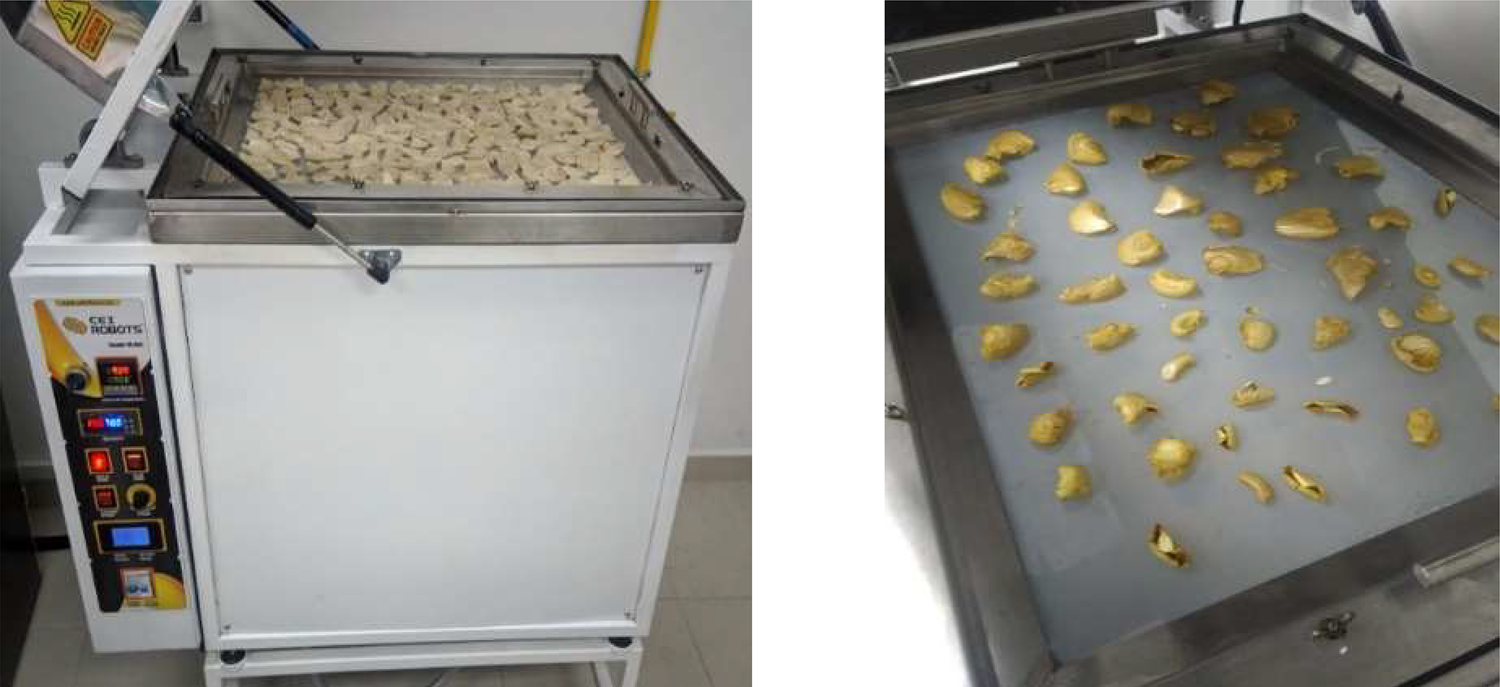
RW drying was carried out with HS-50XL pilot equipment (CEI Robots, Cali, Colombia). Once the water tank reached the required temperature, the fungi were deposited on the surface of the Mylar® film. The drying times were 475, 256 and 170 min at temperatures of 60, 70 and 80 °C, respectively (Figure 1). Drying by lyophilization was carried out with SCIENTZ-18ND equipment (Scientz, Zhejiang, China) at a vacuum pressure of 10 Pa and a condenser temperature of -63 °C for 24 h. Oven drying was carried out in a forced-air oven (Single Display, Memmert, Germany) with an air velocity of 2 m/s at a constant temperature of 65 °C for 12 h. The time when the samples reached a constant final moisture content of approximately 7% was recorded for all procedures. Both the initial and final moisture contents were measured by means of a moisture analyzer (Kern DLB 160, China).
Bromatological characteristics
The ash content (AOAC 942.05), protein content (AOAC 978.04), crude fiber content (AOAC 962.09), ether extract (AOAC 920.39), gross energy (calorimetry) and nonnitrogenous extract (mathematical calculation) were determined according to the literature.
Total polyphenols (TP)
The TP concentrations in the different treatments and the control were measured using the Folin–Ciocalteu (FC) reagent method according to Fu et al. (2002). TP was expressed as milligrams of gallic acid equivalents (GAE) per gram of dry weight (mg GAE/g DW).
Volatile compounds
Volatile compounds were extracted from the samples via solid-phase microextraction (SPME) according to the method of Politowicz et al. (2018). Volatile compounds absorbed in the SPME fiber were identified via gas chromatography (GC) coupled with mass spectrometry (MS) (Agilent Technologies 6890, California, USA) with a selective detector (MSD, AT 5973N, California, USA).
Color
The effects of the different treatments on sample color were evaluated using a CM-5 spectrophotometer (Kónica Minolta, Oaxaca, Japan). Triplicate measurements of the L, a, and b coordinates of each sample were performed to calculate the color index (CI*) according to Vignoni et al., 2006. Additionally, the Euclidean distance (∆E) of all the samples was obtained.
Where:
L*, a* and b* are the deviations of L,
a and b from the values of the dehydrated sample.
Hardness
First, the samples obtained via the three drying methods were subjected to a compression test. The hardness was then defined as the highest point on the time versus force curve obtained via a texturometer (Lloyd LS1SH, Quality Control, Chichester, UK).
Rehydration ratio (RR)
For this analysis, 2 g of dehydrated sample was immersed in distilled water at 35 °C for 30 min, after which it was removed from the water, and the excess water was gently removed with absorbent paper. This process was repeated until the weight was constant. Finally, RR was defined as indicated in [eq. (3)] according to Arora et al., 2003.
Water activity (Aw)
Samples of approximately 5 g were measured using an Aw meter (Decagon Devices, Pullman, AW, USA) (Aishah & Wan Rosli, 2013).
Microstructure analysis
To examine the microstructure of dried P. ostreaus, we used scanning electron microscopy (SEM, FEI Quanta 200 FEG, Hillsboro, USA). A dried sample was used to prepare a 1 mm thick slide, which was plated with gold and placed in the SEM instrument (Quorum Q150R ES, Quorum Technologies Ltd. Ashford. Kent. England). All samples were examined under high vacuum conditions with an acceleration voltage of 15 kV. Micrographs were taken at 100×, 1000× and 2000× magnification.
Results and discussion
Color changes in the samples
The parameters luminosity (L*), a* chromaticity (green (-) and red (+)), and b* chromaticity (yellow (+) and blue (-)) exhibited significant differences between the drying treatments (Table 1). Compared with the results for fresh fungus, treatments T1 and T5 caused an increase in L* (p <0.05). T5 required less time (170 min) to reach a moisture content of 7%. Among the RW treatments, T5 had higher L* values than did T3 and T4. This difference may be because the drying times were much longer for the latter treatments (475 and 256 min, respectively); therefore, the mushrooms were exposed to air for longer, triggering enzymatic browning due to possible oxidation reactions of phenolic compounds.
The mean ± standard deviation of three measurements is shown. ad Means with different letters are significantly different between columns (p <0.05).
The a* values did not differ between T0 and T1, indicating that the combined action of freezing and oxygen reduction during lyophilization limits the enzymatic activity responsible for darkening (Ucar & Karadag, 2019). The a* values increased in the T2, T3, T4 and T5 treatments, and an ochre color was observed in the dry samples due to browning reactions. Compared with the control, the a* parameter increased in all the treatments except T1. However, under RW drying, a* decreased with increasing temperature, which can be attributed to the accelerated action of the enzyme polyphenol oxidase at elevated temperatures during drying (García et al., 2022). This result could also be attributed to nonenzymatic browning reactions due to the reactions between amino groups and reducing sugars that can occur during heating for long periods of time (Tian et al., 2016).
On the other hand, b* increased under RW drying, with a tendency toward yellow coloration. Compared with the result for the fresh sample, lyophilization and oven drying did not affect this parameter. The mean CI* for fresh mushrooms was 17.12 ± 3.30, corresponding to a light gray to dark gray color. However, in the lyophilized samples, CI* was lower, indicating a lighter color (p <0.05). The T2, T3 and T4 samples required more time to reach a low moisture content, which could have allowed reactions that caused a brown color to occur. The CI* value of T5 varied the least from that of the fresh sample. As expected, the lowest ΔE relative to that of the fresh sample was obtained in the lyophilization treatment, followed by the RW drying treatments, which also presented low ΔE values compared with oven drying. This finding indicates that lyophilization and RW drying produced a lower total color variation in the dehydrated samples compared with the fresh samples (Hernández et al., 2021).
Microstructure analysis of dehydrated samples.
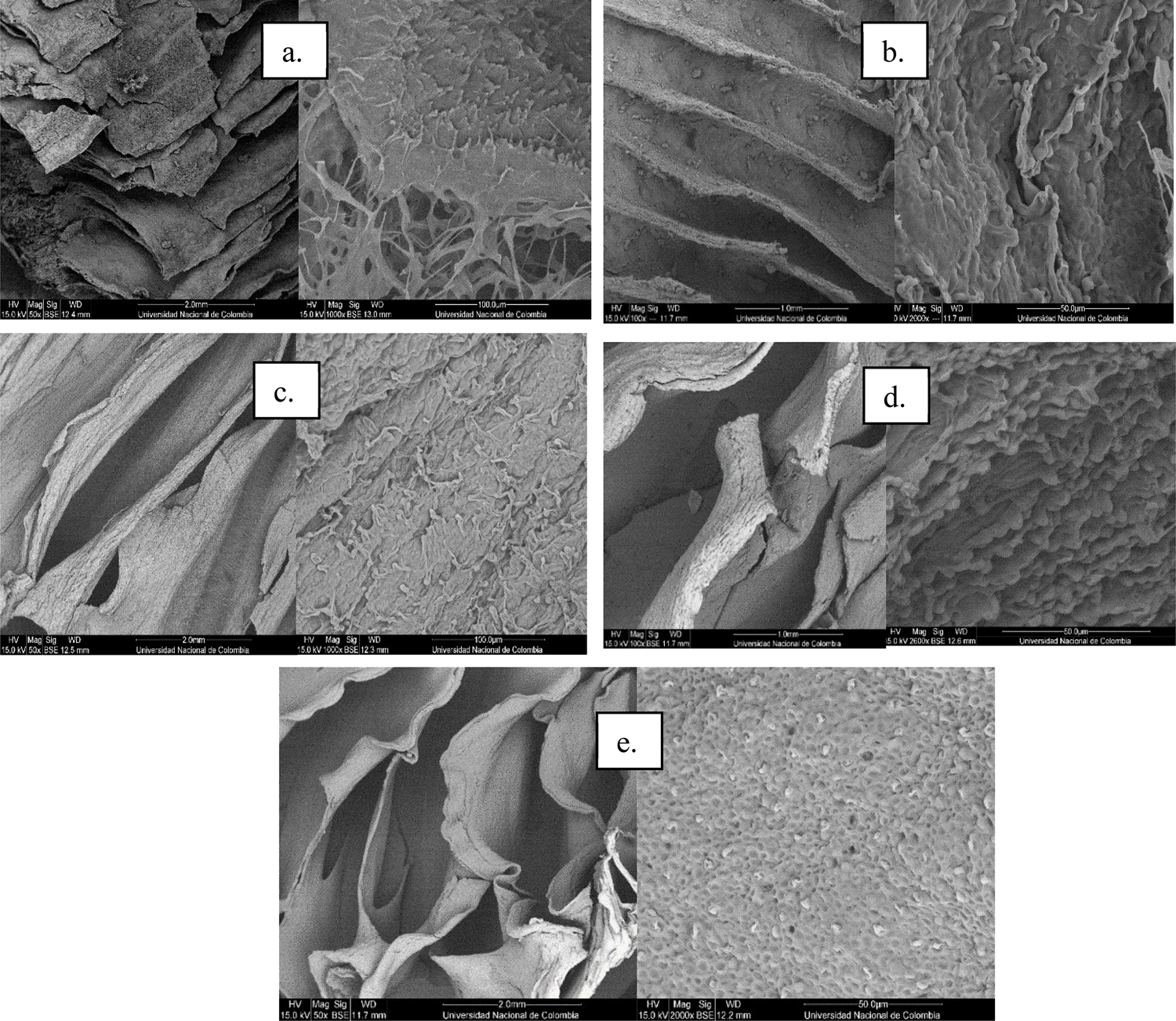
SEM of the dehydrated fungus samples revealed structural differences between the treatments (Figure 2). The micrographs of the lyophilized samples (T1) exhibited less deformation, showing a porous or alveolar structure, in addition to a series of ridges that may correspond to basidia in the terminal part of hyphae (Tian et al., 2016). During lyophilization, the sublimation of ice under high vacuum avoids the effects of shrinkage and preserves the initial porous structure of the material (Keomixay et al., 2019). The T5 samples (RW at 80 °C) also showed many distinguishable pores as a consequence of rapid evaporation of water from the interior to the surface, which avoided structural shrinkage.
: Analysis of the microstructure of P. ostreatus dried by a. T1, lyophilization, b. T2, forced-air oven drying, c. T3, RW at 60 °C, d. T4, RW at 70 °C and e. T5, RW at 80 °C. Images shown at 50× and 1000× magnification.
Oven drying (T2) caused significant changes in the microstructure of P. ostreatus. Figure 2 shows structural and cellular damage, as reflected in the irregular shapes and shrinkage of fungal hyphae, which appear in the micrographs as flattened structures. In the RW treatments at 60 and 70 °C (T3 and T4), less tissue contraction occurred, and the lamellae and basidia are more apparent; however, no pores are visible. The microstructure of the samples dried by RW at 80 °C (T5) was more similar to that of the lyophilized samples, with a greater number of pores and less structural shrinkage. At present, no studies on the microstructure of P. ostreatus dried via RW have been reported. However, comparable results have been reported for mango powder, which exhibited laminates with distinguishable internal pores. This characteristic indicates that when the puree of this matrix is dried, part of the empty space formed during evaporation is not replaced, which increases porosity and improves the rehydration performance of the powder compared with other types of drying (Caparino et al. 2012).
Hardness of dehydrated samples.
The highest hardness values (in Newtons) were obtained for treatments T2, T4 and T5 (Table 2). This can be attributed to moisture elimination, concentration of the components and shrinkage of the structure of the fungi, which, as observed in the microstructure analysis, were more compact and exhibited greater cellular damage compared with the other treatments. The samples dehydrated by lyophilization (T1) presented the lowest hardness values, with an average value of 5.07 +/- 1.85 N, which can be attributed to their high porosity and fragility. Under RW drying, no significant differences were observed between the samples treated at different temperatures. The T2 samples had the highest hardness values because of greater structural damage and surface hardening. In RW drying, some energy transfer between the water and the product occurs via radiation, which results in less structural damage and surface hardening compared with other types of drying. This effect was demonstrated by Robbers (2015), who found that the hardness of kiwi samples dried by RW was much lower than that of samples dried by other methods.
Rehydration ratio (RR).
This parameter was affected by the structural changes (porosity, hardness, shrinkage) in the samples treated by the different drying methods. As indicated in Table 2, treatments T1 and T5 resulted in faster rehydration, and once the samples reached their full rehydration capacity, their size was similar to that of fresh P. ostreatus. This means that these samples had a porous structure capable of absorbing a large amount of water, which is consistent with the results of the microstructure analysis. Oven drying (T2) yielded the lowest RR value due to sample shrinkage and structural damage.
Water activity (Aw)
For fresh P. ostreatus, Aw varied between 0.980 and 0.997, as shown in Table 2; these Aw levels are associated with rapid decomposition of the product after harvest (Ruíz et al., 2010). T1 and T5 resulted in the lowest values of Aw, and the difference between the two treatments was not significant. However, T5 achieved an Aw of 0.29 in 3 h, whereas under lyophilization and oven drying, 24 h was required to reach final Aw values of 0.31 and 0.37, respectively. Kaur et al. (2017) dried mango pulp by RW and obtained an Aw of 0.4 after treatment for 25 min at 95 °C.
Total polyphenol (TP) content in dehydrated samples
Polyphenols are compounds related to the antioxidant effects of many fungi and generally include phenolic acids and flavonoids, followed by tocopherols, ascorbic acid, and carotenoids (Rahimah et al., 2019). Table 2 shows that there were significant differences in TP content between the drying methods. The fresh sample presented the highest TP concentration, while the greatest reduction in TP was observed in treatments T2 and T3, in which the prolonged drying times probably caused deterioration due to oxidation reactions, browning and structural damage (Rahimah et al. 2019).
The smallest reduction in TP content was obtained in the lyophilization treatment (T1) and RW drying at 70 °C (T4) and 80 °C (T5), between which there were no significant differences. Under RW drying, higher temperatures were associated with greater conservation of TP content. This observation was consistent with Abonyi et al. (2022), who reported that the low partial pressure of oxygen in the drying zone due to the high local pressure of water vapor resulting from the rapid evaporation of moisture, combined with a shorter treatment time, prevented the oxidation of phenolic compounds in dehydrated samples and promoted retention of these compounds after heating. However, drying at low temperatures does not inactivate enzymes such as polyphenol oxidase, which can degrade phenolic compounds (Hernández et al., 2016). The above results show that RW drying can preserve bioactive compounds in samples.
Effects of drying treatments on the contents of volatile compounds.
Table 3 shows the variations in volatile compounds in P. ostreatus samples treated by different drying methods.
The main odorous compounds identified in fresh mushrooms are typically C8 compounds. The fresh sample contained 1-octen-3-ol, which is derived from oxygenation and the action of enzymatic complexes on oleic acid and linoleic acid (Tagkouli et al., 2021). 3-Octanone was also detected. These C8 compounds represented 8 and 6.2% of the total concentration of volatile compounds, respectively, and are characteristic of musty, earthy and fruity odors. Similar results were reported by Politowicz et al. (2018). Benzaldehyde (2.5%) is also one of the characteristic volatiles of fungi of the genus Pleurotus; this compound confers fruity and almond-like odors and is derived from the catabolism or oxidative degradation of phenylalanine. Benzaldehyde is present in these fungi, as has also been shown in other studies, such as those by Yin et al. (2019) and Tagkouli et al. (2021).
White rot fungi can degrade lignin, a substituted p-cinnamyl alcohol polymer, and metabolize the resulting monomers into aromatic compounds of interest. In this study, some terpenes, such as p-cymene (4.5%), limonene (3%), 1,8-cineole (16%), citronellal (4%), α-terpineol (4,1%), thymol (6.8%), carvacrol (3.2%), α-terpinyl acetate (6.3%) and terpinen-4-ol (4.5%), were detected in fresh mushrooms. These compounds confer a pleasant camphor aroma, as well as notes of exotic fruits, which can be attributed to the type of substrate used (D'Auria et al., 2014).
In general, treatments T1 and T5 showed the highest retention of volatile compounds with respect to the fresh mushrooms. However, some of these compounds, such as oct-1-en-3-ol, 3-octanone, and 3-octanol, were reduced in content or eliminated. Similar results were also observed by Tagkouli et al. (2021) and Politowicz et al. (2018). Other compounds present in the fresh mushrooms that were lost upon dehydration included furan-2,5-dicarboxaldehyde, 1-octanol, γ-terpinene, linalool, terpinen-4-ol, thymol, and α-terpinyl acetate. According to other studies, the pressure in the drying chamber of the lyophilizer can cause significant losses of volatile compounds to the environment, and volatile compounds can degrade due to the effect of temperature (Politowicz et al., 2018). Some terpenes present in the fresh mushrooms, such as p-cymene, limonene, 1,8-cineole and α-pinene, were present in dry P. ostreatus, with the lowest concentrations observed in the T2 samples. In this study, the samples contained a very high concentration of 1,8-cineole; this molecule is a volatile compound characteristic of eucalyptus, and its presence in P. ostreatus has not been previously reported. The presence of 1,8-cineole is explained by the fact that ground eucalyptus branches were used as a carbon source in the substrate, and the fungus was able to absorb this compound during growth. This demonstrates the high capability of P. ostreatus to capture aromatic compounds from the environment, as reported by Gültepe et al. (2019). This characteristic could be leveraged to assign desirable aromatic characteristics to fungi by incorporating materials that provide these aromas into the substrate.
The dehydration of P. ostreatus also resulted in other compounds at high concentrations. Among them, 2,3-butanediol and 1,3-butanediol were detected in the treatments with lower temperatures and longer drying times. 2,3-Butanediol has a sweet odor and has been found in other studies on the heat treatment of fungi, such as that by Selli et al. (2021). Similarly, the dehydrated samples contained some aldehydes, such as 3-methylbutanal, phenylacetaldehyde and benzaldehyde; the highest relative amounts were observed in the T1 and T5 samples, with the exception of 2-methylbutanal. These compounds, which have also been reported in samples of dehydrated fungi, are derived from isoleucine, leucine, methionine and phenylalanine, which are amino acids that were also detected in the studied fungi (Tagkouli et al., 2021). 3-Methylbutanoic acid, an aliphatic acid, is another aromatic compound that was present in the dehydrated samples, with a relatively high concentration in T2, which resulted in rancid notes (Inga et al., 2019). The presence of this compound may be the result of the prolonged drying time, which can reduce the acceptability of samples treated by forced-air drying.
Bromatological composition.
Different drying methods did not result in significantly different effects on the nutritional composition of P. ostreatus. Therefore, the variations in the concentrations of the compounds can be attributed mainly to the cultivation conditions, primarily including the type of substrate and the type of strain used (Mutukwa et al., 2019; Aishah and Wan Rosli, 2013). The T1 samples exhibited an average moisture content of 7%, similar to that reported previously (Keomixay et al., 2019). Regarding the ash content, a concentration of 9.28 g/100 g was found, related to the mineral content of the fungus, similar to the results of Valencia et al. (2018). This shows that the ash content is important for consumer health due to the high contents of potassium, calcium, magnesium and sodium (Nieto et al., 2019). With respect to the ether extract, a concentration of 6.11 g/100 g was found; this low value is a notable nutritional characteristic of P. ostreatus, since the fungus also contains a high proportion of polyunsaturated fatty acids, which have beneficial effects on health.
In general, fungi use carbon as a source of energy and biomass and use nitrogen to form cellular components such as proteins and nucleic acids. In this study, the protein concentration in T1 was 29.28 g/100 g, similar to the concentration of 31.73% reported by Keomixay et al. (2019) and those reported by Hoa et al. (2015), who used other drying methods.
Carbohydrates represent the largest constituent of Pleurotus species; these components are characterized by a low starch content and a high mannitol content and are important in the diet of diabetic people (Sánchez & Royse, 2017). In this study, a concentration of 47.80 g/100 g was found, similar to that reported in other studies based on the same lyophilization method (Keomixay et al. 2019; Ucar & Karadag, 2019). The fiber content was 7.52 g/100 g. Fungi such as P. ostreatus are characterized by the presence of hemicellulose and chitin, important dietary fibers for people with digestive problems (Sánchez & Royse, 2017).
Conclusions
The effects of different drying methods on the quality of P. ostreatus were compared. Consistent with other studies, the results showed that lyophilization yielded better quality products due to the combined action of freezing and vacuum drying at very low temperature. Moreover, it was verified for the first time that RW drying can be used to dehydrate P. ostreatus hats to obtain a product with low color variation, a visibly porous microstructure that allows easy rehydration and a volatile compound concentration similar to that of the lyophilized product.
Therefore, RW is a suitable alternative for dehydrating P. ostreatus in terms of quality, efficiency and cost as well as in terms of prolonging the shelf life of this highly perishable food, which has represented a scientific and technological challenge. This study also provides useful information for processing industries that involve dehydration by enabling the analysis of different alternatives to select the most appropriate technique for obtaining a high-quality dried product.
Acknowledgments
The authors thank the Vice-Rector for Research, and social interaction (VIIS) of the University of Nariño for financing this research project through agreement No. 159 of October 5, 2018.
References
-
Abonyi B, Feng H, Tang J, Edwards C, Chew B, Mattinson D, Fellman J (2002) Quality retention in strawberry and carrot purees dried with Refractance Window TM system. Journal of Food Science 67 (2): 1051-1056. https://doi.org/10.1111/j.1365-2621.2002.tb09452.x
» https://doi.org/10.1111/j.1365-2621.2002.tb09452.x - Aishah MS, Wan Rosli WI (2013) Effect of different drying techniques on the nutritional values of oyster mushroom ( Pleurotus sajor-caju ). Sains Malaysiana 42 (7): 937-41.
- Arora S, Shivhare U, Ahmed J, Raghavan G (2003) Drying kinetics of Agaricus bisporus and Pleurotus florida mushrooms. American Society of Agricultural Engineering 46: 721-24.
- Caparino O, Tang J, Nindo C I, Sablani S, Powers J, Fellman J (2012) Effect of drying methods on the physical properties and microstructures of mango ( Philippine 'Carabao'var. ) powder. Journal of food engineering 111(1): 135-148.
-
D'Auria M, Racioppi R, Rana G, Laurita A (2014) Studies on volatile organic compounds of some truffles and false truffles. National Production Research 2014, 28: 1709-1717. https://doi.org/10.1080/14786419.2014.940942
» https://doi.org/10.1080/14786419.2014.940942 -
Fu H, Shieh D, Ho C (2002) Antioxidant and free radical scavenging activities of edible mushrooms. Journal of Food Lipids 9 (1): 35-46. https://doi.org/10.1111/j.1745-4522.2002.tb00206.x
» https://doi.org/10.1111/j.1745-4522.2002.tb00206.x -
García Z, Paneque Y, Macías A, Rodríguez D (2022) Comparación de las propiedades antioxidantes del Pleurotus ostreatus antes y después de tratamientos térmicos. Revista Científica Arbitrada de Investigación en Comunicación, Marketing y Empresa REICOMUNICAR 5(9): 221-232. https://doi.org/10.46296/rc.v5i9.0045
» https://doi.org/10.46296/rc.v5i9.0045 - Giri S, Prasad S (2007) Drying kinetics and rehydration characteristics of microwave-vacuum and convective hot-air dried mushrooms. Journal of Food Engineering 78(2): 512-521.
-
Gültepe N, Bufrag S, Abughadyra I, Mohammed K, Alkhunni B (2019) Comparison of some medicinal plants and macrofungi essential oil components for antimicrobial activity against the human and fish pathogens. International Journal of Current Microbiology and Applied Science 8(11): 458-473. https://doi.org/10.20546/ijcmas.2019.811.057
» https://doi.org/10.20546/ijcmas.2019.811.057 -
Hernández B, Martínez C, Torruco J, Rodríguez J, Ruiz I, Vajando E, Herman E (2016) Evaluation of physical and chemical properties of carrots dried by Refractance Window drying. Drying Technology 34(12): 1414-1422. https://doi.org/10.1080/07373937.2015.1118705
» https://doi.org/10.1080/07373937.2015.1118705 -
Hernández López S, Ávalos Vargas A, Zamudio Sánchez FJ, Orozco Gutiérrez G, Borja de la Rosa AM (2021) Colorimetría de los tallos del bambú (Guadua angustifolia) en tres estados de madurez. Maderas, Ciencia y tecnología 23. https://dx.doi.org/10.4067/s0718-221x2021000100408
» https://dx.doi.org/10.4067/s0718-221x2021000100408 -
Hoa H, Wang, Wang H (2015) The effects of different substrates on the growth, yield, and nutritional composition of two oyster mushrooms ( Pleurotus ostreatus and Pleurotus cystidiosus ). Mycobiology 43(4): 423-434. https://doi.org/10.5941/myco.2015.43.4.423
» https://doi.org/10.5941/myco.2015.43.4.423 -
Inga M, García J, Aguilar A, Campos D, Osorio C (2019) Chemical characterization of odour-active volatile compounds during lucuma ( Pouteria lucuma ) fruit ripening. CyTA-Journal of Food 17(1): 494-500. https://doi.org/10.1080/19476337.2019.1593248
» https://doi.org/10.1080/19476337.2019.1593248 - Kaur G, Saha S, Kumari K, Datta A (2017) Mango pulp drying by refractance window method. Agricultural Engineering International: CIGR Journal 19(4):145-151.
- Keomixay P, Nhu T, Van T, Thuy N (2019) Effects of drying and grinding in production of healthy vegetarian soup mix. International Journal of Advances in Agricultural Science and Technology 6(10): 29-39.
-
Koutrotsios G, Kalogeropoulos N, Kaliora A, Zervakis G (2018) Toward an increased functionality in oyster (Pleurotus) mushrooms produced on grape marc or olive mill wastes serving as sources of bioactive compounds. Journal of Agriculture and Food Chemistry 66: 5971-5983. https://doi.org/10.1021/acs.jafc.8b01532.s001
» https://doi.org/10.1021/acs.jafc.8b01532.s001 - Li D, Qin P, Tian J, Wang J (2016) Toughening and its association with the postharvest quality of king oyster mushroom ( Pleurotus eryngii ) stored at low temperature. Food Chemistry 196: 1092-1100.
- Liu Q , Kong W , Hu S , Kang Y , Zhang Y , Ng T (2020) Effects of Oudemansiella radicata polysaccharide on postharvest quality of oyster mushroom ( Pleurotus ostreatus ) and its antifungal activity against Penicillium digitatum. Postharvest Biology and Technology 166: 111207.
-
Mutukwa I, Hall C, Cihacek L, Lee C (2019) Evaluation of drying method and pretreatment effects on the nutritional and antioxidant properties of oyster mushroom ( Pleurotus ostreatus ). Journal of Food Processing and Preservation 43(4): 13910. https://doi.org/10.1111/jfpp.13910
» https://doi.org/10.1111/jfpp.13910 -
Nieto J, Cuzcano Á, Reyes W (2019) Estudio preliminar de la composición nutricional del hongo Pleurotus ostreatus cultivado en pulpa de café. Revista de la Sociedad Química del Perú 85(4): 422-431. https://doi.org/10.37761/rsqp.v85i4.256
» https://doi.org/10.37761/rsqp.v85i4.256 -
Ochoa C, Quintero P, Ayala A, Ortiz M (2012) Drying characteristics of mango slices using the Refractance Window™ technique. Journal of Food engineering, 109(1), 69-75. https://doi.org/10.1016/j.jfoodeng.2011.09.032
» https://doi.org/10.1016/j.jfoodeng.2011.09.032 - Pascual L, Hernández A, Castillo M, Uzárraga R, Rascón M, Flores E (2021) Effect of water activity on the stability of freeze-dried oyster mushroom ( Pleurotus ostreatus ) powder. Drying Technology 39(8): 989-1002.
- Piskov S , Timchenko L , Grimm W , Rzhepakovsky I , Avanesyan S , Sizonenko M , Kurchenko V (2020) Effects of various drying methods on some physico-chemical properties and the antioxidant profile and ACE inhibition activity of oyster mushrooms ( Pleurotus ostreatus ). Foods 9(2): 160.
-
Politowicz J, Lech K, Sánchez L, Figiel A, Szumny A, Grubor M, Carbonell A (2018) Volatile composition and sensory profile of oyster mushroom as affected by drying method. Drying Technology 36(6): 685-696. https://doi.org/10.1080/07373937.2016.1274903
» https://doi.org/10.1080/07373937.2016.1274903 -
Rahimah S, Djunaedi D, Soeroto A, Bisri T (2019) The phytochemical screening, total phenolic contents and antioxidant activities in vitro of white oyster mushroom ( Pleurotus ostreatus ) preparations. Open access Macedonian journal of medical sciences 7(15): 2404. https://doi.org/10.3889/oamjms.2019.741
» https://doi.org/10.3889/oamjms.2019.741 -
Robbers M (2015) Osmotic convective dehydrofreezing process for drying kiwifruit. Journal food science 62: 1039-1047. https://doi.org/10.1111/j.1365-2621.1997.tb15033.x
» https://doi.org/10.1111/j.1365-2621.1997.tb15033.x - Ruíz M, Cortés M, Henríquez L (2010) Efecto de dos atmósferas de empaque en hongos comestibles ( Pleurotus ostreatus L. ) tratados mediante impregnación a vacío con una solución conservante. Vitae 17(1): 11-19.
- Sánchez J, Royse D (2017) Producción mundial de setas Pleurotus spp. con énfasis en países iberoamericanos. La biología, el cultivo y las propiedades nutricionales y medicinales de las setas Pleurotus spp. El Colegio de la Frontera Sur. Tapachula, 17-25.
-
Selli S , Guclu G , Sevindik O , Kelebek H (2021) Variations in the key aroma and phenolic compounds of champignon ( Agaricus bisporus ) and oyster ( Pleurotus ostreatus ) mushrooms after two cooking treatments as elucidated by GC-MS-O and LC-DAD-ESI-MS/MS. Food Chemistry 354: 129576. https://doi.org/10.1016/j.foodchem.2021.129576
» https://doi.org/10.1016/j.foodchem.2021.129576 -
Tagkouli D, Bekiaris G, Pantazi S, Anastasopoulou M, Koutrotsios G, Mallouchos A, Kalogeropoulos N (2021) Volatile Profiling of Pleurotus eryngii and Pleurotus ostreatus cultivated on Agricultural and Agro-Industrial By-Products. Foods 10(6): 1287. https://doi.org/10.3390/foods10061287
» https://doi.org/10.3390/foods10061287 - Tian Y, Zhao Y, Huang J, Zeng H, Zheng B (2016) Effects of different drying methods on the product quality and volatile compounds of whole shiitake mushrooms. Food Chemistry 197: 714-722.
- Trivedi M, D'Costa V, Shitud J, Srivastav S (2017) Refractance Window Technology - A promising drying technique for the food industry. International Journal of Innovative and Emerging Research in Engineering 4(1): 6- 16.
-
Tsiantas K, Tsiaka T, Koutrotsios G, Siapi E, Zervakis G, Kalogeropoulos N, Zoumpoulakis P (2021) On the identification and quantification of ergothioneine and lovastatin in various mushroom species: Assets and challenges of different analytical approaches. Molecules 26(7): 1832. https://doi.org/10.3390/molecules26071832
» https://doi.org/10.3390/molecules26071832 - Ucar T, Karadag A (2019) The effects of vacuum and freeze-drying on the physicochemical properties and in vitro digestibility of phenolics in oyster mushroom ( Pleurotus ostreatus ). Journal of Food Measurement and Characterization 13(3): 2298-2309.
-
Valencia I, Dolores A, Huerta M, Romero O (2018) Carrizo silvestre ( Arundo donax ) como sustrato alternativo en la producción de Pleurotus ostreatus. Scientia fungorum 48: 15-22. https://doi.org/10.33885/sf.2018.48.1231
» https://doi.org/10.33885/sf.2018.48.1231 -
Vignoni L, Césari R, Forte M, Mirábile M (2006) Determinación de índice de color en ajo picado. Información tecnológica 17(6): 63-67. https://doi.org/10.4067/s0718-07642006000600011
» https://doi.org/10.4067/s0718-07642006000600011 -
Yin C, Fan X, Fan Z, Shi D, Yao F, Gao H (2019) Comparison of non-volatile and volatile flavor compounds in six Pleurotus mushrooms. Journal of the Science of Food and Agriculture 99(4): 1691-1699. https://doi.org/10.1002/jsfa.9358
» https://doi.org/10.1002/jsfa.9358
Edited by
-
Area Editor:
Paulo Carteri Coradi