Quantitative analysis and prediction of the damage characteristics of potatoes
Abstract
The conflict between operational efficiency and mechanical damage to tubers that arises during mechanical potato harvesting has become increasingly pronounced. This study investigated collision damage to potatoes using numerical simulation, and a damage prediction model was developed. We first conducted sampling and parameter determination through laboratory experiments, and a high-fidelity 3D geometric model was then reconstructed via reverse engineering. Following this, a multi-factor explicit dynamic simulation scenario was established in which the effects of the mass of the tuber, drop height, and impact angle on the damage characteristics were systematically analysed. Finally, a second-order response surface regression model incorporating three-factor interaction effects was developed using response surface methodology, based on the simulation data. Experimental results demonstrated that the quadratic response surface model achieved a high predictive accuracy for both the collision force and area of damage (R2 > 0.92), with prediction errors ranging from 1.54% to 25.22%. The optimal combination of parameters (a tuber mass of 320 g, an impact angle of 30°, and a drop height of 36.8 cm) was obtained through multi-objective optimisation, and reduced the collision force and area of bruising by 26.14% and 50.83%, respectively. The proposed damage prediction model was validated as reasonable and effective, and provides a theoretical basis for low-damage structural design and optimisation of separation systems in potato harvesters.
Keywords:
potato; impact damage; reverse engineering; explicit dynamics simulation; low-damage harvesting
Introduction
Potatoes are the fourth most important food crop globally, and play an essential role in ensuring global food security (Buono et al., 2009; Vescovo et al., 2025). In recent years, the area used to cultivate this crop has been continuously expanding, which has effectively eased the pressure on the grain supply (Lopes et al., 2023; Wu et al., 2024). However, following the rapid advancement of mechanised harvesting, the mechanical damage caused by impacts and collisions during harvest and postharvest handling has become a primary determinant of the quality and storability of potatoes (Bao et al., 2021; Fang et al., 2025; Zimmermann et al., 2023). Thus, systematic research on the mechanics of potato impact damage and the development of prediction models for the interaction between the crop and machine are crucial. Such models not only provide quantitative clarification of how operational parameters (e.g. drop height, impact angle, conveying speed) affect damage but also provide a solid scientific basis for the optimal design of key components in harvesting machinery, thereby improving operational efficiency and reducing postharvest losses (Zhu et al., 2025).
Various modeling paradigms have been developed in recent years to predict mechanical damage to major horticultural crops such as apples, pears, tomatoes, and sweet potatoes. Ji et al. (2015) represented the apple as an isotropic hyperelastic body in their research, and combined the finite element method (FEM) with robotic grasping experiments to obtain a precise correlation between contact force and the threshold for internal damage. Chen et al. (2025) extended this approach by integrating reverse engineering with FEM to create a predictive model for drop-induced damage in apples. In their research into sweet potatoes, Liu (2021) used the response surface methodology (RSM) with physical experiments to establish a quadratic regression model with the damaged surface area as the response variable. These methods offer two main benefits: firstly, they allow data-driven empirical analysis to be combined with mechanistic simulation, meaning that a balance between physical accuracy and computational speed can be found; and secondly, they represent multi-factor interactions explicitly, which allows for the analysis of nonlinear coupling effects and has shown significant promise for engineering applications.
In previous studies, researchers have thoroughly explored the different experimental variables that affect potato impact damage, such as the mass of the potato, drop height, cultivar, coefficient of restitution, and firmness (Feng et al., 2019; Xie et al., 2020; Xin et al., 2020). Meng et al. (2022) investigated the impact of the drop height and contact material on the coefficient of restitution through experiments. Chen et al. (2020) carried out extensive analyses of the mechanical properties and stress distributions for potato impacts. Zhao et al. (2024) introduced innovative soil-inclusive and soil-free test conditions, created a comprehensive damage index, and analysed multiple factors to find the best parameter combinations. Their approach was empirical, and lacked support from high-fidelity mechanistic models such as FEM or the discrete element method (DEM). These authors did not establish a transferable, generalised predictive framework, which limited the capacity of this approach for proactive design. Similarly, Shen et al. (2024) determined the mechanical properties and damage threshold of the ‘Kexin No. 1’ potato but relied on a simplified spherical model with a radius of 35 mm, which could not accurately capture the true stress concentration effects arising from the irregular surface morphology of a real tuber. Deng et al. (2021) used FEM to model collisions between potatoes and rod separators, with a focus on individual factors such as the rod diameter, but did not carry out a comprehensive analysis of the combined influences of the mass, drop height, and the angle of impact surface inclination. Wang et al. (2024) proposed a novel disturbance-based separation structure, although an underlying mechanistic model was lacking from their research. The optimisation process applied by these authors relied on trial-and-error experimentation, which hindered the realisation of parametric design. Similarly, Jin (2023) developed a test platform for parameter measurement but did not establish a corresponding predictive model, meaning that structural optimisation based on simulation or prediction was not possible. Taken together, these studies highlight an important gap: despite significant advancements in the understanding of individual factors and empirical relationships, a unified, physics-based, and scalable modeling framework for predicting potato damage that incorporates geometric accuracy, multi-body dynamics, and multi-factor interactions is absent.
To address this critical gap, a novel strategy is adopted in this study that involves focusing on the collision between a single potato and the sieve rods, with the aim of eliminating the confounding influences of soil buffering, tuber-tuber interactions, and the dynamic separation sieves. Numerical simulation is employed to determine the characteristic parameters of collision damage between potatoes and the harvester sieve surface, and a predictive model for these damage characteristics is established. The following approaches are used: (i) the conventional spherical simplification is abandoned, mechanical parameters are experimentally determined, and a 3D geometric model is reconstructed using reverse engineering techniques; (ii) an explicit dynamic simulation is carried out to investigate the damage characteristics and spatial distribution of potatoes under single-factor collision scenarios; and (iii) a response surface prediction model is developed based on simulation data to explore the response patterns of damage features to the main influencing factors, and the accuracy of the model is validated through comparative experiments. This study overcomes the limitations of existing research arising from geometric distortion, single-factor analysis, and the lack of predictive models, thereby bridging the gap between high-fidelity simulation and practical harvester design and providing theoretical support for the design and optimisation of low-damage separation structures for potato harvesters.
Material and Methods
‘Kexin No. 1’ is a domestically bred potato variety in China that is characterised by high yield and strong adaptability. The tubers approach maturity between September and October, with a moisture content ranging from 76% to 79%. For this study, samples were manually harvested, and 300 fresh, uniformly sized potatoes (252–588 ± 10 g) were selected for parameter determination, finite element modelling, and collision experiments.
Determination of Morphological and Structural Parameters
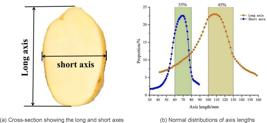
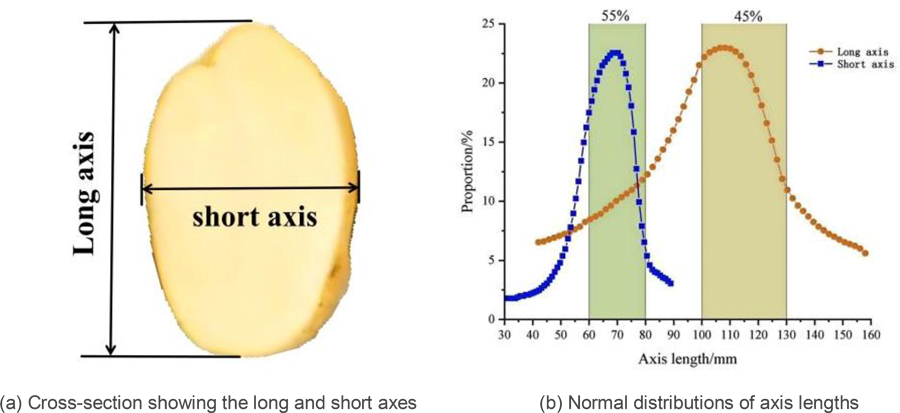
The experimental apparatus included a Xifeng electronic vernier caliper (accuracy: 0.02 mm). A random sample of 100 tubers was selected to measure their geometric dimensions (Figure 1a). Statistical analysis revealed that approximately 55% of the minor diameters were clustered within the range 60–80 mm, while about 45% of the major diameters fell within the range 100–130 mm (Figure 1b). The mean values were adopted as the geometric parameters for FEM.
Determination of Material Properties
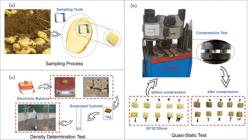
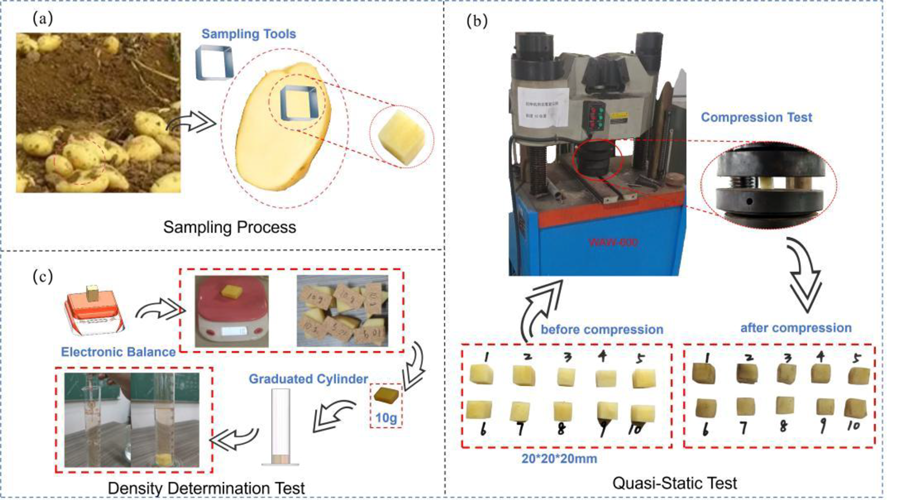
Quasi-static uniaxial compression–tension tests were conducted to determine the ultimate strength and elastic modulus of the potato tubers. The experiments were performed using a TENSON WAW-600 microcomputer-controlled electro-hydraulic servo universal testing machine, with a maximum load capacity of 600 kN, a sampling frequency of 50 Hz, a loading and unloading speed of 3 mm/min for the gripping system, and a deformation measurement accuracy of ±0.5% FS. A compression platen with a diameter of 150 mm was employed, which applied a preload correction of 10 kN at a constant compression rate of 3 mm/min to cuboidal potato samples (20 × 20 × 20 mm) (Figure 2a). The test was repeated 10 times to obtain characteristic force–displacement curves. Immediately after unloading, the lateral and radial deformations were measured and their mean values were recorded. The elastic modulus, shear modulus, and Poisson’s ratio were then calculated using eqs (1), (2), and (3), respectively. Density was determined via the water displacement method: 10 samples of 10 g of potato were weighed (precision: 0.1 g) and their volumes were measured using a graduated cylinder (precision: 1 mL). The process is illustrated in Figure 2c, and the density was calculated using [eq. (4)].
Where:
E - Elastic modulus (MPa);
ε - Linear strain;
ε′ - Shear strain;
F - Force (kN);
A - Cross-sectional area (mm2);
G - Shear modulus (MPa);
μ - Poisson’s ratio;
L - Length (mm);
ΔL - Length deformation (mm);
ρ - Density (kg/m3);
M - Mass (kg);
V - Volume (m3).
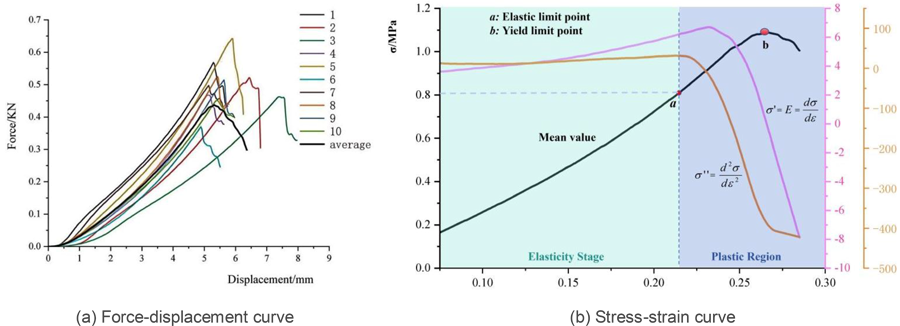
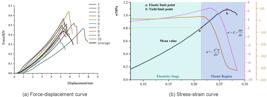
The characteristic curve for the displacement force (Figure 3a) was obtained through quasi-static compression tests (Figure 2b). During the compression process, as the indenter made contact with the potato specimen and displacement increased, the curve for the applied force showed an initial linear rise, indicating that the potato was in the elastic deformation stage. At this stage, only minor, acceptable damage occurs, at a level typical of that encountered during harvesting and transport, and this does not result in significant quality loss. As the compressive force continued to increase, the potato sample began to sustain irreversible damage; the corresponding stress value was identified as the damage threshold for subsequent finite element simulations. Further loading led the specimen to its ultimate failure point, where pronounced plastic deformation and extensive tissue dehydration were observed. Following peak load, the force decreased as the sample fractured. Severe damage at this level should be avoided during actual harvesting operations. The damage threshold was defined as the stress at the onset of nonlinearity in the stress–strain curve, where irreversible tissue deformation begins; this value was determined as approximately 0.81 MPa from quasi-static compression tests (Figure 3b), and was used as the damage threshold for subsequent simulations.
The material properties determined through this procedure (Table 1) provide the essential mechanical basis for damage prediction and quantification in the finite element model.
Construction of the Geometric Model
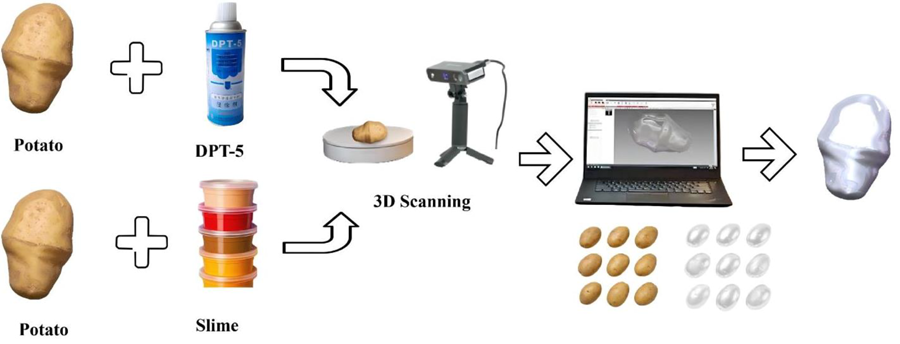
The surface of a potato is geometrically irregular, and its complex curvature significantly influences the distribution of stress concentration. To capture this morphology accurately, a tuber sample was randomly selected, and a 3D model was reconstructed using 3D reverse engineering techniques. Owing to the difficulty in directly measuring the surface curvature parameters, a silicone moulding technique was first employed to replicate the tuber geometry, followed by scanning with a Konca 3D DS2 scanner. To enhance the fidelity of the scanning process, particularly for non-reflective surfaces, a contrast agent (DPT-5) was applied or the tuber was wrapped in space clay to improve the signal-to-noise ratio. Scans obtained under these conditions were subjected to a comparative evaluation to ensure geometric accuracy. The acquired point cloud data were processed using FlexScan3D v4.0 software, exported as an .stl file, and subsequently reconstructed into a solid model in SolidWorks 2023. The final model was saved in .x_t format (Figure 4) and used to quantify the main geometric parameters of the potato, as summarised in Table 2.

Finite Element Simulation Experiment
Settings for the Drop Simulation
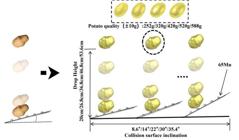
During potato harvesting, collisions between tubers and the separation sieve of the harvester are inevitable. To investigate the influence of the mass of the tuber, the drop height, and the impact angle on damage during freefall, the collision process was simulated using the Explicit Dynamics module in ANSYS. In this simulation, the potato was modelled as an elastoplastic body, with the material parameters determined in Section 1.2 as the initial conditions, and was assumed to exhibit isotropic hardening behaviour. Given the highly irregular surface geometry of the tuber, tetrahedral elements were employed for mesh generation and local refinement of the finite element model. The sieve rods of the harvester were made of 65Mn spring steel and idealised as rigid bodies with fixed constraints. Since the deformation of the sieve surface was neglected in subsequent analyses, a coarse mesh sufficed for this component. The primary material properties of the sieve rods are summarised in Table 3.
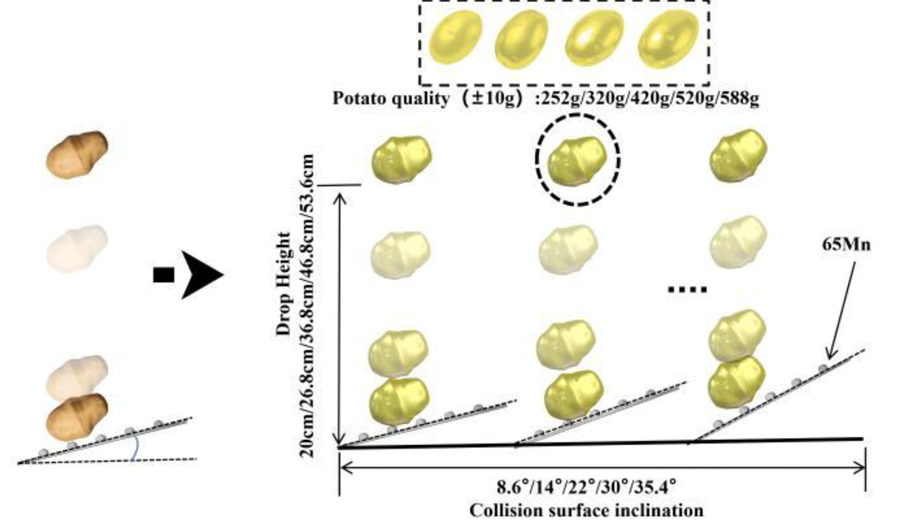
Based on the operational conditions of potato harvesting, a simulation scenario was configured with a full factorial combination of three key variables. Varying values of the impact surface inclination angle (8.6°, 10°, 14°, 18°, 22°, 26°, 30°, 35.4°), drop height (10, 20, 20.8, 30, 36.8, 40, 46.8, and 53.6 cm), and tuber mass (252, 320, 420, 520, and 588 g) were implemented to investigate their interactive effects on collision-induced damage.
To ensure the efficiency of the simulation, a constant coefficient of friction of 0.4 was assigned at the contact interface between the tuber and the sieve surface, and the total duration of the simulation was set to 20 ms. The outputs included the total deformation, equivalent strain, and equivalent stress, which were used to characterise the mechanical response of the tuber during impact. A schematic illustration of the simulation setup is shown in Figure 5.
Extraction and Quantification of Damage Features
Upon completion of the simulation experiment, the finite element model of the potato was analysed to determine the collision force and the stress cloud map. Given the nonlinear characteristics of the impact process, the equivalent stress and the damage area corresponding to the equivalent stress were used as indicators for the assessment of damage. The direct analytical relationship between the damage area and surface curvature proved to be complex, but a theoretical framework was established based on the principle of stress concentration. To enable accurate quantification of the damage, the area corresponding to 0.81 MPa was extracted in conjunction with the stress cloud map in ANSYS, thereby defining the damage area.
The total area of damage Sdamage was conceptualised as an integral over the contact area Ω, where each microarea element contributed to the total damage based on its local stress σ and curvature κ. This relationship was mathematically expressed as shown in [eq. (5)]:
Where:
Sdamage - Total damaged area;
Ω - Contact area between the potato and the stem;
σ - Equivalent stress at the contact point;
σthreshold - Damage threshold (0.81 MPa);
I(σ > σthreshold) - Indicator function, 1.
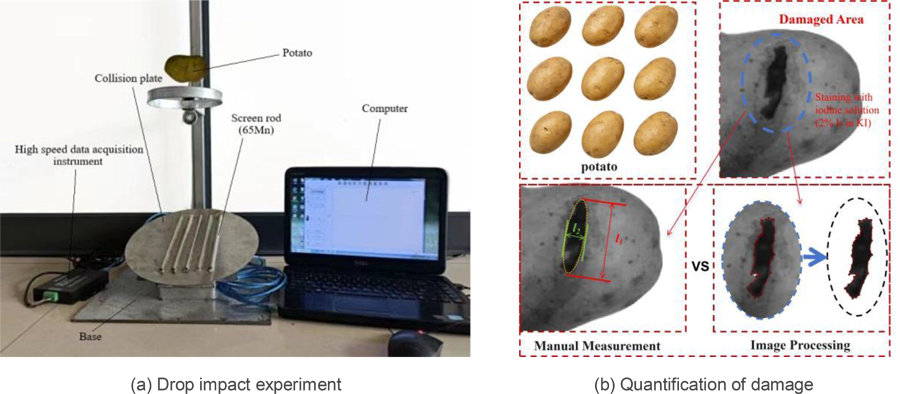
To validate the accuracy of the prediction model for collision damage, a laboratory-based drop impact experiment was conducted. The experimental apparatus primarily consisted of a potato drop test rig, a force sensor (model NOS-F306; rated load 300 kg; comprehensive error ≤0.5% FS; zero balance ±1.0%), a high-speed data acquisition system (model NOS-FVA200, sampling frequency ≤30 kHz), and a computer. The potato drop test rig comprised a support frame, base, separation screen rods (diameter 2 mm, material 65Mn steel), and supporting structures, as illustrated in Figure 6a.
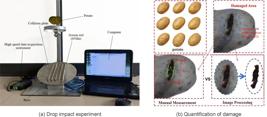
Photograph of the drop impact experiment and illustration of the quantification of damage characteristics.
After the drop impact, the contact surface of each potato was uniformly coated with an iodine solution (2% I2 in KI) and left to incubate for 24 hours at a constant temperature of 25°C in darkness, to allow for full development of the damaged areas (Pathare & Al-Dairi, 2021), which appear as distinct blue-black regions (Figure 6b). The major and minor axes of the stained area of damage were measured, and the area was calculated using [eq. (6)]:
Where:
Sa - Damaged area, cm2;
l1 - Major axis of the damaged region, cm;
l2 - Minor axis of the damaged region, cm.
To reduce human-induced measurement error, an image-based validation approach was implemented. High-resolution digital images of the damaged potato surfaces were captured vertically under a standardised light source (D65 illuminant, 1000 lux) using a Canon EOS 5D Mark IV camera (6720 × 4480 pixels, focal length 50 mm, aperture f/5.6) to ensure distortion-free and shadow-free imaging. The images were processed in MATLAB R2022b to automatically compute the damaged area (Figure 6b). A threshold was applied to segment the stained regions based on the HSV colour space, with criteria set as H ∈ [100, 140] and S > 0.3. To calibrate the spatial resolution, standard graph paper (10 × 10 mm) was imaged under identical conditions, yielding a pixel-to-area conversion factor of 1 pixel = 0.0625 mm2 (i.e. an image resolution of 4 pixels/mm). The area of damage (mm2) was calculated by multiplying the total number of black pixels in the final binary image by the area per pixel. For each sample, images were acquired from three different orientations, with three independent measurements per orientation, and the final reported value was taken as the average of these replicates to minimise operator bias and positional variability. This automated quantification method was validated against manual contour delineation by experienced observers, with a relative error of less than 5%. An image-based approach was employed to quantify the damaged area.
Results and Discussion
Finite Element Results and Analysis
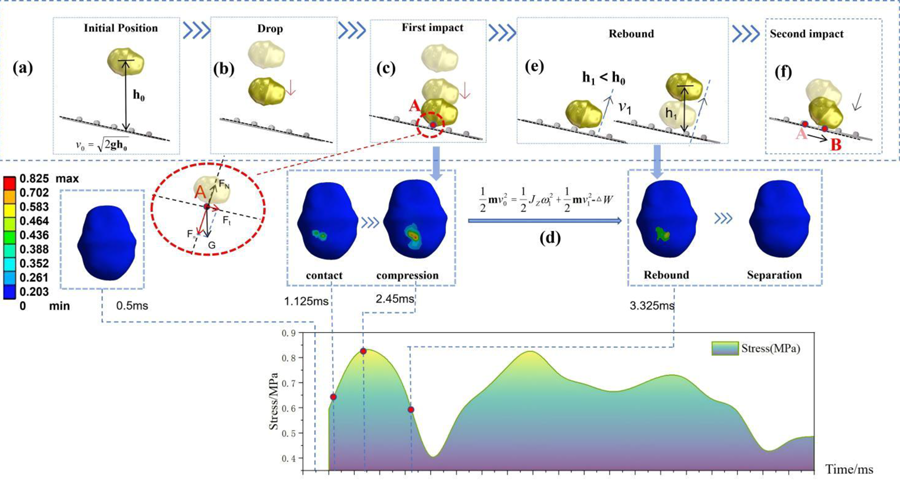
During the process of mechanised harvesting, potatoes sustain mechanical damage due to collisions with machinery. To clarify the patterns of stress variation in potatoes during these collisions, a dynamic collision system between potatoes and screen rods was established with individual potatoes as the basic unit (Caglayan et al., 2018). Three relevant factors affecting the damage characteristics were analysed. Figure 7 shows the variations in the motion state, the surface equivalent stress, and a stress nephogram for a potato with a mass of 420 g, a drop height of 36.8 cm, and a collision angle of 22°, where the damaged area can be clearly observed from the stress nephogram. The entire process (Figure 7a) involves the potato undergoing freefall (Figure 7b), collision contact and compressive deformation (Figure 7c), and rebound (Figure 7e). During the dropping process, gravitational potential energy is converted into kinetic energy, which conforms to the momentum theorem, as shown in the equation in Figure 7d. After coming into contact with the screen rods, the potato is gradually compressed, and its kinetic energy is rapidly converted into internal energy, resulting in elastic compressive deformation in local parts of the tuber. The equivalent stress generated at this stage reaches the peak value, which is the critical moment for mechanical damage. Hence, the damage threshold of potatoes falls within this stage. To enable a study of the damaged area, the region in which the equivalent stress exceeded 0.81 MPa during the simulation was defined as the damaged area of the potato after collision.
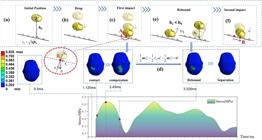
Schematic illustration of the equivalent stress distribution and motion state of a potato during collision under specific conditions.
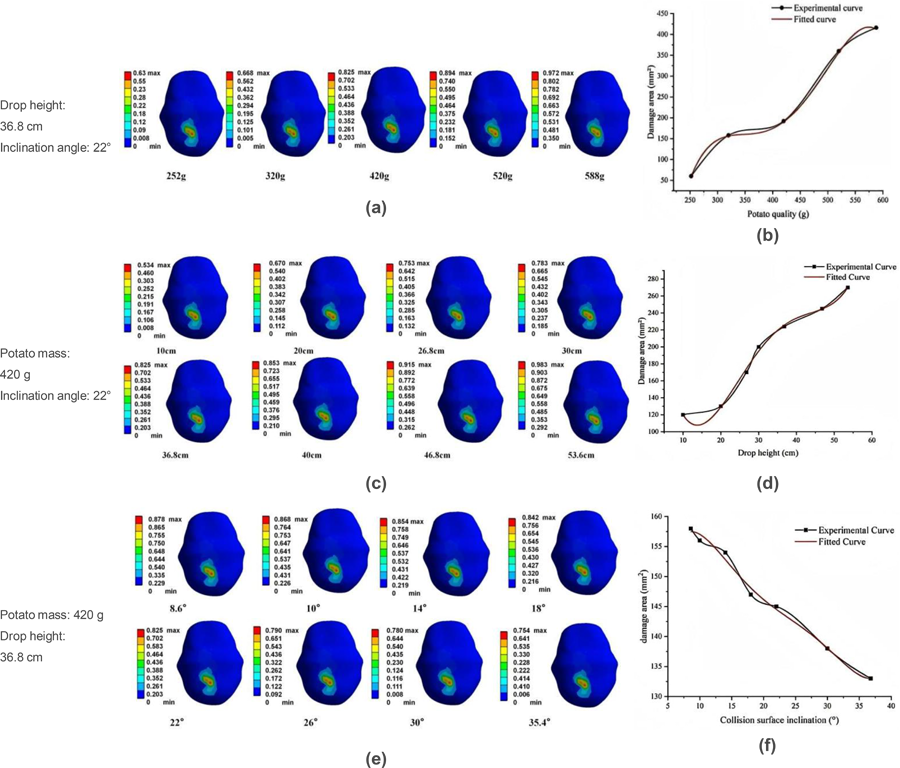
To investigate the influence of the potato’s mass on the damage characteristics, fixed values of the drop height (36.8 cm) and collision surface inclination angle (22°) were selected from the simulation experiments to explore the relationship between the damage characteristics and mass variation. As shown in Figure 8a, as the mass was increased from 252 to 588 g, the maximum equivalent stress gradually rose from 0.630 to 0.972 MPa, corresponding to an increase of 54.28%. This suggests that the greater the mass, the higher the equivalent stress and the larger the area of skin damage, thus increasing the risk of mechanical damage. Figure 8b illustrates the variation in the area of damage to potatoes with different masses during the drop collision process. The simulation data and the fitting curve based on a fourth-order polynomial (Equation (7)) with R2 = 0.99958 show that the damaged area undergoes a nonlinear growth trend with increasing mass, increasing from 66 mm2 at 252 g to 420 mm2 at 588 g, representing an increase of 536%. During the dropping process, when the potato collides with multiple rods, its momentum increases, leading to an increase in the damaged area from the first collision. Subsequent secondary and multiple collisions occur, and the area of damage shows a nonlinear growth with an increase in the mass of the potato.
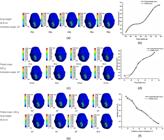
The damage characteristics are also significantly influenced by the drop height. To isolate this effect, simulation experiments were conducted with fixed values for the potato mass (420 g) and impact surface inclination angle (22°). As shown in Figure 8c, the drop height has the most pronounced effect on potato damage: when the height is increased from 10 cm to 53.6 cm, the peak von Mises stress rises from approximately 0.534 to 0.983 MPa, i.e. nearly doubling. The change in the damaged area closely mirrors this stress response, as illustrated in Figure 8d. A fifth-order polynomial fit (Equation (8)) to the simulation data yields an excellent coefficient of determination (R2 = 0.9954), confirming a monotonic increase in the area of damage with the drop height. Specifically, the damaged area increases from 122 mm2at 10 cm to 270 mm2 at 53.6 cm, corresponding to an increase of 121.3%.
The damage characteristics are also influenced by the inclination angle of the impact surface. To isolate this effect, simulation experiments were conducted for fixed values of the potato mass (420 g) and drop height (36.8 cm). As shown in Figure 8e, as the inclination angle is increased from 8.6° to 35.4°, the peak von Mises (equivalent) stress decreases from 0.878 to 0.754 MPa, representing a reduction of 14.12%. Stress concentration consistently occurs in the localised region where the potato first comes into contact with the sieve rod. The variation in the damaged area closely follows this stress trend, as depicted in Figure 8f. A fifth-order polynomial fit (Equation (9)) to the simulation data yields a high coefficient of determination (R2 = 0.953), confirming a monotonic decrease in the damaged area with increasing inclination angle. Specifically, the damaged area declines from 158 mm2 at 8.6° to 132 mm2at 35.4°, a reduction of 16.5%.
These findings indicate that increasing the collision surface inclination angle effectively mitigates potato bouncing behaviour, thereby reducing the number of secondary impacts and lowering the risk of cumulative mechanical damage during handling.
Results of Response Surface Analysis
Section 3.1 described the study of the effects of single factors on the variation in the damage characteristics of potatoes during collision. However, in natural environments, the conditions are not single and constant. To verify the effects of multiple factors on the damage characteristics of potatoes, several values of the inclination angle of the collision surface (8.6°, 14°, 22°, 30°, 35.4°), drop height (20 cm, 26.8 cm, 36.8 cm, 46.8 cm, 53.6 cm), and potato mass (252 g, 320 g, 420 g, 520 g, 588 g) were considered as the experimental factors, with the equivalent stress and damaged area as the response indicators. An RSM design with three factors, five levels and two response indicators was adopted. A total of 20 corresponding sets of simulation data were selected to establish quadratic regression equations, in order to investigate the effects of the interaction between various factors on the damage indicators. The combinations of simulation data are shown in Table 4.
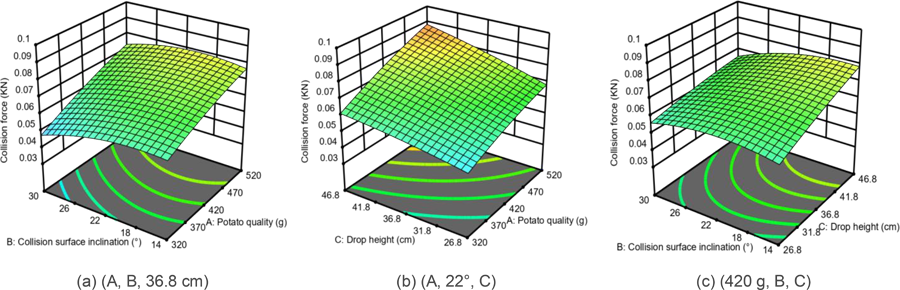
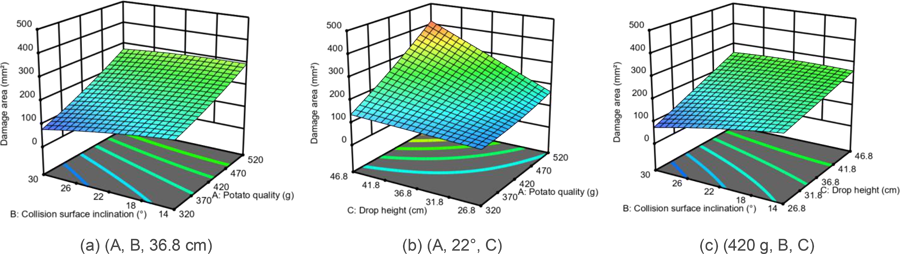
On this basis, with the peak collision force and damage area as the evaluation indicators, RSM was adopted to establish the corresponding prediction models and response surface plots (Figures 9 and 10). The accuracy of the prediction models was assessed based on the coefficient of determination (R2). Equations (10) and (11) represent the prediction models for collision force and damage area, respectively. The R2 values for the two models were 0.9308 and 0.9247, respectively, indicating that the regression models could explain 92.47% of the variation in the response values.

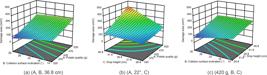
An analysis of variance (ANOVA) for the impact force and damaged surface area (Table 5) showed that the P-values of the two regression models were 0.0001 and 0.0002, respectively; both values were well below 0.01, indicating that the two models were highly significant. Moreover, the P values for both models exceeded 0.05, confirming that the experimental data fitted the quadratic regression equations well. The relative influence of these individual factors on the impact force followed the order A > C > B, and the same ranking applied to the damaged surface area. Notably, the interaction term between the mass and drop height (AC) was found to have a statistically significant effect on the damage area (P = 0.0029), suggesting that potatoes with larger mass subjected to greater drop heights experience a substantial increase in kinetic energy, leading to higher residual energy during secondary impacts and resulting in a superlinear increase in the damage area. The coefficients of determination (R2) for the two models were 0.9308 and 0.9247, respectively, indicating that the models accounted for over 92.47% of the variability in the response values.
To evaluate the discrepancy between the results from the multi-factor potato damage prediction model and the empirical values, a series of validation trials were carried out using the same parameter combinations as in the simulations.
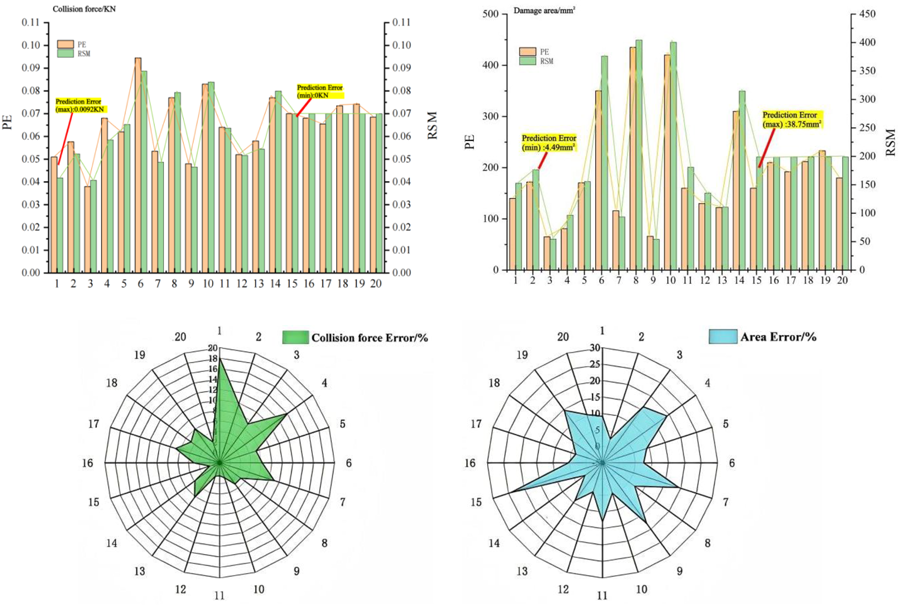
Through a comparative analysis of the outputs from the prediction model and physical experimental results in Table 6, it was found that the maximum prediction error in the collision force was 0.009 kN. For the damaged area, the maximum and minimum prediction errors were 38.75 and 4.49 mm2, respectively. This discrepancy was primarily attributed to inaccuracies in the dyeing process and subsequent boundary identification following impact-induced injury (Figure 11).
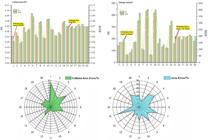
Comparison of results from physical experiment (PE), response surface methodology (RSM), and finite element method (FEM).
Nevertheless, the overall prediction errors remained within an acceptable range. The two models exhibited error ranges of 0–18.10% and 1.54–24.22%, respectively. When the inherent numerical uncertainty associated with extracting the damage boundary during the post-impact dyeing and identification procedure is taken into account, it seems likely that the true error for the prediction models was slightly lower than for the calculated values. In this study, the error between the experimental and predicted values for the damage characteristics of “Kexin No. 1” potatoes was 1.54–25.22%, a narrower range than that reported for the apple damage sensitivity prediction model developed by Chen et al. (2025), which was 1.05–33.33%. This comparative analysis confirms that the collision damage prediction model established here for ‘Kexin No. 1’ potatoes is both reliable and valid.
Parameter Optimisation and Validation
To minimise the drop-induced damage to potatoes, the RSMs for the impact force and damaged surface area were analysed to identify the optimal combination of experimental factor levels. Constraint conditions linking the evaluation metrics to the design variables were established as shown in [eq. (12)] (Liu, et al., 2022), and the optimisation module in Design-Expert software was employed to solve the regression models:
Within the defined parameter ranges, the software identified the optimal combination in terms of minimising both the impact force and damaged area as follows: potato mass 320 g, impact surface inclination 30°, drop height 36.8 cm. This set of parameters yielded the minimum predicted values of 0.0475 kN for the impact force and 76.84 mm2 for damaged surface area.
To validate the reliability of this optimal parameter set, a physical bench test was conducted. Although the ideal drop height (36.80 cm) required precision to two decimal places, the practical conditions of the test rig limited the adjustability to one decimal place, and the validated configuration was as follows: 320 g, 30°, and 36.8 cm. A total of 15 drop impact trials were performed, combining runs from Table 5 and the optimised condition. The average measured values were 0.0517 kN for the impact force and 97.25 mm2 for the damaged area. The relative errors between the experimental averages and the theoretically optimised values are summarised in Table 7.
Before optimisation, the combination of parameters for the experimental potato drop test was as follows: average mass 420 g, impact surface inclination 22°, and drop height 36.8 cm. The experimental results before and after optimisation are compared in Table 7.
As can be seen from Tables 7 and 8, the experimental results agree well with the theoretical optimised values, with a small relative error, indicating that the optimal parameter combination has a high level of reliability. A comparison of results before and after optimisation shows that the collision force and damaged area were reduced by 26.14% and 50.83%, respectively, representing full verification of the effectiveness of this parameter combination in terms of damage reduction.
The optimised parameter values were also compared with values given in the literature for commonly available commercial models, through a comparative drop-impact validation using a test bench. Potatoes with a mass of 320 ± 10 g were selected from the sample set as test subjects, and the results are presented in Table 9.
Experimental comparison between the optimised parameter values obtained in this study and the parameters of mainstream potato harvesters.
The optimised parameter values were also compared with values given in the literature for commonly available commercial models, through a comparative drop-impact validation using a test bench. Potatoes with a mass of 320 ± 10 g were selected from the sample as test subjects, and the results are presented in Table 9.
It can be seen from the table above that although the parameter values for some modern harvesters (e.g. Dongfanghong 4U-2) are aligned with our recommendations, others exceed the safe drop height, suggesting the potential for damage reduction through retrofitting. We note that the model developed here is based on unshielded impact, and that the field performance may be better due to soil cushioning. The design of the simulation experiment realistically reproduces the dynamic behaviour of potatoes during the drop process, and the constructed prediction model has good characterisation capability for test conditions, and can predict damage indicators under the relevant working conditions.
Conclusions
This study addressed the conflict between operational efficiency and mechanical damage in potato harvesting. Numerical simulation was used to investigate damage to potatoes under single-factor collisions with separation screen components, and a tuber damage prediction model was developed. This work provides a theoretical foundation for the structural design and optimisation of low-damage separation systems in potato harvesters, and the contributions made by this paper can be summarised as follows:
-
A high-fidelity geometric model was constructed from solid profiles and 3D scanning reverse modeling, and effectively captured the influence of the surface curvature of the potato on the local stress concentration. When combined with explicit dynamic simulations, it fully reproduced the dynamic behavior of the entire process, including the initial impact, rebound, and secondary impact sequence, and confirmed that damage primarily occurred during the first collision. In addition, the collision force and damaged area of the potato were found to increase significantly and nonlinearly with both the mass of the potato and the drop height, while they decreased monotonically with an increase in the inclination angle of the collision surface.
-
A quadratic response surface regression model of the collision force and damaged area was established based on a three-factor, five-level central composite design. The R2 values for the collision force and damaged area were 0.9308 and 0.9247, respectively, with a significance level of P < 0.001. The model exhibited a prediction error in the range 1.54–25.22%, indicating precise fitting and predictive capability. The ANOVA results indicated a significant impact of the interaction term (AC) involving the mass and drop height on the damaged area (P = 0.0029), highlighting the superlinear increase in damage under high drop conditions for potatoes with a large mass.
-
The optimal combination of parameters derived from multi-objective optimisation was a mass of 320 g, an inclination angle of 30°, and a drop height of 36.8 cm. This combination reduced the collision force and damaged area by 26.14% and 50.83%, respectively. The experimental verification results were closely aligned with the model predictions, thus confirming the engineering feasibility of the optimisation scheme, with relative errors of 8.12% and 21.44% for the impact force and damaged area, respectively.
Although a collision damage prediction model was successfully established and its engineering applicability was verified through physical experiments, certain limitations remain. Firstly, both the simulation and the experiment relied on a scenario with a single potato under freefall, and did not adequately represent the complex conditions of multiple potatoes accumulating and colliding on a vibrating screen surface during actual field harvesting. Secondly, although the prediction model exhibited strong predictive capability within a limited range, the experiments were conducted under conditions where the potatoes were free of soil and had clean surfaces. Varieties from different regions and the structure of the vibrating screen will exert varying influences on potato growth. Future research will therefore prioritise the development of a coupled simulation framework in which DEM is strategically integrated with the existing explicit dynamics simulation (Liu, 2021). More specifically, DEM will be employed to model complex potato–potato interactions, such as multiple accumulations and dynamic disturbance collisions, while the explicit dynamics model will continue to capture the structural deformation and impact forces during contact between the machine and potato. Data exchange mechanisms between these two domains will be established to ensure consistent boundary conditions and load transfer. This integrated approach will facilitate a closed-loop verification process from simulation to test bench and ultimately to field applications. This will significantly enhance the actionability and extensibility of the proposed model, and will accelerate the transition of low-loss potato harvesting technology from laboratory research to robust engineering applications.
Acknowledgements
This work was supported by Shandong Provincial Key Research and Development Program: Research and Industrialization of Key Technologies for Green Production of High-Quality Export Vegetables (grant number 2023TZXD026), and the National Natural Science Foundation of China (grant number 32271992). The authors would also like to thank the editors and reviewers for their valuable comments and constructive suggestions.
References
-
Bao, G., Wang, G., Wang, B., Hu, L., Xu, X., Shen, H., & Ji, L. (2021). Study on the drop impact characteristics and impact damage mechanism of sweet potato tubers during harvest. PLOS One, 16(8), e0255856. https://doi.org/10.1371/journal.pone.0255856
» https://doi.org/10.1371/journal.pone.0255856 -
Buono, V., Paradiso, A., Serio, F., Gonnella, M., De Gara, L., & Santamaria, P. (2009). Tuber quality and nutritional components of "early" potato subjected to chemical haulm desiccation. Journal of Food Composition and Analysis, 22(6), 556 - 562. https://doi.org/10.1016/j.jfca.2009.01.001
» https://doi.org/10.1016/j.jfca.2009.01.001 -
Caglayan, N., Oral, O., Celik, H. K., Cinar, R., Rodrigues, L. C. D. A., Rennie, A. E. W., & Akinci, I. (2018). Determination of time dependent stress distribution on a potato tuber during drop case. Journal of Food Process Engineering, 41(7), e12869. https://doi.org/10.1111/jfpe.12869
» https://doi.org/10.1111/jfpe.12869 -
Chen, Z., Duan, H., & Cai, X. (2020). Distribution characteristics of potato contact stress during the drop impact. Journal of South China Agricultural University, 41(5), 99 - 108. https://doi.org/10.7671/j.issn.1001-411X.202001005
» https://doi.org/10.7671/j.issn.1001-411X.202001005 -
Chen, Z., Sun, L., Jing, L., Cao, X., Wang, Y., Liu, J., Zhang, H., & Wang, J. (2025). Predicting and quantifying damage characteristics in mechanized harvesting: A collision-based study of apples. Postharvest Biology and Technology, 227, 113586. https://doi.org/10.1016/j.postharvbio.2025.113586
» https://doi.org/10.1016/j.postharvbio.2025.113586 -
Deng, W., Wang, C., & Xie, S. (2021). Collision simulation of potato on rod separator. International Journal of Food Engineering, 17(6), 435-444. https://doi.org/10.1515/IJFE-2020-0233
» https://doi.org/10.1515/IJFE-2020-0233 -
Fang, H., Li, J., Zhang, Q., Cheng, G., Lu, J., & Zhang, J. (2025). Design and experiment for a crawler self-propelled potato combine harvester for hilly and mountainous areas. Agriculture, 15(16), 1748. https://doi.org/10.3390/agriculture1516174
» https://doi.org/10.3390/agriculture1516174 -
Feng, B., Sun, W., Sun, B., Zhang, T., Wu, J., & Shi, L. (2019). A study on dropping impact characteristics and damage regularity of potatoes during harvest. Journal of Vibration and Shock, 38(24), 267-274. https://doi.org/10.13465/j.cnki.jvs.2019.24.037
» https://doi.org/10.13465/j.cnki.jvs.2019.24.037 -
Ji, W., Li, J., & Yang, J. (2015). Analysis and validation for mechanical damage of apple by gripper in harvesting robot based on finite element method. Transactions of the Chinese Society of Agricultural Engineering, 31(5), 17 - 22. https://doi.org/10.3969/j.issn.1002-6819.2015.05.003
» https://doi.org/10.3969/j.issn.1002-6819.2015.05.003 -
Jin, T. (2023). Development of potato mechanized harvesting potato soil vibration separation test platform (Master's thesis, Shenyang Agricultural University). https://doi.org/10.27327/d.cnki.gshnu.2023.001306
» https://doi.org/10.27327/d.cnki.gshnu.2023.001306 -
Liu, C. (2021). Study on design and damage law of sweet potato combine harvester (Doctoral dissertation, Shandong Agricultural University). https://doi.org/10.27277/d.cnki.gsdu.2021.001044
» https://doi.org/10.27277/d.cnki.gsdu.2021.001044 -
Liu, X., Chen, K., Wang, X., He, X., & Li, W. (2022). Parameter optimization for a potato rod-type conveyor grading device based on the discrete element method. Tehnicki Vjesnik, 29(4), 1354-1361. https://doi.org/10.17559/TV-20210726055221
» https://doi.org/10.17559/TV-20210726055221 -
Lopes, A. G., Marques Filho, A. C., Correia, T. P. D.S., Firmino, P. C., & Silva, P. R. (2023). Agricultural tractor: Influence to gear selection on energy demand and costs in sugarcane transshipment. Engenharia Agrícola, 43(4), e20230037. https://doi.org/10.1590/1809-4430-Eng.Agric.v43n4e20230037/2023
» https://doi.org/10.1590/1809-4430-Eng.Agric.v43n4e20230037/2023 -
Meng, J., Zhao, X., Chi, M., Wang, K., & Xie, S. (2022). Test of the screening and parameter optimization of swing separation sieve in field operation. Engenharia Agrícola, 42(1), e20210200. https://doi.org/10.1590/1809-4430-Eng.Agric.v42n1e20210200/2022
» https://doi.org/10.1590/1809-4430-Eng.Agric.v42n1e20210200/2022 -
Pathare, P. B., & Al-Dairi, M. (2021). Bruise damage and quality changes in impact-bruised, stored tomatoes. Horticulturae, 7(5), 113. 113. https://doi.org/10.3390/horticulturae7050113
» https://doi.org/10.3390/horticulturae7050113 -
Shen, Y., Hu, H., Xu, G., Chen, Q., Zhou, M., & Zhang, C. (2024). Elastic plastic mechanical properties test and damage analysis of potatoes. Journal of Agricultural Mechanization Research, 46(8), 174-178+185. https://doi.org/10.13427/j.cnki.njyi.2024.08.003
» https://doi.org/10.13427/j.cnki.njyi.2024.08.003 -
Vescovo, D., Manetti, C., Ruggieri, R., Spizzirri, U. G., Aiello, F., Martuscelli, M., & Restuccia, D. (2025). The valorization of potato peels as a functional ingredient in the food industry: A comprehensive review. Foods, 14(8), 1333. 1333. https://doi.org/10.3390/foods14081333
» https://doi.org/10.3390/foods14081333 -
Wang, X., Wei, Z., Su, G., Meng, P., Wang, F., Zhang, X., & Jin, C. (2024). Design and experiment of simple harmonic disturbance separation device for potato harvester. Transactions of the Chinese Society of Agricultural Machinery, 55(4), 101-112. https://doi.org/10.6041/j.issn.1000-1298.2024.04.010
» https://doi.org/10.6041/j.issn.1000-1298.2024.04.010 -
Wu, C., Wang, R., Yang, J., Fang, D., & Wu, D. (2024). Optimization and test of the operating parameters of a camellia oleifera fruit picking device under the synergistic action of a vibration comb. Engenharia Agrícola, 44, e20230087. https://doi.org/10.1590/1809-4430-Eng.Agric.v44e20230087/2024
» https://doi.org/10.1590/1809-4430-Eng.Agric.v44e20230087/2024 -
Xie, S., Wang, C., & Deng, W. (2020). Experimental study on collision acceleration and damage characteristics of potato. Journal of Food Process Engineering, 43, e13457. https://doi.org/10.1111/jfpe.13457
» https://doi.org/10.1111/jfpe.13457 -
Xin, Q., Lv, Z., Liu, L., Cheng, X., & Zhang, W. (2020). Experimental study on maximum shear force per unit diameter of potato seedlings at mature stage. Journal of Agricultural Mechanization Research, 42(5), 176-180+195. https://doi.org/10.13427/j.cnki.njyi.2020.05.030
» https://doi.org/10.13427/j.cnki.njyi.2020.05.030 -
Zhao, Z., Deng, W., Hu, X., Yu, H., & Li, Q. (2024). Investigation of impact contact force testing and damage analysis on potatoes. Agriculture, 14(10), 1740-1740. https://doi.org/10.3390/Agricultural14101740
» https://doi.org/10.3390/Agricultural14101740 -
Zhu, X., Lyu, P., Gao, Q., Ma, H., Chen, Y., Qi, Y., Li, J., & Lyu, J. (2025). Design and comparative experimental study of air-suction mulai-arm potato planter. Agriculture, 15(16), 1714. https://doi.org/10.3390/agriculture15161714
» https://doi.org/10.3390/agriculture15161714 -
Zimmermann, G. G., Jasper, S. P., Savi, D., Francetto, T. R., & Cortez, J. W. (2023). Full-powershift energy behavior tractor in soil tillage operation. Engenharia Agrícola, 43(6), e20230054. https://doi.org/10.1590/1809-4430-Eng.Agric.v43n6e20230054/2023
» https://doi.org/10.1590/1809-4430-Eng.Agric.v43n6e20230054/2023
-
Data Availability Statement:
The datasets generated during and/or analyzed during the current study are available from the corresponding author on reasonable request.
Edited by
-
Area Editor:
Gizele Ingrid Gadotti
The datasets generated during and/or analyzed during the current study are available from the corresponding author on reasonable request.

 Note: P < 0.01 indicates high significance (**); P < 0.05 indicates significance (*)