 Maguerez’s Arch as a guide for extension practices with older adults: an experience report
Abstract
Objective to describe the experience of extension students in the development of a newspaper created together with older adults.
Method this is an experience report linked to a university extension project conducted with older adults attending a Teaching Health Center who were undergoing mental health follow-up and presented difficulties in social skills. Maguerez’s Arch was used as the methodological framework, with four meetings held between July and August 2024, culminating in the collective production of a newspaper.
Results ten older adults participated, contributing memories and affective content. The process included a symbolic autograph session and the delivery of printed copies. The construction of the newspaper promoted active listening, subjective expression, strengthening of bonds, and appreciation of identity.
Final considerations and implications for practice the experience demonstrated potential for promoting mental health and the critical education of students. This activity may be replicated in different contexts as a strategy for care, inclusion, and social protagonism.
Keywords:
Aged; Community-Institutional Relations; Loneliness; Mental Health; Social Inclusion
Resumo
Objetivo descrever a experiência de alunos extensionistas na elaboração de um jornal construído junto a pessoas idosas.
Método relato de experiência vinculado a um projeto de extensão universitária realizado com pessoas idosas usuárias de um Centro de Saúde Escola em acompanhamento em saúde mental que apresentavam dificuldades nas habilidades sociais. Utilizou-se o Arco de Maguerez como referencial metodológico, com quatro encontros entre julho e agosto de 2024, que culminaram na produção coletiva de um jornal.
Resultados participaram dez pessoas idosas, que contribuíram com memórias e conteúdos afetivos. O processo incluiu uma sessão de autógrafos simbólica e a entrega de exemplares. A construção do jornal promoveu escuta ativa, expressão subjetiva, fortalecimento de vínculos e valorização da identidade.
Considerações finais e implicações para a prática a experiência demonstrou potencial para promoção da saúde mental e formação crítica de estudantes. Essa atividade pode ser replicada em diferentes contextos, como estratégia de cuidado, inclusão e protagonismo social.
Palavras-chave:
Inclusão Social; Pessoa Idosa; Relações Comunidade-Instituição; Saúde Mental; Solidão
Resumen
Objetivo describir la experiencia de estudiantes extensionistas en la elaboración de un periódico construido conjuntamente con ancianos.
Método relato de experiencia vinculado a un proyecto de extensión universitaria realizado con ancianos usuarios de un Centro de Salud Escuela en seguimiento de salud mental que presentaban dificultades en las habilidades sociales. Se utilizó el Arco de Maguerez como referencial metodológico, con cuatro encuentros entre julio y agosto de 2024, que culminaron en la producción colectiva de un periódico.
Resultados participaron diez ancianos, que aportaron memorias, objetos afectivos, recetas, poemas y producciones artísticas. El proceso incluyó una sesión simbólica de autógrafos y la entrega de ejemplares. La construcción del periódico promovió la escucha activa, la expresión subjetiva, el fortalecimiento de vínculos y la valorización de la identidad.
Consideraciones finales e implicaciones para la práctica la experiencia demostró potencial para la promoción de la salud mental y la formación crítica de los estudiantes. Esta actividad puede replicarse en diferentes contextos como estrategia de cuidado, inclusión y protagonismo social.
Palabras clave:
Anciano; Inclusión Social; Relaciones Comunidad-Institución; Salud Mental; Soledad
INTRODUCTION
The world population is experiencing unprecedented aging. Currently, more than 1.4 billion people are aged 60 years or older, and this number is expected to double by 2050, reaching approximately 2.1 billion, with a particularly marked impact in low- and middle-income countries.1 In Brazil, between 2010 and 2022, the population aged 65 years or older increased by 57.4%. The number of people aged 60 years or older reached 32.1 million, representing 15.8% of the Brazilian population.2
Mental health in older age also demands urgent attention. Globally, a recent study indicates that approximately 26.0% of older adults experience loneliness, with regional variations reaching 32.0% in North America, 34.0% in Africa, and 34.0% in South America.3 Another survey estimates that 31.6% of older adults living in community households report significant loneliness.4 Chronic loneliness, which occurs in approximately 20.8% of older adults, has been associated with negative outcomes such as depression and increased mortality risk.5
Given this scenario, mental health promotion actions and university extension activities gain relevance as effective strategies. Initiatives that bring older adults and academic communities closer together, encouraging protagonism, affective exchange, and active listening, may strengthen social bonds, reframe identities, and reduce feelings of isolation.6,7
In this context, the present experience report presents the TECER project, which mobilizes students and older adults in the production of a collective newspaper guided by Maguerez’s Arch. This report aims to describe how this extension intervention may promote mental health, emancipation, self-esteem, social belonging, and protagonism, articulating teaching and community care in a transformative process that strengthens the relationship between community and institution. Thus, the objective of the present study is to describe the experience of developing a newspaper created together with older adults.
METHOD
This is an experience report linked to the university extension projects entitled “Grupo Cotidiano: Produzindo Vida Através da Atividade Humana” and “TECER: Cuidando da saúde mental de pessoas com 60 + a partir do território”, developed since June 2023 at a public university in the countryside of São Paulo state. These projects are aligned with the Sustainable Development Goals (SDGs) of the United Nations 2030 Agenda, especially SDG 3 (Good Health and Well-Being), SDG 4 (Quality Education), and SDG 10 (Reduced Inequalities),8 by promoting equitable health, health education, and inclusion of vulnerable populations in care processes.
The activities were carried out at a Teaching Health Center (THC) linked to the institution, with the participation of older adults receiving mental healthcare services.
The project, named TECER (acronym for Terapêutico, Emancipação, Cuidado, Escuta, Reconstrução e Reabilitação (Therapeutic, Emancipation, Care, Listening, Reconstruction, and Rehabilitation)), proposed the collective construction of a newspaper as a strategy to strengthen social bonds, express knowledge, and value the identity of older adults. The name also refers to the act of “weaving” affections, stories, and experiences.
The team consisted of two professors (undergraduate and graduate nursing programs), one doctoral student, four multiprofessional mental health residents, and eight scholarship students from nursing and medical courses. Participants in the TECER group consisted predominantly of older adults (≥60 years), selected from care provided by the mental health resident team at the THC. During follow-up care, difficulties in social skills were identified among some older adults, who were then invited to join the TECER group. Exceptionally, one 55-year-old participant was included for meeting the group’s clinical and psychosocial criteria, especially regarding low social skills and proximity to the proposed age range. All members of the TECER group, ongoing since 2023, were invited to participate in the newspaper development activities. Those who were absent from meetings related to the stages presented or who did not authorize the scientific use of materials through the Informed Consent Form (ICF) were excluded.
The information produced throughout the meetings was recorded through what we termed “memories”, consisting of descriptions of activities prepared at the end of each meeting by a scholarship student previously designated for this role.
The textual and artistic productions developed by participants were digitized and archived in a secure institutional environment (a drive restricted to the project group), ensuring organization and preservation of the material. Photographic records were taken exclusively for documentation and institutional and scientific dissemination purposes, upon express authorization provided in the ICF.
To preserve anonymity, images used underwent cropping, editing, or blurring procedures to prevent any form of participant identification. In cases where authorization for image use with identification was granted, this was previously agreed upon and formally documented.
Maguerez’s Arch9 was adopted as the methodological framework due to its dialogical and emancipatory approach. The process followed the five proposed stages: 1) Observation of reality: mapping the daily life, challenges, relationships, and interests of older adults; 2) Key points: loneliness was identified as the central problem; 3) Theorization: deepening the concept of loneliness in aging, supported by theoretical references and dialogue with healthcare professionals; 4) Hypotheses of solution: proposal of a concrete action to promote bonds and create a collective newspaper; 5) Application to reality: development and publication of the newspaper with the active participation of older adults.
The first four stages were conducted previously, with stage 1 (Observation of reality) detailed in a specific article.10 In the present report, we present stage 5, corresponding to the practical application of the proposal. This phase took place over four meetings held on Friday afternoons between July and August 2024, organized according to a previously structured schedule.
During the first meeting, older adults were welcomed and seated in chairs. Next, the collective newspaper construction project was presented. In a conversation circle, students explained the objectives of the activity and welcomed participants’ initial ideas. The older adults then suggested bringing materials and stories they would like to see published.
In the second meeting, the older adults brought items they wished to publish in the newspaper, such as old photographs of the city, original poems, paintings, family recipes, childhood toys, and crafts made with straw and fabric. They also participated in painting, drawing, and collage workshops, with support from the team to transform their ideas into graphic material. In addition, recipes and oral reports shared by participants were transcribed.
The third meeting was dedicated to organizing content, textual revision, and finalizing artistic activities that would be included in the newspaper. On that day, a photo session was also held to compose a page featuring biographies of the participating authors.
The fourth and final meeting was marked by the official launch of the newspaper. The celebration included a symbolic autograph session, delivery of printed copies, and a collective coffee break.
The present report was submitted to the Research Ethics Committee of Faculdade de Medicina de Botucatu and approved (Opinion 8,181,554). All participants signed the ICF, which included authorization for image use and dissemination of original productions developed during the activities. Activities were conducted according to the ethical principles of university extension, ensuring autonomy, privacy, confidentiality, and dignity of participants, in accordance with Resolution 510/2016 of the Brazilian National Health Council.
RESULTS
A total of ten participants aged between 55 and 76 years, all attendees of the THC, participated in the newspaper construction. The development of the newspaper took place over four weekly meetings lasting approximately two hours each. Below is a description of each meeting, accompanied by photographic records.
Meeting 1 – Presentation of the proposal
The first meeting was dedicated to presenting the collective newspaper construction project—an initiative that immediately generated enthusiasm among participants. From the moment they arrived, they were welcomed with music, a tradition repeated at every meeting, with playlists chosen by the participants themselves and, in some cases, accompanied by instruments brought from home. This musical moment, beyond being a warm reception, played an important role in creating an environment of listening, belonging, and individual expression.
Organized in a conversation circle, the older adults were invited to learn about the objectives of the proposal, presented by students with emphasis on the participatory nature of the activity. The newspaper would not merely be a product, but rather an affective construction anchored in each participant’s memories, experiences, and talents.
During the conversation, participants shared initial ideas and demonstrated great interest in the possibility of “leaving something recorded”—a recurring statement reflecting the desire to see themselves represented and to immortalize fragments of their stories, knowledge, and feelings in a tangible material. This inaugural movement was fundamental for strengthening group bonds and aligning expectations around a collective project that valued memory, authorship, and protagonism among older adults.
Meeting 2 – Sharing memories and affective objects
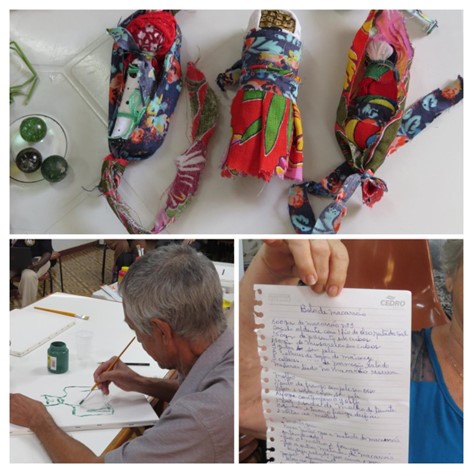
The second meeting was marked by a moment of appreciation of participants’ life stories. The older adults brought objects, materials, and reports they wished to publish in the newspaper and responded enthusiastically, contributing to a rich diversity of content. Among the shared items were old photographs of the city, original poems, paintings, family recipes, childhood toys, and delicate handmade crafts made with straw and fabric—each carrying memories, meanings, and affections. Simultaneously, the older adults participated in painting, drawing, and collage workshops with support from students, who assisted them in translating ideas into the graphic format that would compose the newspaper. In addition, recipes and stories orally narrated by participants themselves were transcribed, preserving the unique way each individual expressed their memories. By transforming memories into visual and textual language, the group began materializing the newspaper as a collective affective record (Figure 1).
Affective childhood toys, painting workshop, and recipe handwritten by the participant. Botucatu, São Paulo, Brazil, 2024.
Meeting 3 – Art workshops and collective construction
The third meeting marked an essential stage in the newspaper construction: organization of content, textual revision, and completion of artistic productions. At this moment, contributions from previous meetings began to take shape in the newspaper layout, reinforcing the collective and authorial nature of the initiative.
With support from students, the older adults revised texts, recipes, poems, and reports, respecting their original forms of expression while also adjusting minor details for final publication. Likewise, graphic materials produced in the painting, drawing, and collage workshops underwent final adjustments to compose the pages harmoniously.
One of the most significant moments of the meeting was the photo session specially dedicated to creating a page featuring biographies of the authors. Each participant was photographed individually in a relaxed and respectful atmosphere, reinforcing recognition of their identity as creators. This appreciation of image and personal history contributed to strengthening the bond with the project, expanding the feeling of belonging and pride in seeing their life trajectory represented in the newspaper.
Meeting 4 – Newspaper launch
The fourth and final meeting was dedicated to the highly anticipated launch of the newspaper, celebrating the lived journey, shared memories, and creations developed throughout the project. The occasion was carefully organized to value participants and give visibility to the protagonism of older adults in the construction of the material.
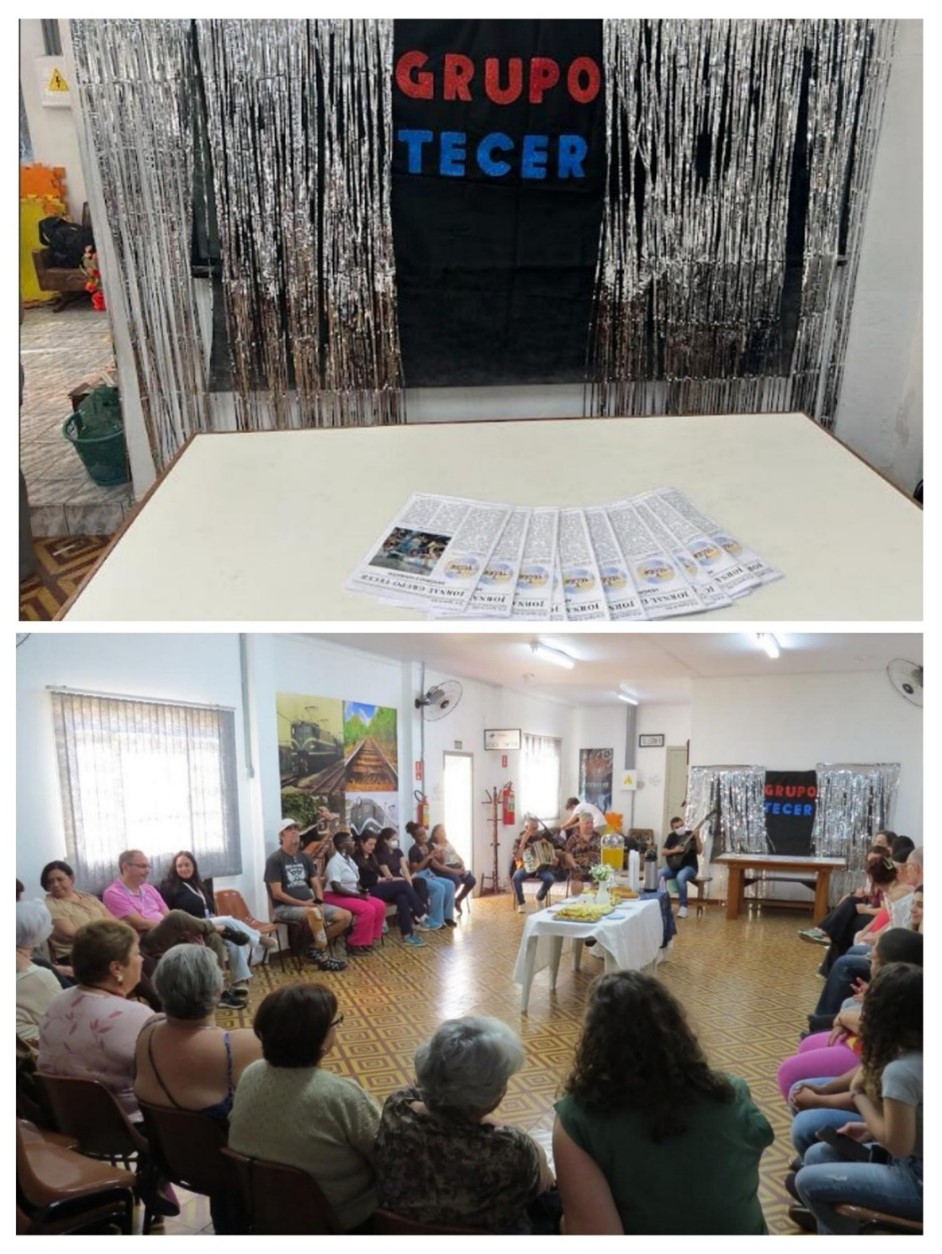
The celebration included the traditional music circle, in an atmosphere of joy and belonging. One participant brought an accordion, and together they sang songs that had marked their childhoods, rekindling memories and promoting a collective experience filled with affection and emotion. The symbolic autograph session added a touch of solemnity and pride: holding their newspapers, the older adults were able to sign the copies and take them home as keepsakes.
The delivery of printed copies was an especially emotional moment, as it represented the materialization of each participant’s effort, stories, and creativity. The institution’s press team was invited and covered the event, recording testimonies and images used in the official coverage. Friends and family members invited by participants were also present, strengthening bonds and publicly recognizing the value of the work accomplished.
At the end, everyone gathered for a collective coffee break, closing the cycle with celebration, affective exchanges, and a sense of accomplishment. The newspaper, more than a graphic product, became a symbol of expression, emancipation, identity, and memory, collectively built through listening, creativity, and care (Figure 2).
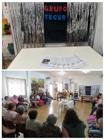
This moment reinforced participants’ feelings of belonging, recognition, and self-esteem, as evidenced by expressions of pride and gratitude captured in images.
DISCUSSION
The experience highlighted the potential of extension projects grounded in Maguerez’s Arch methodology as a participatory strategy for promoting mental health among older adults through the development of a newspaper. The collective construction of the newspaper enabled the strengthening of affective bonds and appreciation of life stories, fulfilling goals related to self-esteem, social belonging, and coping with loneliness.
Loneliness among older adults is recognized in the literature as a risk factor for depression, cognitive decline, and increased mortality. Studies show that older adults who reported loneliness were significantly more likely to present depressive symptoms and poor quality of life.11,12 In Brazil, data from ELSI-Brazil indicate a high prevalence of loneliness associated with factors such as living alone, low educational level, worse health perception, and depressive symptoms.13,14 The pandemic context intensified this condition, revealing depression as the main predictor of loneliness among older adults.14
Within the scope of public policies, Federal Law 10,741/2003, which establishes the Statute of the Older Adult,15 and the National Health Policy for Older Adults16 ensure older adults’ rights to health, community participation, and dignity. The National Mental Health Policy (Law 10,216/2001)17 established the Psychosocial Care Network,18 aiming to promote respect for human rights and social inclusion of people with mental disorders. University extension activities emerge as a strategy capable of strengthening these policies by generating spaces for listening, creativity, affection, and protagonism, broadening relationships between community and institution and promoting lasting social impacts.19
Besides dialoguing with public policies, the experience is also inserted into the tradition of popular education by valuing older adults’ protagonism in the construction of collective knowledge and practices. Popular Health Education (PHE), inspired by the principles of popular education developed by Paulo Freire since the 1960s, became consolidated as a pedagogical approach aimed at working with the population, rather than merely for it.20,21 This perspective seeks to expand subjects’ autonomy through participatory processes, recognizing and legitimizing their everyday knowledge and life experiences. PHE emphasizes horizontality in relationships between healthcare professionals and the community, favoring dialogical practices that strengthen social movements and promote collective transformation. It is therefore a political-pedagogical process that contributes to individual and community emancipation.20-22
In this sense, Maguerez’s Arch methodology approaches the Freirean perspective of problematizing reality, strengthening community bonds and expanding critical awareness.22,23 Furthermore, by positioning itself within the field of university extension, the project reaffirms the university’s social role as a space for transformation, articulating teaching, research, and social practice.24 This articulation is particularly relevant in the context of aging, understood not merely as a biological process but as a social experience demanding recognition, participation, and appreciation of life histories. Thus, initiatives such as this contribute to active aging and mental health promotion while educating students from a critical and citizenship-oriented perspective.25
The use of Maguerez’s Arch as an active methodology in this project aligns with previous educational experiences involving older adults and professionals working in care for this population.26,27 In our study, Maguerez’s Arch proved effective in stimulating active participation, recovering memories, and encouraging protagonism among older adults. Furthermore, the newspaper launch ritual and editorial production acted as symbolic moments of visibility and community recognition. Extending these practices to other contexts may intensify the positive effects observed.
The involvement of undergraduate and graduate students in all stages of the project, from planning to final newspaper production, strengthened critical and citizenship-oriented education by bringing together teaching, research, and social practice. This student protagonism is consistent with the principles of university extension as an educational dimension, as recognized by the National Education Plan and the National Extension Policy.28
Therefore, the report presented here demonstrates that extension projects involving older adults, when grounded in participatory methodologies, may promote mental health, rebuild community bonds, and educate students committed to comprehensive care. Such initiatives respond concretely to the guidelines of public policies focused on aging, highlighting the university as a privileged space for social transformation.
The results obtained demonstrate that the collective construction of a newspaper together with older adults, mediated by extension students, favors the strengthening of bonds, appreciation of memory, and social protagonism. This experience reinforces the potential of extension actions as mental healthcare strategies, especially in contexts of social vulnerability. Although the report did not use standardized assessment instruments, the subjective indicators observed, such as affective expression and spontaneous continuity of activities, point to positive impacts that deserve to be explored in future studies using more robust methodologies.
CONCLUSION AND IMPLICATIONS FOR PRACTICE
The experience demonstrated that a university extension project involving older adults, organized under the methodology of Maguerez’s Arch and centered on the production of a collective newspaper, is a promising intervention for promoting mental health, strengthening social bonds, fostering belonging, and valuing the personal identity of older adults.
As a limitation, since this is an experience report, the proposal did not use systematic assessment methods, which limits generalization of the results. Furthermore, the intervention was restricted to two specific services. Regarding the operationalization of meetings (time, pace, and mediation), it should be highlighted that the participatory conduction, guided by the group’s rhythm, was not configured as a limitation but rather as a structuring element of the proposal. However, this characteristic may require greater flexibility when replicated in contexts with different institutional conditions. Nevertheless, its participatory and adaptable structure allows replication in different contexts, especially where indicators of loneliness and psychological distress among older adults are identified.
Therefore, continuity and expansion of similar projects are recommended as mental healthcare devices and strategies for critical health education. Currently, evaluative studies are underway using psychometric scales and semi-structured interviews with participants to more systematically measure the impacts of the TECER project.
This report enables reflections on loneliness among older adults and points to sensitive and creative paths for promoting social belonging through participatory community practices, in addition to contributing to student education from a critical, affective, and transformative perspective.
ACKNOWLEDGMENTS
We thank the participating senior citizens, students, and partner institutions of the TECER project, whose trust and collaboration made this experience possible.
DATA AVAILABILITY RESEARCH
The research data, including access to the full version of the newspaper, is available at the following web address: https://www.fmb.unesp.br/#!/noticias/v/id::3477/jornal-do-projeto-tecer-lanca-seu-primeiro-exemplar/
-
FINANCIAL SUPPORT
This report received financial support through Public Notice PROEC 01/2023 – Vamos Transformar o Mundo and e Public Notice PROEC 04/2024 - Vamos Transformar o Mundo – 2nd edition, from the Pro-Rectory of University Extension and Culture – PROEC – Botucatu, São Paulo, Brazil.This study was financed in part by the Coordenação de Aperfeiçoamento de Pessoal de Nível Superior - Brazil (CAPES) - Finance Code 001 (Fabiana Tomé Ramos is funded by CAPES - Ordinance 206, September 4, 2018 - through a doctoral scholarship.
References
-
1 World Health Organization. Ageing and health [Internet]. Geneva: WHO; 2024 [citado 16 set 2025]. Disponível em: https://www.who.int/news-room/fact-sheets/detail/ageing-and-health
» https://www.who.int/news-room/fact-sheets/detail/ageing-and-health -
2 Instituto Brasileiro de Geografia e Estatística. Agência IBGE Notícias. Censo 2022: número de pessoas com 65 anos ou mais de idade cresceu 57,4% em 12 anos [Internet]. Rio de Janeiro: IBGE; 2023 [citado 16 set 2025]. Disponível em: https://agenciadenoticias.ibge.gov.br/agencia-noticias/2012-agencia-de-noticias/noticias/38186-censo-2022-numero-de-pessoas-com-65-anos-ou-mais-de-idade-cresceu-57-4-em-12-anos
» https://agenciadenoticias.ibge.gov.br/agencia-noticias/2012-agencia-de-noticias/noticias/38186-censo-2022-numero-de-pessoas-com-65-anos-ou-mais-de-idade-cresceu-57-4-em-12-anos -
3 Susanty S, Nadirawati N, Setiawan A, Haroen H, Pebrianti S, Harun H et al. Overview of the prevalence of loneliness and associated risk factors among older adults across six continents: a meta-analysis. Arch Gerontol Geriatr. 2025;128:105627. https://doi.org/10.1016/j.archger.2024.105627 PMid:39276428.
» https://doi.org/10.1016/j.archger.2024.105627 -
4 Stegen H, Duppen D, Savieri P, Stas L, Pan H, Aartsen M et al. Loneliness prevalence of community-dwelling older adults and the impact of the mode of measurement, data collection, and country: a systematic review and meta-analysis. Int Psychogeriatr. 2024;36(9):747-61. https://doi.org/10.1017/S1041610224000425 PMid:38525677.
» https://doi.org/10.1017/S1041610224000425 -
5 Hajek A, Sutin AR, Posi G, Stephan Y, Peltzer K, Terracciano A et al. Chronic loneliness and chronic social isolation among older adults. A systematic review, meta-analysis and meta-regression. Aging Ment Health. 2025;29(2):185-200. https://doi.org/10.1080/13607863.2024.2385448 PMid:39126212.
» https://doi.org/10.1080/13607863.2024.2385448 -
6 Lopes PO, Silva SR, Silva TC, Fragoso YD, Zanesco A. Age-friendly city: future perspectives for the Brazilian cities. Dement Neuropsychol. 2021;15(3):295-8. https://doi.org/10.1590/1980-57642021dn15-030001 PMid:34630917.
» https://doi.org/10.1590/1980-57642021dn15-030001 -
7 Barbosa DV, Nóbrega WFS, da Silva GCB. Adote um sorriso: o resgate da autoestima de idosos institucionalizados. Rev Conex UEPG (Online) [Internet]. 2020 [citado 18 abr 2026];16(1):1-7. Disponível em: https://revistas.uepg.br/index.php/conexao/article/view/14331/209209213337
» https://revistas.uepg.br/index.php/conexao/article/view/14331/209209213337 -
8 Nações Unidas Brasil. Objetivos de Desenvolvimento Sustentável no Brasil. 2026 [citado 18 abr 2026]. Disponível em: https://brasil.un.org/pt-br/sdgs
» https://brasil.un.org/pt-br/sdgs -
9 Berbel NAN, Sánchez Gamboa SA. A metodologia da problematização com o Arco de Maguerez: uma perspectiva teórica e epistemológica. Filos Educ. 2011;3(2):264-87. https://doi.org/10.20396/rfe.v3i2.8635462
» https://doi.org/10.20396/rfe.v3i2.8635462 -
10 Caldana I, Brandes H, Rodrigues A, Moura T, Goes T, Ramos F et al. Weaving care: embracing demands to older adults in the light of therapeutic monitoring. Saude Colet (Barueri) [Internet]. 2025 [citado 18 abr 2026];15(93):14779-86. Disponível em: https://revistasaudecoletiva.com.br/index.php/saudecoletiva/article/view/3340/4300
» https://revistasaudecoletiva.com.br/index.php/saudecoletiva/article/view/3340/4300 -
11 Puyané M, Chabrera C, Camón E, Cabrera E. Uncovering the impact of loneliness in ageing populations: a comprehensive scoping review. BMC Geriatr. 2025;25(1):244. https://doi.org/10.1186/s12877-025-05846-4
» https://doi.org/10.1186/s12877-025-05846-4 -
12 Zhang Y, Kuang J, Xin Z, Fang J, Song R, Yang Y et al. Loneliness, social isolation, depression and anxiety among the elderly in Shanghai: findings from a longitudinal study. Arch Gerontol Geriatr. 2023;110:104980. https://doi.org/10.1016/j.archger.2023.104980 PMid:36863166.
» https://doi.org/10.1016/j.archger.2023.104980 -
13 Sandy Júnior PA, Borim FSA, Neri AL. Solidão e sua associação com indicadores sociodemográficos e de saúde em adultos e idosos brasileiros: ELSI-Brasil. Cad Saude Publica. 2023;39(7):e00213222. https://doi.org/10.1590/0102-311xpt213222 PMid:37493723.
» https://doi.org/10.1590/0102-311xpt213222 -
14 Braga LS, Moreira BS, Torres JL, Andrade ACS, Lima ACL, Vaz CT et al. A decreased trajectory of loneliness among Brazilians aged 50 years and older during the COVID-19 pandemic: ELSI-Brazil. Cad Saude Publica. 2022;38(11):e00106622. https://doi.org/10.1590/0102-311xen106622 PMid:36921186.
» https://doi.org/10.1590/0102-311xen106622 -
15 Lei n. 10.741, de 1° de outubro de 2003 (BR). Dispõe sobre o Estatuto do Idoso e dá outras providências. Diário Oficial da União [periódico na internet], Brasília (DF), 3 out 2003 [citado 22 set 2025]. Disponível em: https://www.planalto.gov.br/ccivil_03/leis/2003/l10.741.htm
» https://www.planalto.gov.br/ccivil_03/leis/2003/l10.741.htm -
16 Portaria n. 2.528, de 19 de outubro de 2006 (BR). Aprova a Política Nacional de Saúde da Pessoa Idosa. Diário Oficial da União [periódico na internet], Brasília (DF), 20 out 2006 [citado 22 set 2025]. Disponível em: http://bibliotecadigital.economia.gov.br/handle/123456789/590
» http://bibliotecadigital.economia.gov.br/handle/123456789/590 -
17 Lei n. 10.216, de 6 de abril de 2001 (BR). Dispõe sobre a proteção e os direitos das pessoas portadoras de transtornos mentais e redireciona o modelo assistencial em saúde mental. Diário Oficial da União [periódico na internet], Brasília (DF), 06 abr 2001 [citado 22 set 2025]. Disponível em: https://www.planalto.gov.br/ccivil_03/leis/leis_2001/l10216.htm
» https://www.planalto.gov.br/ccivil_03/leis/leis_2001/l10216.htm -
18 Portaria n. 3.088, de 23 de dezembro de 2011 (BR). Institui a Rede de Atenção Psicossocial para pessoas com sofrimento ou transtorno mental e com necessidades decorrentes do uso de crack, álcool e outras drogas, no âmbito do Sistema Único de Saúde (SUS). Diário Oficial da União [periódico na internet], Brasília (DF), 23 dez 2011 [citado 22 set 2025]. Disponível em: https://bvsms.saude.gov.br/bvs/saudelegis/gm/2011/prt3088_23_12_2011_rep.html
» https://bvsms.saude.gov.br/bvs/saudelegis/gm/2011/prt3088_23_12_2011_rep.html -
19 de Souza MA, da Silva CC, Amador DD, Melo LL. Implementation of a play area in a pediatric hospitalization unit through university outreach. Esc Anna Nery. 2024;28:e20240112. https://doi.org/10.1590/2177-9465-EAN-2024-0112en
» https://doi.org/10.1590/2177-9465-EAN-2024-0112en - 20 Freire P, Nogueira A. O que fazer: teoria e prática em educação popular. 4ª ed. Rio de Janeiro: Vozes; 1989.
- 21 Freire P. Educação e mudança. 12ª ed. São Paulo: Paz e Terra; 1979.
- 22 Vasconcelos EM. A Educação Popular na Universidade. In: Vasconcelos EM, Cruz PJSC, organizadores. A educação popular na formação universitária: reflexões com base em uma experiência São Paulo: Hucitec; 2011. p. 15-24.
- 23 Freire P. Pedagogia da autonomia: saberes necessários à prática educativa. São Paulo: Paz e Terra; 1996.
-
24 Fontenele IC. A curricularização da extensão no Brasil: história, concepções e desafios. Rev Katálysis 2024;27:e97067. https://doi.org/10.1590/1982-0259.2024.e97067
» https://doi.org/10.1590/1982-0259.2024.e97067 -
25 Cogo SB, da Silva LMC, Donel CR, Puhl GS, Balconi I, da Costa KC et al. Educação em saúde com idosos ativos: relato de ações de extensão. Rev Eletrônica Acervo Saúde. 2021;13(2):e5724. https://doi.org/10.25248/reas.e5724.2021
» https://doi.org/10.25248/reas.e5724.2021 -
26 Reiser MN, Kuse EA. Arco de Maguerez: estratégia ativa na formação de profissionais de saúde no cuidado à pessoa idosa. Rev Paul Enferm. 2023;34. https://doi.org/10.33159/25959484.repen.2023v34a09
» https://doi.org/10.33159/25959484.repen.2023v34a09 -
27 Silva ABD, Nogueira TMSA, dos Reis DP, Azevedo CCSGF, Telles I, de Paula IG, et al. Aplicação do Arco de Maguerez na investigação da influência da vulnerabilidade social nas multimorbidades em paciente idoso. Revista Foco. 2023;16(9):e3113. https://doi.org/10.54751/revistafoco.v16n9-095
» https://doi.org/10.54751/revistafoco.v16n9-095 -
28 Resolução n. 7, de 18 de dezembro de 2018 (BR). Estabelece as Diretrizes para a Extensão na Educação Superior Brasileira e regimenta o disposto na Meta 12.7 da Lei no 13.005/2014, que aprova o Plano Nacional de Educação - PNE 2014-2024 e dá outras providências. Diário Oficial da União [periódico na internet], Brasília (DF), 18 dez 2018 [citado 22 set 2025]. Disponível em: https://portal.mec.gov.br/index.php?option=com_docman&view=download&alias=105102-rces007-18&Itemid=30192
» https://portal.mec.gov.br/index.php?option=com_docman&view=download&alias=105102-rces007-18&Itemid=30192
Edited by
-
ASSOCIATED EDITOR
Márcia de Assunção Ferreira https://orcid.org/0000-0002-6991-7066
-
SCIENTIFIC EDITOR
Marcelle Miranda da Silva https://orcid.org/0000-0003-4872-7252