 The embodiment of chemical entities in multimodal performances in science classes
ABSTRACT:
We start from the premise that the representation and the concept are directly related in regard to the teaching and learning of Chemistry. In this article we analyze two episodes of teaching to investigate the meanings produced in the classes in which corporal performances were carried out to represent a Chemical entity. These episodes were extracted from videos produced by two research groups in Chemistry teaching. The analyses evidenced the modal resources used by the teachers in the representation with the body and the possible meanings produced with the students. The analyses indicated that the students noticed the behavior of the chemical entity in the subjects that represented the atoms and that this embodiment presented affordances that helped them understand the concepts explored in the performance. The data lead us to argue that the body and movements also produce learnings. Representing a chemical entity using the body proved to be a rational and affective strategy in the understanding of concepts, which brings implications to the training of teachers, in the sense of overcoming epistemological and affective obstacles.
Keywords:
Chemical structural representation; Body performance; Multimodality; Modal transitions
RESUMO:
Partimos da premissa de que a representação e o conceito estão diretamente relacionados quando se trata de ensino e aprendizagem de Química. Neste artigo analisamos dois episódios de ensino nos quais foram executadas performances corporais com o objetivo de investigar os significados produzidos nas aulas em que o corpo foi empregado para representar um ente químico. Esses episódios foram extraídos dos vídeos produzidos por dois grupos de pesquisa em ensino de Química. Foram evidenciados nas análises os recursos modais empregados pelos professores durante a representação com o corpo e os possíveis significados produzidos junto aos estudantes. A análise indicou que os estudantes perceberam o comportamento do ente químico nos sujeitos que representavam os átomos e que essa corporificação apresentou affordances que auxiliaram no entendimento dos conceitos explorados durante a performance. Os dados nos levam a argumentar que o corpo e os movimentos também produzem aprendizagens. Representar um ente químico usando o corpo se mostrou uma estratégia racional e afetiva no entendimento dos conceitos, o que traz implicações para a formação de professores no sentido de superar obstáculos epistemológicos e afetivos.
Palavras-chave:
Representação estrutural química; Performance corporal; Multimodalidade; Transições modais
RESUMEN:
Se parte de la premisa de que la representación y el concepto están directamente relacionados a la enseñanza y aprendizaje de Química. En este artículo se analizan dos episodios didácticos en los que se realizaron performances corporales, con el objetivo de investigar los significados producidos en las clases en que se utilizó el cuerpo para representar una entidad química. Estos episodios provinieron de vídeos que fueron producidos por dos grupos de investigación en enseñanza de Química. El análisis evidenció los recursos modales utilizados por los profesores durante la representación con el cuerpo y los posibles significados que generaron a los alumnos. El análisis apuntó que los estudiantes percibieron el comportamiento de la entidad química en los sujetos que representaban los átomos y que esta corporificación presentó recursos que les ayudaron a comprender los conceptos planteados durante la performance. Los datos nos permiten concluir que el cuerpo y los movimientos también producen aprendizaje. La representación de una entidad química utilizando el cuerpo demostró ser una estrategia racional y afectiva para comprender los conceptos, lo que impacta en la formación del profesorado a superar obstáculos epistemológicos y afectivos.
Palabras clave:
representación estructural química; performance corporal; multimodalidad; transiciones modales
INTRODUCTION
Although in recent decades there have been methodological efforts to make chemistry classes more dynamic, they are still guided by traditionalist principles. Our experience has shown that in science classrooms it is common for students to sit, watch, listen, and write, without being asked to participate more actively.
In chemistry classes, the knowledge present is by nature full of representations. To explain the phenomena of nature, submicroscopic “entities” such as atoms, molecules, ions, and electrons emerge (Mortimer, Machado & Romanelli, 2000), which makes this curricular component highly abstract. These entities are not perceived by the senses and are therefore represented, which makes it difficult for students to understand. Submicroscopic entities are not easily related to the properties of substances or even to what causes them to transform. With this, we argue that teaching chemistry continues to be a major challenge for teachers. Lemke (1998) has already warned that the concepts and models of science, as an amalgam of complex systems of signs and semiotic practices, need to be imaginatively, and we add creatively, integrated by students and applied to phenomena.
In this article we carry out a microanalysis of two teaching episodes by two teachers, in which students were asked to represent, with their own bodies, an aspect of knowledge that was being explored in class. This analysis was built considering multimodality, since both teachers used images for what they were trying to communicate and chose to associate them with another form of representation not commonly used during lessons: corporal representation.
In analyzing the episodes, we chose to explore the students’ and teachers’ speaking time, the teacher’s command for the representation to take place, the images recorded on the blackboard, touch, gestures, and the proxemics of the classroom. The construction of these categories aimed to characterize, through audiovisual recordings of the lesson, the multimodal performance of these teachers when they actively included the students in the lesson, and also to analyze the production of meanings from the embodied representation for the process of polymerization of ethylene units and for the forces involved in the polarity of the water molecule. We also discussed the role of touch as a semiotic resource or mode in the interactions that took place between students and teachers.
As a problem to be investigated, we aim to understand what meanings are produced in classes when the body is used to represent the chemical entity. To this end, we defined the following research questions: What are the modes or modal resources used by teachers in association with representation with the body, and what are the possible meanings produced with students?
Theoretical references
Research dealing with multimodes in communication and the presence of these multimodes in the classroom has been around since the 1950s (Smith, 1979; Portnoy, 1982). Considering the studies of Halliday’s Systemic Functional Linguistics (1978; 1985), in which language comes to be considered a network of systems that offer options for performing socially-oriented functions, and social semiotics, which defends language as a means of expressing and establishing social roles and values, multimodality studies are important (Kress & van Leeuwen, 1996; Norris, 2004; Jewitt, 2009; Kress, 2009 and 2010).
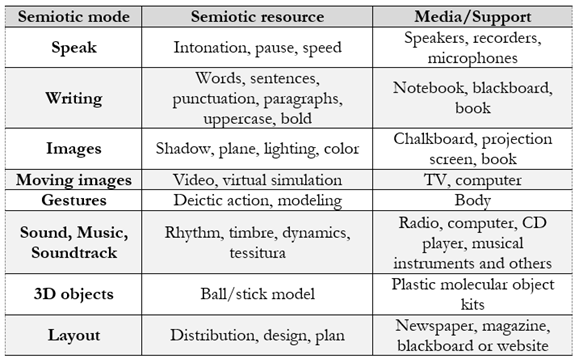
In a multimodal analysis, it is the modes—and not the language—that are studied in all their materiality. According to Bezemer and Kress (2008, p. 172), mode is a resource for producing social and cultural meaning. Since language is multimodal by nature, we believe that meanings are more easily produced when different modes are used to communicate an idea. In ChartL 1we present an expansion of the synthesis constructed by Mortimer, Moro and Sá (2018) in order to better understand semiotic modes.
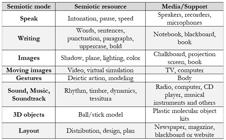
According to Kress (2009), modes represent the “channels” of communication that a culture recognizes. In the case of speech, for example, it can be enhanced by using the following semiotic resources: intonation, to emphasize a concept; pause, to draw the listener’s attention; greater or lesser speed, depending on the importance of what is being said. In writing, the resources can be syntactic, grammatical, lexical and graphic. As can be seen in Chart 1, each of the semiotic modes has resources that enhance that mode and can be exploited in communication.
Kress (2009) states that multimodality is a theory that examines the different ways people use to communicate and express themselves. Adami (2016), for his part, defines it as both a phenomenon of human communication and a diverse and growing field of research. As a communication phenomenon, it combines different semiotic resources, such as spoken or written texts, still or moving images, gestures, proxemics, layout, among others. As a field of research—which O’Halloran and Smith (2011) refer to as “multimodal studies”—there is a focus on the development of theories and analytical tools, and on studies of representations and communication that use modes as an organizing principle (Adami, 2016). This field is approached from different perspectives (Jewitt, 2009) which, according to Adami (2016), are based on four main assumptions: a) communication is, by nature, multimodal; b) analyses centered on speech and writing are unable to explain meaning; c) each mode has specific affordances, resulting from its materiality; d) the different modes contribute to the construction of meanings, which reinforces the importance of relating them. Therefore, the relationships between modes are fundamental to understanding each instance of communication.
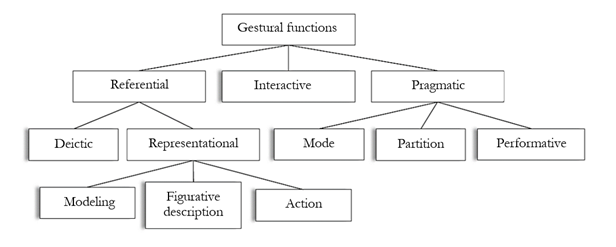
In foreign literature, there is a growing focus on multimodal communication in science teaching (Tang, Tan & Yeo, 2011; Oh & Kim, 2013; Wilson & Bradbury, 2016; Zhang, 2016) and, above all, a focus on representations (Tytler et al., 2013; Prain & Tytler, 2022). Among the semiotic modes commonly investigated, gestures have received greater prominence in the last two decades, since until then they were little considered in terms of research involving communication. In multimodal studies, gesture is an expression of language and establishes a dialectical relationship with speech (McNeill, 2005). This dialectic has methodological implications, since gesture may not just be the movement of hands and arms, but a movement of parts of the body that occurs in tandem with speech. However, the information present in gesture is not always the same as speech, i.e. gesture is not necessarily subordinate to speech, which makes it a semiotic mode. Kendon’s (2004) classification involves the functionality of the gesture and a gestural unit, which brings this categorization closer to social semiotics. These gestural functions, proposed by Kendon (2004), can be divided into referential, interactive and pragmatic, with their respective subdivisions, as shown in Figure 1.
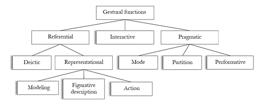
In the referential function, the gesture is related to an object or event. The reference can occur by pointing to the object of reference (deictic function) or by representing the object (representational function), which can be subdivided into three other functions. When body parts are used to model the referent object, the function is modeling. When they are used to describe it, it is figurative description. And when they are used for an action similar to the action of that object, it is action. In the interactive function, the gesture promotes interaction between subjects. And in pragmatics it is related to discourse, by intensifying it or producing rhythm (mode function), by dividing it into parts (partition function) and during an offer, a refusal or a denial (performative function).
Considering that for Kendon (2004) gestures are classified by the functions they perform, we suggest that a similar classification be attributed to proxemics, since the body and objects are positioned in the classroom space, either to represent something, as in representational gestures, or to interact with students, as happens when we use interactive gestures. Thus, based on Hall (1963), we define the spatial arrangement of bodies and objects which serves to represent objects or actions as representational proxemics, and that which fulfills the function of promoting interaction between subjects, either by organizing them or highlighting aspects of what is being represented, as interactive proxemics.
The relationship between gesture and speech in science teaching has been the subject of multimodal research over the last 15 years in Brazil. Several studies stand out: analysis of student learning through multimodal interactions between the visual, the verbal and the gestural (Piccinini & Martins, 2004), analysis of the relationship between students’ words and gestures, showing that they are able to express themselves with gestures rather than words (Padilha & Carvalho, 2011), establishing a relationship between gestures and epistemic practices (Sessa & Trivelato, 2013; Giordan, Silva-Neto & Aizawa, 2015) and analyzing the use of recurring gestures by teachers in higher education classes (Pereira, Mortimer, & Moro, 2015). In our studies, gestures have been shown to be important in promoting what we call a transition between modes (Quadros & Giordan, 2019), and in this work the transition is explored mainly between two modes: embodied representation and image.
Gaze and proxemics have also received attention from researchers in the field of science education. In the case of gaze, Oben and Brône (2015) used eye-tracking data to analyze the effect of speakers’ gaze on their own gestures and that of listeners on the gestures made by the speaker. According to these researchers, there is a significant effect of the listener’s gaze on the speaker’s gestures, which led them to state that gestural behavior is altered as a function of gaze.
The term embodied representation or cognition has been used in psychology—linked to neuroscience—to refer to learning based on sensory-motor experiences, stating that perceptual and interactive richness can provide opportunities to lighten the cognitive load (Pouw, van Gog & Paas, 2014). Along these lines, body movement is interconnected with mental processes, and embodied performance activates cognition (Yang & Shu, 2011; Macedonia, 2019).
Hao and Hood (2019) analyzed the performance of a lecturer as regards the use of speech and body in communication in the construction of values in science. For them, the use of the body was considered as embodied representation. With this analysis, the researchers argue that the auditory (coming from spoken language) associated with the visual (coming from body language) caused an expansion of scientific values, since the meanings were communicated twice. Unlike neuroscience, we believe, like Hao and Hood (2019), that the body has a material character and is a communicational extension. In the same way as speech, body movement will act as a mediator in the construction of meanings.
Developing studies in biogeographical decolonial epistemologies, Bessa-Oliveira (2019) discusses the body at school and argues that learning, being and moving have taken place from perspectives that have either the “right side” or the ‘wrong side.” According to him, in contemporary times, other forms of knowledge exchange are evident, since “education does not happen in isolation from the body and movement” (p. 99, free translation). Therefore, body and mind cannot be dissociated during learning, and students, through the embodiment of chemical entities, can be constructing meanings with real potential to be transformed into knowledge.
In the national literature, some studies have analyzed the movement of teachers who interact with the material environment for the production of scientific knowledge (Silva-Neto, Giordan & Aizawa, 2015; Silva-Neto, Giordan & Aizawa, 2016; Moro, Mortimer & Tiberghien, 2019), the use of gestures associated with speech (Aizawa, Silva-Neto & Giordan, 2014; Moro et al, 2015; Pereira, Mortimer & Moro, 2015) and the use that teachers have made of the body as a way of making meaning (Mortimer et al., 2014).
The human body uses gestures as a means of communication and can be in contact with other physical bodies through touch. However, it is necessary to go deeper into understanding how meanings are constructed in the presence of gestures and touches in the classroom. Although it has been the subject of research related to the production of learning through touch screen devices (Cordero et al., 2018), or of studies involving deaf-blind communities (Bezemer & Kress, 2014), for which, based on social semiotic theory, touch can be considered a mode, the use of touch has not been investigated as a semiotic mode or resource in the absence of such technologies.
Bezemer and Kress (2014) draw on social semiotics to explore ways in which touch is used as a resource for making meaning and unpack the multiplicity of meanings attached to the term itself. These researchers seek to understand whether touch can be considered a “mode” beyond the specific communities cited and thus have a semiotic function in a wider community. To do this, they need to consider Halliday’s metafunctions, i.e. dealing with interpersonal, ideational and textual relations (Kress, 2009; 2010). In this sense, essential aspects of the semiotic mode and its representational and communicational nature are highlighted:
to be able to convey meanings about the social relations of those who are engaged in interaction; to account for states of affairs - ‘goings-on’ - in the world; and to be able to form complete semiotic entities, which display coherence internally and externally with the environment in which they occur (Bezemer & Kress, 2014, p. 78).
The ideational function is the representation of meanings in actions, states and events in the world, in other words, experiences of the world through language. The interpersonal function is the representation of meanings in the social relations of communication, i.e. the strategies for approaching and distancing the person to whom the message is addressed. The textual function, in turn, is the ability to form texts into a complete project of internal coherence. For this reason, Bezemer and Kress (2014) argue that a mode must possess these three functions as characteristics in communication for the production of meaning.
To differentiate between gesture and touch, Bezemer and Kress (2014) argue that gesture is produced through integrated sets of movements of the hands, fingers, arms and facial expression, and is received through sight. Touch, by contrast, relies on contact—usually hands or fingers between the by the maker of the sign with parts of the body of the recipient of the sign. It should be noted that these researchers investigated explicit touch, i.e. touch that is intended to communicate something, i.e. the person who touches is addressing another. After demonstrating the ways in which touch has been used to make meanings, they warn of the need for more research on the subject, since this is an initial study, deemed insufficient for “touch” to be considered a semiotic mode in communication.
Each of the modes used in communication makes use of different modal resources, depending on the audience and the construct to be made. In this sense, each mode has specific affordances for the production of meaning (Kress, 2010). The term affordance was coined by Gibson (1977) from the verb to afford, whose meaning could be summarized as “to provide.” For Gibson, the term presupposes a potential action of an object, and for Halliday, the potential lies in the socially shared meaning (van Leeuwen, 2005). In the case of semiotic modes, modal affordance includes both the potentiality and the limitation of a given mode. Modal affordances refer to the characteristics of the mode that enable or restrict meanings.
Tytler et al., (2013) advocate a representational model based on affordances so that representations are at the center of actions in teaching activities. Prain and Tytler (2022) point out that different modes do different jobs in the making of meanings in science, and that moving between different modes can mean both the reiteration and complementarity of linguistic and non-linguistic meanings that constitute the nature of concepts and processes in science. For them, all modes of representation have particular affordances that act as productive restrictions, in order to meet two requirements: (a) show a correspondence between the explanatory characteristics and the key characteristics of the phenomena; (b) demonstrate internal coherence as an explanatory account.
Danielsson (2016) analyzed the ways in which four chemistry teachers (two Swedish and two Finnish) used different semiotic resources when introducing a new scientific concept in high school science classes. According to Danielsson (2016), these investigated teachers’ use of modes different from those commonly used is probably related to modal affordance, since the drawing explored different particles in an atom and the gestures gave movement to these particles. The diversity of modes used by the teachers allowed the students to perceive the content developed in a more comprehensive way.
From the hypothesis that communication is made up of a structure of modes (Bezemer & Kress, 2008), we carried out a micro-analysis of two performances by different teachers. In doing so, we focused our attention on the affordances of the embodied representation used by these teachers.
METHODOLOGY
The data analyzed in this investigation was produced from audio and video recordings of lessons from a mini-course during the curricular internship of the Chemistry degree course at a public university in São Paulo, and also from audio and video recordings of a set of lessons from the ninth grade of elementary school at a private school in the metropolitan region of Belo Horizonte. In the first case, we selected, from the set of lessons in the mini-course, an episode that took place in teacher Pedro’s class because of the use of a performance with the body to represent the chemical bond, and also because it was the result of an improvisation in the initial planning. In the second case, the episode selected was part of a set of lessons previously planned by teacher Selma to build knowledge about the polarity of molecules. The selection took into account the intention to develop the embodied representation of the water molecule, including polarity.
The mini-course, whose theme was the disposal of plastics, dealt with the production process of these plastics. Twenty-seven high school students from a federal school took part in the mini-course. The teacher in charge was a chemistry graduate who had no teaching experience. The elementary school class, on the other hand, had 22 students aged between 14 and 16. The teacher, Selma, had around ten years’ teaching experience, a degree in Chemistry and a Master’s degree in Education.
In both cases, the research subjects had filled in a Free and Informed Consent Form, following the guidelines of the respective research ethics committees (COEP). The names of the teachers, as well as any student names mentioned throughout the text, are fictitious, following the ethical premises of research involving human beings.
The common feature of both episodes was the embodied representation: in the first case, of the chemical bond, and in the second, of molecular geometry. The analysis of these episodes required the coding of various semiotic modes throughout the episodes. Each episode was watched by each of the researchers in order to define the categories of analysis. According to the research objectives, the categories analyzed were: teacher’s speaking time, student’s speaking time, teacher’s command, touch, representational proxemics, interactive proxemics, deictic gestures, representational gestures and support on the blackboard, on which there were images (drawings and projections). These categories were entered into the NVivo® software, resulting in a set of diagrams in which the categories were represented in different colors and lines (Figures 2 and 8). To make the diagrams easier to read, we left out the deictic and representational gestures, which were only referred to in the analysis and in the transcription tables.
The episodes were transcribed in full as part of the analysis. We chose to use punctuation in the speeches in order to characterize interrogative expressions and modal demarcations, based on the intonation of the speeches, the speakers’ facial expressions and their positions. Some fragments of this transcript have been used with the intention of making it clearer what happened in the classroom. A column has been added to the transcription Chart (3 to 10) to describe other modal categories that are articulated with the speech. Figures illustrating the performances (3 to 6 and 9) have been drawn to help understand the movements and also to preserve the identity of the research subjects.
Results and DISCUSSION
Below we present the analysis of the data from each of the teachers, i.e. the analysis of the episode in which the chemistry undergraduate student represented the process of ethylene polymerization and the analysis of the episode in which the science teacher began the discussion of the polarity of the water molecule based on the forces present in each of the bonds. We explored multimodal categorization diagrams, transcription charts and performance illustrations, which represent different levels of data representation.
The performance of modeling the chemical bond and the polymerization process
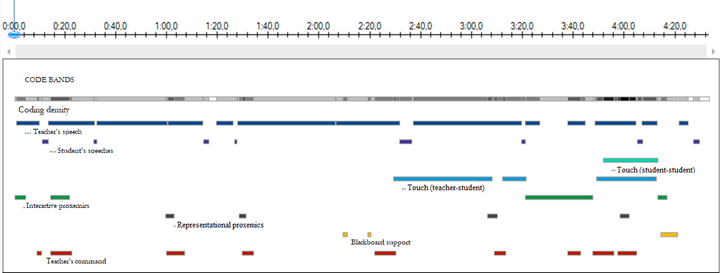
In the lesson from which the episode was taken, teacher Pedro was dealing with the process of forming polyethylene from ethylene. At a certain point, after realizing that the image of the ball-and-stick model projected on the blackboard was not sufficient for understanding this process, the teacher decided to improvise and build an embodied representation with the help of the students that could translate the two representations2. Realizing from the class’s reaction that their knowledge of chemical bonds was limited, the teacher asked the students to help him represent the chemical bond and the polymerization process with their bodies. As the actions in this performance were led by the teacher, we have transcribed his speeches accompanied by other modal categories of action such as gesture, proxemics and gaze. To do this, we started by analyzing the multimodal categorization diagram obtained from the NVivo® software (Figure 2), from which we can extract the interaction sequences, segmenting the episode based on demarcations of semiotic modes that denote phases of interaction. The total duration of the episode was 4 minutes and 12 seconds.
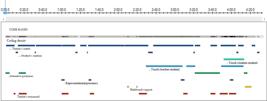
Coding band in NVivo for teacher Pedro’s episode (chemical bond between two carbons and polymerization).
In Figure 2, the coding density indicates the relative number of categories discriminated over the time span, which allows us to recognize the number of semiotic modes mobilized. We can see that the highest density is at the end of the episode. The dark blue band shows that the teacher’s speech prevailed (around 3 minutes and 32 seconds) to the detriment of the students’ speech (approximately 15 seconds), demarcated in lilac. The rest of the time (around 25 seconds) was either laughter or silence. The touches between the teacher and the students (light blue) and between the students (light green) were also coded, marking the formation of the monomer in the first case and the formation of the polymer in the second. The category represented in red, the teacher’s command, refers to the words that guided the students’ actions. Yellow indicates the moments when the teacher referred to the figure projected on the screen, which coincided with the direction of his gaze. Finally, we coded the teacher’s movement towards the students in black—representational proxemics, with which he performed the chemical bond and polymerization—and the teacher’s movement in dark green, which we classified as interaction, i.e. interactive proxemics.
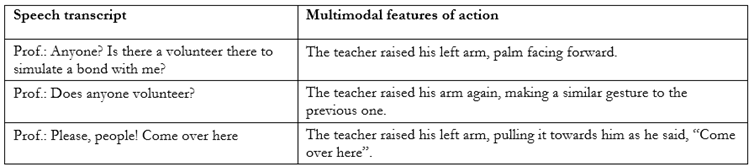
At the first command (in red), the teacher asked the student who had volunteered to take part to stand up and go to the front of the room. To do this, Pedro’s speech was associated with repeated interactive gestures. This “invitation” denotes the breaking of asymmetry in the interaction, in that the front of the room is typically occupied by teachers and, with this invitation, the teacher allowed the space traditionally his to be occupied by the students.
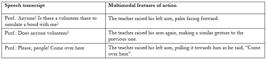
The teacher used the term “simulate” to give meaning to the interactive movement that was to follow, i.e. the chemical bond. As soon as the volunteer student came to the front, the teacher’s second command began.
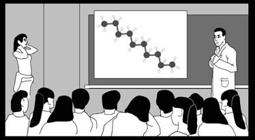
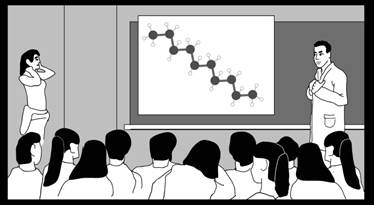
At the second command, the teacher instructed the student to stand in front of him, at a distance of between two and three meters, with the two of them standing to the side, as shown in Figure 3. At this point, the teacher described in detail what each of them represented in this performance. In this description, he combined speech with deictic gestures (pointing to the student and to himself), action gestures (showing with his hand the approximation that would occur in the space of the chemical bond) and modeling gestures (dealing with the attraction between the positive charge of one nucleus and the negative charge of the electrosphere of the other carbon). He also alternated his gaze between the student and the class. This made it clear that the bodies of the student and the teacher represented carbon atoms.
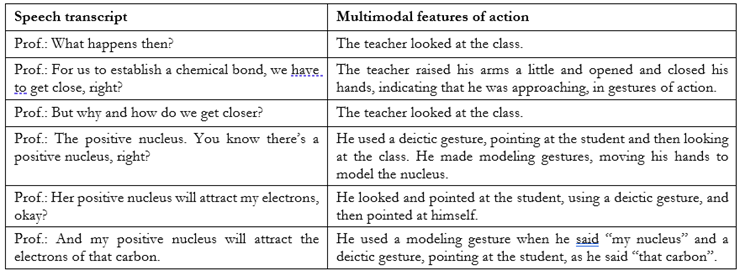
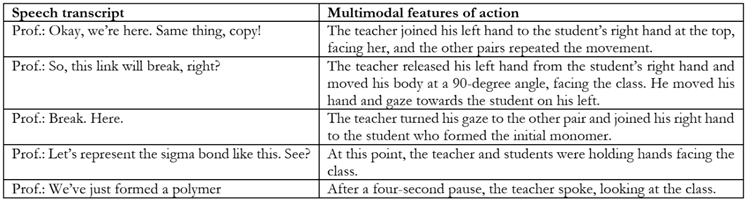
The teacher then mentioned that the two bodies would come together and form a chemical bond. According to Tytler et al. (2013), when the teacher makes explicit what will be represented, a deliberate process of reasoning is underway. Thus, it was through the teacher’s speech that the making of meanings to represent the chemical bond - accompanied by gestures, gaze and movement - began to take place, and was therefore mediated by a set of synchronously combined semiotic modes. By dealing with the attraction between atoms, the student and the teacher are preparing to represent the formation of a chemical bond. Chart 2 shows an extract from this dialog:
The combination of deictic, action and modeling gestures with speech and alternating gazes certainly contributed to the students understanding what the teacher was communicating and being able to follow the performance that would take place from that moment on. By looking, the teacher seemed to want to make sure that the students were following the explanation of the performance that would take place next.
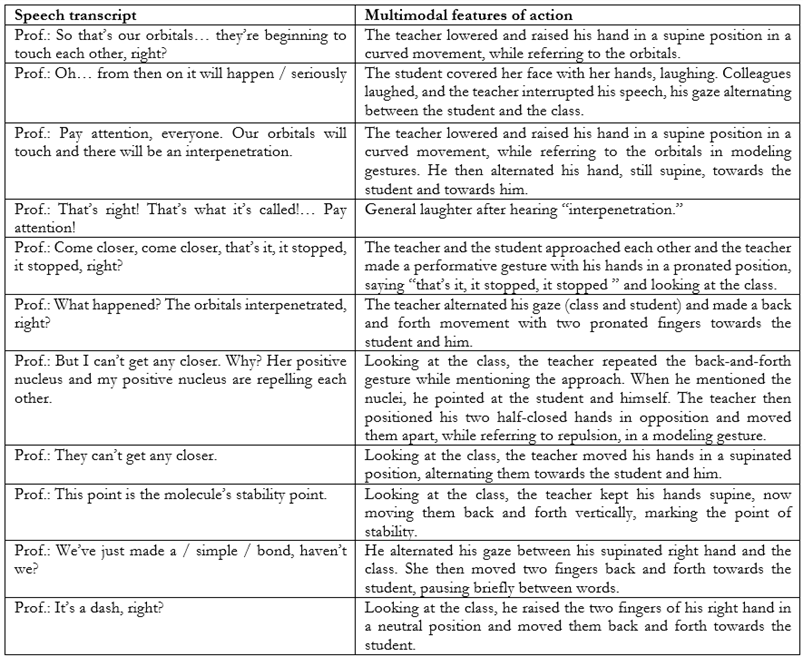
At the third command, the teacher directed the bodies to approach each other up to a distance of about one meter between him and the student, at which point he made a performative gesture, indicating that the student should stop the approaching movement. At the fourth command, the approach continued up to a limit set by the teacher, indicating the forces of repulsion present. At this point, proxemics was explored, since changing the distance between the teacher and the student produced a meaning for the approach between the carbon atoms, which was not represented in the image on the projection screen, fulfilling a representative modeling function for this semiotic mode. Chart 4 shows part of the exchange that took place after the teacher’s third command:
The modeling gesture, used by the teacher when speaking of “orbitals,” characterized a region delimited from top to bottom in the shape of a curve (Chart 3) and gave meaning to the movement resulting from the approach between them (“they are beginning to touch each other”). This meaning was then extended by the use of the term “interpenetration”, which was accompanied by the same modeling gesture as before and followed by a deictic gesture indicating the distance between the bodies. For a moment, the students laughed at the possible double meaning of the word “interpenetration.” The teacher, however, interrupted the explanation and reinforced that it was a term used to characterize the chemical bond, continuing the performance.
Thus, at the same time as the teacher was negotiating the meaning of the chemical bond through a bodily performance and the use of specific terminology, the students’ agitation may have led to meanings resulting not only from the closeness of the teacher’s and student’s bodies, but also from an alternative meaning to the chemical bond latent in the term “interpenetration.” In this way, we observed that the chemical entities momentarily ceased to be the focus of attention, and possibly other meanings were produced by the orchestration of semiotic modes. As already pointed out, Bessa-Oliveira (2019) criticizes the fact that learning is related almost exclusively to the mind, while the body is the one that sits, listens and obeys, which explains the strangeness of these students when they were asked to represent a chemical entity with their own bodies. The data analyzed in this study shows us that, as Bessa-Oliveira (2019) argues, the body and movements also produce learning.
Following the interaction (Chart 3), the teacher used representational gestures to portray the formation of the chemical bond, which were combined with movement and looking towards the group and the bodies. The modeling gesture and the back and forth movement of the fingers stood out to represent the area between the carbon atoms, the deictic gesture for the position of these atoms, and the action gesture with the hands half-closed in opposition for the repulsion between the nuclei (Figure 4).
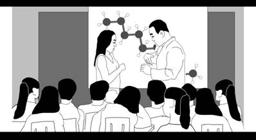
The teacher then looked at the projection screen and pointed to the projected representation of ethylene—whose bonds were the object of study. He drew the class’s attention to the fact that ethylene has a double bond between the carbons. He then turned to the student in front of him and began the fifth command by linking his left hand to the student’s right hand, making the “line” that represented the bond in the projected image similar to the two linked arms. Then he joined his right hand with the student’s left hand to represent the double bond, saying: “Our electrons are going to come together, okay?” again the students burst into laughter, attracted by one of the students who ironically pronounced “uhmmmm” with prolonged intonation. At this point in the performance, the touch occurred, which Bezemer and Kress (2014) consider to be a semiotic mode because it exercises Halliday’s three representational functions, as well as other characteristics already described. The ideational function corresponded to the single and double bonds formed between the two participants and their roles as carbon atoms. The interpersonal function was the link established between the scene performed by the two and the presumed audience. The textual function occurred in the relationship between the entire stage performance and the chemical bond model constructed, in other words, the meaning constructed by the union of the bodies through the touch between the palms of the hands in the interaction between the carbon atoms. At this moment of representation with the body, a tactile signifier and a visual signifier were used at the same time.
At the sixth command, the teacher instructed the student to represent the breaking of one of the bonds and told the class that the electrons were free, indicating the free hands (his left and her right), keeping only one of the bonds, the sigma. At this point in the performance, both student and teacher positioned themselves sideways to each other and facing the class, keeping their gaze directed towards the class.
In this performance, speech, body, gesture, touch, gaze and proxemics made up a multimodal structure for the signification of the double bond between the carbon atoms in the ethylene molecule, an understanding necessary for the teacher to be able to start the polymerization process with other ethylene units.
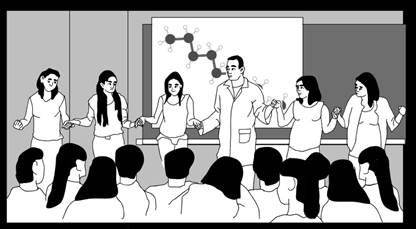
To continue with the construction of the polymer representation, a second multimodal performance took place with the participation of other students. The teacher asked for four more volunteers to continue the representation, and quickly three more students positioned themselves at the front of the room, and a fourth timidly came forward after the teacher said with his hands open in an interactive gesture: “One more to go, folks.” At the seventh command, the teacher organized the volunteers into pairs, in the position where the double connections had already been formed (Figure 5).
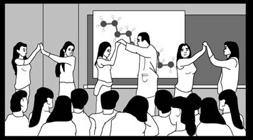
As soon as the three pairs were in position, the teacher began the eighth command and, after a brief explanation, the ninth command, when he went over the instructions described in Chart 5:
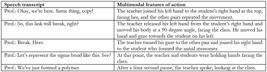
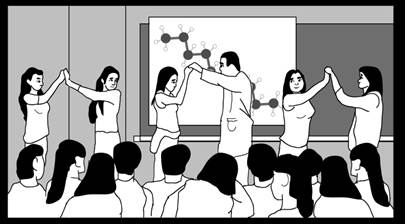
Considering the experience with the three-minute performances (of the bond between the two carbons and the breaking of the bond), the scene depicting the formation of the polymer was done quickly and easily, in less than a minute. Starting with the three pairs formed by the students and the teacher, representing three monomers and therefore three double bonds, represented by the touches between the hands, the teacher commanded the movements of the bodies to join, separate and join the hands together again, in a coordinated and synchronous way. Curiously, the teacher instructed each pair to join only one of their hands at the top, for the double connection. It was only when the movement to unjoin the joined hands took place that the teacher touched the hands of the students flanking him, followed synchronously by the other pairs, which resulted in the formation of a kind of chain of joined hands. In the background, the polyethylene structure remained represented on the screen throughout the performance (Figure 6).
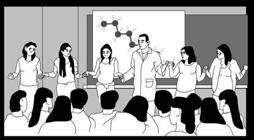
After the body performance, the teacher thanked the students for their participation and turned to the projection screen to refer to the polymer unit of polyethylene represented by simulation software. He marked a grouping on the image on the projection screen and said: “the polymer has this repeating unit.” In doing so, he took up the context of the polymer’s presentation, which had already been developed, even though this imagery was only referenced for a split second during the performance. It is noteworthy that the body performance was classified by the teacher as a simulation (Cart 1) and the image projected on the projection screen (Figure 6) was also the result of a simulation.
The performance of the forces present in the structure of water
The experience reported below took place in a ninth grade class at a private school in the Belo Horizonte/MG region. The curriculum includes five science lessons a week, each lasting 50 minutes, and this stage of schooling is the students’ first contact with the formal teaching of concepts, models and representations characteristic of chemistry. Although there is methodological flexibility, the school uses handouts from the Bernoulli Teaching System (Machado, Raggazzi, & Guedes, 2019) as teaching material and the content includes chemical bonds, the Lewis structure, the polarity of bonds and molecules and molecular geometry.
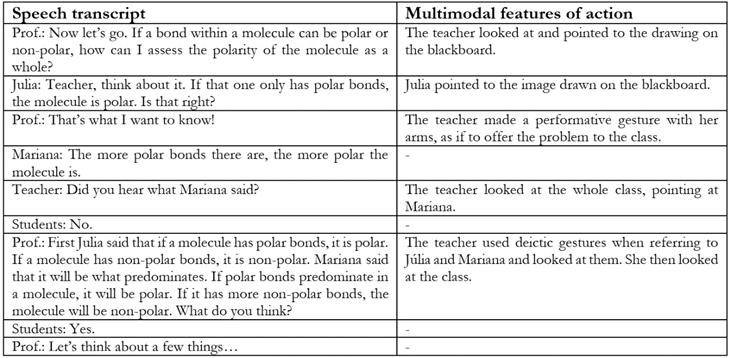
We selected an episode that occurred during the teaching of molecular geometry content, considering that the students had already learned that the polarity of bonds is due to the electronegativity of each atom involved in the bond. The teacher, when introducing the polarity of molecules, asked a question which generated the following dialog (Chart 6):
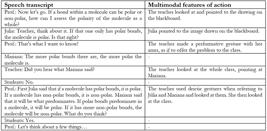
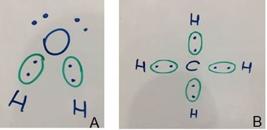
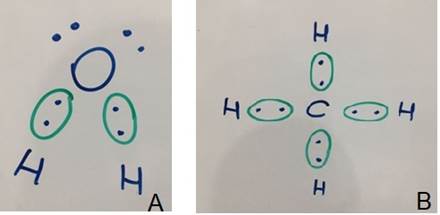
Julia and Mariana’s statements show that they were building an idea that would allow them to predict the polarity of molecules. The other students agreed with their idea, since their reasoning showed a direct link between the predominance of polar or non-polar bonds and the polarity of the molecule. In order to encourage discussion about the polarity of molecules, the teacher asked them to draw on the blackboard the Lewis structures for the molecules of water and methane (Figure 7), as well as others that would be explored during the lesson.
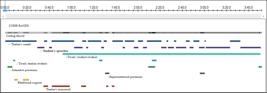
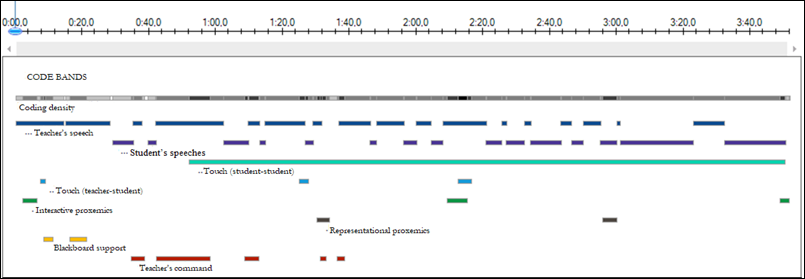
As it wasn’t possible for the students to make a scientifically accepted prediction for these molecules, the teacher proposed an embodied representation. To do this, three students (Antônio, Júlia and Letícia) volunteered and went to the front of the room, breaking the asymmetry in the interaction as in the first episode. The teacher then organized the role-play activity, which was carried out by the three students. We selected the episode in which the performance took place for analysis (with a total of 3 minutes and 39 seconds), based on the multimodal categorization diagram obtained using NVivo® software (Figure 8) and using the same categories as in the previous analysis.
Coding band in NVivo for teacher Selma’s episode (representation of the polarity of the water molecule)
We would point out that in this episode the performance was planned by the teacher and was carried out exclusively by the students, guided by her and the rest of their classmates. In Figure 8 we can see that the density (gray) is more homogeneous, since different semiotic modes were used simultaneously. The teacher’s commands (red) took place in the first half of the performance, while the rest of the time there were discussions aimed at understanding what was being represented. The teacher’s speeches are coded in dark blue and the students in lilac. The students had a more intense verbal participation (1 min 48 s) than in teacher Pedro’s episode. The blackboard support category (yellow) was limited to the beginning of the episode, when the teacher invited them to construct explanations. The touch between the students (light green) started at 50 seconds and lasted until the end of the episode and was fundamental for the forces involved to be discussed. The touches between the teacher and the students occurred only three times (light blue), at the moments when she approached to emphasize an aspect of the representation. Interactive proxemics (dark green) and representational proxemics (black) are also coded.
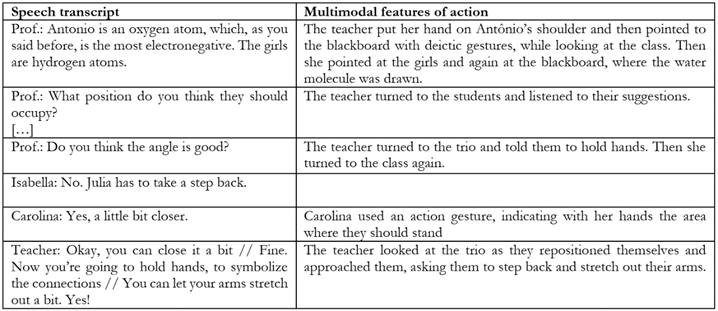
The teacher first explained the role of each of the volunteers, i.e. that Antonio would be the oxygen atom and that the two girls would be the hydrogen atoms. She then asked for help from the whole class, as shown in Chart 7:
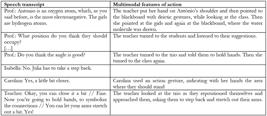
Selma made use of the students’ knowledge by asking them to make positioning suggestions. She then gave her first command, instructing the trio to position themselves as if they were forming the water molecule. The second command came when she asked the students to hold hands and move apart a little, so that their arms were more stretched out. With these two commands, she organized the embodied representation. At the third command, at the suggestion of a student, she asked them to correct the bond angle between the oxygen and the hydrogens.
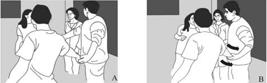
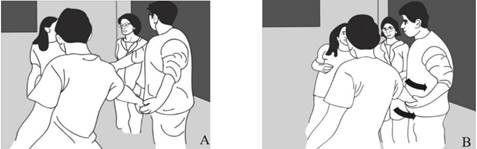
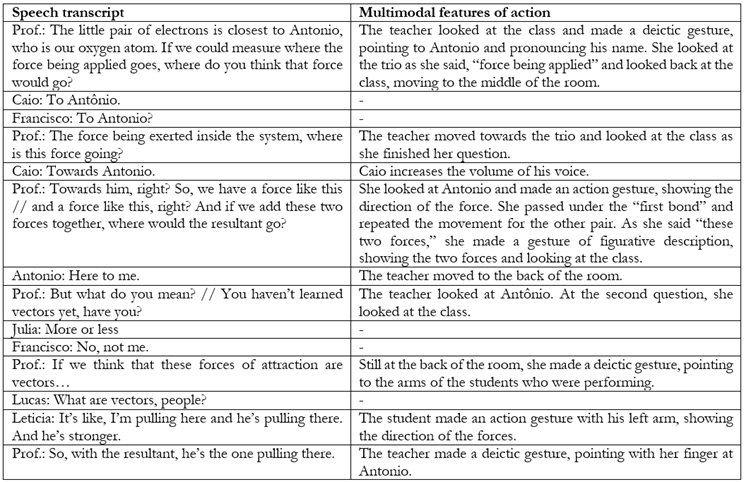
Selma then looked at the position of the students’ arms (Figure 9A) and asked them about the polarity of these bonds. To do this, she approached the trio doing the representation, and the fourth command took place, in which the force of attraction and therefore the polarity of the bond was introduced.
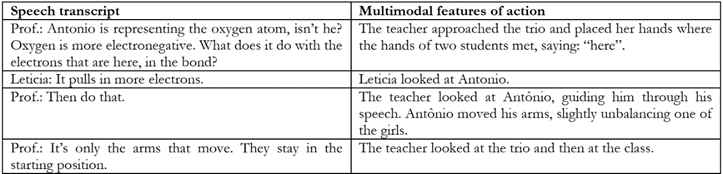
Below is a fragment of the dialog that took place at that moment (Chart 8):
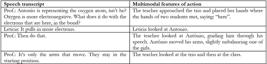
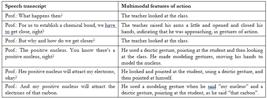
When she asked, “What does it do with the electrons that are here?” (Chart 7), the teacher placed her hands on those of the pair of students, showing the region where the electrons would be if the force of attraction were the same between the oxygen and hydrogen atoms. Although the touch between the students (light green) was already happening, it is possible to see that, by touching the students in the region that represented the shared pair of electrons, the teacher had the clear intention of communicating an idea (Bezemer & Kress, 2014). The teacher’s movement to get closer to the trio and draw attention to the pair of electrons, by touching the point where their hands met, we classify as representational proxemics, since this body movement was intended to highlight the representation.
The teacher’s intervention, when touching the students’ hands, was to get everyone to notice the region where the pair of electrons was being shared. Antonio, who represented the oxygen atom, complied with the request, pulling this “pair of electrons” closer to him (Figure 9B), since he was the most electronegative. In this case, the touch had a specific affordance in providing the insertion of electronegativity in the representation. Then, seeing that the students representing the hydrogens had moved a little, the teacher gave the fifth command, warning them that they couldn’t move, as only the electrons are attracted, which made them return to the starting position, stretching out their arms more.
It was after this that the teacher introduced the concept of forces and tried to get the students to imagine the result of the forces applied to the bonds that make up the water molecule. This dialog is transcribed in Chart 9:
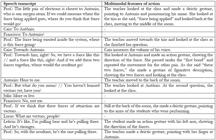
We noticed that some students were already thinking about the resultant force, when they said that it would be in Antônio’s direction. However, this knowledge was not shared by everyone, which led the teacher to continue her questioning. As she approached the trio and said “we have a force like this,” she made an action gesture, as if to show the force acting from the hydrogen atom to the oxygen atom. She then passed under the arms of one pair and made the same gesture with the other bond. This is what we call interactive proxemics, since the teacher physically interacted with the trio performing, showing the action of the forces. The resulting force present in each connection was apparently understood. Therefore, the teacher’s gesture and proxemics also enhanced the students’ understanding and thus also presented their own modal affordances. After several student participations, the teacher introduced the concept of vectors, trying to broaden the understanding of the resultant of forces for the whole. Although some said they had already come into contact with this concept, most of them did not seem to understand its meaning.
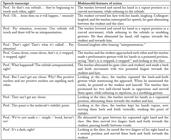
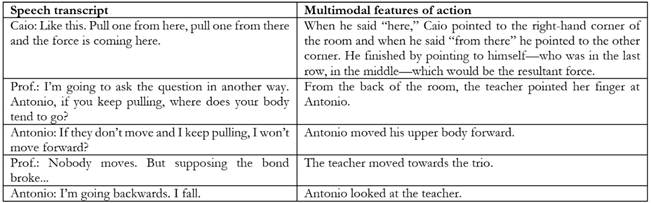
When the discussion of the resultant of forces showed that there were many doubts, Caio took the floor and the dialog described in Chart 10 took place:
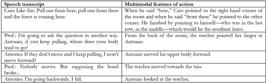
By saying “pull one from here, pull one from there” Caio took on the role of oxygen and made deictic gestures using his arms to represent the forces. However, he expanded the physical space of the representation, using the right and left corners at the front of the room as the source of the forces for each of the bonds. When he said “the force is coming here,” using a modeling gesture, he showed the resulting force by putting his hands together, indicating a single force heading towards him. This showed that the knowledge present in the embodied representation made by the trio was also present in what Caio was communicating, a strong indication that the embodied representation helped this student—and possibly others—to understand the forces involved in chemical bonds and in the molecule as a whole, knowledge that is necessary for understanding the polarity of the molecule.
With the intention of making sure that this was understood, the teacher turned to the trio performing the representation, specifically to Antonio, who was representing oxygen. The warnings given by the teacher to the girls (who represented hydrogen) at the beginning of the representation, that they should not move when considering electronegativity, and that only the pair of electrons (represented by the arms) could move, were hindering Antônio’s understanding. When the teacher allowed him to think about movement, citing the possibility of breaking the bond (Chart 9), Antônio showed that he was also correctly considering the resultant of forces.
Just as Teacher Pedro did, at the end of the performance teacher Selma turned to the blackboard and went back to the drawings that were there, as if to make sure that the students were associating the embodied representation with the representation that was drawn on the blackboard. From this point on, she used her knowledge of the forces involved in bonding to address the polarity of a molecule.
In this case too, the embodied representation had the potential to produce understanding. We argue that the forces present in bonds and the resultant forces in a molecule are essential to help students identify the polarity of a molecule, and that the concept of vector is central to understanding these forces.
By showing, through an embodied representation, what a chemical bond was, Pedro built up the knowledge needed to understand the polymerization of ethylene and the formation of the polymer. Selma, for her part, built up knowledge of the forces involved in a molecule, to show what leads to classifying molecules as polar or non-polar.
FINAL considerations
We analyzed two episodes in which two teachers organized a representation of chemical entities using the body. In one of them the teacher was part of the representation, and in the other only the students were. Our aim was to understand the contributions/limitations - what we might call modal affordance - of producing a representation using the body. The analysis showed evidence that in both episodes the students perceived the behavior of the chemical entity in the subjects representing the atoms and thus improved their own understanding of what was being studied.
Both teachers used various gestures associated with speech, both to guide the representation and to explain the behavior of the represented entities. They both relied on drawings - with which they had identified problems of understanding - when starting the representation with the body, and returned to these drawings at the end of the performances. In addition, proxemics - positioning in relation to the objects in the room - was well explored, both in the interaction and in the representation. In the second episode, it was possible to see that one of the students used the walls of the classroom when dealing with the forces present in the water molecule, increasing the “dimension” of the representation. We can also see that in some moments of the representation the change in the subjects’ positioning was important so that the relationship between the image on the blackboard and the representation with the body were perceived as the same entity. We therefore agree with Price and Jewitt (2013) when they state that the positioning of the subjects offers different opportunities for interaction.
We also noticed how much the gaze contributed to the interaction between the subjects and to enhancing the gestures. In the first episode, there were moments when the teacher negotiated meanings by looking at his own arm, which represented the chemical bond between the two carbons. In the second episode, every time the teacher talked about bonds or forces, she looked at the arms of the students who were making the representation, as if to indicate what she was talking about. Oben and Brône (2015) state that the direction of the gaze has more than the function of directing attention. For them, gestural behavior is altered by gaze behavior.
With regard to affordances, we highlight the limitations of drawing on the blackboard in both episodes, since these drawings were not enough to signify the concepts being worked on. By inserting the embodied representation, other meanings were constructed by the students. In the first episode, the chemical bond between two carbons was embodied and, although using the body as a learning object was not routine for these students, the forces of attraction and repulsion were “located,” as well as the effects they cause on chemical entities, which mediated the understanding of the formation of a polymer. In the second episode, the forces of attraction were somewhat vectorized, which allowed the students to perceive a resultant that would help them identify molecules as polar or non-polar. This leads us to argue that the embodied representation has affordances. They were enhanced by the other semiotic modes present (gestures, speech, gaze, proxemics) and were essential in the students’ understanding of what was being worked on in class. The drawings (or images) on the blackboard acquired movement through the direction of the gaze, gestures, touch or guidance from the teachers and classmates. When there was a lack of understanding of what was being represented by the image, the embodiment of the chemical entities presented affordances that helped with this understanding. We believe that our data corroborates Tytler et al. (2013) when they argue that modal affordances produce meaning.
Touch played a fundamental semiotic role in the construction of the meaning of bond. In the polymerization episode, the embodied representation was “improvised” by the teacher when he noticed the students’ difficulty. In this case, it seemed to us that touch played the role of a semiotic mode, since it was part of the representation as a whole. In the second episode, the teacher used touch at a specific moment in the representation to locate or indicate the presence of the shared pair of electrons. This made the students taking part in the representation consider the greater attraction of oxygen and move the region where the electron pair would be closer to the student representing oxygen. At this point, touch shows signs of also being a semiotic mode. Although they corroborate the studies by Bezemer and Kress (2014), our data do not allow us to generalize them, which implies that these investigations need to be extended.
Waldrip and Prain (2013) warn that it is not enough to use multiple representations constructed from various semiotic modes, emphasizing that it is necessary to move appropriately between one representation and another in order for meanings to be produced. In this work, we saw that the modes gesture, speech, drawing on the blackboard, proxemics, gaze and touch were used while the embodied representation was taking place. The transitions between these different modes took place articulately in the midst of the bodily representation. Our data also showed that the use of different representations by students allows reasoning to be constructed collectively, as advocated by Waldrip and Prain (2013). The presence of one mode does not imply meaning, but the combination of modes, in transitions that show that the different representations used deal with the same concept or phenomenon, can contribute substantially to the signification process.
We point out as well that the embodiment of the chemical entities also produced emotions in the students, especially in the case of the approach of the chemical entities in the bond between the two carbons. When they mentioned the interpenetration of the orbitals, a certain “elation” prevailed for a moment in the classroom. The constant transitions of gaze during this moment were indicative of how feelings are close to meanings. The teacher had to get the students to think again about the chemical bond that was being represented. Although it was a form of representation that was unusual for these students, we saw strong evidence of its contribution to learning.
The two performances analyzed showed that the construction of meaning is mediated by the interaction and multimodal communication of the subjects and objects that make up the classroom scene. This has implications for the field of science teaching, since using the body to represent a chemical entity proved to be a rational and affective strategy for understanding both the chemical bond and the forces involved in a bond. Teacher training needs to overcome epistemological and affective obstacles through expanded mediation of forms of interaction and communication, as prevailing semiotic modes, which still remain centered on verbalization and, at best, imagination. We believe that body performance and the articulation of semiotic modes through multimodality studies can contribute to this overcoming.
References
- Adami, E. (2016). Multimodality. In O. Garcia, N. Flores, & M. Spotti(Eds.). Oxford Handbook of Language and Society(pp. 451-472). Oxford: Oxford University Press.
- Aizawa, A. (2016). A percepção gestual de licenciandos e a representação estrutural química na perspectiva da multimodalidade (Dissertação). Faculdade de Educação, Universidade de São Paulo.
- Aizawa, A., Silva-Neto, A. B., & Giordan, M. (2014). Análise dos modos semióticos de representação estrutural química: categorias emergentes na formação inicial de professores. In T. Galieta, & P. Montanari (Org.). Linguagens e discursos na educação em ciências(pp. 375-390). Rio de Janeiro: Luminária Academia/FAPERJ.
- Bessa-Oliveira, M. A. (2019). O Corpo que habito: esse não é o corpo da sala de aula, do museu, nem o corpo da academia! Revista Científica/FAP, 21(2), 74-102.
-
Bezemer, J., & Kress, G. (2008). Writing in Multimodal texts - A social semiotic account of designs for learning. Written Communication, 25(2), 166-195. http://doi.org/10.1177/0741088307313177
» https://doi.org/10.1177/0741088307313177 - Bezemer, J., & Kress, G. (2014). Touch: A resource for making meaning. Australian Journal of Language & Literacy, 37(2), 77-85.
- Cordero, K., Nussbaum, M., Ibaseta, V., Otaíza, M. J., & Chiuminatto, P. (2018). Read, write, touch: Co‐construction and multiliteracies in a third‐grade digital writing exercise. Journal of Computer Assisted Learning, 34, 162-173.
- Danielsson, K. (2016). Modes and meaning in the classroom -The role of different semiotic resources to convey meaning in science classrooms. Linguistics and Education, 35, 88-99.
- Gibson, J. J. (1977) The theory of affordances. In J. Gibson. The Ecological Approach to Visual Perception (pp. 119-136). Psychology Press.
- Giordan, M., Silva-Neto, A. B., & Aizawa, A. (2015). Relações entre Gestos e Operações Epistêmicas Mediadas pela Representação Estrutural em Aulas de Química e suas Implicações para a Produção de Significados. Química Nova na Escola, 37, 82-94.
- Hall, E. T. (1963). Proxemics: a system for the notation of proxemic behavior. American Anthropologist, v. 65, pp. 1003-1026.
- Halliday, M. A. K. (1978). Language as Social Semiotic London: Edward Arnold.
- Halliday, M. A. K. (1985). As introduction to functional grammar London: Baltimore.
- Hao, J., & Hood, S. (2019). Valuing science: The role of language and body language in a health science lecture. Journal of Pragmatics, 139(1), 200-215.
- Jewitt, C. (2009). Different approaches to multimodality. In C. Jewitt(Ed.) The Routledge Handbook of Multimodal Analysis, (pp 28-39) London: Routledge.
- Kendon, A. (2004). Gesture: Visible action as utterance. Cambridge, UK: Cambridge University Press.
- Kress, G. (2009). What is mode?In: Jewitt, C. (Ed.) The Routledge Handbook of Multimodal Analysis, (pp. 54-67) London: Routledge .
-
Kress, G. (2010). Multimodality: a social semiotic approach to contemporary communication. London: Routledge . http://doi.org/10.1177/1461445612446268b
» https://doi.org/10.1177/1461445612446268b - Kress, G., & Leeuwen, T. Van. (1996). Reading Images: the grammar of visual design. London & New York: Routledge.
-
Lemke, J. L. (1998). Multimedia Literacy Demands of the Scientific Curriculum. Linguistics and Education, 10(3), 247-271. http://doi.org/10.1016/S0898-5898(99)00009-1
» https://doi.org/10.1016/S0898-5898(99)00009-1 - Macedônia, M. (2019). Embodied Learning: Why at School the Mind Needs the Body. Frontiers in Psychology, 10, 1-8.
- Machado, L., Raggazzi, M., & Guedes, R. (2019). Ciências Belo Horizonte: Bernoulli Sistema de Ensino, 2019.
- McNeill, D. (2005). Gesture and Thought Chicago: University of Chicago Press.
-
Moro, L., Mortimer, E. F., & Tiberghien, A. (2019). The use of social semiotic multimodality and joint action theory to describe teaching practices: two cases studies with experienced teachers. Classroom Discourse, 11(3), 1-23. DOI: 10.1080/19463014.2019.1570528
» https://doi.org/10.1080/19463014.2019.1570528 -
Moro, L., Mortimer, E. F., Quadros, A. L., Coutinho, F. Â., Silva, P. S., Pereira, R. R, & Santos, V. C. (2015). Influência de um terceiro modo semiótico na gesticulação de uma professora de Química. Revista Brasileira de Pesquisa em Educação, 15(1), 9-32. Recuperado dehttps://periodicos.ufmg.br/index.php/rbpec/article/view/4300
» https://periodicos.ufmg.br/index.php/rbpec/article/view/4300 - Mortimer, E. F., Moro, L, & Sá, E. F. (2018). Referenciais Teóricos utilizados na pesquisa: Discurso, Semiótica Social e Multimodalidade. In E. F. Mortimer, & A. L. Quadros (Eds.). Multimodalidade no Ensino Superior Ed. UNIJUÍ.
-
Mortimer, E. F., Quadros, A. L., Silva, A. C. A., Sá, E. F. de, Moro, L., Silva, P. S., Pereira, R. R. (2014). Interações entre Modos Semióticos e a Construção de Significados em Aulas de Ensino Superior. Ensaio: pesquisa em educação em ciências, 16(03), 121-145. http://doi.org/10.1590/1983-21172014160306
» https://doi.org/10.1590/1983-21172014160306 - Mortimer, E. F, Machado, A. H., & Romanelli, L. (2000). A proposta curricular de química do Estado de Minas Gerias: Fundamentos e Propostas. Química Nova, 23(2), 273-283.
- Norris, S. (2004). Analyzing multimodal interaction: A methodological framework. New York: Routledge.
- O’Halloran, K., & Smith, B. A. (2011). Multimodal Studies. In K. O’Halloran, & B. A. Smith(Eds.) Multimodal Studies: Exploring Issues and Domains(pp. 1-13), London: Routledge .
-
Oben, B., & Brône, G. (2015). What you see is what you do: on the relationship between gaze and gesture in multimodal alignment. Language and Cognition, 7(4), 546-562. http://doi.org/10.1017/langcog.2015.22
» https://doi.org/10.1017/langcog.2015.22 -
Oh, P. S., & Kim, K. S. (2013). Pedagogical Transformations of Science Content Knowledge in Korean Elementary Classrooms. International Journal of Science Education, 35(9), 1590-1624. http://doi.org/10.1080/09500693.2012.719246
» https://doi.org/10.1080/09500693.2012.719246 - Padilha, J. N., & Carvalho, A. M. P. de. (2011). Relações entre os gestos e as palavras utilizadas durante a argumentação dos alunos em uma aula de conhecimento físico. Revista Brasileira de Pesquisa em Educação em Ciências, 11(2), 25-40.
- Pereira, R. R, Mortimer, E. F, &Moro, L.(2015). Os Gestos Recorrentes e a Multimodalidade em Aulas de Química Orgânica no Ensino Superior. Química Nova na Escola, 37(n. esp.), 43-54.
- Piccinini, C., & Martins, I. (2004). Comunicação multimodal na sala de aula de ciências: construindo sentidos com palavras e gestos. Ensaio: pesquisa em educação em ciências, 6(1), 26-40.
- Portnoy, E. J. (1982). Non-verbal Communication: Awareness in the Classroom. American Music Teacher, 31(4), 14-15.
-
Pouw, W. T. J. L., van Gog, T., & Paas, F. (2014). An Embedded and Embodied Cognition Review of Instructional Manipulatives. Educational Psychology Review, 26(1), 51-72. http://doi.org/10.1007/s10648-014-9255-5
» https://doi.org/10.1007/s10648-014-9255-5 -
Prain, V., & Tytler, R. (2022). Theorising Learning in Science Through Integrating Multimodal Representations. Research in Science Education, 52(3), 805-817. https://doi.org/10.1007/s11165-021-10025-7
» https://doi.org/10.1007/s11165-021-10025-7 -
Price, S., & Jewitt, C. (2013). A multimodal approach to examining “embodiment” in tangible learning environments. Proceedings of the 7thInternational Conference on Tangible, Embedded and Embodied Interaction - TEI ’13, 43-50. http://doi.org/10.1145/2460625.2460632
» https://doi.org/10.1145/2460625.2460632 - Quadros, A. L, & Giordan, M. (2019). Rotas de transição modal e o ensino de representações envolvidas no modelo cinético molecular. Investigações em Ensino de Ciências, 24(3), 74-100.
- Sessa, P., & Trivelato, S. L. F. (2013). A construção de significados e as ferramentas culturais em atividades de campo. In Atas do IXEncontro Nacional de Pesquisa em Educação em Ciências (pp. 1-8). Águas de Lindóia.
- Silva-Neto, A B., Giordan M., & Aizawa, A. (2015) Meaning making with gestures and structural representation media in pre-service teaching. In: J. Lavonen, K. Kalle Juuti, J. Lampiselkä, A. Uitto, & K. Hahl(Eds.). Science Education Research: Engaging Learners for a Sustainable Future. (pp. 958-965), Proceedings of ESERA 2015.
- Silva-Neto, A. B., Giordan M., & Aizawa, A. (2016) Análise multimodal sobre a produção de significados: caracterização de recursos e padrões semióticos. In: Atas doXVIIIEncontro Nacional de Ensino de Química, Florianópolis, 1-12.
-
Smith, H. (1979). Nonverbal Communication in Teaching. Review of Educational Research, 49(4), 631-672. http://doi.org/10.3102/00346543049004631
» https://doi.org/10.3102/00346543049004631 -
Tang, K.-S., Tan, S. C., & Yeo, J. (2011). Students’ Multimodal Construction of the Work-Energy Concept. International Journal of Science Education, 33, 1775-1804. http://doi.org/10.1080/09500693.2010.508899
» https://doi.org/10.1080/09500693.2010.508899 -
Tytler, R., Prain, V., Hubber, P., & Waldrip, B. (Ed.) (2013). Constructing representations to learn in science The Netherlands: Springer Science & Business Media, http://doi.org/10.1007/978-3-319-16450-2_9
» https://doi.org/10.1007/978-3-319-16450-2_9 - Van Leeuwen, T. (2005). Introducing Social Semiotics Routledge.
- Vigotski, L. S. (2001). A Construção do Pensamento e da Linguagem São Paulo: Martins Fontes.
- Waldrip, B., & Prain, V. (2013). Teacher’ initial response to a representational focus. In Constructing Representations to Learn in Science (pp. 15-30). The Netherlands: Sense Publishers.
-
Wilson, R. E., & Bradbury, L. U. (2016). The pedagogical potential of drawing and writing in a primary science multimodal unit. International Journal of Science Education, 38(17), 2621-2641. http://doi.org/10.1080/09500693.2016.1255369
» https://doi.org/10.1080/09500693.2016.1255369 - Yang, J., & Shu, H. (2011). Embodied representation of tool-use action verbs and hand action verbs: Evidence from a tone judgment task. Neuroscience Letters, 493(3), 112-115.
-
Zhang, Y. (2016). Multimodal Teacher Input and Science Learning in a Middle School Sheltered Classroom. Journal of Research in Science Teaching, 53(1), 7-30. http://doi.org/10.1002/tea.21295
» https://doi.org/10.1002/tea.21295
-
1
Article published with funding from theConselho Nacional de Desenvolvimento Científico e Tecnológico- CNPq/Brazil for editing, layout and XML conversion services.
-
2
This information was observed during the analysis session of the students’ lessons and confirmed in an interview at the end of the course.
History
-
Received
16 Mar 2023 -
Preprint posted on
16 Mar 2023
10.1590/SciELOPreprints.6436 -
Accepted
04 Feb 2024

 Source: Based on
  Source:
  Source: authors, based on NVivo® software.
 Source: Authors.
 Source: Image drawn from the video.
 Source: Authors
 Source: Authors
 Source: Image drawn from the video
 Source: Image drawn from the video.
 Source: Authors
 Source: Image drawn from the video.
 Source: authors
 Source: Image on the blackboard.
 Source: authors, based on NVivo® software
 Source: Authors
 Source: Image drawn from the video.
 Source: authors
 Source: Authors
 Source: authors