 Cost of hematopoietic cell transplantation for hematologic malignancies from a transplant center in a developing country
ABSTRACT
Objective: Hematopoietic cell transplantation is a resource-intensive procedure influenced by several cost drivers. The primary objective of this study was to compare the costs of matched-sibling (MSD), unrelated (URD), and haploidentical (Haplo) donor transplants and to identify patient- and transplant-related factors associated with higher costs.
Methods: This observational, retrospective cohort study compared the costs among human leucocyte antigen (HLA)-matched MSD, HLA-matched URD, and Haplo transplants. Patients with hematologic malignancies who underwent their first allogeneic hematopoietic cell transplantation were included. Median cost analyses were performed using a parametric lognormal survival model at 1 year. Patients who did not complete the follow-up were censored. The median follow-up was 53 months, and a total of 177 patients were included (54 MSD, 43 Haplo, and 80 URD).
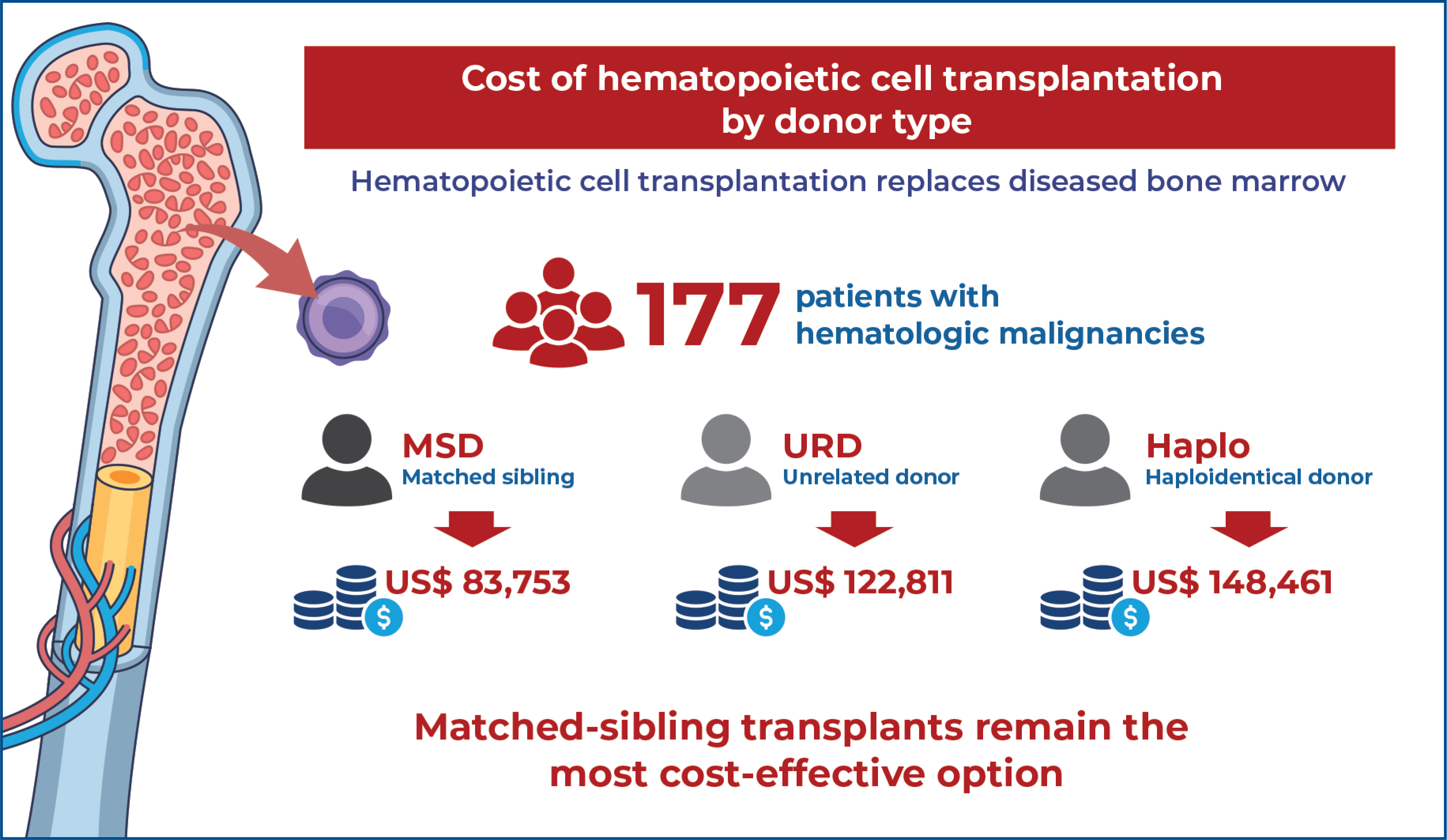
Results: Crude 1-year costs were US$83,753 for MSD, lower than those of URD (US$122,811) and Haplo (US$148,461) (p=0.01). In the 1-year cost model, Haplo (p=0.02) and URD (p=0.01) were associated with higher costs than MSD. In multivariable analysis, Haplo (p=0.008) and URD (p=0.004) remained independently associated with higher costs. Haplo costs were not significantly different from URD costs (p=0.84).
Conclusion: From a financial perspective, sibling transplantation remains the gold standard treatment.
Keywords:
Costs and cost analysis; Transplantation, haploidentical; Hematopoietic stem cell transplantation; Blood donors; Unrelated donors; Siblings cyclophosphamide
Highlights
-
■
Costs compared across matched sibling donor, unrelated donor, and Haplo transplants.
-
■
A total of 177 patients with hematologic malignancies were analyzed.
-
■
Matched sibling donor transplants had the lowest 1-year costs.
-
■
Unrelated donor and Haplo transplants were significantly more expensive than matched sibling donor.
In Brief
Hematopoietic cell transplantation, a procedure to replace diseased bone marrow, is resource-intensive. In 177 patients with hematological malignancies, matched sibling transplants were significantly less costly than unrelated or haploidentical transplants, highlighting sibling donors as the most cost-effective option.
INTRODUCTION
Hematopoietic cell transplantation (HCT) is a resource-intensive procedure influenced by several cost-driving factors. The conditioning regimen, which typically includes high-dose chemotherapy and/or radiation therapy, requires the use of expensive agents such as intravenous busulfan.(1) Procuring and processing hematopoietic stem cells from the bone marrow or peripheral blood further increases costs, especially when donor-matching examinations and mobilization procedures are considered.(2) Hospitalization, which often involves an extended stay in specialized care units, represents another significant expense. The management of post-transplant complications—such as graft-versus-host disease (GVHD) and infections—necessitates additional costly medications and long-term clinical monitoring.(3) Furthermore, the expenses associated with maintenance therapy and the management of long-term side effects or relapse substantially increase the overall financial burden of HCT.(1,3)
The average cost of an allogeneic transplant ranges from US$120,000 to US$400,000 (adjusted to 2012 values) during the initial post-transplant months.(4) In developing countries, the reported unadjusted costs for allogeneic transplantation are markedly lower, at approximately US$12,500 in Mexico, US$17,194 in India, and US$31,500 in Brazil.(4–7) While these cost differences appear substantial—with up to a tenfold variation—they do not account for critical factors that impact clinical outcomes and patient-centered value assessments. Given the significant differences in average household income and Gross Domestic Product between developing and developed countries, direct cross-national cost comparisons may not be economically meaningful.
Studies evaluating the actual costs of HCT show considerable heterogeneity in methodology and time horizon, with most being single-center analyses.(3,5,8) The initial hospitalization for autologous HCT averages between US$36,000 and US$88,000, whereas that for allogeneic HCT averages around US$200,000.(3) A study conducted in the United States using a longitudinal administrative claims database reported a median 100-day total cost of US$99,899 for autologous HCT and US$203,026 for allogeneic HCT, with more than 75% of the total costs incurred during the initial hospitalization period.(9)
Some studies have integrated both cost and outcome measures to compare the two therapeutic strategies through cost-effectiveness or cost-utility analyses.(3,8) For instance, a cost-effectiveness analysis of autologous HCT in older patients with multiple myeloma versus non-transplant strategies demonstrated longer median overall survival among transplant recipients, with an incremental cost-effectiveness ratio of US$72,852 per life-year gained, suggesting that transplantation was cost-effective.(9) Using the same decision-analytic model, early autologous HCT provided a median quality-adjusted survival 1.96 years longer than late HCT and was also considered potentially cost-effective.(10,11)
OBJECTIVE
This single-center study, conducted at a philanthropic institution in São Paulo, Brazil, evaluated the costs of allogeneic hematopoietic cell transplantation by donor type and identified risk factors associated with higher financial burden.
METHODS
This was an observational, retrospective cohort study conducted at the Hospital Israelita Albert Einstein in São Paulo, Brazil. The main objective was to compare costs among matched sibling donor (MSD), unrelated donor (URD), and haploidentical (Haplo) transplant recipients and to identify patient- and transplant-related predictors of higher costs. A human leucocyte antigen (HLA)-matched donor was defined as HLA 6/6 (A, B, and DR) for sibling transplants and HLA 10/10 (A, B, C, DR, and DQ) for unrelated transplants. We included patients with hematologic malignancies who underwent their first allogeneic HCT between January 1, 2010, and December 31, 2021. Cost analysis was performed up to day +365 post-transplantation. During this period, MSD recipients received standard calcineurin and antimetabolite-based GVHD prophylaxis; URD recipients received anti-thymocyte globulin (ATG)-based prophylaxis; and Haplo recipients received post-transplant cyclophosphamide (PTCy)-based prophylaxis.
Demographic and clinical data were extracted from each patient's electronic medical records, whereas cost data were derived from medical billing records using the hospital's standardized cost table. The health economics team worked in close collaboration with the HCT unit to ensure accurate extraction and analysis of cost data. The variables used to determine the cost of each procedure included examinations, medical materials, hospital daily rates, procedures, nursing care, consultations, medications, services, gas therapy, professional fees, and genetic testing.
All cost values were calculated using the hospital's standardized cost table as of October 2023 to eliminate the effects of inflation. Costs included patient-related expenditures such as HLA typing and pre-transplant examinations, but excluded donor-related costs. The values were converted to U.S. dollars (US$) based on the average daily exchange rate for October 2023 (R$4.99 per US$1). The local Ethics Committee approved the study protocol and waived the requirement for informed consent.
Univariate and multivariate analyses of the median costs were performed using a parametric lognormal survival model at 1 year. Patients who did not complete the follow-up were censored to avoid bias arising from apparently lower costs in patients who died or were lost to follow-up. In lognormal models, the exponential of the intercept (β0) represents a median value that is multiplied by each patient's factors (βn). Multivariate models were selected based on the lowest Akaike Information Criterion. All analyses were performed using R software (version 4.4.1; R Foundation for Statistical Computing, Vienna, Austria).
The study was conducted in accordance with the Declaration of Helsinki and was approved by the Ethics Committee of the Hospital Israelita Albert Einstein (CAAE: 51679221.3.0000.0071; #4.991.813). The Ethics Committee waived the requirement for informed consent.
RESULTS
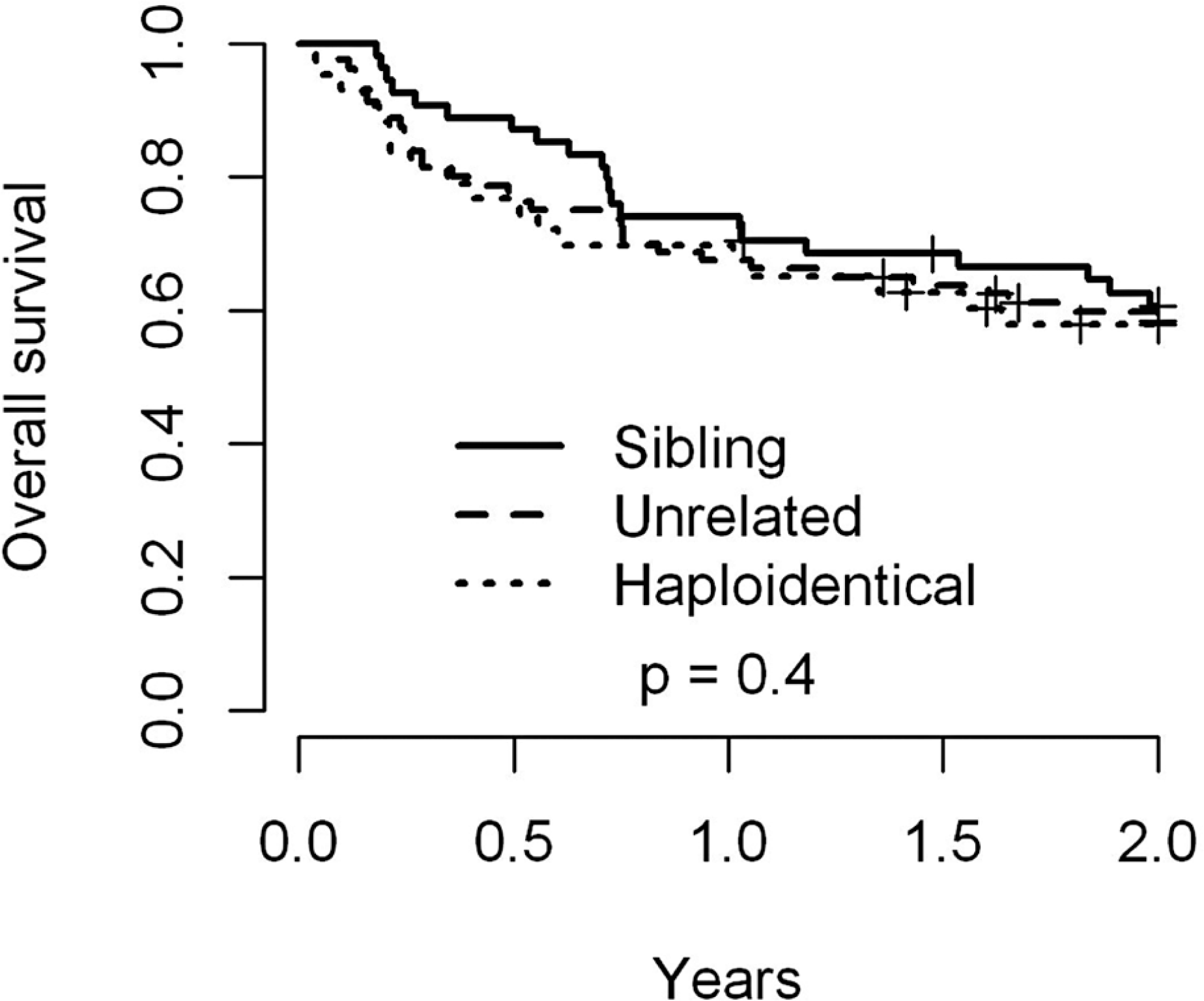
With a median follow-up of 53 months, 177 patients were included: 54 with MSD, 43 with Haplo disease, and 80 with URD. Patients in the Haplo group were younger and received a myeloablative conditioning (MAC) regimen less frequently. These and other patient characteristics are summarized in table 1. Overall survival at 1 year did not differ significantly among the groups: 74% (95% confidence interval (95%CI) 63-87%) for MSD, 70% (95%CI= 57-85%) for Haplo, and 68% (95%CI= 58-79%) for URD (p=0.40; Figure 1).
The crude 1-year costs were US$83,753 (interquartile range [IQR], 50,971-72,287) for MSD, which were lower than those for URD (US$122,811; IQR, 77,615-301,081) and Haplo (US$148,461; IQR, 99,416-284,903; p=0.01).
In the 1-year cost model, Haplo (p=0.02) and URD (p=0.01) transplants were associated with higher costs than MSD. In multivariate analysis, Haplo (p=0.008) and URD (p=0.004) remained independently associated with higher costs (Table 2). Haplo costs were not significantly higher than URD costs (p=0.84). Other factors significantly associated with 1-year costs included sex and functional status: a Karnofsky Performance Status score <90% was associated with higher costs (p=0.0003 compared with Karnofsky 90-100%), and male sex was also associated with higher costs (p=0.003 compared with female sex).
DISCUSSION
Our results show that the costs of allogeneic HCT are significantly higher when using alternative donors, namely URD and Haplo donors. The only other factors significantly associated with costs were Karnofsky Performance Status score and male sex.
The estimated 1-year costs were approximately US$85,000 for MSD, US$120,000 for URD, and US$150,000 for Haplo (p=0.01). Most expenses occurred during the first 3 months post-transplantation, and both Haplo and URD transplants were substantially more expensive than MSD. Although ATG is considerably more costly than PTCy, the overall costs of URD and Haplo transplants did not differ significantly. Other authors have reported that Haplo HCT recipients experience a higher risk of infection and delayed T-cell reconstitution compared with matched HCT recipients.(12) Our data suggest that alternative donor transplants consume more resources than MSD. Whether incorporating PTCy into URD will make URD HCT more cost-effective remains to be determined.
Another notable finding of our study was that patients with Karnofsky Performance Status scores below 90% incurred higher transplantation costs compared with those scoring 90-100%, even though they were less likely to receive MAC regimens. Reduced-intensity conditioning allows allogeneic transplantation in patients with poor performance status; however, in our cohort, it did not lead to lower costs. It should also be noted that the association between lower Karnofsky scores and higher costs is not universal.(13)
Our study had some limitations. Although the cost data were well preserved, it was retrospective in nature, and patient characteristics were prospectively collected and reported to the Center for International Blood and Marrow Transplant Research. Donor-related costs were not included in this analysis. This exclusion was intentional rather than a methodological flaw, as in Brazil, the costs of donor stem cell harvest and URD searches are fully funded by the REDOME (the Brazilian National Donor Registry), which is currently the third largest such registry in the world. If donor search and stem cell harvest costs had been included, the difference between URD and Haplo transplants would have been markedly smaller. For reference, an international donor harvest facilitated by the National Marrow Donor Program currently costs approximately US$50,000 (personal communication from Daniela Oliveira, head of REDOME). Finally, we used an unconventional model for the cost analysis; a parametric survival model was used because the cost data followed a lognormal distribution. In such models, early mortality can paradoxically lower total expenditure, making censoring approaches suitable for cost estimation. This was a single-center study conducted at a high-standard hospital in São Paulo, Brazil, and the absolute costs reported here may not represent those of other transplant centers. Nevertheless, there is no reason to believe that the relative cost differences between donor types would substantially differ across institutions.
CONCLUSION
In conclusion, we showed that alternative donor transplants are more expensive than sibling transplants. Among the alternative donor procedures, Haplo transplants did not differ in cost from unrelated donor transplants, although almost all unrelated donor recipients received anti-thymocyte globulin rather than post-transplant cyclophosphamide. However, donor-related costs may have attenuated this difference. From a financial perspective, sibling transplantation remains the gold standard.
DATA AVAILABILITY
After publication, data will be available from the authors upon request—this condition is justified in the manuscript.
REFERENCES
- 1 Majhail NS, Farnia SH, Carpenter PA, Champlin RE, Crawford S, Marks DI, et al. Indications for Autologous and Allogeneic Hematopoietic Cell Transplantation: Guidelines from the American Society for Blood and Marrow Transplantation. Biol Blood Marrow Transplant. 2015;21(11):1863-9.
- 2 Arnold DE, Emoto C, Fukuda T, Vinks A, Lane A, Teusink-Cross A, et al. Alemtuzumab Precision Dosing in Allogeneic Hematopoietic Cell Transplantation. Biol Blood Marrow Transplant. 2020;26(3):S150.
- 3 Khera N, Zeliadt SB, Lee SJ. Economics of hematopoietic cell transplantation. Blood. 2012;120(8):1545-51.
- 4 Hashmi SK, Srivastava A, Rasheed W, Adil S, Wu T, Jagasia M, et al. Cost and quality issues in establishing hematopoietic cell transplant program in developing countries. Hematol Oncol Stem Cell Ther. 2017;10(4):167-72.
- 5 Jaime-Pérez JC, Heredia-Salazar AC, Cantú-Rodríguez OG, Gutiérrez-Aguirre H, Villarreal-Villarreal CD, Mancías-Guerra C, et al. Cost structure and clinical outcome of a stem cell transplantation program in a developing country: the experience in northeast Mexico. Oncologist. 201;20(4):386-92.
- 6 Sharma SK, Choudhary D, Gupta N, Dhamija M, Khandelwal V, Kharya G, et al. Cost of hematopoietic stem cell transplantation in India. Mediterr J Hematol Infect Dis. 2014;6(1):e2014046.
- 7 Seber A. The cost of hematopoietic stem cell transplantation in the real world. Hematology. 2012;17 Suppl 1:S208-11.
- 8 Preussler JM, Mau LW, Majhail NS, Meyer CL, Denzen EM, Edsall KC, et al. Administrative Claims Data for Economic Analyses in Hematopoietic Cell Transplantation: challenges and Opportunities. Biol Blood Marrow Transplant. 2016;22(10):1738-46.
- 9 Shah GL, Majhail N, Khera N, Giralt S. Value-Based Care in Hematopoietic Cell Transplantation and Cellular Therapy: challenges and Opportunities. Curr Hematol Malig Rep. 2018;13(2):125-34.
- 10 Pandya C, Hashmi S, Khera N, Gertz MA, Dispenzieri A, Hogan W, et al. Cost-effectiveness analysis of early vs. late autologous stem cell transplantation in multiple myeloma. Clin Transplant. 2014;28(10):1084-91.
- 11 Shah GL, Winn AN, Lin PJ, Klein A, Sprague KA, Smith HP, et al. Cost-Effectiveness of Autologous Hematopoietic Stem Cell Transplantation for Elderly Patients with Multiple Myeloma using the Surveillance, Epidemiology, and End Results-Medicare Database. Biol Blood Marrow Transplant. 2015;21(10):1823-9.
- 12 Mehta RS, Saliba RM, Ghanem S, Alousi AM, Rondon G, Anderlini P, et al. Haploidentical versus Matched Unrelated versus Matched Sibling Donor Hematopoietic Cell Transplantation with Post-Transplantation Cyclophosphamide. Transplant Cell Ther. 2022;28(7):395.e1-11.
- 13 Khera N, Emmert A, Storer BE, Sandmaier BM, Alyea EP, Lee SJ. Costs of allogeneic hematopoietic cell transplantation using reduced intensity conditioning regimens. Oncologist. 2014;19(6):639-44.
Edited by
-
Associate Editor:
Ana Maria Malik Fundação Getulio Vargas, São Paulo, SP, Brazil ORCID: https://orcid.org/0000-0002-0813-8886