 Spiritual care in the intensive care unit. Is it already a reality?: an integrative review
ABSTRACT
Introduction Spirituality has emerged as a phenomenon of interest in various global contexts. The adoption of spirituality as a fundamental aspect of healthcare remains underexplored, especially in critical environments such as intensive care units.
Objective To identify strategies for incorporating spiritual care into adult intensive care environments through an integrative literature review.
Methods An integrative review was conducted using the Embase, Web of Science, Medline/PubMed, PsycINFO, LILACS, and Cochrane Central databases. Twenty-one studies published in English, Spanish, or Portuguese over the last 10 years were selected.
Results Different approaches to spirituality were identified, including training implementation, individual interviews, meetings, educational programs, and practices involving healthcare professionals.
Conclusion Spirituality in the intensive care environment has been a growing reality in recent years through efforts aimed at helping healthcare professionals integrate spirituality into the care provided in clinical practice. Individual interviews were the primary strategy for incorporating spiritual care in intensive care unit settings. Questionnaires were used to support these interviews, and the frequency and duration typically involved a single session, ranging from 15 to 60 min.
Spirituality; Spiritual therapies; Critical care; Health personnel; Professional competence; Intensive care units
INTRODUCTION
Spirituality has proven to be a phenomenon of interest in various scenarios worldwide. One of the most widely accepted concepts of spirituality with international consensus is that of Puchalski. She defined spirituality as a dynamic and intrinsic aspect of humanity through which individuals seek meaning, purpose, and transcendence and experience their connection with themselves, others, family, community, society, nature, and the significant or sacred through their attitudes, habits, and practices.1
In the past decade, the topic of spirituality has been addressed in the intensive care unit (ICU) environment through the practices of professionals involved in patient care, thus characterizing spiritual care.2,3 This involves aspects related to promoting connections with others and investigating spiritual needs and religious beliefs. Although spiritual care has been implemented in some healthcare services, healthcare professionals often underestimate it, as its benefits are still relatively unexplored.2
One of the main barriers for professionals not considering and including spirituality in the care provided in ICUs is the lack of knowledge and time necessary for its practice, especially among doctors and nurses.3-5 Cultural context also appears to influence the incorporation of spirituality. Many European countries, especially more developed ones such as the United Kingdom, the Netherlands, and Germany, are more secularized than Asian or Middle Eastern countries. This may result in greater distance from incorporating the spiritual dimension into clinical practice, leading to less active and distant openness to integrating spirituality into healthcare.6-9
Despite the challenges related to implementing strategies that encompass spiritual care in ICUs, many patients and their families acknowledge that the feelings of vulnerability and stress arising from hospitalization require care that goes beyond the physical aspects. Accordingly, aspects of spirituality should also be considered.2,4,9
The ICU environment is characterized by acute changes in clinical aspects where many needs related to care become more evident, such as sleep deprivation, pain, fears, anxiety, distress, and feelings connected to life’s meaning, mortality, and hope, which are identified as spiritual needs.10
Considering the complexity and numerous specificities of the environment, spirituality is beginning to adapt to critical care settings by not only focusing on end-of-life care, from which it originally stems, but also as an approach integrated into the care provided throughout hospitalization.11,12
Regarding the needs of health care professionals, patients, and families in intensive care environments, the adoption of spirituality as a fundamental aspect of health care remains underexplored. This is particularly true of strategies that affirm their implementation within the care context. Therefore, this study aimed to identify strategies for incorporating spiritual care into the ICU through an integrative literature review.
METHODS
The method employed was an integrative literature review selected to synthesize representative research addressing the theme of strategies for incorporating spiritual care into ICUs. The review followed the guidelines proposed by the Joanna Briggs Institute13 and was developed in accordance with the phases described by Toronto and Remington, who determined the following six stages of an integrative review: I) definition of the review question, II) literature search using predetermined criteria, III) critical evaluation of selected studies, IV) analysis and synthesis of literature, V) discussion of new knowledge, and VI) planning the dissemination of results.14 This approach was selected because of its systematic and rigorous nature, which facilitates the extraction of scientific studies with significant implications for clinical practice.14In addition, we adapted the study to follow the Preferred Reporting Items for Systematic Reviews and Meta-Analyses (PRISMA-ScR).15
Search strategy
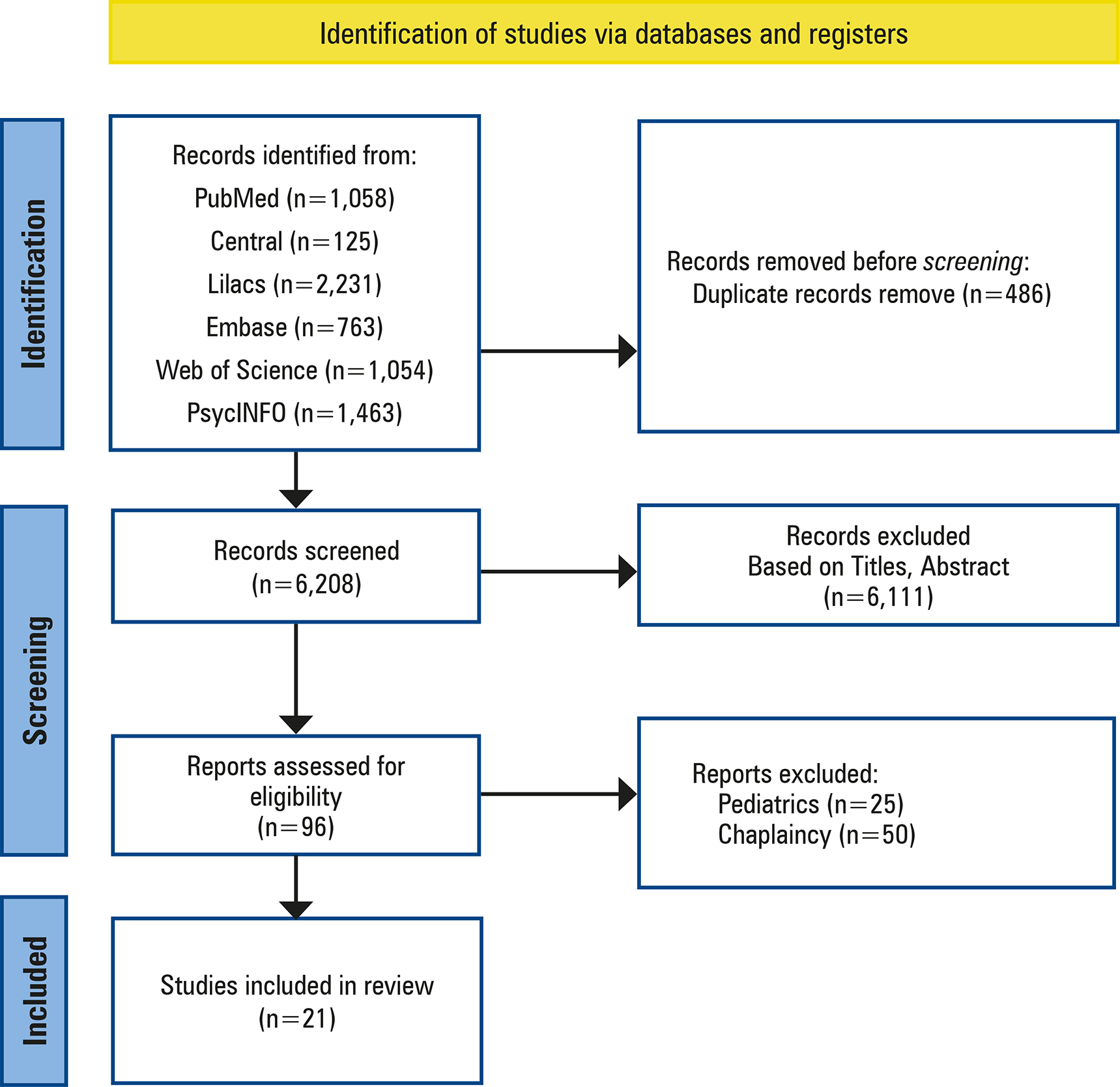
After formulating the research question, “What strategies have healthcare professionals in the ICU scientifically developed to include spirituality into patient care?” Articles were searched between April and November 2023 using the following online databases: Medline via PubMed, Cochrane Central, LILACS, PsycINFO, Web of Science, and Embase via Elsevier (Figure 1).
The search strategy utilized health descriptors (DeCS - Descritores em Ciências da Saúde), Medical Subject Headings (MeSH) terms, and keywords related to spirituality, healthcare professionals, and intensive care. These terms were combined using the Boolean operators AND and OR and adapted for each database (Table 1).
Inclusion criteria
The inclusion criteria were original studies and published articles available in full for complete text reading. When an article of interest was not freely accessible for full-text reading, the authors were contacted to access the material. Articles published in Portuguese, English, or Spanish in the past decade (between 2013 and 2023) were included. The exclusion criteria included review articles, theses, comments, abstracts published at events, and studies focusing on the pediatric/neonatal population and health chaplaincy.
RESULTS
Twenty-one articles were selected (Table 2), originating from 10 countries: the United States of America, with 9 studies;16-24 Iran with three studies;25-27 Spain with two studies;28,29 and Singapore,30 Malaysia,31 Turkey,32 Colombia,33 Canada,34 Saudi Arabia,35 and the Czech Republic with one study each.36
Regarding study design, the review identified seven qualitative studies,16,21,24,25,29,33,34 four randomized controlled trials,23,26,30,31 three cross-sectional studies,17,32,36 two quantitative studies,27,35 and one each of the following: non-randomized,18 cohort,19 observational,28 exploratory descriptive,22 and quasi-experimental studies.20 Regarding the population, 10 studies addressed multidisciplinary teams17,19,21,22,24,27,28,30,33,34 eight studies addressed only the nursing team,16,18,25,26,29,32,35,36 and three studies involved patients and family members in the context of intensive care.20,23,31
The primary methods for addressing and implementing spirituality in the ICU (Table 3) included individual interviews,16,17,21,23-25,28,32,34 trainings,18,20,22,26,29-31 “group awareness,”33,35 meetings and gatherings,19and record analyses.36 The predominant interfaces adopted were questionnaires,17,19,21,27,28,32,34,35,36 classes, practices, workshops,22,23,24,26,29-31 readings,18,20 question scripts,16,25 and textual construction.28
Concerning the frequency and duration of these strategies, most studies occurred only at a single moment,16-21,24,25,27-32,34,35 two studies had three sessions,22,23 one study had four sessions,33 one study had eight sessions,26) and one study did not have a regular frequency as it involved record analysis.36
DISCUSSION
Within the field of health sciences, the relationship between spirituality and care has begun to emerge. This relationship has been particularly highlighted in the context of severe illnesses, especially in patients with cancer, marking a significant milestone in the evolution of palliative care.37 This important approach has led to more in-depth studies of spirituality in recent decades in the context of this type of care and within this specific population.
Since the beginning of the 21st century, with the growing interest in researching spirituality in various settings, attention to care has expanded to several areas, including intensive care.2,3,9,16 Recently, the approach to spiritual care in ICU settings has become a perceived reality in various countries, with the involvement of several healthcare professionals in the care practice.17,28,30,31,36
The role of nursing as a science dedicated to investigating healthcare, its interface with the spiritual dimension in the ICU, and its role and actions in spiritual care are worth highlighting. Many studies have specifically addressed the role of nurses as primary interlocutors of care.16,18,25,26,29,32,35,36 Nurses are fundamental professionals in critical care settings, whereas other multidisciplinary team members form a clinical body that shares competencies attributed to caregiving.
Although care is provided by nurses from the perspective of comprehensiveness, all professionals are responsible for including different dimensions of care in their care practices.38 The integration of spirituality into the clinical practice of intensive care still poses some challenges, ranging from a lack of knowledge and time for its application to the discomfort experienced by professionals.6,22,32,34
To initiate a culture where spirituality is integral to the care plan within the intensive care environment, implementing pedagogical and formative actions, as well as strategies that bring this knowledge closer to intensive care health professionals, is necessary. Some educational initiatives in critical care units indicate that institutions are increasingly incorporating spiritual care into their practices.18,20,26,33
Individual interviews have been the most common strategy for bringing the concept of spirituality closer to intensive care professionals, aiming to standardize their knowledge on this topic.16,21,23-25,28,32,34 Interviews have proven effective in raising awareness among healthcare professionals about various topics related to the spirituality/religiosity (S/R) dimension, such as the definitions and concepts of spirituality, spiritual needs and care, quality of life, and professional competencies. This strategy is particularly useful for acquiring knowledge that is not yet widely disseminated in intensive care settings.
Individual interviews, training sessions, meetings, and gatherings share a generic format that allows professionals to be educated and sensitized to existential issues. These issues often arise due to the extreme vulnerability experienced by patients facing the various challenges inherent in hospitalization in critical care units.2,4,9 However, for professionals to recognize, assess, and address spiritual needs, these educational strategies must be well-structured to encompass the various spirituality-related constructs within the clinical context and align with other healthcare approaches that constitute good clinical practices.
Among the educational interventions on spirituality, it is evident that while various strategies have expanded the themes around spiritual care, there is also a noticeable lack of protocols for addressing this subject. This inconsistency in managing the spiritual dimension in intensive care can be attributed to the diverse approaches to spirituality within clinical settings and the lack of a methodological structure to encompass the S/R dimension.
Some strategies incorporate spiritual practices such as meditation, the use of sacred texts, symbols, and music, and mindfulness-associated breathing exercises. Creating a common curriculum for training different healthcare professionals that addresses, assesses, and recognizes the spiritual needs of patients is a great example of strengthening and decentralizing care for interprofessional teams.20,22,23,26,31
The multiple interfaces for transmitting this knowledge, whether in-person17,18,20,29,33 or remotely,21-24,28 show how much this topic has adapted to modern methodologies to facilitate its dissemination. However, no consensus has been reached regarding the most suitable interface for introducing and implementing spiritual care, highlighting the need to explore the most effective methodologies for addressing spirituality in intensive care settings.
Numerous studies have addressed spirituality at a single point in time, focusing on various implementation strategies or training.16-21,24,25,27-32,34,35 This also highlights the need for a regulatory body of experts to establish defined hours for spiritual care.
Spirituality, as a dimension of care in intensive care settings, is a complex and relatively recent topic that requires significant development to become effectively integrated into care guidelines and protocols. International organizations and private agencies that accredit quality related to good practices recognize the importance of spirituality in the hospital environment and how it forms part of the care plan.39-41 However, institutional interest is still required for its implementation, operationalization, and effectiveness.20
Limitations
Although robust studies with good methodological designs in the area of spirituality and health are available, the intensive care environment still has a limited number of randomized controlled trials, restricting the generalizability of the conclusions.
CONCLUSION
Spirituality in the intensive care environment has intensified in recent years, thanks to initiatives that assist healthcare professionals integrate spirituality into clinical practice. The primary strategy for incorporating spiritual care in intensive care unit settings was individual interviews to familiarize intensive care professionals with the concept of spirituality. These interviews can effectively address aspects related to spiritual care and facilitate its incorporation in intensive care unit settings.
Introducing the theme of spirituality to the intensive care environment, where existential situations oscillate between intense suffering, life, and death, as well as various difficulties arising from hospitalization, highlights the relevance of including spirituality in care to alleviate negative feelings, specifically in intensive care units. It also highlights the responsibility of professionals to adopt practices encompassing the entirety of care provided, which is a fundamental aspect of good clinical practice.
REFERENCES
- 1 Puchalski CM, Vitillo R, Hull SK, Reller N. Improving the spiritual dimension of whole person care: reaching national and international consensus. J Palliat Med. 2014;17(6):642-56.
- 2 Willemse S, Smeets W, van Leeuwen E, Nielen-Rosier T, Janssen L, Foudraine N. Spiritual care in the intensive care unit: an integrative literature research. J Crit Care. 2020;57:55-78.
- 3 Ho JQ, Nguyen CD, Lopes R, Ezeji-Okoye SC, Kuschner WG. Spiritual care in the intensive care unit: a narrative review. J Intensive Care Med. 2018;33(5):279-87.
- 4 Choi PJ, Curlin FA, Cox CE. "The patient is dying, please call the chaplain": the activities of chaplains in one medical center's intensive care units. J Pain Symptom Manage. 2015;50(4):501-6.
- 5 Kim K, Bauck A, Monroe A, Mallory M, Aslakson R. Critical care nurses' perceptions of and experiences with chaplains: implications for nurses' role in providing spiritual care. J Hosp Palliat Nurs. 2017;19(1):41-8.
- 6 Kørup AK, Søndergaard J, Lucchetti G, Ramakrishnan P, Baumann K, Lee E, et al. Religious values of physicians affect their clinical practice: A meta-analysis of individual participant data from 7 countries. Medicine (Baltimore). 2019;98(38):e17265.
- 7 Lucchetti G, Ramakrishnan P, Karimah A, Oliveira GR, Dias A, Rane A, et al. Spirituality, religiosity, and health: a comparison of physicians' attitudes in Brazil, India, and Indonesia. Int J Behav Med. 2016;23(1):63-70.
- 8 Pedersen HF, Birkeland MH, Jensen JS, Schnell T, Hvidt NC, Sørensen T, et al. What brings meaning to life in a highly secular society? A study on sources of meaning among Danes. Scand J Psychol. 2018;59(6):678-90.
- 9 Nascimento LC, Alvarenga WA, Caldeira S, Mica TM, Oliveira FC, Pan R, et al. Spiritual care: the nurses' experiences in the pediatric intensive care unit. Religions (Basel). 2016;7(3):27.
- 10 Puchalski C, Jafari N, Buller H, Haythorn T, Jacobs C, Ferrell B. Interprofessional spiritual care education curriculum: a milestone toward the provision of spiritual care. J Palliat Med. 2020;23(6):777-84.
- 11 Moyano G. Propuesta tutorial de desarrollo de competencias: los cuidados intensivos en la enseñanza mediada por tics. Enfermería Universitaria. 2018;15(1).
- 12 Kurniawati ND, Suharto S, Nursalam N. Mind-body-spiritual nursing care in intensive care unit. In: Proceedings of the 8th International Nursing Conference on Education, Practice and Research Development in Nursing (INC 2017). Atlantis Press; 2017. p. 227-232
- 13 Aromataris E, Munn Z. JBI Manual for Evidence Synthesis. JBI; 2020.
- 14 Toronto CE, Remington R, editors. A step-by-step guide to conducting an integrative review. Springer International Publishing; 2020.
- 15 Page MJ, McKenzie JE, Bossuyt PM, Boutron I, Hoffmann TC, Mulrow CD, et al. The PRISMA 2020 statement: an updated guideline for reporting systematic reviews. BMJ. 2021;372(71):n71.
- 16 Canfield C, Taylor D, Nagy K, Strauser C, VanKerkhove K, Wills S, et al. Critical Care Nurses' Perceived Need for Guidance in Addressing Spirituality in Critically Ill Patients. Am J Crit Care. 2016;25(3):206-11.
- 17 Choi PJ, Curlin FA, Cox CE. Addressing religion and spirituality in the intensive care unit: A survey of clinicians. Palliat Support Care. 2019;17(2):159-64.
- 18 Dunham CM, Burger AJ, Hileman BM, Chance EA, Lisko P. Effect of contemplating patient care spiritual flow principles and mindfulness on trauma center nurses' wellbeing: a pilot trial. Int J Burns Trauma. 2021;11(6):477-85.
- 19 Ernecoff NC, Curlin FA, Buddadhumaruk P, White DB. Health care professionals' responses to religious or spiritual statements by surrogate decision makers during goals-of-care discussions. JAMA Intern Med. 2015;175(10):1662-9.
- 20 Kincheloe DD, Stallings Welden LM, White A. A Spiritual Care Toolkit: an evidence-based solution to meet spiritual needs. J Clin Nurs. 2018;27(7-8):1612-20.
- 21 Price DM, Strodtman LK, Montagnini M, Smith HM, Ghosh B. Health professionals perceived concerns and challenges in providing palliative and end-of-life care: a qualitative analysis. Am J Hosp Palliat Care. 2019;36(4):308-15.
- 22 Puchalski C, Jafari N, Buller H, Haythorn T, Jacobs C, Ferrell B. Interprofessional spiritual care education curriculum: a milestone toward the provision of spiritual care. J Palliat Med. 2020;23(6):777-84.
- 23 Steinhauser KE, Alexander S, Olsen MK, Stechuchak KM, Zervakis J, Ammarell N, et al. Addressing Patient Emotional and Existential Needs During Serious Illness: Results of the Outlook Randomized Controlled Trial. J Pain Symptom Manage. 2017;54(6):898-908.
- 24 Vesel T, Ernst E, Vesel L, McGowan K, Stopka TJ. A qualitative study of the role of palliative care during the COVID-19 pandemic: perceptions and experiences among critical care clinicians, hospital leaders, and spiritual care providers. Am J Hosp Palliat Care. 2022;39(10):1236-43.
- 25 Alimohammadi N, Ziaeirad M, Irajpour A, Aminmansour B. Clinical care needs of patients with severe traumatic brain injury in the intensive care unit. Trauma Mon. 2018;23(2).
- 26 Riahi S, Goudarzi F, Hasanvand S, Abdollahzadeh H, Ebrahimzadeh F, Dadvari Z. Assessing the effect of spiritual intelligence training on spiritual care competency in critical care nurses. J Med Life. 2018;11(4):346-54.
- 27 Salehi ZA, Ahmed HM, Aziz AK, Nemati FA, Dehghan Manshadi SA, Mohammadnejad E. Healthcare worker's attitude toward spirituality and spiritual care in the intensive care unit with COVID-19. Pak J Med Health Sci. 2020;14(3):1540-3.
- 28 García Torrejon MC, Heras de la Calle G, Martin Delgado MC, Franco Garrobo N, Gordo Vidal F, Varillas Delgado D, et al. Spirituality in Critical Care: An Observational Study of the Perceptions of Professionals, Patients and Families, in Spain and Latin America. J Relig Health. 2023;62(4):2391-411.
- 29 de Diego-Cordero R, López-Gómez L, Lucchetti G, Badanta B. Spiritual care in critically ill patients during COVID-19 pandemic. Nurs Outlook. 2022;70(1):64-77.
- 30 Yang GM, Tan YY, Cheung YB, Lye WK, Lim SH, Ng WR, et al. Effect of a spiritual care training program for staff on patient outcomes. Palliat Support Care. 2017;15(4):434-43.
- 31 Yik LL, Ling LM, Ai LM, Ting AB, Capelle DP, Zainuddin SI, et al. The Effect of 5-Minute Mindfulness of Peace on Suffering and Spiritual Well-Being Among Palliative Care Patients: A Randomized Controlled Study. Am J Hosp Palliat Care. 2021;38(9):1083-90.
- 32 Özakar Akça S, Gülnar E, Özveren H. Spiritual care competence of nurses. J Contin Educ Nurs. 2022;53(5):225-31.
- 33 Hernández-Zambrano SM, Carrillo-Algarra AJ, Augusto-Torres C, Katherine-Marroquín I, Enciso-Olivera CO, Gómez-Duque M. Perspective of health personnel on end-of-life care in Intensive Care Units. Enferm Intensiva (Engl Ed). 2020;31(4):170-83.
- 34 Selby D, Seccaraccia D, Huth J, Kurppa K, Fitch M. Patient versus health care provider perspectives on spirituality and spiritual care: the potential to miss the moment. Ann Palliat Med. 2017;6(2):143-52.
- 35 Albaqawi HM, Butcon VR, Molina RR. Awareness of holistic care practices by intensive care nurses in north-western Saudi Arabia. Saudi Med J. 2017;38(8):826-31.
- 36 Kisvetrová H, Školoudík D, Joanovic E, Konecná J, Mikšová Z. Dying care interventions in the intensive care unit. J Nurs Scholarsh. 2016;48(2):139-46.
- 37 Saunders C. Dying of Cancer. St Thomas Hosp Gaz. 1958;56(2):46.
- 38 Brazil. Constituição da República Federativa do Brasil. Brasília (DF): Senado Federal; 1988.
- 39 Galbadage T, Peterson BM, Wang DC, Wang JS, Gunasekera RS. Biopsychosocial and spiritual implications of patients with COVID-19 dying in isolation. Front Psychol. 2020;11:588623.
- 40 Hodge DR. A template for spiritual assessment: a review of the JCAHO requirements and guidelines for implementation. Soc Work. 2006;51(4):317-26.
- 41 Moreira-Almeida A, Sharma A, Van Rensburg BJ, Verhagen PJ, Cook CC. WPA Position Statement on Spirituality and Religion in Psychiatry. Actas Esp Psiquiatr. 2018;46(6):242-8.
Edited by
-
Associate Editor:
Kenneth Gollob Hospital Israelita Albert Einstein, São Paulo, SP, Brazil ORCID: https://orcid.org/0000-0003-4184-3867