 Evaluation of the effects of Plasma-Lyte 148 or 0.9% saline on acid-base balance in patients undergoing neurosurgery: a randomized clinical trial
ABSTRACT
Objective The choice of crystalloid solution considerably affects perioperative outcomes in neurosurgery. This study aimed to evaluate the effects of Plasma-Lyte 148 and 0.9% saline on acid-base and hydroelectrolyte balance in adults undergoing elective neurosurgical procedures.
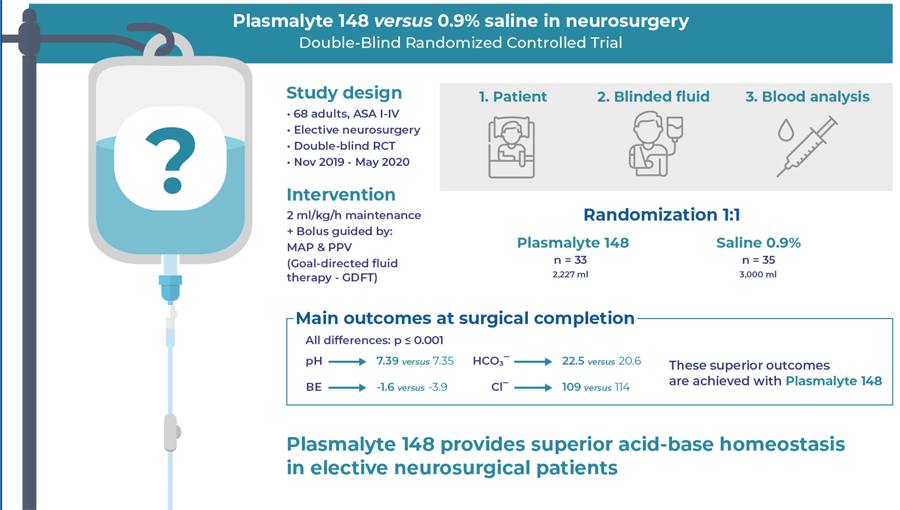
Methods A double-blind randomized controlled trial was conducted at Botucatu Medical School from November 2019 to May 2020. Patients received either Plasma-Lyte 148 or 0.9% saline at a maintenance rate of 2mL/kg/h, with additional bolus guided by mean arterial pressure and pulse pressure variation. The primary endpoint was arterial pH at the end of surgery.
Results Sixty-eight patients (33 in the Plasma-Lyte 148 group and 35 in the saline group) completed the study. The total median volumes administered (1st-3rd quartiles) were 2,227 (1,416-3,000) and 3,000 (2,000-4,000) mL in the Plasma-Lyte 148 and saline groups, respectively (p=0.107). At procedure completion, Plasma-Lyte 148 demonstrated superior acid-base homeostasis with significantly higher pH (7.39±0.04 versus 7.35±0.05, p<0.001), bicarbonate (22.5±1.8 versus 20.6±2.2mmol/L, p<0.001), and base excess (−1.6±2.3 versus −3.9±2.6, p<0.001), while preventing hyperchloremia (109.1±6.6 versus 113.9±4.5 mmol/L, p=0.001).
Conclusion Plasma-Lyte 148 provides superior acid-base homeostasis compared to 0.9% saline in patients undergoing neurosurgery, with significantly better pH, bicarbonate, and base excess profiles while avoiding hyperchloremia. These findings support the preferential use of balanced crystalloids in neurosurgical practice, aligning with current evidence favoring Plasma-Lyte 148 for optimal perioperative fluid management. ReBEC platform registration number: RBR-2592-hd.
Keywords
Neurosurgery; Perioperative fluid management; Balanced crystalloids; Plasma-Lyte 148; Hyperchloremia; Acid-base homeostasis
HIGHLIGHTS
This randomized controlled trial in elective neurosurgery adds important evidence to the growing body of literature comparing Plasma-Lyte 148 with 0.9% saline in specialized surgical populations.
Plasma-Lyte 148 demonstrated superior acid-base homeostasis with significantly higher bicarbonate levels and base excess at surgical completion, whereas 0.9% saline induced hyperchloremia in the saline group.
The biochemical advantages of Plasma-Lyte 148 align with current evidence supporting balanced crystalloids as the preferred choice in perioperative fluid management.
These findings support the emerging consensus favoring balanced crystalloids over normal saline, particularly in populations where acid-base homeostasis is critical.
Our findings contribute to the paradigm shift toward Plasma-Lyte 148 as the preferred crystalloid solution in neurosurgical practice, consistent with recent international guidelines. while preventing hyperchloremia (p≤0.001).
In Brief
This double-blind, randomized trial compared Plasma-Lyte 148 with 0.9% saline in 68 patients undergoing neurosurgery. Plasma-Lyte 148 demonstrated superior acid-base homeostasis with significantly higher pH (7.39 versus 7.35), bicarbonate (22.5 versus 20.6 mmol/L), and base excess (−1.6 versus −3.9),
INTRODUCTION
Intravenous fluid therapy is one of the most fundamental interventions in modern medicine and is administered daily to millions of patients worldwide for volume replacement, hemodynamic optimization, and medication delivery.( 1 )
In neurosurgery, where the maintenance of cerebral homeostasis is critical, appropriate crystalloid selection is particularly important, influencing not only acid-base and electrolyte balance but also intracranial pressure, cerebral perfusion, and neurological outcomes.( 2 - 4 ) Despite this universal relevance, the choice between balanced crystalloids and 0.9% saline remains one of the most debated issues in contemporary anesthesiology and perioperative medicine, with profound implications for patient outcomes across diverse clinical settings.( 5 - 7 )
Over the past two decades, scientific evidence regarding crystalloids has evolved substantially. The pioneering study by Yunos et al. first demonstrated that a chloride-restrictive strategy significantly reduced the incidence of acute kidney injury by 40% (8.4% versus 14%, p<0.001) in 1,533 critically ill patients.( 8 ) This finding was subsequently validated on a much larger scale by the Isotonic Solutions and Major Adverse Renal Events Trial (SMART) and Saline against Lactated Ringer’s or Plasma-Lyte in the Emergency Department (SALT-ED) studies (2018), which demonstrated consistent renal protection with balanced crystalloids in more than 29,000 patients. The SMART study, involving 15,802 critically ill patients, showed a significant reduction in major adverse kidney events (14.3% versus 15.4%, p=0.04), whereas the SALT-ED study, involving 13,347 non-critically ill patients, confirmed similar renal protection (4.7% versus 5.6%, p=0.01).( 9 , 10 )
However, more recent high-impact studies have refined this body of evidence and challenged the long-held assumption that balanced crystalloids are universally superior to 0.9% saline. The Balanced Solution versus Saline in Intensive Care Study (BaSICS; 2021), involving 10,520 critically ill patients, found no significant difference in mortality (26.4% versus 27.2%, p=0.47), raising specific concerns about balanced crystalloids in traumatic brain injury.( 11 ) This concern was amplified by recent meta-analyses, including the study by Diz et al., which demonstrated increased 90-day mortality with balanced crystalloids in patients with traumatic brain injury (odds ratio [OR] 1.31, 95% confidence interval [95%CI] 1.03-1.65, p=0.03).( 12 ) The Plasma-Lyte 148 versus Saline (PLUS) study (2022), one of the most recent and rigorous double-blind clinical trials involving 5,037 critically ill patients, confirmed this equipoise by demonstrating no significant difference in mortality (21.8% versus 22.0%, p=0.90) or renal function between Plasma-Lyte 148 and saline.( 13 )
Despite the extensive literature in general critical populations, a substantial knowledge gap persists in the context of elective neurosurgery.( 14 , 15 ) Unlike traumatic brain injury, where primary brain injury, edema, intracranial hypertension, and hemodynamic instability create a complex pathophysiological context, elective neurosurgery occurs under controlled conditions in stable patients with an intact blood-brain barrier.( 16 , 17 ) This distinction is crucial, as the proposed mechanisms explaining the adverse effects of balanced crystalloids in traumatic brain injury, including cerebral edema, intracranial pressure alterations, and blood-brain barrier dysfunction, may not apply to the elective context.( 18 , 19 )
The few specific studies in elective neurosurgery have consistently demonstrated the metabolic advantages of balanced crystalloids. In a study of 80 patients undergoing elective craniotomy, Shrivastava et al. found that Plasma-Lyte was associated with a significantly higher pH (7.42 versus 7.38, p<0.001) and a lower incidence of metabolic acidosis.( 20 ) Similarly, Dey et al. found identical results in 44 patients, with superior arterial pH (7.41 versus 7.36, p<0.001) and a better electrolyte profile with Plasma-Lyte.( 21 ) Kang et al., in a study involving 586 patients undergoing aneurysm clipping, demonstrated not only metabolic advantages but also superior clinical outcomes, including earlier extubation (122 versus 250 min, p=0.016) and shorter intensive care unit (ICU) stay (1.12 versus 1.37 days, p=0.001) with balanced crystalloids.( 22 )
The physiological basis for these metabolic advantages is well-established. A 0.9% saline solution with a chloride concentration of 154mEq/L (substantially higher than plasma’s 103mEq/L) induces hyperchloremic acidosis through reduction of the strong ion difference, as described by Stewart’s approach.( 23 , 24 ) In contrast, balanced crystalloids, such as Plasma-Lyte 148, with a chloride concentration of 98 mEq/L and presence of metabolic buffers (acetate and gluconate), maintain acid-base balance closer to physiological conditions.( 25 ) Recent experimental studies, including work by Bessa et al. involving an animal model of ischemic stroke, have demonstrated that different sodium concentrations in fluids considerably affect brain, lung, and kidney injury, suggesting that an optimized electrolyte composition may have neuroprotective implications.( 26 )
Considering this gap in the literature and the growing importance of individualized fluid therapy based on clinical context, we conducted this randomized, double-blind controlled trial to directly compare the effects of Plasma-Lyte 148 and 0.9% saline on acid-base balance, electrolyte profile, and perioperative outcomes in patients undergoing elective neurosurgery. Our primary hypothesis was that Plasma-Lyte 148, owing to its more physiological composition, would offer superior acid-base homeostasis compared to 0.9% saline, as measured by arterial pH at the end of surgery. By providing meaningful metabolic advantages without compromising safety, Plasma-Lyte 148 could help refine current evidence in the elective neurosurgical setting. In this context, balanced crystalloids may deliver benefits under controlled conditions while maintaining comparable safety, thereby informing clinical practice and guiding future guidelines in this specialized field.
OBJECTIVE
To evaluate the effects of Plasma-Lyte 148 and 0.9% saline on acid-base balance, electrolyte profile, and perioperative outcomes in patients undergoing elective neurosurgery, with arterial pH at the end of surgery as the primary endpoint.
METHODS
Ethics statements
This study was approved by the Research Ethics Committee (CAAE: 96280018.9.0000.5411; # 2.879.197; September 6, 2018) of the Faculdade de Medicina de Botucatu, Universidade Estadual Paulista . The trial was prospectively registered in the Brazilian Clinical Trials Registry on October 20, 2019, prior to patient enrollment, ensuring transparency and methodological rigor in accordance with international standards for clinical research reporting.( 27 , 28 ) The study was conducted in strict adherence to the principles of the Declaration of Helsinki and followed the Consolidated Standards of Reporting Trials (CONSORT 2010) guidelines for randomized controlled trials.( 29 , 30 ) Written informed consent was obtained from all participants or their legally authorized representatives before enrollment in the study.
Study design and population
This double-blind, randomized controlled clinical trial was conducted at the Hospital de Botucatu Medical School between November 2019 and May 2020. The study design employed rigorous methodological standards to minimize bias and ensure the validity of findings in this specialized neurosurgical population.( 31 , 32 )
Eligible participants were adults aged 18 years or older undergoing elective intracranial neurosurgical procedures, including tumor resection or cerebral aneurysm clipping, and classified as American Society of Anesthesiologists (ASA) physical status I-IV. This broad ASA classification range was deliberately chosen to enhance the external validity of our findings while maintaining safety standards appropriate for major neurosurgical interventions.( 33 , 34 )
The following criteria were defined to eliminate confounding variables that could interfere with the assessment of acid-base and electrolyte homeostasis. We did not include patients with cardiac arrhythmia (which could affect hemodynamic stability and fluid management), chronic kidney disease (which could alter electrolyte handling and acid-base regulation), previously diagnosed acid-base or electrolyte abnormalities (to ensure baseline comparability), pregnancy (due to physiological changes in fluid distribution and acid-base status), or current diuretic use (which could confound fluid balance assessment).( 35 , 36 ) Additionally, we excluded patients who dropped out after randomization, were lost to follow-up, or required transfusion of more than four packed red blood cells (pRBC) in 1 h or 10 pRBC in 24 h, as this would substantially alter the hemodynamic and metabolic milieu beyond the scope of crystalloid comparison.( 37 - 39 )
Patients were randomized in a 1:1 ratio into two groups (0.9% saline and Plasma-Lyte 148) according to the fluid replacement protocol, with codes generated by computer software (random.org) to ensure equal distribution between treatment groups. Allocation concealment was ensured by placing group assignments in sealed, opaque envelopes kept confidential by an individual not involved in the study.( 40 , 41 )
Before each procedure, a member of the hospital pharmacy opened the envelope corresponding to the study group and prepared the assigned solution. To maintain blinding, the fluid containers were covered with opaque black bags labeled with a kit number and bar code, ensuring that patients received only the randomized fluid, and that the attending anesthesiologist remained blinded.( 42 , 43 )
Physicians responsible for evaluating the laboratory test results and possible complications were blinded to the patient grouping until the end of the study.
Surgical procedures
We conducted a comprehensive preoperative evaluation for all participants, including a detailed anesthetic assessment and informed consent documentation. This standardized approach ensured optimal patient preparation and baseline risk stratification.( 44 , 45 )
Once in the operating theater, patients were monitored with continuous cardioscopy, pulse oximetry, and noninvasive blood pressure measurement. After induction of anesthesia, an arterial catheter was placed for invasive blood pressure monitoring and measurement of pulse pressure variation (PPV). A central venous access was established for administering vasoactive drugs when clinically indicated.( 46 , 47 )
Anesthetic depth was monitored using bispectral index (BIS) technology to ensure an optimal hypnotic state throughout the procedure, reflecting current best practices in neuroanesthesia monitoring.( 17 , 48 ) The anesthetic protocol followed evidence-based guidelines and incorporated contemporary approaches to neurosurgical anesthesia management.( 49 )
Mechanical ventilation was optimized using lung protective strategies with tidal volumes of 8mL/kg of predicted body weight, calculated using established formulas (height in cm: 100 for men and 105 for women), consistent with current perioperative ventilation recommendations.( 50 , 51 ) Respiratory rate was adjusted to maintain arterial carbon dioxide tension between 30 and 35 mmHg, targeting mild hypocapnia, as appropriate for intracranial procedures.( 30 , 52 ) Positive end-expiratory pressure was individualized based on lung compliance assessment, typically ranging from 3 to 8cmH2O to optimize oxygenation while minimizing cardiovascular compromise.( 53 , 54 )
Intraoperative fluid was administered according to a goal-directed therapy (Figure 1S, Supplementary Material ), incorporating contemporary evidence on hemodynamic optimization in patients undergoing neurosurgery.( 55 , 56 ) The protocol utilized mean arterial pressure and PPV as primary hemodynamic targets, reflecting current understanding of fluid responsiveness assessment in mechanically ventilated patients.( 57 , 58 )
The randomized crystalloid was infused continuously via an infusion pump at a rate of 2mL/kg/h( 59 ) of ideal body weight( 60 ) during the entire procedure until the end of dressing, when it was interrupted. The anesthesiologist’s assistant administered only the randomized crystalloid fluid. Adjustments to the anesthetic plan were made according to variations in PAM and BIS, and included a 200 mL fluid bolus over 10 min (pump 2), pRBC transfusion, vasopressor bolus, or continuous norepinephrine infusion (Figure 1S, Supplementary Material ). This approach was guided by the standardized protocol to minimize inter-provider variability.
Notably, the drugs and medications administered were diluted exclusively with the randomized solution. Thus, the patients differed only in the type of crystalloid solution administered.
Data collection and study variables
The following variables were assessed: age, sex, weight, height, ASA classification, surgical indication, duration of surgery and anesthesia, volume of crystalloid solution, diuresis, fluid balance, plasma electrolytes and lactate levels, glycemia, arterial pH, HCO3- and base excess, transfusion of pRBC, doses of ephedrine and metaraminol, use of norepinephrine, early extubation in the operating room, length of stay in the ICU and hospital, new neurological deficits, and mortality.
Laboratory reference values were established according to current clinical practice guidelines (Table 1S, Supplementary Material ,), ensuring standardized interpretation of biochemical parameters.( 61 , 62 )
Outcomes
The primary endpoint was arterial blood pH at the end of surgery, representing the most direct assessment of acid-base homeostasis following crystalloid administration.( 63 , 64 ) This endpoint was selected based on its clinical relevance and sensitivity for detecting the metabolic effects of different crystalloid solutions in the perioperative setting. Secondary endpoints were the dosage of HCO3-, base excess, and plasma electrolytes; extubation in the operating room; new neurological deficits; and mortality. Moreover, secondary outcomes such as hospital or ICU length of stay, new neurological deficit, and death were assessed during the first 7 postoperative days. These comprehensive secondary outcomes were designed to capture both biochemical and clinically relevant effects of crystalloid selection in patients undergoing neurosurgery.
Statistical analysis
Sample size calculation
The sample size was calculated based on the meta-analysis by Huang et al.,( 65 ) which compared 0.9% saline with balanced crystalloid solutions in adults undergoing non-renal surgeries. Considering a mean standard deviation of 0.05 for postoperative pH and a clinically relevant difference of 0.035 points in the pH between groups at the end of surgery,( 66 ) a minimum of 33 patients in each group was necessary to test the main hypothesis, providing 80% power of detection and a type 1 error of 5%.
Statistical description
Qualitative variables are expressed as absolute and relative frequencies. Quantitative variables are expressed as mean and standard deviation (normal distribution) or median and quartiles (non-normal distribution). The normality of the distribution of quantitative variables was evaluated from the histogram and Q-Q plot analysis using the Shapiro-Wilk test.
The χ2 and Fisher’s exact tests were used to compare qualitative variables between groups, whereas the Student’s t-test was used to compare the means of continuous variables with normal distribution. The Mann-Whitney U test and Hodges-Lehmann median difference estimate were used to analyze continuous or discrete variables with non-normal distributions.
All differences between outcome variables are presented with their respective 95% CI. Statistical significance was set at p<0.05. All analyses were performed using IBM SPSS Statistics version 22.0 (IBM Corp., Armonk, NY, USA).
Validation of the study
Study reporting adhered to the CONSORT 2010 guidelines for randomized controlled trials.( 67 ) Methodological quality was assessed using contemporary risk of bias evaluation tools, ensuring transparency and reproducibility of findings.( 27 , 49 , 68 )
RESULTS
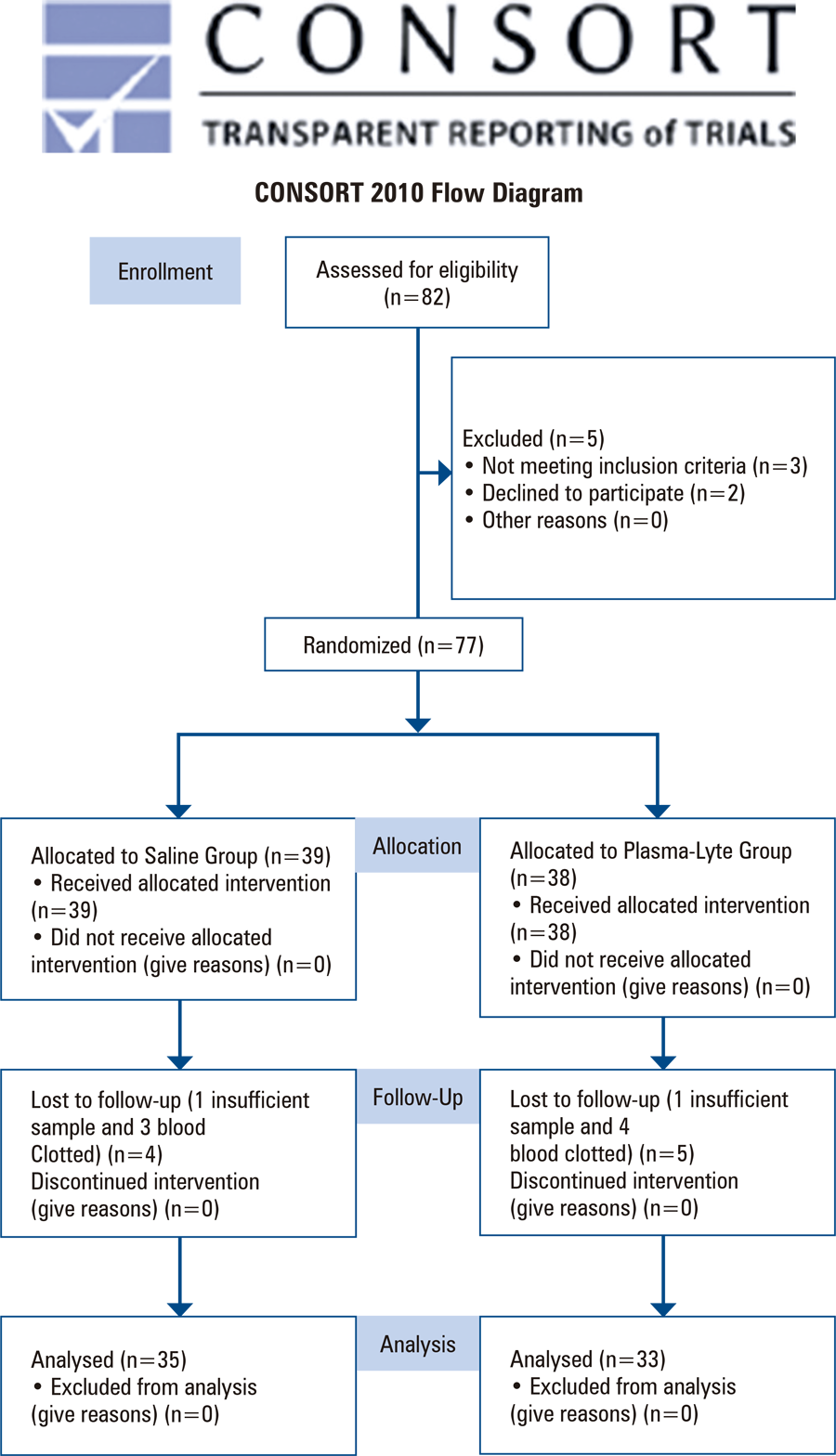
A total of 68 patients completed the study and were included in the per-protocol analysis: 35 patients in the 0.9% saline group and 33 in the Plasmalyte 148 group ( Figure 1 ). The results presented represent the outcomes of patients who reached the end of the study according to their initial allocation (per protocol).
Baseline demographic and clinical characteristics were similar between groups, including age, sex distribution, weight, height, ASA classification, and surgical indication. Baseline acid-base and electrolyte values were also similar between groups ( Table 1 ).
Intraoperative data are presented in table 2 . No significant differences were observed between groups in intraoperative management, including total crystalloid volume administered. There were no significant differences in pRBC transfusion (6 versus 4 patients, p=0.735) or the number of patients requiring norepinephrine (18 versus 14 patients, p=0.457). Diuresis was similar in the Plasma-Lyte 148 and 0.9% saline groups (900 mL [380/1,750] versus 925mL [457/1,450], p=0.846).
At the end of surgery, the Plasma-Lyte group had significantly higher arterial pH than the saline group (7.39±0.04 versus 7.35±0.05, p<0.001). Secondary outcomes showed that the Plasma-Lyte group had higher bicarbonate levels (22.5±1.8 versus 20.6±2.2mmol/L, p<0.001), less negative base excess (-1.6±2.3 versus -3.9±2.6, p<0.001), and lower chloride levels (109.1±6.6 versus 113.9±4.5 mmol/L, p=0.001).
The saline group had higher glucose levels (133 versus 119mg/dL, p=0.030) and slightly higher calcium levels (1.17±0.05 versus 1.14±0.04mmol/L, p=0.040). Sodium and potassium levels were similar between groups ( Table 3 ).
We did not observe differences between groups regarding sodium, potassium, and lactate values.
There were no differences between groups regarding extubation performed in the operating room, length of hospital stay, length of ICU stay, new neurological deficit, or mortality (p>0.05) (Table 2S, Supplementary Material ).
No patient in either group received mannitol or hypertonic saline.
DISCUSSION
This double-blind randomized controlled study demonstrated that Plasma-Lyte 148 provided significant metabolic advantages over 0.9% saline in patients undergoing elective neurosurgery, consistent with patterns reported in the international literature. With Plasma-Lyte, we observed superior arterial pH (7.39±0.04 versus 7.35±0.05, p<0.001), higher bicarbonate levels (22.5±1.8 versus 20.6±2.2mmol/L, p<0.001), less negative base excess (-1.6±2.3 versus -3.9±2.6, p<0.001), and lower chloride concentrations (109.1±6.6 versus 113.9±4.5mmol/L, p<0.001). These findings are virtually identical to those reported by Shrivastava et al., with similar methodology,( 20 ) as well as Dey et al. in elective craniotomies,( 21 ) and Sundaram et al. in aneurysm clipping,( 69 ) establishing a robust pattern of specific evidence for neurosurgery.
The remarkable consistency of these metabolic findings across multiple neurosurgical studies reflects a universal pattern observed in more than 50,000 patients in the general literature. The meta-analysis by Huang et al., involving 871 patients undergoing non-renal surgery, demonstrated similar differences: lower postoperative pH (mean difference 0.05, p<0.001) and lower base excess (mean difference 2.04, p<0.001) with saline.( 65 ) This pattern has been confirmed in diverse contexts, from the landmark study by Yunos et al. in critically ill patients( 8 ) to studies on renal transplantation( 70 ) and abdominal surgery,( 71 ) demonstrating that the metabolic advantages of balanced crystalloids extend across specific populations and clinical contexts.
In our study, no patient required mannitol or hypertonic saline. Administration of these agents to relieve intracranial pressure and cerebral edema could have resulted in hemodynamic and electrolyte changes that could not be attributed solely to the randomized solution.( 72 )
Our findings should be interpreted within the context of the evolving evidence regarding crystalloids. Although previous studies, such as SMART and SALT-ED, demonstrated not only metabolic advantages but also significant renal protection in more than 29,000 patients,( 9 , 10 ) more recent studies, such as BaSICS (2021) and PLUS (2022), revealed substantial equipoise, particularly in general critical populations.( 11 , 13 ) The PLUS study, which included 5,037 patients, demonstrated that despite expected metabolic advantages, there were no significant differences in mortality (21.8% versus 22.0%) or renal function between Plasma-Lyte 148 and saline.( 13 ) This evolution in evidence emphasizes the importance of contextualization and individualization of fluid therapy.
Elective neurosurgery represents a clinical context that is distinct from that of the general critical population studied in large clinical trials. Unlike traumatic brain injury, for which recent meta-analyses have raised concerns about balanced crystalloids,( 12 ) elective neurosurgery occurs in stable patients with intact blood-brain barrier and without the confounding factors typical of trauma, such as primary brain injury, edema, and hemodynamic instability.( 16 , 17 ) Our findings, which demonstrate metabolic advantages without compromising safety, align with this pathophysiological distinction and suggest that the benefits of balanced crystalloids can be obtained with equivalent safety in an elective neurosurgical setting.
The observed metabolic advantages have a solid physiological basis and potentially important clinical implications. Hyperchloremic acidosis induced by saline through a reduction in the strong ion difference, according to Stewart’s approach,( 23 , 24 ) can affect multiple organ systems. Sen et al. demonstrated that each 100 mEq increase in chloride load was associated with a 5.5% increase in death risk at 1 year, even after controlling for total fluid volume.( 73 ) In neurosurgery, where cerebrovascular acid-base regulation is critical for maintaining adequate cerebral perfusion,( 74 , 75 ) preservation of physiological acid-base balance may have neuroprotective implications, as suggested by recent experimental studies.( 26 )
In our study, serum ionic calcium levels were lower in the Plasma-Lyte 148 group than in the 0.9% saline group, although mean values in both groups were within the normal range. This may have occurred because of calcium chelation by plasma gluconate accumulation and the absence of calcium in Plasma-Lyte 148, similar to findings from previous studies,( 19 , 21 , 76 ) suggesting that serum calcium should be monitored in patients receiving Plasma-Lyte 148.
We found no significant differences in plasma concentrations of lactate, sodium, or potassium in both groups, consistent with findings from previous studies.( 7 , 77 , 78 ) Plasma lactate has been used as a marker of tissue perfusion in critically ill patients.( 79 ) The absence of differences in lactate levels between groups in our study indicated that the fluid management was equivalent and adequate to maintain optimum tissue perfusion, independent of the solution infused. Moreover, despite the different sodium concentrations between the two fluids studied (Plasma-Lyte 148, 140mEq/L; 0.9% saline, 154mEq/L), the sodium levels at the end of the procedure did not differ between groups, consistent with findings from other studies using similar methodology.( 21 )
O’Malley et al.( 80 ) compared Ringer’s lactate and 0.9% saline during kidney transplantation and found higher potassium levels in the 0.9% saline group (19% versus 0%), possibly as a result of hyperchloremic metabolic acidosis. Our study excluded patients with chronic kidney injury, pre-existing abnormalities of acid-base or electrolyte balance, or diuretic use, which are commonly encountered in renal transplant surgery and increase susceptibility to acidosis and hyperkalemia. This may explain why no difference in potassium levels was observed between groups.
We observed an increase in diuresis in the Plasma-Lyte 148 group, possibly due to the diuretic effect of gluconate, although this was not statistically significant. Similar findings have been reported by Roquilly et al.,( 81 ) who compared 0.9% saline with balanced solutions in patients with traumatic brain injury, and Chaussard et al.( 76 ) who compared Ringer’s Lactate with Plasma-Lyte 148 in patients with burns in intensive care.
Our findings contribute to the current refinement of fluid therapy, which has evolved from a “one-size-fits-all” approach to individualized strategies based on specific clinical contexts. Recent international consensus statements and guidelines, including European Society of Intensive Care Medicine (ESICM) 2024( 5 ) and PeriOperative Quality Initiative (POQI) 2024,( 3 ) emphasize the importance of this individualization. In elective neurosurgery, where controlled conditions fundamentally differ from general critical contexts, our findings suggest that the metabolic advantages of balanced crystalloids can be achieved safely, offering an optimized therapeutic strategy for this specific population.
Despite the exploratory nature of secondary outcomes, we observed no differences between groups in hospital or ICU length of stay, new neurological deficit, or mortality. Prior neurosurgical studies using a methodology similar to ours did not evaluate these parameters.( 21 , 78 ) We acknowledge that our sample size was calculated focusing solely on the primary outcome. Nevertheless, our study makes a novel contribution by evaluating these outcomes, serving as a foundation for future studies.
Although a significant difference in blood glucose levels was observed between groups, values remained within the normal range and did not require clinical intervention. Additionally, multiple univariate analyses increase the risk of family-wise error rate. Therefore, this difference may be random without clinical relevance. In a similar study, Abhiruchi et al. did not find differences in glucose levels between groups.( 78 )
This study has several strengths. As a double-blind, randomized controlled trial, it demonstrated high methodological quality, with low risk of bias across all evaluated domains. A comprehensive assessment using both the modified Jadad scale and the National Heart, Lung, and Blood Institute (NHLBI) Quality Assessment Tool confirmed the internal validity and reliability of our findings. The maximum scores achieved in both assessment tools indicate that our study meets the highest standards for clinical trial methodology and provides robust evidence for clinical decision-making.( 82 , 83 )
Nevertheless, certain limitations should be acknowledged. Although the sample size was sufficient to detect metabolic differences, it may be insufficient to evaluate rare clinical outcomes. The study population, restricted to elective neurosurgery, limits the generalizability of the findings to other neurosurgical contexts. Future studies with larger sample sizes and long-term follow-ups are needed to assess whether the observed metabolic advantages translate into sustained clinical benefits. Additionally, evaluation of specific biomarkers of brain injury and renal function could provide valuable mechanistic insights into the effects of different crystalloids in the neurosurgical context.
In conclusion, this study demonstrated that Plasma-Lyte 148 provides substantial metabolic advantages over 0.9% saline in elective neurosurgery, confirming the universal pattern observed in the international literature. These findings, obtained in a controlled context that fundamentally differs from the general critical population, contribute to the growing body of evidence supporting individualization of fluid therapy based on clinical context. In elective neurosurgery, where metabolic advantages of balanced crystalloids can be obtained with an equivalent safety profile, our findings offer valuable evidence for informed and personalized clinical decision-making. Future studies should focus on large, multicenter trials powered to detect clinical outcomes, investigation of long-term neurological effects, and exploration of optimal fluid management strategies across different neurosurgical populations. Additionally, the integration of goal-directed fluid therapy protocols with balanced crystalloids presents a promising avenue for optimizing perioperative care in patients undergoing neurosurgery.( 51 , 84 ) Our study provides the foundational evidence necessary to inform future investigations and contributes essential data to guide evidence-based crystalloid selection in contemporary neurosurgical practice.
CONCLUSION
This randomized controlled trial demonstrated that Plasma-Lyte 148 provides superior acid-base homeostasis compared to 0.9% saline in elective neurosurgery, with statistically significant improvements in pH, bicarbonate, base excess, and chloride levels, while maintaining an equivalent safety profile. These findings support the use of balanced crystalloids in elective neurosurgical patients—a clinical context distinct from traumatic brain injury, where balanced solutions have shown concerning outcomes—and contribute essential evidence to support individualized perioperative fluid management.
SUPPLEMENTARY MATERIAL
Supplementary material
ACKNOWLEDGMENTS
This study was financed by internal resources of the Postgraduate Program in Anesthesiology of the Faculdade de Medicina de Botucatu, Universidade Estadual Paulista (FMB-UNESP), and by the Fundação de Amparo à Pesquisa do Estado de São Paulo (FAPESP; grant number: 18/15512-0. Funding approved on December 1, 2018). The authors declare no funding from the pharmaceutical industry and no influence of the sponsor on study design, data collection, analysis, interpretation, manuscript preparation, or the decision to submit the article for publication.
REFERENCES
- 1 McLean DJ, Shaw AD. Intravenous fluids: effects on renal outcomes. Br J Anaesth. 2018;120(2):397-402.
- 2 Ryu T. Fluid management in patients undergoing neurosurgery. Anesth Pain Med (Seoul). 2021;16(3):215-24. Review.
- 3 Ostermann M, Auzinger G, Grocott M, Morton-Bailey V, Raphael J, Shaw AD, et al. Perioperative fluid management: evidence-based consensus recommendations from the international multidisciplinary PeriOperative Quality Initiative. Br J Anaesth. 2024;133(6):1263-75.
- 4 Thomas R, Ghio M, Pappalardo L, Shamassian BH. Fluids, Electrolytes, and Nutrition in the Critically Ill Patient with Neurotrauma. Neurosurg Clin N Am. 2025;36(3):387-400.
- 5 Arabi YM, Belley-Cote E, Carsetti A, De Backer D, Donadello K, Juffermans NP, et al. European Society of Intensive Care Medicine clinical practice guideline on fluid therapy in adult critically ill patients. Part 1: the choice of resuscitation fluids. Intensive Care Med. 2024 21;50(6):813-31.
- 6 Mistry AM. Which Intravenous Isotonic Fluid Offers Better Outcomes for Patients with a Brain Injury? Neurocrit Care. 2025;42(2):715-21.
- 7 Vairasila T. Managing Intracranial Pressure Crisis. Curr Neurol Neurosci Rep. 2025;25(1):12.
- 8 Yunos NR, Bellomo R, Hegarty C, Story D, Ho L, Bailey M. Association between a chloride-liberal vs chloride-restrictive intravenous fluid administration strategy and kidney injury in critically ill adults. JAMA. 2012;308(15):1566-72.
- 9 Semler MW, Self WH, Wanderer JP, Ehrenfeld JM, Wang L, Byrne DW, et al. Balanced Crystalloids versus Saline in Critically Ill Adults. New Engl J Med. 2018;378(9):829-39.
- 10 Self WH, Semler MW, Wanderer JP, Wang L, Byrne DW, Collins SP, et al. Balanced Crystalloids versus Saline in Noncritically Ill Adults. New England Journal of Medicine. 2018;378(9):819-28.
- 11 Zampieri FG, Machado FR, Biondi RS, Freitas FG, Veiga VC, Figueiredo RC, et al. Effect of Intravenous Fluid Treatment With a Balanced Solution vs 0.9% Saline Solution on Mortality in Critically Ill Patients. JAMA. 2021;326(9):818.
- 12 Diz JC, Luna-Rojas P, Díaz-Vidal P, Fernández-Vázquez U, Gil-Casado C, Diz-Ferreira E. Effect of Treatment With Balanced Crystalloids Versus Normal Saline on the Mortality of Critically Ill Patients With and Without Traumatic Brain Injury: A Systematic Review and Meta-Analysis. Anesth Analg. 2025;141(1):152-61.
- 13 Finfer S, Micallef S, Hammond N, Navarra L, Bellomo R, Billot L, et al. Balanced Multielectrolyte Solution versus Saline in Critically Ill Adults. New England J Med. 2022;386(9):815-26.
- 14 Oddo M, Poole D, Helbok R, Meyfroidt G, Stocchetti N, Bouzat P, et al. Fluid therapy in neurointensive care patients: ESICM consensus and clinical practice recommendations. Intensive Care Med. 2018;44(4):449-63.
- 15 Hemachandiran R, Jangra K, Barik AK, Kaur K, Kumar A, Panda NB, et al. Crystalloids versus hydroxyethyl starch (130/0.4) in patients undergoing decompressive craniectomy for isolated traumatic brain injury: A prospective randomized controlled trial. J Neurosci Rural Pract. 2024;16:68.
- 16 Hoh BL, Ko NU, Amin-Hanjani S, Hsiang-Yi Chou S, Cruz-Flores S, Dangayach NS, et al. 2023 Guideline for the Management of Patients With Aneurysmal Subarachnoid Hemorrhage: A Guideline From the American Heart Association/American Stroke Association. Stroke. 2023;54(7):E314-70.
- 17 Carney N, Totten AM, O'Reilly C, Ullman JS, Hawryluk GW, Bell MJ, et al. Guidelines for the Management of Severe Traumatic Brain Injury, Fourth Edition. Neurosurgery. 2017;80(1):6-15.
- 18 Bala R, Bansal T, Mundra A, Kamal K. Comparison and evaluation of two different crystalloids - Normal saline and plasmalyte in patients of traumatic brain injury undergoing craniotomy. Brain Circ. 2022;8(4):200-6.
- 19 Lima MF, Neville IS, Cavalheiro S, Bourguignon DC, Pelosi P, Malbouisson LM, Balanced Crystalloids Versus Saline for Perioperative Intravenous Fluid Administration in Children Undergoing Neurosurgery: A Randomized Clinical Trial. J Neurosurg Anesthesiol. 2019;31(1):30-5.
- 20 Shrivastava P, Murmu R, Suman S, Verma S, Lakra L, Kumar S. The Effect on Serum Electrolytes in Patients Undergoing Elective Craniotomy for Supratentorial Brain Tumors Using Plasmalyte A and Normal Saline as Intravenous Replacement Fluid. Cureus. 2023;15(7):e42656.
- 21 Dey A, Adinarayanan S, Bidkar P, Bangera R, Balasubramaniyan V. Comparison of normal saline and balanced crystalloid (plasmalyte) in patients undergoing elective craniotomy for supratentorial brain tumors: A randomized controlled trial. Neurol India. 2018;66(5):1338-44.
- 22 Kang J, Song YJ, Jeon S, Lee J, Lee E, Lee JY, et al. Intravenous fluid selection for unruptured intracranial aneurysm clipping: Balanced crystalloid versus normal saline. J Korean Neurosurg Soc. 2021;64(4):534-42.
- 23 Stewart PA. Modern quantitative acid-base chemistry. Can J Physiol Pharmacol. 1983;61(12):1444-61.
- 24 Kellum JA. Determinants of blood pH in health and disease. Crit Care. 2000;4(1):6.
- 25 Weinberg L, Collins N, Mourik VK, Tan C, Bellomo R. Plasma-Lyte 148: A clinical review. World J Crit Care Med. 2016;5(4):235.
- 26 Bessa CM, Vilardo AL, Percuchetti DB, Conceição PH, Caruso-Neves C, Capelozzi VL, et al. Effects of different sodium concentrations in fluids on brain, lung, and kidney in experimental ischemic stroke. Sci Rep. 2025;15(1):26496.
- 27 Sterne JA, Savovic J, Page MJ, Elbers RG, Blencowe NS, Boutron I, et al. RoB 2: A revised tool for assessing risk of bias in randomised trials. The BMJ. 2019;366.
- 28 Mayhew D, Mendonca V, Murthy BV. A review of ASA physical status - historical perspectives and modern developments. Anaesthesia. 2019;74(3):373-9. Review.
- 29 Sankar A, Johnson SR, Beattie WS, Tait G, Wijeysundera DN. Reliability of the American Society of Anesthesiologists physical status scale in clinical practice. Br J Anaesth. 2014;113(3):424-32.
- 30 Ostermann M, Bellomo R, Burdmann EA, Doi K, Endre ZH, Goldstein SL, et al. Controversies in acute kidney injury: conclusions from a Kidney Disease: Improving Global Outcomes (KDIGO) Conference. In: Kidney International. Elsevier B.V.; 2020. p. 294-309.
- 31 Kellum JA, Romagnani P, Ashuntantang G, Ronco C, Zarbock A, Anders HJ. Acute kidney injury. Nat Rev Dis Primers. 2021;7(1):52.
- 32 Cannon JW, Khan MA, Raja AS, Cohen MJ, Como JJ, Cotton BA, et al. Damage control resuscitation in patients with severe traumatic hemorrhage: A practice management guideline from the Eastern Association for the Surgery of Trauma. In: Journal of Trauma and Acute Care Surgery. Lippincott Williams and Wilkins; 2017. p. 605-17.
- 33 Holcomb JB, Tilley BC, Baraniuk S, Fox EE, Wade CE, Podbielski JM, et al. Transfusion of plasma, platelets, and red blood cells in a 1:1:1 vs a 1:1:2 ratio and mortality in patients with severe trauma: The PROPPR randomized clinical trial. JAMA. 2015;313(5):471-82.
- 34 Schulz KF, Grimes DA. Allocation concealment in randomised trials: defending against deciphering. Lancet. 2002;359(9306):614-8.
- 35 Pildal J, Chan AW, Hróbjartsson A, Forfang E, Altman DG, Gøtzsche PC. Comparison of descriptions of allocation concealment in trial protocols and the published reports: Cohort study. BMJ. 2005;330(7499):1049-52.
- 36 Karanicolas PJ, Farrokhyar F, Bhandari M. Practical tips for surgical research: blinding: who, what, when, why, how? Can J Surg. 2010;53(5):345-8.
- 37 Fleisher LA, Fleischmann KE, Auerbach AD, Barnason SA, Beckman JA, Bozkurt B, Davila-Roman VG, Gerhard-Herman MD, Holly TA, Kane GC, Marine JE, Nelson MT, Spencer CC, Thompson A, Ting HH, Uretsky BF, Wijeysundera DN; American College of Cardiology; American Heart Association. 2014 ACC/AHA guideline on perioperative cardiovascular evaluation and management of patients undergoing noncardiac surgery: a report of the American College of Cardiology/American Heart Association Task Force on practice guidelines. J Am Coll Cardiol. 2014;64(22):e77-137.
- 38 Boutron I, Estellat C, Guittet L, Dechartres A, Sackett DL, Hróbjartsson A, et al. Methods of blinding in reports of randomized controlled trials assessing pharmacologic treatments: A systematic review. PLoS Med. 2006;3(10):1931-9.
- 39 Stainsby D, MacLennan S, Thomas D, Isaac J, Hamilton PJ. Guidelines on the management of massive blood loss. Br J Haematol. 2006;135(5):634-41.
- 40 Kristensen SD, Knuuti J, Saraste A, Anker S, Bøtker HE, De Hert S, et al. 2014 ESC/ESA Guidelines on non-cardiac surgery: Cardiovascular assessment and management: The Joint Task Force on non-cardiac surgery: Cardiovascular assessment and management of the European Society of Cardiology (ESC) and the European Society of Anaesthesiology (ESA). Eur Heart J. 2014;35(35):2383-431.
- 41 Saugel B, Kouz K, Hoppe P, Maheshwari K, Scheeren TW. Predicting hypotension in perioperative and intensive care medicine. Best Pract Res Clin Anaesthesiol. 2019;33(2):189-97. Review.
- 42 Maheshwari K, Turan A, Mao G, Yang D, Niazi AK, Agarwal D, et al. The association of hypotension during non-cardiac surgery, before and after skin incision, with postoperative acute kidney injury: a retrospective cohort analysis. Anaesthesia. 2018;73(10):1223-8.
- 43 Punjasawadwong Y, Phongchiewboon A, Bunchungmongkol N. Bispectral index for improving anaesthetic delivery and postoperative recovery. Cochrane Database Syst Rev. 2014;2014(6):CD003843. Update in: Cochrane Database Syst Rev. 2019;9:CD003843.
- 44 Messina AG, Wang M, Ward MJ, Wilker CC, Smith BB, Vezina DP, Pace NL. Anaesthetic interventions for prevention of awareness during surgery. Cochrane Database Syst Rev. 2016;10(10):CD007272.
- 45 Neto AS, Hemmes SN, Barbas CS, Beiderlinden M, Fernández-Bustamante A, Futier E, et al. Association between driving pressure and development of postoperative pulmonary complications in patients undergoing mechanical ventilation for general anaesthesia: A meta-analysis of individual patient data. Lancet Respir Med. 2016;4(4):272-80.
- 46 Karalapillai D, Weinberg L, Peyton P, Ellard L, Hu R, Pearce B, et al. Effect of Intraoperative Low Tidal Volume vs Conventional Tidal Volume on Postoperative Pulmonary Complications in Patients Undergoing Major Surgery: A Randomized Clinical Trial. JAMA. 2020;324(9):848-58.
- 47 Stocchetti N, Carbonara M, Citerio G, Ercole A, Skrifvars MB, Smielewski P, et al. Severe traumatic brain injury: targeted management in the intensive care unit. Lancet Neurol. 2017;16(6):452-64.
- 48 Pereira SM, Tucci MR, Morais CCA, Simões CM, Tonelotto BFF, Pompeo MS, et al. Individual positive end-expiratory pressure settings optimize intraoperative mechanical ventilation and reduce postoperative atelectasis. Anesthesiology. 2018;129(6):1070-81.
- 49 Thom MM. Avaliação da administração de Plasmalyte 148 ou solução salina a 0,9% no equilíbrio ácido-base em pacientes submetidos à neurocirurgia: ensaio clínico randomizado [tese]. Botucatu (SP): Universidade Estadual Paulista "Júlio de Mesquita Filho", Faculdade de Medicina de Botucatu; 2023.
- 50 Schultz MJ, Hemmes SNT, de Abreu MG, Pelosi P, Severgnini P, Hollmann MW, et al. High versus low positive end-expiratory pressure during general anaesthesia for open abdominal surgery (PROVHILO trial): A multicentre randomised controlled trial. Lancet. 2014;384(9942):495-503.
- 51 Jangra K, Gandhi AP, Mishra N, Shamim MA, Padhi BK. Intraoperative goal-directed fluid therapy in adult patients undergoing craniotomies under general anaesthesia: A systematic review and meta-analysis with trial sequential analysis. Indian J Anaesth. 2024;68(7):592-605.
- 52 Monnet X, Marik PE, Teboul JL. Prediction of fluid responsiveness: an update. Ann Intensive Care. 2016;6(1):11.
- 53 Yang X, Du B. Does pulse pressure variation predict fluid responsiveness in critically ill patients: A systematic review and meta-analysis. Crit Care. 2014;18(6):1-13.
- 54 Malbrain ML, Marik PE, Witters I, Cordemans C, Kirkpatrick AW, Roberts DJ, et al. Fluid overload, de-resuscitation, and outcomes in critically ill or injured patients: A systematic review with suggestions for clinical practice. Anaesthesiol Intensive Ther. 2014;46(5):361-80.
- 55 Prowle JR, Echeverri JE, Ligabo EV, Ronco C, Bellomo R. Fluid balance and acute kidney injury. Nat Rev Nephrol. 2010;6(2):107-15.
- 56 Khanna AK, Maheshwari K, Mao G, Liu L, Perez-Protto SE, Chodavarapu P, et al. Association between Mean Arterial Pressure and Acute Kidney Injury and a Composite of Myocardial Injury and Mortality in Postoperative Critically Ill Patients: A Retrospective Cohort Analysis. Crit Care Med. 2019;47(7):910-7.
- 57 Salmasi V, Maheshwari K, Yang D, Mascha EJ, Singh A, Sessler DI, et al. Relationship between Intraoperative Hypotension, Defined by Either Reduction from Baseline or Absolute Thresholds, and Acute Kidney and Myocardial Injury after Noncardiac Surgery. Anesthesiology. 2017;126(1):47-65.
- 58 Hammond DA, Lam SW, Rech MA, Smith MN, Westrick J, Trivedi AP, et al. Balanced Crystalloids Versus Saline in Critically Ill Adults: A Systematic Review and Meta-analysis. Annals of Pharmacotherapy. 2020;54(1):5-13.
- 59 Feldheiser A, Aziz O, Baldini G, Cox BP, Fearon KC, Feldman LS, et al. Enhanced Recovery After Surgery (ERAS) for gastrointestinal surgery, part 2: Consensus statement for anaesthesia practice. Acta Anaesthesiol Scand. 2016;60(3):289-334.
- 60 Evans L, Rhodes A, Alhazzani W, Antonelli M, Coopersmith CM, French C, et al. Surviving Sepsis Campaign: International Guidelines for Management of Sepsis and Septic Shock 2021. Crit Care Med. 2021;49(11):e1063-143.
- 61 Clavien PA, Barkun J, de Oliveira ML, Vauthey JN, Dindo D, Schulick RD, et al. The Clavien-Dindo Classification of Surgical Complications. Ann Surg. 2009;250(2):187-96.
- 62 Huang DT, Angus DC, Moss M, Thompson BT, Ferguson ND, Ginde A, et al. Design and rationale of the reevaluation of systemic early neuromuscular blockade trial for acute respiratory distress syndrome. Ann Am Thorac Soc. 2017;14(1):124-33.
- 63 Schulz KF, Grimes DA. Sample size calculations in randomised trials: mandatory and mystical. The Lancet. 2005;365(9467):1348-53.
- 64 Button KS, Ioannidis JP, Mokrysz C, Nosek BA, Flint J, Robinson ES, et al. Power failure: Why small sample size undermines the reliability of neuroscience. Nat Rev Neurosci. 2013;14(5):365-76.
- 65 Huang L, Zhou X, Yu H. Balanced crystalloids vs 0.9% saline for adult patients undergoing non-renal surgery: A meta-analysis. Int J Surg. 2018;51:1-9. Review.
- 66 Dey A, Adinarayanan S, Bidkar P, Bangera R, Balasubramaniyan V. Comparison of normal saline and balanced crystalloid (plasmalyte) in patients undergoing elective craniotomy for supratentorial brain tumors: A randomized controlled trial. Neurol India. 2018;66(5):1338-44.
- 67 Schulz KF, Altman DG, Moher D. CONSORT 2010 Statement: Updated guidelines for reporting parallel group randomised trials. BMJ. 2010;340(7748):698-702.
- 68 Higgins JP, Altman DG, Gøtzsche PC, Juni P, Moher D, Oxman AD, et al. The Cochrane Collaboration's tool for assessing risk of bias in randomised trials. BMJ. 2011;343(oct18 2):d5928-d5928.
- 69 Sundaram SK, Panda NB, Kaloria N, Soni SL, Mahajan S, Karthikeyan M, et al. Effect of Fluid Therapy on Acid-Base Balance in Patients Undergoing Clipping for Ruptured Intracranial Aneurysm: A Prospective Randomized Controlled Trial. Asian J Neurosurg. 2024;19(03):386-94.
- 70 do Nascimento Junior P, Dohler LE, Ogawa CM, de Andrade LG, Braz LG, Módolo NS. Effects of Plasma-Lyte® and 0.9% saline in renal function after deceased-donor kidney transplant: a randomized controlled trial. Braz J Anesthesiology. 2022;72(6):711-9.
- 71 Shaw AD, Raghunathan K, Peyerl FW, Munson SH, Paluszkiewicz SM, Schermer CR. Association between intravenous chloride load during resuscitation and in-hospital mortality among patients with SIRS. Intensive Care Med. 2014;40(12):1897-905.
- 72 Ryu T. Fluid management in patients undergoing neurosurgery. Anesth Pain Med (Seoul). 2021;16(3):215-24.
- 73 Sen A, Keener CM, Sileanu FE, Foldes E, Clermont G, Murugan R, et al. Chloride content of fluids used for large-volume resuscitation is associated with reduced survival. Crit Care Med. 2017;45(2):e146-53.
- 74 Anislie PN, Duffin J. Integration of cerebrovascular CO2 reactivity and chemoreflex control of breathing: mechanisms of regulation, measurement, and interpretation. Am J Physiol Regul Integr Comp Physiol. 2009;296(5):R1473-95.
- 75 Willie CK, Tzeng YC, Fisher JA, Ainslie PN. Integrative regulation of human brain blood flow. J Physiol. 2014;592(5):841-59. Review.
- 76 Chaussard M, Dépret F, Saint-Aubin O, Benyamina M, Coutrot M, Jully M, et al. Physiological response to fluid resuscitation with Ringer lactate versus Plasmalyte in critically ill burn patients. J Appl Physiol. 2020;128(3):709-14.
- 77 Young JB, Utter GH, Schermer CR, Galante JM, Phan HH, Yang Y, et al. Saline versus plasma-lyte A in initial resuscitation of trauma patients: A randomized trial. Ann Surg. 2014;259(2):255-62.
- 78 Patki A, Padhy N, Moningi S, Damera S, Kulkarni D, Ramachandran G. A comparison of the effect of 0.9% saline versus balanced salt solution (plasma-lyte a) on acid base equilibrium, serum osmolarity and serum electrolytes in supratentorial neurosurgical procedures requiring craniotomy. Indian J Anesthesia Analgesia. 2018;5(3):357-63.
- 79 Vincent JL, Quintairos e Silva A, Couto L, Taccone FS. The value of blood lactate kinetics in critically ill patients: a systematic review. Crit Care 2016;20(1):257.
- 80 O'Malley CM, Frumento RJ, Hardy MA, Benvenisty AI, Brentjens TE, Mercer JS, et al. A randomized, double-blind comparison of lactated ringer's solution and 0.9% NaCl during renal transplantation. Anesth Analg. 2005;100(5):1518-24.
- 81 Roquilly A, Loutrel O, Cinotti R, Rozeczwiej E, Flet L, Mahe PJ, et al. Balanced versus chloride-rich solutions for fluid resuscitation in brain-injured patients: a randomised double-blind pilot study. Crit Care. 2013;17(2):R77.
- 82 Kjaergard LL, Villumsen J, Gluud C. Reported Methodologic Quality and Discrepancies between Large and Small Randomized Trials in Meta-Analyses. Ann Intern Med. 2001;135(11):982-9.
- 83 Jüni P. The Hazards of Scoring the Quality of Clinical Trials for Meta-analysis. JAMA. 1999;282(11):1054.
- 84 Chong SL, Zhu Y, Wang Q, Caporal P, Roa JD, Chamorro FIP, et al. Clinical Outcomes of Hypertonic Saline vs Mannitol Treatment Among Children With Traumatic Brain Injury. JAMA Netw Open. 2025;8(5):e2515833.
-
AUTHORS’ STATEMENT ON GENERATIVE ARTIFICIAL INTELLIGENCE:
The authors disclose the use of an AI-powered language model (Manus AI based on Google Gemini technology) during manuscript preparation. The tool was utilized for specific tasks, including: improving language and sentence structure for clarity and readability; and Generating a step-by-step guide to assist with the manual adjustment and renumbering of bibliographic references according to the journal’s guidelines. All scientific content, data interpretation, and final conclusions were developed exclusively by the authors, who retain full responsibility for the integrity and accuracy of the work.
-
DATA AVAILABILITY:
The underlying content is contained within the manuscript.
Edited by
-
Associate Editor:
Rui Moreno Hospital de São José, Lisbon, Portugal ORCID: https://orcid.org/0000-0002-9795-8316
The underlying content is contained within the manuscript.