
 Perceptions of education students on Artificial Intelligence: the case of the University of Extremadura (Spain)
This study analyzes the perceptions of undergraduate students in Education at the University of Extremadura regarding the use of Artificial Intelligence (AI). The main objective is to examine actual patterns of use, the most frequently employed applications, the purposes of such use, and the domains (academic/personal) in which AI is applied, as well as students’ perceptions of whether AI fosters or diminishes creativity, writing skills, and critical thinking. A Likert-scale survey, consisting of 17 items and approved by the Bioethics Committee of the Universitat Autònoma de Barcelona, was administered to 510 students during February and March 2025. The findings indicate a widespread use of AI across academic, personal, and social contexts. ChatGPT emerges as the most employed tool, not necessarily linked to web browsers. Students express highly positive views of AI, particularly regarding the “hedonism” derived from the balance between academic performance and effort invested. The most frequent objectives for its use in writing are consultation, text expansion or summarization, and problem-solving. Respondents consider that the use of AI does not undermine, but rather enhances, their writing skills. Ethical considerations are not raised. Hesitation in responses to certain items suggests a current lack of awareness of some of AI’s potentialities, the need for an ethical–legal framework, and the exponential growth of both its use and the expectations surrounding it.
Keywords:
Artificial Intelligence; New technologies; University; Teaching; Perceptions
 Thumbnail
 Thumbnail
 Thumbnail
 Thumbnail
 Thumbnail


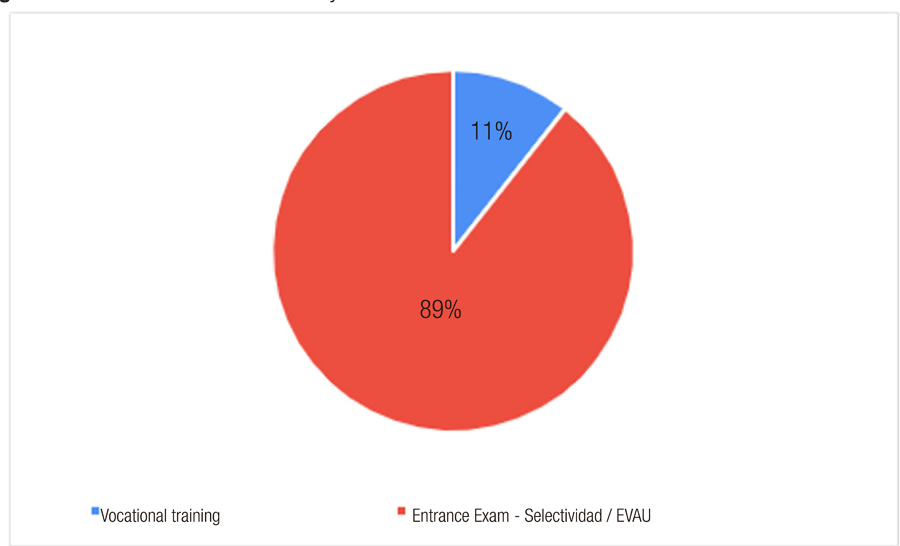 Source: Authors’ own elaboration.
 Source: Authors’ own elaboration.
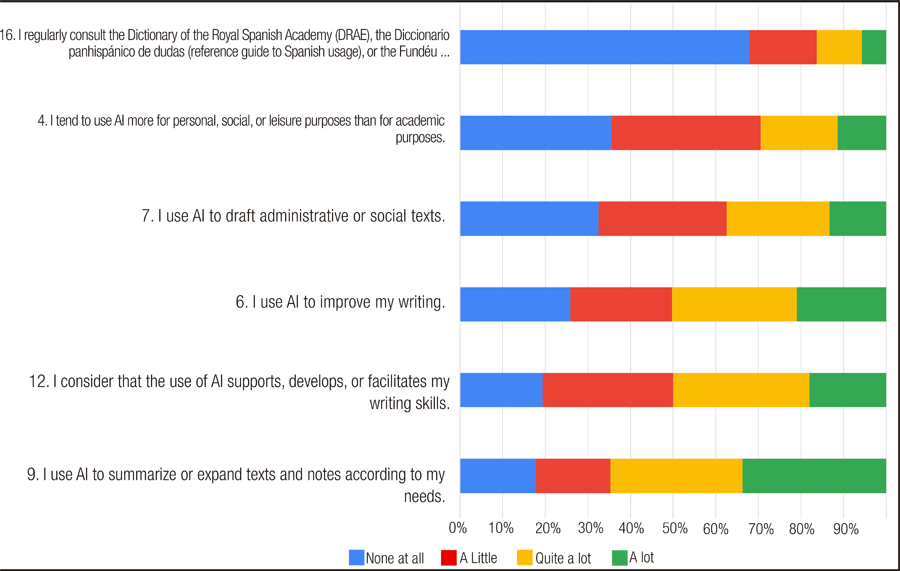 Source: Authors’ own elaboration.