 Assessment of Multiproducts in Schizolobium Parahyba var. Amazonicum Plantations: Tapering Functions Application in Livestock-Forestry Integration Systems
Abstract
Given the strategic importance of commercial forest plantations of native species, this study aimed to select a tapering model to estimate the multiple products of Schizolobium parahyba var. amazonicum planting in integrated livestock-forestry systems in the Amazon and to identify the management regime with the highest production. The research was conducted in the state of Pará, comparing production as a function of variations in spacing and planting age. The Hradetzky, Schöepfer, and Max & Burkhart tapering models were evaluated, considering goodness-of-fit statistics and scatter plots. The Schöepfer model provided the most accurate estimate of tree cross-sectional volume. The management regime with 3.5 × 3.5 m spacing and 60 months promoted the highest assortment production (164 m3) and the lowest amount of residue (60 m3), indicating the largest spacing with the highest plant utilization.
Keywords:
Forest modeling; Management system; Planting spacing; Tree shape
1. INTRODUCTION
Native vegetation is crucial for providing essential ecosystem services that sustain life on Earth (Covey & Megonigal, 2019; Felton et al., 2020). In this context, planted forests emerge as a strategic alternative to meet the demand for timber and reduce pressure on natural ecosystems, which must be preserved (Binkley et al., 2017; Marchi et al., 2018). Furthermore, the exploitation of production forests with native species generates both financial and ecological benefits (Tullus et al., 2025). Thus, research development is essential for improving productive management and aligning economic, environmental, and social interests (Ceretta et al., 2025).
Brazil has established itself as one of the world’s largest forest producers (ITTO, 2025). In 2023, the country set a historic record, surpassing 10 million hectares of planted forest distributed among various species (IBÁ, 2024). In the Amazon region, Schizolobium parahyba var. amazonicum (paricá) stands out for its numerous qualities; its planted area increased from 85,473 ha in 2010 to 90,811 ha in 2018, demonstrating linear growth in the following years (IBÁ, 2019). These data reinforce the relevance of paricá and highlight the dynamism of the Brazilian forestry sector on a global scale.
Paricá plantations occur in different configurations. The species can be cultivated homogeneously (Delarmelina et al., 2023), used in the recovery of degraded areas (Schwartz et al., 2017), or integrated into Integrated Crop-Livestock-Forestry (ILPF) systems (Silva et al., 2020; Mascarenhas et al., 2021; Minini et al., 2024). ILPF crops have gained prominence by offering multiple benefits, such as the increased sustainability (Rodrigues et al., 2023), maximization of resources (Oliveira et al., 2024a), maintenance and reconstitution of forest cover (Ndjadi et al., 2021), nutrient cycling (Bessi et al., 2024), soil bioremediation (Matos et al., 2022) and increased carbon stocks (Leite et al., 2023), in addition to favoring economic viability (Costa et al., 2020) and the generation of carbon credits (Gebara & Agrawal, 2017). Thus, the diversity in planting arrangements highlights the potential of integrated systems to transform forest management.
Paricá has remarkable morphological and physiological characteristics. It is a species native to South America, with accelerated growth, which develops rapidly in height and diameter, with a density ranging from 0.32 to 0.40 g cm-3 (Melo et al., 2018). Classified as a heliophilous and large-sized pioneer, the species reaches heights of 15 to 40 m and diameters of 50 to 100 cm, presenting a straight, cylindrical stem with little tortuosity (Ucella-Filho et al., 2023). These attributes enable its use in various applications, including energy production, civil construction, the manufacturing of utensils, and, most notably, in the lamination industry to produce panels (Callegari et al., 2022; Dionisio et al., 2024). Thus, the intrinsic qualities of paricá qualify it as a valuable option for multiple applications in the timber sector.
Determining the multi-products from paricá wood is essential for the full use of the plantation. In addition to more accurately quantifying the production destined for the largest consumer market for paricá wood: the veneering industry. From a single stem, it is possible to segment the wood for different purposes, based on predetermined measurements that guide its destination (Fiorentin et al., 2019; Menezes et al., 2020). This strategy enables the acquisition of specific products intended for use in sawmills, the laminating industry, energy production, and pulp and paper manufacturing (Baselly-Villanueva et al., 2025). Furthermore, the application of mathematical tapering functions enables the estimation of diameter variation along the stem, thereby contributing to the accurate classification of the wood (Onilude et al., 2017; Souza et al., 2018; Mctague & Weiskittel, 2021; Saud et al., 2024). In this way, tapering modeling represents a powerful tool for optimizing the planning and harvesting of multi-products.
Mathematical taper models are versatile and essential tools in forest management. These models are used to estimate yield, plan forest exploitation, and simulate and optimize timber production (Li et al., 2021). Taper equations can be used to estimate total trunk volume (Laly et al., 2025), marketable volume for different diameters, log volumes of various sizes (Nicoletti et al., 2019; Kärenlampi, 2022), and even biomass (López-López et al., 2017). Additionally, these equations facilitate the development of classification tables based on specific length and diameter limits (Węgiel et al., 2018; Wilms et al., 2024). Thus, taper models demonstrate their effectiveness as instruments that improve the management and sustainability of forest resources.
Improving research on native species planting is crucial to the success of forestry projects. Diversifying management regimes and optimizing production maximizes economic and environmental benefits, attracting new investments. Thus, the hypotheses guiding this work are that (i) among the models analyzed, at least one will indicate precise and accurate results for estimating the volume of assortments of paricá trees in consortium with livestock farming, and (ii) one of the management regimes under analysis stands out concerning the highest production of assortments. Therefore, this study aims to select and validate the most effective taper model and indicate the management regime with the highest production of assortments of Schizolobium parahyba var. amazonicum trees in consortium with livestock farming in the Brazilian Amazon.
2. MATERIAL AND METHODS
2.1. Study Area
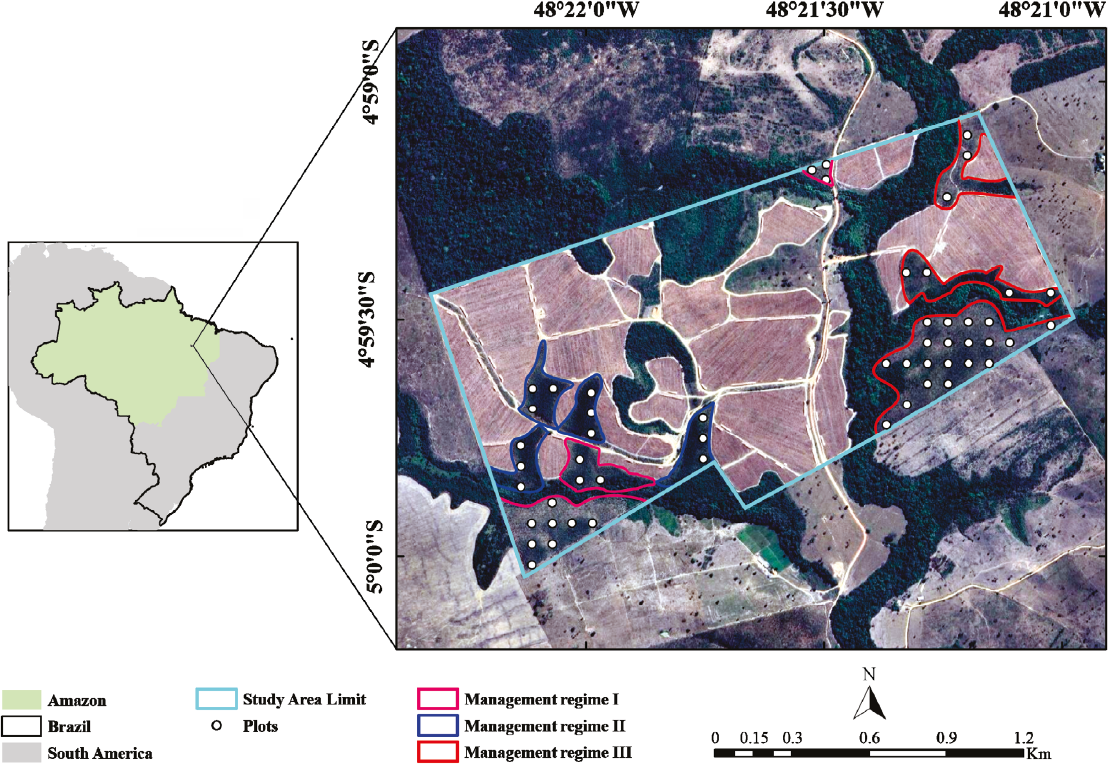
The study took place at Cinco Águas Farm, a private property located at coordinates 05°21’42’’ S and 48°47’36’’ W, in the municipality of Abel Figueiredo, Pará (as illustrated in Figure 1). The farm has a total area of 254 ha, of which 120 ha are designated for planting Eucalyptus grandis, the result of a forestry company’s support, and approximately 46 ha are designated for planting Schizolobium parahyba var. amazonicum (paricá).
Location of the Cinco Águas farm in the Amazon (highlighted) in Brazil. Source: IBGE, SIRGAS (2000).
According to the Köppen-Geiger classification, the climate is classified as type Aw (Álvares et al., 2013). The predominant soils are Dystrophic Yellow Latosol, Yellow Argisol, Red Yellow Argisol, and Haplic Gleysol with gentle to undulating relief, with slopes ranging from 8% to 20% (Santos et al., 2018). The vegetation is characterized as Subperennial Equatorial and Hygrophilous Floodplain Equatorial Forest, with an average annual temperature of 26.6 °C, relative humidity of 82%, and average precipitation of 2,057 mm (Nascimento et al., 2022).
Seedlings produced on-site were used, sourced from seeds purchased in regional stores. The area received a fertilization at the time of planting, followed by a topdressing fertilization after 40 days. The pasture is formed with the forage species Panicum maximum, and the herd consists of 40 head of dairy cattle (undefined breed due to crossbreeding), with a stocking rate of 0.87 individuals per hectare. Although the implementation of the pasture varied in the paricá plantations, the cattle began to roam freely throughout the property as of 2022. Due to these differences, the paricá plantation was segmented into three management regimes (Table 1).
2.2. Data collection
The forest inventory, conducted in 2023, adopted a systematic sampling system, with circular plots of 500 m2 installed at 80 m intervals and stratified according to the management regime area (see Table 1 and Figure 1). Diameter at breast height (DBH) was measured at 1.3 m above the ground using a Haglof Mantax Blue 50 cm equipment, and the average of two perpendicular measurements was used to increase the accuracy of the diameter data.
Cubic measurement was performed indirectly and non-destructively to preserve the integrity of the trees. A Criterion RD 1000 digital dendrometer, mounted on a Kingjoy SF048 tripod (Costa et al., 2022), was used to measure two trees per plot, totaling 106 trees in the entire plantation. Following the Smalian method (Simões et al., 2025), diameters were measured at specific heights 0.1 m, 0.7 m, 1.30 m, and then at 2 m intervals until the insertion of the first branch, corresponding to the commercial height (Biazatti et al., 2020). Additionally, the total height of each tree was recorded.
The trees for cubing were selected to represent the diameter distribution of management regimes and the whole forest, prioritizing individuals without apparent defects (straight trunks, without bifurcation) and with a healthy crown. Specifically, the following criteria were adopted: (i) systematic selection of trees closest to the center of the plot, located in the same spatial positions in relation to geographic north and tree spacing orientation; and (ii) selection of trees to capture the structural variability of the stand as a whole, collecting a sample size of at least 60 trees for the entire forest area and management regimes under inventory. This procedure follows classic recommendations for forest inventory studies, as well as being a routine activity in commercial inventories on the market, practices such as the systematization of plots and trees for collecting height and stem taper measurements (Campos & Leite, 2017).
2.3. Data analysis
Three tapering models were tested to quantify multi-products (Table 2). Among the models evaluated, one was segmented (Max & Burkhart) and two were non-segmented (Hradetzky and Schöepfer). The data were divided into two sets, adjustment and validation, each containing 50% of the records. This equal division facilitates the identification of possible errors in extrapolating the models to the total population, an issue that is especially crucial considering the high variability of individuals in a seed plantation. The equal partition minimizes the bias that could occur in smaller samples (Raj, 1968).
The Hradetzky and Schöepfer models were adjusted in R software (version 4.3.1) using the least squares method. The determination of the optimal combination of integer and fractional powers of the Hradetzky model was performed using the stepwise method (Scolforo et al., 2018). The Max & Burkhart model was adjusted with the “rp.nls” function of the “rpanel” package (Crawford & Bowman, 2021), which implements weighted nonlinear least squares estimates using the Gauss-Newton algorithm (R Core Team, 2023). The significance of the coefficients was evaluated using robust Newey-West standard errors to handle autocorrelation between adjacent sections along the shaft and possible heteroscedasticity patterns (Pinheiro & Bates, 2000), using the Newey-West and coeftest functions from the sandwich package in R.
The selection of the most appropriate model was based on robust quantitative criteria widely used in forestry science. For the response variable (di/d), the Akaike Information Criterion (AIC), the Bayesian Information Criterion (BIC), the estimated efficiency (EE), and the mean percentage error (MPE%) were considered (Table 3). The AIC and BIC criteria combine the error of the estimates with the number of parameters, allowing the comparison of models with different methods and complexities (Dziak et al., 2020), while the EE, similar to the adjusted coefficient of determination (R2 aj), is applied for adjustments via least squares (Nascimento et al., 2020).
The EE and MPE% evaluation criteria were applied to the validation data and variables derived from the models, such as the diameter along the stem (di), the volume of the sections (vi), and the total volume of the tree (tv). Additionally, scatter plots were prepared to compare the observed and estimated values using the “latticeExtra” package (Sarkar & Andrews, 2022) within the R software (R Core Team, 2023). This graphical analysis was essential for identifying trends, confirming the consistency of the models, and verifying possible biases.
The determination of multi-products was based on research carried out in sawmills in the region. Two types of logs were defined for the laminating industry, based on the minimum diameter limits (Table 4). The volume of each multiproduct was calculated based on the diametric distribution of the plantations and segmented by management regime, facilitating the visualization and comparison of data, as demonstrated by Costa et al. (2020).
3. RESULTS
3.1. Model adjustments and selection
The procedure indicated that, for the Hradetzky model, the best combination was obtained with two powers (0.9 and 20). In contrast, while all the parameters of the Hradetzky and Schöepfer models presented statistical significance, the Max & Burkhart model revealed two non-significant parameters (Table 5). Although the models were fitted via ordinary linear regression, the assessment of the significance of the coefficients considered the possible presence of autocorrelation and heteroscedasticity in the residuals, common characteristics in sequential measurements along the shaft. Thus, the standard errors were recalculated using the Newey-West correction, which provides robust estimators under these conditions. The estimated coefficients remained stable, reinforcing the consistency of the models for functional comparison purposes.
In general, the selection criteria presented similar values, except the Max & Burkhart model for the variable volume of the stem sections (Table 6). The AIC and BIC of the di/d variable indicated the Max & Burkhart model as the best model for the adjustment data. However, since this model presented non-significant parameters, it could not be selected for estimating the multi-products. Thus, the selection criteria for the adjustment data (AIC and BIC) of the di/d indicated the Schöepfer model as the best. The Hradetzky model presented the best result for the selection criteria EE and MEP% of the di/d variable and for the di variable. The Schöepfer model also indicated the best result for the variables vi and tv.
The evaluation criteria demonstrate consistent results between the adjustment data and the validation data (Table 7). In both sets, the EE and MPE% criteria were similar for most variables. Specifically, the Hradetzky model performed best for di/d, di, and tv, while the Schöepfer model stood out, particularly for the variable vi. Therefore, the validation data reinforce the selection of the Schöepfer model for the final application in the determination of multi-products.
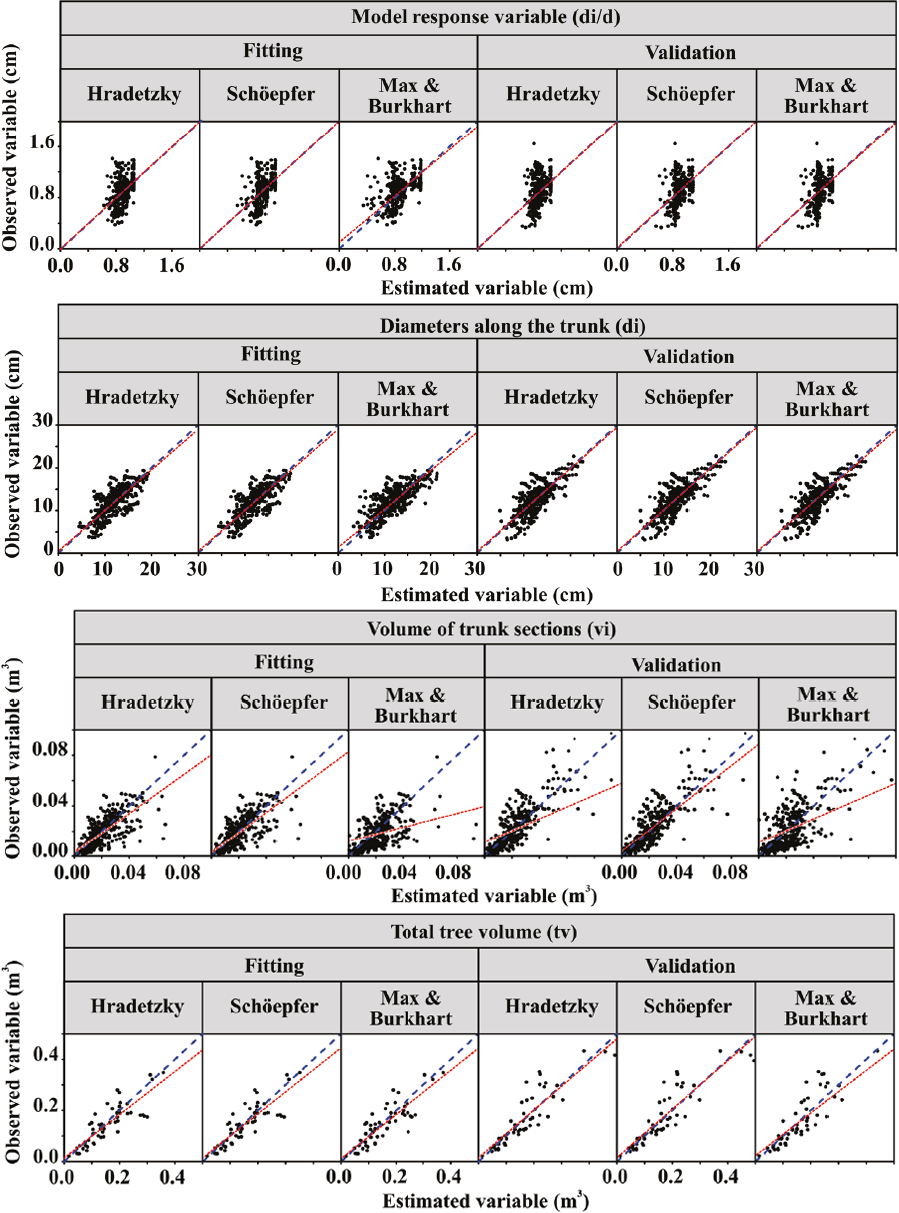
The graphical analysis of the estimated values for the di/d variable reveals specific trends in the behavior of the models. The estimated values were concentrated around 1 cm (Figure 2). In the adjustment data, the Hradetzky and Schöepfer models did not present evident biases, while the Max & Burkhart model showed a tendency to overestimate by up to 1 cm and, thereafter, to underestimate the results. In the validation data, the underestimation bias of this same model remained slight. Consequently, the graphical analysis corroborates the quantitative criteria, reinforcing the choice of the Hradetzky and Schöepfer models for estimating the di/d variable.
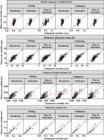
Scatterplots of estimated and observed variables by the tapering models. Where: the black dots represent the estimated values on the X axis and the observed values on the Y axis of the tested variables; The blue lines represent the perfect 1:1 direct relationship line, and the red lines are the trend lines of the estimates.
The graphs of diameters along the stem (di) demonstrated good dispersion and consistency in the estimates (Figure 2). The models tested, both in the adjustment and validation data, exhibited similar dispersion patterns. A slight tendency of overestimation was observed for diameters below 15 cm, followed by an underestimation for larger diameters, especially noticeable in the Max & Burkhart model in the adjustment data.
The evaluation of the section volumes (vi) confirms the expectations regarding the smaller magnitude of the stem volumes, whose results were concentrated in values up to 0.05 m3 (Figure 2). In both data sets, the models tended to overestimate the volumes, with this tendency being less pronounced in the Schöepfer model for the validation data.
The results for the total tree volume (tv) showed a distribution quite consistent with the 1:1 line (Figure 2). The estimated tv values are close to the observed values, although all models show a slight tendency to overestimate. This tendency was smaller in the Schöepfer and Hradetzky models in the validation data. The proximity of the estimated values to the observed values is crucial for the quality of the tv estimates, a variable directly related to the evaluation of multi-products. Thus, the tv analysis reinforces the choice of the Schöepfer model in practical application. Therefore, the Schöepfer model was adopted as the best option for estimating the multiproducts of Schizolobium parahyba var. amazonicum planting.
3.2. Determination of multiproducts
The MR I and MR II regimes, both with 4 × 2 m spacing and 47 months of age, presented similar results, although MR II (without forage) demonstrated 9.02% more wood in the smaller diameter assortment and a greater volume of larger diameter logs, in addition to a higher total volume (Table 8). In contrast, the MR III regime, with 3.5 × 3.5 m spacing and 60 months of age, presented a considerably higher total volume of both assortments, with the smaller diameter assortment being 64.91% higher than that of MR II.
Regarding residues, MR II presented significantly higher amounts (9.66% more than MR I and 84.48% more than MR III). These quantitative differences demonstrate that spacing and age significantly influence the productivity and quality of multi-products, indicating that regimes with greater spacing and age favor the production of more usable wood. Therefore, the analysis of the management regimes reveals that MR III exhibits the best productive potential, contributing to the definition of management strategies that optimize the exploitation of multiple products.
4. DISCUSSION
4.1. Model selection and adjustment
The behavior of tapering models varies according to the region and species, which makes it essential to adjust and select the most appropriate model for each planting condition (Salekin et al., 2021). In this context, trunks can be divided into solids of revolution, exemplified by a neiloid shape at the base, followed by a paraboloid in the center, and a cone at the top (Pukkala et al., 2019). Although segmented models generally present greater accuracy (Rocha et al., 2022), their adjustment is more complex, as it requires the precise identification of the inflection points that delineate each solid in the stem (Zhang et al., 2021). In the present study, the lack of significance in some parameters of the Max & Burkhart model suggests that the inflection points may not have been accurately determined, compromising its performance (Oliveira et al., 2024b).
On the other hand, non-segmented models have the advantage of describing the shape of the stem through a single equation, which facilitates their adjustment and integration, providing reliable accuracy (Stefanello et al., 2021). Specifically, the Hradetzky model can reproduce the stem profile when using multiple fractional powers, with the highest powers representing the base and the lowest the upper part (Pelissari et al., 2017). In the present study, the Hradetzky and Schöepfer models showed similar efficiency, probably due to the similarity in their configurations (Sanquetta et al., 2018), and these results are supported by studies carried out with species such as Pinus taeda (Téo et al., 2018), Araucaria angustifolia (Martins et al., 2017), Eucalyptus grandis (Farias et al., 2019) and Xylopia brasiliensis (Miranda et al., 2020).
4.2. Assortment and waste
Studies on forest plantations spacing are essential, as tree density directly influences growth, yield, and stem shape, in addition to impacting harvesting operations and rotation periods (Tun et al., 2018). In integrated systems, where components are strongly interrelated (Hammarstrom & Bianchi, 2019; Sales et al., 2021), the MR I (with forage) and MR II (without forage) regimes, both with 4 × 2 m spacing and 47 months of age, presented similar assortment volumes.
However, in intercropping systems, spacing becomes even more decisive, as competition between forage and tree species for light, water, and nutrients can significantly affect production (Sarto et al., 2020). Another factor that may have contributed to the lower production observed in MR I is the early entry of cattle, starting in the 36th month after planting (Behling et al., 2021), which, combined with the fact that individuals are thinner due to shorter spacing and age (Marziliano et al., 2015), caused more pronounced mechanical shocks (Gonçalves et al., 2022).
The MR III regime stood out for presenting the highest production. With greater spacing (3.5 × 3.5 m) and an older age (60 months), the trees were more robust (West & Smith, 2020), resulting in stems that were better suited for obtaining multiple products (Barbosa et al., 2019). Furthermore, the greater spacing in MR III reduced the impact of animals on the trees, since the entry of cattle occurred only 12 months after planting. An alternative strategy to increase use in the MR I and MR II regimes would be the application of thinning, which, in addition to increasing the diameter of the remaining trees, offers economic benefits to the integration system (Viana et al., 2021; Grigoreva et al., 2022).
Although studies indicate that plantings with smaller spacing produce trees with smaller diameters, the increase in the number of individuals usually compensates for this difference (Zahabu et al., 2015; Zhang et al., 2020). However, this pattern was not evident in the present study, possibly due to the difference in planting age (Eloy et al., 2018) or the additional benefits of the integration system in MR III, such as natural fertilization promoted by the presence of livestock (Gil et al., 2015).
Finally, the greater volume of waste observed in the MR I and MR II regimes can be attributed to the lower use of the trunks of trees with reduced diameter (Ferraz Filho et al., 2018). A viable solution would be to convert this waste into bioenergy (López-Hortas et al., 2021), considering that, for this purpose, the minimum diameter must be 4 cm; smaller trunks can still be used as firewood (Okello et al., 2001).
The greater spacing, in addition to indicating greater production in cubic meters of assortment, also demonstrated optimized utilization of trunks with a lower volume of residue. The reduction in planting density, in addition to its impact on production, which can be related to reduced competition and greater space for development, also affects the economic aspect. With fewer trees, planting costs are reduced. Thus, the advantage of maximizing production is evident, in addition to production diversification, another economic advantage of integrated production systems.
5. CONCLUSION
The Schöepfer model demonstrated the best performance in estimating the volumes of Schizolobium parahyba var. amazonicum (Huber ex. Ducke) Barneby assortments in an integrated livestock-forestry system.
The management regime with 3.5 × 3.5 m spacing and 60 months of age, integrated with livestock, presented the highest total production volume for both the assortment ≥ 20 cm and ≥ 12 cm. The regime with 4 × 2 m spacing and 47 months of age, without integration with livestock, generated the largest volume of waste, and its allocation to bioenergy is recommended.
To complement this research, we recommend monitoring the planting for further studies at older ages, in addition to obtaining data from other paricá planting areas with different edaphoclimatic conditions and management regimes as a means of validating and consolidating the species for commercial forest plantations.
ACKNOWLEDGEMENTS
This study was partly funded by the Coordination for the Improvement of Higher Education Personnel - Brazil (CAPES), Financial Code 88887.510262/2020-00. We thank the owner of Fazenda Cinco Águas, Mr. Felix Oliveira, and also the Forest Resource Measurement and Management Laboratory (LabFor) of the Federal Rural University of the Amazon (UFRA).
DATA AVAILABILITY
The entire dataset supporting the results of this study is available upon request to the corresponding author, Quinny Soares Rocha. The dataset is not publicly available because the raw data includes georeferenced records of permanent plots, the unrestricted disclosure of which could compromise the security of the sites and violate cooperation agreements with the institutions managing the data. Therefore, this is in accordance with established legal and ethical terms.
SUPPLEMENTARY MATERIAL
The following online material is available for this article:
Additional file 1
REFERENCES
- Alvares CA, Stape JL, Sentelhas PC, Gonçalves JL de M, Sparovek G. Köppen’s climate classification map for Brazil. Meteorol Zeitschrift 2013; 22 (6): 711-728.
- Barbosa RA, Reis GG dos, Reis MDGF, Leite HG, Oliveira CH de R, Silva ML da, et al. Growth, yield and economic analysis of an eucalypt-soybean consortium: Effect of the distance between trees within the row. Revista Árvore 2019; 43 (2): 1-10.
- Baselly-Villanueva JR, Fernández-Sandoval A, Salazar-Hinostroza EJ, Cárdenas-Rengifo GP, Puerta R, Trigoso TSC, et al. MultiProduct optimization of Cedrelinga cateniformis (Ducke) Ducke in different plantation Systems in the Peruvian Amazon. Forests 2025; 16 (1): 1-32.
- Behling M, Martínez GB, Silva AR, Oliveira TK de, Cipriani HN. O eucalipto em sistemas de integração lavoura- pecuária-floresta (ILPF) na Amazônia. In: Oliveira EB de, Pinto Junior JE, editors. O eucalipto e a Embrapa, quatro décadas de Pesquisa e Desenvolvimento. Brasília: EMBRAPA; 2021.
- Bessi D, Bernardi AC de C, Pezzopane JRM, Tanaka MO. Decomposition and stabilization of the organic matter in integrated livestock production systems. Agroforestry System. 2024; 98 (7): 2275-2292.
- Biazatti SC, Môra R, Sccoti MSV, Brito Júnior JF de, Queiroz N dos S, Curto R de A. Criterion Dendrometer as a non-destructive method for dendrometric estimations of native species in Western Amazon. Revista Ibero-Americana Ciências Ambientais 2020; 11 (6): 59-70.
- Binkley D, Campoe OC, Alvares C, Carneiro RL, Cegatta Í, Stape JL. 2017. The interactions of climate, spacing and genetics on clonal Eucalyptus plantations across Brazil and Uruguay. Forest Ecology and Management. 2017; 405: 271-283.
- Callegari DM, Silva B do C, Santos LR dos, Pereira Jr EM, Batista BL, Lobato AK da S, et al. Physiological, biochemical and nutritional aspects in Schizolobium parahyba var. amazonicum (Huber ex Ducke) plants under different zinc supplies. Brazilian Journal of Botany 2022; 45 (3): 845-855.
- Campos JCC, Leite HG. Mensuração florestal: perguntas e respostas. 5th edn. Viçosa: UVF; 2017.
- Ceretta RP da S, Marques JD, Lima MDR, Assis-Pereira G de, Silva MG da, Gonçalves D de A, et al. Planted forests of Tachigali vulgaris in Eastern Amazonia: how spacing affects the anatomical variations and wood density. New Forests 2025; 56 (26): 1-25.
- Costa EA, Liesenberg V, Hess AF, Finger CAG, Schneider PR, Longhi RV, et al. Simulating Araucaria angustifolia (Bertol.) kuntze timber stockswith liocourt’s law in a natural forest in southern Brazil. Forests; 2020 11 (3): 1-14.
- Costa EA, Schons CT, Finger CAG, Hess AF. Fitting volume models for Parana Pine with a nonlinear regression, genetic algorithm and simulated annealing. Journal of Agricultural Science 2022; 14 (2): 36-47.
- Covey KR, Megonigal JP. Methane production and emissions in trees and forests. New Phytologist 2019; 222 (1): 35-51.
- Crawford E, Bowman A. Simple interactive controls for R functions using the tcltk package 2021.
- Delarmelina WM, Caldeira MVW, Souza PH de, Moreau JS, Paula RR, Trazzi PA, et al. Biomass and carbon in Schizolobium parahyba var. amazonicum stands under different spacing. Ciência Florestal 2023; 33 (3): 1-24.
- Dionisio LFS, Soares FL, Milhomem CA, Rodrigues RP, Bardales-lozano RM, Schwartz G. Methods for overcoming seed dormancy of Schizolobium parahyba var . Amazonicum. Revista Ciências Agrárias 2024; 47 (3): 454-462.
- Dziak JJ, Coffman DL, Lanza ST, Li R, Jermiin LS. Sensitivity and specificity of information criteria. Briefings in Bioinformatics 2020; 21 (2): 553-565.
- Eloy E, Caron BO, Elli EF, Schwerz F. Effect of age and spacing on biomass production in forest plantations. Revista Árvore 2018; 5 (2): e420214.
- Farias KJ, Nicoletti MF, Aguiar NS de. Quantification of total volume by volumetric models and tapering in Eucalyptus grandis W. Hill ex Maiden. Revista Ciencias Agroveterinárias 2019; 18 (1): 33-40.
- Felton A, Löfroth T, Angelstam P, Gustafsson L, Hjältén J, Felton AM, et al. Keeping pace with forestry: multi-scale conservation in a changing production forest matrix. Ambio 2020; 49 (5): 1050-1064.
- Ferraz Filho AC, Mola-Yudego B, González-Olabarria JR, Scolforo JRS. Thinning regimes and initial spacing for Eucalyptus plantations in Brazil. Anais da Academia Brasileira de Ciências 2018; 90 (1): 255-265.
- Fiorentin LD, Arce JE, Pelissari AL, Miranda ROV de, Freitas TW de. Optimized planning of assortment production in forest stands. Floresta 2019; 49 (4): 735-744.
- Gebara MF, Agrawal A. Beyond rewards and punishments in the Brazilian Amazon: practical implications of the REDD+ discourse. Forests 2017; 8 (3): 1-27.
- Gil J, Siebold M, Berger T. Adoption and development of integrated crop-livestock-forestry systems in Mato Grosso, Brazil. Agriculture, Ecosystems and Environment 2015; 199: 394-406.
- Gonçalves RTCF, Souza FC de, Gonçalves R de JF, Gomes NSB, Cruz CGS da, Sales ETM. Damages caused by cattle in eucalyptus clones in silvipastoril system in the amazon region. Ciência Florestal 2022; 32 (2): 714-734.
- Grigoreva O, Runova E, Savchenkova V, Hertz E, Voronova A, Ivanov V. Comparative analysis of thinning techniques in pine forests. Journal of Forestry Research 2022; 33 (4): 1145-1156.
- Hammarstrom DG, Bianchi V. Integration of tree crops and pastures: literature review. African Journal of Agricultural Research 2019; 14 (26): 1091-1096.
- IBÁ - Indústria Brasileira de Árvores. IBÁ 2024: relatório anual. Brasília: IBÁ; 2024.
- IBÁ - Indústria Brasileira de Árvores. Relatório 2019. Brasília: IBÁ ; 2019.
- ITTO - International Tropical Timber Organization. GTI REPORT 2025. Yokohama: ITTO; 2025.
- Kärenlampi PP. Empirical observations of the yield of logs from trees of the boreal region. Baltic Forestry 2022; 28 (1): 556.
- Laly FG, Atindogbe G, Sohou GMA, Akpo HA, Fonton NH. Enhancing stem volume estimation for savanna species using variable-exponent taper equation and close-range photogrammetry. Forest Ecosystems 2025; 13: 100331.
- Leite FFGD, Nóbrega GN, Baumgärtner LC, Alecrim FB, Silveira JG da, Cordeiro RC, et al. Greenhouse gas emissions and carbon sequestration associated with Integrated Crop-Livestock-Forestry (ICLF) systems. Environmental Reviews. 2023; 31 (4): 589-604.
- Li D, Guo H, Jia W, Wang F. Analysis of taper functions for larix olgensis using mixed models and TLS. Forests 2021; 12 (2): 1-17.
- López-Hortas L, Rodríguez-González I, Díaz-Reinoso B, Torres MD, Moure A, Domínguez H. Tools for a multiproduct biorefinery of Acacia dealbata biomass. Industrial Crops & Products 2021; 169: 113655.
- López-López SF, Martínez-Trinidad T, Benavides-Meza H, Garcia-Nieto M, Santos-Posadas HM de los. Non-destructive method for above-ground biomass estimation of Fraxinus uhdei (Wenz.) Lingelsh in an urban forest. Urban Forestry & Urban Greening 2017; 24: 62-70.
- Marchi E, Chung W, Visser R, Abbas D, Nordfjell T, Mederski PS, et al. Sustainable Forest Operations (SFO): A new paradigm in a changing world and climate. Science of the Total Environment 2018; 634: 1385-1397.
- Martins APM, Debastiani AB, Pelissari AL, Machado S do A, Sanquetta CR. Estimativa do afilamento do fuste de araucária utilizando técnicas de inteligência artificial. Floresta e Ambiente 2017; 24 (e20160234).
- Marziliano PA, Coletta V, Menguzzato G, Nicolaci A, Pellicone G, Veltri A. Effects of planting density on the distribution of biomass in a douglas-fir plantation in Southern Italy. IForest 2015; 8 (1): 368-376.
- Mascarenhas ARP, Sccoti MSV, Melo RR de, Corrêa FL de O, Souza EFM de, Pimenta AS. Characterization of wood from Schizolobium parahyba var. amazonicum Huber x Ducke trees from a multi-stratified agroforestry system established in the Amazon rainforest. Agroforest Systems 2021; 95: 475-486.
- Matos AMS, Bonini C dos SB, Moreira BR de A, Andreotti M, Heinrichs R, Silva DT da, et al. Long-term integrated crop-livestock-forestry systems recover the structural quality of ultisol soil. Agronomy 2022; 12: (2961).
- Mctague JP, Weiskittel A. Evolution, history, and use ofstem taper equations: a review of their development, application, and implementation. Canadian Journal of Forest Research 2021; 51: 210-235.
- Melo LE de L, Silva C de J, Protásio T de P, Mota G da S, Santos IS, Urbinati CV, et al. Planting density effect on some properties of Schizolobium parahyba wood. Maderas, Ciencia y Tecnología 2018; 20 (3): 381-394.
- Menezes L da S, Figueiredo JBL, Costa LS da, Castro RVO, Junior CAA. Taper modeling and economic evaluation of multi-products obtained from wood of short-rotation Eucalyptus stands. Floresta 2020; 50 (3): 1439-1448.
- Minini D, Reis CA, Maria D de MB, Chagas KPT das, Lins TR da S, Cademartori PHG de, et al. A review on the quality of wood from agroforestry systems. Agroforest Systems 2024; 98: 715-737.
- Miranda EN, Lopes IL e, Araújo LA, Dias TDSP, Lacerda THS, Gomide LR. Efeito de variáveis de copa em funções de afilamento. Advances in Forestry Science 2020; 7 (2): 1057-1066.
- Nascimento RGM, Vanclay JK, Figueiredo Filho A, Machado S do A, Ruschel AR, Hiramatsu NA, et al. The tree height estimated by non-power models on volumetric models provides reliable predictions of wood volume: the Amazon species height modelling issue. Trees, Forests and People 2020; 2 (e100028).
- Nascimento RLX, Souza CC de, Grassi G, Oliveira MA das N de. Caderno de caracterização do estado do Pará. Brasília: Codevasf; 2022.
- Ndjadi SS, Matendo AF, Mwinja AC, Mondo JM, Civava RM, Mushagalusa GN. Integrated crop-livestock-aquaculture farming systems: synergistic approaches for balancing agriculture’s biophysical requirements and environmental supply: a systematic review. African Journal of Rural Development 2021; 6 (3): 167-190.
- Nicoletti MF, Carvalho S de P e C, Machado S do A, Figueiredo Filho A, Oliveira GS. Partial volume prediction through nonlinear mixed modeling. Floresta e Ambiente 2019; 26 (4): e20170329.
- Okello BD, O’Connor TG, Young TP. Growth, biomass estimates, and charcoal production of Acacia drepanolobium in Laikipia, Kenya. Forest Ecology and Management 2001; 142: 143-153.
- Oliveira DMS, Santos RS, Chizzotti FHM, Bretas IL, Franco ALC, Lima RP, et al. Crop, livestock, and forestry integration to reconcile soil health, food production, and climate change mitigation in the Brazilian Cerrado: a review. Geoderma Regional 2024; 37 (e00796).
- Onilude Q, Fajemila A, Adeleye I, Oduola M, Osijo A, Oso A. Stem taper and tree growth characteristics for Triplochitonscleroxylon (K. schum) stands in Ibadan Metropolis, Nigeria. International Journal of BioSciences, Agriculture and Technology 2017; 8 (4): 28-35.
- Pelissari AL, Roveda M, Caldeira SF, Sanquetta CR, Corte APD, Rodrigues CK. Geostatistical modeling of timber volume spatial variability for Tectona grandis l. f. precision forestry. Cerne 2017; 23 (1): 115-122.
- Pinheiro JC, Bates DM. Mixed-effects models in S and S-PLUS. New York: Springer; 2000.
- Pukkala T, Hanssen KH, Andreassen K. Stem taper and bark functions for Norway spruce in Norway. Silva Fennica 2019; 53 (3):1-15.
-
R Core Team. R: A language and environment for statistical computing, version 4.0.5., 2023 [cited 2024 abr. 6]. Available from: Available from: https://cran.r-project.org/
» https://cran.r-project.org/ - Raj D. Sampling theory. 1 st. Oxford: OUP Oxford; 1968.
- Rocha KJ da, Finger CAG, Favalessa CMC, Caldeira SF, Fleig FD. Form and volume of the stem of Tectona grandis L.f. in the central-western region of Brazil. Forests 2022; 13 (1818).
- Rodrigues R de AR, Ferreira IGM, Silveira JG da, Silva JJN da, Santos FM, Conceição MC da. Crop-livestock-forest integration systems as a sustainable production strategy in Brazil. In: Søndergaard N, Sá CD de, Barros-Platiau AF, editors. Sustainability Challenges of Brazilian Agriculture, Berlin: Springer, Cham; 2023.
- Salekin S, Catalán CH, Boczniewicz D, Phiri D, Morgenroth J, Meason DF, et al. Global tree taper modelling: A review of applications, methods, functions, and their parameters. Forests 2021; 12 (913).
- Sales A, Oliveira Neto N de, Paiva HN de, Leite HG, Siviero MA, Vieira SB. Growth and Yield of Schizolobium parahyba var. amazonicum according to soil management in agroforestry systems: a case study in the Brazilian Amazon. Diversity 2021; 13 (511).
- Sanquetta CR, Piva LRO, Wojciechowski J, Corte APD, Schikowski AB. Volume estimation of Cryptomeria japonica logs in southern Brazil using artificial intelligence models. Southern Forests 2018; 80 (1): 29-36.
- Santos HG dos, Jacomine PKT, Anjos LHC dos, Oliveira VÁ de, Lumbreras JF, Coelho MR, et al. Sistema brasileiro de classificação de solos. 5nd ed. Brasília: EMBRAPA ; 2018.
-
Sarkar D, Andrews F. latticeExtra: provides several new high-level functions and methods, as well as additional utilities such as panel and axis annotation functions. Version: 06-30, 2020 [cited 2024 abr. 6]. Available from: Available from: http://latticeextra.r-forge.r-project.org/
» http://latticeextra.r-forge.r-project.org/ - Sarto MVM, Borges WLB, Sarto JRW, Rice CW, Rosolem CA. Root and shoot interactions in a tropical integrated crop-livestock-forest system. Agricultural Systems 2020; 181 (102796).
- Saud P, Chapagain TR, Bhandari SK, Moser WK. Taper functions to predict the upper stem diameter of Chir pine (Pinus roxburghii) in the mid-hills of Nepal. Trees, Forests and People 2024; 17 (100627).
- Schwartz G, Pereira PCG, Siviero MA, Pereira JF, Ruschel AR, Yared JAG. Enrichment planting in logging gaps with Schizolobium parahyba var. amazonicum (Huber ex Ducke) Barneby: A financially profitable alternative for degraded tropical forests in the Amazon. Forest Ecology and Management 2017; 390: 166-172.
- Scolforo HF, McTague JP, Raimundo MR, Weiskittel A, Carrero O, Scolforo JRS. Comparison of taper functions applied to eucalypts of varying genetics in Brazil: application and evaluation of the penalized mixed spline approach. Canadian Journal of Forest Research 2018 48 (5): 568-580.
- Silva CBR da, Santos Junior JA dos, Araújo AJC, Sales A, Siviero MA, Andrade FWC, et al. Properties of juvenile wood of Schizolobium parahyba var amazonicum (paricá) under different cropping systems. Agroforestry Systems 2020; 94: 583-595.
- Simões PHO, Abreu LJFL, Palheta LF, Oliveira Neto CF, Okumura RS, Acosta FC. Volumetric models and form factors for estimating wood stock in sustainable forest management: a study based on commercial species from Southern Amazonia. Trees, Forests and People 2025; 20 (100846).
- Souza GSA de, Cosenza DN, Araújo AC da SC, Pimenta LVA, Souza RB, Almeida FM, et al. Evaluation of non-linear taper equations for predicting the diameter of Eucalyptus trees. Revista Árvore 2018; 42 (1): 1-10.
- Stefanello FR, Netto SP, Behling A, Pelissari AL, Orso GA. Preußner functions for volume estimation of pinus taeda L. in Southern Brazil. New Zealand Journal of Forestry Science 2021; 51 (4): 1-25.
- Téo SJ, Machado S do A, Figueiredo Filho A, Tomé M. Stem taper equation with extensive applicability to several age classes of Pinus taeda L. Floresta 2018; 48 (4): 471-482.
- Tullus T, Lutter R, Randlane T, Saag A, Tullus A, Rähn E, et al. Do silver birch (Betula pendula) and hybrid aspen (Populus tremula × P. tremuloides) plantations on former agricultural land differ from the perspective of biodiversity? New Forests 2025; 56 (2): 1-26.
- Tun TN, Guo J, Fang S, Tian Y. Planting spacing affects canopy structure, biomass production and stem roundness in poplar plantations. Scandinavian Journal of Forest Research 2018; 33 (5): 464-474.
- Ucella-Filho JGM, Dias Júnior AF, Souza EC de, Silva JGM da, Sant’anna Neto A, Silva APC da, et al. Clues about wood density and trace-element variability of Schizolobium parahyba var. amazonicum (Huber ex Ducke) Barneby for bioenergy use. Environmental Science and Pollution Research 2023; 30 (19): 56161-56173.
- Viana L de A, Castro RVO, Souza ÁN de, Soares CPB, Joaquim MS, Costa LS da. Optimization and economic analysis of multiproducts obtained from wood of Eucalyptus stands under different productive capacity classes and rotation ages. Floresta 2021; 51 (2): 293-302.
- Węgiel A, Bembenek M, Łacka A, Mederski PS. Relationship between stand density and value of timber assortments: a case study for Scots pine stands in north-western Poland. New Zealand Journal of Forestry Science 2018; 48 (12).
- West PW, Smith RGB. Effects of tree spacing on branch-size development during early growth of an experimental plantation of Eucalyptus pilularis in subtropical Australia. Australian Forestry 2020; 83 (1): 39-45.
- Wilms F, Berendt F, Bronisz K, Bashutska U, Fotelli M, Radoglou K, et al. Applying taper function models for black locust plantations in Greek post-mining areas. Scientific Reports 2024; 14 (1): 1-18.
- Zahabu E, Raphael T, Chamshama SAO, Iddi S, Malimbwi RE. Effect of spacing regimes on growth, yield, and wood properties of Tectona grandis at Longuza forest plantation, Tanzania. International Journal of Forestry Research 2015; (469760): 1-6.
- Zhang S, Sun J, Duan A, Zhang J. Variable-exponent taper equation based on multilevel nonlinear mixed effect for Chinese fir in China. Forests 2021; 12 (2): 1-13.
- Zhang Y, Tian Y, Ding S, Lv Y, Samjhana W, Fang S. Growth, carbon storage, and optimal rotation in poplar plantations: A case study on clone and planting spacing effects. Forests 2020; 11 (8): 1-15.
Edited by
-
Associate editor:
Bruno Araujo Furtado de Mendonça http://orcid.org/0000-0003-0288-0024