 Yield, Productivity, and Profitability of Intercropping System on Middle-Aged Clonal Teak Plantation
Abstract
Declining forest productivity and increasing food demand are major concerns in Java. Intercropping, which combines clonal teak with turmeric as shade-tolerant, is one approach to addressing these problems. This study specifically examined intercropping of medium-aged clonal teak with turmeric at various densities. The objective of this research was to examine the impact of stand density on the productivity and profitability of 10-year-old clonal teak and turmeric. The research was conducted from 2019 to 2021 in Ngawi. Two treatments were applied, namely stand density (1111, 833, 416, 312, and 250 trees/ha) and intercropping patterns. The results showed that a lower stand density significantly enhanced the standing stock. Intercropping resulted in a larger productivity than monocultures. Furthermore, the highest turmeric productivity at 18-month-old (±3.96 tons/ha) was observed at the second lowest density, while the highest curcumin (7.17%) was at a density of 416 trees/ha. Intercropping yielded a maximum NPV of USD 14,726.
Keywords:
curcumin; financial analysis; stand density; turmeric
1. INTRODUCTION
Declining forest productivity is a major concern in some countries in several areas, primarily caused by deforestation, forest conversion, and land degradation (Ellison et al., 2017; Sudomo et al., 2019). In Indonesia, the total area of deforestation in primary, secondary, and plantation forests reached 121,103.5 hectares per year (Ministry of Environment and Forestry, 2024), while land degradation occurred in an area of 14,006,450 hectares in 2018 (BPS, 2020). Teak forests, which make up a significant portion of production forests, are also affected, with their area continuing to decline due to illegal logging and agricultural expansion (Tsujino et al., 2016). Teak (Tectona grandis L.f.) is recognized as a valuable and abundant tropical hardwood species (Montes et al., 2019), with global plantations spanning 4.35 to 6.89 million hectares across 69 countries (Berrocal et al., 2020). More than 80% of these plantations are in Asia, 10% in Africa, and 6% in tropical America (Kollert & Kleine, 2017). Most teak plantations are located in tropical Asia, particularly India (43%), Indonesia (31%), Thailand (7%), Myanmar (6%), Bangladesh (3%), and Sri Lanka (2%) (Fauzi et al., 2014). In Indonesia, the largest teak forest is on Java, covering 1,000,534 hectares, or 67% of Java’s production forest area (Perhutani, 2014). However, the area of this teak forest has decreased by 750,426 ha (Ministry of Environment and Forestry, 2012). Additionally, teak forest productivity declined from 81.7 m3/ha to 70 m3/ha (Perhutani, 2006). These combined challenges underscore the urgent need for rehabilitation efforts to increase forest and land productivity, particularly through intensive silviculture.
In Indonesia, teak productivity improvement programs continue to be implemented using intensive silviculture techniques, one of which is the use of selected teak clones. Clonal teak plantations are established through a series of breeding programs and are now widely adopted in most production forests in Java (Budiadi et al., 2017; Widiyatno et al., 2023). The teak clones have a diameter growth almost twice that of conventional teak trees (Basri & Wahyudi, 2012). The clonal teak plantation can increase to over 200 m3/ha (Na’iem, 2014). The use of superior clones shortens the harvest period of teak trees from long-term to short-term, reducing the time from around 50 years to around 20 years (Budiadi et al., 2012; Na’iem, 2014). Vegetative propagation of teak clones has successfully increased land productivity and supported the rehabilitation of degraded forests (Hardiwinoto et al., 2021; Wirabuana et al., 2022). Based on the high growth rate, clonal plantations close the canopy quickly and require intensive silvicultural practices to maintain productivity and wood quality. Consequently, proper stand density management is essential as it influences the growing space and resource sharing among intercropping plants (Maharani et al., 2022).
Conversely, forest conditions on Java are under pressure due to the island’s rapid population growth. Statistics Indonesia (2018) reports that of Indonesia’s 266.91 million inhabitants, 150.4 million (more than 50%) reside on Java Island. The growth of this population has led to an increased demand for food (OECD/FAO, 2019). Teak forests play a strategic role in this regard by providing food and improving the welfare of nearby communities through intercropping. An alternative to maintain land productivity is integrated farming or intercropping, which simultaneously and sequentially combines annual and seasonal crops (Maharani et al., 2022). Intercropping can augment product diversification, ensure food security, improve the local economy, and provide environmental benefits, such as carbon sequestration (Roshetko et al., 2013; Bansal et al., 2021). In Indonesia, teak (Tectona grandis L.f.) is the most preferred woody perennial for intercropping, particularly on Java Island, according to Roshetko et al. (2013).
The taungya system is an agroforestry approach that integrates forest plantation with cultivating seasonal crops between the tree rows (Rianse and Abdi, 2010). However, this system is usually practiced only in the first three years after the initial teak planting (Pachas et al., 2019). The taungya system is eventually terminated, and enters the post-taungya period. Investigations on the post-taungya system of middle-aged clonal teak plantations are required to evaluate the potential for intercropping with seasonal crops. Implementing wide spacing in intercropping or agroforestry systems can enhance overall land productivity after three years of planting (Coulibaly et al., 2017). The productivity of the agroforestry system can be maximized by cultivating understory crops, e.g., with turmeric (Curcuma longa L) as a key example, that thrive in the shaded environments (Morcillo et al., 2017). Turmeric was chosen because it tolerates shade (Sharangi et al., 2022), making it suitable for planting under the closed canopies of mid-aged teak clones.
Turmeric is a valuable herbal commodity with extensive applications in medicine and cosmetics (Ahsan et al., 2020; Gulhane, 2025). It is is a medicinal plant in high demand by the traditional medicine industry, in Indonesia, and worldwide (Salim & Munadi, 2017). Turmeric contains a crucial active compound called curcumin, which possesses antioxidant, anti-inflammatory, and antimicrobial properties (Lorenza et al., 2023; Ayub et al., 2021; Budiadi et al., 2025). Growing interest in traditional medicine is increasing the demand for medicinal plants such as turmeric, and developing this crop can provide economic opportunities.
An intercropping system can contribute to the farmer’s income (Lewerissa, 2016). Intercropping systems can produce teak at a rate of USD 541-794/ha/year, whereas teak monoculture generates only USD 452/ha/year (Budiadi et al., 2025). Pujar et al. (2007) found that herbal plants grown under teak produced higher yields and an increased total weight per plant. This also increases the selling price and income. Evaluating the financial analysis of teak and turmeric intercropping is necessary to assess its profitability and effective management for farmers and policymakers. This research promotes economic interests and sustainable agriculture by balancing land productivity, farmer welfare, and environmental sustainability (Weih et al., 2022; Toker et al., 2024). The research novelty is about stand densities in middle-aged clonal teak when intercropped with turmeric as an understory crop. Therefore, this study aimed to determine the effect of stand density in middle-aged clonal teak on the whole land productivity and economic profitability of intercropping with turmeric. This study may also aid rehabilitation efforts by increasing forest and land productivity.
2. MATERIALS AND METHODS
2.1. Site description
This study was conducted on 10-year-old clonal teak intercropped with turmeric (Curcuma longa L.) in Perhutani forest enterprise in Ngawi, East Java, Indonesia. The plots were located between -7º22’52.829” N latitude and 111º18’17.466” E longitude, approximately 75 m above sea level. The average relative air humidity in the area is 40%-50%, with air temperatures averaging 32ºC and 37ºC. Between November and March, peak precipitation occurs with an average annual rainfall of 1172 mm. The research was conducted from December 2019 to June 2021. The turmeric was planted in December 2019 and harvested 18 months later, in June 2021. Teak tree measurements were taken from the beginning of the intercropping period until the end of the observation period.
2.2. Study methods
A clonal teak plantation was established in 2011 and initially had four spacing configurations, namely 3 m x 3 m, 6 m x 2 m, 8 m x 2 m, and 10 m x 2 m. Thinning was carried out on 8-year-olds, resulting in five stand densities (Table 1), resulting in a relatively irregular spacing between the trees.
Stand density of clonal teak intercropped with turmeric in Perhutani forest enterprise in Ngawi, East Java, Indonesia.
A randomized complete block design (RCBD) was adopted with three blocks as replications, as shown in Figure 1. The study design was categorized based on the following criteria:
-
Main treatment: tree planting density, which included five different densities, namely 1,111, 833, 416, 312, and 250 trees/ha. Treatments were separated by three-meter alleys from each other.
-
Subtreatment: intercropping patterns, which focused on:
-
Agroforestry of clonal teak with turmeric, followed by two sampling methods, at the edge of the tree rows (1-meter distance from the tree) and in the middle of the tree rows (center distance at each spacing) with a size of 1 m x 1 m.
-
Clonal teak monoculture as a control in each subtreatment.
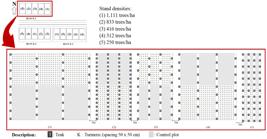
Five planting designs in different stand densities of 10-year-old clonal teak intercropped with turmeric, established in three replicate blocks, each with a control plot. A demonstration plot was established in the area of the Perhutani forest enterprise in Ngawi, East Java.
Turmeric was planted in 2019 under the canopy cover of various stand densities using a spacing of 50 cm × 50 cm. The turmeric rhizomes were used as planting material homogeneously in size, approximately three cm per rhizome, and three buds were cultivated per planting hole. Maintenance activity included regular weeding and fertilization, then fertilization was applied once at the time of planting with manure (approximately 2.5 kg) and nitrogen-phosphorus-potassium fertilizer (20 g) for each plant. Turmeric rhizomes were harvested at 18 months after sowing, cleaned, dried, and weighed until stable weights. A hemispheric camera (Nikon camera with a fish-eye 360º lens) was used to measure canopy openness (%).
2.3. Data collection
The effects of treatments on the tree growth of the middle-aged clonal teak were assessed by measuring several parameters, namely stem diameter (DBH, cm), current annual diameter increment (CADI, cm/year), height (m), and volume (m3/ha). Teak measurements were taken on the inner plot, and crop yields were determined based on turmeric production (gr), productivity (ton/ha), curcumin content (%), and canopy openness. The UV-vis spectrophotometric method was used to analyze curcumin content. The following formula was used to calculate CADI (Equation 1):
where CADIi is the current annual diameter increment (cm/year), DBHi is the diameter at breast height at the current year (cm), and DBH0 is the diameter at breast height at the previous year. The volume was determined using the following formula (Equation 2) (Budiadi et al., 2017):
where V is the volume per hectare (m3 ha-1), DBH is the diameter at breast height (cm).
The financial assessment was based on three parameters: net present value (NPV), benefit-cost ratio (BCR), and equivalent annual income (EAI). The benefits and costs associated with the clonal teak agroforestry system were measured over a specified period of 20 years. The EAI was used to compare the annual income generated from intercropping teak planting. NPV, B/C Ratio, and EAI were calculated using equations 3, 4, and 5, respectively (Shukla SR & Viswanath S, 2014).
where B was the benefits in year t, C was the costs in year t, n was the selected time, and r was the selected discount rate (6%). The currency exchange rate was set at IDR 15,567 per USD, and the prices of teak timber were listed in Table 2. Although the price of turmeric was different based on the variety, the quantity produced, and the growing location.
2.4. Data analysis
Data were analyzed using a two-way analysis of variance (ANOVA), followed by Tukey’s post-hoc test for multiple comparisons among treatment means. Statistical analyses were carried out using the SPSS Statistics 18.0 software, and the differences were considered statistically significant at P<0.05. Canopy openness was analyzed using the Gap Light Analyzer software. Financial analyses were conducted to compare the NPV, BCR, and EAI between treatments.
3. RESULTS
3.1. Effect of stand density on clonal teak productivity
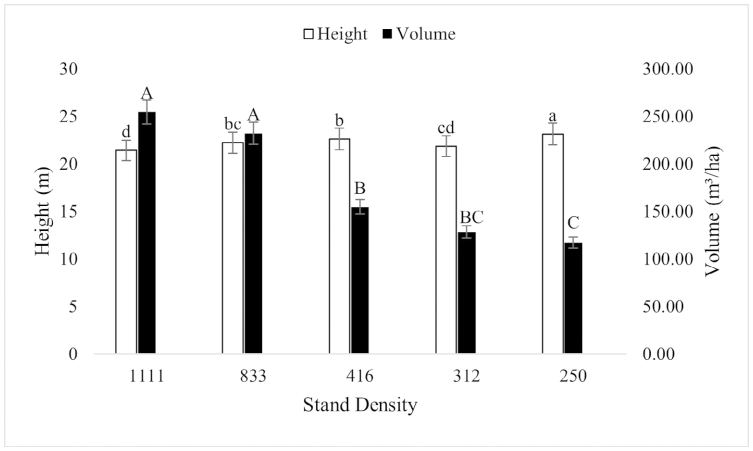
The results showed that stand density significantly affected the growth of the 10-year-old clonal teak, including DBH (P<0.01), CADI (P<0.01), height (P<0.01), and volume (P<0.01) (Table 3). However, the presence of turmeric had a significant effect only on DBH (P<0.05) and volume (P<0.05), as shown in Table 3. The highest DBH, CADI, and height growth rates were noticed at the lowest stand density of 250 trees/ha (Figure 2; Figure 3). However, the highest volume per hectare was found in the highest density, at 1111 trees/ha (Figure 3).
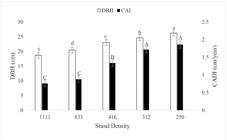
Means and standard deviations for DBH and CADI for each stand density. Different letters show significant differences among treatments at tα 0.05.
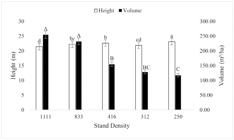
Means and standard deviations for height and volume for each stand density. Different letters show significant differences among treatments at tα 0.05.
The results show that lower density increases both DBH and CADI growth (Figure 2). The lowest density produced the highest DBH (26.25 cm) and CADI (1.86 cm/year) of the 10-year-old clonal teak (Figure 2). Therefore, a density of 250 trees/ha results in higher DBH and CADI than a density of 1111 trees/ha, by 28.95% and 59.13% respectively. These results indicate that density has a significant impact on both diameter growth and current annual diameter increment.
Stand density affected the total height growth of the trees during the observation period, as shown in Table 3. The highest growth in tree height (23.14 m) was observed at the lowest stand density of 250 trees/ha of the 10-year-old clonal teak (Figure 3). Conversely, the lowest tree height at the highest density was 21.42 m. In addition, stand density significantly affected the volume of the stand, with the highest volume (254.77 m3/ha) recorded at 1111 trees/ha and the lowest volume (117.20 m3/ha) at 250 trees/ha (Figure 3).
Intercropping of clonal teak with turmeric considerably influenced the diameter growth and volume compared with the monoculture, as shown in Figure 4. Teak clones intercropped with turmeric achieved a greater diameter (23.07 cm) than monoculture teak clones (22.19 cm). Volume per hectare was also higher with intercropping (185.88 m3/ha) compared to monoculture (165.94 m3/ha). Thus, intercropping 10-year-old teak clones with turmeric increases both diameter and volume.
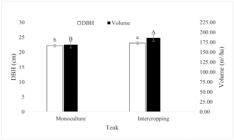
Means and standard deviations for DBH and volume for teak monoculture and teak intercropping. Different letters show significant differences between treatments at tα 0.05.
3.2. Effect of stand density on turmeric yield productivity
The result showed that stand density significantly affected the turmeric yield (P<0.01) (Table 4). However, the sampling methods (edge or center) had no significant effect on turmeric production per plant (gram) or per hectare (ton/ha), as shown in Table 4.
The highest and lowest turmeric production was obtained at stand densities of 312 and 1111 trees/ha, achieving a yield of 3.96 and 0.4 tons/ha, respectively (Table 5). Regarding turmeric quality, stand density has no significant effect on curcumin content, which ranged from 5.12% to 7.17% (Table 5). The highest curcumin content (7.17%) was found at a density of 416 trees per hectare.
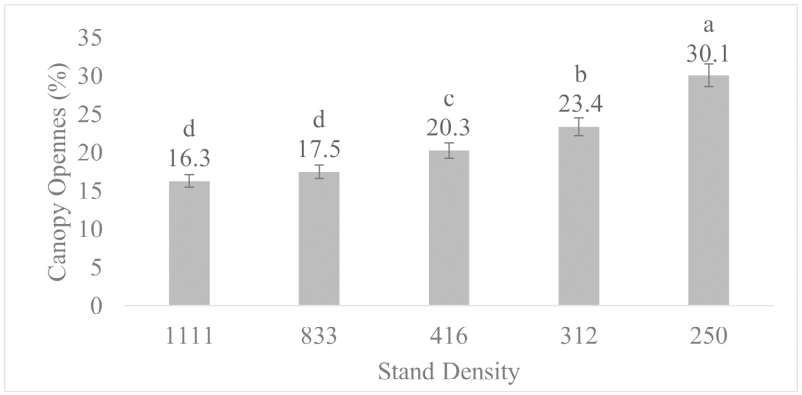
Moreover, turmeric probably absorbs more sunlight with a considerable percentage of canopy openness of the different stand densities (Figure 5). As shown in Figure 5, the results indicate that lower density is associated with a higher percentage of canopy openness. However, a higher percentage of canopy openness does not necessarily result in the highest turmeric production. Production was optimized at a canopy openness of 23.4% with a stand density of 312 trees/ha, compared to 30.1% at 250 trees/ha.
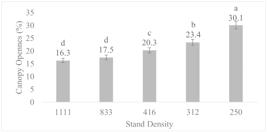
Percentage of canopy openness at different stand densities of middle-age clonal teak in Perhutani forest enterprise in Ngawi, East Java Ngawi, East Java, Indonesia. Different letters show significant differences between treatments at tα 0.05.
3.3. Impact of intercropping on economic value
The financial analysis of intercropping clonal teak with turmeric showed that higher values were associated with lower stand density (Table 6). The highest NPV was observed at a stand density of 250 trees/ha, at 14,726 USD/ha/20 years (NPV>0). This value was 50% higher than the stand density of 1,111 trees/ha, with an NPV>0. Similarly, the EAI was higher for a lower stand density (EAI>0). The BCR value was >1.0, showing that any additional costs in cultivation would yield benefits exceeding the added costs. Stand density of 250 trees/ha had the lowest timber volume per hectare, but showed the highest NPV.
4. DISCUSSION
4.1. Growth and productivity of clonal-teak intercropping and monoculture
The lowest stand density produced the greatest diameter growth and diameter increment (CADI). A previous study has reported that wider spacing reduces the competition index among trees within a stand (Rahmawati et al., 2021), thereby enhancing stem diameter growth (Zahabu et al., 2015). Consequently, the increase in DBH of clonal teak is significantly influenced by the spacing and density of individual trees (Pachas et al., 2019). In addition, thinning applied to the stands contributes to the diameter increment of the teak (Budiadi et al., 2017; Rahmawati et al., 2024). Stand density also affects total height growth (Berrocal et al., 2020; Pamoengkas et al., 2021; Rahmawati et al., 2022). Stand density affects the vertical growth of plants; the denser the stand, the greater the height growth (Chen et al., 2025).
High stand density increases volume but negatively affects small-diameter class distribution, leading to lower income per unit area. In this context, thinning is the most effective treatment to optimize teak growth and produce high-quality wood (Seviset et al., 2017; Acosta et al., 2021). Low stand density boosts intercropped crop yield (Pachas et al., 2019). Teak intercropped with turmeric exhibited superior diameter growth compared to non-intercropped or monoculture stands. Previous research (Xianbang et al., 2024) indicates that intercropping teak with herbs improves soil nutrients and plant health. This suggests intercropping enhances stand productivity and revenue. Intensive turmeric cultivation could further increase teak yields via indirect benefits, including better fertilization and weed control (Khasanah et al., 2015). In intercropping, farmers conduct intensive maintenance, including soil cultivation and weed control (Maharani et al., 2022). This improves soil conditions and reduces competition for nutrients (Xianbang et al., 2024). Intercropping also involves fertilisation, which can boost fertility and nutrient levels (Khasanah et al., 2015; Sudomo & Hani, 2014). Meanwhile, intensive maintenance is not carried out in the teak monoculture. Therefore, intercropping has a positive impact on teak growth (Maharani et al., 2022).
4.2. Effect of stand density on turmeric yield productivity
Turmeric production in this study was lower than commercial-scale turmeric production. The average commercial-scale turmeric production in East Java is around 15 tons/ha (BPS, 2017). This is certainly different from the intercropping pattern under superior clones, where the area used is limited, thereby affecting productivity. This study found that the highest turmeric production occurred at 312 trees/ha. Increased planting space, due to lower stand density, yielded greater understory crops. However, turmeric productivity decreased at the highest canopy openness, i.e., at a density of 250 trees/ha. Excessive light exposure can reduce the rate of photosynthesis in turmeric, resulting in suboptimal growth (Purnomo et al., 2018; Sharangi et al., 2022). This result shows turmeric thrives optimally with sufficient canopy openness at lower stand densities (Yuliantika & Sudarti, 2021).
Stand density affects plant growth and understory species productivity (Pachas et al., 2019; Maharani et al., 2022). Low density aids understory crop cultivation by ensuring sufficient space. While teak initially grew with maize and upland rice, these were terminated due to the canopy cover. For advanced clonal tree intercropping, selecting shade-tolerant crops is vital. Arrowroot and taro, grown under 13-year-old clonal teak, had 43-52% survival and yields of 55-523 kg/ha (Prehaten et al., 2021). Turmeric and other shade-tolerant crops can be planted under middle-aged teak stands. Intercrops can be introduced after teak planting, especially with extended wide spacing (Pachas et al., 2019). Commercial turmeric production averages approximately 15 tons/ha (BPS, 2017). This contrasts with intercropping under clonal stands, where reduced intercropping area affects productivity.
Furthermore, stand density does not significantly impact curcumin content. However, differences in stand density affect light intensity, and the effect of this on curcumin content remains unclear (Sharangi et al., 2022). While curcumin content can increase with high light intensity, it can also decrease with excessive sunlight exposure (Nelson et al., 2017). Sharangi et al. (2022) state that curcumin content in turmeric is influenced not only by light intensity, but also by other environmental factors, one of which is rainfall. In this study, turmeric harvested over 18 months had a curcumin content of around 5-7%. The results of the study indicate that turmeric harvested at 6 months of age and grown in monoculture contains curcumin around 2.2-2.7% (Bata dan Hamzah (2021). The curcumin content in turmeric rhizomes is influenced by several factors. These include the type of turmeric plant, age of harvest, soil conditions, and size or type of rhizome (Ashgari et al., 2009). The curcumin content of turmeric (Curcuma longa) is around 3-8% (Chattopadhyay et al., 2004). Based on this result, intercropping teak and turmeric can provide high levels of curcuminoids. Turmeric is rich in curcumin, a compound that offers numerous health benefits (Cozmin et al., 2024). According to a previous study, 49 active compounds were present in the turmeric rhizome powder, with curcumin being the most abundant (Suprihatin et al., 2020). The high concentration of curcuminoids in turmeric rhizomes is a key factor in evaluating quality and determining market value (Li et al., 2010)
4.3. Impact of intercropping on the economic value
Low stand density leads to larger diameters, thereby increasing the economic value. The results of previous studies showed that the selling prices of teak varied by log diameter (Pachas et al., 2019; Seta et al., 2021). Fourteen-year-old teak clones planted at a distance of 6 m x 2 m with 50% thinning had NPV, IRR, and BCR values of 10,856 (USD/Ha), 15.1, and 8.3, respectively (Seta et al., 2021). The larger the diameter of the log is proportional to the higher the market price. However, the contribution of turmeric cultivation to income is relatively minimal, only approximately 2%, primarily due to the considerably higher price of large-diameter teak timber compared with that of turmeric. Yustinianus et al. (2022) reported that turmeric contained more curcumin than any other herbal plant. The cultivation of turmeric has great future prospects, considering the cultural practice among Indonesians of consuming traditional herbal medicines.
Intercropping systems can increase farmers’ income by providing timber, crops, and other tree products. This improves their financial situation, as well as their ability to purchase food (Datta and Behera, 2023). Financial analysis using NPV, BCR, and EAI criteria shows that intercropping clonal teak with turmeric is economically viable, offering high returns at lower stand density. A financial analysis comparing teak cloning intercropping with other commodities, such as Lesser Yam, revealed an NPV value of 6,213 USD/ha/20 years, or an EAI of 554 USD/ha/year, when planted at a distance of 3 m x 3 m with a density of 1,111 plants/ha (Budiadi et al., 2025). At the same densities, this study of teak clones with turmeric demonstrated a higher economic value. Furthermore, the NPV and EAI were much higher at lower stand densities. This suggests that teak combined with turmeric could be highly lucrative. This method provides additional benefits, including herbal and food products, and supplementary income for local communities, enhancing land productivity and farmers’ income (Arsyad et al., 2020).
5. CONCLUSION
In conclusion, managing stand density is a critical silvicultural treatment for supporting the growth of clonal teak stands and providing growing space for the understory crops. The lowest stand density influences the growth of the middle-aged clonal teak, both in the monoculture and intercropping systems. The result of DBH and CADI of a density of 250 trees/ha increased by 28.95% and 59.13% respectively, compared to a density of 1111 trees/ha. Furthermore, intercropping clonal teak with turmeric can enhance stand productivity, with a larger diameter growth and increment. The second lowest stand density (312 trees/ha) enhances the productivity of understory crops, achieving a yield of 3.96 tons/ha with a curcumin content of 6.09%. Intercropping of clonal teak with turmeric also generates a reasonable economic value with the highest NPV, BCR, and AEV at the lowest density of 14,726 USD/ha, 1.74, and 1,284 USD/ha, respectively. A middle-aged clonal teak can be managed with an optimum stand density of 312 trees/ha for maximum stand production and economic value.
DATA AVAILABILITY
The dataset supporting the results of this study is not publicly available.
REFERENCES
- Acosta FC, Silva IM, Garcia ML, Melo RRD. Productivity and costs of harvester cutting of teak trees for thinning. Floresta e Ambiente 2021; 28(2): 1-8.
- Ahsan R, Arshad M, Khushtar M, Ahmad MA, Muazzam M, Akhter MS, et al. A comprehensive review on physiological effects of curcumin. Drug Res 2020; 70: 441-447.
- Arsyad M, Sabang Y, Agus N, Bulkis S, Kawamura Y. Intercropping farming system and farmers income. AGRIVITA Journal of Agricultural Science 2020; 42(2): 360-366.
- Asghari G, Mostajeran A, Shebli MK. Curcuminoid and essential oil components of turmeric at different stages of growth cultivated in Iran. Research in Pharmaceutical Sciences 2009; 4; 55-61.
- Ayub H, Islam M, Saeed M, Ahmad H, Asmari FA, Ramadan MF, et al. On the health effects of curcumin and its derivatives. Food Science & Nutrition 2024; 12: 8623-8650.
- Badan Pusat Statistik (BPS). Luas dan penyebaran lahan kritis menurut provinsi (hektar), 2013-2018. Jakarta; 2020.
- Badan Pusat Statistik (BPS). Statistik Indonesia. Jakarta; 2018.
- Badan Pusat Statistik (BPS). Statistik tanaman biofarmaka Indonesia. Jakarta; 2017.
- Bansal V, Joshi V, Meena SC. Agroforestry for sustainable rural livelihood: A review. Turkish Online Journal of Qualitative Inquiry 2021; 12(10): 2529-2537.
- Basri E, Wahyudi I. Sifat dasar kayu jati plus Perhutani dari berbagai umur dan kaitannya dengan sifat dan kualitas pengeringan [The basic properties of superior teak of various ages and their relationship to the nature and quality of drying]. Jurnal Penelitian Hasil Hutan 2012; 31; 93-102.
- Berrocal A, Gaitan-Alvarez J, Moya R, Fernández-Sólis D, Ortiz-Malavassi E. Development of heartwood, sapwood, bark, pith and specific gravity of teak (Tectona grandis) in fast-growing plantations in Costa Rica. Journal of Forestry Research 2020; 31(2): 667-676.
- Budiadi, Irwan SNR, Lestari LD, Madjid MIN, Arifin HS, Nurhayati, et al. Biodiversity, social adoptability, and preference toward managing medicinal plants in homegardens across elevations in the Menoreh Mountains, Kulonprogo District, Indonesia. Biodiversitas 2025; 26(3): 1316-1324.
- Budiadi, Widiyatno, Ishii H. Response of a clonal teak plantation to thinning and pruning in Java, Indonesia. Journal of Tropical Forest Science 2017; 29(1): 44-53.
- Budiadi, Prianto SD, Kurniawan WA. 2012. Early growth response of an improved teak stand after thinning and pruning practices. Yogyakarta: Paper presented at the International Conference on New Perspectives of Tropical Forest Rehabilitation for Better Forest Functions and Management; 2012.
- Budiadi, Sawitri, Primananda E, Jihad AN, Campera M, & Rahmawati RB. Integrating indigenous crops in agroforestry systems: Lesser yam and teak mixed systems are more profitable than monocultures in Indonesia. Plants, People, Planet, 2025; 1-13.
- Cardoso DJ, Lacerda AEB, Rosot MAD, Garrastazú MC, Lima RT. Influence of spacing regimes on the development of loblolly pine (Pinus taeda) in Southern Brazil. Forest Ecology Management 2013; 310: 761-769.
- Chattopadhyay I, Biswas K, Bandyopadhyay U, & Banerjee RK. Turmeric and curcumin: Biological actions and medicinal applications. Current Science 2024; 87: 44-50.
- Chen H, Zhang Z, Yang X, Ai X, Wang Y, Liu P. Effects of forest age and stand density on the growth, soil moisture content, and soil carbon content of Populus simoni plantations in the sandy area of western Liaoning, Northeast China. Scientific Reports 2025; 15(1); 2499.
- Coulibaly JY, Chiputwa B, Nakelse T, Kundhlande G. Adoption of agroforestry and the impact on household food security among farmers in Malawi. Agricultural Systems 2017; 155: 52-69.
- Cozmin M, Lungu II, Gutu C, Stefanache A, Duceac LD, Șoltuzu BD, et al. Turmeric: from spice to cure. A review of the anti-cancer, radioprotective and anti-inflammatory effects of turmeric sourced compounds. Front. Nutr. 2024; 11: 1399888.
- Datta P, Behera B. Climate change adaptation through agroforestry: empirical evidence from indian eastern himalayan foothills. In: Strategizing agricultural management for climate change mitigation and adaptation. Springer International Publishing 2023; 167-181.
- Ellison D, Morris CE, Locatelli B, Sheil D, Cohen J, Murdiyarso D, et al. Trees, forests, and water: Cool insights for a hot world. Global Environmental Change 2017; 43: 51-61.
- Fauzi MA, Mahfudz, Pudjiono S, Hamdan AA, Hasna TM, Wibowo A, et al. Beberapa jenis jati (Tectona sp), variasi dan potensi pemuliaannya. Balai Besar Penelitian dan Pengembangan Bioteknologi dan Pemuliaan Tanaman Hutan. Jakarta; 2017.
- Gulhane YS. Turmeric as a Medicinal Herb. IJARSCT 2025; 5(1): 22-36.
- Hardiwinoto S, Fiqri A, Widiyatno. Application of selected teak clone and organic fertilizer to accelerate rehabilitation of lowland forest in java, indonesia. Biodiversitas 2021; 22(4); 1750-1756.
- Hong Y, Heerink N, Jin S, Berentsen P, Zhang L, Van W. Intercropping and agroforestry in China - Current state and trends. Agriculture, Ecosystems and Environment 2017; 244: 52-61.
- Khasanah N, Perdana A, Rahmanullah A, Manurung G, Roshetko JM, Noordwijk M. Intercropping teak (Tectona grandis) and maize (Zea mays): bioeconomic trade-off analysis of agroforestry management practices in Gunungkidul, West Java. Agroforestry Systems 2015; 89(6): 1019-1033.
- Kollert W, Kleine M. The global teak study: analysis, evaluation and potential of teak resources. Vienna: IUFRO World Series 2017; 36.
- Kousar S, Ahmed F, Pervaiz A, Bojnec. Food insecurity, population growth, urbanization and water availability: The role of government stability. Sustainability 2021; 13(22): 1-19.
- Lewerissa E. Agroforestri hutan jati (Tectona grandis) di desa gorua, kecamatan tobelo utara, kabupaten halmahera utara. Uniera 2016; 5(1); 53-60.
- Li S, Yuan W, Deng G, Wang P, Yang P, Aggarwal BB. Chemical composition and product quality control of turmeric (Curcuma longa L.). Pharmaceuti Crops 2021; 2; 28-54.
- Lorenza RD, Forgiono F, Bernardi A, Sacchi A, Laneri S, Greco G. Clinical studies on topical curcumin. Skin Pharmacol Physiol 2023; 36: 235-248.
- Maharani D, Sudomo A, Swestiani D, Murniati, Sabastian GE, Roshetko JM, et al. Intercropping tuber crops with teak in Gunungkidul Regency, Yogyakarta, Indonesia. Agronomi 2022; 12(2): 1-20.
- Ministry of Environment and Forestry. Statistik kehutanan indonesia 2011. Jakarta; 2012.
- Ministry of Environment and Forestry. The State of Indonesia’s Forests 2024. Jakarta; 2024.
- Montes, Castro R, Villanueva C, Pérez S, Uribe M. The tree used in horticulture-based alley cropping. Journal of Applied Horticulture 2019; 21(2): 87-100.
- Morcillo H, Burgess, Mirck, Pantera, Plieninger. Scanning agroforestry-based solutions for climate change mitigation and adaptation in Europe. Enviromental Science and Policy 2017; 80: 44-52.
- Na’iem M. Forest productivity enhancement based on intensive silviculture (SILIN): Efficiency strategy of forest area utilization. In: Nugraha A, editor. Darurat Hutan Indonesia, Mewujudkan Arsitektur Baru Kehutanan Indonesia. 2nd printing. Banten (Indonesia): Wana Aksara; 2014; 162-183.
- Nelson KM, Dahlin JL, Bisson J, Graham J, Pauli GF, Walters MA. The essential medicinal chemistry of curcumin: miniperspective. J. Med. Chem 2017; 60, 1620-1637
- OECD/FAO. OECD-FAO Agricultural Outlook 2019-2028. Paris: OECD Publishing; 2019.
- Pachas ANA, Sakanphet S, Soukkhy O, Lao M, Savathvong S, Newby JC, et al. Initial spacing of teak (Tectona grandis) in northern Lao PDR: Impacts on the growth of teak and companion crops. Forest Ecology and Management 2019; 435: 77-88.
- Pachas ANA, Sakanphet S, Midgley S, Dieters M. Teak (Tectona grandis) silviculture and research: applications for smallholders in Lao PDR. Australian Forestry 2019; 82: 94-105.
- Pamoengkas P, Rachmat HH, Khalifa N. The growth of shorea leprosula at various planting distances and slopes in gunung dahu research forest, bogor, indonesia. Biodiversitas journal of biological diversity 2020; 21(9); 4396-4404.
- Perhutani. Seperempat abad pemuliaan jati perum perhutani. Cepu: Pusbang SDH Perhutani; 2006.
- Perhutani. Statistik perum perhutani 2009-2013. Jakarta: Perum Perhutani; 2014.
- Perhutani. Harga jual kayu bulat jati dan rimba tahun 2021. Jakarta: Keputusan Direksi Perhutani No. 183/KPTS/DIR/12/2020; 2020.
- Prehaten D, Hardiwinoto S, Na’iem M, Supriyo H, Widiyatno, Rodiana D. Productivity of arrowroots and taro grown under superior teak clones with several levels of stand density. Biosaintifika 2021; 13(1): 51-57.
- Pujar S, Madiwalar, Channabasappa, Kumar P. Performance of medicinal and aromatic plants as intercrops with teak. Karnataka Journal of Agricultural Sciences 2007; 20(1); 178-180.
- Purnomo D, Budiastuti MS, Sakya AT, Cholid MI. The potential of turmeric (Curcuma longa L.). Earth Environ. Sci 2018: 142: 1-5.
- Rahmawati RB, Hardiwinoto S, Widiyatno, Budiadi, Amin Y, Hasanusi A. Space planting, competition, and productivity of a seven-year-old clonal teak plantation in the East Java Monsoon Forest Area. Jurnal Manajemen Hutan Tropika 2021; 27(2): 123-131.
- Rahmawati RB, Widiyatno, Hardiwinoto S, Budiadi, Nugroho WD, Wibowo A, et al. Effect of spacing on growth, carbon sequestration, and wood quality of 8-year-old clonal teak plantation for sustainable forest teak management in Java Monsoon Forest. Biodiversitas 2022; 23(8): 4180-4188.
- Rahmawati RB, Hardiwinoto S, Widiyatno, Budiadi, Wibowo A. Productivity of clonal teak plantation under different spacing and thinning intensity in Java Monsoon Forest. IOP Conf. Series: Earth and Environmental Science 2024; 1299(1): 012004.
- Rianse U, Abdi. Agroforestri: solusi sosial dan ekonomi pengelolaan sumber daya hutan. Bandung: Alfabeta; 2010.
- Roshetko JM, Rohadi D, Perdana A, Sabastian G, Nuryartono N, Pramono AA, et al. Teak agroforestry systems for livelihood enhancement, industrial timber production, and environmental rehabilitation. Forests, Trees and Livelihoods 2013; 22(4): 241-256.
- Salim Z, Munadi E. Info Komoditi Tanaman Obat. Jakarta; 2017.
- Seta GW, Widiyatno, Hidayati F, Na’iem M. Impact of thinning and pruning on tree growth, stress wave velocity, and pilodyn penetration response of clonal teak (Tectona grandis) plantation. Forest Science Technology 2021; 17(2): 57-66.
- Seviset S, Thanate P, Udomsak S, Ratthai P, Kananke R, Sittichai C. Mechanical property of 9 years old thinning of teak plantation in Thailand. MATEC Web of Conferences 2017; 95: 03004.
- Shukla SR, Viswanath S. Comparative study on growth, wood quality and financial returns of teak (Tectona grandis L.f.) managed under three different agroforestry practices. Agroforestry Systems 2014; 88(2): 331-341.
- Sudomo A & Hani A. Produktivitas talas (Colocasia esculenta L. Shott) di bawah tiga jenis tegakan dengan sistem agroforestri di lahan hutan rakyat. Jurnal Ilmu Kehutanan 2014; 8; 100-107.
- Sudomo A, Sebastian GE, Perdana A, Prameswati D, Roshetko JM. Intercropping of Zingiber officinale Var. Amarum on teak silviculture in Karangduwet, Paliyan, Gunung Kidul Yogyakarta. IOP Conf. Series: Earth and Environmental Science 2019; 250: 012104.
- Suprihatin T, Rahayu S, Rifa’i M, Widyarti S. Compounds in Turmeric Rhizome Powder (Curcuma longa L.) which have Potential as Antioxidants. Buletin Anatomi dan Fisiologi 2020; 5(1): 35-42.
- Toker P, Huseyin C, Irfan T, Aslı I, Marvin S, Mojtaba K, Engin Y. The advantages of intercropping to improve productivity in food and forage production - a review, Plant Production Science 2024, 27(3), 155-169.
- Tsujino R, Yumoto T, Kitamura S, Djamaluddin I, Darnaedi D. History of forest loss and degradation in Indonesia. Land Use Policy 2016; 57; 335-347.
- Weih M, Mínguez MI, Tavoletti S. Intercropping Systems for Sustainable Agriculture. Agriculture 2022, 12, 291.
- Widiyatno, Wibowo A, Dian N, Seta GW, Prehaten D, Hidayati F, et al. Effect of improved planting stock on tree growth, wood properties, and soil fertility of teak plantations 10 years after planting. Forest Science and Technology 2023; 20(1): 8-15.
- Wirabuana PYAP, Hendrati RL, Baskorowati L, Susanto M, Mashudi, Sulistiadi HBS, et al. Growth performance, biomass accumulation, and energy production in age series of clonal teak plantation. For Sci Technol 2022; 18(2); 67-75.
- Xianbang W, Mingping L, Kunliang L, Qiang H, Dongkang P, Haibin M, et al. Effects of intercropping teak with Alpinia katsumadai Hayata and Amomum longiligulare T.L. Wu on rhizosphere soil nutrients and bacterial community diversity, structure, and network. Frontiers in Microbiology 2024; 15: 1-14.
- Yuliantika, S. Effect of light intensity on turmeric plant growth. Jurnal Penelitian Fisika dan Terapannya 2021; 2(2): 52-57.
- Yustinianus R, Wunas J, Rifai Y, Ramli N. Curcumin content in extract of some rhizomes from Zingiberaceae family. Journal of Pharmaceutical and Medicinal Sciences 2019; 4(1): 15-19.
- Zahabu E, Tumaini R, Shabani A, Omari C, Iddi S, Rogers E. Effect of spacing regimes on growth, yield, and wood properties of Tectona grandis at Longuza Forest Plantation, Tanzania. International Journal of Forestry Research 2015; 3: 1-6.
Edited by
-
Associate editor:
Vanessa Maria Basso http://orcid.org/0000-0003-3141-2262