 Common Allometric Aboveground Biomass Models for Two Atlantic Forest Tree Ferns
 Abstract
Available species-specific allometric aboveground biomass (AGB) models for tree ferns occurring in the Atlantic forest are based on small calibration datasets, potentially leading to increased uncertainty in model parameter estimates. This study constructed common AGB models for Cyathea delgadii Sternb. and Dicksonia sellowiana Hook. using data from 75 individuals destructively sampled in the subtropical Atlantic forest. Three power-law models linking AGB to a single compound variable were calibrated. Incorporating a species effect into the scaling parameter through a dummy variable substantially improved prediction accuracy. Nonetheless, incorporating a species effect into the allometric - exponent resulted in weak parameter identifiability, suggesting that the two species can share a common allometric exponent. The selected AGB model achieved prediction accuracy comparable to available species-specific models, albeit with smaller uncertainty in model parameter estimates. Pooling data from species with similar allometric relationships was shown to be an efficient strategy for improving AGB models.
Keywords:
allometry; nonlinear modeling; xaxim; samambaiaçu; Mata Atlântica.
Tree-level allometric models using diameter at breast height (D) and height (H) as predictor variables are important intermediate tools for estimating aboveground biomass (AGB) stocks for large forest populations (Gaui et al., 2024). Allometric AGB models calibrated with data from mutltiple tree species, hereafter referred to as generic models, are commonly used for (sub)tropical forests. Although allometric relationships may vary among (sub)tropical tree species (Huy et al., 2016), generic models are often the only feasible alternative facing the tedious and expensive effort of acquiring field data for calibrating reliable species-specific AGB models (Chave et al., 2014; Fayolle et al., 2018). Nonetheless, species with different growth forms and/or particular morphological features (e.g., tree ferns and palms) may still require species-specific AGB models, because generic models (e.g., pantropical models) may yield predictions with strong systematic deviations for them (Uller et al., 2021).
Tree ferns are important components of neotropical forests, especially of Atlantic forests, where they can be locally dominant and thereby contribute substantially to overall forest AGB stocks (Noben et al., 2018; Maçaneiro et al., 2019; Oliveira et al., 2024a). However, available species-specific AGB models for tree ferns occurring in the Atlantic forest are based on calibration datasets with sizes ranging from 16 to 45 individuals (Tiepolo et al., 2002; Ziemmer et al., 2016; Uller et al., 2021; Oliveira et al., 2024a; Oliveira et al., 2024b), which may be insufficient to minimize uncertainty in model parameter estimates (McRoberts et al., 2015; Oliveira et al., 2025).
Oliveira et al. (2024a) noted that the ratio between parameters and of models of the form - with either additive or multiplicative residuals - is close to 1.0 for Atlantic forest tree ferns (Ziemmer et al., 2016; Uller et al., 2021). This indicates that D and H have a similar effect on tree fern AGB (Uller et al., 2021), while the effect of D dominates in woody species (Dutcă et al., 2019). Therefore, Oliveira et al. (2024a) suggested a more parsimonious model of the form for Dicksonia sellowiana Hook. (Dicksoniaceae), and thereby achieved a substantial reduction in the uncertainty in model parameter estimates. These authors asserted that generic models with dummy variables to accommodate the species effect - which for tree ferns is primarily related to parameter α (i.e., scaling factor) - are promising alternatives. Given this context, this study constructed common AGB models for two abundant tree ferns in the Atlantic forest, namely Cyathea delgadii Sternb. (Cyatheaceae) and D. sellowiana, aiming to reduce uncertainty in model parameter estimates relative to available species-specific models.
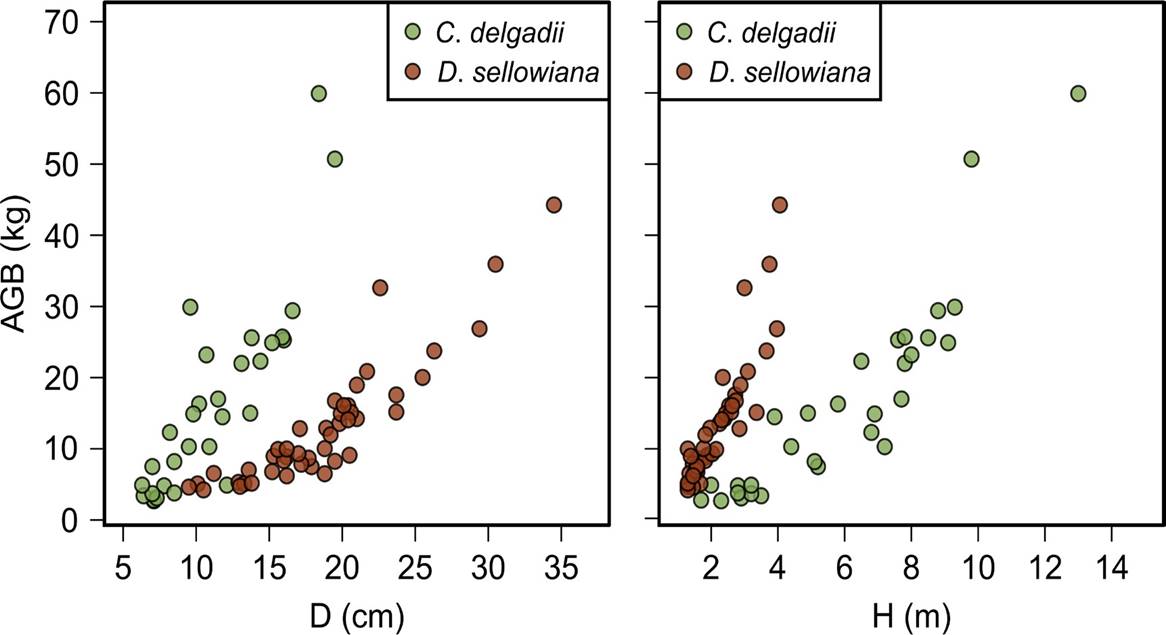
The dataset used in this study combines the datasets from Uller et al. (2021) and Oliveira et al. (2024a) for C. delgadii and D. sellowiana, respectively. In summary, the combined dataset comprises observations for AGB (i.e., dry mass in kg), D (cm), and H (m) from 75 individuals of C. delgadii (30) and D. sellowiana (45) destructively sampled in the state of Santa Catarina, southern Brazil. Ranges for AGB, D and H are 2.7-59.9 kg, 6.3-34.5 cm, and 1.3-13.0 m, respectively; relationships among these variables are presented in Figure 1.
For this study, nonlinear models of the following forms were considered,
-
, (1)
-
, (2)
-
, (3)
where i indexes observations (i = 1, 2, …, n); α, γ, β and λ are parameters to be estimated; εi is the random residual term; and Si is a dummy variable, such that Si = 0 if the ith observation belongs to D. sellowiana and Si = 1 if it belongs to C. delgadii. Under this parameterization, α is the scaling parameter for D. sellowiana and γ is the difference in the scaling parameter between the two species; similarly, β is the allometric exponent for D. sellowiana and λ is the difference in the exponent between the two species. Hereafter, the models of Eqs. (1-3) will be referred to as Model 1, Model 2 and Model 3, respectively. Model residuals were assumed to be independent and normally distributed, ε~N(0,Σ), where ε=(ε1, ε2, ..., εn)' is a vector of residuals and 0,Σ=diag(σ21,σ22,...,σ2n) is a diagonal variance-covariance matrix with heteroscedastic residual variances estimated as,
-
, (4)
where φ and δ are parameters to be estimated.
Model parameters were estimated jointly by maximum likelihood using the gnls function of the nlme R package (Pinheiro et al., 2023). Uncertainty in model parameter estimates was assessed using the percent relative standard error (PRSE), calculated as the estimated standard error1 (SE) of the parameter estimate divided by the absolute value of the parameter estimate times one hundred. Model prediction accuracy was assessed using the mean absolute percentage error (MAPE) and mean systematic percentage error (MSPE). Further, the corrected Akaike information criterion (AICc) was used for model comparison. Formulas for these metrics are provided in Uller et al. (2021) and Oliveira et al. (2024a).
Model parameter estimates are presented in Table 1. All estimates were significantly different from zero according to the t-test at the significance level of 0.05. Model 2 had a considerably smaller AICc than Model 1, supporting the parametrization of the scale parameter α in the former model. In turn, Model 3 had a slightly smaller AICc than Model 2. However, Model 3 had substantially larger PRSEs for the estimated parameters in comparison to Model 2, especially for parameter λ, indicating weak parameter identifiability (Table 1). This is evidence that C. delgadii and D. sellowiana can share a common allometric exponent β. Model 2 from this study had considerably smaller PRSEs than those reported
for model 4 for C. delgadii by Uller et al. (2021, Table 3). In comparison to model 2 for D. sellowiana by Oliveira et al. (2024a, Table II), Model 2 from the present study had slightly smaller PRSEs.

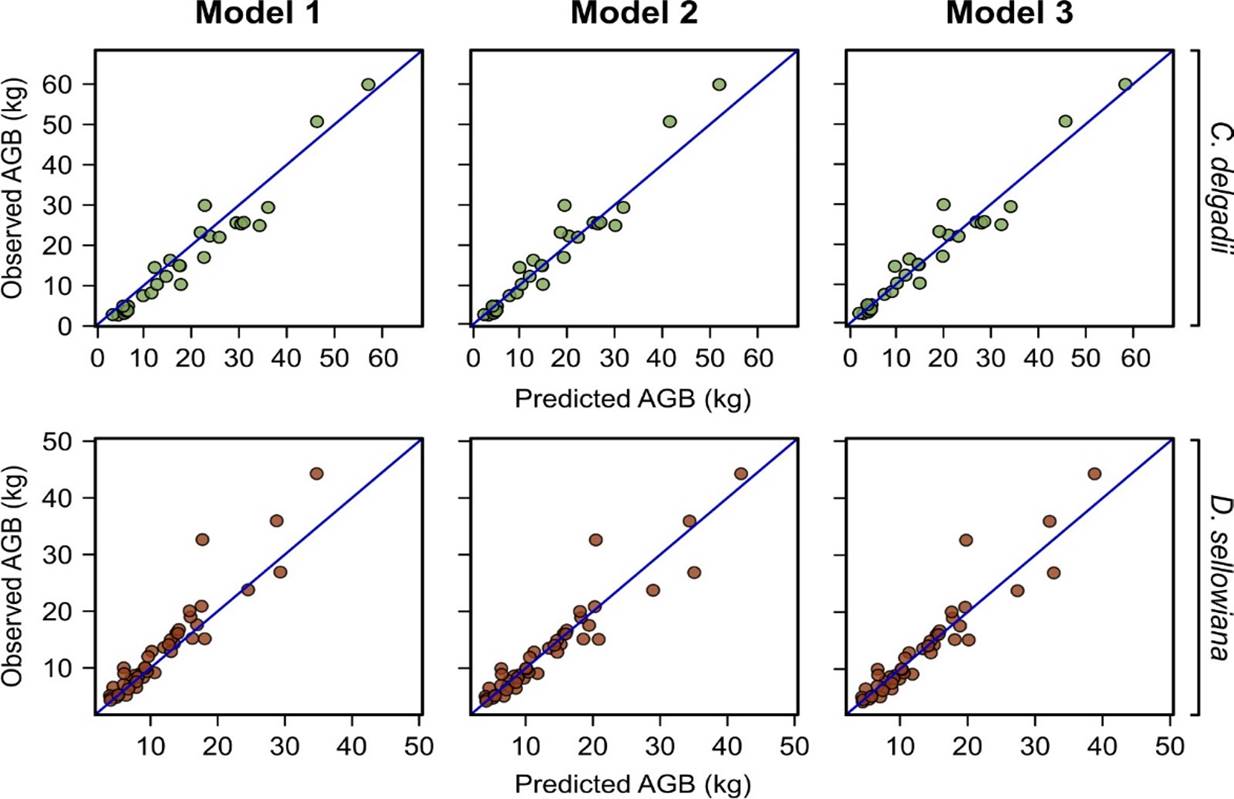
As would be expected, Model 1 was the least accurate, yielding the largest MAPEs and MSPEs for both species; on average, it strongly overpredicted AGB for C. delgadii (Table 2, Figure 2). Relevant decreases in MAPEs and MSPEs were achieved with Models 2 and 3, with no evidence of strong systematic prediction errors (Table 2, Figure 2). The prediction accuracies of Models 2 and 3 from this study are closely comparable to the species-specific models by Uller et al. (2021, Table 3) and Oliveira et al. (2024a, Table III). More specifically, model 4 for C. delgadii by Uller et al. (2021) yielded an MAPE of 17.2% and an MSPE of 4.2%, whereas model 2 for D. sellowiana by Oliveira et al. (2024a) yielded a mean absolute percentage residual2 (MAPR) of 13.4% and an MSPE of 2.0%.
Observed vs. predicted AGB for individuals of C. delgadii and D. sellowiana; 1:1 lines are shown in blue.
Finally, Model 2 from this study is suggested for use during AGB stock estimation, because smaller uncertainty in model parameter estimates indirectly increases the precision of estimates for parameters such as population mean AGB per unit area (McRoberts et al., 2015; Fu et al., 2017; Oliveira et al., 2025). Overall, enlarging model calibration sample sizes by pooling data from species with similar allometric relationships may be an efficient strategy for improving AGB models - and, consequently, forest inventory inference -, provided that model parametrization remains parsimonious.
ACKNOWLEDGEMENTS
We are grateful to Adelar Mantovani, Adilson L. Nicoletti, Alexandre Mariot, Alfredo C. Fantini, Gabriel O. Bollman, Heitor F. Uller, Jackson R. Eleotério, Instituto do Meio Ambiente de Santa Catarina (IMA-SC), and management staff of UHE São Roque for their support.
DATA AVAILABILITY
The raw data underlying this study were collected within the FlorestaSC program. While the program is committed to data sharing, researchers interested in using the data must comply with FlorestaSC’s policy and complete a formal request procedure at https://www.sinflor.com.br/.
REFERENCES
- CHAVE, J; RÉJOU-MÉCHAIN, M; BÚRQUEZ, A; CHIDUMAYO, E; COLGAN, MS; DELITTI, WBC et al. Improved allometric models to estimate the aboveground biomass of tropical trees. Global Change Biology 2014; 20:3177-3190.
- DAVIDSON, R; MACKINNON, JG. Econometric theory and methods. New York: Oxford University Press; 2004.
- DUTCĂ, I; MCROBERTS, RE; NÆSSET, E; BLUJDEA, VN. A practical measure for determining if diameter (D) and height (H) should be combined into D²H in allometric biomass models. Forestry: An International Journal of Forest Research 2019; 92:627-634.
- FAYOLLE, A; NGOMANDA, A; MBASI, M; BARBIER, N; BOCKO, Y; BOYEMBA, F et al. A regional allometry for the Congo basin forests based on the largest ever destructive sampling. Forest Ecology and Management 2018; 430:228-240.
- FU, Y; LEI, Y; ZENG, W; HAO, R; ZHANG, G; ZHONG, Q; XU, M. Uncertainty assessment in aboveground biomass estimation at the regional scale using a new method considering both sampling error and model error. Canadian Journal of Forest Research 2017; 47:1095-1103.
- GAUI, TD; CYSNEIROS, VC; SOUZA, FC; SOUZA, HJ; SILVEIRA FILHO, TB; CARVALHO, DC et al. Biomass equations and carbon stock estimates for the southeastern Brazilian Atlantic forest. Forests 2024; 15:1568.
- HUY, B; POUDEL, KP; TEMESGEN, H. Aboveground biomass equation for evergreen broadleaf forests in South Central Coastal ecoregion of Vietnam: selection of eco-regional or pantropical models. Forest Ecology and Management 2016; 376:276-283.
- MAÇANEIRO, JP; LIEBSCH, D; GASPER, AL; GALVÃO, F; SCHORN, LA. Structural and floristic variations in an Atlantic Subtropical Rainforest in Southern Brazil. Floresta e Ambiente 2019; 26:e2016010.
- MCROBERTS, RE; MOSER, P; OLIVEIRA, LZ; VIBRANS, AC. A general method for assessing the effects of uncertainty in individual-tree volume model predictions on large-area volume estimates with a subtropical forest illustration. Canadian Journal of Forest Research 2015; 45:44-51.
- NOBEN, S; KESSLER, M; WEIGAND, A; TEJEDOR, A; DUQUE, WDR; GALLEGO, LFG; LEHNERT, M. A taxonomic and biogeographic reappraisal of the genus Dicksonia (Dicksoniaceae) in the Neotropics. Systematic Botany 2018; 43:839-857.
- OLIVEIRA, GL; STEPKA, TF; NICOLETTI, MF; FREDERICO, MR. Caracterização e modelagem biométrica de Dicksonia sellowiana Hook. em Floresta Ombrófila Mista alto-montana. Scientia Forestalis 2024b; 52:e3990.
- OLIVEIRA, LZ; MCROBERTS, RE; VIBRANS, AC; LIESENBERG, V; ULLER, HF. Comparing effects of uncertainty in predictions of local and pantropical allometric models on large-area estimates for mean aboveground biomass per unit area. Forestry: An International Journal of Forest Research 2025; 98:661-675.
- OLIVEIRA, LZ; VIBRANS, AC; NICOLETTI, NA; LERNER, J. Allometric mixed-effects models for Dicksonia sellowiana Hook. and its contribution to biomass stocks of Araucaria forests in southern Brazil. Anais da Academia Brasileira de Ciências 2024a; 96(supl. 3):e20230176.
-
PINHEIRO, J; BATES, D; R CORE TEAM (2023), . nlme: Linear and Nonlinear Mixed Effects Models. R package version 3.1-164. 2023 2 mar. 2026. https://CRAN.R-project.org/package=nlme
» https://CRAN.R-project.org/package=nlme - TIEPOLO, G; CALMON, M; FERETTI, AR. Measuring and monitoring carbon stocks at the Guaraquecaba Climate Action Project, Paraná, Brasil. Proceedings of the International Symposium on Forest Carbon Sequestration and Monitoring . Extension Series 2002; 98-115.
- ULLER, HF; OLIVEIRA, LZ; KLITZKE, AR; FREITAS, JV; VIBRANS, AC. Biomass models for three species with different growth forms and geographic distribution in the Brazilian Atlantic Forest. Canadian Journal of Forest Research 2021; 51:1-13.
- ZIEMMER, JK; BEHLING, A; DALLA CORTE, AP. Quantificação da biomassa e dos teores de carbono de pteridófitas arborescentes em Floresta Ombrófila Mista. BIOFIX Scientific Journal 2016; 1:60-73.
-
*
FINANCIAL SUPPORT: This study was conducted within the FlorestaSC program, which is currently funded by Secretaria de Estado do Meio Ambiente e da Economia Verde (SEMAE-SC, grant 2022TR001389) and Fundação de Amparo à Pesquisa e Inovação de Santa Catarina (FAPESC, grant 2023TR001432). The second author is supported by Conselho Nacional de Desenvolvimento Científico e Tecnológico (CNPq, grant 305199/2022-6).
-
1
SEs were estimated based on a first-order Taylor series approximation for the variance-covariance matrix for the estimated model parameters (Davidson & MacKinnon, 2004); the same method was used by Uller et al. (2021) and Oliveira et al. (2024a).
-
2
MAPR is a variation of MAPE in which the absolute differences between the observed and predicted values are divided by the predicted values rather than the observed values.
Edited by
-
Associate editor:
Emanuel José Gomes de Araújo http://orcid.org/0000-0002-2301-1031