 Effects of Heat-Treatment on the Physical and Mechanical Properties of Indonesian-grown Schizolobium parahyba Wood
Abstract
Schizolobium parahyba, a fast-growing tree species from South America, was introduced to Indonesia as a potential timber source. This study aimed to evaluate the effects of heat-treatment at 150-200 ºC (4h) on the physical and mechanical properties of S. parahyba wood. The results show that weight loss (WL) increased from 2.62 ± 0.29% at 150 ºC to 9.22 ± 0.86% at 190 ºC, while anti-swelling efficiency (ASE) increased from 3.44 ± 0.78% at 150 ºC to 29.84 ± 5.40 % at 180 ºC. Compressive strength parallel to grain (CP) increased from 37.99 ± 6.49 MPa (control) to 46.50 ± 5.52 MPa at 170 ºC but declined at higher temperatures. Meanwhile, static bending strength and compressive strength perpendicular to grain (CT) decreased at ≥180 ºC. Overall, moderate heat-treatment at 170 and 180 ºC enhanced dimensional stability and improved CP, whereas higher temperatures (≥180 ºC) caused substantial weight and strength losses.
Keywords:
anti-swelling efficiency; heat-treatment temperatures; introduced wood species; wood compressive strength
1. INTRODUCTION
Schizolobium parahyba, (syn. Schizolobium amazonicum), commonly known as “parica” in Brazil (de Lima Melo et al., 2018), is a tropical fast-growing tree species that shows robust growth performance in the native Amazon region in South America (da Silva et al., 2020). In recent decades (1980s), S. parahyba has been introduced as an exotic species to several tropical countries, including Indonesia. Considering the rapid growth, straight stem, and promising quality, this species holds potential as an alternative timber source for wood working industry, but studies on the quality of wood outside the native region remain scarce. Wood properties need to be investigated to optimize the potential of S. parahyba grown in Indonesia as a timber source.
Several studies provided information on wood properties of S. parahyba, including density and strength properties (de Almeida et al., 2013; Athanázio-Heliodoro et al., 2018; da Silva et al., 2020), as well as anatomical and chemical characteristics (Mattos et al., 2016; Vidaurre et al., 2018). Furthermore, de Almeida et al. (2013) reported that S. parahyba shows good static bending and compression strength, suggesting the suitability for structural applications. However, wood has tangential-to-radial (T/R) ratio average of 2.74 (Athanázio-Heliodoro et al., 2018), which represents an excessive level of hygroscopicity and consequently, low dimensional instability. This phenomenon-greater T/R ratio shrinkage and moisture sorption-is commonly observed in fast-growing wood species (Kaymacki & Bayram, 2021; Priadi et al., 2019). The instability may negatively affect the suitability for wood working applications and should be reduced.
Heat treatment is a useful method widely used to improve wood dimensional stability as well as reduce hygroscopicity (Candelier et al., 2017; Kojima et al., 2020; Mahdiyanti et al., 2023; Murata et al., 2023), and numerous studies confirmed the positive effects (Esteves & Pereira, 2009; Murata et al., 2013; Zhou et al., 2020; Hill et al., 2021; Tang et al., 2025). However, wood exposed to high temperature may have reduced weight and mechanical properties (Esteves & Pereira, 2009; Murata et al., 2013; Kojima et al., 2020). The effect of heat treatment on wood strength is not consistently detrimental but varies according to wood species and applied temperature (Kojima et al., 2021; Tang et al., 2025).
The thermal modification of wood, including heat treatment, is often conducted at 150-240 °C, as temperatures below 150 °C cause no significant changes in the wood properties (Hill et al., 2021). Treatment duration of 2-4 hours is shown to induce substantial alterations in wood properties (Hidayat et al., 2015; Zhou et al., 2020; Kaymacki & Bayram, 2021; Priadi et al., 2025). Improvement in dimensional stability has been reported, with a swelling reduction of 50-80% and an increase in anti-swelling efficiency (ASE) of 18.1-34.3% (Esteves & Pereira, 2009; Tang et al., 2025). However, heat treatment is generally accompanied by a decrease in mechanical properties, which becomes more pronounced at higher temperatures. Previous studies reported notable decreases in compressive strength from 54.17 MPa (untreated) to 42.45 MPa and in modulus of elasticity (MOE) from 10.32 GPa to 7.35 GPa after treatment at 210 ºC (Kaymacki & Bayram, 2021), as well as a significant decrease in the modulus of rupture (MOR) from 120-192 N/mm2 to 102-156 N/mm2 (Hidayat et al., 2015). Candelier et al. (2017) reported mass loss of 11-25% at treatment temperatures of 170-228 C, which corresponds to a marked reduction in bending strength. These findings indicate that, although heat treatment improves dimensional stability, it can significantly impair mechanical performance.
Although extensive research has examined the effects of heat treatment, most previous studies focused on temperate species, such as beech (Lagaňa et al., 2021), pine, spruce (Banadics & Tolvaj, 2019; Kojima et al., 2020; Tolvaj et al., 2012), poplar (Kaymacki & Bayram, 2021) and cedar (Tolvaj et al., 2019). Some work has been conducted on tropical hardwoods, such as mahogany (Zhou et al., 2020), but limited attention has been given to fast-growing tropical species. Furthermore, the effects of heat treatment temperatures on the simultaneous changes in both dimensional stability and mechanical properties are not consistent across species. Therefore, this present study aimed to evaluate the effects of heat treatment at temperatures of 150-200 ºC on the dimensional stability of S. parahyba wood without compromising mechanical properties.
2. MATERIALS AND METHODS
2.1. Sample preparation
Wood specimens were obtained from a 40-year-old S. parahyba tree (DBH = 58 cm) that naturally fell in January 2025 in a tropical reforestation center in East Kalimantan, Indonesia. The study area has a climate of tropical rainforest with mean temperature of 28-29 ºC and RH 78-82% (Karyati et al., 2025). The tree was processed immediately within one week after the fall to prevent further deterioration. From the fallen tree, three logs obtained and each log was sewn into three quarter-sawn boards (6 cm in thickness, 200 cm in length), yielding a total of nine boards. The wood sampling procedures followed ISO 3129:2019, and boards were taken from lower-mid bole.
Specimens were prepared from each board at least 10 cm away from the pith to avoid juvenile wood effects and cut for testing density and weight loss (20 × 20 × 20 mm), dimensional stability (100 × 20 × 20 mm), static bending strength (360 × 20 × 20 mm), as well as compressive strength parallel and perpendicular to grain (60 × 20 × 20 mm). Each test used 35 samples, including five replicates for six treatments (150, 160, 170, 180, 190, and 200 ºC) and control (untreated). All physical and mechanical tests were conducted according to the Deutsches Institut für Normung (DIN) standards (DIN 52182 for density, DIN 52183 for moisture content, DIN 52184 for shrinkage and swelling, DIN 52186 for static bending strength, DIN 52185 for compressive strength parallel to grain, and DIN 52192 for compressive strength perpendicular to grain).
Heat treatment was performed using a laboratory convection oven (Memmert UN55, Germany) under ambient-air conditions. Starting from ambient temperature of ~28 ºC, the oven chamber reached the target temperatures (150, 160, 170, 180, 190, and 200 ºC) in 30-40 minutes. Each treatment then held for 4 hours, followed by 30 minutes cooling down inside the oven. Prior to treatment, all samples were conditioned at 20 °C and 67% RH for 48 hours and reconditioned for 48 hours after treatment, before subsequent testing (Table 1).
2.2. Density and weight loss
All specimens for the density and weight loss were conditioned at 20 ºC and 67% RH for 48 hours to reach air-dried moisture content. After conditioning, specimens were then oven-dried at 103 ± 2 ºC for 48 hours to obtain oven-dried weight (W 0 ). The resulting W 0 was used to calculate the moisture content (~12%). Subsequently, each specimen was measured to obtain air-dried volume (V A ) and weighed to obtain air-dried weight (W A ). The apparent (air-dried) density was then calculated as:
where the W A is air-dried weight (kg) and V A is air-dried volume (m3).
After reconditioning, the heat-treated weight (W H ) of the samples was measured. Weight loss (WL) was determined using the following equations:
where the W 0 is oven-dried weight before treatment (kg), and W H is oven-dried weight after heat-treatment (kg)
2.3. Dimensional stability
Dimensional stability of S. parahyba wood was evaluated by measuring the anti-swelling efficiency (ASE) and tangential-to-radial shrinkage ratio (T/R ratio). The initial dimensions (longitudinal, radial, and tangential) of each specimen were measured using digital caliper (InSize, China), and the initial volume (V 1 ) was calculated. Subsequently, the specimens were oven-dried at 103 ± 2 ºC for 48 hours to determine volumetric shrinkage (βV ) and T/R ratio using the following equations:
where the V 1 is initial volume (mm3), V 0 represents oven-dried volume (mm3), β T implies tangential shrinkage (%), and β R is radial shrinkage (%).
After shrinkage measurement, specimens were heat-treated (150-200 ºC, 4 hours) and conditioned at constant room temperature for 48 hours. The specimens were immersed in distilled water for 72 hours to achieve maximum volumetric swelling (α V ). The α V and ASE were then calculated with the following equations:
where the V S is swollen volume (mm3); V 1 implies initial air-dried volume (mm3); α VC represents volumetric swelling of control specimens (%); and α VT is volumetric swelling of heat-treated specimens (%)
2.4. Mechanical properties
The mechanical properties, including static bending strength (SB), compression strength parallel to grain (CP), and perpendicular to grain (CT), were measured using Universal Testing Machine (UTM) (Wolpert, Germany). The heat treatment was conducted for each treated specimen, while the control was left untreated. Subsequently, the modulus of elasticity (MOE) and the modulus of rupture (MOR) of SB, CP, and CT were calculated from the following equations:
where P is load at proportional limit (N), L implies span length (mm), Δy is deflection (mm), P max represents maximum load (N), b is specimen width (mm), h is specimen thickness mm), and A is contact area under loading head (mm2).
2.5. Statistical analysis
Data collected were statistically analyzed using one-way Analysis of Variance (ANOVA) to evaluate the effects of heat treatment temperature on wood properties. Initially, the data were checked and confirmed for normal distribution and homogeneity of variances using Shapiro-Wilk and Levene’s tests, respectively. When ANOVA showed significant differences (p < 0.05), Tukey’s Honestly Significant Difference (HSD) post-hoc test was applied to determine pairwise differences among temperature treatments.
3. RESULTS AND DISCUSSION
3.1. Density
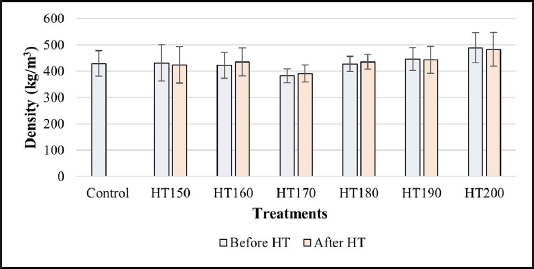
In this study, average wood density of S. parahyba was 432 ± 31 kg/m3 before treatment. The values of all heat-treated samples became slightly increased to 435 ± 29 kg/m3 (Figure 1), but the change was not statistically significant (p = 0.87), suggesting no substantial effect on the bulk density at the air-dried state. This outcome is consistent with the expectation that heat treatment reduces both mass and volume, yielding a compensating ratio of air-dried weight and air-dried volume. Comparable results were reported by Murata et al. (2023) for heat treatment at 220 ºC-237.5 ºC and Hidayat et al. (2015) for treatment at 160-220 ºC. In contrast, Priadi et al. (2025) observed a significant decrease of density at 120 and 150 ºC, showing the role of wood species and treatment conditions in density responses.
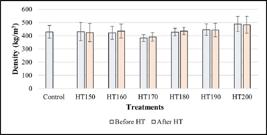
Comparison of wood density before and after heat treatment (HT) at various temperatures. The density was measured based on air-dried volume. HT150-HT200 refers to heat-treatment temperatures of 150-200 ºC.
3.2. Weight loss
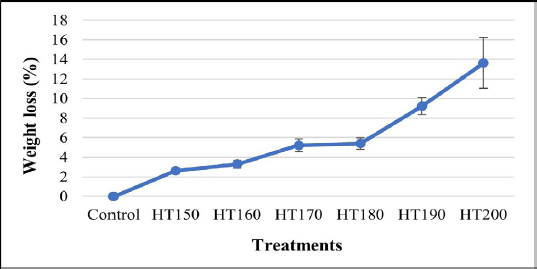
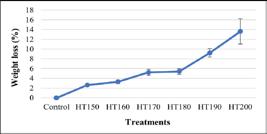
The weight loss (WL), which was calculated from oven-dried weight differences before and after heat treatment, increased with the rising temperatures (Figure 2). The WL remained low at 150 and 160 ºC (2.62 ± 0.29-3.28 ± 0.39%), but increased sharply above 170 ºC, reaching 13.62 ± 2.59% at 200 ºC. ANOVA results confirmed that the differences were statistically significant (p < 0.0001). Comparable patterns were reported by Candelier et al. (2017) at higher values, despite shorter treatment duration (2h), reflecting progressive thermal degradation that started with bound water and volatiles at 150-170 ºC (Hill et al., 2021), followed by hemicellulose and partial lignin degradation at ≥180 ºC (Esteves & Pereira, 2009). Although cellulose generally degrades at higher temperatures, decomposition of amorphous regions may have occurred (Mahdiyanti et al., 2024).
3.3. Dimensional stability
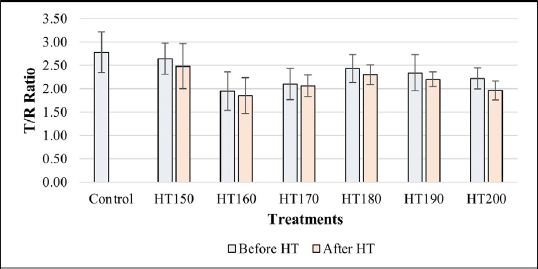
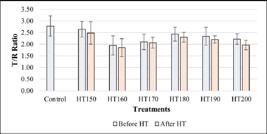
In this study, the dimensional stability of wood was evaluated using the tangential-to-radial shrinkage ratio (T/R ratio) and the ASE. The mean value of initial T/R ratio was 2.35 ± 0.29, exceeding the 2.0 threshold for stable wood and signifying low dimensional stability. After heat treatment, the mean value of T/R ratio for all specimens was slightly decreased to 2.15 ± 0.23 (Figure 3), representing a modest improvement in dimensional stability but remaining above the value of 2.0. This suggested that heat treatment had only a limited effect on reducing anisotropic shrinkage.
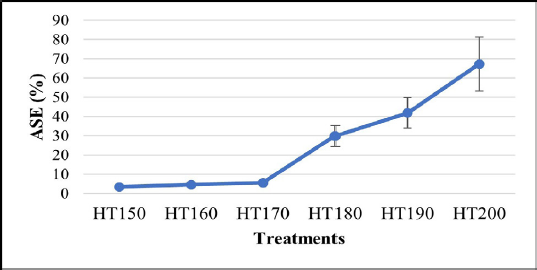
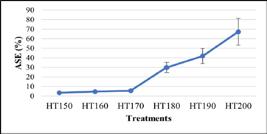
The ASE increased substantially with treatment temperature (Figure 4), ranging from 3.34 ± 0.78 % at 150 ºC to 67.22 ± 14.22 % at 200 ºC. The significant increase (p < 0.001) above 170 ºC represents a temperature threshold where substantial improvements in dimensional stability occur. These improvements were consistent with Candelier et al. (2017), who attributed ASE enhancement to hemicellulose degradation and fewer accessible hydroxyl groups with lower hygroscopicity and limited water uptake (Esteves & Pereira, 2009). The results suggest that while heat treatment does not clearly reduce shrinkage anisotropy (T/R ratio), it effectively improves dimensional stability by reducing wood hygroscopicity, particularly at temperatures ≥180 ºC.
3.4. Static bending strength
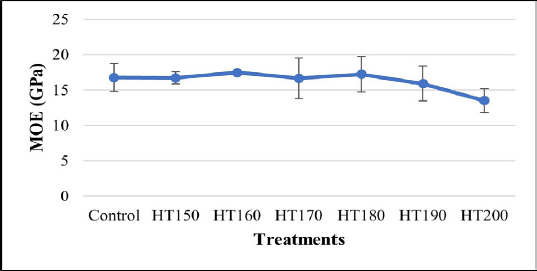
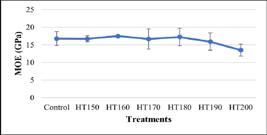
Average values of static bending strength evaluated in this study, including MOE and MOR, showed a similar pattern. The untreated MOE had an average of 16.77 ± 1.99 GPa (Figure 5), significantly higher than previous reports for young S. parahyba in Brazil (5.92 GPa: Athanázio-Heliodoro et al., 2018; 5.02-5.03 GPa: da Silva et al., 2020), which might be due to differences in tree age (>40 years) and growing conditions in Indonesia. ANOVA result indicated no significant effect of heat treatment on MOE (p = 0.067), despite a numerically lower value at 200 ºC (13.49 ± 1.66 GPa).
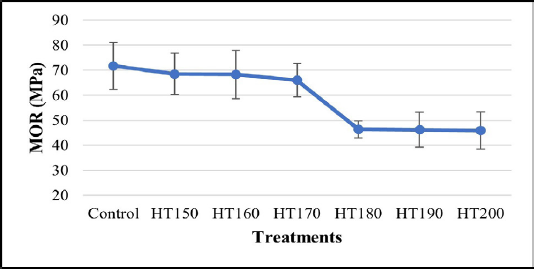
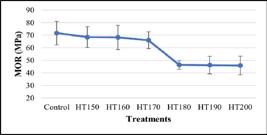
The control specimens showed an average MOR of 71.65 ± 9.36 GPa, which was considerably higher than the values of 40.47 MPa and 30.36-34.41 MPa reported by Athanázio-Heliodoro et al. (2018) and da Silva et al. (2020), respectively. The MOR remained relatively stable up to 170 ºC (66.01 ± 6.72 MPa), which might relate to the maintenance of cellulose stiffness at moderate heat levels (Kojima et al., 2020), before decreasing significantly (p < 0.001) by 35% at 180 ºC and above (Figure 6).
3.5. Compressive strength
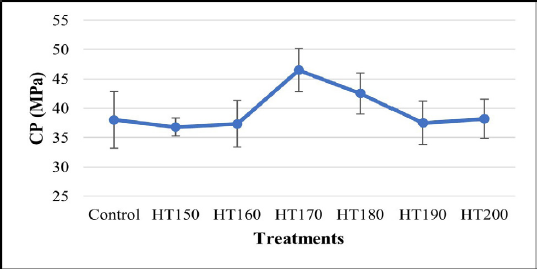
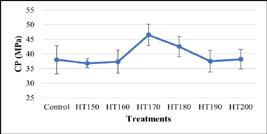
The average values of compressive strength of S. parahyba wood in this study, including both parallel to grain (CP) and perpendicular to grain (CT), showed distinct trends in response to treatment temperatures. The CP was statistically unchanged from control (37.99 ± 4.84 MPa) to 160 ºC (37.33 ± 3.67 MPa), then increased significantly (p = 0.009) to 46.50 ± 5.52 MPa at 170 ºC and 42.55 ± 3.49 MPa at 180 ºC, before declining at higher temperatures (Figure 7). The significant increase of CP at 170 ºC is most plausibly linked to lower equilibrium moisture content and limited cell-wall set under moderate heating, which can raise short-term compressive resistance without altering bulk density (Esteves & Pereira, 2009). At higher temperatures, progressive hemicellulose degradation and related thermal reactions outweigh these benefits and CP decreases (Hofmann et al., 2022). This interpretation is conservative and aligns with the observed stable apparent density and non-significant MOE.
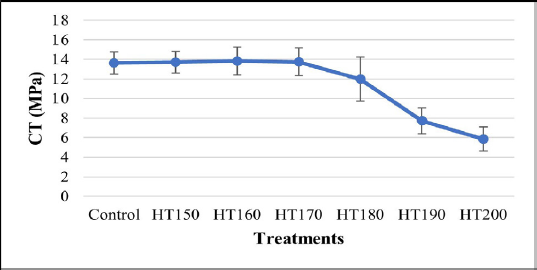
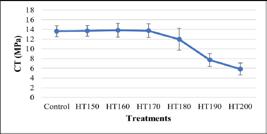
CT had a stable average that remained relatively constant from control (13.64 ± 1.15 MPa) to 170 ºC (13.74 ± 1.43 MPa) but dropped sharply at 180 ºC (11.98 ± 2.25 MPa), and more severely at 190 and 200 ºC (Figure 8). Similar reduction of compressive strength was reported by Kaymacki & Bayram (2021), attributed to progressive hemicellulose breakdown and cellulose depolymerization, which weakened the middle lamella. Additionally, thermal treatment affects both secondary cell wall layer (S2) and middle lamella, with S2 stiffening due to increased cellulose crystallinity (Lagaňa et al., 2021).
4. CONCLUSION
Heat treatment of S. parahyba wood at 150-200 ºC for 4 hours caused substantial changes in the physical and mechanical properties. Weight loss increased significantly above 170 ºC, while wood density remained stable. Dimensional stability improved but is still limited, as shown by a slight decrease in T/R shrinkage ratio and significant increase in ASE values. Regarding mechanical behavior, SB and CP declined significantly at ≥180 ºC, but CP improved at 170 and 180 ºC before decreasing at higher temperatures. Overall, the recommended treatment temperature for Indonesian-grown S. parahyba lies between 170 and 180 ºC, which provides a good balance between enhanced dimensional stability and maintained mechanical strength. From an industrial perspective, this moderate treatment temperature can be used to improve the quality and utilization of S. parahyba wood in applications where dimensional stability and adequate strength are required, such as interior construction and furniture materials. These conclusions apply to small-clear specimens of Indonesian-grown S. parahyba wood under oven (ambient-air) heat treatment. Future work should verify these thresholds across multiple trees, rotation-age (5-10 years) material and assess inert-atmosphere schedules to further decouple dimensional stability gains from strength alterations.
DATA AVAILABILITY
The full dataset supporting the findings of this study is available upon reasonable request to the corresponding author (Muhammad Rosyid Ridho, mrridho@unmul.ac.id).
REFERENCES
- Athanázio-Heliodoro JC, Pacheco L, Gaiad N, Lara-Palma HA, Ballarin AW. Properties of young guapuruvu (Schizolobium parahyba) wood from a forest recovery area. Floresta e Ambiente 2018; 25(3): e20160366
- Candelier K, Hannouz S, Thévenon MF, Guibal D, Gérardin P, Pétrissans M, et al. Resistance of thermally modified ash (Fraxinus excelsior L.) wood under steam pressure against rot fungi, soil-inhabiting micro-organisms and termites. European Journal of Wood and Wood Products 2017; 75(2):249-262.
- da Silva CBR, dos Santos Junior JA, Araújo AJC, Sales A, Siviero MA, Andrade FWC, et al. Properties of juvenile wood of Schizolobium parahyba var. amazonicum (paricá) under different cropping systems. Agroforestry Systems 2020; 94:583-595.
- de Almeida DH, Cavalheiro RS, de Mello Scaliante R, Christoforo AL, Calil Junior C, Lahr FAR. Full characterization of strength properties of Schizolobium amazonicum wood for timber structures. International Journal of Engineering & Technology (IJET-IJENS) 2013; 13:93-96.
- de Lima Melo LE, Silva CJ, Protásio TP, Mota GS, Santos IS, Urbinati CV, et al. Planting density effect on some properties of Schizolobium parahyba wood. Maderas: Ciencia y Tecnología 2018; 20:381-394.
- Esteves BM, Pereira HM. Wood modification by heat treatment: a review. BioResources 2009; 4(1):370-404.
- Hidayat W, Jang JH, Park SH, Qi Y, Febrianto F, Lee SH, et al. Effect of temperature and clamping during heat treatment on physical and mechanical properties of okan (Cylicodiscus gabunensis [Taub.] Harms) wood. BioResources 2015; 10(4):6961-6974.
- Hill C, Altgen M, Rautkari L. Thermal modification of wood- a review: chemical changes and hygroscopicity. Journal of Materials Science 2021; 56:6581-6614.
- Hofmann T, Tolvaj L, Visi-Rajczi E, Varga D. Chemical changes of steamed timber during short-term photodegradation monitored by FTIR spectroscopy. European Journal of Wood and Wood Products 2022; 80:841-849.
- Karyati K, Karmini K, Sari DR, Ruslim Y, Karhani M. Climatological aspects and visitors’ comfort perception in green open spaces of Samarinda city, East Kalimantan, Indonesia. Biodiversitas 2025; 26(6):2806-2820.
- Kaymacki A, Bayram BC. Evaluation of heat treatment parameters’ effect on some physical and mechanical properties of poplar wood with multi-criteria decision-making techniques. BioResources 2021; 16(3):4693-4703.
- Kojima E, Yamasaki M, Imaeda K, Lee CG, Sugimoto T, Sasaki Y. Effects of thermal modification on the mechanical properties of the wood cell wall of softwood: behavior of S2 cellulose microfibrils under tensile loading. Journal of Materials Science 2020; 55:5038-5047.
- Lagaňa R, Csiha C, Horváth N, Tolvaj L, Andor T, Kúdela J, et al. Surface properties of thermally treated European beech wood studied by PeakForce Tapping atomic force microscopy and Fourier-transform infrared spectroscopy. Holzforschung 2021; 75(1):56-64.
- Mahdiyanti SH, Asaoka M, Inagaki T, Tsuchikawa S. Cellulose crystalline structure and thermal properties under heat treatment: an investigation by two-dimensional correlation of near-infrared spectroscopy and differential scanning calorimetry. Journal of Near Infrared Spectroscopy 2024; 32(3):113-124.
- Mahdiyanti SH, Inagaki T, Ridho MR, Marsoem SN, Tsuchikawa S. Thermal behavior of heat-treated wood using two-dimensional correlation of near-infrared spectroscopy and differential scanning calorimetry. Wood Science and Technology 2023; 57:1485-1506.
- Mattos BD, Lourençon TV, Gatto DA, Serrano L, Labidi J. Chemical characterization of wood and extractives of fast-growing Schizolobium parahyba and Pinus taeda. Wood Material Science and Engineering 2016; 11(4):209-216.
- Murata K, Utsumi M, Hirata T, Nakamura M. Effect of thermal modification on the stress relaxation behavior and microstructure of the cell wall. Journal of Wood Science 2023; 69:25.
- Murata K, Watanabe Y, Nakano T. Effect of thermal treatment on fracture properties and adsorption properties of spruce wood. Materials 2013; 6:4186-4197.
- Priadi T, Sholihah M, Karlinasari L. Water absorption and dimensional stability of heat-treated fast-growing hardwoods. Journal of the Korean Wood Science and Technology 2019; 47(5):567-578.
- Priadi T, Wardhani MK, Putra GS, Cahyono TD. Dimensional stability and wettability of modified samama (Anthocephallus macrophyllus) wood with boron, citric acid, and heat treatment. Jurnal Sylva Lestari 2025; 13(1):190-202.
- Tang J, Zhan T, Li Z, Jiang J, Lyu J. Optimization of dimensional stability and mechanical performance of thermally modified wood using cyclic-gradient thermal treatment. Construction and Building Materials 2025; 458:139596.
- Vidaurre GB, Vital BR, Colodette JL, Oliveira AC, da Silva JGM, Moulin JC, et al. Anatomical and chemical properties of juvenile Schizolobium amazonicum wood. Revista Árvore 2018; 42(3): e420301.
- Zhou F, Fu Z, Gao X, Zhou Y. Changes in the wood-water interactions of mahogany wood due to heat treatment. Holzforschung 2020; 74:853-863.
Edited by
-
Associate editor:
Fernando Gomes http://orcid.org/0000-0003-0363-4888