 Comparison of drop table and diversified chiropractic techniques in patients with non-specific neck pain
Abstract
Introduction: Neck pain is a common musculoskeletal disorder associated with pain, reduced cervical mobility, and decreased muscle strength, often leading to functional limitations. Chiropractic manipulation is widely used as a conservative treatment, yet the comparative effects of different techniques remain unclear.
Objective: To compare the effects of the diversified and drop table chiropractic techniques on pain, cervical range of motion, and muscle strength in individuals with non-specific neck pain.
Methods: This randomized controlled clinical trial included 45 participants with non-specific neck pain, randomly assigned to three groups: diversified (DG; n = 15), drop table (DTG; n = 15), and control (CG; n = 15). Interventions were applied twice weekly for four weeks. The primary outcome measure was pain level assessed using the McGill Pain Questionnaire. Secondary outcome measures were cervical joint range of motion assessed with a goniometer and isometric neck muscle strength assessed using a microFET2 dynamometer. Outcomes were assessed pre- and post-intervention.
Results: Both DG and DTG demonstrated significant increases in cervical range of motion compared with the CG. Pain levels significantly decreased in both intervention groups. DG showed significant improvements across all isometric muscle strength measures, while DTG demonstrated selective improvements in flexion and right lateral flexion. CG showed no significant changes, except a decrease in extensor strength.
Conclusion: Chiropractic interventions effectively reduce pain and enhance cervical function in individuals with non-specific neck pain. The diversified technique provided broader muscle strength improvements, while the drop table technique showed more selective effects, emphasizing the need for individualized technique selection in clinical practice.
Keywords:
Neck pain; Chiropractic; Diversified technique; Drop table technique; Muscle strength
Resumo
Introdução: A dor cervical é um distúrbio musculoesquelético comum associado à dor, à mobilidade cervical reduzida e à diminuição da força muscular, frequentemente levando a limitações funcionais. A manipulação quiroprática é amplamente utilizada como um tratamento conservador, mas os efeitos comparativos de diferentes técnicas permanecem incertos.
Objetivo: Comparar os efeitos das técnicas quiropráticas diversified e drop table na dor, amplitude de movimento cervical e força muscular em indivíduos com dor cervical não específica.
Métodos: Este ensaio clínico controlado e randomizado incluiu 45 participantes com dor cervical não específica, aleatoriamente designados para três grupos: diversified (DG; n = 15), drop table (DTG; n = 15) e controle (CG; n = 15). As intervenções foram aplicadas duas vezes por semana durante quatro semanas. O desfecho primário foi o nível de dor, avaliado por meio do Questionário de Dor de McGill. Os desfechos secundários foram a amplitude de movimento articular cervical, avaliada com um goniômetro, e a força muscular isométrica do pescoço, avaliada com um dinamômetro microFET2. Os desfechos foram avaliados antes e após a intervenção.
Resultados: Ambos os grupos DG e DTG demonstraram aumentos significativos na amplitude de movimento cervical em comparação ao CG. Os níveis de dor diminuíram significativamente em ambos os grupos de intervenção. O DG demonstrou melhorias significativas em todas as medidas de força muscular isométrica, enquanto o DTG demonstrou melhorias seletivas na flexão e flexão lateral direita. O CG não mostrou alterações significativas, exceto diminuição na força dos extensores.
Conclusão: As intervenções quiropráticas reduzem efetivamente a dor e melhoram a função cervical em indivíduos com dor cervical inespecífica. A técnica diversified proporcionou melhorias mais amplas na força muscular, enquanto a técnica drop table apresentou efeitos mais seletivos, enfatizando a necessidade de uma seleção individualizada da técnica na prática clínica.
Palavras-chave:
Dor cervical; Quiropraxia; Técnica diversified; Técnica drop table; Força muscular
Introduction
Neck pain is one of the most common musculoskeletal problems, posing a significant economic and functional burden on both the healthcare system and individuals worldwide.1 With a lifetime prevalence ranging from 30 to 50%, neck pain negatively affects daily activities, work capacity, and quality of life.2 Clinically, neck pain is classified as "non-specific neck pain" when it is not associated with trauma or a specific pathology, and this group constitutes one of the most common subtypes of cervical dysfunction.3
Non-specific neck pain is typically characterized by decreased cervical spine range of motion, cervical muscle weakness, postural abnormalities, and pain.4 Manual therapy approaches, physical therapy applications, and exercise protocols are frequently preferred conservative treatment methods for managing these symptoms. Among these methods, chiropractic manipulation stands out because it involves high-velocity, low-amplitude techniques aimed at correcting spinal alignment, enhancing neural transmission and reducing pain.5,6
Current research highlights the positive effects of chiropractic manipulation in reducing neck pain, increasing cervical range of motion, and improving muscle function.7 However, given the diversity of chiropractic treatment approaches, it is important to comparatively evaluate the effects of different techniques (e.g., diversified and drop table) on clinical outcomes. Such comparative analyses can contribute to individualized, evidence-based clinical decision-making regarding technique selection.
In this context, the present study aimed to compare the effects of two different chiropractic techniques, diversified and drop table, on pain levels, cervical joint range of motion, and neck muscle strength in individuals with non-specific neck pain.
Methods
This randomized controlled clinical trial included preand post-intervention assessments for both the intervention and control groups. The study was conducted on human participants and received ethical approval from the Gümüşhane University Scientific Research and Publication Ethics Committee on December 27, 2022 (No: 2022/7). Written informed consent was obtained from all participants.
This study involved 45 volunteers aged 18 – 65 years, with neck pain, who were recruited from the Kayro-Fit
Physical Therapy Consultation Center. The inclusion criteria were as follows: signing the informed consent form; being between 18 and 65 years of age; having previously consulted an orthopedic or physical therapy physician for neck pain; having no contraindications to chiropractic treatment; no history of cervical surgery; and experiencing neck pain for more than seven days. The exclusion criteria were: being under 18 or over 65 years of age; having experienced trauma to the cervical region within the past month; having any systemic disorder; and having any contraindications to chiropractic treatment (e.g., brain tumor, cervical fracture).
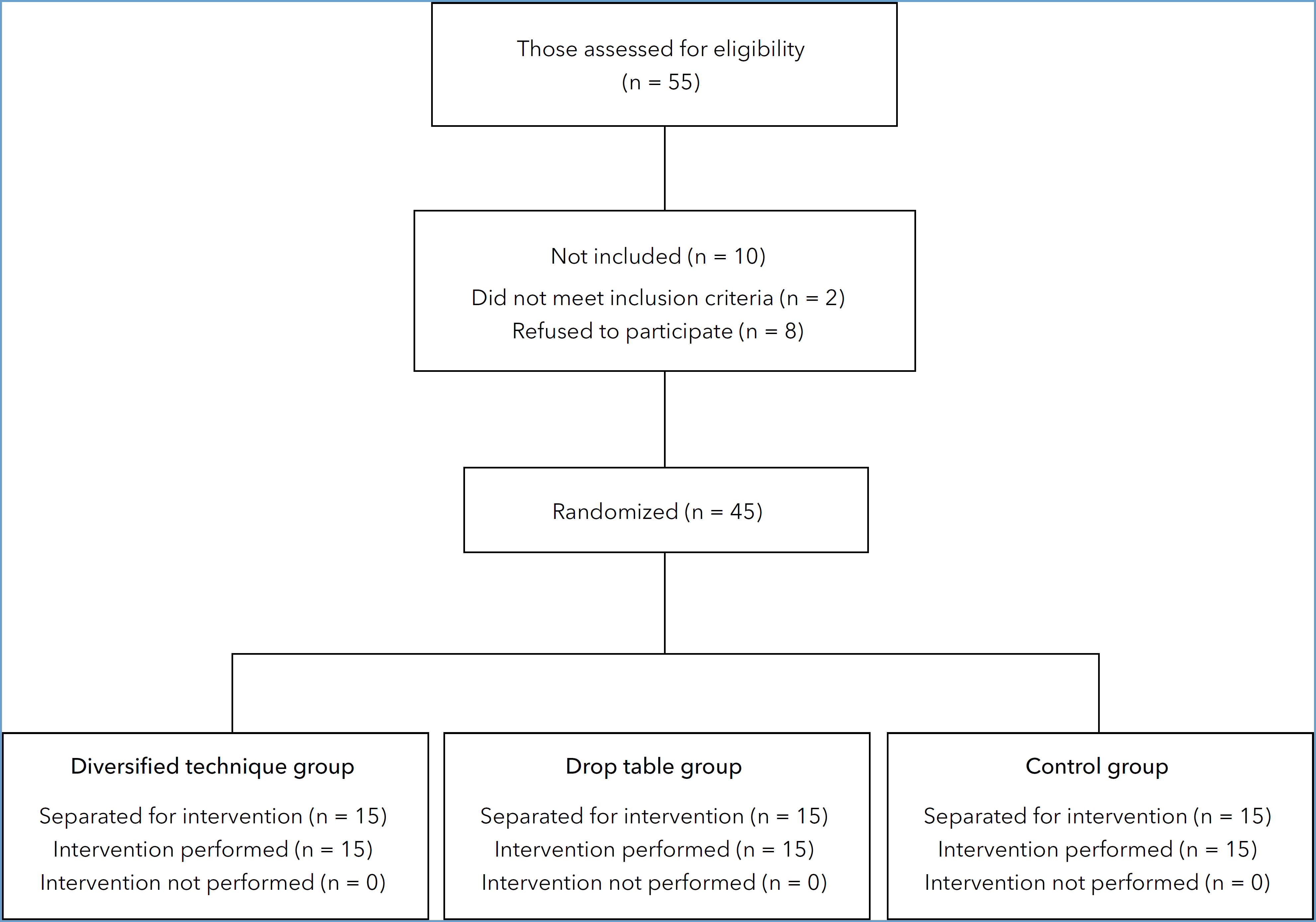
Of the 55 individuals assessed for eligibility, two had systemic disorders, and eight declined to participate. Therefore, the study proceeded with 45 participants. Three groups, balanced for age, gender, height, and weight, were randomly assigned for comparison in this study. The groups were as follows: the diversified technique group (DG; n = 15), the drop table group (DTG; n = 15), and the control group (CG; n = 15) (Figure 1).
Pre-treatment assessments were conducted for all participants. Subsequently, the DG and DTG received spinal manipulation treatment twice a week for four weeks. Participants in the CG were offered a free chiropractic session after completing the study. A sham manipulation was not preferred because it may not represent a truly inert condition; even minimal manual contact, joint positioning, or therapist–patient interaction can produce neuromuscular or psychological effects.
Therefore, to avoid potential confounding influences of pseudo-manual stimulation, a non-intervention control group was chosen to reflect the natural course of non-specific neck pain and to isolate the specific therapeutic effects of the drop table and diversified techniques. Post-treatment assessments were performed at the end of the four-week period. Outcome measurements were performed pre- and post-intervention of the spinal manipulation treatment program.
Pre-manipulation assessment
Prior to the intervention, each participant underwent preliminary assessment tests, including the cervical compression test, cervical distraction test, and Spurling maneuver, to ensure the safety of spinal manipulation and to exclude potential contraindications.8
Diversified technique
Prior to the manipulation procedure, manual palpation was performed to identify the target spinal segment.
Participants were positioned supine during the assessment to minimize muscle tone. Palpation was used to evaluate cervical vertebral mobility, segmental alignment, and potential restrictions. Segments exhibiting subluxation or hypomobility were selected as targets for manual manipulation.
During the manipulation, the physical therapist positioned the participant to optimize access to the targeted segment. The therapist then applied a short-duration, high-velocity, low-amplitude (HVLA) impulse force with the hand correctly placed on the transverse processes. This force produced a rapid joint movement at the targeted segment. An observed increase in joint mobility following the intervention indicated a successful application. This procedure is consistent with classical HVLA chiropractic manipulation techniques described in the literature.5,9
Drop table technique
The drop table technique involves the application of a HVLA manipulative force using a specialized chiropractic table equipped with a segmental drop mechanism. In this study, Thuli Tables® with a segmental drop system were used. The drop technique — mainly used to realign the pelvis, sacrum, spine, and neck bones — is a system in which solid joints, such as the pelvic joints, can be safely treated using a specially designed table.10 Prior to manipulation, the target segment was identified through palpation, and participants were positioned supine to minimize cervical muscle activity. Once a segment exhibiting hypomobility or subluxation was identified, the drop mechanism beneath the segment was adjusted according to the participant's body weight. The practitioner then applied a light impulse force to the target joint while simultaneously releasing the mechanism, causing the segment to move downward abruptly and in a controlled manner. This mechanical drop produces a therapeutic manipulation effect.
For the cervical region, this procedure was generally applied three times until sufficient movement was achieved in the targeted segment. The drop table technique reduces the physical effort required by the practitioner, as the force is transmitted through the table mechanism rather than the hands, while providing precise and controlled mobilization of the target segment.11
Sample size
Neck flexion was assessed both before and after treatment. The mean changes were 6.13, 2.33 and 1.47 for DG, DTG and CG, respectively. A post-hoc power analysis was performed using G*Power 3.1 software with a repeated-measures analysis of variance (ANOVA) model incorporating a within-between interaction. Effect sizes were calculated by considering the standard deviations of the pre- and post-treatment measurements for each group. A sensitivity analysis was performed for different values of the correlation coefficient (r). Assuming r = 0.30, Cohen's f was calculated as 0.54, and the power of the test was found to be 89%. Assuming r = 0.50, the effect size was found to be Cohen's f = 0.64 and the power was found to be 97%. Assuming a higher correlation coefficient (r = 0.70) resulted in an increased effect size of Cohen's f = 0.82, with a power exceeding 99%.
Randomization
Participants were randomly assigned numbers from 1 to 45. Using a simple random sampling method in Microsoft Excel, a numerical sequence was generated, and participants were subsequently allocated to the study groups according to this sequence.
Blinding
This study was designed as a single-blind randomized controlled trial. Due to the nature of the interventions — differences in technique application, sound, and positioning — it was not possible to fully blind participants. However, participants were informed that they would receive a chiropractic intervention, without disclosing the specific technique to be applied. CG was evaluated without receiving any intervention.
Practitioners were not blinded, as they needed to
know which technique to apply according to the protocol. All assessments, however, were conducted by an independent researcher who was blinded to group allocation and not involved in the treatment process, ensuring measurement blinding. Data analysis was performed by a statistician using only group codes, with group identities concealed.
Outcome measures
The primary outcome measure was pain intensity assessed using the McGill Pain Questionnaire (MGPQ). Secondary outcome measures were cervical range of motion, assessed with a goniometer, and isometric neck muscle strength, assessed using a microFET2 dynamometer.
The MGPQ is a structured instrument designed to evaluate the characteristic features of pain in detail, encompassing sensory, affective, evaluative, and other dimensions. It consists of 78 descriptive statements organized into 20 categories, allowing participants to describe their pain by selecting one descriptor per category, each of which is scored. The Pain Rating Index is subsequently calculated from these scores.12 The MGPQ is widely used in both research and clinical practice, as it captures not only pain intensity but also qualitative aspects and individual perception of pain. In the present study, the MGPQ was administered pre- and postintervention to determine the effects of chiropractic treatments on pain.
Cervical range of motion was measured using a goniometer for flexion, extension, right and left lateral flexion, and right and left rotation movements.13 All measurements were performed by the same therapist in a standardized sitting position, both before and after the intervention, to ensure consistency. These measurements were used to objectively evaluate changes in cervical mobility.
Muscle strength assessment was conducted at the time of participants’ inclusion in the study. Isometric neck muscle strength in flexion, extension, and right and left lateral flexion was measured using a microFET2 hand dynamometer (Hoggan Health Industries). Testing was performed with participants positioned in either the supine or prone position to maximize stabilization and isolate cervical muscle activation, while maintaining the head in a neutral position. Participants were instructed to sustain their head position for three seconds during an isometric contraction. This procedure, known as the "Make" test, required participants to push against the hand dynamometer with maximum effort, while the evaluator did not attempt to overcome the contraction. Prior to testing, all participants performed a familiarization trial in each position, and the resistance applied by the evaluator was adjusted to match the maximum force generated by the participants.
For flexor strength assessment, participants were placed in the supine position on the treatment table, and the dynamometer was positioned on the forehead, with resistance applied simultaneously during the head-lifting movement. For lateral flexion, the dynamometer was positioned just above the ear. For extensor strength, participants were placed in the prone position with a pillow under the chest/shoulder region for support, and the dynamometer was placed on the occipital region of the head, with resistance applied during the head-lifting movement. Each measurement was repeated three times with a 30–60 second rest interval between repetitions. The mean of the three trials for each direction was calculated, and the sum of the average values across all four directions was recorded as the overall muscle strength score. To minimize variability, all measurements were performed by the same physical therapist under standardized environmental conditions.14
Statistical analysis
The data obtained in the study were analyzed using the SPSS (Statistical Package for Social Sciences) for Windows 22.0 program. Descriptive statistical methods, including number, percentage, mean, and standard deviation, were used in the evaluation of the data. Differences in the ratios of categorical variables between independent groups were analyzed using chi-square and Fisher's exact tests. ANOVA (one-way analysis of variance) was used to compare continuous quantitative data between independent groups. The repeated measures ANOVA test was used to compare measurements within the groups.
Results
There was no significant difference between the patient groups based on gender (X2 = 0.536; p = 0.765 > 0.050). Of the DG, eight (53.3%) were male and seven (46.7%) were female; of the DTG, six (40.0%) were male and nine (60.0%) were female; and of the CG, seven (46.7%) were male and eight (53.3%) were female. There were no significant differences in the age, height, weight and body mass index of the study participants between the groups (p > 0.05) (Table 1).
As shown in Table 2, no significant difference was found between the groups in MGPQ scores prior to application (p > 0.05). Afterwards, a significant decrease was observed in the DG and DTG scores (p < 0.05), whereas no significant change was observed in the CG scores (p > 0.05).
At baseline, there were no significant between-group differences in flexion, right rotation, left rotation, right lateral flexion, or left lateral flexion (p > 0.05), whereas extension was significantly higher in the CG (p < 0.05). Following the intervention, no significant between-group differences were observed for any cervical range of motion parameter (p > 0.05). Within-group analyses showed significant improvements in all cervical range of motion measures in both the DG and DTG (p < 0.05). In the CG, significant improvements were also found in flexion and left rotation, while the remaining range of motion measures did not change significantly (Tabale 3).
Measurement of the neck's range of motion measurement data before (T0) and after (T1) treatment
As presented in Table 4, the study found no significant difference in neck flexor and extensor muscle strength between the groups (p > 0.05). In intragroup comparisons, flexor muscle strength increased significantly in both the DG and DTG, whereas extensor muscle strength increased significantly only in the DG. In the CG, no significant change was observed in flexor muscle strength, while extensor muscle strength significantly decreased (p < 0.05). Significant differences in lateral flexion strength were observed between the groups after application. Right and left lateral flexion measurements revealed that DG muscle strength values were significantly higher than those of the CG (p < 0.05). Intragroup comparisons revealed a significant increase in both right and left lateral flexion strength in the DG. In the DTG, only the increase in right lateral flexion was significant, while no significant change was observed in left lateral flexion or in the CG (Table 4).
Discussion
This study examined the effects of two different chiropractic techniques on joint range of motion, pain level, and neck muscle strength in individuals with nonspecific neck pain. According to the findings, both DG and DTG showed significant increases in cervical joint range of motion compared to CG. Regarding pain assessments, the MGPQ results showed a significant decrease in both chiropractic intervention groups. When evaluated in terms of neck isometric muscle strength, significant increases were recorded in all measurements in the DG. In the DTG, significant increases were obtained only in isometric muscle contractions in the right lateral flexion and flexion directions, with no significant changes observed in the other muscle strength measurements. In the CG, a significant decrease was observed only in neck extensor muscle strength, while no significant changes were observed in other isometric muscle strengths. Based on these findings, it can be concluded that chiropractic applications may be an effective conservative treatment option for individuals with non-specific neck pain, both to reduce pain and to increase cervical range of motion and specific muscle strength.
Neck pain is a common musculoskeletal problem that negatively affects daily living activities and is often accompanied by limited cervical mobility, pain, and decreased muscle strength.15 Chiropractic manipulations are among the commonly used conservative treatment methods for managing these symptoms. The literature shows that chiropractic applications have the potential to reduce cervical spine pain and support functional improvement in many studies.6,16 In this context, the findings of our study are consistent with the existing literature, particularly in terms of pain reduction and improvements in range of motion. The fact that similar meaningful results were achieved with both techniques suggests that they may represent effective alternatives to each other.
In addition to the mechanical effects of chiropractic manipulations, their neurophysiological effects have also been highlighted in various studies. It has been shown that following manipulation, proprioceptive feedback increases in spinal segments and pain-modulating mechanisms are activated.17,18 It has been reported that manipulations applied to the cervical region, in particular, raise the pain threshold at the central nervous system level and positively affect muscle activation.
In this regard, the more pronounced effect of the diversified technique on neck muscle strength in our study suggests that the activation level of these neurophysiological mechanisms may differ between techniques.
Although studies examining the effectiveness of the drop table technique are limited, some evidence suggests that drop-assisted manipulation may be associated with biomechanical and functional changes.10 In this context, the observation of a significant increase in isometric muscle strength, particularly in the flexion and right lateral flexion directions, in our study using the drop table technique suggests that this technique may have more selective effects on motor performance in certain directions. However, this limited effect can be explained by differences in the breadth or depth of the mechanical stimulus generated during application compared to the diversified technique.
The observation of a significant decrease in extensor muscle strength only in the CG suggests that motor function may decline over time even without any intervention in individuals with non-specific neck pain. This finding indicates that the untreated process may lead not only to the continuation of symptoms but also to a decline in functional capacity. Therefore, the timely and effective application of conservative approaches is critical in preventing functional loss.
In a randomized controlled trial, Bakken et al.19 evaluated the effects of spinal manipulative therapy (SMT) and home-based stretching exercises on pain and disability in individuals with persistent or recurrent neck pain. The study randomized 131 participants into SMT + exercise and exercise-only groups. The treatment period lasted two weeks, with each participant receiving four sessions. The primary outcome measures were pain level, assessed using the NRS-11 and MGPQ; secondary measures included neck disability, measured by the Neck
Disability Index) and quality of life (EQ-5D). The findings showed that the combination of SMT and home exercises resulted in more significant improvements in pain and disability compared to exercise alone. In our study, the effect of manipulation on pain was also assessed using the MGPQ, and a significant reduction in pain was observed in both manipulation groups.
A randomized controlled trial conducted by Gorrell et al.5 compared the effects of manual and instrument-assisted cervical manipulation on pain, disability, and cervical active joint range of motion in individuals with mechanical neck pain. Active range of motion in the direction of cervical flexion, extension, right/left lateral flexion, and right/left rotation was assessed in all participants before and after treatment. According to the findings, no significant differences were found between the two groups in any direction after the intervention. However, although moderate effect sizes were reported in some directions, the significance threshold was not reached. In our study, the effects of the drop table and diversified techniques on joint range of motion in individuals with non-specific neck pain were compared in separate groups, and it was observed that both applications led to significant increases in cervical flexion, extension, lateral flexion, and rotation.
In a randomized controlled study, Häkkinen et al.20 examined the effects of manual therapy and stretching exercises on cervical function in women with chronic neck pain. A total of 125 participants were divided into two groups: one group received manual therapy for the first four weeks followed by four weeks of stretching exercises, while the other received the same interventions in reverse order. The effectiveness of the interventions was evaluated by measuring isometric neck muscle strength and cervical active/passive range of motion. According to the results, an 11–14% increase in neck muscle strength was recorded at the end of four weeks in both groups. However, although these increases were significant, they remained clinically limited, and no significant additional improvement was observed until the 12th week. Similarly, cervical range of motion improved by only 7–15% during the first four weeks; although such changes were particularly noticeable in one group in the flexion-extension direction, they remained limited overall.
In our study, the effects of drop table and diversified chiropractic techniques were comparatively examined in individuals with non-specific neck pain; the evaluation was performed using objective parameters such as isometric muscle strength and cervical range of motion. The findings showed that both techniques resulted in improvements in cervical range of motion, whereas muscle strength gains were broader in the DG. In contrast, the drop table technique demonstrated more selective improvements, particularly in flexion and right lateral flexion. In this context, our study suggests that more dynamic and segmentally focused chiropractic approaches may have a stronger effect on cervical function compared to the limited strength increase findings of Häkkinen and colleagues.20
Conclusion
Our study demonstrates that chiropractic applications are effective in reducing pain and improving cervical function in individuals with non-specific neck pain.
In particular, the broader effect of the diversified technique on isometric muscle strength suggests that this technique may be more effective in improving motor function. The drop table technique, on the other hand, provides more selective gains in certain areas, which may be an important criterion in selecting techniques based on patient characteristics in clinical practice. In this regard, we believe that chiropractic applications should be selected with an individualized approach.
Data availability statement
Data are available from the corresponding author upon reasonable request.
Acknowledgements
The authors sincerely thank all staff members and colleagues who provided valuable support and guidance during the planning and execution of this study. Their assistance in clinical procedures, data collection, and technical advice was greatly appreciated.
References
-
1 Safiri S, Kolahi AA, Hoy D, Buchbinder R, Mansournia MA, Bettampadi D, et al. Global, regional, and national burden of neck pain in the general population, 1990–2017: Systematic analysis of the Global Burden of Disease Study 2017. BMJ. 2020;368:m791. https://doi.org/10.1136/bmj.m791
» https://doi.org/10.1136/bmj.m791 -
2 Hurwitz EL, Randhawa K, Yu H, Côté P, Haldeman S. The Global Spine Care Initiative: a summary of the global burden of low back and neck pain studies. Eur Spine J. 2018;27(Suppl 6):796-801. https://doi.org/10.1007/s00586-017-5432-9
» https://doi.org/10.1007/s00586-017-5432-9 -
3 Côté P, Wong JJ, Sutton D, Shearer HM, Mior S, Randhawa K, et al. Management of neck pain and associated disorders: A clinical practice guideline from the Ontario Protocol for Traffic Injury Management (OPTIMa) Collaboration. Eur Spine J. 2016; 25(7):2000-22. https://doi.org/10.1007/s00586-016-4467-7
» https://doi.org/10.1007/s00586-016-4467-7 -
4 Blanpied PR, Gross AR, Elliott JM, Devaney LL, Clewley D, Walton DM, et al. Neck pain: revision 2017: Clinical practice guidelines linked to the International Classification of Functioning, Disability and Health from the Orthopaedic Section of the American Physical Therapy Association. J Orthop Sports Phys Ther. 2017;47(7):A1-83. https://doi.org/10.2519/jospt.2017.0302
» https://doi.org/10.2519/jospt.2017.0302 -
5 Gorrell LM, Beath K, Engel RM. Manual and instrument applied cervical manipulation for mechanical neck pain: a randomized controlled trial. J Manipulative Physiol Ther. 2016;39(5):319-29. https://doi.org/10.1016/j.jmpt.2016.03.003
» https://doi.org/10.1016/j.jmpt.2016.03.003 -
6 Miller J, Gross A, D'Sylva J, Burnie SJ, Goldsmith CH, Graham N, et al. Manual therapy and exercise for neck pain: a systematic review. Man Ther. 2010;15(4):334-54. https://doi.org/10.1016/j.math.2010.02.007
» https://doi.org/10.1016/j.math.2010.02.007 -
7 Nielsen MF, Ishøi L, Juhl C, Hölmich P, Thorborg K. Pain provocation tests and clinical entities in male football players with longstanding groin pain are associated with pain intensity and disability. Musculoskelet Sci Pract. 2023;63:102719. https://doi.org/10.1016/j.msksp.2023.102719
» https://doi.org/10.1016/j.msksp.2023.102719 -
8 Rubinstein SM, van Middelkoop M, Assendelft WJJ, de Boer MR, van Tulder MW. Spinal manipulative therapy for chronic non-specific low-back pain. Cochrane Database Syst Rev. 2011; 2011(2):CD008112. https://doi.org/10.1002/14651858.cd008112.pub2
» https://doi.org/10.1002/14651858.cd008112.pub2 -
9 Martínez-Segura R, Fernández-de-Las-Peñas C, Ruiz-Sáez M, López-Jiménez C, Rodríguez-Blanco C. Immediate effects on neck pain and active range of motion after a single cervical high-velocity low-amplitude manipulation in subjects presenting with mechanical neck pain. J Manipulative Physiol Ther. 2006;29(7):511-7. https://doi.org/10.1016/j.jmpt.2006.06.022
» https://doi.org/10.1016/j.jmpt.2006.06.022 -
10 Oh H, Choi S, Lee S, Choi J, Lee K. Effects of the flexion-distraction technique and drop technique on straight leg raising angle and intervertebral disc height of patients with an intervertebral disc herniation. J Phys Ther Sci. 2019;31(8):666-9. https://doi.org/10.1589/jpts.31.666
» https://doi.org/10.1589/jpts.31.666 -
11 Harrison DD, Jackson BL, Troyanovich S, Robertson G, George D, Barker WF. The efficacy of cervical extension-compression traction combined with diversified manipulation and drop table adjustments in the rehabilitation of cervical lordosis: a pilot study. J Manipulative Physiol Ther. 1994;17(7):454-64. https://pubmed.ncbi.nlm.nih.gov/7989879/
» https://pubmed.ncbi.nlm.nih.gov/7989879/ -
12 Costa LCM, Maher CG, McAuley JH, Hancock MJ, Oliveira WM, Azevedo DC, et al. The Brazilian-Portuguese versions of the McGill Pain Questionnaire were reproducible, valid, and responsive in patients with musculoskeletal pain. J Clin Epidemiol. 2011;64(8):903-12. https://doi.org/10.1016/j.jclinepi.2010.12.009
» https://doi.org/10.1016/j.jclinepi.2010.12.009 -
13 Batool SA, Shakil-Ul-Rehman S, Tariq Z, Ikram M. Effects of fasciatherapy versus fascial manipulation on pain, range of motion and function in patients with chronic neck pain. BMC Musculoskelet Disord. 2023;24(1):789. https://doi.org/10.1186/s12891-023-06769-0
» https://doi.org/10.1186/s12891-023-06769-0 -
14 Grondin F, Colman D, Peyrot N, Maillard O, Freppel S, Caderby T, et al. Reliability and difference in neck extensor muscles strength measured by a portable dynamometer in individuals with and without chronic neck pain. J Man Manip Ther. 2022;30(3):192-8. https://doi.org/10.1080/10669817.2021.2024676
» https://doi.org/10.1080/10669817.2021.2024676 -
15 Côté P, Yu H, Shearer HM, Randhawa K, Wong JJ, Mior S, et al. Non-pharmacological management of persistent headaches associated with neck pain: A clinical practice guideline from the Ontario protocol for traffic injury management (OPTIMa) collaboration. Eur J Pain. 2019;23(6):1051-70. https://doi.org/10.1002/ejp.1374
» https://doi.org/10.1002/ejp.1374 -
16 Gross A, Kay TM, Paquin JP, Blanchette S, Lalonde P, Christie T, et al. Exercises for mechanical neck disorders. Cochrane Database Syst Rev. 2015;1(1):CD004250. https://doi.org/10.1002/14651858.cd004250.pub5
» https://doi.org/10.1002/14651858.cd004250.pub5 -
17 Pickar JG, Bolton PS. Spinal manipulative therapy and soma-tosensory activation. J Electromyogr Kinesiol. 2012;22(5):785-94. https://doi.org/10.1016/j.jelekin.2012.01.015
» https://doi.org/10.1016/j.jelekin.2012.01.015 -
18 Bialosky JE, George SZ, Horn ME, Price DD, Staud R, Robinson ME. Spinal manipulative therapy-specific changes in pain sensitivity in individuals with low back pain (NCT01168999). J Pain. 2014;15(2):136-48. https://doi.org/10.1016/j.jpain.2013.10.005
» https://doi.org/10.1016/j.jpain.2013.10.005 -
19 Bakken AG, Eklund A, Warnqvist A, O'Neill S, Axén I. The effect of two weeks of spinal manipulative therapy and home stretching exercises on pain and disability in patients with persistent or recurrent neck pain; a randomized controlled trial. BMC Musculoskelet Disord. 2021;22(1):903. https://doi.org/10.1186/s12891-021-04772-x
» https://doi.org/10.1186/s12891-021-04772-x -
20 Häkkinen A, Salo P, Tarvainen U, Wirén K, Ylinen J. Effect of manual therapy and stretching on neck muscle strength and mobility in chronic neck pain. J Rehabil Med. 2007;39(7):575-9. https://doi.org/10.2340/16501977-0094
» https://doi.org/10.2340/16501977-0094
Edited by
-
Associate editor:
Ana Paula Cunha Loureiro