 Do quality-of-life domains reflecting physical function predict social participation in the chronic post-stroke phase?
Abstract
Introduction: Stroke survivors commonly present with mobility limitations, reduced social participation, and impaired quality of life.
Objective: To investigate whether the physical functioning (PF) and role physical (RP) domains of quality of life predict social participation in the chronic post-stroke phase.
Methods: This cross-sectional study included 23 individuals in the chronic phase after stroke. Social participation was assessed using the Participation domain of the Stroke Impact Scale, and quality of life was measured with the Medical Outcomes 36-Item Short-Form Health Survey (SF-36). The PF and RP domains were considered indirect indicators of mobility. Data were analyzed using Spearman's correlation and simple and multiple linear regression analyses (p < 0.05).
Results Both domains were positively correlated with social participation (PF: rho = 0.652; RP: rho = 0.796; p < 0.001). In simple linear regression models, PF and RP explained 34% and 49% of the variance, respectively. In the multiple regression model, the combined variables explained 57% of the variance, with RP emerging as the strongest predictor.
Conclusion The PF and RP domains of the SF-36 are significant predictors of social participation in the chronic post-stroke phase. Greater perceived physical functioning and lower impact of physical limitations on daily roles (higher RP score) are associated with higher levels of social participation.
Keywords:
Stroke; Mobility limitations; Social participation; Quality of life; Patient-reported outcome measures
Resumo
Introdução: Pacientes após acidente vascular cerebral (AVC) frequentemente apresentam limitações na mobilidade, restrições de participação social e prejuízo da qualidade de vida.
Objetivo: Investigar se os domínios capacidade funcional (CF) e limitações por aspectos físicos (LAF) da qualidade de vida são preditores da participação social na fase crônica pós-AVC.
Métodos: Trata-se de um estudo transversal com 23 pacientes pós-AVC, que analisou dados de participação social (Stroke Impact Scale – domínio Participação) e qualidade de vida (Medical Outcomes Study 36-Item Short-Form Health Survey - SF-36) na fase crônica. Os domínios CF e LAF do SF-36 foram utilizados como indicadores indiretos da mobilidade dos participantes. Foram conduzidos testes de correlação de Spearman e regressões lineares simples e múltiplas (p < 0,05) entre os domínios CF e LAF com a participação social.
Resultados: Ambos os domínios apresentaram correlação positiva e significativa com a participação social (CF: rho = 0.652; LAF: rho = 0.796; p < 0,001). Na regressão linear simples, CF e LAF explicaram 34% e 49% da variância da participação social, respectivamente. Na regressão múltipla, o modelo que considerou ambos os domínios conjuntamente explicou 57% da variância na participação social, sendo o domínio LAF o principal preditor.
Conclusão: Na fase crônica do AVC, os domínios CF e LAF do SF-36 são preditores da participação social. Isso sugere que em relação à qualidade de vida, quanto maior a percepção da CF e menor a percepção de LAF, maior a participação social de indivíduos na fase crônica pós-AVC.
Palavras-chave:
Acidente vascular cerebral; Limitação da mobilidade; Participação social; Qualidade de vida; Medidas de resultados relatados pelo paciente
Introduction
The International Classification of Functioning, Disability and Health (ICF) conceptualizes mobility across four domains: (1) changing and maintaining body position; (2) carrying, moving, and handling objects; (3) walking and moving; and (4) moving around using transportation.1 These domains underpin independent mobility,2 which remains a central goal in stroke rehabilitation.2-4 During the acute phase, mobility limitations are common and contribute significantly to difficulties in performing activities of daily living (ADLs) and participating socially.5
Loss of mobility, particularly the ability to walk, is one of the most disabling consequences of stroke. Accordingly, gait rehabilitation has expanded beyond walking recovery to include community ambulation.6 This ability is closely linked to social participation, since it enables engagement in physical and leisure activities, access to public transportation, and interaction with others.7
Participation, defined as involvement in real-life situations,1 is frequently compromised after stroke. Individuals often resume basic domestic and sedentary tasks but remain limited in more physically demanding or community-based activties.8 Thus, participation plays a central role in post-stroke social reintegration,9 and its restriction is strongly associated with reduced quality of life.10
Limitations in social participation among stroke survivors are an important public health concern. These restrictions arise from a combination of physical impairments (e.g., limb dysfunction, communication difficulties, cognitive deficits), emotional factors (e.g., depression, social isolation), and environmental barriers. Despite this, rehabilitation strategies continue to focus primarily on restoring physical function, with social participation rarely adopted as a primary outcome. This mismatch may reduce the overall effectiveness of rehabilitation, since even patients with mild impairments can experience substantial limitations in social roles and daily activities.10
Participation restrictions may persist for several years after stroke, particularly affecting autonomy in outdoor environments, social relationships, and vocational or educational activities. These limitations often result in social isolation and increased dependence on family members or caregivers. Notably, social participation remains modifiable even in the absence of further recovery in body functions, underscoring its relevance as a target for intervention in chronic stroke. In addition, personal factors such as self-concept and perceived recovery influence post-stroke participation and provide important insight into overall functioning.8 Consequently, social participation among stroke survivors remains suboptimal, high-lighting the need for further investigation of the factors contributing to these restrictions.10
According to the World Health Organization (WHO), quality of life (QoL) reflects an individual's perception of their position in life within their cultural and value context and in relation to their goals, expectations, and concerns.11
Given its multidimensional nature, improving QoL is a key objective of post-stroke rehabilitation,12 since stroke-related impairments significantly affect well being.13,14 Moreover, QoL assessment provides a broader understanding of disease impact beyond clinical measures.15
Stroke survivors commonly experience activity limitations and participation restrictions, leadin to reduced QoL.14 In this context, physical therapy aims to mitigate impairments, increase activity levels and social participation, and improve overall QoL.16 Given the substatial impact of stroke on mobility, QoL, and participation, this study investigated whether the physical functioning (PF) and role physical (RP) domains of the Medical Outcomes Study 36-Item Short-Form Health Survey (SF-36) — reflecting individuals’ perceptions of their physical capabilities — predict social participation in the chronic post-stroke phase. It was hypothesized that these self-reported QoL domains would be significant predictors of social participation in individuals with chronic stroke.
Methods
This is observational, cross-sectional study, approved by the Research Ethics Committee of the Hospital de Clínicas de Porto Alegre (HCPA) (Protocol No. 8206962 4.0.0000.5327), and all participants provided written informed consent. The study was conducted and reported in accordance with the Strengthening the Reporting of Observational Studies in Epidemiology (STROBE) guidelines.17-19
The study population comprised 58 individuals with stroke who were hospitalized at the HCPA between August 2022 and April 2024. These individuals were originally enrolled in a parent study entitled "Mobility Scale and Ruler: content validation, repeatability, and interrater reproducibility in the assessment of mobility in post-stroke patients during hospitalization," which was approved by the HCPA Research Ethics Committee (CAAE: 42306321130015327). Clinical data were stored and managed in a secure institutional database.
A population-based, non-probabilistic sample was obtained by consecutively including participants from the parent study who met the following criteria: a single stroke episode, age ≥ 18 years, either sex, and preserved cognition and communication abilities. Exclusion criteria were recurrent stroke between the first and second assessments and the presence of comorbid neurological diseases. Eligible participants were contacted and received a link to the informed consent form via email or WhatsApp.
Participants were eligible if they scored zero on three cognitive items of the National Institutes of Health Stroke Scale (NIHSS), assessed during the acute hospitalization phase: level of consciousness (1a), response to questions (1b), and ability to follow commands (1c). Any score above zero resulted in exclusion.
Clinical data and outcomes were collected between October 2024 and March 2025, when all participants were in the chronic post-stroke phase (defined as > six months after stroke). Data were obtained using an anamnesis form, the Stroke Impact Scale (SIS) 3.0, and SF-36. Data collection was performed according to participant preference, either via Google Forms or telephone interviews.
The participation domain of the SIS 3.0 assesses the impact of stroke on social activities over the previous four weeks, with scores ranging from 0 to 100, where higher scores indicate better social participation.20 The SF-36 measures quality of life across eight domains, also scored from 0 to 100, with higher values indicating better quality of life.21 The SF-36 has demonstrated excellent reliability in Brazilian individuals with chronic stroke (> 6 months),22 with high intraclass correlation coefficients (ICC = 0.89) for both test–retest and interrater reliability. These findings support its use in clinical and research settings in this population. Convergent validity, assessed through correlations with the Nottingham Health Profile, demonstrated moderate to strong associations between conceptually similar domains. The high overall correlation (ρ = 0.80) further supports the instrument's validity for assessing physical, functional, and psychosocial aspects in this population.
Only the SF-36 domains reflecting participants’ perceptions of physical function were included in the analyses: PF and RP. The PF domain evaluates limitations in daily physical activities of varying intensity, including vigorous activities (e.g., running, lifting heavy objects), moderate activities (e.g., pushing a vacuum cleaner or moving a table), climbing stairs, walking different distances, and self-care (e.g., bathing or dressing).21 The RP domain assesses the extent to which physical health interferes with work or daily activities over the previous four weeks, including reduced time spent on tasks, decreased productivity, limitations in the types of activities performed, and increased effort required.21
Statistical analysis
Spearman's correlation analysis was used to examine the association between the SF-36 PF and RP domains and social participation. Simple and multiple linear regression were then applied to evaluate the extent to which these domains predicted social participation scores. The significance level was set at p < 0.05. All statistical analyses were performed using JASP software.23
Results
From an initial sample of 58 individuals with stroke, nine were excluded due to multiple strokes and three for post-stroke cognitive or communication impairments. In addition, 15 patients could not be contacted, seven had died, and one declined participation, resulting in a final sample of 23 participants. Of these, two completed the SF-36 and SIS via Google Forms, while 21 responded by telephone.
Most participants were male (n = 16), with a mean age of 60 ± 16.8 years, and had experienced ischemic stroke. All scored zero on NIHSS cognitive items during acute hospitalization, indicating preserved cognition. Assessments were conducted at a mean of 18.4 (±5.5) months post-stroke, corresponding to the chronic phase. SF-36 domain scores ranged from 36.9 (±39.7) to 72.2 (±24.1), with mean social participation scored at 68.4 (±24.3) (Table 1).
Correlation analysis revealed that social participation was positively and significantly associated with the SF-36 domains RP (rho = 0.796; p < 0.001) and PF (rho = 0.652; p < 0.001). Figure 1 present scatter plots illustrating these relationships.
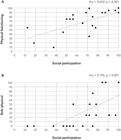
Scatter plot showing the relationship between social participation (Stroke Impact Scale) and (A) physical functioning and (B) role physical (SF-36).
In the simple linear regression analysis, both RP (β = 0.70; p < 0.001; R² = 0.49) and PF (β = 0.59; p = 0.003; R² = 0.34) were significant predictors of social participation, explaining 49% and 34% of the variance, respectively. In the multiple linear regression model including both variables, only RP remained significantly associated with social participation (β = 0.54; p = 0.004), whereas PF was not statistcally significant (β = 0.31; p = 0.076). The model showed an adjusted R² of 0.57, indicating that the two variables together explained 57% of the variance in social participation, with RP emerging as the primary predictor (Table 2).
Simple and multiple linear regression analyses examining the association between SF-36 quality-of-life domains (role physical and physical functioning) and social participation
Discussion
Social participation is frequently disrupted and restricted following stroke. Although many individuals resume domestic and sedentary activities, they often remain limited in more physically demanding tasks and activities performed in community settings.8 Additionally, individuals with stroke commonly report reduced quality of life, largely attributable to functional limitations.13 In chronic and complex conditions such as stroke, disability and quality of life are influenced not only by physical impairments but also by behavioral, emotional, and psychological factors.24 In the present study, participants exhibited impairments in social participation and across all quality of life domains, corroborating previous findings that these outcomes are adversely affected after stroke.8,10,13,14
The post-stroke period is typically categorized into five phases: hyperacute (0–24 h), acute (1–7 days), early subacute (up to 3 months), late subacute (up to 6 months), and chronic (beyond 6 months).25 In the present study, participants were assessed at a mean time point greater than six months after stroke, corresponding to the chronic phase.
This study examined the relationship between the SF-36 domains PF and RP, considered indicators of perceived physical function, and social participation. However, these domains represent subjective outcomes,12,26 reflecting participants' perceptions of their physical condition and its impact on daily activities. Accordingly, the findings are based on self-reported measures of quality of life and social participation.
From a conceptual perspective, the PF domain aligns with the ICF construct of capacity,1 since both refer to an individual's potential to perform activities of varying physical demand under standardized conditions. Conversely, the RP domain corresponds to the ICF construct of performance1 because it reflects how health conditions influence the execution of activities in real-life contexts, accounting for environmental and personal factors. Thus, PF expresses perceived capacity, whereas RP reflects perceived performance, supporting the conceptual alignment between SF-36 domains and the ICF framework.
Correlation analysis demonstrated a strong associated between social participation and RP (rho = 0.796) and a moderate associated with PF (rho = 0.652), according to Mukaka's classification.27 These findings indicate that greater social participation are associated with better perceived quality of life in domains related to PF and RP. In practical terms, individuals with higher levels of social participation tend to report better ability to perform daily physical activities and fulfill habitual or occupational roles.
In the regressional analyses, both SF-36 domains were identified as significant predictors of social participation in the simple models. The RP domain explained 49% of the variance, underscoring the relevance of perceived limitations in daily roles, whereas PF explained 34%, indicating a smaller but still menaingful contribution of perceived functional capacity. The combined model explained 57% of the variance, reinforcing the importance of perceived physical function — particularly role-related limitation — in explaining social participation.
These findings are consistent with those reported by Törnbom et al.,28 who used a composite measure of physical function derived from the strength, activities of daily living, mobility, and hand function domains of the SIS. The authors identified physical function as the only factor significantly associated with social participation in the first year after stroke. Together, these findings support the role of physical function as a key determinant of social participation across the different stages of stroke recovery, including the chronic phase.
In the multiple linear regression analysis, however, only the RP domain remained statistically significant, whereas PF was no longer significant. The model indicated that the two domains together explain 57% of the variance in social participation. These findings suggest that, although both domains are individually associated with social participation, perceived functional limitation, rather than the mere ability to perform physical tasks, has greater explanatory relevance when both variables are considered simultaneously. This result highlights the importance of perceived physical limitations in functional performance as a key factor associated with social participation in the post-stroke context. Supporting this interpretation, Della Vecchia et al.29 showed that self-perceived activity limitation, assessed via the SIS domain of ADLs and instrumental activities of daily living, was the main predictor of social participation among individuals after stroke, even after adjusting for cognitive and contextual factors. The authors further emphasize that interventions addressing not only objectively measured physical impairments but also the subjective experience of functional limitation may be more effective in promoting social participation in this population.29
The unexplained variance in social participation may be attributed to additional determinants, particularly environmental and personal factors. Within the ICF framework, contextual factors are divided into environmental factors — related to the physical, social, and attitudinal environment, which may act as facilitators or barriers —and personal factors, such as age, cultural background, and lifestyle. These factors substantially influence functioning and disability by modulating the impact of health conditions on individuals’ lives.1 According to Zhou et al.,10 motor, cognitive, language, and emotional impairments, together with contextual and environmental barriers, directly affect social participation. Thus, a comprehensive understanding of post-stroke participation restriction requires a multifactorial approach that extends beyond physical function to include the broader biopsychosocial context, encompassing both personal and environmental factors of the ICF.
A study involving 55 individuals in the chronic post-stroke phase investigated, within the ICF framework, the contribution of upper limb deficits to activity and participation domains.30 The results showed that handgrip strength was significantly correlated with all activity measures, explaining up to 62% of the variance, whereas shoulder pain showed the strongest association with social participation, accounting for 30% of its variance. These findings indicate that motor deficits and pain in the paretic upper limb are important factors associated with functional limitation and reduced social participation after stroke.30 Complementing these findings, Purton et al.31 emphasize that upper limb dysfunction, particularly impaired bimanual function, substantially affects individuals’ lives by limiting self-care, participation in meaningful activities, and social roles, while also influencing self-image and personal identity. Thus, post-stroke social participation is partly influenced by paretic upper limb function, which affects not only task performance but also the subjective dimensions of lived experience.
Although the present study indicates that perceived PF and RP are associated with social participation in the chronic post-stroke phase, these findings should be interpreted with caution. The sample consisted exclusively of individuals with preserved cognition and communication, recruited from a single hospital, which may limit generalizability to populations with cognitive or language impairments or to different sociocultural contexts. Moreover, the absence of direct mobility assessment in the chronic phase, relying instead on PF and RP domains as proxies for physical function, is a key limitation. This limitation precludes inferring that mobility itself predicts social participation, restricting analysis to perceived mobility. Future research should incorporate objective mobility measures alongside self-reported outcomes to enable more robust conclusions regarding the role of physical function in social participation.
Conclusion
The findings indicate that higher perceived PF and lower role limitations due to physical health (RP) are associated with greater social participation in the chronic post-stroke phase. Multiple regression analysis showed that these domains together explained more than half of the variance in social participation. These results highlight the relevance of perceived physical function, particularly role-related limitations, as an important factor associated with social participation in individuals with chronic stroke.
Data availability statement
The data that support the findings of this study are available upon reasonable request.
References
-
1 World Health Organization (WHO). International classification of functioning, disability and health. Geneva: WHO; 2001. https://tinyurl.com/u7a4y7yb
» https://tinyurl.com/u7a4y7yb -
2 Van Criekinge T, Heremans C, Burridge J, Deutsch JE, Hammerbeck U, Hollands K, et al. Standardized measurement of balance and mobility post-stroke: Consensus-based core recommendations from the third Stroke Recovery and Rehabilitation Roundtable. Neurorehabil Neural Repair. 2024;38(1):41–51. https://doi.org/10.1177/15459683231209154
» https://doi.org/10.1177/15459683231209154 -
3 Vahlberg B, Cederholm T, Lindmark B, Zetterberg L, Hellström K. Factors related to performance-based mobility and self-reported physical activity in individuals 1-3 years after stroke: a cross-sectional cohort study. J Stroke Cerebrovasc Dis. 2013; 22(8):e426-34. http://dx.doi.org/10.1016/j.jstrokecerebrovasdis.2013.04.028
» http://dx.doi.org/10.1016/j.jstrokecerebrovasdis.2013.04.028 -
4 Moore JL, Nordvik JE, Erichsen A, Rosseland I, Bø E, Hornby TG. Implementation of high-intensity stepping training during inpatient stroke rehabilitation improves functional outcomes. Stroke. 2020;51(2):563–70. http://dx.doi.org/10.1161/strokeaha.119.027450
» http://dx.doi.org/10.1161/strokeaha.119.027450 -
5 Silva MCL, Polese JC, Starling JMP, Pereira LSM. Caracterização clínica e motora-funcional de idosos hospitalizados pósacidente vascular cerebral. Rev Neurocienc. 2014;22(3):337-43. http://dx.doi.org/10.34024/rnc.2014.v22.8069
» http://dx.doi.org/10.34024/rnc.2014.v22.8069 -
6 Lord SE, McPherson K, McNaughton HK, Rochester L, Weatherall M. Community ambulation after stroke: how important and obtainable is it and what measures appear predictive? Arch Phys Med Rehabil. 2004;85(2):234–9. http://dx.doi.org/10.1016/j.apmr.2003.05.002
» http://dx.doi.org/10.1016/j.apmr.2003.05.002 -
7 Barclay RE, Stevenson TJ, Poluha W, Ripat J, Nett C, Srikesan CS. Interventions for improving community ambulation in individuals with stroke. Cochrane Database Syst Rev. 2015;2015 (3):CD010200. http://dx.doi.org/10.1002/14651858.cd010200.pub2
» http://dx.doi.org/10.1002/14651858.cd010200.pub2 -
8 Hoyle M, Meredith P, Ownswort T, Khan A, Gustafsson L. Associations between participation and personal factors in community-dwelling adults post-stroke. Brain Impair. 2023;24(3): 456-73. http://dx.doi.org/10.1017/brimp.2022.31
» http://dx.doi.org/10.1017/brimp.2022.31 -
9 Pereira GS, Corrêa FI, Santos HM, Júlio CE, Bazán JAP, Bissoli MEF, et al. Translation and cross-cultural adaptation of the Brazilian version of the PM-Scale: A specific measure of participation after stroke. Braz J Phys Ther. 2023;27(2):100497. http://dx.doi.org/10.1016/j.bjpt.2023.100497
» http://dx.doi.org/10.1016/j.bjpt.2023.100497 -
10 Zhou X, Du M, Dai X, Zhu S, Zhou L, Li X. Intervention patterns and preliminary effectiveness on Social Participation following stroke: a scoping review. BMC Neurol. 2023;23(1):275. http://dx.doi.org/10.1186/s12883-023-03250-2
» http://dx.doi.org/10.1186/s12883-023-03250-2 -
11 World Health Organization. WHOQOL: Measuring quality of life. Geneva: WHO; 1998. https://www.who.int/tools/whoqol
» https://www.who.int/tools/whoqol -
12 Song YY, Sun WJ, Wang C, Tian YM, Liu H, Jiang Y. Effects of multicomponent exercise on quality of life, depression and anxiety among stroke survivors: A systematic review and meta-analysis. J Clin Nurs. 2023;32(21-22):7677-90. http://dx.doi.org/10.1111/jocn.16853
» http://dx.doi.org/10.1111/jocn.16853 -
13 Min KB, Min JY. Health-related quality of life is associated with stroke deficits in older adults. Age Ageing. 2015;44(4):700–4. http://dx.doi.org/10.1093/ageing/afv060
» http://dx.doi.org/10.1093/ageing/afv060 -
14 Hwang HS, Kim H. Factors affecting the quality of sleep and social participation of stroke patients. Brain Sci. 2023;13(7):1068. http://dx.doi.org/10.3390/brainsci13071068
» http://dx.doi.org/10.3390/brainsci13071068 -
15 Brandão AD, Teixeira NB, Brandão MC, Vidotto MC, Jardim JR, Gazzotti MR. Translation and cultural adaptation of the stroke impact scale 2.0 (SIS): a quality-of-life scale for stroke. Sao Paulo Med J. 2018;136(2):144-9. http://dx.doi.org/10.1590/1516-3180.2017.0114281017
» http://dx.doi.org/10.1590/1516-3180.2017.0114281017 -
16 Costa CMB, Araújo CMRS, Nogueira EM, Oliveira TP, Dias CS. Funcionalidade de usuários com doenças neurológicas crônicodegenerativas. Rev CIF Bras. 2021;13(1):84–93. http://dx.doi.org/10.4322/cifbrasil.2021.010
» http://dx.doi.org/10.4322/cifbrasil.2021.010 - 17 Pereira MG. Epidemiologia: teoria e prática. Rio de Janeiro: Guanabara Koogan; 1995.
- 18 Rothman KJ, Greenland S, Lash TL. Epidemiologia moderna. Porto Alegre: Artmed; 2011.
-
19 Malta M, Cardoso LO, Bastos FI, Magnanini MMF, Silva CMFP. Iniciativa STROBE: subsídios para a comunicação de estudos observacionais. Rev Saude Publica. 2010;44(3):559–65. http://dx.doi.org/10.1590/s0034-89102010000300021
» http://dx.doi.org/10.1590/s0034-89102010000300021 -
20 Duncan PW, Bode RK, Lai SM, Perera S. Rasch analysis of a new stroke-specific outcome scale: the stroke impact scale. Arch Phys Med Rehabil. 2003;84(7):950-63. http://dx.doi.org/10.1016/s0003-9993(03)00035-2
» http://dx.doi.org/10.1016/s0003-9993(03)00035-2 -
21 Ware Jr JE, Sherbourne CD. The MOS 36-item short-form health survey (SF-36). I: conceptual framework and item selection. Med Care. 1992;30(6):473–83. https://tinyurl.com/4kcuj263
» https://tinyurl.com/4kcuj263 -
22 Cabral DL, Laurentino GEC, Damascena CG, Faria CDCM, Melo PG, Teixeira-Salmela LF. Comparisons of the Nottingham Health Profile and the SF-36 health survey for the assessment of quality of life in individuals with chronic stroke. Rev Bras Fisioter. 2012;16(4):301–8. https://doi.org/10.1590/S1413-35552012005000029
» https://doi.org/10.1590/S1413-35552012005000029 -
23 JASP Team. JASP (Version 0.95.0). 2024 [cited 2025 Aug 5]. Available from: https://jasp-stats.org
» https://jasp-stats.org -
24 LeBrasseur NK, Sayers SP, Ouellette MM, Fielding RA. Muscle impairments and behavioral factors mediate functional limitations and disability following stroke. Phys Ther. 2006;86 (10):1342–50. http://dx.doi.org/10.2522/ptj.20050162
» http://dx.doi.org/10.2522/ptj.20050162 -
25 Bernhardt J, Hayward KS, Kwakkel G, Ward NS, Wolf SL, Borschmann K, et al. Agreed definitions and a shared vision for new standards in stroke recovery research: the stroke recovery and rehabilitation roundtable taskforce. Int J Stroke. 2017;12 (5):444-50. https://doi.org/10.1177/1747493017711816
» https://doi.org/10.1177/1747493017711816 -
26 Oliveira-Kumakura ARS, Batista LMOS, Spagnol GS, Valler L. Functionality and quality of life in Brazilian patients 6 months post-stroke. Front Neurol. 2023;14:1020587. http://dx.doi.org/10.3389/fneur.2023.1020587
» http://dx.doi.org/10.3389/fneur.2023.1020587 -
27 Mukaka MM. Statistics corner: a guide to appropriate use of correlation coefficient in medical research. Malawi Med J. 2012;24(3):69-71. https://pmc.ncbi.nlm.nih.gov/articles/PMC3576830/
» https://pmc.ncbi.nlm.nih.gov/articles/PMC3576830/ -
28 Törnbom K, Persson HC, Lundälv J, Sunnerhagen KS. The impact of physical function on participation in the first year post-stroke. Acta Neurol Scand. 2017;135(6):649–55. https://doi.org/10.1111/ane.12661
» https://doi.org/10.1111/ane.12661 -
29 Della Vecchia C, Préau M, Haesebaert J, Viprey M, Rode G, Termoz A, et al. Factors associated with post-stroke social participation: a quantitative study based on the ICF framework. Ann Phys Rehabil Med. 2023;66(3):101686. https://doi.org/10.1016/j.rehab.2022.101686
» https://doi.org/10.1016/j.rehab.2022.101686 -
30 Faria-Fortini I, Michaelsen SM, Cassiano JG, Teixeira-Salmela LF. Upper extremity function in stroke subjects: relationships between the international classification of functioning, disability, and health domains. J Hand Ther. 2011;24(3):257-64. https://doi.org/10.1016/j.jht.2011.01.002
» https://doi.org/10.1016/j.jht.2011.01.002 -
31 Purton J, Sim J, Hunter SM. The experience of upper-limb dysfunction after stroke: a phenomenological study. Disabil Rehabil. 2021;43(23):3377–86. https://doi.org/10.1080/09638288.2020.1743775
» https://doi.org/10.1080/09638288.2020.1743775
Edited by
-
Associate editor:
Ana Paula Cunha Loureiro