 Association between cervical posture, smartphone use, and physical activity: a pilot study
Abstract
Introduction: The increasing use of smartphones has raised concerns among health professionals, particularly regarding its effects on mental health and sedentary behavior.
Objective: To investigate the association between cervical posture, average daily smartphone use, and weekly physical activity in young adults.
Methods: This cross-sectional study included 13 participants (five men and eight women) with a mean age of 33.9 ± 2.6 years. Cervical posture was assessed by photogrammetry using the Brazilian-developed Postural Assessment Software to analyze horizontal (HHA) and vertical head alignment (VHA). Daily smartphone use time was obtained from device-generated reports, and weekly physical activity was self-reported. Associations between variables were examined using Spearman's correlation coefficient (rs), with statistical significance set at p < 0.05.
Results: No statistically significant associations were found between smartphone use and HHA (rs = −0.058; p = 0.851) or VHA (rs = −0.215; p = 0.480). Weekly physical activity showed a moderate positive correlation with HHA (rs = 0.452; p = 0.121) and a negative correlation with VHA (rs = −0.338; p = 0.258), neither reaching statistical significance.
Conclusion: Smartphone use and physical activity were not significantly associated with cervical posture alignment in this sample.
Keywords:
Posture; Mobile phone; Physical exercise; Photogrammetry
Resumo
Introdução: O crescente uso dos smartphones é alvo de preocupação para profissionais da área da saúde, principalmente quanto aos efeitos ligados à saúde mental e ao sedentarismo.
Objetivo: Avaliar a relação entre a postura cervical, o tempo médio diário de uso do smartphone e o tempo médio semanal de prática de atividade física em indivíduos adultos jovens.
Métodos: Trata-se de um estudo transversal com 13 indivíduos (cinco homens e oito mulheres), com idade média de 33,9 ± 2,6 anos. A postura cervical foi avaliada por meio de biofotogrametria, utilizando o Software de Avaliação Postural (SAPO) para análise do alinhamento horizontal (AH) e vertical (AV) da cabeça. O tempo diário de uso de smartphone (TDUS) foi obtido por relatórios do dispositivo, e o tempo semanal de atividade física (TSAF) foi autorreferido. As correlações entre variáveis foram investigadas pelo coeficiente de correlação de Spearman (rs), adotandose um nível de significância de p < 0,05 para todas as análises.
Resultados: Não houve associação estatisticamente significativa entre TDUS e AH (rs = −0,058; p = 0,851) ou com o AV (rs = −0,215; p = 0,480). O TSAF apresentou correlação positiva de magnitude moderada com o AH (rs = 0,452; p = 0,121), sem significância estatística, e correlação negativa com o AV (rs = −0,338; p = 0,258), também sem significância.
Conclusão: O uso do smartphone, assim como o tempo de atividade física, não se associou significativamente ao alinhamento postural cervical.
Palavras-chave:
Postura; Telefone celular; Exercício físico; Fotogrametria
Introduction
The growing use of smartphones has raised concerns among health professionals, particularly regarding its potential effects on physical and mental health. In Brazil, data from the National Continuous Household Sample Survey indicate that, in 2022, approximately 160.4 million individuals aged over 10 years owned a mobile phone, corresponding to 86.5% of this population.1 Moreover, average daily internet use via smartphones exceeds five hours, highlighting the high level of exposure to these devices.2
Potential mental health impacts include sleep disturbances, technological dependence, anxiety, and depression. Prolonged smartphone use has also been associated with eye strain, hypertension, changes in high-density lipoprotein, and altered morning cortisol levels.3
Changes in posture and musculoskeletal function, particularly in the cervical region, have also been reported. Excessive neck flexion during smartphone use may contribute to "text neck syndrome",4 although its direct relationship with neck pain remains controversial.5-7
Increased screen time may also reduce physical activity, contributing to sedentary behavior, a well-established risk factor for several chronic conditions.8-10 Conversely, regular physical activity is associated with benefits for overall and musculoskeletal health, including potential effects on neck pain.11,12
Accurate assessment of postural changes is essential for clinical decision-making and monitoring.13 Although widely used, visual assessment is subjective, has limited interrater reliability, and may fail to detect subtle alterations, supporting the use of complementary methods.13,14
Photogrammetry is a quantitative method that enables reliable analysis of postural alignment.15,16 Among available tools, Orthostatic Postural Assessment Software (SAPO) is widely used due to its clear anatomical landmarking guidelines, good intra- and interrater reliability, user-friendly interface, and free access, making it suitable for low-resource settings.16
However, observational studies simultaneously examining smartphone use, physical activity, and objective measures of cervical alignment in young adults remain limited. Therefore, this study aimed to investigate the association between cervical posture, daily smartphone use, and weekly physical activity in young adults.
Methods
This exploratory pilot study employed a cross-sectional design to investigate preliminary associations between cervical posture, smartphone use, and physical activity. The study was approved by the Research Ethics Committee of Universidade Paulista (CAAE: 74541123. 2.0000.5512), and all participants provided written informed consent.
A convenience sample of 13 individuals aged 30-39 years who were smartphone users was included. Individuals with a prior diagnosis of structural spinal deformities and pregnant women were excluded. The variables analyzed included personal characteristics, mean daily smartphone use, and weekly physical activity. Smartphone use time was obtained from device-generated reports, based on the average of the previous three weeks, while physical activity was self-reported. The International Physical Activity Questionnaire17 was not used because this was a pilot study and data collection procedures were simplified to ensure feasibility.
Posture was assessed using photogrammetry with software SAPO.16,18,19 Cervical posture was evaluated using two measures: horizontal head alignment (HHA), defined as the angle between a horizontal reference lineand the line connecting the tragus to the spinous process of C7; and vertical head alignment (VHA), defined as the angle between a vertical reference line and the line connecting the tragus to the acromion (Figure 1).18,20 A decrease in HHA and increase in VHA indicate greater forward head posture.
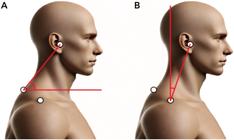
(A) Horizontal head alignment, defined as the angle with its vertex at the spinous process of C7, formed by the intersection between a horizontal reference line and the line passing through the tragus; (B) Vertical head alignment, defined as the angle with its vertex at the acromion, formed by the intersection between a vertical reference line and the line passing through the tragus.
Images were obtained in right and left lateral views with participants in a standing position, and anatomical landmarks were marked using 2-cm polystyrene spheres. Following the established protocol,18 the camera was mounted on a tripod three meters from the participant and set at half of the participant's height. A black background was used to enhance marker visibility, and a plumb line served as a vertical reference.
The line included two markers placed one meter apart for image calibration in the software. Images were captured using a smartphone compatible with the SAPO software. Anatomical landmarks were identified in both views to calculate HHA and VHA. The mean value from both views was used for each alignment measure.
Data were analyzed using descriptive statistics (mean standard ± deviation). Associations between variables were examined using Spearman's correlation coefficient (rs), with a significance level set at p < 0.05. All analyses were performed using IBM SPSS Statistics 25 (IBM Corp., Armonk, NY, USA).
Results
The sample comprised 13 young adults (5 men and 8 women), with a mean age of 33.9 ± 2.6 years, mean body weight of 67.5 ± 12.5 kg, and mean height of 1.68 ± 0.08 m. Mean daily smartphone use was 303.9 ± 73.7 minutes, and mean weekly physical activity was 4.5 ± 2.7 hours. Mean HHA and VHA were 49.1 ± 4.4° and 15.4 ± 5.6°, respectively (Table 1).
As shown in Table 2, no statistically significant associations were found between daily smartphone use andHHA (rs = −0.058; p = 0.851) or VHA (rs = −0.215; p = 0.480). Weekly physical activity showed a moderate positive correlation with HHA (rs = 0.452), albeit not statistically significant (p = 0.121). Likewise, no significant association was observed between physical activity and VHA (rs = −0.338; p = 0.258).
Spearman correlations between smartphone use, physical activity, and head alignment (n = 13)
Discussion
This study examined the association between cervical posture, smartphone use, and physical activity in young adults. No statistically significant associations were observed between smartphone use, physical activity, and the cervical alignment parameters evaluated in this pilot sample.
The absence of an association between smartphone use and cervical posture is consistent with recent evidence. In a scoping review, Grasser et al.5 reported insufficient evidence to support a direct relationship between neck flexion during smartphone use and neck pain, despite the widespread discussion of "text neck." Similarly, Damasceno et al.6 and Correia et al.7 found no consistent association between smartphone use and neck pain in adult and young populations. Together, these findings suggest that smartphone-related postures may be transient and vary throughout the day as individuals continuously adjust their posture.
Although no significant association was observed between physical activity and cervical alignment in this study, existing evidence supports its role in musculoskeletal health. Rani et al.14 reported that smaller craniovertebral angles are associated with neck pain, while Palmlöf et al.12 found that leisure-time physical activity is associated with a lower incidence of prolonged neck pain. These findings suggest that physically active individuals may exhibit better postural control and reduced mechanical load in the cervical region; however, this was not observed in the present pilot study.
This study has several important limitations. The small sample size and the use of self-reported physical activity may have introduced recall bias or overestimation of activity levels. In addition, the cross-sectional design precludes causal inference. These factors should be considered when interpreting these findings.
Despite these limitations, this pilot study contributes to the ongoing discussion regarding the relationship between smartphone use, physical activity, and cervical posture. These results suggest that smartphone use alone may not be associated with measurable changes in cervical alignment. Similarly, although physical activity is widely recognized for its benefits to musculoskeletal health, no significant associations were observed with the postural parameters analyzed. These results highlight the need for caution when interpreting relationships between sedentary behavior, physical activity, and cervical posture, and underscore the importance of future studies with larger samples and more robust designs to inform clinical recommendations.
Conclusion
Daily smartphone use was not significantly associated with cervical posture alignment in young adults. Similarly, no statistically significant associations were observed between physical activity and the cervical alignment parameters evaluated in this pilot study. Further studies with larger samples and longitudinal designs are needed to better understand these relationships.
Data availability statement
The data that support the findings of this study are available upon reasonable request.
References
-
1 Instituto Brasileiro de Geografia e Estatística. PNAD contínua: acesso à internet e à televisão e posse de telefone móvel celular para uso pessoal 2022. IBGE; 2023 [cited 2024 Jul 15]. Available from: https://tinyurl.com/e8z239vp
» https://tinyurl.com/e8z239vp -
2 Tirone J. Digital Brazil 2024: navegue pelos dados e insights. Global AD; 2024 [cited 2024 Jul 13]. Available from: https://tinyurl.com/jwv4hwpc
» https://tinyurl.com/jwv4hwpc -
3 Nakshine VS, Thute P, Khatib MN, Sarkar B. Increased screen time as a cause of declining physical, psychological health, and sleep patterns: a literary review. Cureus. 2022;14(10):e30051. https://doi.org/10.7759/cureus.30051
» https://doi.org/10.7759/cureus.30051 -
4 Tsantili AR, Chrysikos D, Troupis T. Text neck syndrome: disentangling a new epidemic. Acta Med Acad. 2022;51(2):123-7. https://doi.org/10.5644/ama2006-124.380
» https://doi.org/10.5644/ama2006-124.380 -
5 Grasser T, Dario AB, Parreira PCS, Correia IMT, Meziat-Filho N. Defining text neck: a scoping review. Eur Spine J. 2023;32 (10):3463-84. https://doi.org/10.1007/s00586-023-07821-2
» https://doi.org/10.1007/s00586-023-07821-2 -
6 Damasceno GM, Ferreira AS, Nogueira LAC, Reis FJJ, Andrade ICS, Meziat-Filho N. Text neck and neck pain in 18-21-year-old young adults. Eur Spine J. 2018;27(6):1249-54. https://doi.org/10.1007/s00586-017-5444-5
» https://doi.org/10.1007/s00586-017-5444-5 -
7 Correia IMT, Ferreira AS, Fernandez J, Reis FJJ, Nogueira LAC, Meziat-Filho N. Association between text neck and neck pain in adults. Spine (Phila Pa 1976). 2021;46(9):571-8. https://doi.org/10.1097/brs.0000000000003854
» https://doi.org/10.1097/brs.0000000000003854 -
8 Lissak G. Adverse physiological and psychological effects of screen time on children and adolescents: literature review and case study. Environ Res. 2018;164:149-57. https://doi.org/10.1016/j.envres.2018.01.015
» https://doi.org/10.1016/j.envres.2018.01.015 -
9 Brasil. Vigitel Brazil 2006-2021: vigilância de fatores de risco e proteção para doenças crônicas por inquérito telefônico. Brasília: Ministério da Saúde; 2022. https://tinyurl.com/pszvnb3m
» https://tinyurl.com/pszvnb3m -
10 World Health Organization. WHO guidelines on physical activity and sedentary behaviour. Geneva: WHO; 2020 [cited 2024 Jul 15]. Avialable from: https://iris.who.int/bitstream/handle/10665/336656/9789240015128-eng.pdf
» https://iris.who.int/bitstream/handle/10665/336656/9789240015128-eng.pdf -
11 Warburton DE, Nicol CW, Bredin SSD. Health benefits of physical activity: the evidence. CMAJ. 2006;174(6):801-9. https://doi.org/10.1503/cmaj.051351
» https://doi.org/10.1503/cmaj.051351 -
12 Palmlöf L, Holm LW, Alfredsson L, Magnusson C, Vingård E, Skillgate E. The impact of work-related physical activity and leisure physical activity on the risk and prognosis of neck pain: a population-based cohort study on workers. BMC Musculoskelet Disord. 2016;17:219. https://doi.org/10.1186/s12891-016-1080-1
» https://doi.org/10.1186/s12891-016-1080-1 -
13 Fedorak C, Ashworth N, Marshall J, Paull H. Reliability of the visual assessment of cervical and lumbar lordosis: how good are we? Spine (Phila Pa 1976). 2003;28(16):1857-9. https://doi.org/10.1097/01.brs.0000083281.48923.bd
» https://doi.org/10.1097/01.brs.0000083281.48923.bd -
14 Rani B, Paul A, Chauhan A, Pradhan P, Dhillon MS. Is neck pain related to sagittal head and neck posture?: A systematic review and meta-analysis. Indian J Orthop. 2023;57(3):371-403. https://doi.org/10.1007/s43465-023-00820-x
» https://doi.org/10.1007/s43465-023-00820-x -
15 Krawczky B, Pacheco AG, Mainenti MRM. A systematic review of the angular values obtained by computerized photogrammetry in sagittal plane: a proposal for reference values. J Manipulative Physiol Ther. 2014;37(4):269-75. https://doi.org/10.1016/j.jmpt.2014.01.002
» https://doi.org/10.1016/j.jmpt.2014.01.002 -
16 Ribeiro AFM, Bergmann A, Lemos T, Pacheco AG, Russo MM, Oliveira LAS, et al. Reference values for human posture measurements based on computerized photogrammetry: a systematic review. J Manipulative Physiol Ther. 2017;40(3):156-68. https://doi.org/10.1016/j.jmpt.2016.12.001
» https://doi.org/10.1016/j.jmpt.2016.12.001 -
17 Craig CL, Marshall AL, Sjöström M, Bauman AE, Booth ML, Ainsworth BE, et al. International physical activity questionnaire: 12-country reliability and validity. Med Sci Sports Exerc. 2003;35(8):1381-95. https://doi.org/10.1249/01.mss.0000078924.61453.fb
» https://doi.org/10.1249/01.mss.0000078924.61453.fb -
18 Duarte M, Ferreira EA, Maldonado EP, Freitas AZ. Documentação sobre o SAPO: software para avaliação postural. BMClab; 2005 [cited 2023 Apr 12]. Available from: https://bmclab.pesquisa.ufabc.edu.br/sapo2/SAPOdoc.pdf
» https://bmclab.pesquisa.ufabc.edu.br/sapo2/SAPOdoc.pdf -
19 Ferreira EAG, Duarte M, Maldonado EP, Burke TN, Marques AP. Postural assessment software (PAS/SAPO): Validation and reliabiliy. Clinics (Sao Paulo). 2010;65(7):675-81. https://doi.org/10.1590/s1807-59322010000700005
» https://doi.org/10.1590/s1807-59322010000700005 -
20 Paes JL, Piazza L, Tormen L, Libardoni TC, Pasquali T, Santos GM. Confiabilidade intra e interexaminador da avaliação do alinhamento da cabeça nas posições sentado e em pé. Fisioter Pesqui. 2017;24(1):29-39. https://doi.org/10.1590/1809-2950/15962824012017
» https://doi.org/10.1590/1809-2950/15962824012017
Edited by
-
Associate editor:
Emmanuel Souza da Rocha