 Factors associated with access to rehabilitation services one month after stroke in Brazil: Influence of sociodemographic, clinical-functional factors and the pandemic
ABSTRACT
Despite being devastating, the pandemic brought opportunities to investigate the operation of rehabilitation services in different health contexts. To identify the factors associated with access to rehabilitation services among individuals with stroke one month after hospital discharge. This is a prospective longitudinal study, in which individuals with stroke were recruited in a Brazilian city from September 2019 to February 2021. The factors associated with access to rehabilitation services were investigated using linear regression analysis, considering 11 sociodemographic and clinical-functional variables and the period of access to rehabilitation services (pre-pandemic or during the COVID-19 pandemic) (a=5%). In total, 150 participants were included; 50.7% had access to rehabilitation services pre-pandemic and 49.3% during the pandemic. Functional independence was the only significant factor, explaining 27% of the variance in access (F=56.2; p<0.001). A lower level of functional independence was the only factor associated with access to rehabilitation services one month after hospital discharge among individuals with stroke, regardless of the pandemic period.
Keywords:
Stroke; Rehabilitation Services; COVID-19
RESUMO
Apesar de devastadora, a pandemia trouxe oportunidades para investigar o funcionamento dos serviços de reabilitação em diferentes contextos de saúde. O objetivo deste artigo é identificar os fatores relacionados ao acesso de indivíduos com AVC aos serviços de reabilitação um mês após a alta hospitalar. Trata-se de estudo longitudinal prospectivo, em que indivíduos com AVC foram recrutados em uma metrópole brasileira no período de setembro de 2019 a fevereiro de 2021. Os fatores relacionados ao acesso aos serviços de reabilitação foram investigados por meio de análise de regressão linear, considerando 11 variáveis sociodemográficas e clínico-funcionais e o período de acesso aos serviços de reabilitação (antes ou durante a pandemia de covid-19) (a=5%). No total foram incluídos 150 participantes, dos quais 50,7% tiveram acesso a serviços de reabilitação no período pré-pandemia e 49,3% no período pandêmico. O nível de independência funcional foi o único fator significativo, explicando 27% (F=56,2; p<0,001) do acesso. O menor nível de independência funcional foi o único fator associado ao acesso aos serviços de reabilitação um mês após a alta hospitalar em indivíduos com AVC, independentemente do período pandêmico.
Descritores:
Acidente Vascular Cerebral; Serviços de Reabilitação; COVID-19
RESUMEN
Aunque devastadora, la pandemia ha brindado oportunidades para analizar el funcionamiento de los servicios de rehabilitación en diferentes contextos de salud. El objetivo de este artículo es identificar los factores relacionados con el acceso de las personas con ACV a los servicios de rehabilitación un mes después del alta hospitalaria. Se trata de un estudio longitudinal prospectivo, en el que se reclutaron a individuos con ACV en una metrópoli brasileña en el período de septiembre de 2019 a febrero de 2021. Los factores relacionados con el acceso a los servicios de rehabilitación se evaluaron mediante un análisis de regresión lineal, considerando 11 variables sociodemográficas y clínico-funcionales y el período de acceso a los servicios de rehabilitación (antes o durante la pandemia de la covid-19) (a=5%). Se incluyeron un total de 150 participantes, de los cuales el 50,7% de ellos tuvo acceso a los servicios de rehabilitación en el período prepandémico; y el 49,3% en el período pandémico. El nivel de independencia funcional fue el único factor significativo, que explica el 27% (F=56,2; p<0,001) de acceso. El menor nivel de independencia funcional fue el único factor asociado con el acceso a los servicios de rehabilitación un mes después del alta hospitalaria en individuos con ACV independientemente del período de pandemia.
Palabras clave:
Accidente Cerebrovascular; Servicios de Rehabilitación; COVID-19
INTRODUCTION
Owing to its high risk of disability, stroke remains a huge challenge for public healthcare services worldwide1. Meta-analyses and guidelines2,3 recommend that rehabilitation for individuals with stroke must begin early, but this is not commonly observed. Rehabilitation is a person-centered process with specific aims to optimize health, functioning, and quality of life4,5. Therefore, it is expected that individuals with disabilities, as usually observed after stroke, achieve full access to referred rehabilitation services. Moreover, access to rehabilitation services by individuals with stroke can influence their functional recovery and future healthcare costs5,6.
Although many studies have investigated access to rehabilitation services in general7-9, studies addressing access to rehabilitation services after stroke are scarce. In developed countries, age, race, sex, health insurance, disability level, and environmental and social conditions have been identified as factors associated with access to rehabilitation services after stroke4,5. In developing countries, few studies have investigated factors associated with access to rehabilitation services by individuals with stroke10,11. The identification of these factors could be useful for understanding the direction of care in these countries. In addition, this knowledge may optimize the allocation of human and financial resources to care for these individuals in developing countries, where the burden of stroke is even greater5.
The COVID-19 pandemic was a relevant event that directly impacted the availability of rehabilitation services12. Even in contexts without a crisis, people with disabilities have faced inaccessible rehabilitation services; during the pandemic, barriers in accessing these services may have been exacerbated. Therefore, it is possible that the pandemic became a factor associated with reduced access to rehabilitation services, mainly in Brazil, which had one of the highest numbers of cases and deaths due to COVID-1913. It is important to emphasize that during the pandemic, the global trend of increasing admissions of severe stroke cases was also observed in Brazil14. Therefore, a higher demand for access to rehabilitation services by individuals with stroke may have occurred during the pandemic and may be necessary even after its end.
Despite being devastating, the pandemic brought opportunities to investigate the functioning of rehabilitation services in different health contexts3. Even after its end, information about the operation of rehabilitation services during the pandemic offers opportunities to create improvements that favor strong, responsive, and comprehensive healthcare systems. This information is necessary for rehabilitation services to maintain continuity and comprehensiveness of care during current and future crises. Thus, the identification of factors associated with access to rehabilitation, considering the pandemic as a potential predictor, may be useful for directing public policies that favor immediate and complete access to rehabilitation services by individuals with stroke in different health contexts. This study aimed to identify the factors associated with access to rehabilitation services by individuals with stroke one month after hospital discharge in Southeastern Brazil, considering sociodemographic and clinical-functional variables, as well as the period of access to rehabilitation services-before or during the pandemic-as potential factors.
METHODOLOGY
Study design
A prospective longitudinal study was conducted with individuals with stroke, regardless of stroke type. This study was developed and reported following the Strengthening the Reporting of Observational Studies in Epidemiology (STROBE) guidelines15.
Population
Individuals with stroke admitted to a stroke unit at a large public hospital in Southeastern Brazil during the pre-pandemic and the pandemic were included.
Study Setting
Individuals with stroke were recruited from a hospital located in Belo Horizonte, an important metropolitan area in Southeastern Brazil. Belo Horizonte city, a metropolis in this region, has the third largest urban agglomeration in Brazil and a ratio of stroke services to population similar to that of other major metropolises, such as Madrid, Toronto, Washington DC, and Frankfurt. Individuals were recruited from September 2019 to February 2021. Each patient included in the study was sequentially interviewed one month after hospital discharge.
INCLUSION CRITERIA
All participants admitted to the stroke unit during the recruitment period were screened and invited to participate in the study, as recommended for representative cohort studies16. The inclusion criteria were as follows: 1) first diagnosis of stroke; 2) age ≥20 years; 3) residence in the metropolitan area of Belo Horizonte; and 4) referral to rehabilitation professionals by the hospital team at the time of hospital discharge. Individuals who had functional dependence prior to stroke, defined as a score ≤17 on the Barthel Index (BI), as previously used4,12, were excluded. This version of the Barthel Index includes 10 activities of daily living, is scored in one-point increments, and ranges from 0 to 20 points17-19. Another exclusion criterion was the presence of previous cognitive decline (score ≥1 on the Hetero-anamnesis List Cognition Score)20. Individuals’ proxies answered both questionnaires based on the individuals’ activity performance and cognitive function immediately before the stroke20. All eligibility criteria were verified in the hospital within 72 hours of hospital admission.
Sample calculation
Sample size was estimated using the equation P=(n+1)×10, in which “n” refers to the number of independent variables in the multiple regression model21. In this study, 11 independent variables were selected: age, sex, living arrangements, place of residence, education level, socioeconomic status, participation in health follow-up immediately preceding stroke, access to public or private healthcare services, stroke severity, level of functional independence (Modified Barthel Index [MBI]), and the period of access to rehabilitation services (before or during the pandemic). Therefore, the estimated sample size was 120 individuals. Considering potential losses during follow-up, an additional 20% was added to the sample calculation, and data from at least 144 volunteers were collected at the time of hospital discharge22.
Data collection
The dependent variable in this study was the proportional access to rehabilitation services one month after hospital discharge, considering the number of referred rehabilitation services prescribed by the stroke unit multiprofessional team4. To obtain a numerical value for the dependent variable, the number of rehabilitation services accessed one month after discharge was divided by the number of rehabilitation services referred during hospitalization. Therefore, the dependent variable ranged from 0 to 100, with higher values representing greater access.
The independent variables in the present study were:
-
Sociodemographic: age (years), sex (female or male), living arrangements (living alone or with a partner), place of residence (in the capital city or in other areas of the metropolitan area), education level (illiterate; one to four years of study; five to seven years of study; eight to ten years of study; and eleven or more years of study), socioeconomic status23, participation in healthcare follow-up immediately before the stroke, and type of rehabilitation service (private or public). Socioeconomic status was based on the classification system of the Brazilian Association of Research Companies, in which the purchasing power of the Brazilian population is classified according to aspects related to the physical structure of the household, the number of durable consumer goods, and the education level of the head of household23.
-
Clinical-functional: stroke severity and level of functional independence. Stroke severity was assessed using the National Institutes of Health Stroke Scale (NIHSS), which is a valid and reliable measure of stroke severity24. Functional independence was assessed using the MBI, which has been shown to be a valid and reliable measure of functional independence in individuals with stroke17,19.
-
Period of access to rehabilitation services: this variable was determined based on the date of hospital discharge. The pandemic period was defined as the period from September 2020 to March 2021. The pre-pandemic period was defined as the period from September 2019 to March 20209,8.
After confirmation of the eligibility criteria and provision of written informed consent, the independent variables were collected at hospital discharge. All baseline assessments (T0) were standardized according to the routine admission procedures of the stroke unit and conducted by a multiprofessional team. In addition, referrals provided by the hospital rehabilitation team at discharge were recorded. One month after hospital discharge (T1), data regarding rehabilitation access were collected by telephone using a semi-structured questionnaire based on previous similar studies regarding access to rehabilitation services4,25,26. Patients or their proxies were asked whether the patient had accessed any rehabilitation service after hospital discharge, as referred by the rehabilitation team of the stroke unit. The following guiding question was asked: “Did you (or the patient) undergo rehabilitation treatment after hospital discharge?”
Data analysis
Descriptive statistics were performed for all variables, considering the variable type and distribution normality (Kolmogorov-Smirnov test).
Stepwise linear regression analyses were conducted to identify the factors associated with access to rehabilitation services one month after stroke. For this model, the following assumptions were verified: linearity and homoscedasticity (plots of standardized residuals against standardized associated factor values), independence of residuals (Durbin-Watson test; values close to 2), normality (visual inspection of histograms and data plots), multicollinearity (variance inflation factor not substantially greater than 1), and influential outliers (Cook’s distance>1). The entry criterion for variables in the model was set at 0.05 and the removal criterion at 0.10. All statistical analyses were performed using SPSS for Windows software (SPSS Inc., Chicago, IL, USA), version 20, with a significance level of a=0.05.
Ethical aspects
The study was approved by the institutional research ethics committee (CAAE:264313 19.6.0000.5149). All individuals or their proxies provided written informed consent before inclusion in the study.
RESULTS
Participant characteristics
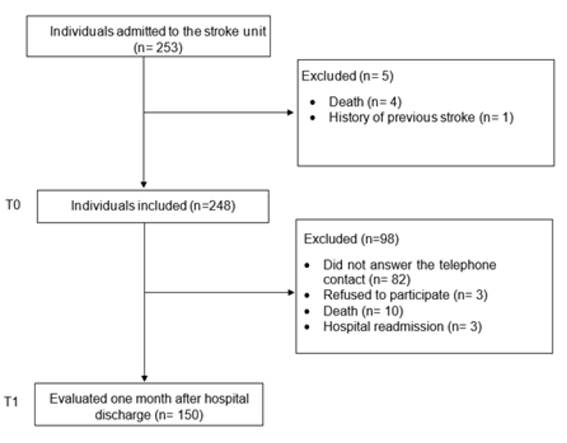
Figure 1 shows the flow of participants through the study. As shown, 248 individuals met all study inclusion criteria, and one month after hospital discharge, 150 volunteers were assessed for access to rehabilitation services.
Regarding the sociodemographic characteristics of the volunteers assessed at T1, 50.6% were female. The mean age of all participants was 61.5 years (standard deviation [SD] = 14.5), and most lived in the capital (61.3%), had studied for fewer than 5 years (57.3%), were classified as economic class “C1” or “C2” (59.3%), and had access to public rehabilitation services (85.3%) (Table 1). Regarding the clinical-functional characteristics, most volunteers were classified as having slight stroke severity (52%) and had a mean MBI score of 55.1±34.9. Finally, 50.7% had access to rehabilitation services in the pre-pandemic period and 49.3% in the pandemic period, and at least one referred rehabilitation service was accessed by all participants. Considering the total number of referrals provided by the hospital rehabilitation team, 46.1±34.7% were accessed by the participants.
Regression analyses
Table 2 presents the results of the regression analyses. Only the level of functional independence assessed by the MBI was retained in the model and explained 27% (F=56.2; p<0.001) of the variance in access to rehabilitation services one month after hospital discharge. The MBI was negatively associated with access to rehabilitation services, indicating that volunteers with lower functional independence after stroke were more likely to access the rehabilitation services referred by the hospital rehabilitation team one month after the stroke.
DISCUSSION
This study aimed to identify factors associated with access to rehabilitation services among individuals with stroke one month after hospital discharge in southeastern Brazil, considering sociodemographic and clinical-functional variables, as well as the period of access to rehabilitation services before or during the pandemic. According to the results, the level of functional independence assessed at hospital discharge, measured by the MBI, was the only significant factor associated with access to rehabilitation services.
The only independent variable associated with access to rehabilitation services was the lower level of functional independence. In a non-pandemic study that followed individuals with stroke for a longer period of six months, similar results were found27. In that study, conducted in a developed country, the level of functional independence, assessed using the Barthel Index and the modified Rankin Scale, was a significant factor associated with access to rehabilitation services (OR=1.6 to 6.7)27. Another recent study conducted in a developed country also found that functional independence, assessed using the modified Rankin Scale, was significantly associated with access to rehabilitation services, together with place of residence (urban versus rural) and access to private healthcare services4. Our results suggest that, regardless of other variables, the limitations identified by the MBI were the only factors associated with access to rehabilitation services among individuals with stroke within one month after hospital discharge. Therefore, the level of functional independence should be systematically evaluated in acute care services, as this outcome can facilitate the transition of care after hospital discharge.
Among the sociodemographic variables examined, including age, sex, living arrangements, place of residence, education level, and socioeconomic status, none were retained in the model. Although most participants in the present study were similar to cohorts described in previous studies4,27 in characteristics such as age range, living arrangements, and residence in urban areas, access to rehabilitation services in those studies was evaluated over a longer period. This difference may explain the difference between the findings of the present study and those of previous studies. It is possible that, during the subacute phase of stroke, the level of functional independence is a critical factor associated with access to rehabilitation services and, therefore, when analyzed together with sociodemographic variables, becomes the only significant factor.
In the present study, the type of rehabilitation service offered was not a significant factor associated with access. In the study conducted by Olmedo-Vega et al.4, the ability to pay for private rehabilitation services during the investigated period was a significant factor associated with access, and 76% of individuals with stroke used private healthcare4. To explain the findings of the present study, it is important to highlight that in Brazil most of the population is served by a public and universal health system, named the Brazilian Unified Health System (SUS)28. SUS services guarantee all Brazilian citizens access to healthcare, from primary care to hospitalization and rehabilitation units28. In addition, the study sample included individuals recruited from a Brazilian public hospital, which should be considered when interpreting this result.
Surprisingly, the pandemic was not a significant factor associated with access to rehabilitation services after stroke. This result suggests that even with the substantial changes in personal and service routines during the pandemic period29,30, access to rehabilitation services depends primarily on the level of functional independence of individuals affected by stroke. Previous studies have indicated that individuals with stroke who perceived better functional status were less likely to receive care from health professionals5,26. It is possible that, despite the difficulties imposed by the pandemic, participants in the present study with lower levels of functional independence were more motivated to seek access to rehabilitation services. Another possible explanation is that rehabilitation services were able to adapt and continue providing access to individuals with stroke, as had occurred during the pre-pandemic period. However, these possibilities were not investigated in this study.
This study has several limitations. First, the analysis considered the pandemic context in Brazil, which differed from other countries in several ways regarding COVID-19 countermeasures. Second, the sample consisted of individuals with stroke living in a metropolis in only one region of Brazil, and the results may not reflect the situation in other regions of the country. Furthermore, barriers to accessing rehabilitation services were not investigated, and this knowledge could contribute to a better understanding of access during both periods. Despite these limitations, to the best of our knowledge, no study has investigated factors associated with access to rehabilitation services after stroke while also considering the period of access-before and during the COVID-19 pandemic-as an independent variable. It is also important to emphasize that studies investigating factors associated with access to rehabilitation services in developing and underdeveloped countries are scarce. Therefore, identifying these factors may help rehabilitation services improve care for this population in different healthcare contexts, particularly in developing and underdeveloped countries where the burden of stroke is even greater.
CONCLUSION
Lower level of functional independence was the only significant factor associated with access to rehabilitation services one month after hospital discharge in individuals with stroke from Southeastern Brazil, whether before or during the pandemic.
DATA AVAILABILITY
All data underlying the findings of this study are available in the published article.
REFERENCES
-
1 Winstein CJ, Stein J, Arena R, Bates B, Cherney LR, et al. Guidelines for adult stroke rehabilitation and recovery: a guideline for healthcare professionals from the American Heart Association/American Stroke Association. Stroke. 2016;47(6):e98-e169. doi: 10.1161/STR.0000000000000098
» https://doi.org/10.1161/STR.0000000000000098 -
2 Bernhardt J, Hayward KS, Kwakkel G, Ward NS, Wolf SL, et al. Agreed definitions and a shared vision for new standards in stroke recovery research: the stroke recovery and rehabilitation roundtable taskforce. Neurorehabil Neural Repair. 2017;31(9):793-9. doi: 10.1177/1545968317732668
» https://doi.org/10.1177/1545968317732668 -
3 Weinstein SM. How COVID-19 informed the future impact of the specialty of physical medicine and rehabilitation across the health care continuum. PM & R. J Injury Func Rehabil. 2021;13(6):551-3. doi: 10.1002/pmrj.12620
» https://doi.org/10.1002/pmrj.12620 -
4 Olmedo-Vega V, Aguilar-Idáñez MJ, Arenillas-Lara JF. Comprehensive post-stroke rehabilitation: its long-term effects and the socio-environmental factors conditioning access to it. Rev Neurol. 2021;73(1):1-9. doi: 10.33588/rn.7301.2021037
» https://doi.org/10.33588/rn.7301.2021037 -
5 Ostwald SK, Godwin KM, Cheong H, Cron SG. Predictors of resuming therapy within four weeks after discharge from inpatient rehabilitation. Topics Stroke Rehabil. 2009;16(1):80-91. doi: 10.1310/tsr1601-80
» https://doi.org/10.1310/tsr1601-80 -
6 Vázquez-Guimaraens M, Caamaño-Ponte JL, Seoane-Pillado T, Cudeiro J. Factors related to greater functional recovery after suffering a stroke. Brain Scienc. 2021;11(6). doi: 10.3390/brainsci11060802
» https://doi.org/10.3390/brainsci11060802 -
7 Dawkins B, Renwick C, Ensor T, Shinkins B, Jayne D, Meads D. What factors affect patients' ability to access healthcare? An overview of systematic reviews. Trop Med Int Health. 2021;26(10):1177-88. doi: 10.1111/tmi.13651
» https://doi.org/10.1111/tmi.13651 -
8 Demenech LM, Dumith SC, Vieira MECD, Neiva-Silva L. Income inequality and risk of infection and death by COVID-19 in Brazil. Rev Bras Epidemiol. 2020;23:e200095. doi: 10.1590/1980-549720200095
» https://doi.org/10.1590/1980-549720200095 -
9 Hamiduzzaman M, De-Bellis A, Abigail W, Fletcher A. Critical social framework on the determinants of primary healthcare access and utilisation. Family Med Community Health. 2021;9(Suppl 1):e001031. doi: 10.1136/fmch-2021-001031
» https://doi.org/10.1136/fmch-2021-001031 -
10 Magalhães JP, Faria-Fortini I, Menezes KK, Lara IA, Batista LR, et al. Determinants of access to rehabilitation professionals by individuals with stroke in the first six months after hospital discharge in Brazil: a study based on the Andersen model. Topics Stroke Rehabil. 2024;31(6):615-24. doi: 10.1080/10749357.2024.2304969
» https://doi.org/10.1080/10749357.2024.2304969 -
11 Silva SM, Dutra TMFV, Braga MAF, Silva EAM, Faria-Fortini I, et al. Predictors of access to healthcare services within 1 month after stroke in a developing country: a longitudinal prospective study. Physiother Res Int. 2023:e2000. doi: 10.1002/pri.2000
» https://doi.org/10.1002/pri.2000 -
12 Dalise S, Tramonti F, Armienti E, Niccolini V, Caiglia-Tenaglia M, et al. Psycho-social impact of social distancing and isolation due to the COVID-19 containment measures on patients with physical disabilities. Eur J Phys Rehabil Med. 2021;57(1):158-65. doi: 10.23736/S1973-9087.20.06535-1
» https://doi.org/10.23736/S1973-9087.20.06535-1 -
13 Castro MC, Kim S, Barberia L, Ribeiro AF, Gurzenda S, et al. Spatiotemporal pattern of COVID-19 spread in Brazil. Science. 2021;372(6544):821-6. doi: 10.1126/science.abh1558
» https://doi.org/10.1126/science.abh1558 -
14 Benevides ML, Elias S, Costa PB, Martins ALP, Martins GL, et al. Acute ischemic stroke and COVID-19 pandemic in Brazil: a comparative study of frequency and risk factors before and during SARS-CoV-2 era. Neurol Sci. 2022;43(8):4611-7. doi: 10.1007/s10072-022-05873-8
» https://doi.org/10.1007/s10072-022-05873-8 -
15 Cuschieri S. The STROBE guidelines. Saudi J Anaesth. 2019;13(Suppl.1):S31-4. doi: 10.4103/sja.SJA_543_18
» https://doi.org/10.4103/sja.SJA_543_18 - 16 Herbert R, Jamtvedt G, Hagen KB, Mead J. Practical evidence-based physiotherapy. 2nd ed. Oxford: Elsevier Health Sciences, 2011. 186 p.
-
17 Cincura C, Pontes-Neto OM, Neville IS, Mendes HF, Menezes DF, et al. Validation of the National Institutes of Health Stroke Scale, modified Rankin Scale and Barthel Index in Brazil: the role of cultural adaptation and structured interviewing. Cerebrovasc Dis. 2009;27(2):119-22. doi: 10.1159/000177918
» https://doi.org/10.1159/000177918 -
18 Collin C, Wade DT, Davies S, Horne V. The Barthel ADL Index: a reliability study. Int Disabil Stud. 1988;10(2):61-3. doi: 10.3109/09638288809164103
» https://doi.org/10.3109/09638288809164103 -
19 Kwon S, Hartzema AG, Duncan PW, Min-Lai S. Disability measures in stroke: relationship among the Barthel Index, the Functional Independence Measure, and the Modified Rankin Scale. Stroke. 2004;35(4):918-23. doi: 10.1161/01.STR.0000119385.56094.32
» https://doi.org/10.1161/01.STR.0000119385.56094.32 -
20 Lees R, Fearon P, Harrison JK, Broomfield NM, Quinn TJ. Cognitive and mood assessment in stroke research: focused review of contemporary studies. Stroke. 2012;43(6):1678-80. doi: 10.1161/STROKEAHA.112.653303
» https://doi.org/10.1161/STROKEAHA.112.653303 -
21 Audigé L. Veterinary Epidemiologic Research: I. Dohoo, W. Martin, H. Stryhn, Atlantic Veterinary College, Charlottetown, PE, Canada, 2003. Prev Vet Med. 2005;68(2-4):289-92. doi: 10.1016/j.prevetmed.2004.11.001
» https://doi.org/10.1016/j.prevetmed.2004.11.001 -
22 Baccaro A, Wang YP, Candido M, Conforto AB, Brunoni AR, et al. Post-stroke depression and cognitive impairment: Study design and preliminary findings in a Brazilian prospective stroke cohort (EMMA study). J Affect Disord. 2019;245:72-81. doi: 10.1016/j.jad.2018.10.003
» https://doi.org/10.1016/j.jad.2018.10.003 -
23 Kamakura W, Mazzon JA. Critérios de estratificação e comparação de classificadores socioeconômicos no Brasil. Rev Admin Empres. 2016;56:55-70. doi: 10.1590/s0034-759020160106
» https://doi.org/10.1590/s0034-759020160106 -
24 Taylor-Rowan M, Wilson A, Dawson J, Quinn TJ. Functional assessment for acute stroke trials: properties, analysis, and application. Front Neurol. 2018;9:191. doi: 10.3389/fneur.2018.00191
» https://doi.org/10.3389/fneur.2018.00191 -
25 Jan S, Essue BM, Glozier N, Lindley R, Li Q, Hackett ML. Are rehabilitation services following stroke accessed equitably in Australia?: findings from the psychosocial outcomes in stroke (POISE) cohort study. BMC Public Health. 2013;13:884. doi: 10.1186/1471-2458-13-884
» https://doi.org/10.1186/1471-2458-13-884 -
26 Labberton AS, Barra M, Rønning OM, Thommessen B, Churilov L, et al. Patient and service factors associated with referral and admission to inpatient rehabilitation after the acute phase of stroke in Australia and Norway. BMC Health Serv Res. 2019;19(1):871. doi: 10.1186/s12913-019-4713-x
» https://doi.org/10.1186/s12913-019-4713-x -
27 Haan R, Limburg M, van der Meulen J, van den Bos GA. Use of health care services after stroke. Qual Health Care. 1993;2(4):222-7. doi: 10.1136/qshc.2.4.222
» https://doi.org/10.1136/qshc.2.4.222 -
28 Paim J, Travassos C, Almeida C, Bahia L, Macinko J. The Brazilian health system: history, advances, and challenges. Lancet. 2011;377(9779):1778-97. doi: 10.1016/S0140-6736(11)60054-8
» https://doi.org/10.1016/S0140-6736(11)60054-8 -
29 Odone A, Lugo A, Amerio A, Borroni E, Bosetti C, et al. COVID-19 lockdown impact on lifestyle habits of Italian adults. Acta Biomed. 2020;91(9-S):87-9. doi: 10.23750/abm.v91i9-S.10122
» https://doi.org/10.23750/abm.v91i9-S.10122 -
30 Rimmer A. Covid-19: GPs can stop health checks for over 75s and routine medicine reviews. BMJ. 2020;368:m1157. doi: 10.1136/bmj.m1157
» https://doi.org/10.1136/bmj.m1157
-
Funding sources:
Coordenação de Aperfeiçoamento de Pessoal de Nível Superior [CAPES, Grant number 001], Brazil; Fundação de Amparo à Pesquisa do Estado de Minas Gerais [FAPEMIG, APQ-00736-20], Brazil; Conselho Nacional de Desenvolvimento Científico e Tecnológico [CNPq, Grant number 302494/2018-9], Brazil; Pró-reitoria de Pesquisa da Universidade Federal de Minas Gerais [PRPq/UFMG, Grant number 05/2021]