 Association between walkability and physical activity among children and adolescents: a systematic review
ABSTRACT
Housing conditions in a neighborhood may be associated with physical activity among children and adolescents. This study aimed to evaluate the association between walkability and physical activity levels in children and adolescents. We conducted a systematic review, searching for articles published until April 2023 in the following databases: PubMed, SPORTDiscus, LILACS, Web of Science, Scopus, Embase, and Cochrane. It included studies that evaluated the association between walkability and physical activity among children and adolescents. The Newcastle Ottawa scale was used to assess the individual quality of the studies. In total, 35 studies were included, 5 longitudinal. The sample size ranged from 143 to 45,392 participants. Most of the studies found a positive association between walkability and physical activity, ~86%. Of the 19 studies that evaluated physical activity using objective methods (most of them accelerometers), 74% found positive results; for subjective methods, the percentage was 94%. Walkability was positively associated with higher levels of physical activity among children and adolescents.
Keywords
Walkability; Physical Activity; Children; Adolescents; Systematic Review
RESUMO
As condições de moradia em um bairro podem estar associadas à prática de atividade física entre crianças e adolescentes. Este estudo teve como objetivo avaliar a associação entre caminhabilidade e níveis de atividade física em crianças e adolescentes. Realizou-se uma revisão sistemática buscando artigos publicados até abril de 2023 nas seguintes bases de dados: PubMed, SPORTDiscus, LILACS, Web of Science, Scopus, Embase e Cochrane. Foram incluídos estudos que avaliaram a associação entre caminhabilidade (walkability) e atividade física entre crianças e adolescentes. A escala Newcastle Ottawa foi utilizada para avaliar a qualidade individual dos estudos. No total, foram incluídos 35 estudos, sendo cinco longitudinais. O tamanho da amostra variou de 143 a 45.392 participantes. A maioria dos estudos encontrou uma associação positiva entre caminhabilidade e atividade física (~86%). Dos 19 estudos que avaliaram a atividade física por meio de métodos objetivos (a maioria deles acelerômetros), 74% encontraram resultados positivos; para métodos subjetivos, o percentual foi de 94%. A caminhabilidade esteve positivamente associada a maiores níveis de atividade física entre crianças e adolescentes.
Descritores
Caminhabilidade; Atividade Física; Crianças; Adolescentes; Artigo de Revisão
RESUMEN
Las condiciones de vivienda en un barrio pueden asociarse con la práctica de actividad física entre niños y adolescentes. Este estudio tuvo el objetivo de evaluar la asociación entre caminabilidad y niveles de actividad física en niños y adolescentes. Se realizó una revisión sistemática buscando artículos publicados hasta abril de 2023 en las siguientes bases de datos: PubMed, SPORTDiscus, LILACS, Web of Science, Scopus, Embase y Cochrane. Se incluyeron estudios que evaluaron la asociación entre caminabilidad y actividad física entre niños y adolescentes. Se utilizó la escala Newcastle Ottawa para evaluar la calidad individual de los estudios. En total, se incluyeron 35 estudios, de los cuales cinco son longitudinales. El tamaño de la muestra osciló entre 143 y 45392 participantes. La mayoría de los estudios encontró una asociación positiva entre caminabilidad y actividad física (aproximadamente el 86%). De los 19 estudios que evaluaron la actividad física a través de métodos objetivos (la mayoría acelerómetros), el 74% encontró resultados positivos; para métodos subjetivos, el porcentaje fue del 94%. La caminabilidad se asoció positivamente con niveles más altos de actividad física entre niños y adolescentes.
Palabras clave
Caminabilidad; Actividad Física; Niños; Adolescentes; Artículo de Revisión
INTRODUCTION
Physical activity is essential for good health and should be practiced since early life 1 . Along with sedentary habits, it is developed during the first years, especially between the ages of 0 and 5 2 . These habits tend to last throughout adulthood, making it difficult to change them later. Among the benefits of starting physical activity early, physical conditioning and cardiorespiratory health stand out, as they provide health benefits during adulthood, especially by protecting against cardiovascular risks 3 - 5 .
Physical activity during childhood go far beyond a moment of leisure: they create healthy life habits, granting lifelong benefits 3 . In adulthood, physical activity has been shown to be beneficial against several health outcomes, such as cardiovascular disease and all-cause mortality 6 , diabetes 7 , obesity 8 , 9 , and metabolic syndrome 10 . Among older adults, physical activity is especially protective against multimorbidity 11 . This range of protection confirms the importance of physical activity since early years. However, its practice depends on suitable and available places for it to take place, meaning the urban environment in which people live must be accessible to pedestrians, providing easy, safe, and convenient areas for walking, exercising, and moving around. This is referred to as walkability 12 .
Despite this range of evidence pointing to the influence of physical activity during early years, most adolescents do not reach the recommended physical activity for their age as proposed in guidelines 13 . Data from almost 300 schools, totaling approximately 1.6 million students from the ages 11 to 17, showed 81% of this population as physically inactive. Among girls, the prevalence was even higher, reaching almost 85% 13 . Among adults in the United States, data from 2008 to 2017 showed a positive advance in physical activity, but numbers are still low and showed only about 25% of urban dwellers were physically active 14 .
Studies suggest social environments and specific programs should encourage physical activity 15 . Moreover, it is important to determine the association between walkability and physical activity among children and adolescents, since healthy habits tend to last throughout an individual’s life. Given the significance of physical activity throughout life, it is imperative to recognize that the surrounding environment plays a pivotal role in influencing its engagement. Conducting a systematic review is instrumental in elucidating the extent to which this relationship is established or not. Therefore, this study evaluates the association between walkability and physical activity levels in children and adolescents.
METHODOLOGY
The following systematic review and meta-analysis was carried out following the Preferred Reporting Items for Systematic Reviews and Meta-Analyses Protocols (PRISMA) guidelines 16 . The study protocol was registered in the International Prospective Register of Systematic Reviews (PROSPERO) under registration number CRD42021290914 and was published in the Brazilian Journal of Physical Activity and Health 17 .
To formulate the research question, the Population, Intervention, Comparison, Outcome, and Study Design (PICOS) strategy was used, as outlined in Supplementary Table 1 . Guided by this approach, the ensuing research question was formulated as follows: “What is the association between walkability and physical activity in children and adolescents?”.
Search strategy and databases
The searches were conducted until December 2021 and updated in April 2023, encompassing databases such as PubMed, SPORTDiscus, LILACS, Web of Science, Scopus, Embase, and Cochrane. We also searched Google Scholar to include studies from grey literature. Furthermore, a comprehensive screening of references from the included studies was conducted, along with relevant systematic reviews.
Search terms and their combinations were meticulously optimized based on distinctive characteristics of each individual database. We prioritized using terms from Medical Subject Heading (MeSH), along with searches encompassing titles and abstracts whenever feasible. The amalgamation of terms related to walkability and the outcome of interest, physical activity, was achieved using Boolean operators ‘OR’ and ‘AND’. A detailed outline of the complete search strategy implemented across each database is available in Supplementary Table 2 .
Quality of evidence in included studies in the systematic review. Newcastle-Ottawa Scale (NOS) (n=35)
Inclusion and exclusion criteria
Studies meeting the following criteria were eligible for inclusion: observational design encompassing either cross-sectional or longitudinal design; primary focus on walkability, or its criteria, as the independent variable; examination of its association with physical activity.
We excluded studies conducted with animals or in vitro models, studies with patients with specific diseases, studies with adults or older adults, review, and opinion articles.
Review process
Initially, two reviewers gathered virtually to streamline the study selection procedure, aimed at enhancing uniformity and optimizing outcomes. As part of this endeavor, a pilot phase involving 50 titles and abstracts was executed before the official commencement of the review. The main goal was to establish standardization and, if necessary, to effect potential refinements to the inclusion and exclusion criteria.
After conducting the searches, results were imported into the EndNote x7 tool to facilitate the exclusion of duplicates. Then, the reviewers transferred the titles to the Rayyan tool, which served as a platform for the comprehensive study selection process. The initial step encompassed screening titles and abstracts, followed by involving a thorough examination of articles meeting the criteria for inclusion and exclusion. The study selection process was executed in an independently by two reviewers, with any discrepancies being fixed by a third party. Following these steps, a review of the references within the included studies was undertaken, supplemented by a search using Google Scholar. This meticulous course of action was planned to ensure the inclusion of all pertinent studies available in the literature.
Data extraction and quality of evidence
For each included study, we gathered key details, including identification particulars (author and year), sample description (e.g., 1500 participants from Brazil), age (average age of participants), study design (cross-sectional or longitudinal), method employed to measure physical activity (subjective or objective), and main findings (e.g., positive correlation observed between walkability and increased engagement in physical activity).
The evaluation of evidence quality was executed using the Newcastle Ottawa Scale (NOS) 53 . Two independent reviewers conducted the assessment of individual study quality, with any discrepancies being fixed by a third party. For longitudinal studies, the original NOS scale was employed, encompassing eight distinct items pertaining to aspects such as study selection, comparability, and outcome evaluation. Each item was awarded a point denoting high quality, except for the comparability item, which could receive up to two points. In the context of cross-sectional designs, an adapted version of the scale was used, based on a prior publication 54 . This scale comprises seven items addressing study selection, comparability, and outcome assessment, with points indicating high quality on each respective item. Consequently, the cumulative NOS scale score ranges from 0 to 9 for cohort studies and 0 to 8 for cross-sectional studies.
RESULTS
Study selection
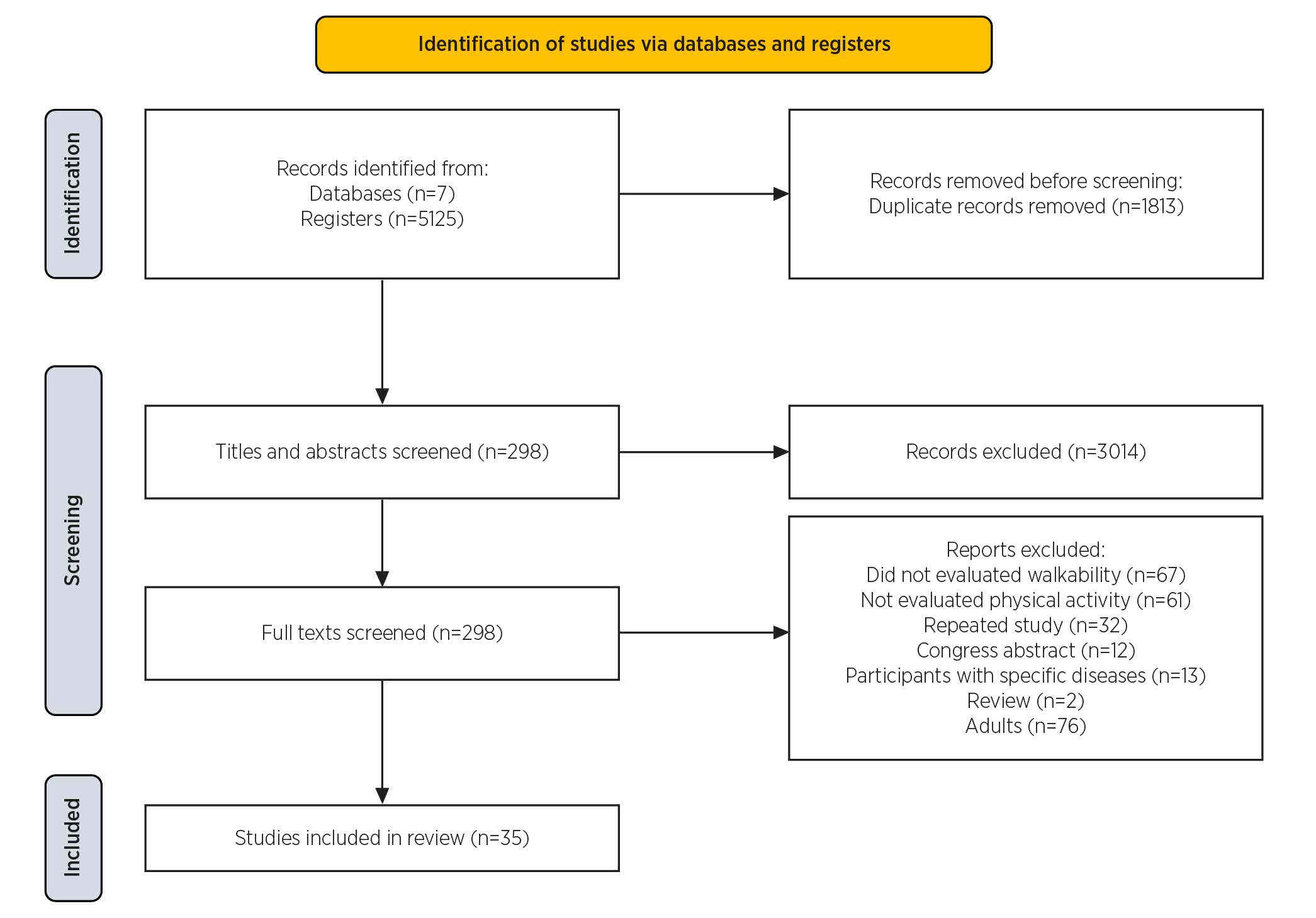
Figure 1 presents the flowchart of studies selection. Considering the seven databases, we found 5125 articles and 3312 after excluding duplicates. In the process of titles and abstracts reading, we selected 298 manuscripts, of which 262 were excluded for the following reasons: did not evaluated walkability (n=67); evaluated different outcomes (n=67); repeated study (n=32); congress abstracts (n=12); participants with specific diseases (n=13); review study (n=2); participants adults (n=76). Thus, 35 studies were included in the present review, totaling approximately 120 thousand participants.
Study characteristics
Most studies were published in the United States (n=13) 18 - 21 , 26 - 28 , 30 , 34 , 35 , 37 , 38 , 49 ,from 2007 24 to 2023 48 , 49 . Five studies were longitudinal and, mostly, cross-sectional (n=30). The smallest sample size was 143 adolescents aged 13-18 years old in one study published in South Africa 48 , while the largest was 45.392 youth aged 10-17 years old in a study conducted in the United States, in 2012 20 . Most studies (n=19) assessed physical activity using objective methods, such as accelerometers. Alternatively, 16 studies assessed physical activity using subjective methods, such as questionnaires.
Risk of bias in studies
Table 2 presents the NOS scale with the individual quality of risk of each study. Of the four longitudinal studies, three scored 6 points and two scored 7 points. Regarding cross-sectional studies, the score ranged from 3 points in one study to 7 in another, totaling anhe average score of 5.
Main findings
Of the 35 studies included, 30 found at least one significant result between walkability or some of its components and levels of physical activity among children and adolescents, which represents around 86% of the studies. Of the five longitudinal studies, three found a significant association between walkability and higher levels of physical activity 37 , 47 , 50 .
Of the 19 studies that assessed physical activity using objective methods, 14 found positive results between walkability and physical activity 19 , 22 , 24 , 25 , 28 , 29 , 32 , 36 , 37 , 39 , 44 , 46 , 47 , 50 , representing around 74% of the studies. Four studies found null results between walkability and physical activity levels 20 , 21 , 49 , 55 . On the other hand, the study by Nakabazzi et al. 64 , found a negative result between walkability and physical activity.
Of the 16 studies that assessed physical activity using a questionnaire, 15 (94%) found a positive association between walkability and physical activity 18 , 27 , 31 , 33 - 35 , 37 - 42 , 45 , 48 , 51 , while only one study found a null result between walkability and physical activity 20 .
DISCUSSION
This systematic review included 35 studies that evaluated the association between walkability, or one of its components, and physical activity among children and adolescents. The results showed most of the studies, 86%, found a positive association between walkability and physical activity, suggesting that living near places that facilitate physical activity increases physical activity levels among children and adolescents.
Our findings could be fundamental to create public policies and redirect resources towards building suitable environments in neighborhoods that encourage greater physical activity. The literature corroborates these findings, and a study in Turkey found most of the sample associated lack of time as a barrier to physical activity 56 . In other words, an environment that allowed people to do physical activity without commuting would increase the chances of fewer students giving up physical activity, regardless of age. A study of adults aged 55 years old and over showed neighborhood walkability can contribute to greater physical activity 57 , increasing levels of movement.
With our results, we expect public policies to be carried out, encouraging the implementation of appropriate areas for physical activity. It is likely that investments in neighborhoods with greater walkability will result in increased levels of physical activity among children and adolescents, which, in the future, will develop protection against chronic diseases and health problems. Among adults and older adults, higher levels of physical activity could be a healthy alternative to administer chronic diseases 58 . However, parents need to be aware and encourage their children to do more outdoor activities and limit screen time, especially among the youngest.
Excessive screen time should be especially discouraged among children and adolescents, as it can have a negative impact on physical activity 59 . A cross-sectional study found that higher levels of physical activity and less screen time were positively associated with increased mental health among children during the pandemic 60 . Corroborating these hypotheses, a cluster randomized clinical trial with 86 children showed reducing recreational screen time resulted in a substantial increase in physical activity levels among children 61 .
Children’s and adolescents’ mental health requires special attention from everyone, and physical activity can be a positive influence 60 . Physical activity among children and adolescents releases excess energy, reduces anxiety and depression, relieves tension, and increases self-esteem 63 . A meta-analysis of adolescents and young people, including 24 studies, found the presence of mental disorders was associated with a higher risk of suicide, as was attempted suicide, which reinforces the importance of physical activity at this age 64 .
To the best of our knowledge, we are the first systematic review to evaluate the association between walkability and physical activity in children and adolescents. Results are promising and show the living environment is associated with greater physical activity among this population. However, the studies are very heterogeneous and include important differences, such as sample size, characterization of walkability, assessment of physical activity, design (only five studies were longitudinal), among others. This facilitated a meta-analysis to assess grouped results. Finally, no studies achieved the maximum score on the NOS scale, either for longitudinal or cross-sectional studies. It is recommended that future cohorts be conducted to assess longitudinal effects of walkability on physical activity levels, which will allow a meta-analysis to be conducted in the future.
CONCLUSION
Walkability was positively associated with higher levels of physical activity among children and adolescents. Implementing public policies and creating suitable environments for physical activity could result in higher levels of physical activity in the future.
REFERENCES
-
1. Hallal PC, Victora CG, Azevedo MR, Wells JCK. Adolescent physical activity and health: a systematic review. Sports Med. 2006;36:1019-30. doi: 10.2165/00007256-200636120-00003
» https://doi.org/10.2165/00007256-200636120-00003 -
2. Crumbley CA, Ledoux TA, Johnston CA. Physical Activity During early childhood: the importance of parental modeling. Am J Lifestyle Med. 2019;14(1):32-5. doi: 10.1177/1559827619880513
» https://doi.org/10.1177/1559827619880513 -
3. Landry BW, Driscoll SW. Physical activity in children and adolescents. PM R. 2012;4(11):826-32. doi: 10.1016/j.pmrj.2012.09.585
» https://doi.org/10.1016/j.pmrj.2012.09.585 -
4. Füssenich LM, Boddy LM, Green DJ, Graves LEF, Foweather L, et al. Physical activity guidelines and cardiovascular risk in children: a cross sectional analysis to determine whether 60 minutes is enough. BMC Public Health. 2016;16:67. doi: 10.1186/s12889-016-2708-7
» https://doi.org/10.1186/s12889-016-2708-7 -
5. Lee IM. Physical activity and cardiac protection. Cur Sports Med Reports. 2010;9(4):214-9. doi: 10.1249/JSR.0b013e3181e7daf1
» https://doi.org/10.1249/JSR.0b013e3181e7daf1 -
6. Breckenkamp J, Blettner M, Laaser U. Physical activity, cardiovascular morbidity and overall mortality: results from a 14-year follow-up of the German Health Interview Survey. J Public Health (Bangkok). 2004;12:321-8. doi: 10.1007/s10389-004-0051-4
» https://doi.org/10.1007/s10389-004-0051-4 -
7. Norat DA, Leitzmann M, Tonstad S, Vatten L. Physical activity and the risk of type 2 diabetes: a systematic review and dose-response meta-analysis. Eur J Epidemiol. 2015;30(7):529-42. doi: 10.1007/s10654-015-0056-z
» https://doi.org/10.1007/s10654-015-0056-z -
8. Jakicic JM, Davis KK. Obesity and physical activity. Psychiatr Clin North Am. 2011;34:829-40. doi: 10.1016/j.psc.2011.08.009
» https://doi.org/10.1016/j.psc.2011.08.009 -
9. Strasser B. Physical activity in obesity and metabolic syndrome. Ann N Y Acad Sci 2013. 1281(1):141-59. doi: 10.1111/j.1749-6632.2012.06785.x
» https://doi.org/10.1111/j.1749-6632.2012.06785.x -
10. Renninger M, Hansen BH, Steene-Johannessen J, Kriemler S, Froberg K, et al. Associations between accelerometry measured physical activity and sedentary time and the metabolic syndrome: A meta-analysis of more than 6000 children and adolescents. Pediatr Obesity. 2019;15(1):e12578. doi: 10.1111/ijpo.12578
» https://doi.org/10.1111/ijpo.12578 -
11. Delpino FM, Lima APM, Silva BGC, nuness BP, Caputo EL, et al. Physical activity and multimorbidity among community-dwelling older adults: a systematic review with meta-analysis. Am J Health Promot. 2022;36(8):1371-85. doi: 10.1177/08901171221104458
» https://doi.org/10.1177/08901171221104458 -
12. Westenhöfer J, Nouri E, Reschke ML, Seebach F, Buchcik J. Walkability and urban built environments—a systematic review of health impact assessments (HIA). BMC Public Health. 2023;23(1):518. doi: 10.1186/s12889-023-15394-4
» https://doi.org/10.1186/s12889-023-15394-4 -
13. Guthold R, Stevens GA, Riley LM, Bull FC. Global trends in insufficient physical activity among adolescents: a pooled analysis of 298 population-based surveys with 1·6 million participants. Lancet Child Adolesc Health. 2020;4(1):23-35. doi: 10.1016/S2352-4642(19)30323-2
» https://doi.org/10.1016/S2352-4642(19)30323-2 -
14. Whitfield GP, Carlson SA, Ussery EN, Fulton JE, Galuska DA, et al. Trends in meeting physical activity guidelines among urban and rural dwelling adults – United States, 2008-2017. MMWR Morb Mortal Wkly Rep. 2019;68(23):513-8. doi: 10.15585/mmwr.mm6823a1
» https://doi.org/10.15585/mmwr.mm6823a1 -
15. Ståhl T, Rütten A, Nutbeam D, Bauman A, Kannas L, et al. The importance of the social environment for physically active lifestyle – Results from an international study. Soc Sci Med. 2001;52(1):1-10. doi: 10.1016/s0277-9536(00)00116-7
» https://doi.org/10.1016/s0277-9536(00)00116-7 -
16. Page M, Mckenzie JE, Bossuyt PM, Boutron I, Hoffmann TC, et al. The PRISMA 2020 statement: an updated guidelines for reporting systematic reviews. J Clin Epidemiol. 2021;134:178-89. doi: 10.1016/j.jclinepi.2021.03.001
» https://doi.org/10.1016/j.jclinepi.2021.03.001 -
17. Bruno GBM, Delpino FM, Miragem AA, Olsson LAV, Mello AD. Walkability and physical activity: a protocol for systematic review and meta-analysis / Associação entre walkability e atividade física: um protocolo para revisão sistemática e meta-análise. Rev Bras Ativ Fís Saúde; 2022;27:e0284. doi: 10.12820/rbafs.27e0284
» https://doi.org/10.12820/rbafs.27e0284 -
18. Tappe KA, Glanz K, Sallis JF, et al. Children’s physical activity and parents’ perception of the neighborhood environment: neighborhood impact on kids study. Int J Behav Nutr Phys Act. 2013;10(39). doi: 10.1186/1479-5868-10-39
» https://doi.org/10.1186/1479-5868-10-39 -
19. Carlson JA, Saelens BE, Kerr J, Schipperijn J, Conway TL, et al. Association between neighborhood walkability and GPS-measured walking, bicycling and vehicle time in adolescents. Health Place. 2015;32:1-7. doi: 10.1016/j.healthplace.2014.12.008
» https://doi.org/10.1016/j.healthplace.2014.12.008 -
20. Kasehagen L, Busacker A, Kane D, Rohan A. Associations between neighborhood characteristics and physical activity among youth within rural-urban commuting areas in the US. Matern Child Health J. 2012 16(Suppl 2):258-67. doi: 10.1007/s10995-012-1188-3
» https://doi.org/10.1007/s10995-012-1188-3 -
21. Galvez MP, McGovern K, Knuff C, Resnick S, Brenner B, et al. Associations between neighborhood resources and physical activity in inner-city minority children. Acad Pediatr. 2013;13(1):20-6. doi: 10.1016/j.acap.2012.09.001
» https://doi.org/10.1016/j.acap.2012.09.001 -
22. Muthuri SK, Wachira LJM, Onywera VO, Trembay MS. Associations between parental perceptions of the neighborhood environment and childhood physical activity: Results from ISCOLE-Kenya. J Phys Act Health. 2016;13(3):333-43. doi: 10.1123/jpah.2014-0595
» https://doi.org/10.1123/jpah.2014-0595 -
23. McGrath LJ, Hinckson EA, Hopkins WG, Mavoa S, Witten K, et al. Associations Between the Neighborhood Environment and Moderate-to-Vigorous Walking in New Zealand Children: Findings from the URBAN Study. Sports Med. 2016;46(7):1003-17. doi: 10.1007/s40279-016-0533-x
» https://doi.org/10.1007/s40279-016-0533-x -
24. Hume C, Salmon J, Ball K. Associations of children’s perceived. neighborhood environments with walking and physical activity. Am J Health Promot. 2007;21(3);201-7. doi: 10.4278/0890-1171-21.3.201
» https://doi.org/10.4278/0890-1171-21.3.201 -
25. Hinckson E, Cerin E, Mavoa S, Smith M, Badland H, et al. Associations of the perceived and objective neighborhood environment with physical activity and sedentary time in New Zealand adolescents. Int J Behav Nutr Phys Act. 2017;145(14). doi: 10.1186/s12966-017-0597-5
» https://doi.org/10.1186/s12966-017-0597-5 -
26. Evenson KR, Murray DM, Birnbaum AS, Cohen DA. Examination of perceived neighborhood characteristics and transportation on changes in physical activity and sedentary behavior: the trial of activity in adolescent girls. Health Place. 2010;16(5):977-85. doi: 10.1016/j.healthplace.2010.06.002
» https://doi.org/10.1016/j.healthplace.2010.06.002 -
27. Franzini L, Elliott MN, Cuccaro P, Schester M, Gilliland MJ, et al. Influences of physical and social neighborhood environments on children’s physical activity and obesity. Am J Public Health. 2009;99(2):271-8. doi: 10.2105/AJPH.2007.128702
» https://doi.org/10.2105/AJPH.2007.128702 -
28. Sallis JF, Conway TL, Cain KL, Carlson JA, Frank LD, et al. Neighborhood built environment and socioeconomic status in relation to physical activity, sedentary behavior, and weight status of adolescents. Prev Med (Baltim); 110. Epub ahead of print 2018. doi: 10.1016/j.ypmed.2018.02.009
» https://doi.org/10.1016/j.ypmed.2018.02.009 -
29. Goon S, Kontulainen S, Muhajarine N. Neighborhood built environment measures and association with physical activity and sedentary time in 9–14-year-old children in Saskatoon, Canada. Int J Environ Res Public Health. 2020;17(11):3837. doi: 10.3390/ijerph17113837
» https://doi.org/10.3390/ijerph17113837 -
30. Huang JH, Hipp JA, Marquet O. Neighborhood characteristics associated with park use and park-based physical activity among children in low-income diverse neighborhoods in New York City. Prev Med 2018;110:47-54. doi: 10.1016/j.ypmed.2019.105948
» https://doi.org/10.1016/j.ypmed.2019.105948 -
31. Sheu-jen H, Wen-chi H, Patricia AS, et al. Neighborhood environment and physical activity among Urban and Rural Schoolchildren in Taiwan. Health Place; 16. Epub ahead of print 2010. doi: 10.1016/j.healthplace.2009.12.004
» https://doi.org/10.1016/j.healthplace.2009.12.004 -
32. Weimann H, Björk J, Rylander L, Bergman P, Eiben G. Neighborhood environment and physical activity among young children: A cross-sectional study from Sweden. Scand J Public Health. 2015;43(3):283-93. doi: 10.1177/1403494815570515
» https://doi.org/10.1177/1403494815570515 -
33. Dias AF, Gaya AR, Santos MP, Brand C, Pizarro AN, et al. Neighborhood environmental factors associated with leisure walking in adolescents. Rev Saude Publica. 2020;54:61. doi: 10.11606/S1518-8787.2020054002222
» https://doi.org/10.11606/S1518-8787.2020054002222 -
34. Babey SH, Tan D, Wolstein J, Diamant AL. Neighborhood, family and individual characteristics related to adolescent park-based physical activity. Prev Med. 2015;76:31-6. doi: 10.1016/j.ypmed.2015.04.001
» https://doi.org/10.1016/j.ypmed.2015.04.001 -
35. Grigsby-Toussaint DS, Chi SH, Fiese BH. Where they live, how they play: Neighborhood greenness and outdoor physical activity among preschoolers. Int J Health Geogr. 2011;66:1-10. doi: 10.1186/1476-072X-10-66
» https://doi.org/10.1186/1476-072X-10-66 -
36. Markevych I, Smith MP, Jochner S, Standl M, Brüske I, et al. Neighbourhood and physical activity in German adolescents: GINIplus and LISAplus. Environ Res. 2016;147:284-93. doi: 10.1016/j.envres.2016.02.023
» https://doi.org/10.1016/j.envres.2016.02.023 -
37. Datar A, Nicosia N, Shier V. Parent perceptions of neighborhood safety and children’s physical activity, sedentary behavior, and obesity: evidence from a national longitudinal study. Am J Epidemiol. 2013;177(10):1065-73. doi: 10.1093/aje/kws353
» https://doi.org/10.1093/aje/kws353 -
38. Esteban-Cornejo I, Carlson JA, Conway TL, Cain KL, Saelens BE, et al. Parental and adolescent perceptions of neighborhood safety related to adolescents’ physical activity in their neighborhood. Res Quart Exerc Sport. 2016;87(2);191-9. doi: 10.1080/02701367.2016.1153779
» https://doi.org/10.1080/02701367.2016.1153779 -
39. Meester FD, Van Dyck D, De Bourdeaudhuij I, Cardon G. Parental perceived neighborhood attributes: Associations with active transport and physical activity among 10-12 year old children and the mediating role of independent mobility. BMC Public Health. 2014;14:631. doi: 10.1186/1471-2458-14-631
» https://doi.org/10.1186/1471-2458-14-631 -
40. Zhang R, Zhang CQ, Lai PC, Cheng W, Schüz B, et al. Park environment and moderate-to-vigorous physical activity in parks among adolescents in a high-density city: the moderating role of neighbourhood income. Int J Health Geogr. 2021;20(1):35. doi: 10.1186/s12942-021-00289-7
» https://doi.org/10.1186/s12942-021-00289-7 -
41. Mendonça G, Florindo AA, Rech CR, Freitas DKS, Farias Junior JC. Perceived neighborhood environmental characteristics and different types of physical activity among Brazilian adolescents. J Sports Sci. 2018;36(9):1068-75. doi: 10.1080/02640414.2017.1356024
» https://doi.org/10.1080/02640414.2017.1356024 -
42. Zhang X, Jee S, Fu J, Wang B, Zhu L, et al. Psychosocial characteristics, perceived neighborhood environment, and physical activity among Chinese adolescents. J Phys Act Health. 2021;18(9):1120-5. doi: 10.1123/jpah.2020-0397
» https://doi.org/10.1123/jpah.2020-0397 -
43. D’Haese S, Van Dyck D, De Bourdeaudhuij I, et al. The association between objective walkability, neighborhood socio-economic status, and physical activity in Belgian children. Int J Behav Nutr Phys Act. 2014;11:104. doi: 10.1186/s12966-014-0104-1
» https://doi.org/10.1186/s12966-014-0104-1 -
44. Colley RC, Christidis T, Michaud I, Tjepkema M, Ross NA, et al. The association between walkable neighbourhoods and physical activity across the lifespan. Health Rep. 2019;30(9):3-13. doi: 10.25318/82-003-x201900900001-eng
» https://doi.org/10.25318/82-003-x201900900001-eng -
45. Cheng J, Yu H. The relationship between neighborhood environment and physical activity in Chinese youth: a retrospective cross-sectional study. J Public Health (Berl). 2022;30:2801-8. doi: 10.1007/s10389-021-01547-5
» https://doi.org/10.1007/s10389-021-01547-5 -
46. Mitáš J, Sas-Nowosielski K, Groffik D, Frömel K. The safety of the neighborhood environment and physical activity in Czech and Polish adolescents. Int J Environ Res Public Health. 2018;15(1):126. doi: 10.3390/ijerph15010126
» https://doi.org/10.3390/ijerph15010126 -
47. Timperio A, Crawford D, Ball K, Salmon J. Typologies of neighbourhood environments and children’s physical activity, sedentary time and television viewing. Health Place. 2017;43:121-7. doi: 10.1016/j.healthplace.2016.10.004
» https://doi.org/10.1016/j.healthplace.2016.10.004 -
48. Wayas FA, Smith JA, Lambert EV, Guthrie-Dixon N, Wasnyo Y, et al. Association of perceived neighbourhood walkability with self-reported physical activity and body mass index in south african adolescents. Int J Environ Res Public Health. 2023;20(3);2449. doi: 10.3390/ijerph20032449
» https://doi.org/10.3390/ijerph20032449 -
49. Carver A, Cerin E, Akram M, Sallis JF, Cain KL, et al. Associations of home and neighborhood environments with children’s physical activity in the U.S.-based neighborhood impact on kids (NIK) longitudinal cohort study. Int J Behav Nutr Phys Act. 2023;20(9). doi: 10.1186/s12966-023-01415-3
» https://doi.org/10.1186/s12966-023-01415-3 -
50. Bird M, Datta GD, Chinerman D, Kakinami L, Mathieu ME, et al. Associations of neighborhood walkability with moderate to vigorous physical activity: an application of compositional data analysis comparing compositional and non-compositional approaches. Int J Behav Nutr Phys Act. 2022;19(1):55. doi: 10.1186/s12966-022-01256-6
» https://doi.org/10.1186/s12966-022-01256-6 -
51. Castro DN, Aquino R, Amorim LDAF. Perceived neighborhood characteristics and practice of physical activity among adolescents and young adults: a model with distal outcomes. Cad Saude Publica. 2022;38(9):e00062622. doi: 10.1590/0102-311XPT062622
» https://doi.org/10.1590/0102-311XPT062622 -
52. Nakabazzi B, Wachira L-JM, Oyeyemi AL, Ssenyonga R, Onywera VO. Parental-perceived home and neighborhood environmental correlates of accelerometer-measured physical activity among school-going children in Uganda. PLOS Glob Public Health. 2021;1(12):e0000089. doi: 10.1371/journal.pgph.0000089
» https://doi.org/10.1371/journal.pgph.0000089 -
53. Wells G, Shea B, O’Connell D, Petreon J, Losos WM, et al. The Newcastle-Ottawa Scale (NOS) for assessing the quality of nonrandomised studies in meta-analyses. Ottawa, ON: Ottawa Hospital Research Institute; 2024 [cited 2024 10 08]. Available from: https://api.semanticscholar.org/CorpusID:79550924
» https://api.semanticscholar.org/CorpusID:79550924 -
54. Herzog R, Álvarez-Pasquin MJ, Díaz C, Barrio JLD, Estrada JM, et al. Are healthcare workers intentions to vaccinate related to their knowledge, beliefs and attitudes? a systematic review. BMC Public Health. 2013;13. doi: 10.1186/1471-2458-13-154
» https://doi.org/10.1186/1471-2458-13-154 -
55. O’Donoghue G, Kennedy A, Puggina A, Aleksovska K, Buck C, et al. Socio-economic determinants of physical activity across the life course: A ‘DEterminants of DIet and Physical ACtivity’ (DEDIPAC) umbrella literature review. PLoS ONE. 2018;13(10):e0190737. doi: 10.1371/journal.pone.0190737
» https://doi.org/10.1371/journal.pone.0190737 - 56. Daskapan A, Tuzun EH, Eker L. Perceived Barriers to Physical Activity in University Students. J Sports Sci Med. 2006;5:615-20
-
57. Colom A, Mavoa S, Ruiz M, Warnberg J, Muncunill J, et al. Neighbourhood walkability and physical activity: moderating role of a physical activity intervention in overweight and obese older adults with metabolic syndrome. Age Ageing. 2021;50(3):963-8. doi: 10.1093/ageing/afaa246
» https://doi.org/10.1093/ageing/afaa246 -
58. Marques A, Santos T, Martins J, Matos MG, Valeiro MG. The association between physical activity and chronic diseases in European adults. Eur J Sport Sci. 2018;18(1):140-9. doi: 10.1080/17461391.2017.1400109
» https://doi.org/10.1080/17461391.2017.1400109 -
59. Rocka A, Jasielska F, Madras D, Krawiec P, Pac-Kozuchowska E. The impact of digital screen time on dietary habits and physical activity in children and adolescents. Nutrients. 2022;14(14):2985 doi: 10.3390/nu14142985
» https://doi.org/10.3390/nu14142985 -
60. Tandon PS, Zhou C, Johnson AM, Gonzalez ES, Krohus E, et al. Association of children’s physical activity and screen time with mental health during the covid-19 pandemic. JAMA Netw Open. 2021;4(10):e2127892. doi: 10.1001/jamanetworkopen.2021.27892
» https://doi.org/10.1001/jamanetworkopen.2021.27892 -
61. Pedersen J, Rasmussen MGB, Sørensen SO,Montensen SR, Olesen LG, et al. Effects of limiting recreational screen media use on physical activity and sleep in families with children: a cluster randomized clinical trial. JAMA Pediatr. 2022;176(8):741-9. doi: 10.1001/jamapediatrics.2022.1519
» https://doi.org/10.1001/jamapediatrics.2022.1519 -
62. Biddle SJH, Asare M. Physical activity and mental health in children and adolescents: A review of reviews. Br J Sports Med. 2011;45(11):886-95. doi: 10.1136/bjsports-2011-090185
» https://doi.org/10.1136/bjsports-2011-090185 -
63. Guo Z, Zhang Y. Study on the interactive factors between physical exercise and mental health promotion of teenagers. J Healthc Eng. 2022;2022(1):4750133. doi: 10.1155/2022/4750133
» https://doi.org/10.1155/2022/4750133 -
64. Gili M, Castellví P, Vives M, Torre-Luque A, Almenara J, et al. Mental disorders as risk factors for suicidal behavior in young people: A meta-analysis and systematic review of longitudinal studies. J Affect Disord. 2019;245:152-62. doi: 10.1016/j.jad.2018.10.115
» https://doi.org/10.1016/j.jad.2018.10.115
-
Financing source:
National Council for Scientific and Technological Development (CNPq)
-
Approved by the Research Ethics Committee CAAE No..