 Application of the International Classification of Functioning, Disability, and Health in spinal cord injury rehabilitation: a case study
ABSTRACT
The International Classification of Functioning, Disability, and Health (ICF) has been widely used as a framework to support and guide clinical reasoning across rehabilitation settings. Despite increasing familiarity with the ICF over the years, many professionals still experience difficulties implementing it in clinical practice, often perceiving it as complex. This study aimed to describe the application of the ICF to support clinical decision-making in the rehabilitation of a patient with spinal cord injury: a 53-year-old single Black woman with a neurological level of injury at T5 and with overweight. Data were collected during the patient’s history-taking process using a structured questionnaire based on the ICF. Assessment tools were selected according to the patient’s reported impairments, activity limitations, and participation restrictions. These included the International Standards for Neurological Classification of Spinal Cord Injury, handgrip dynamometry, the Brazilian version of the Spinal Cord Independence Measure - Self-Reported version, and the Modified Functional Reach Test. The disability diagnosis identified a limitation in independently bathing due to trunk muscle weakness, impaired trunk control, and fear of falling, especially when alone at home. This study demonstrated that the ICF can be a valuable tool in clinical decision-making in spinal cord injury rehabilitation. Its systematic approach facilitated the assessment of functioning and supported the development of an individualized therapeutic plan.
Keywords:
International Classification of Functioning, Disability and Health; ICF; Rehabilitation; Spinal Cord Injuries; Case Reports.
RESUMO
A Classificação Internacional de Funcionalidade, Incapacidade e Saúde (CIF) tem sido amplamente utilizada como modelo para subsidiar e orientar o raciocínio clínico em diversas áreas da reabilitação. Contudo, apesar do aumento do conhecimento sobre a CIF ao longo dos anos, muitos profissionais ainda enfrentam dificuldades em implementá-la na prática clínica, descrevendo sua aplicação como bastante complexa. Este estudo teve como objetivo descrever a aplicação da CIF para auxiliar na tomada de decisão clínica na reabilitação de uma paciente com lesão medular: uma mulher negra, solteira, de 53 anos, com nível neurológico em T5 e sobrepeso. A coleta de informações durante a anamnese da paciente foi realizada por meio de um questionário estruturado baseado na CIF. Considerando as deficiências, limitações de atividades e restrições de participação relatadas pela paciente, diversos instrumentos de avaliação foram utilizados. As avaliações incluíram os Padrões Internacionais para Classificação Neurológica da Lesão Medular, a dinamometria de preensão manual, a versão brasileira da Spinal Cord Independence Measure - Self-Reported Version, e o teste de alcance funcional modificado. O diagnóstico de incapacidade indicou dificuldade de tomar banho de forma independente devido à fraqueza muscular dos músculos do tronco, instabilidade no controle do tronco, e medo de quedas, especialmente quando a paciente se encontrava sozinha em casa. Este estudo demonstrou que a aplicação da CIF pode ser uma ferramenta valiosa na tomada de decisão clínica para a reabilitação de pacientes com lesão medular. A abordagem sistemática da CIF permitiu avaliar as incapacidades da paciente e elaborar um plano terapêutico personalizado.
Descritores:
Classificação Internacional de Funcionalidade, Incapacidade e Saúde; CIF; Reabilitação; Traumatismos da Medula Espinal; Relatos de Casos
RESUMEN
La Clasificación Internacional del Funcionamiento, la Discapacidad y la Salud (CIF) es utilizada ampliamente como modelo para respaldar y guiar el razonamiento clínico en varias áreas de la rehabilitación. A pesar del creciente conocimiento sobre la CIF a lo largo de los años, muchos profesionales aún enfrentan dificultades para implementarla en la práctica clínica y describen su aplicación como muy compleja. Este estudio tuvo como objetivo describir la aplicación de la CIF para ayudar en la toma de decisiones clínicas en la rehabilitación de una paciente con lesión de la médula espinal: una mujer negra, soltera, de 53 años, con un nivel neurológico en T5 y sobrepeso. La recopilación de información durante la anamnesis de la paciente se realizó mediante un cuestionario estructurado basado en la CIF. Teniendo en cuenta las deficiencias, las limitaciones de actividad y las restricciones de participación reportadas por la paciente, se utilizaron varios instrumentos de evaluación. Las evaluaciones incluyeron los Estándares Internacionales para la Clasificación Neurológica de la Lesión de la Médula Espinal, la dinamometría de la fuerza de agarre, la versión brasileña de la Spinal Cord Independence Measure - Self-Reported Version y la prueba de rango funcional modificada. El diagnóstico de discapacidad reveló dificultad para bañarse de forma independiente debido a la debilidad muscular de los músculos del tronco, inestabilidad en el control del tronco y temor a las caídas, especialmente cuando la paciente estaba sola en casa. Este estudio demostró que la CIF puede ser una herramienta valiosa para aplicarse en la toma de decisiones clínicas relacionadas a la rehabilitación de pacientes con lesión de la médula espinal. El enfoque sistemático de la CIF permitió evaluar la discapacidad de la paciente y elaborar un plan terapéutico personalizado.
Palabras clave:
Clasificación Internacional del Funcionamiento, la Discapacidad y la Salud; Rehabilitación; Traumatismos de la Médula Espinal; Informes de Casos
INTRODUCTION
Spinal cord injury (SCI) is a complex and disabling clinical condition that significantly affects the quality of life of millions of individuals worldwide and imposes substantial costs1. Its impact extends across physical, emotional, and social domains, creating multifaceted challenges for affected individuals and their families2. According to the Global Burden of Disease (GBD) study, nearly one million new cases of SCI were reported in 2019, with an estimated prevalence of 21 million3. In Brazil, SCI represent a major public health concern, with most cases (78.5%) resulting from traumatic causes4. Beyond impairments directly associated with the injury, individuals with SCI face significant barriers in the labor market, including high unemployment rates and reliance on social assistance. These factors underscore the urgent need for rehabilitation programs that go beyond physical recovery and prioritize social participation4.
However, establishing a rehabilitation program that effectively reduces limitations and participation restrictions remains a complex challenge. This difficulty stems partly from the predominance of traditional practices focused on the patient’s health condition, without adequately considering other determinants on functioning, such as personal, social, emotional, and environmental factors5-8. Consequently, the entire clinical decision-making process becomes constrained-from patient assessment and data collection to the implementation of an individualized treatment plan. The focus often remains on common impairments associated with SCI, such as pain, spasticity, muscle spasms, sexual dysfunction, respiratory complications, and bladder and bowel dysfunction9),(10, which are not necessarily related to the functional limitations and social restrictions experienced by the individual. Moreover, when functioning is not comprehensively assessed, referrals to other healthcare professionals are often overlooked, leading to gaps in multidisciplinary care that could otherwise address broader concerns and promote more effective rehabilitation outcomes11.
In this context, the International Classification of Functioning, Disability, and Health (ICF) stands out as a universally accepted conceptual framework that prioritizes functioning as a core component of health12. The ICF incorporates contextual factors, both personal and environmental, that may act as facilitators of or barriers to human functioning. Grounded in the biopsychosocial model, the ICF acknowledges the complex and dynamic interaction among these factors, which may influence and individual’s functioning positively, negatively, or neutrally. Accordingly, it provides a comprehensive perspective of functioning and disability associated with health conditions, encompassing body functions structures, as well as activity limitations and participation restrictions within each person’s specific context12. Thus, the ICF represents a valuable tool for the rehabilitation of individuals with SCI11.
However, 23 years after its publication by the World Health Organization (WHO), the ICF remains underutilized in clinical practice by most rehabilitation professionals5-8. Although it has gained recognition over time, only one in four physical therapist reports using the ICF, whether in clinical settings or in higher education institutions. This limited uptake is partly attributed to the complexity of its implementation and to the lack of publications providing practical guidance for its clinical application5-8. This gap highlights the need for further studies to support professionals in incorporating the ICF into clinical decision-making in neurofunctional rehabilitation, promoting an approach that emphasizes activities and social participation among individuals with SCI. This study aims to illustrate the practical application of the ICF in clinical decision-making in neurofunctional rehabilitation, using a case study of a patient with SCI.
METHODOLOGY
Study design, ethical aspects, and sample characterization
This study is a cross-sectional case report conducted in August 2023 at the Physical Therapy Teaching Clinic of Faculdade Morgana Potrich, in Mineiros, Goiás State, Brazil. The study sample consisted of a 53-year-old Afro-Brazilian woman with overweight (body mass index [BMI]: 28.12 kg/m²), single, residing in a municipality in the southwest of Goiás State, and employed as a domestic worker. Approximately three years earlier, she sustained a fracture of the fifth thoracic vertebra after falling from a tree. Following the accident, she was transferred to a hospital in another city, where she underwent surgery to stabilize the fracture two days after the injury and remained hospitalized for nine days. She was discharged approximately 30 days after surgery and subsequently began a multidisciplinary rehabilitation program at a specialized center. According to the initial medical reports, the patient presented with paraplegia below the T4 level, classified on the American Spinal Injury Association (ASIA) as ASIA A, indicating a complete injury13.
After being informed about the study procedures, the participant provided written informed consent. The preparation of this case report followed the CAse REport (CARE) guidelines, in accordance with the recommended checklist (Supplementary Material 1)14),(15.
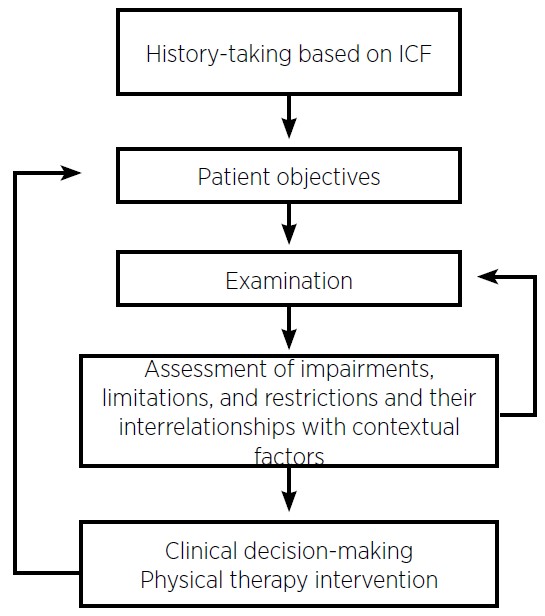
The clinical decision-making process was conducted in several stages and based on the ICF, as illustrated in Figure 1. It is important to note the limited standardized use of ICF terminology in clinical and outpatient records and assessments16. In this study, terminology was adopted in accordance with definitions proposed by the ICF12. Terms such as “functional,” “functional capacity,” “functional complaint,” or “kinetic-functional diagnosis,” commonly used to refer to functioning, were applied specifically in the context of physiological functions of body systems or replaced with more precise terminology. For instance, “physical therapy diagnosis” or “disability diagnosis” were used instead of “kinetic-functional diagnosis”16.
Clinical decision-making process based on the International Classification of Functioning, Disability, and Health
Procedures
The patient underwent the following assessments performed by a specialist in neurofunctional physical therapy:
-
Neurological level assessment using the ASIA Impairment Scale, in accordance with the International Standards for Neurological Classification of Spinal Cord Injury (ISNCSCI)13. This standardized instrument classifies SCI by identifying the neurological level of the injury, the presence of motor and sensory impairment, and whether the injury is complete or incomplete13.
-
Muscle tone assessment using the Modified Ashworth Scale, which measures resistance to passive movement. Spasticity is graded on a scale of 0 to 4, in which 0 indicates no increase in muscle tone and 4 indicates extreme rigidity17.
-
Evaluation of superficial and deep sensation using a cotton wisp and a pin, in accordance with the ISNCSCI13. A total of 26 dermatomes (C2-S2) were analyzed bilaterally. Sensation was classified into three categories: absent (0), impaired (1), or normal (2).
-
Pain intensity assessment using the Visual Analog Scale, ranging from 0 to 10, in which 0 represents “no pain” and 10 indicates “the worst possible pain”18. The patient was instructed to report the presence of pain at rest and/or during movement, as well as its intensity and location.
-
Range of motion assessment, both passive and active, using a Carci goniometer, in accordance with the recommendations of Cipriano19. For upper and lower limb goniometry, the patient was positioned in the supine position on the examination table.
-
Muscle strength assessment was conducted using manual muscle testing (MMT), following the recommendations by Kendall et al.20. The evaluation included the major muscle groups of the upper limbs, lower limbs, and trunk. Strength was graded on a six-point scale, in which 0 indicates absence of contraction and 5 represents normal strength20.
-
Handgrip strength (HGS) was measured using a 90-kg electronic hand dynamometer (INSTRUTHERM). Each hand was tested three times in alternating order, with a one-minute rest interval between trials. For the analysis, both the highest value obtained and the mean values for the dominant and non-dominant hands were considered21),(22.
-
Functional independence in activities of daily living was assessed using the Brazilian version of the Spinal Cord Independence Measure - Self-Reported Version (brSCIM-SR)23. The brSCIM-SR consists of 17 items addressing daily tasks relevant to individuals with SCI, organized into three main domains: 1) self-care; 2) respiration and sphincter management; and 3) mobility. Total scores range from 0 to 100, with higher scores indicating greater functional independence23.
-
Balance and functional mobility were assessed using the Modified Functional Reach Test (mFRT)24. The patient was positioned with the hips, knees, and ankles flexed at 90°, with both feet firmly supported on the floor. A measuring tape was fixed to the wall at acromion height of the tested arm to ensure proper alignment. The test was performed on two surfaces: a plinth (more stable surface) and the patient’s wheelchair (less stable surface). In both conditions, the patient was instructed to lean forward as far as possible without trunk rotation or touching the wall. The distance reached, measured in centimeters from the tip of the third metacarpal, was recorded as the outcome24.
As this was a case report, data analysis focused on a detailed description of the clinical decision-making process. In the Results section, each stage of this process is presented in detail, enabling readers to follow the clinical reasoning in a clear and logical manner.
RESULTS
History taking
Patient information was collected on August 4, 2023, at the Physical Therapy Teaching Clinic using a structured questionnaire comprising 48 items, as detailed in Table 1 (Supplementary Material 2). This questionnaire was developed based on the ICF, considering the clinical experience of the neurofunctional physical therapy specialist who authored this study, as well as the ICF Core Sets for individuals with SCI developed by Cieza et al.25. For example, Question 20 (“Do your current limitations affect your ability to participate in social activities, hobbies, or travel? Do you experience difficulties going to the cinema, traveling, or engaging in sports you previously enjoyed?”) is related to the ICF Participation component and was derived from the Core Set categories d760 (family relationships), d910 (community life), and d920 (recreation and leisure)25.
It is important to emphasize that although this questionnaire may be used with other patients with SCI, its main objective is to provide guidance to healthcare professionals regarding potential issues to be explored during the history-taking process, rather than to restrict the interview to these specific questions. The challenge at this stage lies is identifying relevant issues within each ICF domain related to the patient’s health condition, while considering their individuality, using professional experience and the Core Sets as guiding references. The following information was obtained from the patient’s responses to the questions in Table 1 (Supplementary Material 2).
Body functions and structures
The patient is experiencing the consequences of traumatic injury to the thoracic region of the spinal cord, resulting in multiple impairments. Observed structural and functional impairments include complete loss of sensation and motor function in the lower half of the body, severely compromised bladder and bowel control, presence of clonus, muscle hypotonia, and neuropathic pain in the lower limbs.
Activities
Regarding daily activities, the patient is able to perform certain household tasks, such as washing dishes, doing laundry (washing, hanging, and ironing clothes), and cooking. However, she presents limitations in transferring from sitting to standing, picking up objects from the floor and lifting them, grasping objects with both hands and moving them overhead, transferring from the wheelchair to the bed, and moving around the house using the wheelchair. She also experiences difficulties bathing independently, performing hygiene of the lower limbs, dressing and undressing in positions other than supine, and transferring from the wheelchair to the toilet.
Participation
The patient experiences participation restrictions in several activities. She reports difficulty independently propelling her wheelchair to nearby locations, as well as challenges using transportation to attend church or visit her mother’s home, and therefore rarely leaves her house.
Environmental factors
At home, the patient identifies multiple environmental barriers that limit her independence in daily activities. Transfers from the wheelchair to the bed are hindered by the height of the bed, and the narrow bathroom doorway prevents wheelchair access. Additionally, the shower chair has fixed armrests, making transfers unfeasible. The patient also does not have access to specialized orthotic devices to support standing posture and faces broader accessibility challenges within her condominium and the urban environment, including the absence of ramps, uneven streets, and narrow sidewalks.
As for facilitators, although she lives alone, the patient receives daytime assistance from a caregiver who helps with bathing and accompanies her to physical therapy sessions, church, the bank, and other external activities. She also reports adequate family support and financial assistance from her former employer.
Personal factors
Despite the aforementioned challenges, the patient appeared motivated, cooperative, communicative, and determined. Her motivation to seek treatment stems from her desire to achieve greater independence and perform daily activities autonomously. In addition to sessions at the teaching clinic, she also committed to private therapy twice a week, hoping to regain the ability to walk. However, due to her impairments, she reports a significant fear of falling.
Examination
The examination was guided by the patient’s responses to the questions presented in Table 1 (Supplementary Material 2), which also informed the selection of assessment instruments. To obtain measurable parameters within each ICF domain in which the patient reported difficulties, the following were assessed: neurological level of injury, muscle strength, sensation, HGS, muscle tone, balance, and performance in activities of daily living. These assessments were conducted using methods supported by the scientific literature. Furthermore, certain aspects were evaluated based on observation of task performance and/or information obtained during the structured interview. All assessed domains were categorized according to severity and expressed using ICF qualifiers, as detailed in Table 2 (Supplementary Material 3).
The examination was conducted at the Physical Therapy Teaching Clinic on August 9, 2023. All tests were administered in strict accordance with the protocols and methodologies established in the scientific literature for each instrument. The assessment identified the neurological level of injury as T5, based on motor, sensory, and overall neurological levels according to the ASIA classification. To avoid causing embarrassment to the patient, the assessment of anal sensation and voluntary anal contraction was not performed, which precluded classification of the injury as complete or incomplete. In the muscle tone assessment, the patient scored 0 on the Modified Ashworth Scale across all tested muscle groups, indicating no increase in muscle tone17.
The evaluation revealed preserved active and passive range of motion in the upper and lower limbs, as well as in the trunk. Muscle strength in the upper limbs was also preserved, with a score of 5/5. However, the patient presented with paralysis of the lower limbs (0/5) and weakness of the trunk flexor and extensor muscles (3/5). HGS testing showed a maximum value of 26 kgf and a mean of 24 kgf in the dominant (right) hand, while the non-dominant (left) hand demonstrated a maximum value of 22 kgf and a mean of 20 kgf. The dominant hand HGS was within the normal range (22.9-38.1 kgf), whereas the non-dominant hand HGS was slightly below the expected range (20.9-34.1 kgf), suggesting a mild reduction in strength26.
The assessment of functional independence in activities of daily living yielded the following scores: self-care (14/20), respiration and sphincter management (22/40), and mobility (11/40), resulting in a total score of 47 points. This score indicates the need for assistance in performing daily activities (score <55)27. Additionally, the evaluation of functional mobility demonstrated a reach distance of 12 cm on the unstable surface (wheelchair) and 19 cm on the stable surface (plinth). Although no cutoff values for the mFRT were identified in the literature, these findings suggest a significant limitation in functional mobility, especially during wheelchair use.
Based on the assessment of the patient’s functional status, as documented during the history-taking process, an ICF categorical profile was developed (Table 2, Supplementary Material 3)11, using the standardized language of the classification. This profile provides a visual representation of the patient’s disabilities at the time of assessment, along with the tests administered and their respective results, expressed using ICF qualifiers. Moreover, it outlines short- and long-term goals aligned with the patient’s perspectives. The establishment of clear and meaningful goals contributes to increasing the patient’s intrinsic motivation and strengthening her engagement in the rehabilitation process.
Findings according to the ICF
Impairments
Within the ICF component related to body functions and structures, several impairments were identified. These include absence of tactile functions (b265) and sensory functions of the lower limbs related to temperature and other stimuli (b270). The patient also presented impairments in fecal (b5253) and urinary continence (b6202). Regarding muscle strength (b730), including muscle strength of the lower half of the body (b7303) and of the trunk (b7305), paraplegia was observed. Furthermore, significant deficits were identified in functions related to involuntary movement reactions, such as postural reactions, righting reactions, and balance reactions (b755).
Limitations in performing activities
Regarding the Activities domain, the physical therapist identified several limitations. The patient experiences difficulty changing basic body positions, particularly maintaining a standing position (d410), lifting objects overhead due to reduced trunk control (d4300), bending or stooping to pick up objects (d4105), and transferring from the wheelchair to the bed (d4105). Due to these limitations, she relies on a wheelchair for mobility and uses assistive devices (d465). Concerning dressing and lower-limb hygiene (d5100), the patient requires assistance from her caregiver.
Participation restrictions
Prior to the injury, the patient was highly active, employed as a domestic worker and independently performing all activities of daily living. However, the injury resulted in restrictions in most of these activities, and she now requires assistance from others to, for example, attend church and engage in activities related to “religion and spirituality” (d930).
Clinical decision-making
The use of the questionnaire presented in Table 1 (Supplementary Material 2), combined with clinical reasoning, was crucial in establishing the patient’s disability diagnosis. The questionnaire provided a comprehensive overview of her functional status, highlighting issues identified both from the patient’s perspective and from the physical therapist’s assessment. This integrated approach enabled a more thorough and individualized evaluation, facilitating the identification of relationships between the issues reported by the patient and their potential underlying causes, thereby supporting the recognition of specific needs. As a result, the treatment plan could be developed in a more effective and targeted manner.
Although many individuals with SCI present several complaints, we highlight two primary concerns identified during the history-taking process-activity limitation and participation restriction-which illustrate the use of the ICF in clinical decision-making.
Complaint of activity limitation
The patient’s main activity-related difficulty was bathing: “I cannot go to the bathroom by myself or bend down to wash my feet because I am afraid of falling forward.” She reported that she only bathed when her caregiver was present and, on some occasions, skipped bathing due to the caregiver’s absence.
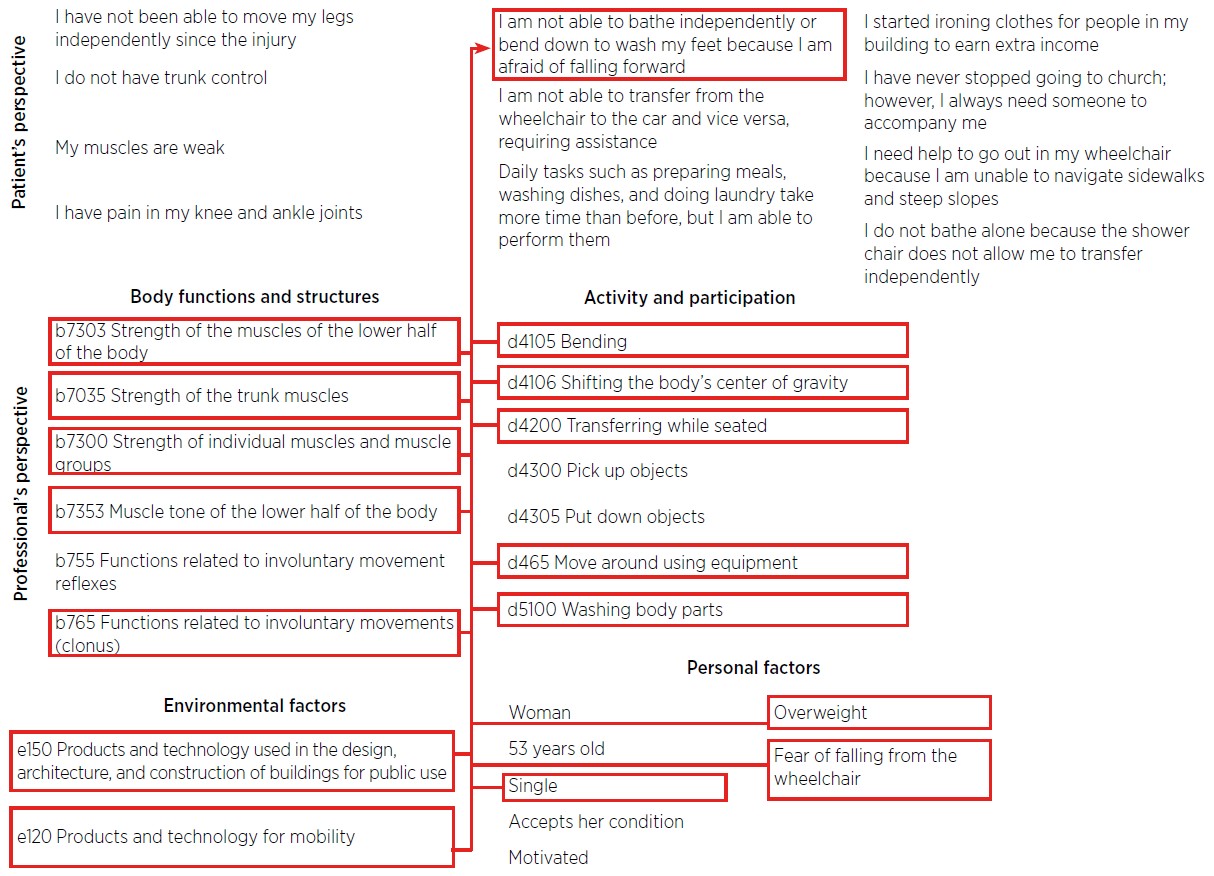
To understand the interrelationships among ICF domains affecting this activity limitation, several factors were analyzed (Figure 2). Within the Body Functions and Structures domain, decreased strength of the trunk flexor and extensor muscles (MMT=3/5) and impaired trunk control were observed, even when the patient was seated on a more stable surface, such as the plinth (mFRT=19 cm). Regarding environmental factors, the narrow bathroom doorway prevents wheelchair access, and the shower chair does lacks removable armrests, which could otherwise increase her independence during bathing.
Within the Personal Factors domain, the patient reports feeling insecure about her wheelchair, particularly fearing tipping, which negatively impacts her daily activities, including transfers. This fear was evident not only in her self-report but also in her performance on the mFRT: she achieved a short distance when the test was performed in the wheelchair (12 cm) compared with the plinth, a more stable surface (19 cm). This difference may be attributed to her concern that the wheelchair could tip over, even with examiners present to ensure safety. This finding is consistent with the literature emphasizing the role of wheelchair design in mobility outcomes28),(29. Although folding wheelchairs, such as the one used by the patient, may offer greater comfort, they can present challenges in terms of stability and transfer performance compared to rigid-frame wheelchairs28),(29. Additionally, the patient presents with overweight, which increases the physical demand of movement and may further hinder activities requiring trunk extension, such as “bending forward to wash her feet during bathing.”
Therefore, the patient’s disability diagnosis indicates a limitation in bathing independently, resulting from trunk muscle weakness, impaired trunk control, fear of falling, and overweight, especially when she is alone at home. Accordingly, a multidisciplinary approach is essential to improve her ability to bathe autonomously. The physical therapist should implement an intervention plan that includes strengthening exercises targeting the trunk flexor and extensor muscles to improve stability. Balance and coordination training are also recommended to enhance postural control on both stable and unstable surfaces. Furthermore, task-specific training of activities of daily living should be incorporated, including simulated bathing tasks in a controlled environment to increase the patient’s confidence and functional ability. Transfer training between the wheelchair and the shower chair should also be included to enhance safety and independence.
The acquisition of a shower chair with removable armrests may enhance the patient’s independence in this activity. A social worker can assist in securing resources and social benefits, such as an appropriate wheelchair and necessary home modifications. Nutritional assessment and dietary counseling by a registered dietitian may support muscle recovery and weight reduction, thereby positively influencing strength and mobility. Additionally, psychological support may help the patient address anxiety and fear of falling, contributing to greater confidence and engagement in the rehabilitation process.
Assessment of Functioning, Disability, and Health of a patient with spinal cord injury using the International Classification of Functioning, Disability, and Health
Complaint of participation restrictions
The patient’s primary participation-related difficulty was the inability to attend church independently, despite it being located only a few blocks from her home. Steep streets hinder her mobility: “I have never stopped going to church, but I always need someone to accompany me” and “I need help to go out with my wheelchair because I am unable to navigate the sidewalks and slopes.”
She obtained a very low score in the mobility domain of the brSCIM-SR assessment (11/40), suggesting additional challenges related to mobility and independence in this context. The lowest scores were observed in the subcategories of transfers and outdoor mobility over distances greater than 100 meters, in which the patient scored 0 points. These findings are consistent with her reports of mobility restrictions when using the wheelchair, both in community ambulation and in transfers, such as from the wheelchair to the bed.
Within the Body Functions and Structures domain, in addition to trunk muscle weakness and impaired trunk control, another important factor influencing wheelchair mobility is HGS. The patient demonstrated a total HGS of 48 kgf, with 26 kgf in the right upper limb and 22 kgf in the left. These values are considerably lower than those reported as necessary to achieve a SCIM mobility score of 70 (HGS=102.52 kgf), although these reference data were derived from male patients30. Thus, the patient may face difficulties in propelling the wheelchair, which is an essential function for urban mobility30)(31).
Another relevant factor is the cardiopulmonary conditioning required for wheelchair propulsion. This variable was not assessed due to the limited space available in the physical therapy clinic; however, it could be evaluated using an adapted version of the 6-Minute Walk Test for wheelchair users (6-minute push test) or the Brazilian version of the Adapted Manual Wheelchair Circuit30 32. Ribeiro Neto et al.30. reported a positive association between the distance covered within a given time and the level for assistance required to perform activities of daily living, as measured by the SCIM. Specifically, a cutoff value of 270 meters during three minutes of wheelchair propulsion corresponded to a SCIM score of 70.
Within the Activities domain, the patient demonstrated an inability to use the wheelchair in tasks essential for community mobility, such as navigating obstacles, ascending steps, going up and down steep ramps, and performing wheelies.
In the Environmental Factors domain, relevant barriers include urban and architectural obstacles, such as streets without ramps, steep inclines, and uneven or damaged surfaces. Within the Personal Factors domain, the patient’s insecurity and fear of falling outdoors further contribute to her participation restrictions.
Therefore, the patient’s disability diagnosis indicates a restriction in practicing her religion at places of worship and participating in liturgical activities. In addition to the previously described activity limitations, this restriction is related to reduced HGS, possible cardiorespiratory deconditioning, and limited wheelchair skills. Accordingly, the physical therapist should incorporate wheelchair propulsion training, assessment of cardiopulmonary fitness, aerobic exercise, and task-specific training to improve wheelchair handling skills. These strategies may enhance the patient’s independence in participating in daily activities. In this context, alongside the multidisciplinary team, guidance from an experienced wheelchair user may also be valuable. Such mentoring can provide practical instruction in urban mobility skills, including navigating curbs and sidewalks, applying appropriate propulsion techniques to ascend and descend small steps, and performing wheelies to overcome minor obstacles and surface irregularities-skills essential for safe and independent community mobility.
CONCLUSION
This study illustrated the practical application of the ICF in clinical decision-making in the neurofunctional rehabilitation of a patient with SCI, highlighting the importance of a comprehensive, patient-centered approach. Data collection using a structured questionnaire aligned with the ICF Core Sets enabled a detailed assessment of functional impairments, activity limitations, and participation restrictions, which are fundamental elements for treatment planning.
Data Availability:
The Entire Dataset Supporting The Results Of This Study Is Available Within The Article.
REFERENCES
-
1 Malekzadeh H, Golpayegani M, Ghodsi Z, Sadeghi-Naini M, Asgardoon M, et al. Direct cost of illness for spinal cord injury: a systematic review. Glob Spine J. 2022;12(6):1267-81. doi: 10.1177/21925682211031190
» https://doi.org/10.1177/21925682211031190 -
2 Budd MA, Gater Jr DR, Channell I. Psychosocial consequences of spinal cord injury: a narrative review. J Pers Med. 2022;12(7):1178. doi: 10.3390/jpm12071178
» https://doi.org/10.3390/jpm12071178 -
3 Ding W, Hu S, Wang P, Kang H, Peng R, et al. Spinal cord injury: the global incidence, prevalence, and disability from the Global Burden of Disease Study 2019. Spine (Phila Pa 1976). 2022;47(21):1532-40. doi: 10.1097/BRS.0000000000004417
» https://doi.org/10.1097/BRS.0000000000004417 -
4 Faleiros F, Marcossi M, Ribeiro O, Tholl A, Freitas G, et al. Epidemiological profile of spinal cord injury in Brazil. J Spinal Cord Med. 2023;46(1):75-82. doi: 10.1080/10790268.2021.1947679
» https://doi.org/10.1080/10790268.2021.1947679 -
5 Pernambuco AP, Lana RC, Polese JC. Knowledge and use of the ICF in clinical practice by physiotherapists and occupational therapists of Minas Gerais. Fisioter Pesqui. 2018;25(2):134-42. doi: 10.1590/1809-2950/16765225022018
» https://doi.org/10.1590/1809-2950/16765225022018 -
6 Santos LNL, Pereira TMA, Melo AWS, Vilarinho TA, Lima DF, et al. Conhecimento e utilização da CIF por docentes fisioterapeutas na cidade de Teresina-PI. Rev Neurocienc. 2020;28:1-14. doi: 10.34024/rnc.2020.v28.10247
» https://doi.org/10.34024/rnc.2020.v28.10247 -
7 Silva GM, Santos LO, Lopes ACB, Melo ES, Monteiro JA, et al. Assessment of the level of knowledge and applicability of the International Classification of Functioning, Disability and Health (CIF) in physiotherapy professionals. Res Soc Dev. 2021;10(5):e57210515238. doi: 10.33448/rsd-v10i5.15238
» https://doi.org/10.33448/rsd-v10i5.15238 - 8 Castro CC, Pinto CN, Almeida MA. Conhecimento e aplicação da Classificação Internacional de Funcionalidade, Incapacidade e Saúde por fisioterapeutas de Fortaleza. Rev Fisioter S Fun. 2015;4(2):6-13.
-
9 Vall J, Costa CMC, Pereira LF, Friesen TT. Application of the International Classification of Functioning, Disability and Health in individuals with spinal cord injury. Arq Neuropsiquiatr. 2011;69(3):513-8. doi: 10.1590/S0004-282X2011000400020
» https://doi.org/10.1590/S0004-282X2011000400020 -
10 Strøm V, Månum G, Arora M, Joseph C, Kyriakides A, et al. Physical health conditions in persons with spinal cord injury across 21 countries worldwide. J Rehabil Med. 2022;54:jrm00302. doi: 10.2340/jrm.v54.2040
» https://doi.org/10.2340/jrm.v54.2040 -
11 Rauch A, Escorpizo R, Riddle DL, Eriks-Hoogland I, Stucki G, et al. Using a case report of a patient with spinal cord injury to illustrate the application of the International Classification of Functioning, Disability and Health during multidisciplinary patient management. Phys Ther. 2010;90(7):1039-52. doi: 10.2522/ptj.20090327
» https://doi.org/10.2522/ptj.20090327 - 12 Organização Pan-Americana da Saúde, Organização Mundial da Saúde. CIF: Classificação Internacional de Funcionalidade, Incapacidade e Saúde. São Paulo: Editora da Universidade de São Paulo; 2008.
-
13 Rupp R, Biering-Sørensen F, Burns SP, Graves DE, Guest J, et al. International standards for neurological classification of spinal cord injury: revised 2019. Top Spinal Cord Inj Rehabil. 2021;27(2):1-22. doi: 10.46292/sci2702-1
» https://doi.org/10.46292/sci2702-1 -
14 Gagnier JJ, Kienle G, Altman DG, Moher D, Sox H, et al. The CARE guidelines: consensus-based clinical case reporting guideline development. J Clin Epidemiol. 2014;67(1):46-51. doi: 10.1016/j.jclinepi.2013.08.003
» https://doi.org/10.1016/j.jclinepi.2013.08.003 -
15 Riley DS, Barber MS, Kienle GS, Aronson JK, von Schoen-Angerer T, et al. CARE guidelines for case reports: explanation and elaboration document. J Clin Epidemiol. 2017;89:218-35. doi: 10.1016/j.jclinepi.2017.04.026
» https://doi.org/10.1016/j.jclinepi.2017.04.026 -
16 Barreto MCA, Andrade FG, Castaneda L, Castro SS. A Classificação Internacional de Funcionalidade, Incapacidade e Saúde (CIF) como dicionário unificador de termos. Acta Fisiatr. 2021;28(3):207-13. doi: 10.11606/issn.2317-0190.v28i3a188487
» https://doi.org/10.11606/issn.2317-0190.v28i3a188487 -
17 Bohannon RW, Smith MB. Interrater reliability of a modified Ashworth scale of muscle spasticity. Phys Ther. 1987;67(2):206-7. doi: 10.1093/ptj/67.2.206
» https://doi.org/10.1093/ptj/67.2.206 - 18 Hayes MHS, Patterson DG. Experimental development of the graphic rating method. Psychol Bull. 1921;18:98-9.
- 19 Cipriano JJ. Manual fotográfico de testes ortopédicos e neurológicos. 5a. ed. Porto Alegre: Artmed; 2012.
- 20 Kendall FP, McCreary EK, Provance PG, Rodgers MM, Romani WA. Músculos: provas e funções. 5a. ed. Barueri: Manole; 2007.
-
21 Lee SC, Wu LC, Chiang SL, Lu LH, Chen CY, et al. Validating the capability for measuring age-related changes in grip-force strength using a digital hand-held dynamometer in healthy young and elderly adults. Biomed Res Int. 2020;2020(1):6936879. doi: 10.1155/2020/6936879
» https://doi.org/10.1155/2020/6936879 -
22 Sisto SA, Dyson-Hudson T. Dynamometry testing in spinal cord injury. J Rehabil Res Dev. 2007;44(1):123-36. doi: 10.1682/jrrd.2005.11.0172
» https://doi.org/10.1682/jrrd.2005.11.0172 - 23 Ilha J, Avila LCM, Santo CCE, Swarowsky A. Tradução e adaptação transcultural da versão brasileira da Spinal Cord Independence Measure - Self-Reported Version (brSCIM-SR). Rev Bras Neurol. 2016;52(1):2-17.
-
24 Lynch SM, Leahy P, Barker SP. Reliability of measurements obtained with a modified functional reach test in subjects with spinal cord injury. Phys Ther. 1998;78(2):128-33. doi: 10.1093/ptj/78.2.128
» https://doi.org/10.1093/ptj/78.2.128 -
25 Cieza A, Kirchberger I, Biering-Sørensen F, Baumberger M, Charlifue S, et al. ICF core sets for individuals with spinal cord injury in the long-term context. Spinal Cord. 2010;48(4):305-12. doi: 10.1038/sc.2009.183
» https://doi.org/10.1038/sc.2009.183 - 26 Caporrino FA, Faloppa F, Santos JBG, Réssio C, Soares FHC, et al. Estudo populacional da força de preensão palmar com dinamômetro Jamar®. Rev Bras Ortop. 1998;33(2):150-4.
-
27 Amatachaya S, Khammon N, Wattanapan P, Wiyanad A, Thaweewannakij T, et al. Reference values and cutoff scores of the Spinal Cord Independence Measure III to determine independence for wheelchair users and ambulatory individuals with spinal cord injury. Arch Phys Med Rehabil. 2023;104(1):83-9. doi: 10.1016/j.apmr.2022.09.016
» https://doi.org/10.1016/j.apmr.2022.09.016 -
28 Wolf N, Maseko L, Franzsen D, de Witt PA. Wheelchair prescription after spinal cord injury: satisfaction and functional mobility. S Afr J Occup Ther. 2022;52(1):68-77. doi: 10.17159/2310-3833/2022/vol52n1a8
» https://doi.org/10.17159/2310-3833/2022/vol52n1a8 - 29 Kouzelis A, Vlamis I. Wheelchair design for patients with spinal cord injuries. Acta Orthop Traumatol Hell. 2022;73(3):276-83.
-
30 Ribeiro Neto F, Costa RRG, Dorneles JR, Gonçalves CW, Veloso JHCL, et al. Handgrip strength cutoff points for functional independence and wheelchair ability in men with spinal cord injury. Top Spinal Cord Inj Rehabil. 2021;27(3):60-69. doi: 10.46292/sci20-00040
» https://doi.org/10.46292/sci20-00040 -
31 Ribeiro Neto F, Costa RRG, Tanhoffer RA, Leal JC, Bottaro M, et al. Muscle strength cutoff points for functional independence. Arch Phys Med Rehabil. 2020;101(6):985-93. doi: 10.1016/j.apmr.2020.01.010
» https://doi.org/10.1016/j.apmr.2020.01.010 -
32 Cowan RE, Callahan MK, Nash MS. The 6-min push test is reliable and predicts low fitness in spinal cord injury. Med Sci Sports Exerc. 2012;44(10):1993-2000. doi: 10.1249/MSS.0b013e31825cb3b6
» https://doi.org/10.1249/MSS.0b013e31825cb3b6
Edited by
-
Responsible editor:
Sônia LP Pacheco de Toledo