 Profile of research groups and publications in pediatric physical therapy in Brazil
ABSTRACT
The increase in the number of researchers and publications in Brazil demonstrates the country’s scientific growth, particularly in pediatric physical therapy. This study aimed to describe the profile of research groups and publications in pediatric physical therapy in Brazil. A bibliometric approach was employed, using data from the CNPq Research Groups Directory, the CNPq Lattes Platform, and the CAPES Sucupira Platform. Data on research groups, researchers, and productions were collected through January 2023 and analyzed using SPSS (version 23.0). A total of 41 research groups and 357 researchers were identified, with a predominance of female researchers (75.6%) and concentration in the Southeast (41.2%). Most groups focused on health and development of preschool children (82.9%). Researchers published an average of 31.52 ± 47.301 articles in national and international journals. Most held a master’s degree (89.6%) and a doctoral degree (79%), but only 8.1% were CNPq research productivity fellows. Among these, Level 2 was the most frequent (17; 4.8%), followed by Level 1A (5; 1.4%), Levels 1D and 1B (3; 0.8% each), and Level 1C (1; 0.3%). These findings may support greater dissemination and application of human and financial resources in scientific research in pediatric physical therapy.
Keywords:
Scientific Research; Child Health; Adolescent; Pediatrics; Bibliometrics
RESUMO
O aumento do número de pesquisadores e publicações no Brasil demonstra o crescimento científico no país, principalmente na área de fisioterapia pediátrica. Este estudo teve como objetivo descrever o perfil dos grupos de pesquisa e publicações na área da fisioterapia pediátrica no Brasil. Foi realizado um estudo bibliométrico nas plataformas Diretório dos Grupos de Pesquisa do CNPq, Plataforma Lattes do CNPq e Plataforma Sucupira da CAPES. Todos os dados dos grupos, pesquisadores e produções foram coletados até janeiro de 2023 e analisados no programa estatístico SPSS (versão 23.0). Participaram 41 grupos de pesquisa e 357 pesquisadores, com predominância do sexo feminino (75,6%) e da Região Sudeste do país (41,2%). O principal foco dos grupos foi a realização de pesquisas na área de saúde e desenvolvimento da criança pré-escolar (82,9%). Os pesquisadores publicaram em média 31,52±47,301 artigos em periódicos nacionais e internacionais. Grande parte dos pesquisadores tinha titulação acadêmica de mestrado (89,6%) e doutorado (79%), porém apenas 8,1% são bolsistas de produtividade em pesquisa do CNPq, destacando-se o Nível 2 com 17 (4,8%) pesquisadores contemplados, seguido do Nível 1A com 5 (1,4%), Nível 1D e B com 3 (0,8%) cada e Nível 1C com 1 (0,3%). Os resultados podem contribuir para maior divulgação e aplicação de recursos humanos e financeiros na pesquisa científica em fisioterapia pediátrica.
Descritores:
Pesquisa Científica; Saúde da Criança; Adolescente; Pediatria; Bibliometria
RESUMEN
El creciente número de investigadores y publicaciones en Brasil demuestra el avance científico en el país, especialmente en el área de la fisioterapia pediátrica. Este estudio tuvo como objetivo describir el perfil de grupos de investigación y publicaciones en el área de fisioterapia pediátrica en Brasil. Se realizó un estudio bibliométrico en las plataformas Diretório dos Grupos de Pesquisa de CNPq, Plataforma Lattes de CNPq y Plataforma Sucupira de CAPES. Todos los datos de los grupos, investigadores y producciones se recolectaron hasta enero de 2023 y se analizaron en el programa estadístico SPSS (versión 23.0). Participaron 41 grupos de investigación y 357 investigadores, predominantemente del sexo femenino (75,6%) y de la región Sudeste del país (41,2%). Los grupos tuvieron por enfoque la realización de investigaciones en el área de la salud y el desarrollo de los niños en edad preescolar (82,9%). Los investigadores publicaron un promedio de 31,52±47,301 artículos en revistas nacionales e internacionales. La mayoría de los investigadores tenían una maestría (89,6%) y un doctorado (79%), pero solo el 8,1% de ellos tienen becas de productividad en investigación del CNPq, destacando el nivel 2 con 17 (4,8%) investigadores seleccionados, seguido del nivel 1A con 5 (1,4%), nivel 1D y B con 3 (0,8%) cada uno y nivel 1C con 1 (0,3%). Se espera que los resultados puedan contribuir a una mayor difusión y aplicación de los recursos humanos y financieros en la investigación científica en fisioterapia pediátrica.
Palabras clave:
Investigación Científica; Salud Infantil; Adolescente; Pediatría; Bibliometría
INTRODUCTION
Pediatric physical therapy (PPT) encompasses care from birth to adolescence, aiming to enhance and rehabilitate motor and sensory functions and to promote functional independence in the developing child. Practice is guided by the biopsychosocial model of the International Classification of Functioning, Disability and Health (ICF), proposed by the World Health Organization (WHO). Thus, the field directly contributes to reducing the demand for consultations in primary health units and to lowering morbidity rates across different age groups1-3.
To ensure high-quality care and professional recognition in this field, it is essential that practitioners remain up to date with the healthcare context in which they work and integrate the best available scientific evidence into their practice, alongside patient preferences and clinical expertise. These elements constitute the three pillars of evidence-based practice (EBP), supporting high-quality clinical practice across all levels of care, from primary to tertiary settings4,5.
The American Physical Therapy Association (APTA) emphasizes the importance of investment in scientific research as an essential requirement for the development and advancement of physical therapy, including the pediatric field6. The expansion of rigorous research aligned with EBP contributes to the development of improved clinical approaches and techniques, ensuring effective and appropriate care for this population while reducing costs associated with treatments lacking proven efficacy7.
A national survey conducted by the Brazilian Association of Cardiorespiratory Physical Therapy and Intensive Care Physical Therapy (ASSOBRAFIR), using data from the Research Ethics Committees (CEP) system of the National Research Ethics Committee (CONEP), identified an increase in scientific production in PPT in Brazil between 2002 and 2010, accompanied by greater journal standards and quality requirements8. From an international perspective, studies examining research in PPT have also reported substantial growth over the past 30 years, with improvements both in methodological rigor of published articles and in the breadth of the populations studied by the research groups9.
Understanding the characteristics of research groups and the profiles of researchers in PPT is an important step toward identifying the primary focus areas of scientific research and examining how research activities in the field are being continued. This study aimed to describe the profile of research groups and publications in PPT in Brazil.
METHODOLOGY
This bibliometric study included a sample of 41 research groups and 357 researchers in physical therapy, identified via the Directory of Research Groups (DGP)-a database of active scientific research groups in Brazil10-maintained by the National Council for Scientific and Technological Development (CNPq), which aims to promote and disseminate science in the country11.
For group-level analysis, the official DGP website was accessed, and the following information was extracted: group name and researchers’ names; year of establishment; date of last update; CNPq major area and subarea classification; acronym of the Higher Education Institution (HEI); state and geographic region; and number of research lines, leaders, researchers, students, and technical staff.
Research groups were included if they met the following criteria: constituted a research group in physical therapy; were institutionally certified; were validated and updated within the DGP platform; and included the terms “child,” “adolescent,” or “child development” in the group title, research lines, or descriptive text outlining the group’s activities and scope. Groups were excluded if they had incomplete or outdated information, lacked institutional certification, or did not belong to the CNPq area of physical therapy and occupational therapy.
During the initial search in the DGP platform, the following filters were applied: status “updated,” major area “Health Sciences,” and subarea “physical therapy and occupational therapy,” using the “exact search” option. The search terms yielded the following results: “child” (37 groups), “adolescent” (17 groups), “child health” (16 groups), “adolescent health” (five groups), and “child development” (18 groups), totaling 93 groups. After screening, 44 duplicates and eight outdated entries were excluded, resulting in a final sample of 41 groups.
To determine the representativeness of PPT groups within the DGP, an additional survey was conducted to identify the total number of updated groups. In the first search, all groups classified under the major area of Health Sciences were identified, totaling 4,702 groups. Subsequently, groups within the area of physical therapy and occupational therapy were selected, resulting in 334 groups. Finally, those specifically focused on PPT were identified, totaling 41 groups. The search was conducted between September 2022 and January 2023.
To analyze the curricula of professionals affiliated with DGP research groups, data were collected from the CNPq Lattes platform, which is considered the national standard for documenting researchers’ academic and professional records12. Using the Lattes website, the following information was extracted: name; sex; state; date of last curriculum update; HEI; year of graduation; number of specializations and continuing education courses; academic degrees (master’s and doctoral); CNPq productivity fellowship and respective level; research lines; and number of bibliographic outputs (books, book chapters, and national and international articles).
Researchers’ profiles were also reviewed on Google Scholar and ResearchGate to complement citation data and to obtain the h-index.
To analyze researchers affiliated with graduate programs, data were collected from the Sucupira Platform of the Coordination for the Improvement of Higher Education Personnel (CAPES), which is used to evaluate graduate programs13. CAPES aims to expand and promote academic graduate education in Brazil14. The following information was extracted: affiliation with master’s and doctoral programs; primary area of the program; evaluation area; year of establishment; and CAPES rating.
The study was conducted in five stages:
1) Access to the DGP information source to identify data on research groups, including institution, state, and region; number and names of researchers; number and types of research lines; and number of members and technical staff.
2) Extraction of data from the Lattes curricula of researchers affiliated with each group, including academic background, affiliation with graduate programs; student supervision; research lines; and scientific output (books, book chapters, and national and international scientific articles).
3) Database organization. After data extraction, the information was recorded and categorized in an Excel database to facilitate organization and statistical analysis. The spreadsheet stored all data retrieved from the platforms in a predefined order established by the researchers, with variables coded and structured for subsequent transfer to statistical software.
4) After organizing the database, the information was transferred to the Statistical Package for the Social Sciences (SPSS) software, version 23.0. Descriptive statistical analysis was performed, including means, standard deviations, and absolute and relative frequencies, enabling comprehensive characterization of the research groups and researchers. Data normality was assessed using the Kolmogorov-Smirnov test. Comparisons between groups with and without affiliation to graduate programs were conducted using Student’s t-test for independent groups. The significance level was set at p<0.05.
5) Interpretation of results. Following statistical analyses, the results were interpreted for the construction of tables and figures, which are presented in the Results section.
This study followed the recommendations of the Strengthening the Reporting of Observational Studies in Epidemiology (STROBE) guidelines to ensure standardized and transparent reporting.
RESULTS
The sample comprised 41 research groups certified and updated in the DGP platform, totaling 357 researchers, of whom 270 (75.6%) were female and 87 (24.4%) were male. Of the total, 345 researchers (96.6%) had updated their Lattes curricula within the previous three years (2019-2022).
From a broader perspective of research groups registered in the DGP, 4,702 groups belong to the major area of Health Sciences, of which 334 (7.10%) are classified under physical therapy and occupational therapy. Within this area, 41 groups (12.28%) focus on PPT.
Regarding regional distribution, the Southeast accounted for 18 (43.9%) pediatric groups, followed by the Northeast with eight (19.5%), the Central-West and South with six groups each (14.6%), and the North with three (7.3%). The state with the highest concentration was São Paulo, with 12 groups (29.3%). Most institutions hosting these groups were public universities, totaling 36 (87.8%). Regarding research lines, four groups (12.2%) reported five research lines. The most frequently addressed research line focused on the preschool population, represented in 34 groups (82.9%).
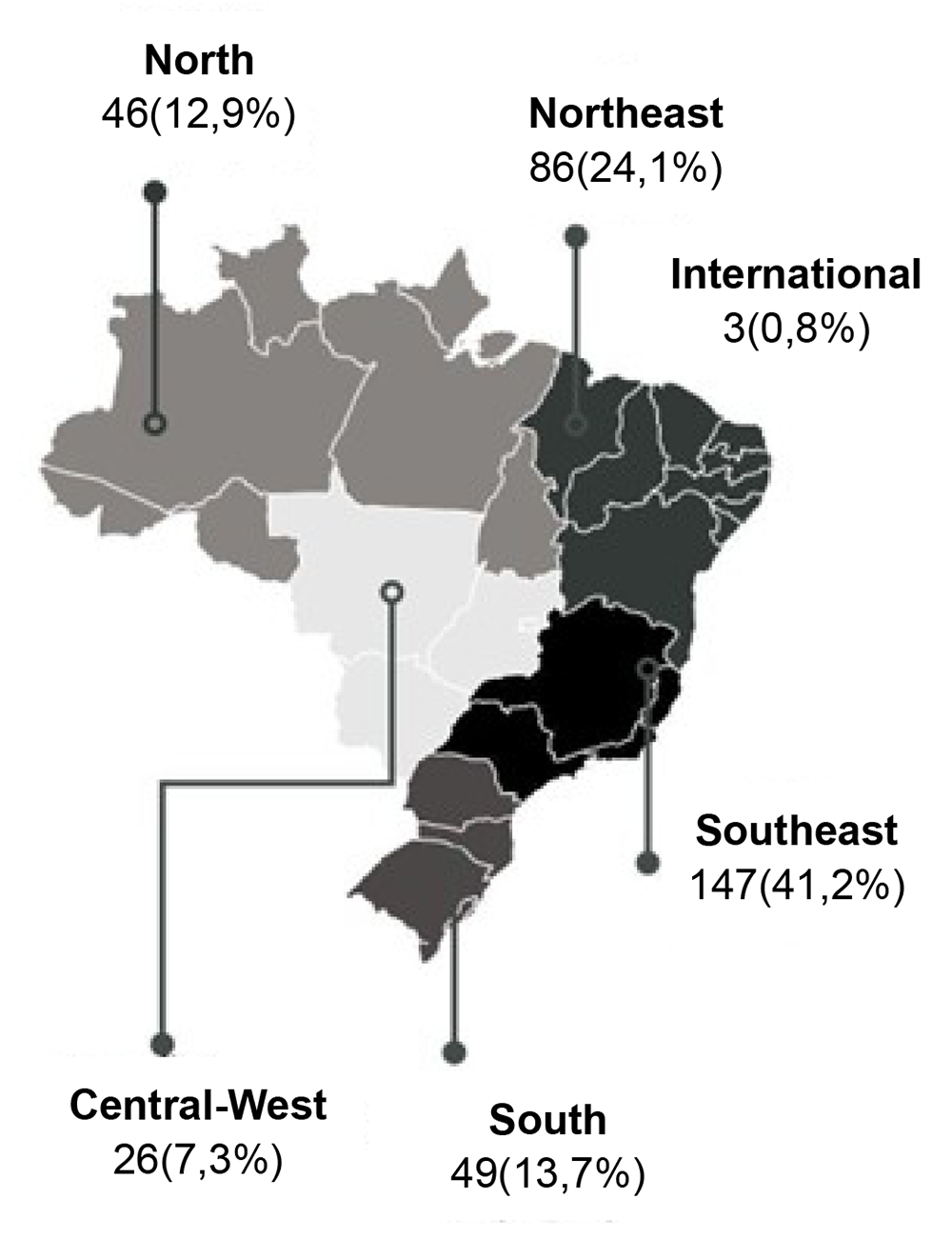
Figure 1 presents the geographic distribution of professionals, highlighting the predominance of the Southeast, with 147 researchers (41.2%). At the state level, São Paulo accounted for 86 professionals (24.1%), followed by Pará with 37 (10.4%) and Minas Gerais with 32 (9%).
In terms of professional training, 256 researchers (71.7%) held an undergraduate degree in physical therapy, 61 (17.1%) in occupational therapy, and 40 (11.2%) in other fields. The majority (337; 94.4%) did not report additional undergraduate degrees. The earliest year of graduation was 1971 and the most recent was 2021, with an average time since graduation of 20.92±9.49 years.
Regarding undergraduate institutions, 110 universities/colleges across Brazil were identified. The institution with the highest number of graduates among the researchers was the Universidade Federal de São Carlos, with 41 researchers (11.5%), followed by the Universidade Estadual do Norte do Paraná with 21 (5.9%), the Universidade do Estado do Pará with 20 (5.6%), and the Universidade Federal de Pernambuco with 17 (4.8%). Researchers’ academic degrees are presented in Table 1.
Another variable analyzed was the number of researchers holding CNPq productivity fellowships and their respective levels. A total of 29 professionals (8.1%) were recipients of a CNPq productivity fellowship. The most common category was Level 2, awarded to 17 researchers (4.8%), followed by Level 1A with five (1.4%), Levels 1D and 1B with three each (0.8%), and Level 1C with one (0.3%).
Regarding research lines, 159 professionals (44.5%) reported a primary focus on preschoolers (6-10 years). Table 2 presents the distribution of research lines in the field of child and adolescent health.
Concerning bibliographic output, 326 (91.3%) had published at least one scientific article, with an average of 31.52±47.301 publications. Of these, 244 (68.3%) had at least one article specifically related to the field under study. In terms of international publications, 251 professionals (70.3%) reported at least one article published in international journals.
Regarding other types of scholarly output, 123 researchers (34.5%) had published one or more books, and the majority (263; 73.7%) had authored book chapters.
In relation to researchers’ digital profiles, 125 professionals (35%) had information available on Google Scholar. On this platform, the number of citations ranged from a minimum of one (0.3%) to a maximum of 9,043 (0.3%). The h-index ranged from a minimum of three (0.6%) to a maximum of 54 (0.3%). On ResearchGate, most professionals (232; 65%) had no citations recorded, whereas 25 (35%) had at least one citation, with values ranging from a minimum of one (0.3%) to a maximum of 6,090 (0.3%).
Table 3 presents data on bibliographic output, technical production, and academic supervision.
Regarding graduate programs registered with CAPES, 88 researchers (24.6%) were affiliated with a master’s program, 68 (19%) with doctoral programs, and 53 (14.8%) held more than one affiliation. The primary area of concentration of the graduate programs was Physical Therapy and Occupational Therapy (15.1%), followed by Biological Sciences (2%) and Physical Education (1.1%). In terms of CAPES evaluation areas, Physical Education was the most prominent (15.4%), followed by Medicine I (2%) and the Interdisciplinary area (2%).
As for the year of establishment of these programs, the earliest was created in 1971 and the most recent in 2019, with an average year of 2002. All identified graduate programs were offered in an in-person format. CAPES ratings ranged from 3 to 7. Ratings of 4 and 7 were each assigned to 21 programs (5.9%), followed by ratings of 5 and 6, with 17 programs each (4.8%), and rating 3, with 15 programs (4.2%).
For comparative analysis of bibliographic output between researchers affiliated and not affiliated with a graduate program, affiliation with a master’s program was used as the reference category, given the larger number of affiliated researchers. A significance value of p<0.05 was adopted to determine statistically significant differences. Table 4 presents the number of publications by researchers with and without affiliation to graduate programs.
DISCUSSION
This study characterized the profile of Brazilian researchers in PPT, revealing a predominance of female researchers, concentrated in the Southeast of the country, with a mean time since graduation of 20.9 years and a primary focus on the preschool research line. The findings also indicated a predominance of researchers holding a master’s degree, with an emphasis on publications in international journals.
The predominance of female researchers may be associated with the growing role of women in science, particularly in the pursuit of professional development in recent years, especially within pediatrics15. Women account for 54% of doctoral candidates in Brazil, representing a 10% increase over the past 20 years16. Historically, the Southeast has served as a major hub for scientific and technological development in Brazil, a pattern also observed in previous studies of this nature. This scenario has been highlighted by a previous study17, which verified this regional predominance-especially in the city of São Paulo-and argued that this may be associated with greater investment toward research and development in this region.
Regarding research lines, the preschool age group (2-6 years old) was the most frequently studied. This finding may be explained by the emphasis in pediatric research on quality of life during early childhood, given the importance of appropriate development for preventing delays and disabilities and for reducing mortality rates. Age stratification in pediatric research remains both a clinical and ethical challenge, which may contribute to the lack of standardization in the literature18,19.
A preference for publishing scientific articles rather than books, book chapters, or conference abstracts was observed, with a clear emphasis on publication in international journals. This trend may be explained by the greater visibility and recognition afforded to researchers who publish in higher-impact journals20. The growing prominence of physical therapists and occupational therapists in scientific production over the past five decades is reflected in the increase in publications in international journals-especially those indexed in PubMed and available on the Physiotherapy Evidence Database (PEDro) platform-as well as in the rising interest among professionals in pursuing specialization after graduation, evidenced by the increased demand for graduate programs. A higher number of researchers holding a master’s degree was also identified, consistent with findings from previous studies20. This pattern may be linked to national policies supporting graduate education and research promoted by funding agencies and universities in Brazil21.
Additionally, growth in the PPT field is attributed to increasing interest in child health research and to the recognized importance of practice in pediatric neurology. It also reflects the broader scientific expansion of the profession. A previous study22 reported exponential growth in the number of physical therapy researchers, increasing from 57 to 573 from 1998 to 2008. Given the rising interest in scientific research, productivity fellowships and their respective levels were also analyzed. In Health Sciences, CNPq productivity levels follow an ascending order: 2, 1D, 1C, 1B, and 1A. To award a fellowship, CNPq evaluates the researcher’s publication profile, that is, both productivity and scientific impact. Productivity is measured by the number of articles published throughout the researcher’s career, whereas impact or quality is assessed based on citation counts and/or the impact factor of the journals in which the work is published23.
In this study, 29 professionals (8.1%) were fellowship holders, of whom 17 (4.8%) held a Level 2 productivity fellowship, indicating a productive profile in terms of both quantity and quality of publications. Other studies on this topic24 analyzing the profile of physical therapists in Brazil have likewise reported a predominance of fellows at this level, highlighting an emphasis on relevant bibliographic production in the field.
Additionally, 328 researchers (91.9%) were not affiliated with any productivity fellowship. This finding is consistent with a previous national survey25 showing that only approximately 1% of physical therapist researchers hold a CNPq productivity fellowship. This scenario reflects insufficient governmental investment in science and technology relative to the growing number of researchers. It also underscores the limited engagement of private universities in supporting scientific research26.
Despite the increase in the number of researchers and publications, Brazil still lags far behind other economically developed countries, reflecting limited incentives for scientific production, which may discourage academics and professionals27. In 2019, the share of total funding allocated to the CNPq by the Brazilian Ministry of Science, Technology, Innovation and Communication decreased from 31.88% to 15.99%28.
When comparing the bibliographic output of researchers affiliated and not affiliated with graduate programs, a significant difference is observed in the number of published articles among those who are affiliated. This finding may be associated with the substantial increase in academic degrees between 2005 and 2015-106% growth in master’s degrees and 506% in doctoral degrees-as well as the existence of 30 graduate programs in physical therapy accredited by CAPES in Brazil in 202129. Despite funding cuts in recent years, during the COVID-19 pandemic CAPES invested in the Strategic Emergency Program for the Prevention and Combat of Outbreaks, Endemics, Epidemics, and Pandemics, supporting projects linked to graduate programs across the country28.
Physical therapy, as a science, seeks to continuously advance its knowledge to achieve the best possible outcomes in clinical interventions, and this progress occurs by means of research. The same applies to PPT, which has increasingly demonstrated its relevance in society in the process of health promotion and rehabilitation30. A previous survey31 identified evidence of growth in physical therapy research groups registered in the DGP between 1989 and 2012. In this study, physical therapy groups were found to still represent a relatively small proportion compared to other professions within Health Sciences. However, PPT stands out within physical therapy, accounting for 41 groups (12.28%), indicating growing research interest and scientific output in this specialty.
The steady and significant increase in bibliographic production by physical therapists in pediatrics has contributed to the advancement of EBP21, whose primary objective is to implement clinical approaches and techniques supported by the best available evidence, as it is the professional’s responsibility to remain up to date with the growing body of research across multiple platforms32. In this context, pediatric physical therapists implement interventions aimed at facilitating the daily lives of children and their families, thereby improving quality of life33.
Despite its recognized importance, physical therapy studies involving individuals aged 0-18 years have decreased significantly over the past 30 years21. This suggests that, although overall growth has been observed, further progress is still needed-particularly regarding research that includes other age groups. Moreover, PPT studies remain relatively recent and continue to expand worldwide; however, investment in this area is still limited. Providing adequate financial and structural support to ensure high-quality research is therefore both a priority and a challenge, as is the proper training of researchers34.
A survey examining the 100 most cited pediatric studies over the past 50 years found that more than half originated from the United States and the United Kingdom, with no Brazilian studies among those cited. This predominance has been attributed to stronger research funding, higher overall research quality, and the greater availability of high-impact local journals in those countries35.
It is important to highlight that this study examined graduate programs regarding their ratings, as well as the most frequent primary and evaluation areas in PPT. Such analyses remain scarce in the literature and contribute to assessing the quality of professional training in this field. Previous studies have addressed this challenge and indicate that significant progress is still needed regarding publication output and international visibility, which may be reflected in lower program ratings, as observed in the survey18.
The findings of this study provide relevant support for strengthening PPT in Brazil by outlining the current landscape of research groups and scientific production in the field. The predominance of research focused on the health and development of preschool children highlights a trend toward prioritizing this topic both in clinical practice and in the formulation of public policies related to child health.
The identification of a high level of academic qualification among researchers, combined with the low proportion of CNPq research productivity fellowship holders, underscores a mismatch between qualification and institutional recognition. This finding reinforces the need to expand investment in scientific research with the provision of fellowships and project funding, particularly in strategic fields such as PPT. This scenario points to the importance of initiatives aimed at enhancing the recognition of scientific production and consolidating research lines that address the specific demands of the Brazilian pediatric population.
In the clinical context, the growth of scientific production directly contributes to EBP, supporting the adoption of more effective, safe, and child-centered physical therapy interventions. Furthermore, the data obtained may assist educational and research institutions in defining curricular priorities, developing professional training strategies, and strengthening collaborative networks among researchers from different regions of the country.
CONCLUSION
This study contributes to understanding the profile of PPT researchers in Brazil and demonstrates the advancement of scientific contributions in the field, both nationally and internationally. A clear trend toward pursuing graduate education at different academic levels was observed, which is reflected in scholarly output and EBP. Its practical relevance lies in expanding knowledge about the national scientific production profile and in encouraging continued investment in research and innovation in child health, with potential impact on the quality of care provided to the pediatric population.
Nevertheless, gaps remain, including the scarcity of similar studies and limitations such as the relatively small sample size and regional disparities in research production. Future studies may deepen this analysis by employing statistical investigations over time.
DATA AVAILABILITY
The data underlying this study are available in the published article.
REFERENCES
-
1 David MLO, Ribeiro MAGO, Zanolli ML, Mendes RT, Assumpção MS, et al. Proposta de atuação da fisioterapia na saúde da criança e do adolescente: uma necessidade na atenção básica. Saúde Debate. 2013;37(96):120-9. doi: 10.1590/S0103-11042013000100014
» https://doi.org/10.1590/S0103-11042013000100014 -
2 Cynthia C, Duck M, McQuillan R, Brazill L, Malik S, et al. Exploring the role of physiotherapists in the care of children with autism spectrum disorder. Phys Occup Ther Pediat. 2019;39(6):614-28. doi: 10.1080/01942638.2019.1585405
» https://doi.org/10.1080/01942638.2019.1585405 - 3 Organização Mundial da Saúde. Classificação de Funcionalidade, Incapacidade e Saúde. Geneva: OMS; 2008.
-
4 Kasper MJ, Alvarenga LFC, Schwingel G, Toassi RFC. Atenção Primária como cenário de prática e aprendizagem na formação de fisioterapeutas no Brasil: percepção de estudantes, profissionais e usuários. Interface. 2022;26:e210508. doi: 10.1590/interface.210508
» https://doi.org/10.1590/interface.210508 -
5 Casarotto RA, Fonseca MCR, Marques AP. Práctica clínica e investigación en fisioterapia: compromiso de la revista Fisioterapia e Pesquisa. Fisioter Pesqui. 2020;27(1). doi: 10.1590/1809-2950/00000027012020
» https://doi.org/10.1590/1809-2950/00000027012020 -
6 American Physical Therapy Association. APTA position on research [Internet]. 2019 [cited 2022 Dec 18]. Available from: https://acapt.org/docs/default-source/pdfs/rc-63-19-apta-position-on-research.pdf?sfvrsn=9d4e89d8_2
» https://acapt.org/docs/default-source/pdfs/rc-63-19-apta-position-on-research.pdf?sfvrsn=9d4e89d8_2 - 7 Ramirez-velez RO, Meneses-Echavez JF, Gonzalez-Ruiz K, Garcia S, Agredo-Zuñiga RA. Critical analysis of physical therapy groups promoting scientific research in Colombia. a cross-sectional study. Catussaba. 2013;2(2):39-44.
- 8 Silva COS, Gardenghi G. Análise quantitativa da submissão de projetos de pesquisa científica realizados em Fisioterapia Pediátrica e Neonatal cadastrados no sistema CEP/CONEP de 2002 a 2010. Assobrafir Cien. 2012;3(1):33-44.
-
9 Benn NL, Birchard EA, Korompai EI, Davari M, Patel V, et al. Chronicling research and practice evolution in pediatric physical therapy. Pediatr Phys Ther. 2022;34(2):253-60. doi: 10.1097/PEP.0000000000000885
» https://doi.org/10.1097/PEP.0000000000000885 -
10 Diretório dos Grupos de Pesquisa. Conselho Nacional de Desenvolvimento Científico e Tecnológico [Internet]. Brasília: CNPQ; c2022 [cited 2022 Oct 28]. Available from: http://lattes.cnpq.br/web/dgp/o-que-e/
» http://lattes.cnpq.br/web/dgp/o-que-e/ -
11 Brasil. Ministério da Ciência, Tecnologia e Inovação. Conselho Nacional de Desenvolvimento Científico e Tecnológico [Internet]. c2022 [cited 2022 Oct 28]. Available from: https://www.gov.br/mcti/pt-br/composicao/rede-mcti/conselho-nacional-de-desenvolvimento-cientifico-e-tecnologico
» https://www.gov.br/mcti/pt-br/composicao/rede-mcti/conselho-nacional-de-desenvolvimento-cientifico-e-tecnologico -
12 Brasil. Ministério da Ciência, Tecnologia e Inovação. Cadastrar-se no Currículo Lattes [Internet]. c2022 [cited 2022 Oct 28]. Available from: https://www.gov.br/pt-br/servicos/cadastrar-se-no-curriculo-lattes
» https://www.gov.br/pt-br/servicos/cadastrar-se-no-curriculo-lattes -
13 Brasil. Ministério da Ciência, Tecnologia e Inovação. Novo desenho garante melhorias à Plataforma Sucupira da Capes [Internet]. c2022 [cited 2022 Oct 28]. Available from: http://portal.mec.gov.br/component/tags/tag/35995
» http://portal.mec.gov.br/component/tags/tag/35995 -
14 Brasil. Coordenação de Aperfeiçoamento de Pessoal de Nível Superior. Portal Brasileiro de Dados Abertos [Internet]. Brasília: Ministério da Ciência, Tecnologia e Inovações; c2022 [cited 2022 Oct 28]. Available from: https://dados.gov.br/organization/about/coordenacao-de-aperfeicoamento-de-pessoal-de-nivel-superior-capes
» https://dados.gov.br/organization/about/coordenacao-de-aperfeicoamento-de-pessoal-de-nivel-superior-capes -
15 Fishman M, Williams 2nd WA, Goodman DM, Ross LF. Gender differences in the authorship of original research in pediatric journals, 2001-2016. J Pediatr. 2017 191:244-9. doi: 10.1016/j.jpeds.2017.08.044
» https://doi.org/10.1016/j.jpeds.2017.08.044 - 16 De Negri F. Women in Science: Still Invisible?. In: Prusa A, Picanço LB, Barnes SB, Gatto M, Brysk A, et al., editors. Snapshot of the Status of Women in Brazil 2019. Washington, DC: Woodrow Wilson International Center for Scholars; 2019. p. 18-19.
-
17 Sidone OJG, Haddad EA, Mena-Chalco JP. A ciência nas regiões brasileiras: evolução da produção e das redes de colaboração científica. Transinformação. 2016;28(1):15-32. doi: 10.1590/2318-08892016002800002
» https://doi.org/10.1590/2318-08892016002800002 -
18 Lipkin PH, Macias MM, Baer Chen B, Coury D, Gottschlich EA, et al. Trends in pediatricians' developmental screening: 2002-2016. Pediatrics. 2020;145(4):e20190851. doi: 10.1542/peds.2019-0851
» https://doi.org/10.1542/peds.2019-0851 -
19 Oliveira PH, Pinheiro MG, Isquierdo LA, Sukiennik R, Pellanda LC. Brazilian pediatric research groups, lines of research, and main areas of activity. J. Pediatr. 2015;91(3):299-305. doi: 10.1016/j.jped.2014.09.002
» https://doi.org/10.1016/j.jped.2014.09.002 -
20 Gonçalves E, Santos MIP, Maia BT, Brandão RCS, Oliveira EA, et al. Produção científica dos pesquisadores da área de pediatria no CNPq. Rev Bras Educ Med. 2014;38(3):349-55. doi: 10.1590/S0100-55022014000300009
» https://doi.org/10.1590/S0100-55022014000300009 -
21 Jesus TS, Gianola S, Castellini G, Colquhoun H, Brooks D. Evolving trends in physiotherapy research publications between 1995 and 2015. Physiother Can. 2020;72(2):122-31. doi: 10.3138/ptc-2018-0065
» https://doi.org/10.3138/ptc-2018-0065 -
22 Coury HJCG, Vilella I. Perfil do pesquisador fisioterapeuta brasileiro. Braz J Phys Ther. 2009;13(4):356-63. doi: 10.1590/S1413-35552009005000048
» https://doi.org/10.1590/S1413-35552009005000048 -
23 Wainer J, Vieira P. Avaliação de bolsas de produtividade em pesquisa do CNPq e medidas bibliométricas: correlações para todas as grandes áreas. Perspect Ciên Inf. 2013;18(2):60-78. doi: 10.1590/S1413-99362013000200005
» https://doi.org/10.1590/S1413-99362013000200005 -
24 Sturmer G, Viero CCM, Silveira MN, Lukrafka JL, Plentz RD. Análise do perfil e da produção científica dos fisioterapeutas bolsistas produtividade do Conselho Nacional de Desenvolvimento Científico e Tecnológico. Braz J Phys Ther. 2013;17(1):41-8. doi: 10.1590/S1413-35552012005000068
» https://doi.org/10.1590/S1413-35552012005000068 -
25 Melo NG, Cunha IA, Alves JF, Santos AL, Nogueira AP, et al. Perfil de formação e produção científica do fisioterapeuta pesquisador no Brasil. Fisioter Pesqui. 2021;28(1):60-9. doi: 1809-2950/20019528012021
» https://doi.org/1809-2950/20019528012021 -
26 De Negri JA, Kubota LC. Políticas de incentivo à inovação tecnológica no Brasil [Internet]. Brasília: Instituto de Pesquisa Econômica Aplicada; 2008 [cited 2026 Mar 24]. Available from: https://repositorio.ipea.gov.br/handle/11058/3237
» https://repositorio.ipea.gov.br/handle/11058/3237 -
27 Cross D, Thomson S, Sinclair A. Research in Brazil: A report for CAPES by Clarivate Analytics [Internet]. 2020 [cited 2023 Jan 12]. Available from: https://www.gov.br/capes/pt-br/centrais-de-conteudo/17012018-capes-incitesreport-final-pdf
» https://www.gov.br/capes/pt-br/centrais-de-conteudo/17012018-capes-incitesreport-final-pdf -
28 Panizzon M, Costa CF, Medeiros IBO. Práticas das universidades federais no combate à covid-19: a relação entre investimento público e capacidade de implementação. Rev Adm Pública. 2020;54(4):635-49. doi: 10.1590/0034-761220200378
» https://doi.org/10.1590/0034-761220200378 -
29 Padula RS, Dal Lago P. Pós-graduação stricto sensu em Fisioterapia no Brasil: contexto atual. Fisioter Pesqui. 2021;28(4):367-8. doi: 10.1590/1809-2950/00000028042021
» https://doi.org/10.1590/1809-2950/00000028042021 - 30 Pountnet T. Fisioterapia pediátrica. Rio de Janeiro: Elsevier Brasil; 2008.
-
31 Sá K, Lordêlo P. Um retrato dos grupos de pesquisa da fisioterapia e terapia ocupacional no Brasil. Rev Pesqui Fisio. 2015;5(1). doi: 10.17267/2238-2704rpf.v5i1.610
» https://doi.org/10.17267/2238-2704rpf.v5i1.610 -
32 Filippin LI, Wagner MB. Fisioterapia baseada em evidência: uma nova perspectiva. Braz J Phys Ther. 2008;12(5):432-3. doi: 10.1590/S1413-35552008000500014
» https://doi.org/10.1590/S1413-35552008000500014 -
33 Goldstein DN, Cohn E, Coster W. Enhancing participation for children with disabilities: application of the ICF enablement framework to pediatric physical therapist practice. Ped Phys Ther. 2004;16(2):114-20. doi: 10.1097/01.PEP.0000127567.98619.62
» https://doi.org/10.1097/01.PEP.0000127567.98619.62 -
34 Moerchen VA, Lundeen H, Dole RL. Educational research priorities for pediatric physical therapy: a consensus study. Pediatr Phys Ther. 2020;32(1):60-9. doi: 10.1097/PEP.0000000000000666
» https://doi.org/10.1097/PEP.0000000000000666 -
35 Chhapola V, Tiwari S, Deepthi B, Kanwal SK. Citation classics in pediatrics: a bibliometric analysis. World J Pediatr. 2018;14(6):607-14. doi: 10.1007/s12519-018-0146-6
» https://doi.org/10.1007/s12519-018-0146-6