Evaluation of the occurrence of multiple paternity in Squalus acanthias in the South Atlantic region using nuclear markers
Abstract
Understanding shark reproductive modes is crucial for conservation, as these K-strategist species are vulnerable to overexploitation. The spiny dogfish (Squalus acanthias), a small shark listed as ‘vulnerable’ by the IUCN, has a 22-month gestation period and a reproductive output ranging from 1 to 21 pups per litter. This study aimed to investigate multiple paternity in S. acanthias using Single Nucleotide Polymorphism (SNP) markers. Samples from six litters, comprising 40 individuals collected in Argentina, were analyzed using a ddRADseq library. SNP markers were screened with the STACKS pipeline, and kinship and paternity were analyzed using COANCESTRY and COLONY software. Results revealed 1,021 to 1,620 SNPs per litter, with multiple paternity detected in all litters. The number of sires per litter ranged from 2 to 4. No correlation was found between litter size and multiple paternity, suggesting this behavior may enhance genetic diversity. The species’ size and sex segregation, coupled with females in shallower waters, increase their vulnerability to fishing pressure. Overfishing and bycatch exacerbate the reduction in sexually mature individuals, threatening population recovery. This study highlights the need for management policies that incorporate reproductive strategies, especially for species like S. acanthias with complex life histories and low recovery rates.
Keywords:
ddRAD; genomic; shark; SNPs; kinship
Introduction
Knowledge of species’ mating systems is fundamental for understanding species behavior and helpul for developing strategies for their conservation (Pratt and Carrier, 2001; Lamarca et al., 2020 a ). Polyandry involves multiple males fertilizing a single female within the same reproductive season, a phenomenon known as multiple paternity (Daly-Engel et al., 2006; Karl, 2008), observed across various taxa including all vertebrate classes (reviewed in Taylor et al., 2014). This behavior is common among species with internal fertilization (Birkhead, 2000; DeWoody and Avise, 2001).
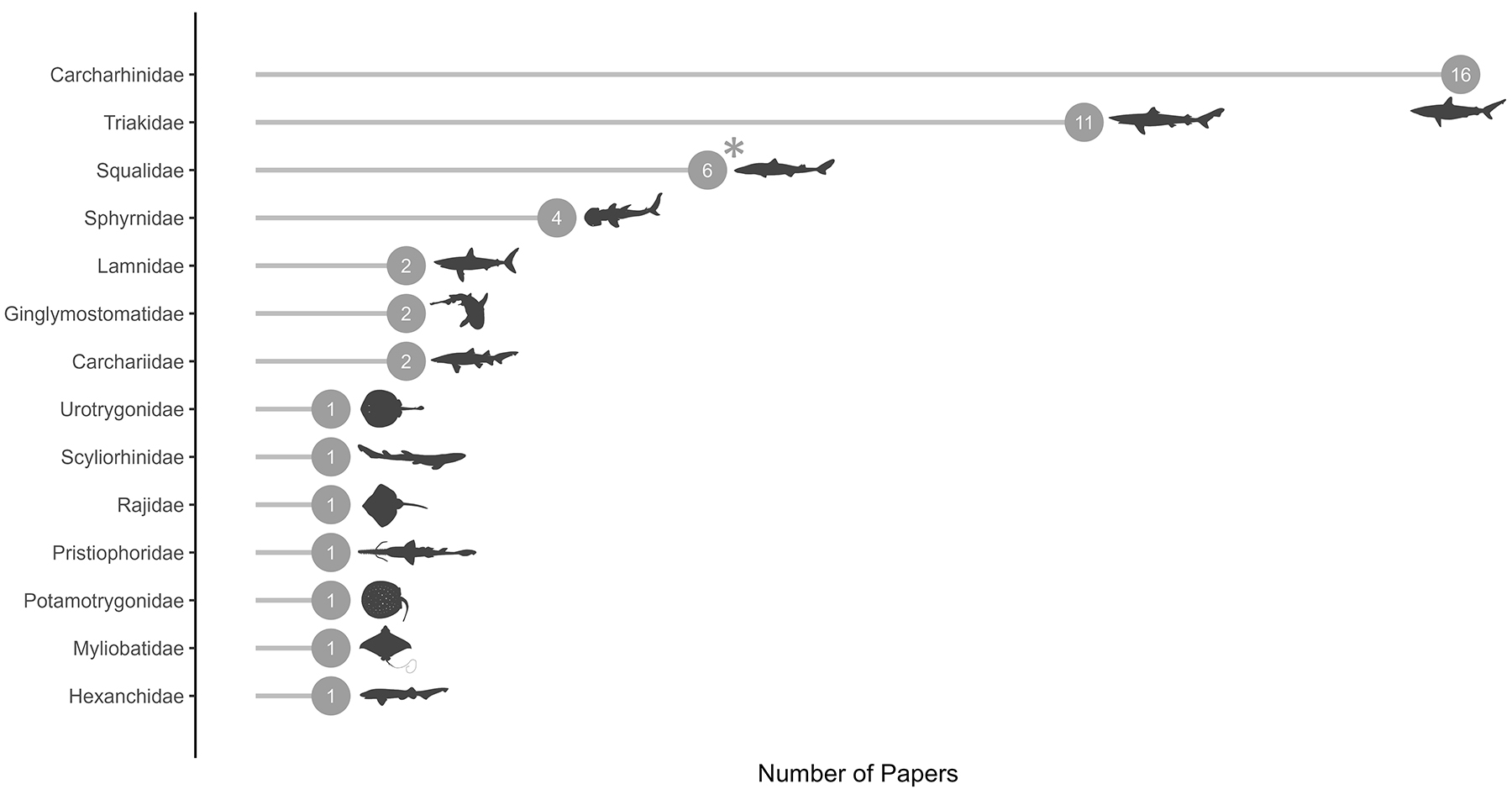
Eight orders of elasmobranchs, including six orders of sharks and two orders of rays, have shown evidence of multiple paternity: Carcharhiniformes, Hexanchiformes, Lamniformes, Orectolobiformes, Squaliformes, Pristiophoriformes, Rajiformes, and Myliobatiformes (Figure 1) (see Table S1). Sharks have evolved various reproductive modes over their evolutionary history, including oviparity (egg-laying) and different forms of viviparity (internal fertilization) (Chapman et al., 2004). Despite these adaptations, little is known about sperm storage and competition in most shark species, although females of many shark species can store sperm in the oviducal gland for extended periods, ranging from months to years before fertilization (Pratt, 1993; Hamlett et al., 1998, 1999; Lamarca et al., 2024).
Number of studies reporting multiple paternity in elasmobranch families, representing 14 families and 33 species of sharks and rays. The numbers inside the circles indicate the number of published studies for each family. The asterisk (*) in Squalidae indicates that the present study is included in the count.
The reasons for this behavior are still a knowledge gap to be filled in studies of cartilaginous fish (Lamarca et al., 2020a). Fox et al. (2019) proposed two probable ideas for the occurrence of polyandry in animals, the first consists of genetic benefits, since parentage of the offspring tends to be observed in males that have the aptitude above-average genetic fitness, and the second is a possible imbalance between mating rates for males and females, which can lead to sexual conflicts.
More specifically in elasmobranchs, multiple matings have obvious benefits for male fitness, as they are likely to generate more offspring with each additional mating. For females, the benefits of multiple matings can only be considered genetic (Lyons et al., 2017), as sharks do not form monogamous couples, do not provide parental care for the offspring, and do not share resources after mating (Pratt and Carrier, 2001). The description of elasmobranch mating systems is fundamental for the design and implementation of conservation and management strategies (Pratt and Carrier, 2001), particularly for those sustaining economically important fisheries or under vulnerable conservation status.
In addition, males are aggressive during mating attempts, whereas females often suffer serious injuries during copulation, making them more susceptible to predation during and after mating attempts, as well as more exposed to the risks of blood disorders, infections, and sexually transmitted diseases (Daly-Engel et al., 2010; Byrne and Avise, 2012; Ritter and Amin, 2019). Thus, multiple mating for females may be a means by which they avoid excessive harassment by males, where the cost of resisting to mating is greater than the cost of accepting mating, a hypothesis known as “convenience polyandry” (Portnoy et al., 2007; DiBattista et al., 2008).
Squalus acanthias Linnaeus, 1758, popularly known as “spiny dogfish”, is considered a small shark (~1.5m total length), is highly migratory and with a worldwide distribution, except in the tropical and polar regions (Compagno, 1984). The spiny dogfish is a mesopredator species with a highly diversified diet, including small invertebrates, teleost fishes, crustaceans, and cephalopods (Dunn et al., 2013). This species can live up to 75 years (Cailliet et al., 2001) and sexual maturation occurs between 60-70 cm TL (total length) for males and 75-90cm TL for females (Muus and Nielsen 1999), accompanied by long gestational periods (18 to 24 months) with an average of 1 to 21 pups per gestation (Compagno, 1984).
Like many elasmobranchs, S. acanthias has K-strategist characteristics, with slow growth rates, low fecundity, and late sexual maturation (Compagno, 1984; King and McFarlane, 2003; Dell’Apa et al., 2015), consequently, it is sensitive to overfishing (Gračan et al., 2020; Haque et al., 2021). Therefore, the complete recovery of the stock could take approximately ten years, which is approximately the period required to reach female sexual maturity (7.5 years) plus gestation time (two years) (Bargione et al., 2019).
Globally, S. acanthias is classified as VU “Vulnerable” by the International Union for Conservation of Nature (IUCN) red list of endangered species (Finucci et al., 2020). Despite its threatened conservation status, the spiny dogfish is an economically important species, used for food consumption, obtaining liver oil, vitamins, sandpaper, leather, and fertilizers (Compagno, 1984). Moreover, the consumption of S. acanthias meat can be harmful to human health due to the high accumulation of heavy metals, as reported by the study by Kirov et al. (2022).
Genetic studies on S. acanthias mostly use microsatellite markers, such as studies evaluating population genetic structure (Veríssimo et al., 2010), spatial versus temporal population structure (Thorburn et al., 2018), assessment of genetic diversity levels and evolution (Gračan et al., 2020), and gene function and expression (Cutler et al., 2022). In addition, studies on reproductive biology, such as those by Lage et al. (2008) and Veríssimo et al. (2011) in the North Atlantic Ocean, detected polyandry using microsatellite markers.
Advancements in molecular techniques have enabled the use of genetics to study reproductive biology from a new perspective, allowing for accurate kinship assignment and detection of polyandry through multiple paternity by analyzing female and offspring DNA (Green et al., 2017; Liu et al., 2020; Nevatte et al., 2023).
Single nucleotide polymorphisms (SNPs) are widely distributed genomic markers with the main advantage of being applicable to non-model organisms (Helyar et al., 2011; Peterson et al., 2012). They enable the detection of neutral and adaptive regions, which enhance the robustness of population genetic parameters and facilitates the identification of adaptive processes (Allendorf et al., 2010). These characteristics make SNPs an ideal marker type for conservation studies (Funk et al., 2012), population genetics, and ecology in various fish species (Zhang et al., 2015; Cruz et al., 2017; DiBattista et al., 2017; Colloca et al., 2020; Adachi et al., 2023; Cruz et al., 2023; Torres et al., 2024), as well as for studies of relatedness and multiple paternity (Flanagan and Jones, 2019; Bester-van der Merwe et al., 2019; Marie et al., 2019; Duchatelet et al., 2020; Liu et al., 2020; Nevatte et al., 2023). Genomic approaches, such as double-digest restriction site-associated DNA sequencing (ddRADseq), can provide informative SNPs (Peterson et al., 2012) that reveal insights into the reproductive strategies employed by S. acanthias.
No populations of S. acanthias have previously been analyzed for genetic diversity and reproductive patterns with SNPs markers. Thus, the main goal of this study was to investigate the reproductive patterns of S. acanthias, in the Southwest of the Atlantic Ocean, testing the hypothesis of the maintenance of polyandry with multiple paternity in this species.
Material and Methods
Sample collection and DNA extraction
Muscle tissue was obtained from 40 samples of Squalus acanthias from six litters (mothers and their pups), collected from two locations in Argentina: Mar del Plata (MP = 17) in the north and Puerto de Santa Cruz (PSC = 23) in the south. The litter sizes ranged from 3 to 12 pups per litter. Tissues from all individuals were deposited in the fish collection of the Laboratory of Fish Biology and Genetics, UNESP, in Botucatu, São Paulo, Brazil. DNA samples were extracted from muscle tissue fragments preserved in 95% ethanol using the Wizard® Genomic DNA Purification Kit (Promega, Madison, WI, USA), following the manufacturer’s solution-based DNA extraction protocol for animal tissues.
To confirm sample identification, the COI barcode region was amplified according to Hebert et al. (2003) for DNA barcode analyses of six samples, corresponding to the mothers of each litter. PCR amplicons were visualized on a 1% agarose gel and bi-directionally sequenced using the BigDye Terminator v.3.1 Cycle Sequencing Kit (Applied Biosystems, Inc.) on an ABI 3500 capillary sequencer, following the manufacturer’s instructions. The sequences were aligned in Geneious 4.8.5 (Kearse et al., 2012). Genetic distances were estimated using the Kimura-2-Parameter Model (K2P) (Kimura, 1980). The final matrix contained 26 sequences, including six obtained in the present study and 20 retrieved from the Barcode of Life Data System - BOLD (https://www.boldsystems.org/).
A maximum likelihood phylogenetic reconstruction was performed to construct a tree from the pairwise distances estimated using the General Time Reversible (GTR+I) substitution model. The best-fit substitution model was selected using the MEGA X model selection tool (Kumar et al., 2018). The tree was tested by bootstrap with 1,000 pseudoreplicates (Felsenstein, 1985), and all sequences analyzed were submitted to GenBank (Accession nos. PQ142937, PQ142938, PQ142939, PQ142940, PQ142941, PQ142942).
SNP library construction
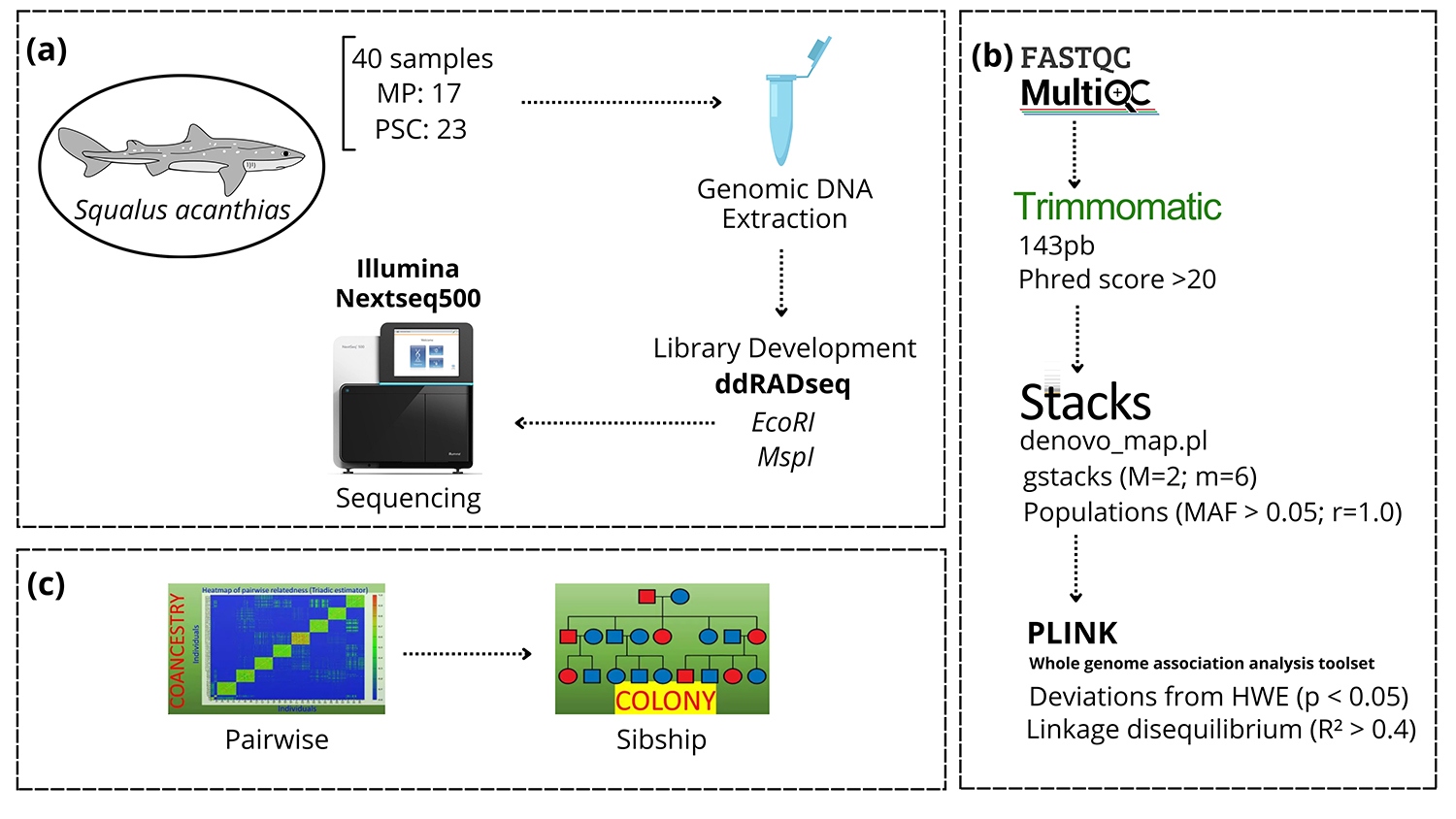
The 40 samples of S. acanthias were used for the ddRADseq technique (Peterson et al., 2012) (Figure 2). The EcoRI and MspI restriction enzymes were used for digestion, according to the method described by Campos et al. (2017). Following the digestion, a pair of adaptors were attached to the fragments of each enzyme. The Nextera® Index Primers (Illumina, San Diego, CA, USA) i5 and i7 (Nextera DNA CD Indexes, 96 indexes, 96 samples) were used to index the samples. A pool of processed samples was prepared and submitted to 1% agarose gel electrophoresis. The fragments within 300-500 base pairs (bp) were removed and purified using the Wizard® SV Gel and PCR Clean-Up System kit (Promega, Madison, WI, USA). The pool was then sequenced using an NGS Illumina Nextseq500 at the UNESP Biotechnology Institute (IBTEC), in Botucatu, São Paulo, Brazil.
Workflow used for the ddRADseq technique (Double-digest restriction site-associated DNA sequencing): (a) Sampling locations and DNA sequencing. MP = Mar del Plata and PSC = Puerto de Santa Cruz. Genomic DNA was extracted and libraries were prepared using the restriction enzymes EcoRI and MspI. (b) Bioinformatic processing and filtering, including FastQC/MultiQC, TRIMMOMATIC, STACKS (de novo pipeline and parameters applied), and PLINK for filtering loci deviating from Hardy-Weinberg equilibrium (HWE) and in linkage disequilibrium. MAF = Minor Allele Frequency. (c) Kinship analyses, including pairwise relatedness estimation using COANCESTRY and sibship reconstruction using COLONY.
After sequencing, the quality was assessed using FastQC (Andrews et al., 2015) and MultiQC (Ewels et al., 2016). All reads were trimmed to 143 bp using TRIMMOMATIC (Bolger, Lohse and Usadel, 2014) for the removal of adapters. All retained reads presented a Phred quality score above 20. The filtered and trimmed sequences were analyzed using Stacks 2.0 (Catchen et al., 2013), according to the protocol described by Rochette and Catchen (2017). As a reference genome was unavailable, the Stacks program denovo_map.pl was used to assemble the loci. The parameter optimization performed with the values (M=2, m=6, n=1) was in accordance with the recommendations provided by Paris, Stevens and Catchen (2017). The ‘ustacks’ unit was applied to build the stacks from the filtered reads. Subsequently, ‘cstacks’ was used to generate a reference catalogue. The ‘sstacks’ unit aligned reads from each sample with the catalogue, and the ‘gstacks’ unit called the variants. Finally, the Stacks populations pipeline was used with the application of two SNP filters: the first filter selected SNPs that occurred in 100% of individuals (r=1.0) per population, and the second filter excluded SNPs with an MAF (Minor Allele Frequency) value <0.05. The output files from Stacks were converted into other formats for input into the remaining programs using PGDSpider 2.1.1.5 (Lischer and Excoffier, 2011).
Multiple paternity
For the assessment of multiple paternity, the different SNP dataset comprising the six litters, were subjected to PLINK 1.9 (Chang et al., 2015) for the application of quality control filters, such as the removal of samples based on the rate of missing data per individual, using mind = 0.1, which removes all samples with more than 10% missing genotypes. Finally, SNPs that deviated from the Hardy-Weinberg equilibrium were removed, and linkage disequilibrium filters were applied with the following parameters: window size = 40, step size = 5, and R² threshold = 0.4.
The presence of multiple paternity in the litters was tested using two methods: pairwise relatedness and sibship analysis. Pairwise relatedness between mothers and pups were calculated using COANCESTRY (https://www.zsl.org/about-zsl/resources/software/coancestry; Wang, 2011). To determine which of the seven different estimators available in the program was most suitable for our data, we simulated 300 dyads for various relationship categories, including unrelated (r = 0), parent-offspring (r = 0.5), full-siblings (r = 0.5), and half-siblings (r = 0.25), based on the allele frequencies of the final filtered datasets for each litter of Squalus acanthias. Allele frequency information was filtered for each litter using R and the Related 1.0 package (https://github.com/timothyfrasier/related; Pew et al., 2015), an R implementation of COANCESTRY.
The simulation included a conservative genotyping error rate of 0.01 for each locus, with no missing data or allelic dropout. Pairwise relatedness was then calculated for the simulated dyads with the seven estimators, using the default value (100) for the number of reference individuals used for the triadic likelihood estimator (TrioML). The best relatedness estimator was identified based on both its accuracy (closeness to the true value) and precision (variation around the estimated values), as suggested by Attard et al. (2018). This involved examining Pearson’s correlation coefficient calculated for each estimator by COANCESTRY. Simulated dyad data for each relationship category were used to calculate means and standard deviations and to construct box plots for visual assessment of variance. The estimators used were Wang and LynchLi, which are modified to handle small sample sizes and provide unbiased estimates of relatedness (Wang, 2017). Therefore, these estimators were selected for the empirical analysis. The parameters for the empirical analysis were the same as those used in the simulation, with genotyping error accounted for in the analysis. The genotype input file containing all individuals was generated with Related, and all other required files were created following the instructions in the COANCESTRY manual.
To determine the most likely number of sires for each litter, a sibship analysis was conducted using COLONY (ver. 2.0.7.0, https://www.zsl.org/about-zsl/resources/software/colony; Jones and Wang, 2010). The program uses a full-likelihood approach to infer relationships among the offspring (full siblings, half siblings, or unrelated) and can reconstruct the genotypes of potential parents. For the analyses, COLONY assumes that the loci are in Hardy-Weinberg equilibrium (HWE) and linkage equilibrium.
The program uses a full-likelihood approach to infer relationships among the offspring (full siblings, half siblings, or unrelated) and can reconstruct the genotypes of potential parents. For the analyses, COLONY assumes that the loci are in HWE and linkage equilibrium. The genotypes of the pups and their mothers were included in the sibship analysis with COLONY, specifying this maternal relationship in the project file. Each litter was analyzed separately, using parameters similar to those described by Nevatte et al. (2023), as follows: males and females were set to a polygamous mating system, with no inbreeding and no clones present among the offspring. Considering that sharks are diploid and dioecious organisms, these options were selected. The full-likelihood method was chosen as the analysis method, with medium likelihood precision, medium run length, and five runs. The initial random number seed for the first run was set to 1234. No sibship prior was applied, sibship scaling was set to the default (Yes), and allele frequencies were not updated. The markers were set as codominant, with an allelic dropout rate of 0 and a genotyping error rate of 0.01. Allele frequencies were estimated during the analysis.
In the context of relatedness and sibship analysis performed by the COLONY software, inclusion and exclusion probabilities are metrics that evaluate the accuracy and reliability of paternity assignments and relationships among individuals. A high inclusion probability (above 0.99) indicates confidence in the data, showing that the individuals assigned as parents are indeed the biological parents of the offspring. This means that the COLONY results have high certainty and are reliable. A high exclusion probability (above 0.99) indicates strong confidence that any individual not identified as a parent is indeed not the biological parent of the offspring. This reinforces the accuracy of the assignments made, minimizing the possibility of significant errors.
High inclusion and exclusion probabilities are crucial to ensure that relatedness and sibship assignments are accurate. They provide the necessary level of certainty to infer biological relationships with confidence, which is fundamental in population genetics and evolutionary biology studies. When both inclusion and exclusion probabilities are greater than 0.99 within the same sample group, a high degree of confidence can be assigned to the results of the COLONY analysis. This indicates that the assigned parents are indeed biological parents, and that any other individual was correctly excluded as a possible parent. This significantly enhances the credibility of the results and conclusions derived from the genetic study. Therefore, to estimate the number of males contributing to each litter in our data, only Prob (Inc) and Prob (Excl) values greater than 99% were considered.
Ethics permit and approval statement
All Squalus acanthias specimens analyzed in this study were obtained from targeted fishing operations in two localities along the Argentine coast. The samples were provided by collaborating researchers (Dr. Sergio M. Delpiani and Dr. Gabriela Delpiani, Investigaciones Marinas y Costeras, Argentina). Sampling was conducted in accordance with relevant local regulations; no specific permit number was issued.
Results
The adult specimens used in this study were molecularly identified with DNA barcoding to confirm their previous morphological identification. The barcode sequences obtained ranged in length from 642 to 650 base pairs, revealing high percentages of similarity (>99%) with S. acanthias deposited in BOLD (Table S2). The intraspecific genetic distances values were 0.3%. The results of the Maximum Likelihood (ML) tree showed a single group for S. acanthias, formed by the adult individuals of this study, collected in two regions of Argentina, and the individuals extracted from the BOLD collected in different regions of the Atlantic Ocean (Figure S1).
After confirming the specimen identification, a ddRAD library was developed for 40 samples of S. acanthias resulting in 94,308,943 raw data reads ranging from 1,082,597 to 3,124,731 reads per sample. After quality filtering, 51,582,038 reads were kept, ranging from 594,373 to 1,873,556 (Table S3). All reads were standardized with 143 bp, and after quality filtering, we obtained 1,021 SNPs (litter 1), 1,090 SNPs (litter 2), 1,124 SNPs (litter 3), 1,150 SNPs (litter 4), 1,620 SNPs (litter 5), and 1,480 SNPs (litter 6), which were used in subsequent analyses.
Multiple paternity
The pairwise relatedness and sibship analyses revealed the presence of multiple paternity in S. acanthias. The relatedness estimates using COANCESTRY for the Lynchli and Wang estimators were nearly identical for all litters and are reported here (Table 1). For litter 1 (8 pups), half-sibling relationships were found for 3 pups, with pups 104841, 104843 and 104846 being half-siblings pups (Lynchli range: 0.352-0.362 and Wang range: 0.372-0.375). For litter 2 (3 pups), half-sibling relationships were found for 2 pups, with pups 104850 and 104851 being half-siblings (Lynchli 0.329 and Wang 0.349). For litter 3 (3 pups), half-sibling relationships were found for 2 pups (Lynchli: 0.388 and Wang 0.406). For litter 4 (4 pups), half-sibling relationships were found for 2 pups, with pup 104859 being a half-sibling of pup 104860 (Lynchli 0.306 and Wang 0.321). For litter 5 (12 pups), half-sibling relationships were found for 5 pups, with pups 104862, 104863, 104864, 104865, and 104866 being half-siblings (Lynchli range: 0.065-0.229 and Wang range: 0.090-0.246). For litter 6 (4 pups), half-sibling relationships were found for all 4 pups (Lynchli range: 0.204-0.353 and Wang range: 0.227-0.373).
Relatedness estimates generated by COANCESTRY for the six litters, using the Lynchli and Wang estimators.
The sibship analysis with COLONY confirmed multiple paternity in the six litters analyzed (Table 2). In litter 1, the analysis indicated that five males sired the litter. Father 1 would have sired three pups (104840, 104844, and 104846) with low Inc and Exc probabilities (0.58). Father 2 would have sired two pups (104841 and 104847) with Inc and Exc probabilities (>0.99). Father 3 would have sired one pup (104842) with a high Inc probability (>0.99) and low Exc probability (0.31). Father 4 would have sired one pup (104843) with Inc and Exc probabilities (>0.99). Father 5 would have sired one pup (104845) with a high Inc probability (>0.99) and low Exc probability (0.47). Thus, considering only inclusion and exclusion probabilities (>0.99), this litter had at least two distinct fathers: Father 2 with two pups and Father 4 with one pup.
Results from the sibship analysis performed using COLONY for the litters of Squalus acanthias. Only probabilities (>99%) are reported. The inclusion probability Prob (Inc.), exclusion probability Prob (Exc.), and vouchers of the pups for each full-sibling family are presented.
Additionally, the pups identified here as half-siblings (104841 and 104843), sired by fathers 2 and 4 respectively, were consistent with the results found in the pairwise relatedness estimates conducted with COANCESTRY. In litter 2 (3 pups), the analysis indicated that the litter was sired by two males. Father 1 would have sired two pups (104849 and 104850), but the Inc and Exc probabilities were low (0.13), and Father 2 would have sired only one pup (104851), with Inc and Exc probabilities (>0.99).
The half-sibling relationship between 104850 and 104851 was also confirmed by the pairwise analysis conducted with COANCESTRY. In litter 3 (3 pups), the analysis indicated that the litter was sired by three males, meaning that each pup had a different father. Father 1 would have sired one pup (104853), Father 2 one pup (104854), and Father 3 one pup (104855). All with Inc and Exc probabilities (>0.99). The half-sibling relationship between 104854 and 104855 was also confirmed by the pairwise analysis conducted by COANCESTRY. In litter 4 (4 pups), the analysis indicated that the litter was sired by four males, with each pup having a different father. Father 1 sired one pup (104857), Father 2 one pup (104858), Father 3 one pup (104859), and Father 4 one pup (104860). All with Inc and Exc probabilities (>0.99). The half-sibling relationship between pups 104859 and 104860 was confirmed by the pairwise analysis conducted by COANCESTRY.
In litter 5, the largest litter in this study (12 pups), the analysis indicated that the litter was sired by three males. Father 1 would have sired three pups (104862, 104863, and 104864). Father 2 would have sired four pups (104865, 104866, 104867, and 104868). Father 3 would have sired five pups (104869, 104870, 104871, 104872, and 104873). All with Inc and Exc probabilities (>0.99). The half-sibling relationship between 104862, 104863, 104864, 104865, and 104866 and the other pups was confirmed by the pairwise analysis conducted by COANCESTRY. Finally, in litter 6 (4 pups), the analysis indicated that the litter was sired by four males, with each pup having a different father. Father 1 sired one pup (104875), Father 2 one pup (104876), Father 3 one pup (104877), and Father 4 one pup (104878). All with Inc and Exc probabilities (>0.99). The half-sibling relationship between 104875 and 104876 and the other pups was confirmed by the pairwise analysis conducted by COANCESTRY.
Discussion
The results of this study offer insights into the reproductive strategies of Squalus acanthias along the Argentine coast, particularly regarding the occurrence of polyandry and multiple paternity, which have not been previously evaluated using SNP markers. The application of the ddRADseq methodology enabled a detailed analysis of the species’ genome, providing a robust basis for identifying SNP markers and inferring relationships among embryos. Additionally, this study extends the geographic range of documented multiple paternity occurrences.
In terms of fecundity, moderate levels were observed, with litter sizes ranging from three to twelve offspring. This range is aligned with the established reproductive parameters of the species, which range from one to twenty-one offspring per gestation cycle (Compagno, 1984). Conversely, congeneric species such as Squalus megalops (Macleay, 1881) typically produce two to four pups per pregnancy (Watson and Smale, 1998), whereas Squalus blainvillei (Risso, 1827) typically produces an average of three to four offspring per litter (Ebert et al., 2013).
Comparing our findings with previous studies based on microsatellites, such as Lage et al. (2008), our results reveal a substantial improvement in the detection of multiple paternity. While Lage et al. reported multiple paternity predominantly in larger litters (>5 pups), we detected multiple paternity in both small litters (as few as 3 offspring) and in larger litters (9 and 12 offspring). This demonstrates that the commonly accepted association between litter size and the probability of multiple paternity may have been partially driven by methodological limitations rather than by biological constraints.
The use of thousands of SNP markers greatly increased the resolution of our kinship analyses, allowing for more accurate estimates of the number of sires and a clearer distinction among relatedness categories within each litter. The high SNP recovery per litter provided more informative data than traditional microsatellite panels, enabling us to uncover patterns of paternity that were likely undetectable in previous studies. Additionally, our findings are consistent with Colonello et al. (2016), who showed that female reproductive cycles in Squalus acanthias exhibit variable fertility and may experience increased embryo loss during late gestation due to fishing-related stress.
Taken together, our results contribute new evidence that multiple paternity occurs even in small litters and highlight the importance of high-resolution genomic markers for accurately describing mating systems in elasmobranchs. These findings provide a foundation for further discussion of reproductive strategies in S. acanthias.
According to Veríssimo et al. (2011), who analyzed 29 litters of S. acanthias (with five to seven pups per litter) using seven microsatellite markers, the study revealed that litter size increased with female size but was similar between polyandrous and monogamous females. This suggests that, although litter size may be influenced by female size, multiple paternity did not have a significant impact on litter size, as also observed in our study. Thus, polyandry in S. acanthias may be influenced by other ecological or behavioral factors, rather than just litter size and fecundity.
The evidence found in this study of multiple paternity occurring in both small and large litters, coupled with the high number of males (fathers) contributing to the fertilization of smaller litters, could indicate that this reproductive strategy is being utilized by the species to help maintain genetic variability. This phenomenon could be a response to a decrease in available females for mating, potentially explaining why a litter of 3 to 4 pups may have one father for each pup. Literature reports also indicate that when a female mates with multiple males during the same breeding season (polyandry), the first male to copulate tends to father the largest number of pups in the litter (Orr and Brennan, 2015). Thus, when multiple pups are attributed to different fathers, it may be possible to identify the first male to mate with the female.
A recent study by Andrade et al. (2024) confirms that S. acanthias is more frequently captured in shallow coastal areas (between 19 and 150 meters deep), with females being more abundant and larger than males. Some females were found pregnant with advanced-stage embryos, although the embryos were aborted before sampling. This further supports the observed size and sex segregation relative to depth in this species. Understanding bathymetric variation is crucial for managing and conserving fishery resources. Additionally, S. acanthias exhibits sexual dimorphism, with females being larger than males and taking longer to reach sexual maturity (Colonello et al., 2016). This species also demonstrates sex and size segregation, known as bathymetric variation, with males often found in deeper waters and females in shallower depths (Andrade et al., 2024). This segregation increases the vulnerability of females to population declines caused by intensive fishing (Shepherd et al., 2002; Lamarca et al., 2020b).
Throughout the Atlantic Ocean, S. acanthias populations have been affected by varying levels of fishing pressure (Colonello et al., 2016). In the southwestern Atlantic, this species is often caught as bycatch by major industrial fisheries and discarded at sea (Massa et al., 2004; Cedrola et al., 2012; Góngora et al., 2023). In the North Atlantic, along the coasts of the USA and Canada, this shark has been significantly impacted by continuous removal since the early 20th century (Rago et al., 1998; Wallace et al., 2009; Dell’Apa et al., 2015). This exploitation can decrease reproduction rates due to reduced abundance or altered sex ratios of mature individuals (Daly-Engel et al., 2006). Capturing more females can significantly reduce the species’ chances of survival and persistence.
Although multiple paternity may not be directly related to litter size, female size is crucial for reproductive capacity and the production of more offspring. Therefore, protecting these females in their natural habitat is essential for species survival. Given that S. acanthias has one of the longest gestation periods among elasmobranchs and that larger females may produce more pups, protecting this species is crucial for ensuring that both males and females reach sexual maturity and reproduce, thereby ensuring the species’ survival.
Many sharks and rays have already become extinct, with about a third of species lost due to human pressures, and fishing has been responsible for 67.3% of these extinctions (Dulvy et al., 2021). Maintaining genetic variability is vital for species survival. The findings of this study emphasize the need for management policies that consider genetic diversity and reproductive practices, particularly for species with complex life histories and low stock replacement rates. Multiple paternity can help maintain gene flow and genetic diversity (Newcomer et al., 1999; Hoekert et al., 2002; Hudson, 2022) and may aid in reducing infertility (Schmidt et al., 2010; Hudson, 2022). Therefore, multiple matings and the occurrence of multiple paternity can be essential for supporting genetic diversity within the species.
The capture of pregnant females, which often abort due to stress, represents a significant challenge. Future research should focus on expanding sampling and applying advanced genomic techniques to explore other aspects of the reproductive biology of S. acanthias. Studies in different geographical regions and ecological contexts would also be valuable for understanding variations in reproductive strategies. This study enhances our understanding of the complex reproductive strategies of S. acanthias, highlighting the prevalence of multiple paternity and the need for conservation measures that account for the genetic diversity and reproductive practices of the species along the Argentine coast.
Conclusion
In summary, we provide evidence that multiple paternity continues to be a reproductive strategy used by Squalus acanthias. This was the first study conducted with SNPs, and the markers showed great efficiency in detecting multiple paternity in both large and small litters. Our findings on multiple paternity are consistent with those already observed in litters of various elasmobranch species and highlight that the occurrence of this behavior in both large and small litters may be related to intrinsic factors of the group. Therefore, this study demonstrates the importance of the persistence of multiple paternity, especially in groups more vulnerable to fishing pressure, contributing to the maintenance of genetic diversity and species persistence.
Supplementary material
Figure S1 -
Table S1 -
Table S2 -
Table S3 -
Acknowledgements
BRB received financial support from Fundação de Amparo à Pesquisa do Estado de São Paulo - FAPESP grants 2019/15131-0. CO received financial support from Fundação de Amparo à Pesquisa do Estado de São Paulo - FAPESP grant nº 2020/13433-6; Conselho Nacional de Desenvolvimento Científico e Tecnológico (CNPq), grants nºs 306054/2006-0 and 441128/2020-3; and Pro-Reitoria de Pesquisa da Universidade Estadual Paulista Júlio de Mesquita Filho (PROPe-UNESP).
References
- Adachi AM, Roque PC, Hazin FH, Vianna M, Rotundo MM, Oliveira C and Cruz VP (2023) Genetic population structure and diversity of the whitetail dogfish Squalus albicaudus (Chondrichthyes, Squaliformes) along the Brazilian coast as identified by SNP markers. Fishes 8:373.
- Allendorf FW, Hohenlohe PA and Luikart G (2010) Genomics and the future of conservation genetics. Nat Rev Genet 11:697-709.
- Andrade H, Nilsen T, Vollen T, Harbitz A, Junge C and Albert OT (2024) A longline survey for spurdog distribution and life history along the Norwegian coast. Fish Manag Ecol 31:e12676.
- Attard CR, Beheregaray LB and Möller LM (2018) Genotyping-by-sequencing for estimating relatedness in nonmodel organisms: Avoiding the trap of precise bias. Mol Ecol Resour 18:381-390.
- Bargione G, Donato F, La Mesa M, Mazzoldi C, Riginella E, Vasapollo C and Lucchetti A (2019) Life-history traits of the spiny dogfish Squalus acanthias in the Adriatic Sea. Sci Rep 9:14317.
- Bester-van der Merwe AE, Maduna SN, Hull KL, Bell J, Rossouw C and Wintner SP (2019) Evidence for multiple paternity and confirmation of an Indo-Pacific origin of blacktip shark Carcharhinus limbatus occurring in South Africa. Afr J Mar Sci 41:281-289.
- Birkhead T (2000) Promiscuity: An evolutionary history of sperm competition. Harvard University Press, Cambridge.
- Bolger AM, Lohse M and Usadel B (2014) Trimmomatic: A flexible trimmer for Illumina sequence data. Bioinformatics 30:2114-2120.
- Byrne RJ and Avise JC (2012) Genetic mating system of the brown smoothhound shark (Mustelus henlei), including a literature review of multiple paternity in other elasmobranch species. Mar Biol 159:749-756.
- Cailliet GM, Andrews AH, Burton EJ, Watters DL, Kline DE and Ferry-Graham LA (2001) Age determination and validation studies of marine fishes: Do deep-dwellers live longer? Exp Gerontol 36:739-764.
- Campos M, Conn JE, Alonso DP, Vinetz JM, Emerson KJ and Ribolla PE (2017) Microgeographical structure in the major Neotropical malaria vector Anopheles darlingi using microsatellites and SNP markers. Parasit Vectors 10:76
- Catchen J, Hohenlohe PA, Bassham S, Amores A and Cresko WA (2013) Stacks: An analysis tool set for population genomics. Mol Ecol 22:3124-3140.
- Cedrola PV, González AM, Chiaramonte GE and Pettovello AD (2012) Bycatch of sharks (Elasmobranchii) in the Patagonian red shrimp Pleoticus muelleri (Bate, 1888) fishery. Rev Mus Argent Cienc Nat 14:349-356.
- Chang CC, Chow CC, Tellier LC, Vattikuti S, Purcell SM and Lee JJ (2015) Second-generation PLINK: Rising to the challenge of larger and richer datasets. Gigascience 4:47.
- Chapman DD, Prodöhl PA, Gelsleichter J, Manire CA and Shivji MS (2004) Predominance of genetic monogamy by females in a hammerhead shark, Sphyrna tiburo: Implications for shark conservation. Mol Ecol 13:1965-1974.
- Colloca F, Carrozzi V, Simonetti A and Di Lorenzo M (2020) Using local ecological knowledge of fishers to reconstruct abundance trends of elasmobranch populations in the Strait of Sicily. Front Mar Sci 7:508.
- Colonello JH, Cortés F, Belleggia M and Massa AM (2016) Reproductive and population parameters of spiny dogfish Squalus acanthias in the southwestern Atlantic Ocean. J Fish Biol 88:1758-1775.
- Compagno LJV (1984) Sharks of the world: An annotated and illustrated catalog of shark species known to date. FAO, Rome.
- Cruz VP, Rotundo MM, Charvet P, Boza BR, Souza BC, Cerqueira NNCD, Oliveira C, Lessa R and Foresti F (2023) Investigating an unknown biodiversity: Evidence of distinct lineages of the endemic chola guitarfish Pseudobatos percellens Walbaum, 1792 in the Western Atlantic Ocean. Diversity 15:344.
- Cruz VP, Vera M, Pardo BG, Taggart J, Martinez P, Oliveira C and Foresti F (2017) Identification and validation of single nucleotide polymorphisms as tools to detect hybridization and population structure in freshwater stingrays. Mol Ecol Resour 17:550-556.
- Cutler CP, Murray D, Ojo T, Harmon S, MacIver B, Cramb G and Zeidel ML (2022) Aquaporin (AQP) channels in the spiny dogfish, Squalus acanthias I: Characterization of AQP3 and AQP15 function and expression, and localization of the proteins in gill and spiral valve intestine. Comp Biochem Physiol B Biochem Mol Biol 258:110702.
- Daly-Engel TS, Grubbs RD, Holland KN, Toonen RJ and Bowen BW (2006) Assessment of multiple paternity in single litters from three species of carcharhinid sharks in Hawaii. Environ Biol Fishes 76:419-424.
- Daly-Engel TS, Grubbs RD, Feldheim KA, Bowen BW and Toonen RJ (2010) Is multiple mating beneficial or unavoidable? Low multiple paternity and genetic diversity in the shortspine spurdog Squalus mitsukurii Mar Ecol Prog Ser 403:255-267.
- Dell’Apa A, Bangley CW and Rulifson RA (2015) Who let the dogfish out? A review of management and socio-economic aspects of spiny dogfish fisheries. Rev Fish Biol Fish 25:273-295.
- DeWoody JA and Avise JC (2001) Genetic perspectives on the natural history of fish mating systems. J Hered 92:167-172.
- DiBattista JD, Feldheim KA, Thibert-Plante X, Gruber SH and Hendry AP (2008) A genetic assessment of polyandry and breeding-site fidelity in lemon sharks. Mol Ecol 17:3337-3351.
- DiBattista JD, Saenz-Agudelo P, Piatek MJ, Wang X, Aranda M and Berumen ML (2017) Using a butterflyfish genome as a general tool for RAD-Seq studies in specialized reef fish. Mol Ecol Resour 17:1330-1342.
- Duchatelet L, Oury N, Mallefet J and Magalon H (2020) In the intimacy of the darkness: Genetic polyandry in deep-sea luminescent lanternsharks Etmopterus spinax and Etmopterus molleri (Squaliformes, Etmopteridae). J Fish Biol 96:1523-1529.
- Dulvy NK, Pacoureau N, Rigby CL, Pollom RA, Jabado RW, Ebert DA and Simpfendorfer CA (2021) Overfishing drives over one-third of all sharks and rays toward a global extinction crisis. Curr Biol 31:4773-4787.
- Dunn MR, Stevens DW, Forman JS and Connell A (2013) Trophic interactions and distribution of some squaliforme sharks, including new diet descriptions for Deania calcea and Squalus acanthias PLoS One 8:e59938.
- Ebert DA, Fowler SL and Compagno LJV (2013) Sharks of the world: A fully illustrated guide. Wild Nature Press, Plymouth.
- Ewels P, Magnusson M, Lundin S and Käller M (2016) MultiQC: Summarize analysis results for multiple tools and samples in a single report. Bioinformatics 32:3047-3048.
- Felsenstein J (1985) Phylogenies and the comparative method. Am Nat 125:1-15.
- Flanagan SP and Jones AG (2019) The future of parentage analysis: From microsatellites to SNPs and beyond. Mol Ecol 28:544-567.
- Fox RJ, Head ML and Jennions MD (2019) Disentangling the costs of male harassment and the benefits of polyandry for females. Behav Ecol 30:872-881.
- Funk WC, McKay JK, Hohenlohe PA and Allendorf FW (2012) Harnessing genomics for delineating conservation units. Trends Ecol Evol 27:489-496.
- Góngora ME, Núñez JR, Cochia PD and Bovcon ND (2023) Species composition and assemblage analysis of fishes caught as bycatch by the Patagonian shrimp fishery in the southwest Atlantic. An Acad Bras Cienc 95:e20200735.
- Gračan R, Lazar B, Zupan S and Bužan E (2020) Genetic characterisation of the spiny dogfish Squalus acanthias in the Adriatic Sea: Evidence for high genetic diversity and an Atlantic-South Pacific origin. Mar Freshw Res 72:131-139.
- Green ME, Appleyard SA, White W, Tracey S and Ovenden J (2017) Variability in multiple paternity rates for grey reef sharks (Carcharhinus amblyrhynchos) and scalloped hammerheads (Sphyrna lewini). Sci Rep 7:1528.
- Hamlett WC, Knight DP, Koob TJ, Jezior M, Luong T, Rozycki T, Brunette N and Hysell MK (1998) Survey of oviducal gland structure and function in elasmobranchs. J Exp Zool 282:399-420.
- Haque AB, Cavanagh RD and Seddon N (2021) Evaluating artisanal fishing of globally threatened sharks and rays in the Bay of Bengal, Bangladesh. PLoS One 16:e0256146.
- Hebert PD, Ratnasingham S and De Waard JR (2003) Barcoding animal life: Cytochrome c oxidase subunit 1 divergences among closely related species. Proc R Soc Lond B Biol Sci 270:S96-S99.
- Helyar SJ, Hemmer-Hansen J, Bekkevold D, Taylor MI, Ogden R, Limborg MT and Nielsen EE (2011) Application of SNPs for population genetics of nonmodel organisms: New opportunities and challenges. Mol Ecol Resour 11:123-136.
- Hoekert W, Neuféglise H, Schouten A and Menken SB (2002) Multiple paternity and female-biased mutation at a microsatellite locus in the olive ridley sea turtle (Lepidochelys olivacea). Heredity 89:107-113.
- Jones OR and Wang J (2010) COLONY: A program for parentage and sibship inference from multilocus genotype data. Mol Ecol Resour 10:551-555.
- Karl SA (2008) The effect of multiple paternity on the genetically effective size of a population. Mol Ecol 17:3973-3977.
- Kearse M, Moir R, Wilson A, Stones-Havas S, Cheung M, Sturrock S, Buxton S, Cooper A, Markowitz S, Duran C et al (2012) Geneious Basic: An integrated and extendable desktop software platform for the organization and analysis of sequence data. Bioinformatics 28:1647-1649.
- Kimura M (1980) A simple method for estimating evolutionary rates of base substitutions through comparative studies of nucleotide sequences. J Mol Evol 16:111-120.
- King JR and McFarlane GA (2003) Marine fish life history strategies: Applications to fishery management. Fish Manag Ecol 10:249-264.
- Kirov V, Neshovska H and Manev I (2022) Heavy metal levels in meat of spiny dogfish (Squalus acanthias) from Bulgarian Black Sea. Tradit Mod Vet Med 7:77-79.
- Kumar S, Stecher G, Li M, Knyaz C and Tamura K (2018) MEGA X: Molecular evolutionary genetics analysis across computing platforms. Mol Biol Evol 35:1547-1549.
- Lage CR, Petersen CW, Forest D, Barnes D, Kornfield I and Wray C (2008) Evidence of multiple paternity in spiny dogfish (Squalus acanthias) broods based on microsatellite analysis. J Fish Biol 73:2068-2074.
- Lamarca F, Carvalho PH and Netto -Ferreira AL (2024) The loss of female sperm storage ability as a potential driver for increased extinction in Chondrichthyes Evol Ecol 38:461-479.
- Lamarca F, Carvalho PH, Vilasboa A, Netto -Ferreira AL and Vianna M (2020a) Is multiple paternity in elasmobranchs a plesiomorphic characteristic? Environ Biol Fishes 103:1463-1470.
- Lamarca F, Vianna M and Vilasboa A (2020b) The first reproductive parameters and evidence of multiple paternity in one new spiny dogfish species, Squalus albicaudus (Squaliformes, Squalidae). J Fish Biol 97:1268-1272.
- Lischer HEL and Excoffier L (2011) PGDSpider: An automated data conversion tool for connecting population genetics and genomics programs. Bioinformatics 28:298-299.
- Liu SYV, Tsai WP, Lee M and Chien HW (2020) Accessing multiple paternity in the shortfin mako shark (Isurus oxyrinchus). Zool Stud 59:e49.
- Lyons K, Chabot CL, Mull CG, Paterson Holder CN and Lowe CG (2017) Who’s My Daddy? Considerations for the influence of sexual selection on multiple paternity in elasmobranch mating systems. Ecol Evol 7:5603-5612.
- Marie AD, Herbinger C, Fullsack P and Rico C (2019) First reconstruction of kinship in a scalloped hammerhead shark aggregation reveals the mating patterns and breeding sex ratio. Front Mar Sci 6:676.
- Massa AM, Lucifora LO, Hozbor NM, Sánchez R and Bezzi S (2004) Condrictios de la región costera bonaerense y uruguaya. In: El Mar Argentino y sus recursos pesqueiros. Tomo 4. Los peces marinos de interés pesquero. Caracterización biológica y evaluación del estado de explotación. INIDEP, Mar del Plata, pp 85-99.
- Muus BJ and Nielsen JG (1999) Sea fish. Scandinavian Fishing Year Book, Hedehusene.
- Nevatte RJ, Williamson JE and Gillings MR (2023) First evidence of multiple paternity and hybridisation in Australian sawsharks. Mar Freshw Res 74:586-600.
- Newcomer SD, Zeh JA and Zeh DW (1999) Genetic benefits enhance the reproductive success of polyandrous females. Proc Natl Acad Sci U S A 96:10236-10241.
- Orr TJ and Brennan PL (2015) Sperm storage: Distinguishing selective processes and evaluating criteria. Trends Ecol Evol 30:261-272.
- Paris JR, Stevens JR and Catchen JM (2017) Lost in parameter space: A road map for stacks. Methods Ecol Evol 8:1360-1373.
- Peterson BK, Weber JN, Kay EH, Fisher HS and Hoekstra HE (2012) Double digest RADseq: An inexpensive method for de novo SNP discovery and genotyping in model and non-model species. PLoS One 7:e37135.
- Pew J, Muir PH, Wang J and Frasier TR (2015) related: An R package for analysing pairwise relatedness from codominant molecular markers. Mol Ecol Resour 15:557-561.
- Portnoy DS, Piercy AN, Musick JA, Burgess GH and Graves JE (2007) Genetic polyandry and sexual conflict in the sandbar shark, Carcharhinus plumbeus, in the western North Atlantic and Gulf of Mexico. Mol Ecol 16:187-197.
- Pratt Jr HL (1993) The storage of spermatozoa in the oviducal glands of western North Atlantic sharks. In: Demski LS and Wourms JP (eds) The reproduction and development of sharks, skates, rays and ratfishes. Developments in environmental biology of fishes, vol 14. Springer, Dordrecht, pp 139-149.
- Pratt HL and Carrier JC (2001) A review of elasmobranch reproductive behavior with a case study on the nurse shark, Ginglymostoma cirratum Environ Biol Fishes 60:157-188.
- Rago PJ, Sosebee KA, Brodziak JKT, Murawski SA and Anderson ED (1998) Implications of recent increases in catches on the dynamics of Northwest Atlantic spiny dogfish (Squalus acanthias). Fish Res 39:165-181.
- Ritter EK and Amin RW (2019) Mating scars among sharks: Evidence of coercive mating? Acta Ethol 22:9-16.
- Rochette NC and Catchen JM (2017) Deriving genotypes from RAD-seq short-read data using stacks. Nat Protoc 12:2640-2659.
- Schmidt JV, Chen CC, Sheikh SI, Meekan MG, Norman BM and Joung SJ (2010) Paternity analysis in a litter of whale shark embryos. Endang Species Res 12:117-124.
- Shepherd TD, Page FH and Macdonald BA (2002) Length- and sex-specific associations between spiny dogfish (Squalus acanthias) and hydrographic variables in the Bay of Fundy and Scotian Shelf. Fish Oceanogr 11:78-89.
- Taylor ML, Price TA and Wedell N (2014) Polyandry in nature: A global analysis. Trends Ecol Evol 29:376-383.
- Thorburn J, Jones R, Neat F, Pinto C, Bendall V, Hetherington S, Bailey DM, Leslie N and Jones C (2018) Spatial versus temporal structure: Implications of inter-haul variation and relatedness in the North-east Atlantic spurdog Squalus acanthias Aquat Conserv Mar Freshw Ecosyst 28:1167-1180.
- Torres Y, Rotundo MM, Vianna M, Charvet P, Faria VV, Oliveira C, Foresti F and Cruz VP (2024) Population structure of the critically endangered Brazilian guitarfish Pseudobatos horkelii (Rhinobatidae) revealed by double-digest restriction site-associated DNA sequencing. Aquat Conserv Mar Freshw Ecosyst 34:e4035.
- Veríssimo A, Grubbs D, McDowell J, Musick J and Portnoy D (2011) Frequency of multiple paternity in the spiny dogfish Squalus acanthias in the Western North Atlantic. J Hered 102:88-93.
- Veríssimo A, McDowell JR and Graves JE (2010) Global population structure of the spiny dogfish Squalus acanthias Mol Ecol 19:183-193.
- Wallace S, McFarlane G, Campana S and King JR (2009) Status of spiny dogfish in Atlantic and Pacific Canada. Biol Manag Spiny Dogfish Sharks:313-334.
- Wang J (2011) COANCESTRY: A program for simulating, estimating and analysing relatedness and inbreeding coefficients. Mol Ecol Resour 11:141-145.
- Wang J (2017) Estimating pairwise relatedness in a small sample of individuals. Heredity 119:302-313.
- Watson G and Smale MJ (1998) Reproductive biology of shortnose spiny dogfish, Squalus megalops, from the Agulhas Bank, South Africa. Mar Freshw Res 49:695-703.
- Zhang HW, Yin SW, Zhang LJ, Hou XY, Wang YY and Zhang GS (2015) Development and validation of single nucleotide polymorphism markers in Odontobutis potamophila from transcriptomic sequencing. Genet Mol Res 14:2080-2085.
Internet Resources
-
Andrews S, Krueger F, Seconds-Pichon A, Biggins F, Wingett S (2015) FastQC: A quality control tool for high throughput sequence data, Andrews S, Krueger F, Seconds-Pichon A, Biggins F, Wingett S (2015) FastQC: A quality control tool for high throughput sequence data, https://www.bioinformatics.babraham.ac.uk/projects/fastqc/ (accessed 22 July 2024).
» https://www.bioinformatics.babraham.ac.uk/projects/fastqc/ -
Finucci B, Cheok J, Chiaramonte GE, Cotton CF, Dulvy NK, Kulka DW, Neat FC, Pacoureau N, Rigby CL, Tanaka S et al (2020) Squalus acanthias, The IUCN Red List of Threatened Species, (2020) Squalus acanthias, The IUCN Red List of Threatened Species, https://www.iucnredlist.org/species/91209505/124551959 (accessed 21 July 2024).
» https://www.iucnredlist.org/species/91209505/124551959 -
Hudson A (2022) Shark promiscuity: Investigating drivers of shark polyandry to advocate for better science based management, California Digital Library, Hudson A (2022) Shark promiscuity: Investigating drivers of shark polyandry to advocate for better science based management, California Digital Library, https://escholarship.org/uc/item/7194h9j4 (accessed 21 July 2024).
» https://escholarship.org/uc/item/7194h9j4
Accession numbers for genetic sequences generated for this study are provided in Table S2 and in the Methods section of the manuscript.