Neonatal screening for spinal muscular atrophy: Report of a multicenter study in Brazil
Abstract
Spinal muscular atrophy (SMA) is considered one of the most common autosomal recessive disorders, with an estimated incidence of 1 in 10,000 live births. Testing for SMA has been recommended for inclusion in neonatal screening (NBS) panels since there are several therapies available and there is evidence of greater efficacy when introduced in the pre/early symptomatic phases. In the present study, dried blood spot samples collected by the Reference Services of Neonatal Screening of the Brazilian states of Rio Grande do Sul, Sao Paulo, Mato Grosso and Bahia to perform the routine NBS panel were also screened for 5q-SMA, using real-time PCR (SALSA MC002 technique). In this study, samples from 80,000 newborns were analyzed, enabling the identification of 7 5q-SMA cases, which were confirmed by multiplex ligation-dependent probe amplification (MLPA). Considering our findings, Brazil has an incidence of 5q-SMA of 1 in 11,428 live births. This work expands regional knowledge about the incidence of SMA and is fundamental for planning the implementation of screening for this condition in Brazil.
Keywords:
Spinal Muscular Atrophy; Neonatal Screening; Brazil; 5q-SMA; SMN1 gene
Spinal muscular atrophy (SMA) is a severe autosomal recessive neuromuscular disease characterized by the degeneration of motor neurons in the spinal cord and brainstem, leading to progressive muscle weakness and atrophy (Lunn and Wang, 2008; Mercuri et al., 2012). Globally, the incidence of SMA is estimated to be approximately 1 in 10,000 live births, with a carrier frequency of around 1 in 50 individuals (D’Amico et al., 2011).
The primary genetic cause of 5q-Spinal Muscular Atrophy (5q-SMA) is a homozygous deletion or pathogenic variants in the SMN1 (survival motor neuron 1) gene, including point mutations or small insertions/deletions (indels), which result in insufficient production of the survival motor neuron (SMN) protein, essential for motor neuron maintenance and survival (Lefebvre et al., 1995; Bürglen et al., 1996). The SMN1 and SMN2 genes are highly homologous and located within a large inverted duplication on chromosome 5q13, which predisposes to rearrangements and deletions. Although they share more than 99 % sequence identity, a single nucleotide change - the c.840C>T substitution in exon 7 of SMN2 - causes an alteration in pre-mRNA splicing, resulting in a truncated and largely non-functional SMN protein (Lefebvre et al., 1995; Bürglen et al., 1996). While the SMN2 copy number does not serve as a diagnostic criterion, it is a major modifier of disease severity and a determinant for therapeutic decision-making, particularly in the context of public health and early treatment eligibility (Finkel et al., 2017).
The severity of the disease varies widely, with different types of SMA classified according to the age of onset of symptoms and the maximum motor function achieved (D’Amico et al., 2011; Mercuri et al., 2012). In the current therapeutic era, patients are also frequently categorized according to functional status as “non-sitters,” “sitters,” or “walkers,” reflecting the level of achieved motor milestones rather than solely the traditional type I-IV classification (Mercuri et al., 2022). Without intervention, SMA leads to significant motor impairment, respiratory difficulties, and reduced life expectancy, particularly in its most severe type (Prior et al., 2010).
In this context, newborn screening (NBS) emerges as a crucial strategy for the early identification of infants with SMA, allowing for therapeutic intervention before the onset of clinical symptoms or at an early stage of the disease, optimizing the impact of treatment (Dangouloff et al., 2021; Cooper et al., 2024). The concept of NBS, widely established with the success of screening for phenylketonuria (Guthrie and Susi, 1963), was gradually expanded to include other conditions, aiming at the prevention of infant morbidity and mortality.
In Brazil, after some isolated non-governmental initiatives, NBS had its first formal steps with the implementation of the early diagnosis program for congenital hypothyroidism and phenylketonuria in 1992 (Ministério da Saúde, 1992), later consolidating with the creation of the National Newborn Screening Program (PNTN) in 2001 (Ministério da Saúde, 2001). Law No. 14,154/2021 represented an important milestone for the PNTN, expanding the number of screened diseases, including SMA in its 5th phase (Ministério da Saúde, 2021). The incorporation of SMA into the NBS panel in Brazil reflects the recognition of the importance of early diagnosis to improve the prognosis of these patients, aligning with the positive experiences observed in other countries, and other regions of our country, that have already implemented this screening (Cooper et al., 2024; Romanelli et al., 2024; Berzal-Serrano et al., 2025; Hegedűs et al., 2025; Servais and Moreno, 2025). In a continental country like Brazil, laboratories that already have structure/experience can collaborate with the Reference Services of Neonatal Screening (SRTN), acting as reference centers for states that do not yet have the capacity to implement NBS for SMA; benefiting patients in appropriate times as recommended in the PNTN. This paper reports the update of an NBS project for SMA in Brazil (Oliveira Netto et al., 2023), by expanding the knowledge on SMA incidence and enhancing the robustness of data by integrating samples from a wide range of regions.
The study commenced only after obtaining approval from the local ethics committee at each participating center. Prior to sample collection, families were informed about the inclusion of a SMA test in the routine newborn screening panel. They were also given the option to decline participation in the study and continue with the standard NBS panel, without the SMA test. The ethics committees approved the waiver of individual written informed consent through the provision of a parent information leaflet, following a procedure consistent with similar ongoing projects aimed at expanding newborn screening programs (Oliveira Netto et al., 2023). Phase 1 (March 2022-April 2023) and Phase 2 (November 2023-October 2024) were conducted consecutively as part of a multicenter incidence study, rather than a prospective pilot aligned with PNTN timelines.
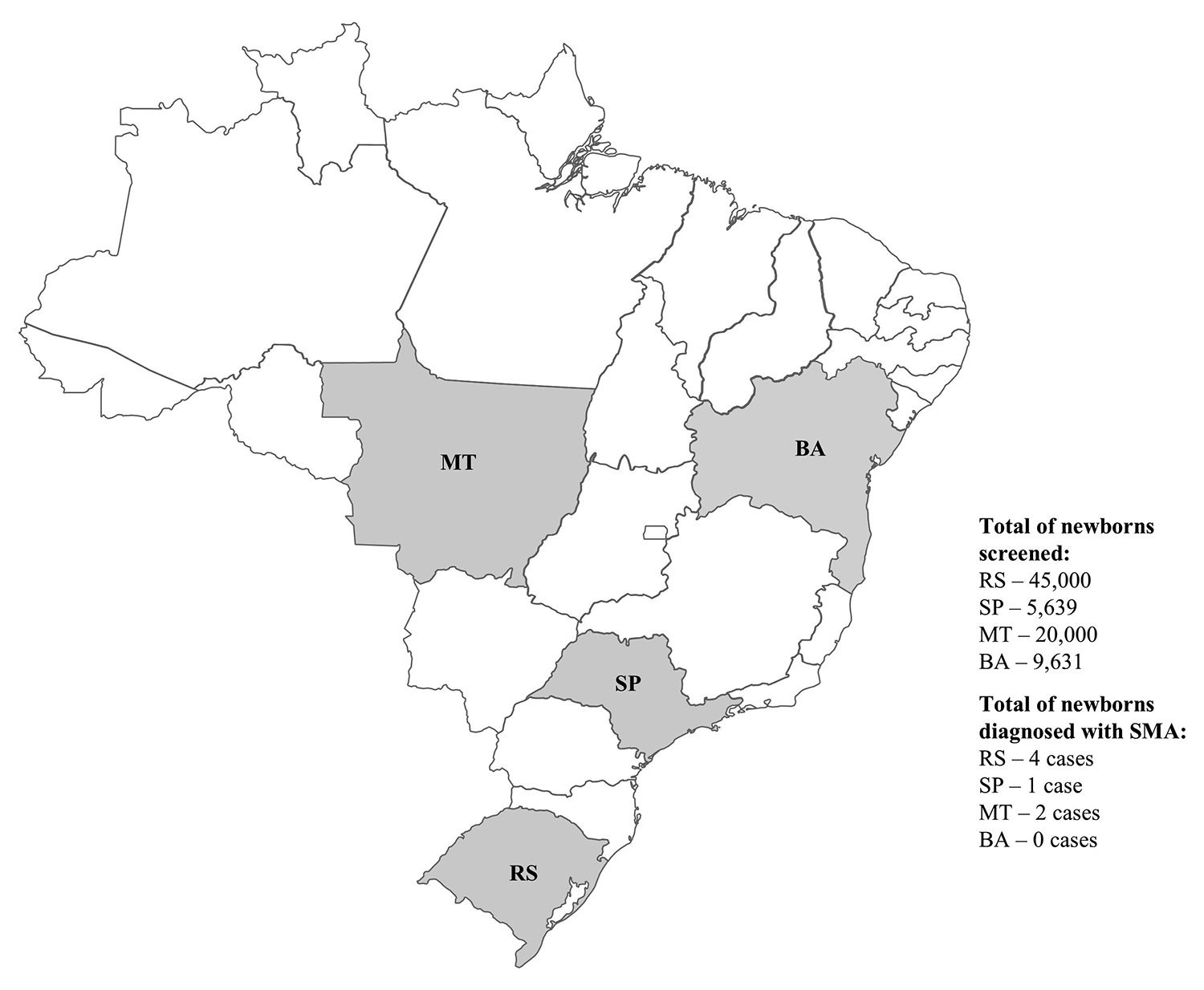
Dried blood spot (DBS) samples from the conventional heel prick test of 80,000 newborns were collected in the primary health care units connected to the SRTN of the four Brazilian states: SRTN/RS - Rio Grande do Sul, SRTN/Unicamp - Sao Paulo, SRTN/UFMT - Mato Grosso and SRTN/APAE Salvador - Bahia. These samples were then shipped to a research laboratory at Hospital de Clinicas de Porto Alegre (HCPA) where they were processed and analyzed.
DNA was extracted from the DBS samples of all newborns included in the study, following the method described in SALSA MC002 SMA Newborn Screen kit (MRC-Holland) (Strunk et al., 2019). These DNA samples were analyzed using real-time qPCR (first-tier test) with the SALSA MC002 SMA Newborn Screen kit (MRC-Holland) on the QuantStudio 5 real-time PCR system (Applied Biosystems). This reaction utilizes a single primer pair to amplify a region of exon 7 that includes the c.840C>A polymorphism, which differentiates the SMN1 gene from the SMN2 gene. Following amplification, a fluorescent probe will hybridize to the PCR amplicons, and fluorescence will be measured during the generation of a melting curve (SMN1 Tm 64 ºC and SMN2 Tm 57 ºC). The absence of a specific peak for SMN1 will indicate exon 7 deletion, as described by Strunk et al. (2019). Positive or potentially positive cases were further analyzed (second-tier test) using Multiplex Ligation-dependent Probe Amplification (MLPA) with the specific SALSA MLPA Probemix P060 SMA kit (MRC-Holland). These analyses were performed according to the manufacturer’s protocol to determine the copy number of SMN2. These results allow the identification of potentially affected SMA patients, who were invited to collect a new sample for confirmatory laboratory procedures.
This phase of the study lasted 11 months (November 2023 to October 2024) and had 40,000 DBS analyzed samples. The division by states was organized in such a way that 10,000 DBS samples collected at SRTN/RS, 639 DBS samples collected at SRTN/Unicamp, 20,000 collected at SRTN/UFMT and 9,361 collected at SRTN/APAE Salvador were sent to the research laboratory for the SMA screening. Combining the first and second phases of the study, 80,000 samples from newborns were screened for the disease. The first phase of the study lasted 13 months (March 2022 to April 2023).
Out of the 80,000 samples screened, a total of 79,992 presented negative results for SMA in the first-tier test. The samples that obtained a negative result presented melt peaks at 64 ºC (SMN1) and 56 ºC (SMN2), or only at 64 ºC. The absence of a melt peak corresponding to the SMN2 gene has no clinical consequences and it occurs frequently. As far as we know, no newborns carrying a homozygous deletion of SMN1 gene were missed within the samples screened in this study.
Seven samples obtained positive results for SMA in the first-tier test and had the result confirmed by the second-tier test. The samples that obtained suggestive results for SMA presented a melt peak at 56 ºC (SMN2) only. Thus, MLPA (second-tier test) was performed enabling the confirmation of deletion and determination of the number of copies of SMN2 exon 7, which serves as a predictor of the SMA clinical type. In these seven samples the deletion of SMN1 was confirmed. Among them, two samples presented 4 copies of SMN2 exon 7, three samples presented 3 copies of SMN2 exon 7 and the other two samples presented 1 copy of SMN2 exon 7 (Table 1).
One sample presented a positive result only in the first-tier test, but the second-tier test did not confirm the deletion. Consequently, a false positive result was obtained in the first-tier test, demonstrating the importance of performing MLPA for diagnostic confirmation. Further investigation using other techniques, such as long-range PCR or next-generation sequencing, could help identify possible SNPs within probe-binding regions or other causes for the isolated false-positive result.
The results of this study enabled the obtention of updated population data on the estimated incidence of SMA in Brazil, based on the frequency of positive cases. We identified 7 patients with the homozygous deletion of SMN1, providing an incidence of 1 in 11,428 live births. Beyond that, this work demonstrates the feasibility of the screening for 5q-SMA using samples collected for the conventional NBS test and transporting them from diverse and distant regions, which is extremely important for the successful expansion of the PNTN. Having said that, we acknowledge the limitation related to sample transportation from distant states, which may have impacted the turnaround time for first-tier results. Delays between sample collection and analysis were mainly due to logistics and centralized laboratory processing in Porto Alegre. This reflects real-world challenges in sample transport across large geographical distances. The samples were, however, transported under controlled temperature and humidity conditions, maintaining DNA integrity.
In Brazil, the Federal District and the State of Minas Gerais have been carrying out screening for SMA since 2023 and 2024, respectively, within the PNTN (Secretaria da Saúde do Distrito Federal, 2023; NUPAD, 2024). In addition, in the State of São Paulo, the Jô Clemente Institute is also carrying out a pilot project for SMA screening, and already reported results in 192,000 newborns (Romanelli et al., 2024).
Pilot studies and statewide programs in various countries and regions such as Australia, Belgium, Canada, China, Germany, Hungary, Italy, Japan, Latvia, Netherlands, Norway, Poland, Portugal, Russia, Spain, Taiwan, Turkey, Ukraine, United Kingdom and United States have demonstrated the feasibility and value of performing NBS for SMA (Velikanova et al., 2022; Celik et al., 2024; Cooper et al., 2024; Berzal-Serrano et al., 2025; Hegedűs et al., 2025). By early 2024, 33 countries had reported either piloting or implementing established NBS programs for SMA (Vrščaj et al., 2024).
While the clinical benefits of early NBS and treatment are clear, the costs associated with implementing NBS programs and providing lifelong disease modifying therapies are substantial (Shih et al., 2022; Zanoteli, 2024). Developing a well-organized program is considered fundamental not only for achieving favorable outcomes for affected children but also for managing healthcare costs (Becker et al., 2024; Albuquerque et al., 2025). The cost-effectiveness of newborn screening for SMA has been demonstrated in various countries (Velikanova et al., 2022; Weidlich et al., 2023; Ghetti et al., 2024; Hata et al., 2025). Factors influencing costs include the screening methodology, the need for confirmatory testing, and the long-term available therapies (Romanelli et al., 2021). For example, the methodology used in this study, SALSA MC002 assay, requires manual handling and visual interpretation. Although effective and cost-efficient for regional laboratories, large-scale national implementation would benefit from automation or high-throughput platforms to optimize workflow and reproducibility. Newborn screening for SMA, combined with early access to disease-modifying therapies, serves as a critical public health policy. Data from Australia demonstrate its effectiveness in significantly reducing the disease burden, improving outcomes by a factor of seven, including slowing the progression of comorbidities, lowering mortality rates, and decreasing the need for ventilation (Kariyawasam et al., 2023). As reported by Woodcock et al. (2025), the cost of screening is lower than the cost of symptomatic treatment and, in addition to this, the current scenario in Brazil must be considered, which already has treatment as a public policy.
In conclusion, this report brings the final results of a multicenter incidence study encompassing both phases (Oliveira Netto et al., 2023; present study), aiming to estimate 5q-SMA incidence across Brazilian regions, through the screening of 80,000 newborns over 24 months. DBS samples were collected by SRTN/RS (45,000), SRTN/Unicamp (5,639), SRTN/UFMT (20,000) and SRTN/APAE Salvador (9,631) and sent to the research laboratory for analysis (Figure 1). The identification of 7 patients with homozygous deletion in SMN1 pointed to an incidence of 1 in 11,428 newborns. Nonetheless, we recognize the relatively short 24-month collection period, which may influence incidence estimates. Long-term follow-up data over ≥5 years is recommended to provide greater confidence in the incidence data.
Acknowledgments
ABON and RG were supported by CNPq (grants #130790/2021-4, and 303219/2019-0, respectively). We would like to thank all patients and families included in this study. We would like to thank Fabrizio Barbosa for his administrative support. This work was funded by a research grant from Novartis.
References
- Albuquerque ALA, Chadanowicz JK, Bevilacqua IP, Staub ALP, Winckler PB, Silva PZ, Fagondes SC, Ferrari RS, Trojahn CDO, Sacharuk VZ et al (2025) Clinicogenetic characterization and response to disease-modifying therapies in spinal muscular atrophy: Real-world experience from a reference center in Southern Brazil. J Pediatr (Rio J) 101:38-45.
- Becker MM, Nardes F, Dangouloff T, Servais L, Araujo APQC and Gurgel-Giannetti J (2024) Why should a 5q spinal muscular atrophy neonatal screening program be started? Arq Neuropsiquiatr 82:1-9.
- Berzal-Serrano A, García-Bohórquez B, Aller E, Jaijo T, Pitarch-Castellano I, Rausell D, García-García G and Millán JM (2025). Outcomes of a pilot newborn screening program for Spinal Muscular Atrophy in the Valencian community. Int J Neonatal Screen 11:7.
- Bürglen L, Lefebvre S, Clermont O, Burlet P, Viollet L, Cruaud C, Munnich A and Melki J (1996) Structure and organization of the human survival motor neurone (SMN) gene. Genomics32:479-482.
- Celik KM, Kose CC, Kaya D, Tekin K, Silan F (2024) Spinal muscular atrophy carrier screening program: Awareness and attitude of healthcare professionals in Turkey. J Community Genet 15:665-672.
- Cooper K, Nalbant G, Sutton A, Harnan S, Thokala P, Chilcott J, McNeill A and Bessey A (2024) Systematic review of newborn screening programmes for Spinal Muscular Atrophy. Int J Neonatal Screen 10:49.
- D’Amico A, Mercuri E, Tiziano FD, Bertini E (2011) Spinal muscular atrophy. Orphanet J Rare Dis 6:71.
- Dangouloff T, Vrščaj E, Servais L, Osredkar D; SMA NBS World Study Group (2021) Newborn screening programs for spinal muscular atrophy worldwide: Where we stand and where to go. Neuromuscul Disord 31:574-582.
- Finkel RS, Sejersen T, Mercuri E and ENMC SMA (Workshop Study Group) (2017) 218th ENMC International Workshop: Revisiting the consensus on standards of care in SMA Naarden, The Netherlands, 19-21 February 2016. Neuromuscul Disord 27:596-605.
- Ghetti G, Mennini FS, Marcellusi A, Bischof M, Pistillo GM, Pane M (2024). Cost-effectiveness analysis of newborn screening for Spinal Muscular Atrophy in Italy. Clin Drug Investig 44:687-701.
- Guthrie R and Susi A (1963). A simple phenylalanine method for detecting phenylketonuria in large populations of newborn infants. Pediatrics 32:338-343.
- Hata A, Uda A, Tanaka S, Weidlich D, Toro W, Schmitt L, Igarashi A and Bischof M (2025) Cost-utility analysis of newborn screening for spinal muscular atrophy in Japan. J Med Econ 28:44-53.
- Hegedűs K, Lénárt I, Xue A, Monostori PB, Baráth A, Mikos B, Szabolcsc U, Géresi A, Szabó AJ, Bereczki C et al (2025) Results of the Hungarian Newborn Screening Pilot Program for Spinal Muscular Atrophy. Int J Neonatal Screen 11:29.
- Kariyawasam DS, D’Silva AM, Sampaio H, Briggs N, Herbert K, Wile V and Farrar MA (2023) Newborn screening for spinal muscular atrophy in Australia: A non-randomised cohort study. Lancet Child Adolesc Health 7:159-170.
- Lefebvre S, Bürglen L, Reboullet S, Clermont O, Burlet P, Viollet L, Benichou B, Cruaud C, Millasseau P and Zeviani M (1995) Identification and characterization of a spinal muscular atrophy-determining gene. Cell 80:155-165.
- Lunn MR and Wang CH (2008) Spinal muscular atrophy. Lancet 371:2120-2133.
- Mercuri E, Bertini E and Iannaccone ST (2012) Childhood spinal muscular atrophy: Controversies and challenges. Lancet Neurol 11:443-452.
- Mercuri E, Sumner CJ, Muntoni F, Darras BT and Finkel RS (2022) Spinal muscular atrophy. Nat Rev Dis Primers 8:52.
- Ministério da Saúde - Brasil (1992) Portaria GM/MS no22 de 15 de janeiro de 1992 - Programa de Diagnóstico Precoce do Hipotireoidismo Congênito e Fenilcetonúria. Diário Oficial da União, Brasília.
- Ministério da Saúde - Brasil (2001) Portaria GM/MS no 822 de 06 de junho de 2001 - Programa Nacional de Triagem Neonatal. Diário Oficial da União, Brasília.
- Ministério da Saúde - Brasil (2021) Lei no 14.154, de 26 de maio de 2021, para aperfeiçoamento do Programa Nacional de Triagem Neonatal. Diário Oficial da União, Brasília.
- Oliveira Netto AB, Brusius-Facchin AC, Lemos JF, Pasetto FB, Brasil CS, Trapp FB, Saute JAM, Donis KC, Becker MM, Wiest P, Coutinho VLS et al (2023) Neonatal screening for spinal muscular atrophy: A pilot study in Brazil. Genet Mol Biol 46:e20230126.
- Prior TW, Snyder PJ, Rink BD, Pearl DK, Pyatt RE, Mihal DC, Conlan T, Schmalz B, Montgomery L, Ziegler K et al (2010) Newborn and carrier screening for spinal muscular atrophy. Am J Med Genet A 152A:1608-1616.
- Romanelli TVL, Monfardini F, Lourenço NCV, Rocha KM, Weinmann K, Pavanello R and Zatz M (2021) Newborn screening for 5q Spinal Muscular Atrophy: Comparisons between real-time PCR methodologies and cost estimations for future implementation programs. Int J Neonatal Screen 7:53.
- Romanelli TVL, Mendonça RH, Toledo MS, Hadachi SM, Grindler CM, Zanoteli E, Marques W Jr, Oliveira ASB, Breinis P, Morita MDPA et al (2024) Integrated approaches and practical recommendations in patient care identified with 5q Spinal Muscular Atrophy through newborn screening. Genes (Basel) 15:858.
- Servais L and Moreno CAM (2025) Spinal muscular atrophy in Brazil: From individual treatment to global management. J Pediatr (Rio J) 101:4-6.
- Shih STF, Keller E, Wiley V, Farrar MA, Wong M and Chambers GM (2022) Modelling the cost-effectiveness and budget impact of a newborn screening program for Spinal Muscular Atrophy and Severe Combined Immunodeficiency. Int J Neonatal Screen 8:45.
- Strunk A, Abbes A, Stuitje AR, Hettinga C, Sepers EM, Snetselaar R, Schouten J, Asselman FL, Cuppen I, Lemmink H et al (2019) Validation of a fast, robust, inexpensive, two-tiered neonatal screening test algorithm on dried blood spots for Spinal Muscular Atrophy. Int J Neonatal Screen 5:21.
- Velikanova R, van der Schans S, Bischof M, van Olden RW, Postma M and Boersma C (2022) Cost-effectiveness of newborn screening for Spinal Muscular Atrophy in The Netherlands. Value Health 25:1696-1704.
- Vrščaj E, Dangouloff T, Osredkar D, Servais L and SMA NBS World Study Group (2024) Newborn screening programs for spinal muscular atrophy worldwide in 2023. J Neuromuscul Dis 11:1180-1189.
- Weidlich D, Servais L, Kausar I, Howells R and Bischof M (2023) Cost-effectiveness of newborn screening for Spinal Muscular Atrophy in England. Neurol Ther 12:1205-1220.
- Woodcock IR, Kariyawasam DS, Kava MP, Yiu EM, Clark D, Adams J, Bischof M, Peacock A, Taylor C and Smith NJC (2025) Cost-effectiveness of newborn screening for Spinal Muscular Atrophy in Australian hospitals. Neurol Ther 14:1007-1022.
- Zanoteli E (2024) The effects of disease-modifying therapies in SMA-5q type 1 and the importance of early diagnosis of the disease. Arq Neuropsiquiatr 82:s004418009272.
Internet Sources
-
Núcleo de Ações e Pesquisa em Apoio Diagnóstico da Faculdade de Medicina da UFMG (NUPAD) (2024) Núcleo de Ações e Pesquisa em Apoio Diagnóstico da Faculdade de Medicina da UFMG (NUPAD) (2024) https://www.nupad.medicina.ufmg.br/minas-gerais-amplia-doencas-do-programa-de-triagem-neonatal/, (accessed 26 May 2025).
» https://www.nupad.medicina.ufmg.br/minas-gerais-amplia-doencas-do-programa-de-triagem-neonatal/, -
Secretaria da Saúde do Distrito Federal (2023) Secretaria da Saúde do Distrito Federal (2023) https://www.saude.df.gov.br (accessed 26 May 2025).
» https://www.saude.df.gov.br
Data Availability
The dataset that supports the results of this study is not publicly available