 Sustainable impacts of multi-mode logistics in Brazil’s soybean supply chain
Abstract
Abstract Soybean production plays an important role in the Brazilian economy, contributing approximately 7% of its GDP. While existing studies focus predominantly on cultivation issues, they often overlook broader supply chain dynamics. Considering the vast territory of Brazil, logistics poses a potential bottleneck for competitiveness. To overcome this, two major infrastructure projects, Ferrogrão and Norte/Sul, aim at integrating railway, waterway, and highway networks, enhancing connectivity between midwestern soybean-producing municipalities and Brazil's northern ports. The present study evaluates the impact of these multi-mode logistics projects on sustainability, focusing on cost efficiency (economic dimension), CO2 emissions (environmental dimension), and socioeconomic outcomes (social dimension). Using a logistic optimization model, we analyzed strategies that minimize soybean transportation costs and CO2 emissions along the newly constructed northern section of the Norte/Sul railway. Additionally, econometric methods were employed to compare the socioeconomic effects of the Norte/Sul railway on municipalities relative to the highway routes targeted by the Ferrogrão project. Findings indicate that adopting multi-mode transport reduces logistics costs by 13-19% and CO2 emissions by about 10%, although direct impacts on wages at transshipment municipalities show variability, depending on the specific project considered.
Keywords:
Soybean; Sustainability; Multi-mode logistics; Agriculture; Brazil
Resumo
Resumo A produção de soja exerce um papel estratégico na economia brasileira, representando aproximadamente 7% do PIB nacional. A literatura existente sobre o tema concentra-se majoritariamente em aspectos relacionados ao cultivo, frequentemente negligenciando as dinâmicas mais amplas da cadeia de suprimentos. Dada a vasta extensão territorial do país, a logística configura-se como um potencial gargalo à competitividade dessa cadeia. Nesse contexto, dois grandes projetos de infraestrutura — Ferrogrão e Norte-Sul — propõem a integração de modais ferroviário, hidroviário e rodoviário, com o objetivo de aprimorar a conectividade entre os municípios produtores de soja do Centro-Oeste e os portos da região Norte. Este estudo avalia os impactos desses projetos de logística multimodal sob a ótica da sustentabilidade, considerando suas três dimensões: eficiência de custos (econômica), emissões de CO2 (ambiental) e resultados socioeconômicos (social). Por meio de um modelo de otimização logística, foram analisadas estratégias para minimizar os custos de transporte e as emissões de CO2 ao longo do trecho norte recentemente construído da ferrovia Norte-Sul. Complementarmente, aplicaram-se métodos econométricos para comparar os efeitos socioeconômicos da ferrovia Norte-Sul nos municípios afetados, em relação às rotas rodoviárias previstas pelo projeto Ferrogrão. Os resultados indicam que a adoção do transporte multimodal pode reduzir os custos logísticos entre 13% e 19%, e as emissões de CO2 em cerca de 10%. No entanto, os efeitos diretos sobre os salários nos municípios de transbordo variam conforme o projeto analisado.
Palavras-chave:
Soja; Sustentabilidade; Logística multimodal; Agricultura; Brasil
1 Introduction
Brazil is the world’s largest producer of soybeans, providing 40% of the global supply (USDA, 2023). The 2023/2024 harvest yielded 155.7 thousand tons (CONAB, 2023), covering 62.3% of the country’s cultivated area (Mapbiomas, 2023). The soybean supply chain in Brazil contributes to 7% of the country’s Gross Domestic Product (GDP) and creates over 2 million direct and indirect jobs (Cepea, 2023). Such impressive numbers result from decades of public policies dedicated to developing high-productivity seeds and disseminating advanced production technologies (Maranhão et al., 2019; Picoli et al., 2020). As a typical commodity, soybean cultivation in Brazil is often associated with high financial leverage and a well-structured export supply chain.
Research on soybean production in Brazil focuses predominantly on cultivation activities, emphasizing productivity and environmental issues (Silva et al., 2021; Caetano et al., 2018; Cavalett & Ortega, 2010, among others). Socioeconomic assessments of the impacts on nearby communities are similarly centered on cultivation-related factors and often show conflicting results. For instance, Silva et al. (2021) found a positive correlation between soybean production and GDP at a municipal level. Similarly, Martinelli et al. (2017) found a comparable relationship between the Human Development Index (HDI) and soybean production in municipalities. Conversely, Oliveira & Silva (2021) associated soybean production with increasing inequality and unemployment among the young population.
An emerging research topic related to soybean production in Brazil refers to the logistic aspects of the supply chain. Commodities logistics are studied extensively in terms of pricing strategies (Li et al., 2018), network design (Rezaei-Malek et al., 2016), and trade competitiveness (Reis et al., 2020). Soybean production in Brazil is concentrated in the southern and midwestern states. About 70% of the production is exported through the southeastern and northern ports, arriving there using mainly road transportation (COMEXSTAT, 2023; Embrapa, 2023), presenting significant cost and environmental bottlenecks for Brazil’s global competitiveness. In a highly competitive market like commodities exportation, governmental support may sustain the country’s competitiveness (Anderson & Valenzuela, 2021).
Studies by Souza et al. (2020), Oliveira et al. (2020), and Morais et al. (2023) use optimization models to assess the best locations for soybean outflow, considering the cost and environmental dimensions. Those authors explore forthcoming changes in Brazilian logistics infrastructure, particularly the Ferrogrão railroad project, which aims to connect midwestern states to the Amazonian ports. Brazil's rail transportation system is not as developed as that of other extensive countries. Brazil has approximately 30.8 thousand kilometers of railways, with a rail density of 3.6 km per 1000 square kilometers. This represents just over 10% of the 293.5 thousand kilometers of railways found in the USA, which have a rail density of 29.8 km per 1,000 square kilometers (ANTF, 2023; Overhaul, 2025). Hence, a new project focused on commodities transportation may significantly reduce costs for producers.
Most studies on soybean logistics in Brazil rely on optimization models to evaluate the optimal location of outflow routes, with a primary focus on economic costs and, to a lesser extent, environmental outcomes. However, little attention has been given to the broader implications of these logistic corridors for regional and sustainable development. In particular, the socioeconomic and environmental consequences of infrastructure projects such as Ferrogrão for local communities remain underexplored. The present study addresses this gap by examining how new multimodal soybean logistics pathways affect the sustainability of municipalities involved. We contribute to the literature by moving beyond cost-efficiency and productivity metrics, assessing instead how soybean logistics influence social and environmental indicators at the municipal level. In doing so, the present paper highlights the role of logistics infrastructure not only as an economic driver, but also as a determinant of regional development and sustainability outcomes.
Our findings indicate that, although railroad transportation has the potential to reduce operating costs and mitigate carbon emissions, its impact on the socioeconomic status of local communities, especially regarding income in the logistics chain, is localized and dependent on specific pathways. This is an important insight, as the expansion of logistics infrastructure into the Amazon is often justified in terms of its benefits to local communities.
The remainder of the present paper is organized as follows: Section 2 describes the soybean logistics in Brazil and the municipalities affected by railroads. Section 3 defines the analysis methods for cost, environmental, and socioeconomic assessment. Section 4 presents and discusses the results, while Section 5 provides the concluding remarks.
2 A close look at soybean logistics in Brazil
The Brazilian transportation system is mainly utilized for moving low-value commodities with low marginal costs, such as grains and ore (Brasil, 2021). To be profitable in the transportation industry, it is necessary to operate at high volumes so that transportation becomes financially viable. In addition, it can be observed from the transportation matrix that road transportation is used more frequently than rail and waterway options, which are typically more suitable for long-distance, high-volume transport (Casaca et al., 2017). For instance, between 1993 and 2013, road transportation accounted for 60% of cargo movement in the country, while rail and waterways contributed only 20% and 10%, respectively (Casaca et al., 2017).
From the early 1990s on, the Brazilian government has pursued a long-term strategy to improve its rail infrastructure. This strategy involved partnering with the private sector through contracts that outline mutual commitments and investments on both sides. Although privatization has increased rail volume, it has not expanded significantly the network’s overall extension (Sampaio & Daychoum, 2017). Recently, the Ministry of Transport (formerly the Ministry of Infrastructure) published the “National Logistics Plan 2035” (Brasil, 2021). This plan aims to connect several ongoing railroad projects to not only expand but also renew the rail system, to gradually shift the country’s reliance from road to rail transportation. As soybeans are the primary export product of the Brazilian economy, their transportation serves as a direct indicator of the overall effectiveness of the country’s infrastructure.
The potential impacts of developing new transportation infrastructure, such as the Ferrogrão project, go beyond improving logistics and global market competitiveness. While these infrastructures can potentially reduce greenhouse gas emissions, decrease transportation costs, and increase production outflow efficiency – ultimately driving local development in the municipalities affected by the project – it is essential to consider the trade-offs involved. The project poses significant risks to the well-being of traditional communities and may contribute to deforestation in the Amazon region. Balancing these socio-environmental impacts with the economic benefits is critical to ensure that such initiatives lead to sustainable regional development.
The following sections provide a detailed discussion of the existing logistics pathways and the proposed new routes, explore the Ferrogrão project in comparison with the Norte-Sul railway, and analyze the demographic and socioeconomic characteristics of the impacted municipalities. This review lays the groundwork for analyzing the expected effects of the Ferrogrão project on sustainable regional development, providing a basis for evaluating the potential impacts of railway infrastructure investments in Brazil.
2.1 Soybean logistics pathways
Logistics costs are crucial in exploring natural resources and commodities. Well-structured government projects should include port and transportation infrastructure and essential facilities related to energy, water, and social services (Kingwell et al., 2020). Further, logistics activities are an important part of international trade (Anderson & Valenzuela, 2021) and may greatly impact competitiveness. The decision-making process for production and distribution must consider external factors that can disrupt the supply chain and add costs to transportation, such as air pollution, climate, noise, accidents, and traffic congestion (Mostert & Limbourg, 2016). In this context, grain logistics is a well-known bottleneck for Brazilian soybean production, imposing high costs and reduced productivity and competitiveness (Morais et al., 2023; Oliveira et al., 2020).
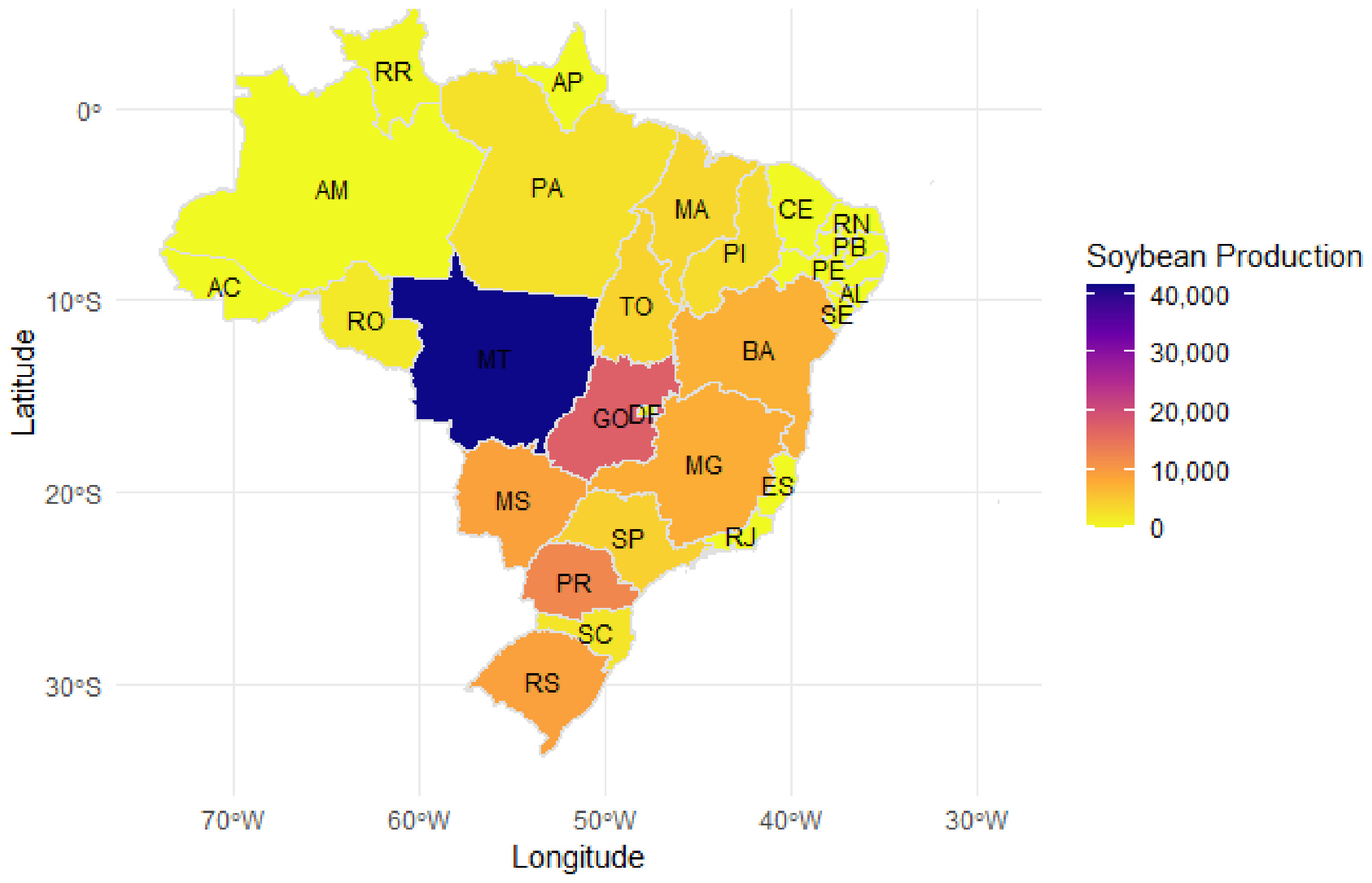
From the supply chain standpoint, the soybean crop exhibits strong seasonal behavior, described as follows: harvesting begins in most states during the first semester, reaching its peak in April. In the second semester, harvests occur in August and September, during the cold season in the southern hemisphere. Although transportation flow remains significant during this period, it is not as intense as in the warmer months. Geographically, according to the National Supply Company (CONAB, 2023), soy farms are concentrated in the Midwestern and southern states of the country (Figure 1). CONAB (2023) reported that Mato Grosso state produced around 40 million tons in harvest in 2021/2022, but surrounding states also reached significant marks: 17 million in Goiás and 9 million in Mato Grosso do Sul. Brazil, in total, produced 125 million tons of soybeans. According to Cepea (2023), the average price of soybeans reached US$ 0.55 per kilogram, whereas the 2021/2022 harvest generated around 60 billion dollars.
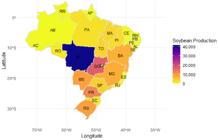
Soybean production in Brazil. Source: Elaborated by the authors using data from CONAB (2023).
Embrapa (2023) reported that 60% of the soybeans and 50% of the soy meal from the 2022 harvest were exported, leaving a significant portion of soybean production in the country. Regardless, most of the grains still needed to be moved to the southeastern and southern regions of Brazil. Not only is this the most densely populated area of the country (São Paulo, Rio de Janeiro, and Paraná states), but it is also home to Brazil’s most important maritime ports (Santos, Paranaguá, and Itaguaí) (ANTAQ, 2023). Hence, the majority of the soybeans must be moved over approximately 2,000 km to reach either the domestic market or export gateways.
The largest port in Brazil is the Port of Santos (São Paulo state), which shipped 18.3 million tons in 2022. In recent years, logistics projects in other regions have taken advantage of infrastructure development across the country. One example is the Port of Itaqui (Maranhão state), where favorable maritime conditions provide a natural advantage for operating big vessels (around 400,000 tons per ship). Traditionally, the region has been mainly considered for shipping ore and derived products, but in recent decades, the Port of Itaqui have emerged as an important player in the commodities market, operating tanker ships and significant grain cargo, especially soybeans (around 8 million tons in 2022, according to ANTAQ (2023)). However, despite its potential to promote regional development, using the Port of Itaqui does not shorten the distance traveled by soybeans; it still requires transportation over approximately 2,000 km.
Having roads as the most important transportation mode, long distances between farms and ports are filled with challenges: long unpaved pathways that can leave trucks stuck in mud during the rainy season, while dry periods can increase dust, reducing visibility, and causing potholes. These difficulties are compounded by single-lane roads with no rest stops or regions to pull over, making passing very dangerous. Such precarious conditions are commonly found on roads like MA-006 and BR-135, among others. These roads can accommodate traffic loads of around 4,000 trucks per day, each carrying up to 75 tons. Although safety concerns are significant, it is also important to consider the impact on productivity. Under these circumstances, fleet movement is considerably slowed, reducing overall traffic speed. Fliehr et al. (2019) report an average speed of around 40 km/h on these roads; however, in certain parts, truck drivers can spend up to 8 hours traveling just 100 kilometers.
Considering the benefits from both cost and environmental impact perspectives, other transportation modes could be explored for the route between farms and ports. One important initiative is the transportation of soybeans using barges and scows along interior shipping rivers. Two rivers, in particular, are gaining importance in this regard: the Madeira River and the Tapajós River. The Madeira River is a waterway capable of moving large barges carrying up to 35 shipping containers, totaling 70,000 tons of soybeans in a single convoy (equivalent to more than 1,500 trucks). It connects to the BR-364 highway, which starts in São Paulo state and extends 4,374 km to Acre state. Beyond the Madeira River, other relevant waterways include Tapajós River, which connects with the BR-153 highway (known as the Belém-Brasilia Road), and serves the states of Goiás and Tocantins. These waterways provide important alternatives to road transport, alleviating some of the logistical challenges faced in soybean transportation.
In an effort to improve the grain supply chain logistics, another initiative known as the “Arco Norte” focuses on leveraging the navigability of the northern and northeastern regions of Brazil. The Arco Norte pathway aims to integrate multiple transportation modes to streamline grain movement from production sites to ports with favorable maritime conditions. This multi-mode system is designed to reduce costs and environmental impacts while enhancing the efficiency of grain exports. Cities such as Manaus (AM), Porto Velho (RO), Itacoatiara (AM), Santarém (PA), Miritituba (PA), and São Luís (MA) play a pivotal role in this pathway, providing outbound capacity for soybean shipments. However, despite the advantages offered by the Arco Norte pathway, it faces significant challenges on the inbound side due to a lack of sufficient roadway and railroad infrastructure.
Brazil is not served by an extensive railroad system. Historically, the flexibility of trucking has been preferred over the cost-efficiency of trains for long-distance transportation. However, one train with 100 cars can carry as much cargo as a fleet of 300 trucks, offering productivity benefits in terms of speed, safety, resource management, and lower marginal costs. In this context, the Brazilian Government has developed a project called “Ferrogrão” to support the transportation of soybeans to ports along the Arco Norte pathway. This project aims to improve the efficiency of grain transportation from farms to ports by using high-technology logistics standards. Although still in the conceptual and design stage, Ferrogrão is expected to integrate trains, trucks, cabotage, and maritime ports, thus making the overall transportation streamlined, more efficient, and effective. This project is designed to connect the state of Mato Grosso, especially the major grain-producing city of Sinop, to the state of Pará, through the multi-mode hub of Miritituba, located in the municipality of Itaituba.
However, Ferrogrão currently faces capacity limitations due to constraints in the existing railroad network. The proposed railway extends around 1,000 km and aims to link logistics centers such as Itacoatiara, Santarém, and Barcarena, which can be further served by barges. The high-efficiency transportation provided by trains is expected to reduce freight costs by about 40%, compared to the current truck-based system. As an immediate consequence, it is expected that southern and southeastern ports will shift their focus to container shipments, while northern and northeastern ports will concentrate on exporting ore and grains.
Despite its potential for cost reduction, carbon emission mitigation, and socioeconomic benefits to local communities, the Ferrogrão project has sparked controversy due to concerns over its potential impacts on deforestation in indigenous areas and the well-being of Amazonian communities (Costa et al., 2021). Balancing the economic benefits of the project with its environmental and social implications remains a critical challenge to its implementation.
2.2 Comparison and contrast between EF-170 (Ferrogrão) and EF-151 (Norte/Sul) railroads
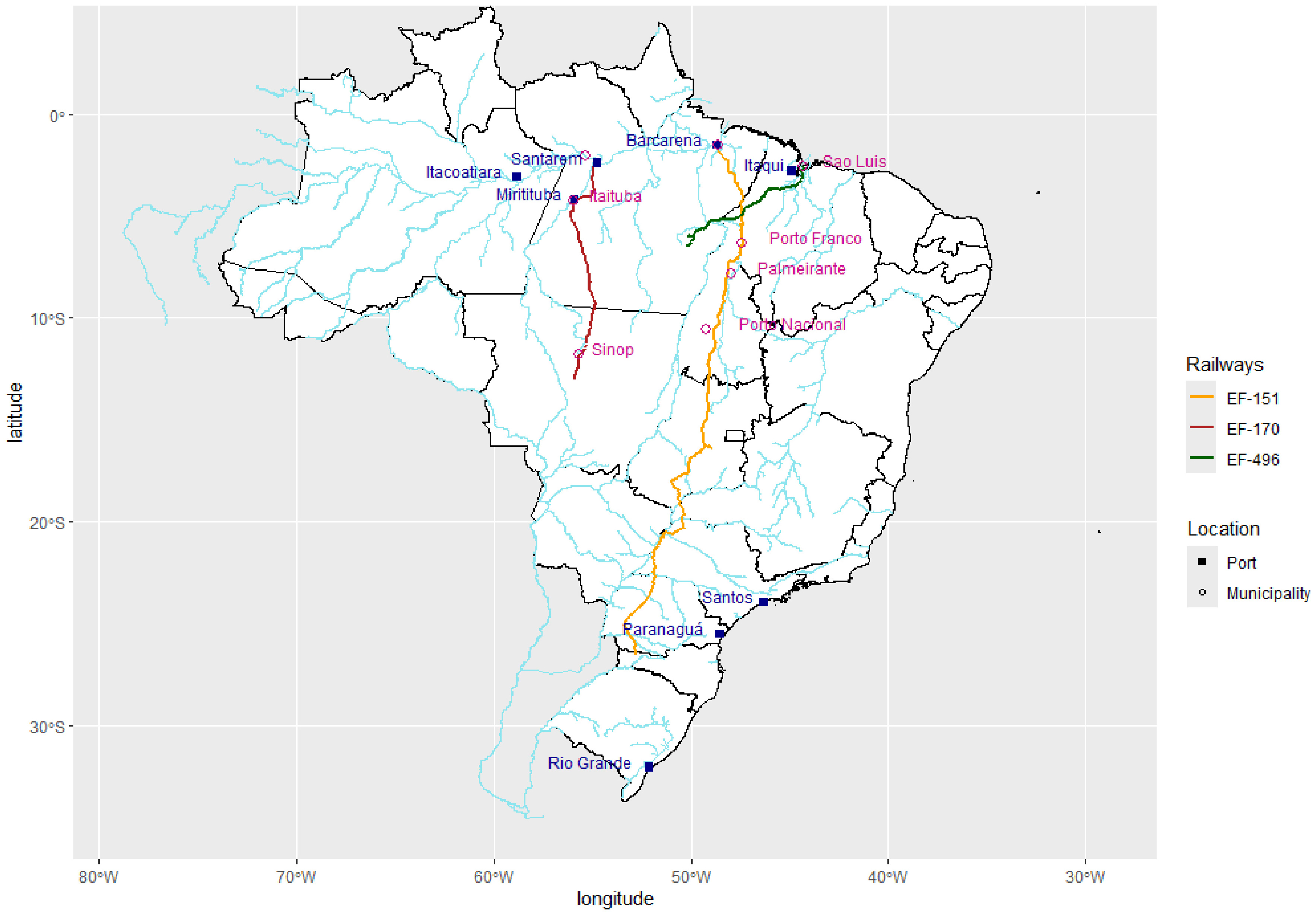
Two railroad projects play an important role in the expansion of multi-mode logistics in Brazil: railroad EF-151 (Norte/Sul) and railroad EF-170 (Ferrogrão). The north section of Norte/Sul (Tramo Norte – FNSTN) connects the state of Tocantins (starting from the municipality of Porto Nacional) to Port of Itaqui, in the state of Maranhão. It has been operational since 2008, when it was gradually expanded. EF-170 (Ferrogrão) is still a project, with a large potential to transport grains. Figure 2 shows the Norte/Sul railroad and its connections to both maritime and river ports. The north section is the stretch between the Port of Itaqui and the municipality of Porto Nacional. Additionally, Figure 2 highlights the EF-170 project, as well as railroad EF-496, which connects Norte/Sul railroad to Port of São Luis.
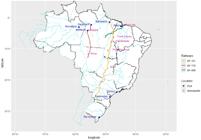
Brazilian map with highlights of the Norte/Sul railway (EF-151), Ferrogrão (EF-170) project, ports, waterways, and municipalities. Source: Elaborated by the authors using data from the Ministry of Transports (Brasil, 2023).
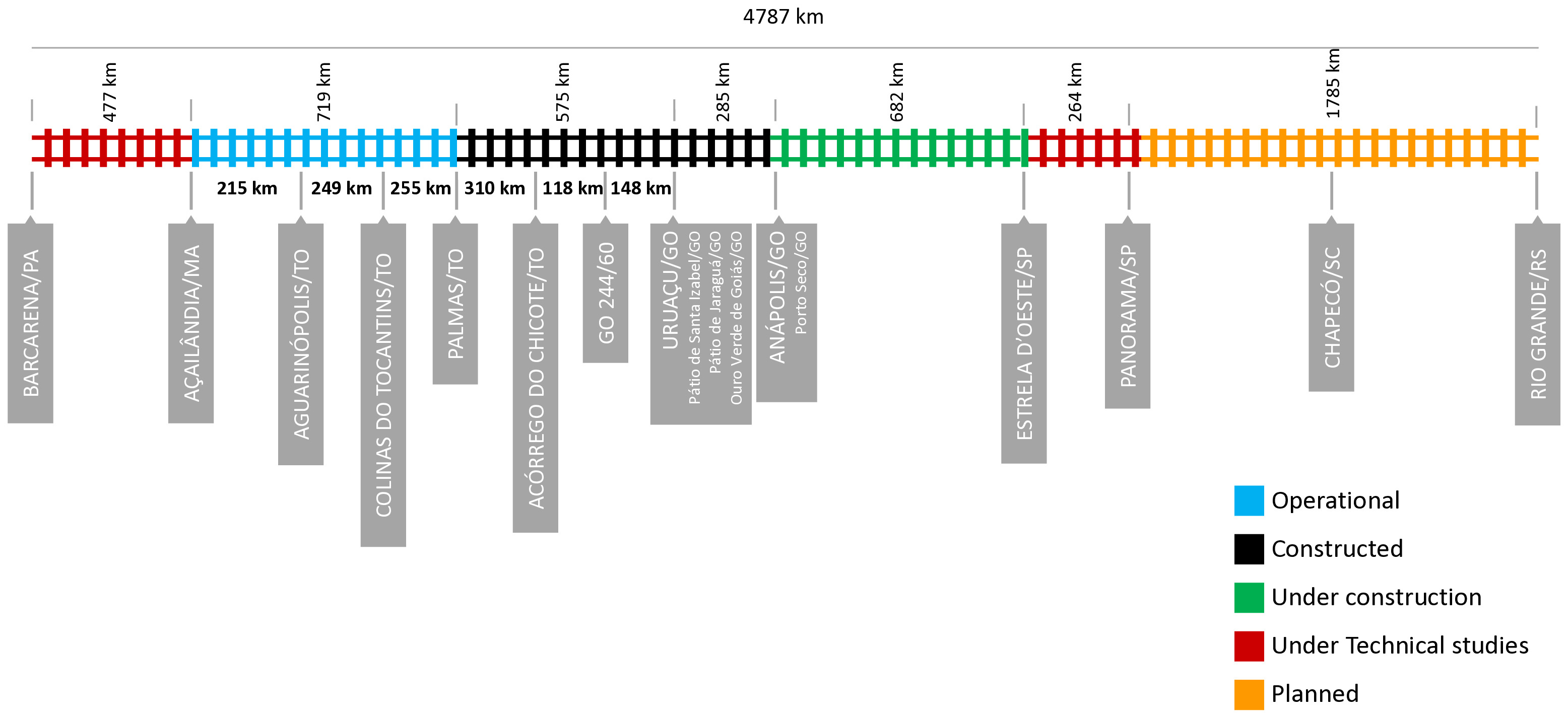
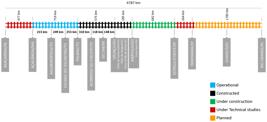
Railroad EF-151 was conceptually designed to link the extremes of Brazilian territory, starting from Rio Grande do Sul (extreme south) to Pará (extreme north). To date, the main operating section is the north. Along its 744 kilometers, Norte/Sul serves mainly for transporting soybeans and corn between Porto Nacional and Açailândia. In the city of Açailândia, there is a connection between the Norte/Sul railroad and Estrada de Ferro do Carajás (EFC, Carajás railroad, EF-496), an important corridor used to export ore and other minerals from Brazil. EF-496 extends the railroad pathway, connecting the rail corridor to the Port of São Luis. Figure 3 shows the details of EF-151.
The Ferrogrão railroad is an ambitious project that covers 933 kilometers, connecting municipalities of Sinop to Itaituba. The Ferrogrão project oversees a multi-mode facility transportation from Sinop to the ports of Miritituba, Santarém, and Itapacurá. All those cities can access the waterways of Tapajós River, reaching the most important exporting port terminals: Santarém, Itacoatiara, Barcarena, and Santana (which are jointly named Arco Norte). In Figure 2, we see the Ferrogrão railroad (EF-170) and its connections to waterways.
The Arco Norte ports are already important exportation routes for soybeans produced in the Mato Grosso state. In 2020, approximately 11.7 million tons of soybeans were exported throughout these ports (COMEXSTAT, 2023). It has been forecasted in the Ferrogrão project assumptions report (ANTT, 2022) that the capacity of the four terminals covered by the railroad cargo moving through Miritituba may reach up to 16.5 million tons per year (MTPY). This indicates the need to expand the terminal’s capacity beyond 25 MTPY in case it is used for transporting the expected cargo.
Hence, there is a clear parallel between EF-151 (Norte/Sul) and EF-170 (Ferrogrão). Both connect the interior of the country, high commodities producers which are located around 1,000 kilometers away, from exporting facilities. The interior section of the railroad network serves as an inbound structure since they are close to farms. The connection between Sinop terminal and Miritituba in Ferrogrão operates in the same way as the connection between Porto Nacional and Porto Franco for the Norte/Sul. On the other hand, destination sections are located within port terminals for grain flow: EF-151 ends at the Port of Itaqui, whereas Ferrogrão is expected to end at the Cargo Transshipment Station at Tapajós River.
Beyond their physical characteristics, both railroads share similarities with the type of cargo they transport. Since its launch in 2008, the Norte/Sul railroad has primarily been used for transporting soybeans. By 2021, over 6 MTPY of soybeans were transported, accounting for around 60% of all cargo moved by this rail line. Corn followed as the second-largest commodity, representing about 20% of the total cargo transported by Norte/Sul. Projections for EF-170 indicate that 80% of its transported cargo comprises soy and corn, very similar to the composition observed in the EF-151 railroad.
Railroads EF-151 and EF-170 can also be compared in terms of the temporal evolution of soybean production in their surrounding regions. In the early 2000s, a producer region named MATOPIBA (Maranhão, Tocantins, Piauí, and Bahia) was considered a new agricultural frontier in Brazil. Before the Norte/Sul railroad was commissioned, such a region had already produced 4 MTPY of grains (2000). In 2016, total grain production reached 10 MTPY (IBGE, 2023b). In addition, the activity in Itaqui Port increased from 625,000 tons of soybean exported, to 2 MTPY in 2006 and 4 MTPY in 2016 (IBGE, 2023b).
We observe a parallel in soybean production between the MAPOTIBA region and the municipality of Sinop. Both regions have high production of soybeans and rely heavily on road transportation to move products to ports. Around 69% of grain transportation from Mato Grosso (MT) uses the road mode (ANTT, 2023; COMEXSTAT, 2023). There are three main export corridors for MT soybean production: (1) Arco Norte, including the ports of Belém, Santarém, Manaus, and Santana; (2) the south/southeast route leading to ports such as Santos, Rio Grande, Paranaguá, Vitória, Imbituba, and São Francisco do Sul; and (3) the connection between Norte/Sul railroad and Port of Itaqui.
Also, it is important to mention the soybean production of Pará state (PA) because it is Mato Grosso's neighbor and shares similar logistical characteristics. Located along the BR-163 corridor, Pará benefits from established logistical infrastructure. Between 2001 and 2020, Pará experienced a significant increase in its exported soybeans, growing from 2,000 to 2,000,000 tons. This growth has positioned Pará as an important player in the soybean export market. Given its location and growing production, Pará is advised to consider using Ferrogrão railroad to transport its agricultural products for export.
After outlining the similarities between the railway systems and the expansion of the agricultural frontier towards Pará, a feasibility study was conducted to assess Ferrogrão’s potential from Sinop to Miritituba. The assumptions and reasoning are outlined in section 3.
2.3 Municipalities affected by soybean logistics
This section summarizes the statistics of the municipalities considered in the study, that is, those affected by north pathways for soybean production. Table 1 shows their populational, economic, and social profile. All information is provided by the Brazilian Institute of Geography and Statistics (IBGE, 2023a). The demographic profile comprises Population and Population Density. In the economic statistics, we included the average workers’ wages, measured according to minimum salary. In 2021, the minimum wage was R$ 1,100.00/month (US$ 220.00/month considering the current exchange rate). The indicator Occupied Population measures the percentage of the population with formal or informal occupation, compared with the total number of potential workers (older than 14 years). Lastly, in this set, we point out the GDP per capita, in R$/year/capita. The social indicators comprise the municipal HDI (a census variable, last measured in 2010), and the percentage of the population served by sewage sanitation.
The cities analyzed have distinct demographic characteristics. São Luís, the capital of the state of Maranhão, is naturally the most populous city in the sample, followed by Santarém, which has a significantly smaller population of 331,942 inhabitants. At the opposite end, Palmeirante has only 4,798 inhabitants, and Porto Franco, the second smallest city in the sample, has 23,903 inhabitants.
In addition to their small populations, the two smallest cities also stand out for their low employment rates. In Palmeirante, this indicator does not reach 10% of the population over 14 years old, while in Porto Franco, it is 10.8%. Even when considering informal occupations, the result for the sample is still below the national average. The average wage, on the other hand, is not only similar among the municipalities analyzed but also close to the national average.
Despite the low employment rates and average wages, it is noteworthy that the per capita GDP is higher than the national average in half of the municipalities, including Porto Franco. This suggests a high-income concentration, which may help explain the poor performance in the HDI.
In terms of access to basic services, as measured by the percentage of households connected to the sewage system, there is a significant disparity between the municipalities. In São Luís, the rate reaches 65.4% of the population, while in Palmeirante it is only 6.6%, and in Porto Franco, 3.1%. Even in Sinop, a key city in the soybean supply chain, the rate is only 10.8%. It is worth noting that Sinop is located at the beginning of the Ferrogrão route, in one of the most important soybean-producing regions. In 2022, this municipality harvested about 581,400 tons of soybeans (IBGE, 2023a).
In summary, these municipalities are situated in historically less economically developed regions of northern and northeastern Brazil, contrasting with the more prosperous states in the south and southeast. Changes such as the construction of the railway analyzed in this study, while potentially posing environmental impacts, such as deforestation, present an important trade-off. They could not only reduce pollution but also drive economic development in highly vulnerable regions, where the population could benefit from improvements to socioeconomic indicators.
3 Materials and methods
This section explains the materials and methods we used to examine the issues involved with soybean transportation in Brazil. Firstly, we investigated the potential for reducing costs and pollution by changing the transportation route, which currently relies mostly on roads, to a new multi-mode route that incorporates rail, water, and road transport. We provide detailed information about this in section 3.1. Secondly, we examine the effects of multi-mode transport activities on the labor market. This analysis aims to measure the possible socioeconomic effects of the changes in soybean pathways. Our approach then goes beyond the existing literature, providing a significant contribution not only to studies on multi-mode transport but also in terms of its relationship with sustainability.
3.1 The transport mode selection analysis and CO2 analysis
3.1.1 An overview of the most common methods
The decision between transporting grains by road or railroad requires a comprehensive evaluation of both modes, including quantitative and qualitative factors, such as political and unquantifiable human influences. Several authors have suggested studying decision-making when making such comparisons. Crisalli et al. (2013) proposed a “what-if / what-do” analysis, which considers the potential routes of the “Transportation National Investment Plans” in Italy. These authors defined routes based on O-D estimation (Origin-Destination), and then defined a utility function for the transport activity, considering three attributes in the objective function: (1) total moving time, converted into money value; (2) production cost of the transportation; and (3) external costs. Gursoy (2010) proposed the use of the Analytic Hierarchy Process (AHP) method applied to Turkey’s transportation system. In this analysis, the objective function is maximized by selecting weights for four criteria (price, travel time, safety, and accessibility) for each mode of transportation: road, road and rail, and road and maritime.
Under a more comprehensive perspective, Meixell & Norbis (2008) presented a review of studies focused on transportation choice (mode choice and carrier selection). These authors summarized the materials and methods of 48 papers that studied such themes and classified them according to their contributions to fields of decision-making attributes, supply chain integration, or multi-mode decisions. They concluded that important themes were under-represented in the transportation choice literature such as environmental and energy use concerns, security in the supply chain, and supply chain integration. Arencibia et al. (2015) conducted a survey in companies to determine the factors that influence the selection of transportation mode. The survey revealed that several aspects such as costs, transit time, travel frequency, punctuality, cargo damage, flexibility, cargo tracking, environmental impact, and shipping availability play a crucial role in determining the mode of transportation.
Souza et al. (2020) studied the problem of mode selection in the context of Brazilian soybean transportation. They approached the problem from an optimization standpoint and used linear programming to determine the most cost-effective routes for transporting soybeans from Mato Grosso. Their findings suggest that investing in infrastructure to support multi-mode transportation would be beneficial for the soybean trade in Brazil. Similarly, Oliveira et al. (2020) used a linear programming problem to compare the cost of the current road pathway for soybean transportation with the upcoming multi-mode Ferrogrão project. These authors concluded that the multi-mode pathway is more cost-effective.
The mode selection problem for Brazilian soybean transport is also analyzed by Souza et al. (2023). Using a Cost-effectiveness Analysis (CEA), these authors evaluate the benefits of two logistic projects in Brazil, the Ferrogrão and the Araguaia-Tocantins Waterway. The analysis assumes that reducing the number of trucks would be beneficial. The variables measured include the reduction in transportation cost, CO2 emissions, and increased energy efficiency. Souza et al. (2023) conclude that the Ferrogrão pathway has a greater cost-benefit than the Araguaia-Tocantins.
The present paper contributes to the mode-selection literature by evaluating the soybean supply chain in the context of the Brazilian Norte/Sul railway. Using linear programming, we analyzed soybean logistics data to estimate the rate of adoption of railway transportation along this route, which serves as a reference for the upcoming Ferrogrão project.
3.1.2 The transport mode selection analysis applied to Brazilian soybean
The present study estimates the transport mode selection that minimizes soybean logistics costs over the 15 years since the implementation of Norte/Sul (EF-151) railway. The resulting logistics costs and CO2 emissions are then compared to those of a pure road route. We combine traditional logistics perspectives from Novaes et al. (2006) and Ballou (2009) with contemporary approaches proposed by Daramola (2022) to evaluate transport mode selection. Since the Ferrogrão railway (EF-170) project is still in the conceptual design phase, we believe that the lessons learned from the Norte/Sul railroad can be applied to the Ferrogrão project due to similarities discussed between the two.
We used a linear programming model to minimize total transportation costs based on soybean transportation demand along the Norte/Sul railway. All supply and demand nodes form an Origin-Destination matrix (O-D matrix) to estimate routes and total traveled distance to estimate Greenhouse Gases (GHG) (in tons of equivalent CO2). Finally, we use the results in terms of mode selection to estimate a curve and describe the evolution in the rail path adoption pattern.
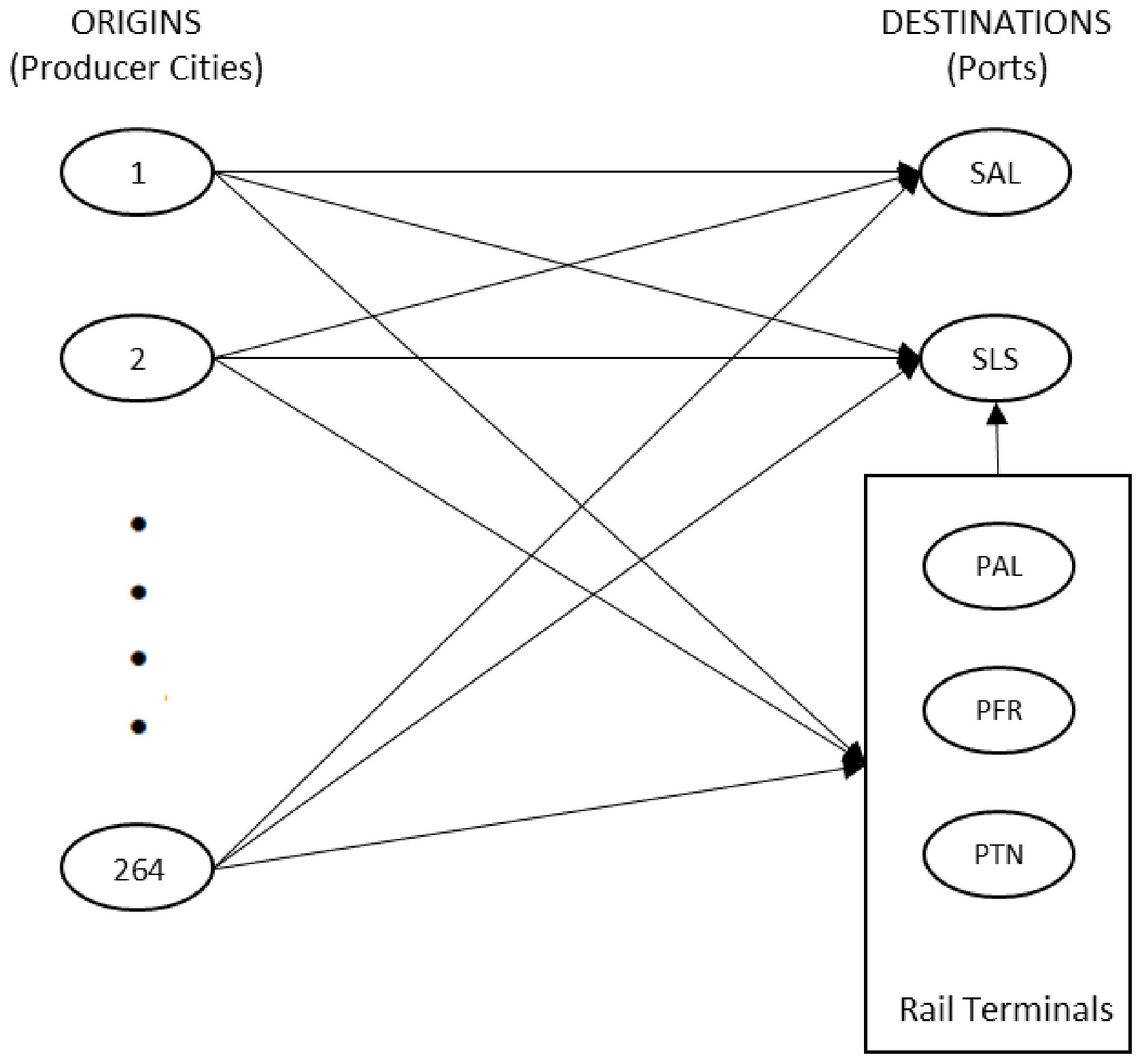
The model used to calculate CO2 emissions was based on the classical transportation problem (Dantzig & Thapa, 2003) to determine the expected soybean volume between 2006 and 2022, considering the production farm (origin) and the exporting port terminal (destination). The classical formulation is given in Equations 1 to 4. To use this formulation, we included railroad terminals as transshipment points between trains and trucks. For the Norte/Sul Railway, we considered that 264 cities of farm producers in MATOPIBA and the northwest of Mato Grosso as shipping cargos to exporting ports (São Luis and Salvador). On the top, Palmeirante, Porto Franco, and Porto Nacional intermode terminals serve as transshipment points between the Norte/Sul Railway and the Estrada de Ferro Carajás. Figure 4 shows a diagram of the adapted model, explaining the logic behind the arcs from origin (producer cities) and destination (exporting terminal).
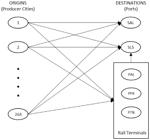
In the classical formulation of Equations 1-4, the parameter represents the transportation marginal cost between the -th producer cities, () and the -th exporting terminals (). The decision variable indicates the transported volume between the arc . The parameter represents the total volume supplied by the origin node , while the parameter represents the total volume demanded by the destination node . In this model, we assumed that , where and . That is, we assumed that the total demand is supplied, with total demand represented by parameter . Finally, the constraint in Equation 4 guarantees non-negativity for transported volumes.
Subject to:
x_ij ≥0
The classical model described in Equations 1 to 4 was adapted to accommodate the distinct cost parameters of the case study. Equations 5 to 10 show the modified model, which reflects the scheme in Figure 4. The objective function minimizes the transportation cost between the origin and destination nodes, but with different marginal cost parameters: , , and , expressed in R$/ton. Parameter corresponds to the average costs of road transport from the supplier () to the demand port (), parameter represents the average cost of road transport from the supplier () to the intermode (), and parameter , represents the average cost of railroad transport from the intermode (), to the port (). All parameter values were extracted from Brasil (2022c), considering agricultural solid bulk cargo1 and transshipment costs.
As in the classical formulation, we assumed the total demand is supplied, implying that , where and . The demand in destination , , represents the soybean exportation at each port (COMEXSTAT, 2023). Equations 9 and 10 ensure, respectively, that the inbound and outbound flow from the railroad terminals are subjected to each terminal () capacity (). Equation 10 considers the production of each municipality according to annual production data available at IBGE (2023b). This equation is constrained by the capacity of each terminal each year (data from COMEXSTAT, 2023).
Subject to:
All data used in the modeling were gathered from public agencies. The CO2 emission factor was also extracted from Brasil (2022c), considering seven-axle road vehicles used for agricultural solid bulk cargo. Finally, time series of transported soybean by route was obtained using ANTT data, which covers the years 2006, 2007, and 2008 – when the Norte/Sul Railway was not finished yet. During this period, the volume of Porto Franco was assigned to the Estrada de Ferro Carajás (EFC). In addition, data of this terminal is classified as EFC until 2007 and then changes to FNSTN in 2008. In 2009, the Palmeirante terminal data became available, and in 2015, Porto Nacional was incorporated into FNSTN, according to ANTT data.
3.2 The socioeconomic analysis
In addition to the environmental dimension (CO2 emissions) and the economic dimension (cost reduction), we also evaluated the impact of multi-mode transportation activities on the socioeconomic dimension. Employment and income are traditional variables used in socioeconomic development analysis. Thus, we assume that labor market indicators can approximate the socioeconomic effects of the new soybean pathway, particularly the average income of logistic workers (variable salary_real). We regressed such variable against the soybean flow through municipalities – Norte/Sul Railway (variable soy_flow_rail_NS), Norte/Sul Roadway (soy_flow_road_NS), Ferrogrão Roadway (variable soy_flow_road_FG) – that are important transshipment points for both modes of transport.
To estimate the socioeconomic effects of soybean logistics, we used three-panel data regression models: pooled OLS, fixed effects, and random effects. A panel data structure refers to observations of various units, each observed at different time points (. The estimation structures vary in how they account for individual heterogeneity. The pooled structure assumes that the marginal effects of explanatory variables on the dependent variable are constant across units. A simple OLS regression is suitable for estimating the model coefficients. To account for differences between units, the constant term of the model is allowed to vary among units. Such constant terms absorb all unobserved aspects that differentiate the units (let denote them). The model with constant terms that capture all unit-specific characteristics remaining constant over time is referred to as the fixed effects model. In such an approach, there is an assumption that the unobserved effects are correlated with the independent variables . However, when the estimators that account for unobserved effects regarding the units are uncorrelated with the independent variables (thus ), we have a random effects model. In this case, with , and are independent from the disturbance term of the regression model. We assume in this last approach that the unobserved effects consist of independent drawings from an underlying population (Heij et al. 2004; Wooldridge, 2019).
3.2.1 Variables and regression models
To identify the factors that explain the salary levels of logistic workers, we considered variables from three analytical dimensions: i) socioeconomic, ii) institutional, and iii) infrastructure. In the socioeconomic dimension, we considered MHDI, which encompasses longevity, education, and income. It measures health and quality of life, educational attainment, and living standards based on access to goods and services. Therefore, municipalities with a higher MHDI are expected to have better salaries. For the institutional dimension, tax revenue is a proxy for the government’s capacity to implement public policies, such as professional training initiatives. Thus, a positive relationship is expected between tax revenue and salary levels. The infrastructure dimension focuses on multi-modal logistics infrastructure. An increase in soybean flow through highways and railways is expected to impact salaries positively. Table 2 summarizes the dependent and independent variables included in the regression models, along with their description, unit, and source.
The regression analysis is based on twelve-year panel data from 2008 to 2019, where each municipality-year corresponds to an observation. The general assumption is that salary serves as the dependent variable, modeled as , with independent variables , representing soybean transportation and local socioeconomic indicators.2 Starting with an exponential model, where denotes the random error, we transformed it into a linear panel data model as shown in Equation 13. In this linearized form, represents the random noise. Test results for heteroscedasticity and autocorrelation are provided in the Appendix 1.
where
Table 3 shows the soy flow in each corridor by year.
Tests for the best specification are provided in the Appendix 1, while the results are detailed in Section 4.
4 Results and discussion
4.1 Results of the CO2 emissions and transportation cost analysis
Using the optimization model described in Section 3.1.2, we run two scenarios to calculate yearly costs and CO2 emissions from soybean transportation. As mentioned, data is applied for the mode selection problem for Norte/Sul railway (FNSTN), according to Equations 5-10. The mathematical model was implemented in Python and solved using the Gurobi optimization solver. Computational experiments were performed on a machine equipped with a 2-core Intel processor (4 logical threads), 7.92 GB of RAM, running Windows 10.
Scenario 1 comprises a hypothetical situation assuming that only Porto Franco terminal was available and participating in EFC (real scenario until 2009). Scenario 2 considers the introduction of Porto Nacional and Palmeirante, corresponding to the real flow after 2009. Thus, scenario 1 corresponds to a full road option, while scenario 2 corresponds to a mixed road+rail route. Table 4 shows the results by scenario: total emissions in tons of equivalent CO2 (tonCO2e), total of tons per useful kilometers (TKU), and total costs in millions of Brazilian reais (M R$). The computational experiments revealed consistent performance trends across both tested instances. The total execution time was 0.5983 seconds for Scenario 1 and 0.6940 seconds for Scenario 2. In both cases, the mathematical optimization phase was highly efficient, requiring only 0.0755 seconds and 0.0387 seconds, respectively. Consequently, the most computationally expensive phase for both scenarios was the loading and preprocessing of the data matrices via the Pandas library, which accounted for 0.4305 seconds in the first instance and 0.5791 seconds in the second.
According to the results, the implementation of the Norte/Sul railway led to a decrease of around 13% to 19% in CO2e emissions, when compared to a hypothetical scenario where this infrastructure does not exist. Additionally, this reduction in emissions occurs even with an average increase of 17% in TKU transported. Total costs of the multi-mode scenario are, on average, 10% lower than the road scenario. The marginal costs per TKUs decreased from R$ 0.38 to R$ 0.30.
We also estimated the rail adoption curve. Between 2009 and 2020 (Table 5), the share of railroad transportation in the region increased from 1% to around 50%. The number of TKUs transported increased from 308 in 2010 to 4,352 in 2020, covering around 115,000 kilometers. This rapid growth in rail usage reflects the increased acceptance and reliance on this mode of transport in the region, indicating the potential for further expansion. Such a trend provides a solid foundation for projecting the feasibility of the Ferrogrão project, as it suggests that a well-integrated rail network can effectively support and enhance the logistics of soybean transportation, contributing to the overall efficiency of the supply chain.
4.2 Results of socioeconomic analysis
4.2.1 Descriptive analyses
The regression model and all associated statistical tests were run using the software R (R Project, 2026). Computational experiments were performed on a machine equipped with a 2-core Intel processor (4 logical threads), 7.92 GB of RAM, running Windows 10. Descriptive statistics for variables that describe municipalities' socioeconomic aspects are presented in Table 6.
The average real wage of logistics workers is R$ 788.1, with values ranging from R$ 356.6 to R$ 2,192.2. This range suggests considerable differences in real wages in logistics activities, as evidenced by the standard deviation of R$ 137.9. The MHDI of the municipalities also varies significantly, indicating inequality in human development across the localities.
The average real revenue from the ICMS (state tax) on transportation activities is approximately R$ 89.1 million. However, there is a large dispersion in the values (standard deviation of R$ 57.9 million), with revenues ranging from R$ 4.2 million to R$ 183.7 million. This suggests a concentration of ICMS revenue in certain municipalities, probably due to the strategic location of transportation terminals.
Regarding soybean flow, the Norte/Sul Roadway shows an average flow of 1.142 million tons, with high variability (standard deviation of 9.626 million tons). In contrast, the average flow through the Norte/Sul Railway is 2.898 million tons, with a smaller variation (standard deviation of 1.299 million tons), representing more than double the volume transported by road. Additionally, the Ferrogrão Roadway has an average flow of 4.888 million tons, indicating it is the most utilized route for soybean transport.
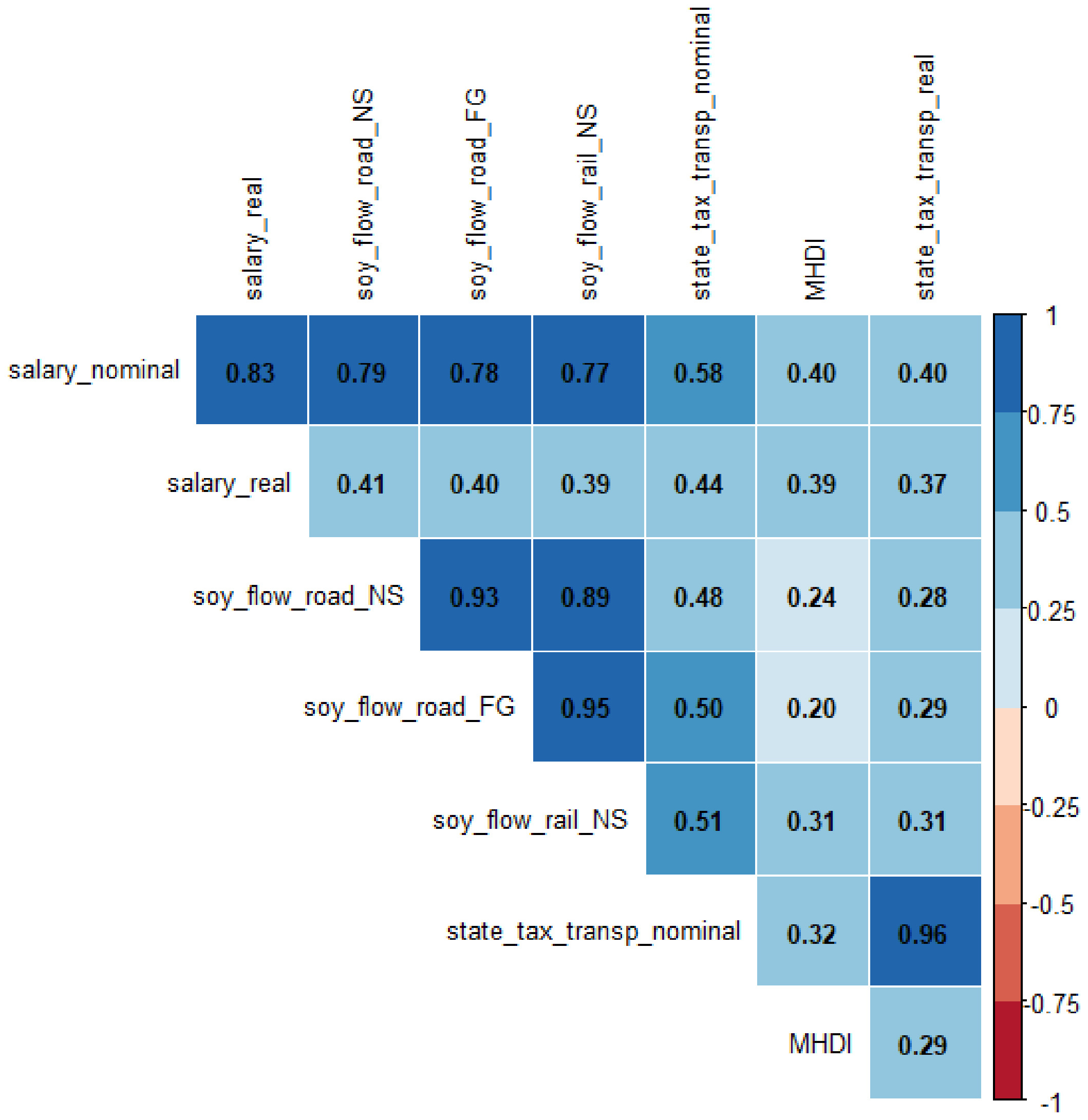
These data reveal a significant variation in human development, ICMS revenues, and soybean flows among the municipalities. The concentration of soybean flow along certain routes reflects the reliance on specific transport modes and highlights the importance of improving logistics to enhance competitiveness and promote regional development. Figure 5 shows the correlation heatmap of these and other important variables.
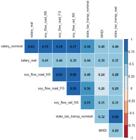
We have found some interesting results from the correlation heatmap. The mean salary of logistics workers (in real terms) is positively correlated to the Municipal Human Development Index (MHDI). The correlation coefficient for these variables is 0.4. This intuitively means that a higher salary leads to an increase in welfare and a decrease in poverty. The average salaries also show a stronger correlation with variables related to the flow of soybeans using different means of transport and routes (Norte/Sul or Ferrogrão path), hovering around 0.4.
4.2.2 Model results and discussion
The F-test comparing the pooling model with fixed effects demonstrated that fixed or random effects models are more appropriate to describe the issue discussed in this paper. Next, we used the Hausman test to assess the consistency between the coefficients of the fixed-effect and random-effect models and to identify any systematic differences. The results led to the rejection of the null hypothesis, showing that the differences in the coefficients are not systematic. Thus, the Hausman test indicates that the random-effects model is the most appropriate choice. Table 7 presents the results.
All the models described in Table 6 revealed significant relationships (p-value < 0.1) between dependent and independent variables. As discussed earlier, the F-test and Hausman test were conducted, indicating that random effects models are more appropriate than pooled OLS and fixed effects models.
Wages in the logistics sector exhibit positive elasticities with respect to the quantity transported via the Ferrogrão roadway. In contrast, soybean transport through the Norte/Sul roadway has a negative effect on logistics sector wages in the analyzed municipalities. Specifically, the positive effect is concentrated in port cities, while a negative effect is observed in other municipalities. Moreover, the impact of soybean transport on wages intensifies with higher volumes of soybeans transported.
Regarding control variables, municipal tax revenue, rather than the MHDI, shows a positive and significant effect on wages. This result suggests that tax revenue may play a relevant role in wage appreciation, possibly by enabling local investments, such as professional training initiatives, that improve working conditions and stimulate demand for more qualified labor. Conversely, the lack of a significant impact of the MHDI indicates that aggregated human development, as measured by this index, does not appear to be directly related to wage levels in the logistics sector.
The results highlight that the impacts on wages in the logistics sector vary depending on the specific transportation routes. The Ferrogrão roadway exhibits a positive and significant effect on wages. This result indicates that the infrastructure impact of logistics is positive in port cities, suggesting localized economic benefits for communities closely connected to the logistics chain. Conversely, the soybean flow through the Norte/Sul roadway shows a negative impact on wages, underscoring disparities in how different pathways influence local labor markets. These findings suggest that the direct benefits of the new logistics activities are localized and dependent on specific pathways, failing to generate broad-based socioeconomic improvements for all communities along the routes.
In sum, the findings of this research indicate that, in the short and medium term, local communities face a trade-off between the positive externalities of multi-modal logistical routes and the potential negative impacts on wages and land use in sensitive biomes. Costa et al. (2021) emphasize that new logistics projects in the Amazon region will cross indigenous lands in the Xingu, altering their primary use. Using data from previous logistical investments, these authors simulate land-use scenarios and conclude that such projects have the potential to increase deforestation in the region. On the other hand, these logistical routes could reduce costs in the soybean supply chain (and other commodity supply chains), enhancing Brazil’s competitiveness and positively contributing to the country’s aggregate GDP. In this context, policymakers must conceptualize multi-modal logistics projects from a broad perspective, balancing their short- and medium-term use for the currently dominant commodity (soybean) with long-term considerations for land use and sustainability.
4.3 Theoretical implications
The present study uses the results of an optimization model to estimate the rational adoption of a new logistic mode over time. Using historical data from a phased railroad implementation (Norte/Sul), we showed that as the length of railway increases, the volume of commodity transported also increases. This relation varies according to characteristics of the analyzed scenario, such as the origin of the commodities and the degree of access to the new logistic pathways.
From a theoretical perspective, this approach contributes to the literature by demonstrating how adoption dynamics can be modeled to compare different logistics modes competing for the same cargo. The choice of producer centers as commodity origins along transportation routes emerges as a sensitive step in this application, given the dispersed nature of agricultural production.
Furthermore, the study reinforces and extends existing discussions on multimodal transport impacts. While most analyses emphasize economic aspects and, to a lesser extent, environmental outcomes, our findings highlight the need to incorporate potential socioeconomic implications for municipalities. This shift broadens the theoretical debate on logistics corridors, positioning them not only as efficiency-enhancing infrastructure but also as drivers of regional development and sustainability, an issue still insufficiently addressed in the literature.
4.4 Practical implications
The results confirm that multi-mode logistics corridors help to reduce CO2 emissions and soybean costs. However, the socioeconomic effects of these logistics corridors on the municipalities that host them are limited. The regression results do not allow us to conclude that such projects have a positive impact on salaries, but that only port cities show more consistent effects, although the causal relationship remains uncertain.
Taken together, the economic, environmental, and socioeconomic results reveal a consistent but uneven pattern of impacts arising from the expansion of multi-mode logistics corridors. We cannot affirm that cost efficiency gains automatically translate into socioeconomic improvements at the municipal level in the new logistic corridors. This suggests that, if they exist, the benefits generated in the economic dimensions are partially internalized locally, being spatially diffused along the supply chain rather than retained in host municipalities. In this sense, logistics efficiency acts as a necessary but not sufficient condition for local development, highlighting a structural disconnect between productivity gains and income distribution. Therefore, the alignment between these dimensions depends on complementary institutional mechanisms capable of capturing and redistributing the gains from improved logistics, reinforcing the need for integrated policy design that bridges infrastructure performance with local socioeconomic outcomes.
From a practical perspective, these findings suggest that the expansion of multi-mode logistics projects can be included effectively into environmental and productivity policies, particularly those aimed at reducing emissions and enhancing supply chain efficiency. Conversely, when the objective of public policy is to foster socioeconomic development, such as income generation or improvements in local labor markets, the expansion of multi-mode logistics projects should not be regarded as the primary instrument. In such cases, complementary policies specifically targeting social and economic outcomes are necessary to ensure broader developmental benefits.
5 Concluding remarks
The present paper examines the impact of the expansion of multi-mode logistics projects in Brazil’s northern region (Arco Norte) on costs, CO2 emissions, and socioeconomic factors, considering the soybean supply chain. The research findings indicate that the utilization of rail and water transportation can lead to a reduction of soybean logistics expenses by 13% to 19%, while also decreasing CO2 emissions by approximately 10%. Regarding the impact on wages in the logistical sector, results indicate disparities depending on the specific transportation pathways considered. The Ferrogrão roadway shows a positive and significant effect on wages, highlighting its potential to generate localized economic benefits, particularly in port cities. In contrast, the Norte/Sul roadway exhibits negative impacts, underscoring the unequal distribution of benefits across different logistical routes. Additionally, state tax revenue has a positive and significant impact on wages, suggesting that higher fiscal capacity may indirectly improve labor conditions through local investments or enhanced demand for skilled labor raising income levels within the logistics sector.
These findings underscore the localized and pathway-dependent nature of the benefits associated with new logistics activities. From a broader perspective, municipalities hosting such paths face a trade-off between land usage and local economic gains, raising critical discussions about income transfer mechanisms to ensure that local communities benefit equitably from these projects. The ability of the state to invest in and support the logistics sector appears to be essential for driving wage growth. This highlights the importance of integrated policies that consider both human development and fiscal capacity to ensure broader socioeconomic benefits along these transportation routes.
As a limitation of the present study, we highlight the restricted number of variables used to measure socioeconomic and environmental benefits of the logistic pathways. Regarding the socioeconomic assessment conducted using a regression model, the possibility of selecting more potential predictors was limited by endogeneity, a frequent problem reported in the econometric literature (Wooldridge, 2019). Future work could consider applying non-parametric methods to overcome the endogeneity problem. Furthermore, another limitation refers to the environmental dimension, which is evaluated using the optimization model. A single variable (CO2eq emissions) represented this dimension. Information about deforestation was not included in the models, and we suggest that future work consider these data.
In conclusion, policymakers need to take a comprehensive perspective when conceptualizing multi-mode logistics projects, considering their long-term usage beyond the demands of current economic commodities. While the soybean economic cycle is likely that to remain a significant driver of the Brazilian economy in the coming decades, infrastructure investments should aim not only to improve competitiveness of the soybean supply chain but also contribute to broader social development. Future research should, then, explore topics such as the impact of soybean logistics on land usage and evaluation of public policies, which were beyond the scope of this study.
Appendix 1 Results of Econometric Tests.
1. Model Selection Tests
• F Test for Individual Effects
F = 9.9023, df1 = 8, df2 = 81, p-valor=1.676×10⁻⁹
Conclusion: There are significant individual effects, justifying the use of fixed or random effects models.
• Hausman test
χ2=3.727, df = 5, p-value = 0.5893
Conclusion: The random effects model is consistent and preferable.
2. Residual Diagnostics
• Normality Test (Shapiro-Wilk)
W=0.89227, p-value = 1.192×10⁻⁶
Conclusion: The null hypothesis of normality of residuals is rejected.
• Heteroscedasticity Test (Studentized Breusch-Pagan)
BP = 1.4532, df = 4, p-value = 0.8349
• Conclusion: There is no evidence of heteroscedasticity in the residuals.
• Serial Correlation Test (Breusch-Godfrey/Wooldridge)
χ2=15.448, df = 10, p-value = 0.1166
Conclusion: There is no evidence of serial correlation in the residuals.
3. Summary of Results
• Models with individual effects (fixed or random) are preferable to the pooled model.
• The random effects model is consistent and was chosen based on the Hausman test results.
• The residuals meet the conditions of homoscedasticity and lack of serial correlation, but do not follow a normal distribution.
The lack of normality in the residuals does not compromise the consistency or efficiency of the estimators, provided other assumptions are met. In this model, the absence of heteroscedasticity and serial correlation suggests that the estimates remain consistent and efficient.
-
1
GSA cargo: Granel Sólido Agrícola.
-
2
Dummies for municipalities were not included, as the specific characteristics of each locality were captured by the control variable for MHDI, which summarizes relevant indicators of education, income, and health.
-
Financial support:
This research was funded by the National Council for Scientific and Technologica lDevelopment (CNPq), process number 405728/2023-9.
-
How to cite:
Silva, A. V., Mota, D. O., Lima, R. I. R., Veloso, R. B., Fonseca, C. V. C., & Ribeiro, C. O. (2026). Sustainable impacts of multi-mode logistics in Brazil’s soybean supply chain. Gestão & Produção, 33, e7825. https://doi.org/10.1590/1806-9649-2026v33e7825
Statement on Data Availability
The data supporting the findings of this study were collected from public sources. The compiled data will be made available upon request.
References
-
Anderson, K., & Valenzuela, E. (2021). What impact are subsidies and trade barriers abroad having on Australasian and Brazilian agriculture? The Australian Journal of Agricultural and Resource Economics, 65(2), 265-290. https://doi.org/10.1111/1467-8489.12413
» https://doi.org/10.1111/1467-8489.12413 -
ANTAQ. (2023). Brazilian National Agency of Waterway Transport homepage Retrieved in 2023, December 12, from https://www.gov.br/antaq/pt-br
» https://www.gov.br/antaq/pt-br -
ANTF. (2023). Brazilian National Association of Railway Transporters homepage Retrieved in 2025, October 1, from https://www.antf.org.br/boletim-antf/painel-antf/#:~:text=O%20Painel%20ANTF%20traz%20a,para%20o%20transporte%20de%20cargas
» https://www.antf.org.br/boletim-antf/painel-antf/#:~:text=O%20Painel%20ANTF%20traz%20a,para%20o%20transporte%20de%20cargas -
ANTT. (2022). Estudos de viabilidade da Ferrogrão (Feasibility studies for Ferrogrão project) Brazilian National Agency of Land Transportation. Retrieved in 2023, November 23, from https://www.gov.br/antt/pt-br/assuntos/ferrovias/novos-projetos-ferroviarios/ferrograo-ef-170/arquivos-para-download/estudos-de-viabilidade
» https://www.gov.br/antt/pt-br/assuntos/ferrovias/novos-projetos-ferroviarios/ferrograo-ef-170/arquivos-para-download/estudos-de-viabilidade -
ANTT. (2023). Brazilian National Agency of Land Transportation homepage Retrieved in 2023, November 23, from https://www.gov.br/antt/pt-br
» https://www.gov.br/antt/pt-br -
Arencibia, A. I., Feo-Valero, M., García-Menéndez, L., & Román, C. (2015). Modelling mode choice for freight transport using advanced choice experiments. Transportation Research Part A, Policy and Practice, 75, 252-267. https://doi.org/10.1016/j.tra.2015.03.027
» https://doi.org/10.1016/j.tra.2015.03.027 - Ballou, R. H. 2009. Gerenciamento da cadeia de suprimentos: logística empresarial. Porto Alegre: Bookman.
-
Brasil. Ministério da Fazenda. (2022a). Brazilian Ministry of Finance homepage Retrieved in 2022, November 1, from https://www.confaz.fazenda.gov.br/boletim-de-arrecadacao-dos-tributos-estaduais
» https://www.confaz.fazenda.gov.br/boletim-de-arrecadacao-dos-tributos-estaduais -
Brasil. Ministério do Trabalho e Emprego. (2022b). Brazilian Ministry of Labour and Employment homepage Retrieved in 2022, November 1, from http://pdet.mte.gov.br/acesso-online-as-bases-de-dados
» http://pdet.mte.gov.br/acesso-online-as-bases-de-dados -
Brasil. Ministério da Infraestrutura. (2022c). Manual de análise de impacto socioeconômico e custo-benefício para apoio ao planejamento de sistemas e infraestruturas de transporte. Apêndice III – Caderno de parâmetros para análises custo-benefício Retrieved in 2023, November 23, from https://www.ppi.gov.br/wp-content/uploads/2023/04/Apendice-III_Caderno-de-parametros_ACB_v3.pdf
» https://www.ppi.gov.br/wp-content/uploads/2023/04/Apendice-III_Caderno-de-parametros_ACB_v3.pdf -
Brasil. Ministério da Infraestrutura. (2021). Brazilian national logistics plan 2035 Retrieved in 2023, December 26, from https://www.gov.br/transportes/pt-br/assuntos/planejamento-integrado-de-transportes/politica-e-planejamento/RelatorioExecutivoPNL_2035final.pdf
» https://www.gov.br/transportes/pt-br/assuntos/planejamento-integrado-de-transportes/politica-e-planejamento/RelatorioExecutivoPNL_2035final.pdf -
Brasil. Ministério dos Transportes. (2023). Brazilian Ministry of Transports homepage Retrieved in 2023, July 14, from https://www.gov.br/transportes/pt-br/assuntos/dados-de-transportes/bit/bit-mapas
» https://www.gov.br/transportes/pt-br/assuntos/dados-de-transportes/bit/bit-mapas -
Caetano, J. M., Tessarolo, G., De Oliveira, G., Kelly da Silva, S., José, A. F. D.-F., & Nabout, J. C. (2018). Geographical patterns in climate and agricultural technology drive soybean productivity in Brazil. PLoS One, 13(1), e0191273. https://doi.org/10.1371/journal.pone.0191273 PMid:29381755.
» https://doi.org/10.1371/journal.pone.0191273 -
Casaca, A. C. P., Galvão, C. B., Robles, L. T., & Cutrim, S. S. (2017). The Brazilian cabotage market: A content analysis. International Journal of Shipping and Transport Logistics, 9(5), 601-625. https://doi.org/10.1504/IJSTL.2017.086316
» https://doi.org/10.1504/IJSTL.2017.086316 -
Cavalett, O., & Ortega, E. (2010). Integrated environmental assessment of biodiesel production from soybean in Brazil. Journal of Cleaner Production, 18(1), 55-70. https://doi.org/10.1016/j.jclepro.2009.09.008
» https://doi.org/10.1016/j.jclepro.2009.09.008 -
Centro de Avançados em Economia Aplicada – Cepea. Escola Superior de Agricultura "Luiz de Queiroz" – ESALQ-USP. Associação Brasileira das Indústrias de Óleos Vegetais – ABIOVE. (2023). Cadeia da Soja e do Biodiesel: PIB, Empregos e Comércio Exterior – Primeiros Resultados e Metodologia Retrieved in 2023, December 17, from https://www.cepea.esalq.usp.br/upload/kceditor/files/Cepea_Abiove_RelatorioCompleto_Maio23.pdf
» https://www.cepea.esalq.usp.br/upload/kceditor/files/Cepea_Abiove_RelatorioCompleto_Maio23.pdf -
COMEXSTAT. (2023). Comex Stat – Website for Free Access to Brazilian Foreign Trade Statistics Retrieved in 2023, November 25, from http://comexstat.mdic.gov.br/pt/geral
» http://comexstat.mdic.gov.br/pt/geral -
CONAB. (2023). Companhia Nacional de Abastecimento homepage Retrieved in 2023, June 29, from https://portaldeinformacoes.conab.gov.br/produtos-360.html
» https://portaldeinformacoes.conab.gov.br/produtos-360.html -
Costa, W., Davis, J., Ribeiro de Oliveira, A., Fernandes, F., Rajão, R., & Britaldo, S. S. F. 2021. Ferrogrão railroad with a freight terminal in Matupá will split in half the indigenous lands of Xingu Retrieved in 2023, December 20, from https://csr.ufmg.br/csr/wp-content/uploads/2021/07/Nota-MT-322_final_EN.pdf
» https://csr.ufmg.br/csr/wp-content/uploads/2021/07/Nota-MT-322_final_EN.pdf -
Crisalli, U., Comi, A., & Rosati, L. (2013). A Methodology for the assessment of rail-road freight transport policies. Procedia: Social and Behavioral Sciences, 87, 292-305. https://doi.org/10.1016/j.sbspro.2013.10.611
» https://doi.org/10.1016/j.sbspro.2013.10.611 - Dantzig, G. G., & Thapa, M. N. (2003). Transportation problem and variations. New York: Springer.
-
Daramola, A. (2022). A comparative analysis of road and rail performance in freight transport: an example from Nigeria. Urban, Planning and Transport Research, 10(1), 58-81. https://doi.org/10.1080/21650020.2022.2033134
» https://doi.org/10.1080/21650020.2022.2033134 -
Embrapa. (2023). Brazilian Agricultural Research Corporation (EMBRAPA) homepage Retrieved in 2023, July 17, from https://www.embrapa.br/soja/cultivos/soja1/dados-economicos
» https://www.embrapa.br/soja/cultivos/soja1/dados-economicos -
Fliehr, O., Zimmer, Y., & Smith, L. H. (2019). Impacts of transportation and logistics on Brazilian soybean prices and exports. Transportation Journal, 58(1), 65-77. https://doi.org/10.5325/transportationj.58.1.0065
» https://doi.org/10.5325/transportationj.58.1.0065 -
Gursoy, M. (2010). A method for transportation mode choice. Scientific Research and Essays, 21(1). Retrieved in 2023, July 17, from http://www.academicjournals.org/SRE
» http://www.academicjournals.org/SRE -
Heij, C., Boer, P., Franses, P. H., Kloek, T., & van Dijk, H. K. (2004). Econometric methods with applications in business and economics. Oxford: Oxford University Press. https://doi.org/10.1093/oso/9780199268016.001.0001
» https://doi.org/10.1093/oso/9780199268016.001.0001 -
IBGE. (2022). Brazilian Institute of Geography and Statistics homepage Retrieved in 2022, November 1, from https://www.ibge.gov.br/estatisticas/economicas/contas-nacionais/9088-produto-interno-bruto-dos-municipios.html
» https://www.ibge.gov.br/estatisticas/economicas/contas-nacionais/9088-produto-interno-bruto-dos-municipios.html -
IBGE. (2023a). IBGE cidades Retrieved in 2023, December 28, from https://cidades.ibge.gov.br/
» https://cidades.ibge.gov.br/ -
IBGE. Sistema IBGE de Recuperação Automática – SIDRA. (2023b). Dados de produção de soja nos municípios/estados/mesorregiões: SIDRA. Instituto Brasileiro de Geografia e Estatística Retrieved in 2023, November 25, from https://sidra.ibge.gov.br/tabela/1612
» https://sidra.ibge.gov.br/tabela/1612 -
Kingwell, R., Loxton, R., & Mardaneh, E. (2020). Factors and scenarios affecting a farmer’s grain harvest logistics. The Australian Journal of Agricultural and Resource Economics, 64(2), 244-265. https://doi.org/10.1111/1467-8489.12355
» https://doi.org/10.1111/1467-8489.12355 -
Li, T., Chen, Y., & Li, T. (2018). Pricing strategies of logistics distribution services for perishable commodities. Algorithms, 11(11), 186. https://doi.org/10.3390/a11110186
» https://doi.org/10.3390/a11110186 -
Mapbiomas. (2023). Homepage Retrieved in 2023, June 29, from https://mapbiomas.org
» https://mapbiomas.org -
Maranhão, R. L. A., Carvalho Júnior, O. A., Hermuche, P. M., Gomes, R. A. T., Pimentel, C. M. M., & Guimarães, R. F. (2019). The spatiotemporal dynamics of soybean and cattle production in Brazil. Sustainability, 11(7), 2150. https://doi.org/10.3390/su11072150
» https://doi.org/10.3390/su11072150 -
Martinelli, L. A., Batistella, M., Silva, R. D., & Moran, E. (2017). Soy expansion and socioeconomic development in municipalities of Brazil. Land, 6(3), 62. https://doi.org/10.3390/land6030062
» https://doi.org/10.3390/land6030062 -
Meixell, M. J., & Norbis, M. (2008). A review of the transportation mode choice and carrier selection literature. International Journal of Logistics Management, 19(2), 183-211. https://doi.org/10.1108/09574090810895951
» https://doi.org/10.1108/09574090810895951 -
Morais, G. R., Yuri, C. D. C., De Oliveira, G. F., Saldanha, R. R., & Maia, C. A. (2023). A sustainable location model of transshipment terminals applied to the expansion strategies of the soybean intermodal transport network in the State of Mato Grosso, Brazil. Sustainability, 15(2), 1063. https://doi.org/10.3390/su15021063
» https://doi.org/10.3390/su15021063 -
Mostert, M., & Limbourg, S. (2016). External costs as competitiveness factors for freight transport – A state of the art. Transport Reviews, 36(6), 692-712. https://doi.org/10.1080/01441647.2015.1137653
» https://doi.org/10.1080/01441647.2015.1137653 -
Novaes, A. G., Gonçalves, B. S., Costa, M. B., & Santos, S. (2006). Rodoviário, ferroviário ou marítimo de cabotagem? O uso da técnica de preferência declarada para avaliar a intermodalidade no Brasil. Transportes, 14(2). https://doi.org/10.14295/transportes.v14i2.64
» https://doi.org/10.14295/transportes.v14i2.64 -
Oliveira, A. L. R. D., Filassi, M., Lopes, B. F. R., & Marsola, K. B. (2020). Logistical transportation routes optimization for Brazilian soybean: an application of the origin-destination matrix. Ciência Rural, 51(2), e20190786. https://doi.org/10.1590/0103-8478cr20190786
» https://doi.org/10.1590/0103-8478cr20190786 -
Oliveira, R. C., & Silva, R. D. S. (2021). Increase of Agribusiness in the Brazilian Amazon: development or Inequality? Earth, 2(4), 1077-1100. https://doi.org/10.3390/earth2040064
» https://doi.org/10.3390/earth2040064 -
Overhaul. (2025). Traversing railways across the EU and USA Retrieved in 2025, October 1, from https://over-haul.com/traversing-railways-across-the-eu-and-usa/#:~:text=Railways%20in%20the%20USA,48th%20and%20efficiency%20as%2012th
» https://over-haul.com/traversing-railways-across-the-eu-and-usa/#:~:text=Railways%20in%20the%20USA,48th%20and%20efficiency%20as%2012th -
Picoli, M. C., Rorato, A., Leitão, P., Camara, G., Maciel, A., Hostert, P., & Sanches, I. D. A. (2020). Impacts of public and private sector policies on soybean and pasture expansion in Mato Grosso: brazil from 2001 to 2017. Land, 9(1), 20. https://doi.org/10.3390/land9010020
» https://doi.org/10.3390/land9010020 -
Reis, M., Gilberto, J., Amorim, P. S., Cabral, J. A. S. P., & Toloi, R. C. (2020). The impact of logistics performance on Argentina, Brazil, and the US Soybean Exports from 2012 to 2018: a gravity model approach. Agriculture, 10(8), 338. https://doi.org/10.3390/agriculture10080338
» https://doi.org/10.3390/agriculture10080338 -
Rezaei-Malek, M., Tavakkoli-Moghaddam, R., Zahiri, B., & Bozorgi-Amiri, A. (2016). An interactive approach for designing a robust disaster relief logistics network with perishable commodities. Computers & Industrial Engineering, 94, 201-215. https://doi.org/10.1016/j.cie.2016.01.014
» https://doi.org/10.1016/j.cie.2016.01.014 -
R Project. (2026). The R Project for Statistical Computing Retrieved in 2026, March 1, from https://www.r-project.org/
» https://www.r-project.org/ -
Sampaio, P. P. S., & Daychoum, M. T. (2017). Two decades of rail regulatory reform in Brazil (1996–2016). Utilities Policy, 49, 93-103. https://doi.org/10.1016/j.jup.2017.06.007
» https://doi.org/10.1016/j.jup.2017.06.007 -
Silva, E. H. F. M., Luis, A. S. A., Zanon, A. J., Aderson, S. A. J., Antunes de Souza, H., Kassio dos Santos, C., Nilson, A. V. J., & Marin, F. R. (2021). Impact assessment of soybean yield and water productivity in Brazil due to climate change. European Journal of Agronomy, 129, 126329. https://doi.org/10.1016/j.eja.2021.126329
» https://doi.org/10.1016/j.eja.2021.126329 -
Souza, M. M. D., Rocha, M. P., Farias, V., & Tavares, H. (2020). Optimization of soybean outflow routes from Mato Grosso, Brazil. International Journal for Innovation Education and Research, 8(8), 176-191. https://doi.org/10.31686/ijier.vol8.iss8.2502
» https://doi.org/10.31686/ijier.vol8.iss8.2502 -
Souza, M. M., Oliveira, A. L. R. D., & Da Rocha, M. P. D. C. (2023). Strategies to promote intermodality in the Amazonian Northern arc region: a cost-effectiveness analysis of infrastructure. Revista de Economia e Agronegócio, 21(1), 1-12. https://doi.org/10.25070/rea.v21i1.14643
» https://doi.org/10.25070/rea.v21i1.14643 -
USDA. (2023). United States Department of Agriculture homepage Retrieved in 2023, June 29, from https://ipad.fas.usda.gov/cropexplorer/cropview/commodityView.aspx?cropid=2222000
» https://ipad.fas.usda.gov/cropexplorer/cropview/commodityView.aspx?cropid=2222000 - Wooldridge, J. M. (2019). Introductory econometrics: a modern approach (7th ed.). Boston: Cengage Learning.
-
Editor-in-Chief
Pedro Munari