 Production and quality of bell pepper fruits using different fertilization sources
ABSTRACT
Bell peppers are an economically and socially important vegetable, and cultivation technologies aim to reduce production costs and increase yields, which can be achieved through the use of organic fertilization and irrigation. Therefore, this study aimed to evaluate the production and post-harvest quality of bell pepper fruits using different fertilization sources in Neossol soil. The experiment was conducted in a randomized block design with five treatments and five replications (T1= 30% (1/2 topsoil + 1/2 bovine manure) and 70% soil; T2= 30% (traditional organic compost) and 70% soil; T3= 30% (organic compost Bokashi) and 70% soil; T4= 30% (Biobokashi granules) and 70% soil; and T5 - control, 100% soil and fertirrigation). The following characteristics were evaluated: number of fruits per plant (NF), fresh fruit mass (FFM), longitudinal fruit length (LFL), transverse diameter (TD), fruit yield (Y), total soluble solids content (SS), vitamin C (Vit. C), titratable acidity (TA), and ratio (SS/TA). The mean results were subjected to normality and homogeneity of variance tests, and analysis of variance. Using the F-test, the treatment means were compared using Tukey's test (p≤0.05). Treatments T1, T2, and T4 provided higher values for FFM, LFL, TD, and Y. There was no statistical difference between treatments for the variables SS, TA, and Ratio. The highest vitamin C content occurred in T5 and T1, with no statistical difference between them. It is concluded that treatments T1 and T2 had higher fruit production. Post-harvest quality, regarding vitamin C content, stood out in treatments T5 and T1. The mixture of bovine manure with soil and topsoil (T1), as well as the traditional organic compost (T2) and bokashi (T3), showed viability in terms of production and post-harvest quality compared to T5 (fertigation).
Keywords:
Capsicum annuum L.; organic compound; fertirrigation; semiarid
RESUMO
O pimentão é uma hortaliça importante econômica e socialmente e as tecnologias de cultivo buscam reduzir custos de produção e aumento no rendimento, que podem ser alcançados com uso da adubação orgânica e irrigação. Assim, objetivou-se avaliar a produção e qualidade pós-colheita dos frutos de pimentão usando fontes de adubação, em solo da classe Neossolo. O experimento foi desenvolvido em delineamento em blocos casualizados, com cinco tratamentos e cinco repetições (T1= 30% (terra vegetal 1/2 + esterco bovino 1/2) e 70% de solo; T2= 30% (composto orgânico tradicional) e 70% solo; T3= 30% (composto orgânico Bokashi) e 70% de solo; T4= 30% (Biobokashi farelado) e 70% de solo; e, T5= testemunha, 100% de solo e fertirrigado). Avaliou-se o número de frutos por planta (NFR), massa fresca de frutos (MFFR), comprimento longitudinal de frutos (CF), diâmetro transversal (DT), produção de frutos (PROD), teor de sólidos solúveis totais (SST), vitamina C (Vit. C), acidez titulável (AT) e ratio (SST/AT). Os resultados médios foram submetidos aos testes de normalidade e homogeneidade de variâncias, análise de variância pelo teste F, comparação das médias dos tratamentos pelo teste de Tukey (p≤0,05). Os tratamentos T1, T2 e T4 proporcionaram maiores valores para MFFR, CF, DT e PROD. Não houve diferença estatística entre os tratamentos para as variáveis SS, AT e Ratio. O maior teor de vitamina C ocorreu em T5 e T1, sem diferença estatística entre eles. Conclui-se, que os tratamentos T1 e T2 tiveram maiores produções de frutos. A qualidade pós-colheita, quanto ao teor de vitamina C, se destacou nos tratamentos T5 e T1. A mistura de esterco bovino, com solo e terra vegetal (T1), bem como, o composto orgânico tradicional (T2) e bokashi (T3), apresentaram viabilidade quanto a produção e qualidade pós-colheita em relação ao T5 (fertirrigação).
Palavras-chaves:
Capsicum annuum L.; composto orgânico; fertirrigação; semiárido
Bell pepper (Capsicum annuum L.) is a member of Solanaceae family and the fruits of this vegetable show relevant bioactive compounds which improve consumer’s health, such as vitamins, flavonoids, carotenoids, capsaicinoids, volatile oils, fatty acids, proteins, fibers and minerals. In addition to its nutritional richness, bell peppers have flavor, aroma, and color, and are used as food, medicine, and spice (Sini et al., 2024).
Bell pepper is grown and commercialized worldwide, including in the Brazilian agricultural market, where it has significant economic and social importance (Sousa, 2022). Despite its economic importance, producers are unable to produce high-yield and high-quality bell peppers due to biotic factors, such as pests and diseases, and also abiotic factors, such as water and salt stress (Manna & Ray, 2015). However, the impact of these factors can be minimized by employing technologies in bell pepper cultivation, such as the use of protected environments.
The indiscriminate use of inorganic fertilizers reduces the organic matter content of the soil, increases erosion and soil degradation, which may increase soil salinity (Persiani et al., 2021; Sulok et al., 2021).
In bell pepper cultivation, technologies focused on sustainability issues are employed to reduce production costs and increase productivity. Thus, the use of organic fertilizers can help achieve this goal, since it is an economical practice to improve soil structure and fertility (Sediyama et al., 2014). Soil structure and fertility improvements can increase crop productivity and resource use efficiency, affecting an increase in development of sustainable agriculture systems.
The organic compound originates from the composting process, which is carried out by the microbial decomposition of organic matter in its solid state as organic waste into a fertilizer. Composting can be made traditionally or using Bokashi technique. According to Siqueira & Siqueira (2013), the difference lies in the fact that at the end of the composting process, the nutrients from the Bokashi are made available in the form of organic chelates, reducing losses due to volatilization or leaching; and it introduces beneficial microorganisms into the soil that will play an important role in biomass decomposition.
The use of Bokashi is an organic practice recommended due to its ecological and economics advantages: this fertilizer can be produced on the property itself and it also reduces production costs (Montanha et al., 2022). According to Figueiredo (2020), the use of inputs and local residues for producing compounds like Bokashi and liquid biofertilizers is an alternative technology of low cost and positive impacts.
In the organic farming, the production system aims the non-use of agrochemicals and the use of livestock waste, like bovine, pig and poultry manure, and also organic fertilizers, such as Bokashi and vermicompost (Rodrigues & Ribeiro, 2023). For Hata et al. (2020) biofertilizer and Bokashi improve the microbiological quality of the substrate and the agronomic variables of lettuce grown in protected cultivation.
Generally, the organic compounds significantly increase the growth and production of bell peppers, resulting in positive effects on several fruit yield variables and post-harvest qualities, due to, among other factors, the efficiency in plant nutrition with an increase in productivity (Arançon et al., 2005; Sediyama et al., 2009; Al-Harbi et al., 2020).
Given the above, information should be sought on the effect of organic compound fertilizer on fruit production and organoleptic qualities of fruit post-harvest. The authors aimed to evaluate the production and post-harvest quality of the bell pepper produced in protected environment submitted to different sources of fertilization.
MATERIAL AND METHODS
The experiment was carried out in a protected environment under plastic house conditions, at Instituto Federal de Educação, Ciência e Tecnologia da Paraíba (IFPB), São Gonçalo, Sousa, PB (6º50’11”S, 38º17’47”W, average altitude 223 m). The protected environment showed the following characteristics: 39.90 m long, 24.40 m wide, 2.20 m ceiling height, wire mesh covered with 50% shading screen.
According to Köppen classification, the climate in the region is ‘BSh’, hot and dry, with the loss of water by evaporation greater than rainfall, annual average is 654 mm and rainfall concentration from January to June, showing average temperature and humidity around 28ºC and 64% respectively, under caatinga climatic conditions (Dubreuil et al., 2018).
During the experiment, the authors collected climatic data, such as temperatures and relative air humidity, inside the greenhouse, using a digital thermo-hygrometer. Temperatures for Tmin was around 21ºC most of time during the experiment, Tmax ranging from 35 to 36ºC, though (Figure 1).
The experimental design used was of randomized blocks, with five treatments and five replications. Each experimental unit consisted of three 18 dm3-capacity pots (31 cm high and 27.5 cm in diameter), containing one plant in each pot. The treatments consisted of fertilization sources: T1= 30% (½ topsoil + ½ bovine manure) and 70% soil; T2= 30% traditional organic compost and 70% soil; T3= 30% organic compost using the Bokashi technique and 70% soil; T4= 30% Biobokashi residues and 70% soil; T5= control, consisting of 100% soil and weekly fertigated.
The soil used in the experiment was Fluvisol Entisol, sandy texture (Embrapa, 2018). Physical chemical properties are presented in Table 1.
In treatment T5, weekly fertigations were performed, according to Trani et al. (2011); the authors applied 14.15 g of N, 1.51 g of P, 20.92 g of K, 6.30 g of Ca, 4.67 g of Mg and 6.17 g of S of macronutrients per plant throughout the crop cycle. We used the chemical treatment as control in order to evaluate the potential of organic sources for supplying minerals to plants.
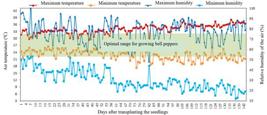
Variations in temperature and relative humidity during the experimental period. Sousa, IFPB, 2024.
Before the installation of the experiment, based on the soil analysis, the pH was corrected using dolomitic limestone and NPK (15-07-32) at a ratio of 1.0 g/dm3 for all treatments. The pots were distributed inside the greenhouse, in five rows spaced 1.5 m, spacing 0.5 m between plants.
Bell pepper seedlings, cv. Kolima F1 (Agristar), were produced in 50-cm3 tubes, using as substrate Bokashi organic compost produced in loco. Seedlings were transplanted when they showed seven or eight definitive leaves, 12-15 cm height.
The pots were perforated at their bottom. Then, drainage was performed, consisting of a thin layer of No. 1 crushed stones and a nylon mesh. Before filling the pots, the substrates were chemically analyzed, and their attributes are presented in Tables 2 and 3. Information on nutrients for Biobokashi residues (T4) is presented in Table 2. Biobokashi is a fertilizer which is made of fish meal, bone meal, rock minerals, rice bran, molasses and coal (Silva et al., 2018). This fertilizer is classified as class A organic compost (Brasil, 2020).
The crop was drip irrigated using adjustable emitters, flow of 0.8 L/h (Implebrás modelo IM-R70) coupled to flexible lateral pipelines (16 mm), considering two emitters per pot. The system consisted of a reservoir (a 1000-L-capacity Fortlev polyethylene water tank), and a moto-pump (Intechmachine 0.5 hp peripheral pump with 1” inlet and outlet).
Two irrigations were performed during the day, in the early morning and late afternoon. In each irrigation event, enough water was applied to cause drainage (using visual analyses).
During the experiment, plants were managed using staking and sprout thinning. Cultural practices were carried out according to the crop’s needs, such as irrigation, control of invasive plants, pests and diseases.
We performed four fruit harvests (August 8, August 28, September 11 and October 4, 2023). After harvesting, the fruits were taken to Laboratório de Análises Físico-químicas de Alimentos (Food Physicochemical Analyses Laboratory), at IFPB campus, where traits, such as yield and post-harvest quality, were evaluated.
Regarding the group, the hybrid bell pepper cv. Kolima F1 is square; regarding size, bell peppers are classified by their longitudinal dimension (cm) and weight (g): large fruits (>10 cm and >260 g), medium (>8 cm and ≤10 cm, >180 g and ≤260 g), small (>5 cm and ≤8 cm, >50 g and ≤180 g) and mini (≤5 cm and ≤50 g); regarding the category, the fruits are classified as extra, category I, and category II depending on the defect tolerance limits established by the regulations (Brasil, 2021).
Fruit yield: number of fruits per plant (NF); longitudinal fruit length (LFL) and fruit transverse diameter (TD) were evaluated using a digital caliper (± 0.1 mm); fresh fruit mass (FFM) was evaluated using a precision scale (0.0001 g), expressed in g/fruit; fruit yield (Y) was obtained using the number of fruits per plant and fresh fruit mass (NF x FFM), considering the result expressed in g/plant.
Post-harvest quality: total soluble solid content (SS) was evaluated using a refractometer HI96800 (Hanna instruments), being measured directly in the fruit furrow, and the results expressed in °Brix; pH, measured using a benchtop pH meter; Vitamin C (Vit. C), determined by titrating 3 g of crushed and homogenized pulp with 50 mL of 12% oxalic acid. The result was expressed in mg ascorbic acid per 100 g of pulp. Titratable acidity (TA) was determined by titrating 10 g of pulp crushed in a blender and homogenized with 90 mL of distilled water. The authors used as titrant 0.11 N standardized NaOH solution. The results were expressed in grams of malic acid per 100 g of sample; SS/TA ratio. The post-harvest quality analyses were carried out according to the methodology of Instituto Adolfo Lutz (1985).
The data were submitted to Shapiro Wilk’s test (normality test) and, Barlett’s test (homogeneity of variance). The analysis of variance was carried out by F test and averages were compared using Tukey test (p≤0,05). The statistical analyses were evaluated using Sisvar software (Ferreira, 2019).
Except for NF, the treatments applied affected all the yield variables evaluated. For FFM, we noticed a significant difference between treatment T1 and treatments T3 and T5, considering that T1 showed a superior performance. For LFL, a significant difference was noticed between treatments T1 and T4, compared to T5, considering this latter one provided shorter LFL in comparison to T1 and T4. In relation to TD, treatment T4 was superior to the treatments T3 and T5, not differing from the other treatments. For Y, a significant difference was verified only for treatments T1 and T5, being T5 94.4% superior comparing to T5 (Table 4).
RESULTS AND DISCUSSION
For fruit yield, the treatments used significantly affected fruit fresh mass (FFM), length (LFL), diameter (TD) and yield (Y) at 5% probability, with no significant response to number of fruits per plant (NF). The number of fruits per plant was not affected by the treatments applied, average NF verified was 6.0 fruits per plant (Table 4).
These results showed the importance of the organic fertilization for producing larger fruits and, consequently, greater plant production. The greatest production provided by organic fertilization is in accordance with the results obtained by other authors studying bell pepper crop (Arancon et al., 2005; Al-Harbi et al., 2020). These results showed that the organic input can improve nutrient availability, structure, aeration and soil water retention capacity (Hijami et al., 2022).
Considering the treatments used in pot cultivation, the bell pepper cultivar Kolima F1 showed in T1 87.50%, T2 86.60%, T3 85.39%, T4 85.18% and T5 75.34% of small-sized fruits (Figure 2). According to Sediyama et al. (2009), the yields of extra, special, and first-class fruits showed greater gains with the addition of organic compost, combined with chemical fertilizer.
In general, the authors verified that for all treatments in this study, the harvested fruits were classified as small. This fact may be related to the high temperature verified during the experiment, since the reduction in fruit size is related to the shorter time between fertilization and fruit ripening, a fact considered an adaptation mechanism to thermal stress (Pagama & Nawata, 2008).
In Table 5, the authors presented average values of vitamin C (Vit. C), soluble solids (SS), hydrogen potential (pH), titratable acidity (TA) and Ratio (SS/TA) in bell pepper fruits in relation to different types of fertilization. The treatments have not affected SS, pH, TA and Ratio, showing average values of 5.27 ºBrix (SS), 5.22 (pH), 0.26% of malic acid (TA) and 20.49 (Ratio) (Table 5).
These results corroborated the results presented by Silva et al. (2020) studying organic and/or mineral fertilization. The authors have not observed significant differences in titratable acidity in bell pepper fruits. Sediyama et al. (2014), in a study using pig manure biofertilizers, have not observed any effect of this organic fertilization on soluble solids content.
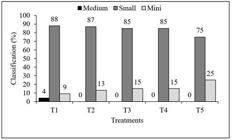
Physical classification of the bell pepper fruits, cv. Kolima F1, produced under fertilization sources. T1= 30% 1/2 topsoil + 1/2 bovine manure) and 70% soil; T2= 30% (traditional organic compost) and 70% soil; T3= 30% (organic compost/Bokashi) and 70% soil; T4= 30% (Biobokashi residues) and 70% soil; and T5= control, 100% soil and weekly fertigation. Sousa, IFPB, 2024.
Acidity is a result from the organic acids present in food, these can influence flavor, odor, color, stability, and quality maintenance of fruits (Santos et al., 2013). Given the above, these results show that the treatments applied have not affected organoleptic quality of fruits (SS and TA and Ratio).
The highest content of vitamin C occurred in treatments T5 (92.64 mg/100 g) and T1 (92.17 mg/100 g), not differing statistically from each other (Table 5). For Santana et al. (2004), the wide variation in vitamin C levels found in fruits is probably due to the effect of climatic conditions, soil nutrition, and the characteristics of the genotype itself. In this study, these results occurred due to the fact that the substrates of the treatments T1 and T5 showed lower N content. Some studies have shown the negative correlation between nitrogen fertilization and vitamin C content (Albornoz, 2016; Ochoa-Velasco et al., 2016), since high doses of nitrogen can reduce the concentration of ascorbic acid in fruits (Stefaniak et al., 2020).
Evaluating the results presented in this study, the authors concluded that the largest production of fruits was noticed in treatments based on organic matter and organic compost. The chemical fertilization and the treatment based on organic matter provided higher vitamin C content.
REFERENCES
- ALBORNOZ, F. 2016. Crop responses to nitrogen over fertilization: A review. Scientia Horticulturae 205: 79-83.
- AL-HARBI, AR; OBADI, A; AL-OMRAN, AM; ABDEL-RAZZAK, H. 2020. Sweet peppers yield and quality as affected by biochar and compost as soil amendments under partial root irrigation. Journal of the Saudi Society of Agricultural Sciences19: 452-460.
- ARANCON, NQ; EDWARDS, CA; BIERMAN, P; METZGER, JD; LUCHT, C. 2005. Effects of vermicomposts produced from cattle manure, food waste and paper waste on the growth and yield of peppers in the field. Pedobiologia 49: 297-306.
- BRASIL. 2020. Ministério da agricultura, pecuária e abastecimento. Instrução normativa n. 61. MAPA Brasília, DF: Ministério da agricultura, pecuária e abastecimento, 08 jul. 2020. Assunto: Estabelece as regras sobre fertilizantes orgânicos e biofertilizantes à agricultura.
-
BRASIL. 2021. Ministério da agricultura, pecuária e abastecimento. Secretaria de Defesa Agropecuária. Portaria n. 371, 2021. Diário Oficial da União: edição 145, seção 1, página 4. Available atAvailable athttps://www.in.gov.br/en/web/dou/-/portaria-n-371-de-30-de-julho-de-2021-335752425 Acesso em:06 jun. 2024.
» https://www.in.gov.br/en/web/dou/-/portaria-n-371-de-30-de-julho-de-2021-335752425 - DUBREUIL, V; FANTE, KP; PLANCHON, O; SANT’ANNA NETO, JL. 2018. Os tipos de climas anuais no Brasil: uma aplicação da classificação de Köppen de 1961 a 2015. Revista Franco-Brasileira de Geografia 37: 1-20.
- EMBRAPA. Empresa brasileira de pesquisa agropecuária. 2018. Sistema brasileiro de classificação de solos5. ed. Brasília, DF: Embrapa. 356p.
- FAJDETIĆ, NR; OSTOJIĆ, LB; ROBERT BENKOVIĆ, R; ZIMA, D; BLAŽINKOV, M; MIROSAVLJEVIĆ, K; POPOVIĆ, B; BENKOVIĆ-LAČIĆ, T. 2025. Effects of three organic fertilizers and biostimulants on the morphological traits and secondary metabolite content of lettuce. Horticulturae 11: 1288.
- FERREIRA, DF. 2019. Sisvar: a computer analysis system to fixed effects split plot type designs. Revista Brasileira de Biometria 37: 529-535.
- FIGUEIREDO, LL. Bokashis e biofertilizantes para produção orgânica de alimentos na agricultura familiar 2020. 62p. (M.Sc. thesis).
- HATA, FT; SPAGNUOLOB, FÁ; PAULA, MT; MOREIRA, AA; VENTURA, UM; FREGONEZIC, GAF; OLIVEIRA, ALM. 2020. Composto de bokashi e biofertilizante aumentam variáveis agronômicas da alface em cultivo protegido e indicam alterações microbiológicas do substrato. Jornal de Alimentação e Agricultura dos Emirados32: 640-646.
- HIJAMI, MF; ARIFIN, M; PUSPITOJATI, E. 2022. Potential analysis of organic fertilizer business development from beef cattle manure. Asian Journal of Applied Research for Community Development and Empowerment 6: 1-5.
- IAL, Instituto Adolfo Lutz. 1985. Normas analíticas do Instituto Adolfo Lutz v. 1, métodos químicos e físicos para análises de alimentos. 3a. ed. São Paulo: IMESP,. p.394-395.
- MANNA, DC; RAY, P. 2015. Determination of transplanting time of the capsicum seedlings for yield and profit maximization. International Journal of Bioresource Science2: 71-80.
- MONTANHA, YGA; NARIMATSU, KCP; SILVA, RLS; RECCO, CRSB; RODRIGUES, GB. 2022. Influência do composto orgânico bokashi no desenvolvimento da alface americana (Lactuca sativa L.). Revista Ibero-Americana de Humanidades, Ciências e Educação 8: 530-539.
- OCHOA-VELASCO, CH; VALADEZ-BLANCO, R; SALAS-CORONADO, R; SUSTAITA-RIVERA, F; HERNANDEZ-CARLOS, B; GARCIA-ORTEGA, S; SANTOS-SÁNCHES, NF. 2016. Effect of nitrogen fertilization and Bacillus licheniformis biofertilizer addition on the antioxidants compounds and antioxidant activity of greenhouse cultivated tomato fruits (Solanum lycopersicum L. var. sheva). Scientia Horticulturae201: 338-345.
- PAGAMAS, P; NAWATA, E. 2008. Sensitive stages of fruit and seed development of chili pepper (Capsicum annuum L. var. shishito) exposed to high-temperature stress. Scientia Horticulturae117: 21-25.
- PERSIANI, A; MONTEMURRO, F; DIACONO, M. 2021. Agronomic and environmental performances of on-farm compost production and application in an organic vegetable rotation. Agronomy 11: 1-18.
- RODRIGUES, TM; RIBEIRO, IS. 2023. Avaliação do crescimento do tomateiro sobre diferentes tipos de fertilizantes orgânicos. Revista Jornada Científica e Tecnológica15: 1-4.
- SANTANA, LRR; MATSUURA, FCAU; CARDOSO, RL. 2004. Genótipos melhorados de mamão (Carica papaya L.): avaliação sensorial e físico-química dos frutos. Ciência Tecnologia de Alimentos24: 217-222.
- SANTOS, MS; TELES, JS; SANTOS, RM; GERVASIO, APG. 2013. Determinação de ácidos orgânicos em sucos de frutas tropicais por Eletroforese Capilar de Zona. Scientia Plena9: 1-10.
- SEDIYAMA, MAN; SANTOS, MR; VIDIGAL, SM; PINTO, CLO; JACOB, LL. 2014. Nutrição e produtividade de plantas de pimentão colorido, adubadas com biofertilizante de suíno. Revista Brasileira de Engenharia Agrícola e Ambiental18: 588-594.
- SEDIYAMA, MAN; VIDIGAL, SM; SANTOS, MR; SALGADO, LT. 2009. Rendimento de pimentão em função da adubação orgânica e mineral. Horticultura Brasileira27: 294-299.
- SILVA, ACCP; ALMEIDA, KB; ARAGÃO, CA; FIGUEIREDO NETO, A; OLIVEIRA, FJV. 2020. Agronomic performance of chili hybrids in different types of substrate under protected cultivation. Research, Society and Development9: e7819119574.
- SILVA, PNL; LANNA, NBL; CARDOSO, AII. 2018. Doses de bokashi em cobertura na produção de beterraba. Revista de Agricultura Neotropical5: 28-34.
- SINI, HN; BARZEGAR, R; MASHAEE, SS; GHAHSARE, MG; MOUSAVI-FARD, S; MARYAM, M. 2024. Effects of biofertilizer on the production of bell pepper (Capsicum annuum L.) in greenhouse. Journal of Agriculture and Food Research16: 1-9.
- SIQUEIRA, APP; SIQUEIRA, MFB. 2013. Bokashi adubo orgânico fermentado Ed. Coordenadoria de difusão de tecnologia. (Manual Técnico n. 40).
- SOUSA, AM. 2022. Manejo da irrigação e da adubação nitrogenada para produção da cultura do pimentão Fortaleza: UFC. 110p. (Ph.D. thesis).
- STEFANIAK, J; PRZYBYL, JL; LATOCHA, P; LATA, B. 2020. Bioactive compounds, total antioxidant capacity and yield of kiwi berry fruit under different nitrogen regimes in field conditions. Journal of the Science of Food and Agricultutre 100: 3832-3840.
- SULOK, KMT; AHMED, OH; KHEW, CY; ZEHNDER, JAM; LAI, PS; JALLOH, MB; MUSAH, AA; AWANG, A; ABDU, A. 2021. Effects of organic amendments produced from agro-wastes on sandy soil properties and black pepper morpho-physiology and yield. Agronomy 11: 1-23.
- TRANI, PE; TIVELLI, SW; CARRIJO, OA. 2011. Fertirrigação em hortaliças 2. ed. Campinas: IAC. 51p. (Boletim Técnico IAC, 196).
-
Consent for publication
All authors allow to publish the manuscript
-
Data availability
Data will be made available upon request to the corresponding author.
-
Declaration of generative AI and AI-assisted technologies in the writing process
The authors state that they did not use artificial intelligence tools.
Data will be made available upon request to the corresponding author.