 Advances in tomato breeding for resistance to Meloidogyne enterolobii: an analysis of wild accessions and commercial rootstocks
ABSTRACT
Root-knot nematodes (RKNs, Meloidogyne spp.) represent the phytonematodes with the highest global economic impact. In tomato, various Meloidogyne species infect the crop, and the use of resistant cultivars is considered an important control strategy. However, M. enterolobii has recently been causing significant concern due to its aggressiveness, and resistance genes are ineffective in controlling this species. Therefore, the present study aimed to evaluate the resistance of various wild tomato accessions to M. javanica, M. enterolobii, M. incognita, and M. paranaensis nematode species. And commercial rootstocks were tested solely against M. enterolobii. To investigate the inheritance of resistance to this pathogen, selected genotypes were intercrossed in a diallel scheme and their progenies were phenotypically evaluated. For this purpose, eight wild tomato species (S. galapagense, S. pimpinellifolium, S. chmielewskii, S. chilense, S. peruvianum, S. habrochaites, S. neorickii, and S. pennellii) and 15 commercial rootstocks were evaluated. The S. peruvianum accession showed the lowest reproduction factor (RF) and nematodes per gram of root (NGR) values, indicating an important source of resistance, especially against M. enterolobii. The evaluated tomato rootstocks were susceptible to M. enterolobii, although some exhibited relatively low RF and NGR values, indicating a degree of tolerance. The diallel analysis revealed significant effects for general and specific combining abilities, indicating the importance of additive and non-additive effects in the inheritance of resistance. The rootstocks TD1, Embajador, and Shield stood out, being recommended for use in breeding programs aimed at developing rootstocks tolerant to M. enterolobii.
Keywords:
Solanum spp.; root-knot nematodes; genetic resistance
RESUMO
Os nematoides das galhas radiculares (RKNs, Meloidogyne spp.) representam os fitonematoides com maior impacto econômico global. No tomateiro, várias espécies de Meloidogyne infectam a cultura e o uso de cultivares resistentes é considerado uma importante estratégia de controle. No entanto, M. enterolobii tem causado recentemente preocupação significativa devido à sua agressividade, e os genes de resistência são ineficazes para controlar esta espécie. Portanto, o presente estudo teve como objetivo avaliar a resistência de diversos acessos de tomate selvagem aos nematoides M. javanica, M. enterolobii, M. incognita e M. paranaensis e porta-enxertos comerciais de tomate exclusivamente para M. enterolobii. Para investigar a resistência a esse patógeno, genótipos selecionados foram cruzados em um esquema dialélico e suas progênies foram avaliadas fenotipicamente. Para tanto, foram avaliadas oito espécies de tomate selvagem (S. galapagense, S. pimpinellifolium, S. chmielewskii, S. chilense, S. peruvianum, S. habrochaites, S. neorickii e S. pennellii) e 15 porta-enxertos comerciais. O acesso S. peruvianum apresentou os menores valores de fator de reprodução (FR) e nematoides por grama de raiz (NGR), indicando uma importante fonte de resistência, especialmente contra M. enterolobii. Os porta-enxertos de tomate avaliados foram suscetíveis ao M. enterolobii, embora alguns apresentaram valores relativamente baixos de FR e NGR, indicando um grau de tolerância. A análise dialélica revelou efeitos significativos para as habilidades de combinação geral e específica, indicando a importância dos efeitos aditivos e não aditivos na herança da resistência. Destacaram-se os porta-enxertos TD1, Embajador e Shield, sendo recomendados para uso em programas de melhoramento visando o desenvolvimento de porta-enxertos tolerantes a M. enterolobii.
Keywords:
Solanum spp.; nematoide das galhas; resistência genética
Root-knot nematodes (RKNs, Meloidogyne spp.) constitute the group of phytonematodes with the highest global economic impact, characterized by their wide host range and causing significant productivity losses in various agriculturally important crops (Rutter et al., 2022). RKNs are obligatory sedentary endoparasites that, upon penetrating the roots of their host, migrate to the vascular cylinder, where they initiate a series of changes in the root, resulting in gall formation and the establishment of specialized nutrition cells, known as "giant cells" (Przybylska & Obrępalska-Stęplowska, 2020). Such modifications in the root structure significantly compromise the plant's ability to absorb water and nutrients, decreasing crop growth and productivity. Moreover, the presence of these infections increases the plant's vulnerability to secondary pathogenic agents, resulting in a synergistic disease complex with other pathogenic microorganisms, including Fusarium oxysporum and Verticillium dahlia (Back et al., 2002; Karssen et al., 2013).
In tomato (Solanum lycopersicum L.), roots are commonly infected by different species of RKNs, among which M. javanica, M. incognita, M. arenaria, M. hapla, and the recently identified M. enterolobii stand out due to their significant impact on agricultural productivity (El-Sappah et al., 2019; Philbrick et al., 2020; Sikandar et al., 2023). In response to this challenge, adopting integrated management strategies, particularly genetic resistance, has proven to be essential to mitigate losses caused by RKNs in endemic areas (El-Sappah et al., 2019; Silva et al., 2019). The initial discovery of resistance in tomatoes to RKNs was documented by Bailey (1941) in the wild species Lycopersicon peruvianum L. PI 128657, where a singular dominant gene, Meloidogyne incognita-1 (Mi-1), located on chromosome 6, was identified. This gene exhibits protective activity against M. incognita, M. arenaria, and M. javanica, but does not offer resistance against M. hapla and M. enterolobii (Williamson & Kumar, 2006; Philbrick et al., 2020). Beyond Mi-1, new resistance genes/alleles to Meloidogyne species (Mi-2 to Mi-9, including Mi-HT) have been reported in accessions of S. peruvianum, which may confer resistance to M. hapla and be effective under high temperatures (El-Sappah et al., 2019). Despite this genetic diversity, Mi-1 remains the only resistance option available in the market, underlining the urgent need for research and development to expand resistance options (Pradhan et al., 2023).
For M. enterolobii, the Mi-1 gene is not effective in controlling this species, needing the search for new sources of resistance (El-Sappah et al., 2019; Philbrick et al., 2020). Gene banks contain vast untapped resources that may have applications in breeding programs. Thus, evaluating the genetic potential of Solanum germplasm (section Lycopersicon) for economically significant pathogens like Meloidogyne spp. can be considered an important strategy. Silva et al. (2019), assessing wild and commercial tomatoes, found three genotypes (S. lycopersicum ‘Yoshimatsu’ and ‘CNPH 1246’ and S. pimpinellifolium ‘CNPH 1195’) tolerant to M. enterolobii.
This study aims to evaluate the resistance of various wild tomato accessions to Meloidogyne javanica, M. enterolobii, M. incognita, and M. paranaensis nematode species and to evaluate tomato rootstocks exclusively to M. enterolobii, using diallel crosses involving the best-performing rootstocks to elucidate the genetic basis of resistance to this pathogen. From these findings, the study aims to establish the groundwork for developing a targeted breeding program that promotes the development of tomato cultivars tolerant to M. enterolobii.
MATERIAL AND METHODS
Plant material
For this study, different accessions of wild tomato species (Solanum galapagense, S. pimpinellifolium, S. chmielewskii, S. chilense, S. peruvianum, S. habrochaites, S. neorickii, and S. pennellii),and cultivars of S. lycopersicum L. (‘Micro-Tom’, ‘Trinidade’, ‘Sweet Heaven’, and ‘Santa Clara’) and tomato rootstocks from various commercial companies were evaluated (Table 1).The evaluation of wild species and cultivars, no susceptible control was included, as the aim was to assess the natural variability in resistance among them. In the rootstock trial, the susceptible cultivar ‘Santa Clara’ was used as a control to compare the effectiveness of the rootstocks in reducing nematode reproduction.
Evaluation for resistance to Meloidogyne spp.
To evaluate the resistance of tomato genotypes to Meloidogyne spp., two greenhouse trials were conducted in 2021 at the Rural Development Institute of Paraná (IDR-Paraná) and the State University of Londrina (UEL), both located in the municipality of Londrina, Paraná, Brazil. During the experimental period, the average temperature inside the greenhouses was 30°C. A completely randomized design with 12 replications was adopted for both trials. The first trial assessed the resistance of wild tomato species to four root-knot nematode species: M. javanica, M. incognita, M. enterolobii, and M. paranaensis. The second trial evaluated commercial tomato rootstocks for resistance exclusively to M. enterolobii.
The inocula of M. javanica, and M. enterolobii were originally obtained, respectively, from infected soybean and guava plants (Psidium guajava L.) in Londrina and Carlópolis. And M. incognita and M. paranaensis from coffee plants (Coffea sp.) in Altônia, all cities in the State of Paraná. Each population was purified from a single egg mass and subsequently multiplied on tomato plants (Santa Clara cultivar) in a greenhouse at IDR-Paraná.
For these experiments, the seeds of tomato accessions were sown in polystyrene trays containing Carolina Soil® substrate. Thirty days after sowing, the seedlings were transplanted into 945 mL polystyrene cups containing sand and soil (7:1) previously sterilized, and three grams of Osmocote® (15% N, 9% P2O5, 12% K2O, 1% Mg, 2.3% S, 0.05% Cu, 0.45% Fe, 0.06% Mn, 0.02% Mo).
Ten days after transplanting the seedlings, each plant was inoculated with 1 mL of an aqueous nematode suspension. The suspension concentration was 1,000 eggs and second-stage juveniles (J2) per mL for M. javanica, M. incognita, and M. paranaensis, and 500 eggs and J2 per mL for M. enterolobii. Both inoculum extraction and final nematode quantification followed Boneti & Ferraz (1981), using a Peter’s chamber under a light microscope. Forty-five days after inoculation, the roots of the plants were washed in running water, blotted dry with paper towels, and weighed on a semi-analytical balance. The roots were processed as described above. Finally, the number of nematodes per gram of root (NGR) and the nematode reproduction factor (RF = final population of nematodes/initial inoculated population) were determined.
Diallel crosses
Based on evaluating rootstocks for resistance to M. enterolobii, seven rootstocks were selected for crosses in a complete 7 x 7 diallel, without reciprocals. The seven rootstocks used were: Shield, BS PE 0041, TD1, Embajador, BASF-01, Woodstock, and Muralha. The crosses were carried out in a greenhouse at the UEL, in a diallel scheme with only the F1s, yielding 21 double hybrids. These hybrids were evaluated for resistance to M. enterolobii, as described above.
Data analysis
The data from wild tomatoes and rootstocks were subjected to the assumptions of variance analysis (normality of data, homogeneity of variances, and independence of errors). However, these assumptions were unmet and analyzed using non-parametric statistics. ANOVA-type statistics (ATS), which have an approximate F distribution under the null hypothesis based on asymptotic theory, were applied to the data. To discern differences across treatments, the Bonferroni correction was applied with a significance threshold set at p<0.05. Spearman correlation analysis and multivariate analysis (principal components and UPGMA hierarchical clustering analysis based on standardized Euclidean distance) were also performed to evaluate wild tomatoes. For the rootstock crosses, the data met the assumptions. They were analyzed based on variance analysis and Griffing's diallel analysis method to determine the general and specific combining ability (GCA and SCA, respectively) and their quadratic components. Griffing’s analysis (1956) adopted a fixed effects model. All analyses were performed with the help of the R program (https://www.r-project.org) using the nparLD, AgroR, pheatmap, corrplot and Diallel Analysis R packages.
RESULTS AND DISCUSSION
Using a nonparametric ANOVA-type statistical analysis, a significant effect (p<0.01) was observed for the sources of variation - treatments (T) and experiments x treatments (E x T) - on the reproduction factor (RF) and nematodes per gram of root (NGR) in all four assays (M. paranaensis, M. incognita, M. javanica and M. enterolobii) (Table 2). Concerning experiments (E), a significant effect on RF and NGR was detected in the assays involving M. paranaensis and M. javanica. The highest mean RF value was observed in the M. enterolobii assay (70.4 and 66.6% in experiments 1 and 2, respectively). Regarding NGR, values ranged from 2011.9 to 4751.9 nematodes/g of root in experiment 1 and 2124.9 to 2977.2 nematodes/g of root in experiment 2.
Among the wild tomato accessions evaluated, Solanum peruvianum exhibited the lowest values of NGR and RF, standing out as the most resistant genotype (Table 3). When challenged with Meloidogyne paranaensis, M. incognita, M. javanica, and M. enterolobii, this accession showed mean NGR values of 235.2, 77.65, 396.9, and 295.9, and corresponding RF values of 2.8, 1.85, 6.25, and 16.5, respectively.
Native to Peru and parts of Ecuador, S. peruvianum is known for its broad genetic variability and its potential as a source of resistance genes against various pathogens and pests affecting tomato cultivation. In the case of RKNs, multiple resistance genes, such as Mi-1, Mi-2, Mi-3, Mi-4, Mi-5, Mi-6, Mi-7, and Mi-8, have been identified in accessions of this species, conferring varying levels of resistance (Pradhan et al., 2023; Shilpa et al., 2022). Nevertheless, the RF values above 1 observed for M. javanica and M. incognita suggest a partial breakdown of resistance, which may be associated with factors such as high pathogen population density or adverse environmental conditions. Specifically, soil temperatures above 28°C have been shown to reduce the effectiveness of Mi-mediated resistance, underscoring the importance of considering environmental variables when selecting and deploying resistant genotypes in breeding programs (Williamson, 1998).
For M. enterolobii, the S. chilense accession also stood out, showing no statistically significant difference from S. peruvianumin terms of NGR, suggesting its potential as a source of resistance to this nematode species. These findings are consistent with those of Silva et al. (2019), who reported that the S. chilense accession 'LA 1963' exhibited significantly lower reproductive indices and gall formation compared to the susceptible control. Together, these results highlight S. chilense as a promising genetic resource for breeding programs focused on developing resistance to M. enterolobii. The other wild tomato accessions (S. galapagense, S. pimpinellifolium, S. chmielewskii, S. habrochaites, S. neorickii, and S. pennellii) were susceptible to all four nematode species evaluated.
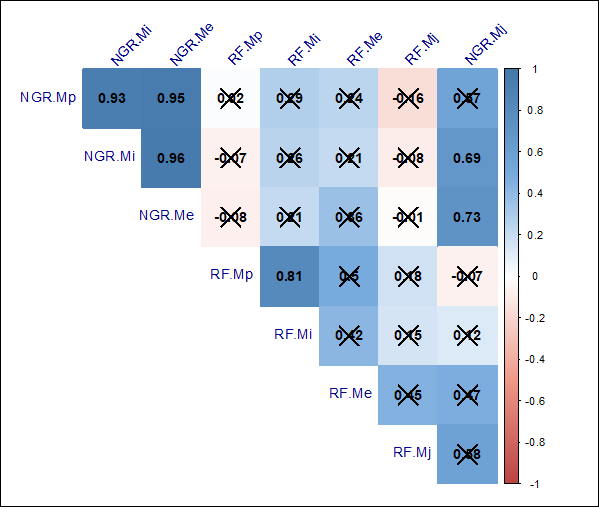
By Spearman’s correlation analysis (Figure 1), a strong positive correlation was found among Meloidogyne species for NGR, except in the M. javanica x M. paranaensis assay, indicating a similarity in the response of wild accessions to different Meloidogyne species in terms of resistance. For RF, a positive correlation was observed only between M. paranaensis and M. incognita. No correlation was detected between NGR and RF in the assays evaluated.
ANOVA-type statistic and means for evaluating different tomato genotypes (commercial and wild) for control of Meloidogyne paranaensis, M. incognita, M. javanica, and M. enterolobii in a greenhouse. Londrina, UEL, 2025.
By principal component analysis (PCA), the first two components explained 73.6% of the variation (PCA1 and PCA2 with 46.8% and 26.8%, respectively), and the formation of three groups was observed (Figure 2A). Groups I and II comprised the Micro-Tom accessions (with higher NGR values) and S. peruvianum (with lower NGR and RF values), respectively. Group III included the other accessions with intermediate to high values for NGR and RF. The UPGMA hierarchical clustering analysis also identified the formation of three groups, validating the results obtained from the PCA (Figure 2B).
Using the non-parametric ANOVA-type statistic, a significant effect (p<0.01) was observed for all sources of variation in both experiments (Table 4). In experiment 1, the average values for reproduction factor (RF) and number of galls per root system (NGR) were 27.81 and 802.84, respectively, whereas in experiment 2, these averages increased to 50.10 and 1,525.53, respectively, indicating a higher level of nematode pressure in the second assay. All evaluated rootstocks were susceptible to Meloidogyne enterolobii, although differences in the degree of susceptibility were observed.

Spearman correlation analysis of the reproduction factor (RF) and nematodes per gram of root (NGR) evaluated in different tomato genotypes (commercial and wild) for the control of Meloidogyne paranaensis, M. incognita, M. javanica, and M. enterolobii in greenhouse. Londrina, UEL, 2025.
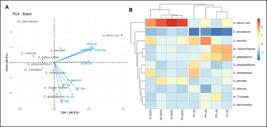
Principal component analysis (A) and hierarchical clustering UPGMA based on Euclidean distance (B) of the reproduction factor and nematodes per gram of root evaluated in different tomato genotypes (commercial and wild) for the control of Meloidogyne paranaensis, M. incognita, M. javanica, and M. enterolobii in greenhouse. Londrina, UEL, 2025.
In experiment 1, the lowest NGR values were recorded for the cultivars Embajador, TD1, BASF-02, Volt, and Muralha, which showed mean RF values of 6.44, 7.83, 11.41, 20.67, and 12.77, respectively (Table 5). Similarly, in experiment 2, the cultivars TD1, Embajador, BASF-02, Green Rise, and Green Power exhibited the lowest NGR values, with corresponding RF values of 24.24, 19.41, 35.23, 23.15, and 23.59, respectively. Despite the overall susceptibility, these results suggest the existence of variability in the response to M. enterolobii among the tested rootstocks, which can be explored in breeding programs.
Given these findings, breeding efforts should prioritize the identification of new resistance sources, and the development of strategies aimed at enhancing tolerance to M. enterolobii. Tolerant plants are capable of maintaining productivity even under high infestation levels, exhibiting minimal or no yield losses (Philbrick et al., 2020). In this context, understanding the inheritance of resistance and its underlying genetic effects is essential for guiding selection strategies. Additive effects, which can be accumulated through successive self-pollinations, favor direct selection of tolerant genotypes. Conversely, non-additive effects-such as dominance and epistasis-are fundamental for exploiting heterosis in hybrid combinations (Lv et al., 2012; Onofri et al., 2021). Based on the tolerance levels observed in both experiments, seven rootstocks were selected for subsequent diallel analysis and classified into three tolerance groups: (i) high tolerance - TD1 and Embajador; (ii) intermediate tolerance - Shield and Muralha; and (iii) low tolerance - BASF-01, BS PE 0041, and Woodstock. This classification will serve as the foundation for further genetic analyses aiming to dissect the inheritance of tolerance traits and guide the development of more resilient tomato rootstocks.
By analysis of variance, a significant effect was observed for treatments and general and specific combining abilities (GCA and SCA, respectively) concerning NGR, indicating that both additive and non-additive effects influence this trait (Table 6). Based on the quadratic components, non-additive effects predominated over additive effects, with a ratio of 0.1640. This is the first report in the literature to address the inheritance of resistance to M. enterolobii in tomato crops. In cotton, Lv et al. (2012) found dominance effects played a more important role in resistance to M. incognita. Conversely, Williams & Windham (1990) noted that additive effects were more significant for corn resistance to M. arenaria and M. javanica.
Based on the gi values, the cultivars TD1, Embajador, and Shield exhibited the lowest negative GCA values, indicating that these genotypes play an important role in providing genes related to the reduction of NGR (Figure 3). Thus, they can be incorporated into breeding programs, such as recurrent selection, to increase the frequency of alleles favorable to M. enterolobii resistance.
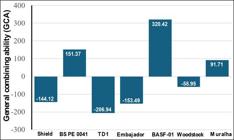
Estimate of the general combining ability for seven tomato rootstocks related to nematodes per gram of roots inoculated with Meloidogyne enterolobii. Londrina, UEL, 2025.
About the sij values, the crosses Embajador × BASF-01, Shield × BASF-01, and BS PE 0041 × Muralha exhibited the most negative values, indicating promising specific combining abilities for traits associated with tolerance to Meloidogyne enterolobii (Figure 4). Advancing breeding programs aimed at improving tolerance and/or resistance to M. enterolobii is crucial given the nematode’s high aggressiveness, wide geographic distribution, and proven ability to overcome resistance genes commonly deployed in commercial tomato cultivars.

Estimate of the specific combining ability for seven tomato rootstocks related to nematodes per gram of roots inoculated with Meloidogyne enterolobii. Londrina, UEL, 2025.
The study investigated the resistance of wild tomato accessions and tomato rootstocks to different species of nematodes, focusing on Meloidogyne enterolobii to elucidate the genetic basis of resistance to this pathogen. The results indicated a significant variation in resistance among the wild tomato accessions to Meloidogyne species. The S. peruvianum accession showed the lowest RF and NGR values, indicating a potential source of resistance, especially against M. enterolobii. The evaluated tomato rootstocks were susceptible to M. enterolobii, although some exhibited relatively low RF and NGR values, indicating a degree of tolerance. The diallel analysis revealed significant effects for the general and specific combining abilities, indicating the importance of additive and non-additive effects in the inheritance of resistance to M. enterolobii. The results highlighted the importance of the genotypes TD1, Embajador, and Shield, based on the GCA values, for reducing the number of NGRs.
Acknowledgments
We thank the Brazilian Federation Agency for Support and Evaluation of Graduate Education (CAPES) by scholarship awarded to the first author, to State University of Londrina and Rural Development Institute of Paraná (IDR-Paraná) for the support.
The authors thank Dr. Juliano Tadeu Vilela de Resende for providing seeds of wild tomato species.
REFERENCES
-
BACK, MA; HAYDOCK, PPJ; JENKINSON, P. 2002. Disease complexes involving plant parasitic nematodes and soilborne pathogens. Plant Pathology 51: 683-697. https://doi.org/10.1046/j.1365-3059.2002.00785.x.
» https://doi.org/10.1046/j.1365-3059.2002.00785.x - BAILEY, DM. 1941. The seedling test method for root-knot-nematode resistance. Proceedings of the American Society for Horticultural Science 38: 573-575.
- BONETI, JIS; FERRAZ, S. 1981. Modificação no método de Hussey & Barker para extração de ovos de Meloidogyne exigua em raízes de cafeeiro. Fitopatologia Brasileira 6: 1-1.
-
EL-SAPPAH, AH; ISLAM, MM; EL-AWADY, HH; YAN, S; QI, S; LIU, J; CHENG, GT; LIANG, Y. 2019. Tomato natural resistance genes in controlling the root-knot nematode. Genes (Basel) 10: 925. https://doi.org/10.3390/genes10110925.
» https://doi.org/10.3390/genes10110925 - GRIFFING, B. 1956. Concept of general and specific combining ability in relation to diallel crossing systems. Australian Journal of Biological Sciences 9: 463-493.
-
KARSSEN, G; WESEMAEL, W; MOENS, M. 2013. Root-knot nematodes. In Plant nematology, UK: CABI, pp. 73-108. https://doi.org/10.1079/9781780641515.0073.
» https://doi.org/10.1079/9781780641515.0073 -
LV, AZHI; ZHANG, H; ZHANG, Z XIN. 2012. Conversion of the statistical combining ability into a genetic concept. Journal of Integrative Agriculture, 11: 43-52. Chinese Academy of Agricultural Sciences http://dx.doi.org/10.1016/S1671-2927(12)60781-0.
» https://doi.org/10.1016/S1671-2927(12)60781-0 -
ONOFRI, A; TERZAROLI, N; RUSSI, L. 2021. Linear models for diallel crosses: a review with R functions. Theoretical and Applied Genetics, 134: 585-601. Springer Berlin Heidelberg. https://doi.org/10.1007/s00122-020-03716-8.
» https://doi.org/10.1007/s00122-020-03716-8 -
PHILBRICK, AN; ADHIKARI, TB; LOUWS, FJ; GORNY, AM. 2020. Meloidogyne enterolobii, a major threat to tomato production: Current status and future prospects for its management. Frontiers in Plant Science 11. https://doi.org/10.3389/fpls.2020.606395.
» https://doi.org/10.3389/fpls.2020.606395 -
PRADHAN, P; NARESH, P, BARIK, S; ACHARYA, GC; BASTIA, R; ADAMALA, AK; DAS, MP. 2023. Breeding for root-knot nematode resistance in fruiting Solanaceous vegetable crops: a review. Euphytica 219: 71. https://doi.org/10.1007/s10681-023-03204-2.
» https://doi.org/10.1007/s10681-023-03204-2 -
PRZYBYLSKA, A; OBRĘPALSKA-STĘPLOWSKA, A. 2020. Plant defense responses in monocotyledonous and dicotyledonous host plants during root-knot nematode infection. Plant and Soil 451: 239-260. https://doi.org/10.1007/s11104-020-04533-0.
» https://doi.org/10.1007/s11104-020-04533-0 -
RUTTER, WB; FRANCO, J; GLEASON, C. 2022. Rooting out the mechanisms of root-knot nematode-plant interactions. Annual Review of Phytopathology 60: 43-76. https://doi.org/10.1146/annurev-phyto-021621-120943.
» https://doi.org/10.1146/annurev-phyto-021621-120943 -
SHILPA, PS; THAKUR, V; SHARMA, A; RANA, RS; KUMAR, P. 2022. A status-quo review on management of root knot nematode in tomato. The Journal of Horticultural Science and Biotechnology 97: 403-416. https://doi.org/10.1080/14620316.2022.2034531
» https://doi.org/10.1080/14620316.2022.2034531 -
SIKANDAR, A; JIA, L; WU, H; YANG, S. 2023. Meloidogyne enterolobii risk to agriculture, its present status and future prospective for management. Frontiers in Plant Sciences 13. https://doi.org/10.3389/fpls.2022.1093657.
» https://doi.org/10.3389/fpls.2022.1093657 -
SILVA, AJ; OLIVEIRA, GH; PASTORIZA, RJG; MARANHÃO, EHA; PEDROSA, EMR; MARANHÃO, SRVL; BOITEUX, LS; PINHEIRO, JB; CARVALHO FILHO, JLS. 2019. Search for sources of resistance to Meloidogyne enterolobii in commercial and wild tomatoes. Horticultura Brasileira 37: 188-198. https://doi.org/10.1590/s0102-053620190209.
» https://doi.org/10.1590/s0102-053620190209 - WILLIAMS, WP; WINDHAM, GL. 1990. Resistance of maize to Meloidogyne arenaria and Meloidogyne javanica Theoretical and Applied Genetics 80: 810-812.
-
WILLIAMSON, V; KUMAR, A. 2006. Nematode resistance in plants: the battle underground. Trends in Genetics 22: 396-403. https://doi.org/10.1016/j.tig.2006.05.003
» https://doi.org/10.1016/j.tig.2006.05.003 - WILLIAMSON, VM. 1998. Root-knot nematode resistance genes in tomato and their potential for future use. Annual Review of Phytopathology 36: 277-293.
-
Consent for publication:
All authors consent to the publication of the manuscript in Horticultura Brasileira.
-
Data availability:
Data will be made available upon request to the corresponding author.
-
Declaration of generative AI and AI-assisted technologies in the writing process:
The authors declare that no generative AI or AI-assisted technologies were used in the writing process.
Data will be made available upon request to the corresponding author.