 Yield and spilanthol content in jambu varieties (Acmella spp.) biostimulated with Trichoderma strains
ABSTRACT
Jambu is a leafy vegetable with enormous versatility, showing potential for fresh food and industrial exploitation due to the biosynthesis of spilanthol. The aim was to evaluate the biostimulant potential of Trichoderma spp. in promoting growth, yield, and spilanthol content in varieties of jambu. For that purpose, we conducted an experiment divided into two trials. We used a randomized block design arranged in a 3×4+3 factorial scheme, with four replications, in which the treatments consisted of the combination of jambu varieties (first factor) and biostimulants (second factor), plus three additional treatments (without inoculation). Plant height, stem diameter, and number of leaves were assessed at the seedling stage. In the field, flowering, leaf gas exchange, vegetative development, biomass production, and spilanthol content were assessed. Jamb03-MIX seedlings showed higher plant height and stem diameter. The leaf gas exchange showed the highest values in Jamb-16 with and without biostimulant. Jamb17-MIX presented earlier flowering. The growth and yield of the shoot were superior for Jamb16-IBLF006 and Jamb16-MIX, influencing the grouping. Principal component analysis separated Jamb-03 based on inflorescence yield and internal CO2 concentration. Jamb03-MIX had higher inflorescence production than the other varieties biostimulated with MIX. The content of spilanthol in the inflorescences of Jamb17-MIX (39.24 mg/g DM) was influenced by biostimulation when compared to Jamb17-Ad (31.64 mg/g DM). However, the compound did not respond in Jamb-03 and Jamb-16. Therefore, the inoculation of Trichoderma spp. in jambu promotes the development of more vigorous seedlings, early flowering, and biomass accumulation and modulates the biosynthesis of spilanthol, but the specificity of the Trichoderma variety interaction conditioned the results.
Keywords:
Acmella oleracea; Acmella ciliata; toothache plant; cultivation system; Amazon
RESUMO
O jambu é uma hortaliça folhosa com enorme versatilidade, exibindo potencial para alimentação in natura e exploração industrial, em razão da biossíntese de espilantol. Assim, objetivamos avaliar o potencial bioestimulante de Trichoderma spp. na promoção de crescimento, produtividade e teor de espilantol em variedades locais de jambu. Para isso, foi realizado experimento dividido em dois ensaios. Adotamos delineamento em blocos ao acaso, em esquema fatorial 3x4+3, com quatro repetições, sendo os tratamentos compostos pela combinação das variedades de jambu (primeiro fator) e os bioestimulantes (segundo fator), com três tratamentos adicionais (sem inoculação). Na fase de muda avaliamos altura de planta, diâmetro do coleto e número de folhas. Em campo foi avaliado florescimento, trocas gasosas foliares, desenvolvimento vegetativo, produção de biomassa e teor de espilantol. Jamb03-MIX apresentou melhores respostas para altura e diâmetro do coleto. As trocas gasosas foliares foram superiores em Jamb-16 com e sem bioestimulação. Houve precocidade de florescimento para Jamb17-MIX. O crescimento e a produtividade da parte aérea foram superiores para Jamb16-IBLF006 e Jamb16-MIX, influenciando no agrupamento. A análise de componentes principais separou Jamb-03 com base na produtividade de inflorescências e concentração interna de CO2. Jamb03-MIX teve produção de inflorescências superior às demais variedades bioestimuladas com MIX. O teor de espilantol nas inflorescências de Jamb17-MIX (39,24 mg/g MS) foi influenciado pela bioestimulação quando comparado a Jamb17-Ad (31,64 mg/g MS). Entretanto, o composto não respondeu em Jamb-03 e Jamb-16. Logo, a inoculação de Trichoderma spp. em jambu promove o desenvolvimento de mudas mais vigorosas, precocidade no florescimento, acúmulo de biomassa e modula a biossíntese de espilantol, porém os resultados são condicionados pela especificidade da interação Trichoderma-variedade.
Palavras-chave:
Acmella oleracea; Acmella ciliata; planta da dor de dente; sistema de cultivo; Amazônia.
Acmella Rich. is a pantropical genus from the Asteraceae family, comprising more than 30 species distributed on different continents (Jansen, 1985; Silva & Santos, 2011). Seventeen species of the genus Acmella have been described in Brazil, seven of which can be found in the Amazon: A. oleracea (L.) R. K. Jansen, A. brachyglossa Cass., A. ciliata (Kunth) Cass. and A. kalelli M.M. Campos, C.F. Hall & J.U.M. Santos, popularly known as jambu, in Portuguese (BFG 2015; Campos et al., 2019).
Jambu is a leafy vegetable widely studied due to its various secondary metabolites, including spilanthol (Sut et al., 2020). The biosynthesis of spilanthol occurs in all organs of the jambu plant, however, the partitioning of this compound differs according to the organ, with the inflorescences being responsible for the highest concentrations (Bellumori et al., 2022; Sharma et al., 2022).
In the current model of agricultural production, different types of cultivation are used to increase the yield performance of crops by modulating plant responses by modifying the environment, generating effects even on the routes that make up secondary metabolism, given that plants respond to biotic and abiotic effects (Dedino et al., 2022). For jambu, research using plant and microbiological biostimulants has shown an increase in mass yield, phenolic compounds, and alkylamides (Sut et al., 2020; Vieira et al., 2021). However, associations of Trichoderma spp. as a biostimulant in jambu cultivation are still unknown in the literature.
The use of Trichoderma spp. in jambu cultivation is presented as a management strategy since promising results related to growth, yield, and secondary metabolism have been observed in vegetables such as tomato and Chinese cabbage (Pereira et al., 2019; Ji et al., 2020). It is worth noting that these results depend on the type of biostimulant, the form and place of application, and the genotype or variety used, as genetic variability can promote different effects (Bucio et al., 2015).
Thus, based on the effects of using Trichoderma spp. in agriculture, it is important to investigate whether managing the growing environment with strains of this fungal genus induces growth and increases in spilanthol content, considering the genetic variability in Acmella spp. Therefore, the present study aimed: (i) to evaluate the growth promotion and yield of biostimulated local jambu varieties and (ii) to verify modulations in the spilanthol content in jambu organs following biostimulation with Trichoderma spp.
MATERIAL AND METHODS
Experimental location
The experiment was conducted in Igarapé-Açu, Pará (01°07'48.47''S, 47°36'45.31''W, and 54 meters altitude). The climate in the region, according to the Köppen-Geiger’s classification, is Am-type, characterized as humid megathermic, with annual averages of temperature, relative air humidity, and rainfall of 26°C, 85%, and 2500 mm, respectively (Alvares et al., 2013).
The research was conducted in a protected environment, using a two-sided arch type greenhouse, 32 m long, 16 m high, with a ceiling height of 4.0 m, covered with a 150-micron transparent plastic film. The soil in the area is classified as Latossolo Amarelo (Embrapa, 2018), corresponding to Ferralsols (yellow soil) in the international classification (FAO, 2015). During the experiment, the temperature and humidity values inside the greenhouse were recorded using a portable digital thermos-hygrometer (model HTC 2, with probe) installed 1.2 m above the ground.
Experimental design
A randomized block design (RBD) was adopted in a 3x4+3 factorial scheme with four replications. The first factor consisted of three local varieties of Acmella spp. (Jamb-03, Jamb-16 and Jamb-17), and the second factor was the inoculation of four products based on Trichoderma spp., three of which were commercial strains whose active ingredient was the species Trichoderma harzianum (strain IBLF 006 [1.0 x 10¹⁰ CFU/g]), T. asperellum (strains CBMAI 1622 [1.4 x 10⁹ conidia/g], and IBLF 1236 [2.0 x 10⁸ CFU/g]); and a pool of T. asperellum composed of strains native to the Amazon (MIX [1.0 x 10⁸ conidia/mL]), with molecular identification and biochemical activity described by Sousa et al. (2021).
In addition, three additional treatments were added, corresponding to the non-biostimulated cultivation of the jambu varieties (without Trichoderma spp.). There were 60 experimental plots of 20 plants each, with six central plants considered the useful area.
The local varieties of jambu used were obtained from the Acmella spp. collection of the Amazonian Olericulture Study Group (GEOA) at the Campus of Capanema: Jamb-03 (A. oleracea), Jamb-16 (A. ciliata), and Jamb-17 (A. oleracea), all identified at the Museu Paraense Emílio Goeldi, and listed under the registration codes MG249017 (Jamb-03), MG249043 (Jamb-16), and MG249042 (Jamb-17).
In November 2023, seedlings were grown in expanded polystyrene trays with 200 cells, filled with commercial substrate (Carolina Soil®), with three seeds sown per cell. After sowing, the trays were kept in a greenhouse and irrigated twice daily manually, in the morning (9 a.m.) and afternoon (4 p.m.). Once the seedlings had emerged, thinning was conducted, leaving just one seedling per cell.
The first inoculation with Trichoderma spp. was conducted 17 days after sowing (DAS). For the commercial strains (IBLF 006, CBMAI 1622, and IBLF 1236), the suspensions were prepared according to the manufacturer's recommendations, while for MIX the suspension was obtained by washing colonies multiplied on rice. We inoculated 400 mL of suspension per tray, except for the additional treatments. At 25 DAS (December, 2023), when the seedlings had two pairs of definitive leaves, they were transplanted into the field.
Description of the cultivation system
Before transplanting, the soil physical and chemical properties in the 0-20 cm layer were as follows: pH (H2O) = 6.1; organic matter (O.M.) = 1.7%; phosphorus (P res) = 27.0 mg/dm3; potassium (K+) = 13.0 mg/dm3; magnesium (Mg2+) = 0.9 cmolc/dm3; calcium (Ca2+) = 2.2 cmolc/dm3; H+Al = 2.0 cmolc/dm3; copper (Cu) = 0.8 mg/dm3; iron (Fe) = 158 mg/dm3; manganese (Mn) = 3.8 mg/dm3; Zinc (Zn) = 4.7 mg/dm3; sum of bases (SB) = 3.20 cmolc/dm3; cation exchange capacity (CEC) = 5.20 cmolc/dm3; base saturation (V) = 61.5%, clay = 152 g/kg; silt = 26 g/kg; total sand = 822 g/kg; medium texture.
Transplanting occurred in beds measuring 1 m2 and 0.20 m high, spaced 1 m apart and covered with straw. The plots were spaced 0.20 x 0.20 m apart. Fertilization was conducted according to the recommendations of Brasil et al. (2020) for leafy vegetables in the state of Pará, based on the chemical analysis of the soil.
During the experiment, soil temperature and humidity parameters were monitored in the plots in the morning (9 a.m.) and afternoon (4 p.m.) using a digital sensor (PHD 3000) inserted into the growing soil at 15 cm depth to verify the appropriate conditions for the growth of Trichoderma spp. colonies in the system. A micro-sprinkler irrigation system was installed, with micro-sprinklers spaced at 2.5 m intervals along the hoses, each providing a flow rate of 82 L/h and covering a radius of three meters to irrigate the plants. The irrigation system operated twice a day.
Four days before transplanting, a second inoculation was conducted, applying the Trichoderma spp. products directly to the growing soil to promote greater establishment of the fungal population (Bucio et al., 2015). The inoculated dosages followed the manufacturer’s recommendations. The fungal suspensions were administered using a calibrated backpack sprayer, inoculating 500 mL/m2.
Leaf gas exchange
Gas exchange analyses were conducted 20 days after the transplant (DAT), before the appearance of inflorescences, to assess the physiological behavior of the jambu plants, using an Infrared Gas Analyzer (IRGA, model LCpro T, ADC BioScientific). Readings were taken in the morning (8 a.m. to 12 p.m.) under saturating light, with a photosynthetic photon flux density of 1000 µmol/m2/s and ambient CO2 conditions. The readings were taken on the second pair of fully expanded leaves from the apex, on two plants per plot, with two readings per leaf, according to the methodology adapted from Silva et al. (2015).
The following characteristics were obtained from the gas exchange analysis: a) net CO2 assimilation (A), b) transpiration (E), c) stomatal conductance (gs), d) internal CO2 concentration (Ci), and e) water use efficiency (WUE), calculated from the A/E ratio.
Growth and yield assessments
One day before transplanting, the biostimulated and non-biostimulated treatments were evaluated to assess seedling vegetative development. 20 plants per treatment were assessed, measuring plant height (HP) with a graduated ruler in centimeters, stem diameter (SD) in millimeters using a digital caliper, and number of leaves (NL) by counting fully developed leaves.
Seven days after transplanting, plants with flower buds were checked and evaluated about days to flowering (DF). Plots that presented 50% of the plants plus one with flower buds were considered to have flowered, corresponding to 11 plants.
At the end of the growing season (35 DAT), three plants were harvested from the useful area to evaluate the characteristics related to vegetative development and yield. The flowering pattern was adopted as the harvesting parameter, and the experimental plots where 50% of the plants had fully opened floral chapters were suitable, and the following characteristics were assessed:
-
) main branch length (MBL): measured from the neck to the apex of the main branch, using a tape measure, in cm;
-
) main branch diameter (MBD): measured at the base of the main branch using a digital caliper, expressed in mm;
-
) number of secondary branches (NSB): obtained by counting the total number of secondary branches/plant;
-
) number of leaves (NL): determined by counting all the leaves on the plant, considering those that are fully developed;
-
) shoot fresh mass (SFM): obtained by weighing the shoot (stems and leaves) on a semi analytical digital scale and expressed in grams;
-
) shoot dry mass (SDM): conducted by drying the shoot in a forced circulation oven at 65°C for 48 h and then weighing it on a semi analytical digital scale, expressed in grams;
-
) shoot fresh mass yield (SFMY): obtained from the quantity of fresh mass produced per plant, according to the number of plants per square meter, expressed in kg/m2;
-
) shoot dry mass yield (SDMY): obtained from the amount of dry mass produced per plant, according to the number of plants per square meter, expressed in kg/m2;
-
) inflorescence fresh mass yield (IFMY): determined based on the total fresh mass of inflorescences produced per plant according to the number of plants per quare meter, with values expressed in g/m2;
-
) inflorescence dry mass yield (IDMY): determined based on the dry mass of inflorescences produced per plant according to the number of plants per square meter, with values expressed in g/m2.
Extraction and quantification of spilanthol
To assess the spilanthol content, the shoot (leaves + stem) and the inflorescences were washed with running water, distilled water, and frozen at -22°C. The samples were then freeze-dried and processed in a Willey-type knife mill equipped with a 10 mesh sieve, allowing the fine powder to be formed. After grinding, 0.1 g aliquots of the samples were extracted in glass tubes containing 1.9 mL of 99.5% ethanol (1:9 m/v) as a solvent, homogenized in a vortex for 30 seconds at 2.800 rpm, and heated in a water bath for 1 hour at 50°C, according to the methodology adapted from Bae et al. (2010).
After extraction, the chlorophyll was removed by exhaustive extraction, using a ratio of 1:9 v/v, with a 0.16 M NaCl solution (100 µL of extract and 900 µL of NaCl), under constant homogenization for 30 seconds at 2.800 rpm and subsequent centrifugation (14.000 rpm, 20 min at 25°C). The supernatant extracts obtained were saturated with N2 (g) and stored at -22°C until spilanthol quantification (Sampaio et al., 2022).
Spilanthol was quantified using a UPLC system (Ultra Performance Liquid Chromatography, Thermo Scientific, Ultimate 3.000). To do this, the extracts were diluted in methanol and ultrapure water (1:9 v/v), filtered through a 0.22 μm syringe filter (PVDF), and then 5 μL was injected into a Kinetex EVO C18 100 Å, 1.7 μm 100 × 2.1 mm column (Phenomenex, Torrance, CA, USA).
The phase was composed of ultrapure water (Solvent A) and acetonitrile (Solvent B), both filtered through a 0.22 μm membrane (nylon). Elution was performed in isocratic mode, with constant 30% solvent B for 30 min at 25°C. Chromatograms were obtained based on the retention time of spilanthol and the absorbance range (229 nm).
A stock solution of isolated spilanthol at 1 mg/mL was prepared as described by Sampaio et al. (2024). The chromatographic purity of the isolated spilanthol was determined by analyzing the normalized areas of the peaks and subtracting the peaks present in the analytical blank after injection into a UHPLC chromatograph, analyzing the absorption spectrum on a diode array detector (DAD). An analytical calibration curve with six concentration points was constructed from dilutions of the stock solution, and the limit of detection (LDV) and limit of quantification (LQV) were used to quantify the compost in all extracts from shoot and inflorescence.
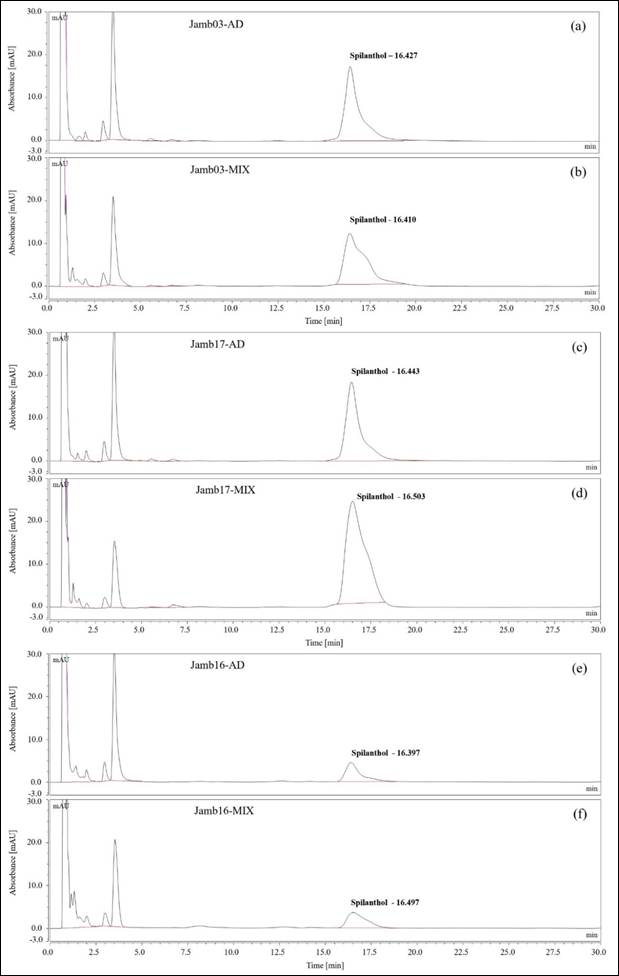
Based on the inoculation responses at the seedling stage, growth, and biomass production for each variety, we selected the extraction results for the inflorescences of the three varieties biostimulated with MIX to compare the effects on the spilanthol content. The chromatographic profile shows the detection of spilanthol in the samples, confirmed by the calibration curve of the standard solution.
Statistical analysis
The data were subjected to the identification of outliers (boxplot and identify outliers) and verification of normality of residuals (Shapiro Wilk and qqplot) and homogeneity of variances (Bartlett test). We conducted a multivariate analysis of variance (MANOVA) for the sets of response variables, and the mean vectors were compared using the Wilks test at a 5% significance level. In addition, multivariate contrasts were assessed using the ‘biotools’ package and the ‘mvpaircomp’ function (Silva, 2021).
In the cluster analysis, we submitted the dissimilarity matrix to the UPGMA method (Unweighted Pair Group Method Using an Arithmetic Average) using the Multivariate Analysis package (Azevedo, 2024). The consistency of the grouping was checked by the cophenetic correlation coefficient (Sokal & Rohlf, 1962). For the principal component analysis (PCA), the variables were standardized on the same scale using the scale function. The PCA analysis was conducted using the factoextra package (Kassambara & Mundt, 2020) and represented as a biplot graph. All the data obtained were processed and statistically analyzed using the R programming language, version 4.3.3 (R Core Team, 2024).
RESULTS
Climate monitoring
The temperature reached values between 22.5°C and 34°C, with relative humidity ranging from 35% to 92% in the morning, with fluctuations in the afternoon in the range of 24°C to 34°C and relative humidity between 31% and 68%. The results from the soil microclimate monitoring showed adequate humidity for the production cycle, ranging from 40% to 80% over the days evaluated, reaching values above 80% in the afternoon. The temperature ranged between 28°C and 29°C in the morning and 29°C to 31°C in the afternoon.
Trial I. Vegetative development in the seedling stage
MANOVA showed significant differences (p<0.05) for all the main effects evaluated (varieties and biostimulants) and for the interaction effects for the initial performance in vegetative development in the seedling stage after inoculation. These significant results show that at least one of the mean vectors differed. In addition to the MANOVA, the multivariate contrasts showed differences for a significant number of pairs when evaluating varieties within each biostimulant for all the variables analyzed simultaneously.
The contrasts ‘Jamb03-MIX versus Jamb03-IBLF006’, ‘Jamb03-MIX versus Jamb03-CBMAI1622’ and ‘Jamb03-MIX versus Jamb03-AD’ showed significant results (p<0.05), with one of the pairs always being the Jamb03-MIX treatment. Therefore, the significance of the contrasts is due to the higher HP, NL, and SD values in Jamb03-MIX (Table 1).
The results showed that Jamb-17 seedlings biostimulated with CBMAI 1622 or MIX showed significant contrasts with Jamb17-IBLF 006 due to the reduced growth in this treatment. In addition, the contrast between Jamb17-MIX and Jamb17-AD was significant, as shown by the difference in growth parameters, which were higher in Jamb17-MIX. For the contrasts ‘Jamb16-IBLF 1236 versus Jamb16-IBLF 006’ and ‘Jamb16-IBLF 1236 versus Jamb16-MIX’, the results were significant due to the lower HP values in Jamb16-IBLF 1236.
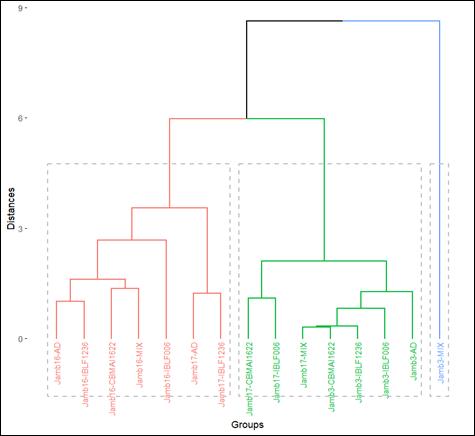
When evaluated using the clustering approach (Figure 1), it was possible to separate the treatments into groups using the UPGMA method. Three groups were formed: Group I (Jamb16-AD, Jamb16-IBLF1236, Jamb16-CBMAI1622, Jamb16-MIX, Jamb16-IBLF006, Jamb17-AD, and Jamb17-IBLF1236), Group II (Jamb17-CBMAI1622, Jamb17-IBLF006, Jamb17-MIX, Jamb03-CBMAI1622, Jamb03-IBLF1236, Jamb03-IBLF006, and Jamb03-AD), and Group III (Jamb03-MIX) (Figure 1). The UPGMA method provided an adequate cophenetic correlation coefficient (CCC = 0.71), confirming the agreement of the dendrogram with the dissimilarity matrix among the treatments analyzed.
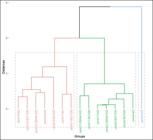
Dendrogram obtained via UPGMA method showing the similarity between the groups represented by treatments composed of local jambu varieties (Acmella spp.) associated with biostimulants based on Trichoderma spp. considering the frequency of discrepancy for plant height (HP), number of leaves (NL), and stem diameter (SD). Colors correspond to groups: Group I (red), Group II (green) and Group III (blue). Jamb-03: A.oleracea; Jamb-17: A. oleracea; Jamb-16: A. ciliata; AD: Additional; IBLF 006: T. harzianum; CBMAI 1236: T. asperellum; IBLF 1236: T. asperellum; MIX: pool of T. asperellum. Capanema-PA, UFRA, 2024.
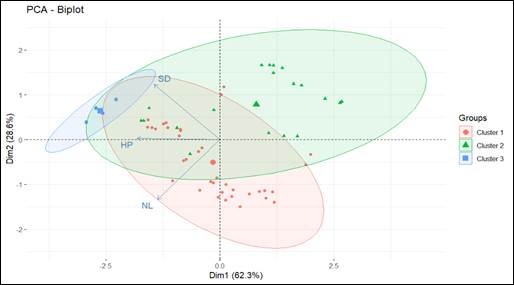
The cluster analysis confirms the results obtained for the multivariate contrasts, with the Jamb03-MIX treatment forming a group isolated from the others related to the best vegetative performance of the seedlings. PCA was used complementary to assess the influence of the variables on the grouping. It was found that the contribution of the variables in explaining the variation in the data was efficient, as it reduced the data set, concentrating more than 90% of the variation in the first two dimensions (Figure 2).
HP was the variable with the greatest contribution to explaining the variation in the first dimension (Dim1), as it was aligned with the corresponding axis (Figure 2). HP and SD had greater weight in discriminating Jamb03-MIX due to the length of the vector and its position in the quadrant. In addition, HP and SD are correlated because their vectors form an angle of less than 90º.
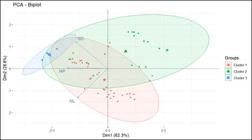
Principal componente analysis biplot for plant height (HP), number of leaves (NL), and stem diameter (SD) of local jambu (Acmella spp.) varieties associated with biostimulant based on Trichoderma spp.. Capanema-PA, UFRA, 2024.
On the other hand, the correlation between SD and NL was low, as they had an angle greater than 90º. The NL had a strong influence on distinguishing the treatments made up of the Jamb-16 variety, as shown by the length and proximity of the vector, a result that was the opposite of the SD vector, which was more sensitive to discriminating the Jamb-03 and Jamb-17 treatments, reinforcing the results of the multivariate grouping and contrasts.
Trial II. Vegetative development and yield
For gas exchange, the MANOVA showed significance (p<0.05) only for the effects of block and variety, with no difference between the mean vectors for the other effects. Only ‘Jamb16-IBLF006 versus Jamb16-AD’ and ‘Jamb16-IBLF1236 versus Jamb16-AD’ were significant among the contrasts tested. These results may be mainly related to the net CO2 assimilation rates (A) in Jamb16-AD (51.86 µmol/m2/s) concerning Jamb16-IBLF006 (47.14 µmol/m2/s) and IBLF1236 (50.44 µmol/m2/s), as well as variations in the other physiological variables (Table 2), influencing the mean vectors for these contrasts.
For the growth and biomass production variables, all the effects were highly significant by MANOVA, confirming that there was a significant difference (p<0.05). Although the mean vectors differed in all the effects studied, only the contrast ‘Jamb17-MIX versus Jamb17-AD’ was significant at p<0.05. This contrast aligns with the differences in DF, IFMY, and IDMY. In Jamb17-MIX, DF was reduced compared to Jamb17-AD (13 and 18 days, respectively) (Table 3). In addition, Jamb17-MIX showed higher IFMY (45.06 g/m2) and IDMY (5.05 g/m2) compared to the non-biostimulated treatment, with a gain of 95.49% in fresh mass and 108.68% in dry mass of inflorescence/m2 (Table 4).
Mean values of days to flowering (DF), main branch length (MBL), number of secondary branches (NSB), number of leaves (NL), shoot fresh mass (SFM) and shoot dry mass (SDM) of local varieties of jambu (Acmella spp.) associated with biostimulants based on Trichoderma spp. Capanema-PA, UFRA, 2024.
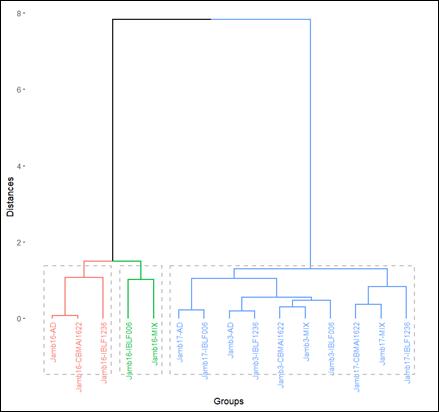
We subjected the treatments to cluster analysis based on gas exchange, growth, and biomass production variables to assess the similarities and differences in biostimulation (Figure 3). This resulted in the formation of three groups: Group I (Jamb16-AD, Jamb16-CBMAI1622 and Jamb16-IBLF1236), Group II (Jamb16-IBLF006 and Jamb16-MIX) and Group III (Jamb17-AD, Jamb17-IBLF006, Jamb03-AD, Jamb03-IBLF1236, Jamb03-CBMAI1622, Jamb03-MIX, Jamb03-IBLF006, Jamb17-CBMAI1622, Jamb17-MIX, and Jamb17-IBLF1236). The treatments were grouped according to the level of similarity, where Jamb-16 (A. ciliata) formed Groups I and II; Group III consisted of the varieties Jamb-03 and Jamb-17, both from the A. oleracea species (Figure 3).
For the treatments of the Jamb-16 variety, although they belong to the same species, they formed distinct groups (I and II), confirming the dissimilarity concerning the variables analyzed (Figure 3). In Jamb16-IBLF006 and Jamb16-MIX, we observed high growth performance and biomass production, a factor that contributed to the differentiation between groups.
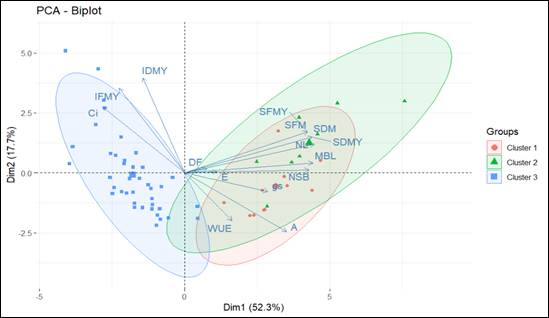
The growth variables (MBL, NL, NSB, SFM, and SDM), shoot biomass production (SFMY and SDMY), and gas exchange (A, gs, and WUE) were highly relevant in explaining the variation in Dim1 due to the length of the vectors and the angle concerning the axis of the first dimension (Figure 4). This group of variables showed a strong positive correlation, which is indicated by the formation of an angle of less than 90° between the vectors. Among the variables, DF and transpiration (E) contributed little to explaining the data variation due to the shorter vector, close to the origin.
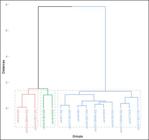
Dendrogram obtained via UPGMA method showing the similarity between the groups represented by treatments composed of local jambu (Acmella spp.) varieties associated with biostimulants based on Trichoderma spp. considering the frequency of discrepancy for gas exchange, growth, and biomass production variables. Colors correspond to groups: Group I (red), Group II (green) and Group III (blue). Jamb-03: Acmella oleracea; Jamb-17: A. oleracea; Jamb-16: A. ciliata; AD: Additional; IBLF 006: T. harzianum; CBMAI 1236: T. asperellum; IBLF 1236: T. asperellum; MIX: pool of T. asperellum. Capanema-PA, UFRA, 2024.
PCA was used to understand which variables most influenced the distinction between treatments and confirm the grouping analysis, with the first two dimensions (Dim1 and Dim2) being able to explain 70% of the variation in the data set (Figure 4). This shows that there was a reduction in the dimensionality of the original variables, with a 30% loss in data explanation, making the results robust.
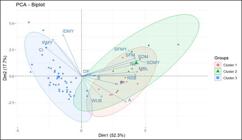
Principal componente analysis biplot for the variables of leaf gas exchange [net CO2 assimilation (A), stomatal conductance (gs), transpiration (E), internal CO2 concentration (Ci), and water use efficiency (WUE)], growth [days to flowering (DF), main branch length (MBL), number of secondary branches (NSB), and number of leaves (NL)] and biomass production [shoot fresh mass (SFM), shoot dry mass (SDM), shoot fresh mass yield (SFMY), shoot dry mass yield (SDMY), inflorescence fresh mass yield (IFMY) and inflorescence fresh mass yield (IDMY)] of local jambu (Acmella spp.) varieties associated with biostimulants based on Trichoderma spp.. Capanema-PA, UFRA, 2024.
Jamb16-MIX and Jamb16-IBLF 006 were strongly influenced by the shoot growth and biomass production variables, characterizing high vegetative development, as seen by the proximity to the corresponding vectors (Figure 4).
The second dimension (Dim2) was mostly explained by IFMY, IDMY and internal CO2 concentration (Ci), with a strong positive correlation (Figure 4). In addition, the high fresh and dry yield of inflorescences per square meter in Jamb-03 plants confirms the results obtained in the PCA, where it can be seen that IFMY and IDMY had a high influence on the differentiation of this variety, with the greatest increase being shown by Jamb03-MIX.
Spilanthol content
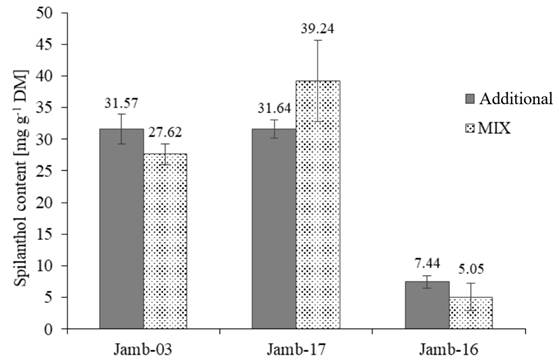
The chromatographic profile of Jamb-03 and Jamb-16 varieties, there was no increase in spilanthol content due to biostimulation with MIX (Figure 5 and Figure 6). On the other hand, the Jamb17-MIX plants showed a difference in content, as evidenced by the chromatograms (Figure 5c), being relatively higher than Jamb17-AD (Figure 5d). In addition, in all treatments we observed the presence of other bioactive compounds in the chromatographic profile, reflecting the diverse production of secondary metabolites in jambu.
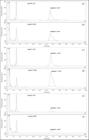
Chromatograms of the ethanolic extracts of the inflorescences of local jambu (Acmella spp.) varieties grown individually and associated with Trichoderma spp. Based biostimulants, showing diferente absorbance intensities for the compounds pilanthol and distinct chromatographic profiles. Jamb03-AD (a) versus Jamb03-MIX (b); Jamb17-AD (c) versus Jamb17-MIX (d); Jamb16-AD (e) versus Jamb16-MIX (f). AD: Additional; MIX: pool of T. asperellum. Jamb03-AD (a) versus Jamb03-MIX (b); Jamb17-AD (c) versus Jamb17-MIX (d); Jamb16-AD (e) versus Jamb16-MIX (f). AD: Additional; MIX: pool of T. asperellum. Capanema-PA, UFRA, 2024.
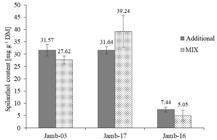
Comparison of spilanthol content in methanolic extracts of inflorescences of local jambu (Acmella spp.) varieties associated with biostimulants based on Trichoderma spp. and their respective additional treatments (without inoculation). AD: Additional; MIX: pool of T. asperellum. Capanema-PA, UFRA, 2024.
DISCUSSION
Weather factors can be limiting to the development of Trichoderma spp. strains due to their influence on mycelial growth. Most species have their growth stimulated by substrate temperatures between 25°C and 30°C and high relative humidity (Meyer et al., 2019). In this study, we observed that the weather parameters of the air in the protected environment may have contributed to the low-temperature range and high soil humidity associated with the straw. These conditions created a suitable microclimate for developing Trichoderma spp. and favored conidia germination in the cultivation system. For some strains of T. asperellum, mycelial growth is still expressive at temperatures up to 32°C (Domingues et al., 2016).
In a study by Oliveira et al. (2019) with strains of the T. harzianum and T. asperellum species, greater mycelial growth, sporulation capacity, and germination of conidia were observed at temperatures of up to 35°C for T. harzianum. This adaptation is important, especially in the Amazon region, where average air temperatures exceed 26°C over the year and can reach over 30°C during the summer due to the high relative air humidity (Alvares et al., 2013).
In the seedling stage, the differences in growth promotion provided significant effects in the multivariate contrasts. The initial vegetative development of plants requires adequate availability of nutrients and water to obtain vigorous seedlings, and the use of Trichoderma spp. can be a strategy, as it allows for an increase in the availability of nutrients, as well as producing compounds that help with plant metabolism (Lanzuise et al., 2022). This may explain the greater growth of Jamb-03 biostimulated with MIX, possibly due to variations in colonization intensity. In addition, the strains that make up MIX come from Amazonian soils (forest areas), adapted to the region's soil and climatic conditions, with positive results in growth promotion (Silva et al., 2012). However, this interpretation remains speculative, as no analyses were performed to determine the colonization rate.
The effects on vegetative development provided by Trichoderma spp. are due to the bioavailability of nutrients and the ability to produce indoleacetic acid (IAA) and volatile compounds, promoting an increase in plant biomass and changes in root morphogenesis (Ortuño et al., 2016; Vergara et al., 2016). For Jamb03-MIX, it was possible to observe a positive influence of Trichoderma spp. on seedling formation, with greater stimulation in HP and SD.
We observed that CBMAI1622 and MIX promoted an increase in NL for Jamb-17 compared to non-biostimulated seedlings, as shown by the cluster analysis. The increase in leaves facilitates the development of jambu seedlings in the field due to the greater photosynthetically active area for producing photoassimilates. Therefore, our results suggest that jambu seedlings of the Jamb-03 and Jamb-17 varieties biostimulated with Trichoderma spp. can conclude the time in the tray with a higher leaf biomass content and possibly more vigorous (Table 1). However, there are variations between the results promoted by the strains and varieties due to Trichoderma-plant specificity (Souza et al., 2022).
In a study by Souza et al. (2022) evaluating the inoculation of T. asperellum in lettuce, it was possible to verify that seedlings development responses differed between the cultivars. Also, according to the authors, the interaction of different materials with Trichoderma spp. can generate positive, negative, or no effects. These results corroborate our findings, in which NL showed no evident variation in biostimulated seedlings (Table 1), suggesting a low contribution to the observed multivariate pattern.
We observed no significant difference between the mean vectors for the gas exchange variables, although changes in biotic or abiotic factors can alter plant metabolism, affecting physiological responses (Santos, 2020). The differences observed were related to the varieties (Table 2). Jamb-16 showed high net CO2 assimilation, transpiration, and water use efficiency rates, directly reflecting the greater stomatal opening. These results show that Jamb-16 has a strong potential for photosynthesis and the production of fresh and dry biomass due to the relationship between net CO2 assimilation and the synthesis of photoassimilates in the plant.
The low internal CO2 concentration may have influenced high stomatal conductance rates observed in Jamb-16 (except for Jamb16-IBLF006), inferring increases in leaf mesophyll photosynthesis (Taiz et al., 2017). These results are justified by the fact that Jamb-16 has a high NL, which enhances the use of internal CO2 concentration, with a consequent increase in photosynthesis. Sampaio et al. (2022), studying species of A. oleracea and A. ciliata, found a higher rate of net CO2 assimilationin materials UFRA 5, UFRA 6, and UFRA 8, all belonging to the A. ciliata species, characterizing the genetic capacity of the species for photosynthesis and increased fresh mass, a valuable characteristic for leafy vegetables such as jambu, making it possible to increase yield in cultivation systems, and consequently a quick return on financial investments.
Regarding growth parameters and biomass production, the effect of Trichoderma spp. biostimulation was different between the varieties. Only Jamb17-MIX responded to inoculation for DF, showing an earlier response than Jamb17-AD (a reduction of five days). Trichoderma spp. has been shown to reduce the time to the start of flowering and stimulate the development of flower buds (Andrzejak et al., 2021).
In jambu, promising results regarding the use of Trichoderma spp. to reduce DF is a crucial factor in the commercialization of inflorescences since it is possible to anticipate the harvest period, improving this niche of production that has been growing due to the possibility of numerous harvests per plant cycle and the greater added value of the inflorescences compared to the shoot, due to the spilanthol content (Sharma et al., 2022).
In terms of growth characteristics and biomass production, it is possible that biostimulation helped with rapid adaptation to the field and superior absorption of water and nutrients, which was reflected in the parameters and accumulation of shoot mass at harvest. We found higher shoot biomass production in Jamb16-IBLF006 and Jamb16-MIX, which explains the separation of these treatments in the grouping. Differences in the solubilization of nutrients (phosphorus, potassium, iron, etc.) by the strains may have caused oscillations in the intensity of mass accumulation (Eslahi et al., 2020).
Our findings showed that the local jambu varieties had different responses, as A. oleracea showed lower MBL, approximately 112% lower SFM, and 182% lower SDM than A. ciliata. These results can be seen in the PCA, where Jamb16-MIX and Jamb16-IBLF006 were the most influenced by the SFMY and SDMY vectors, reflecting mass accumulation. Differences such as these help the choice at the field level, aligning the characteristics of the jambu varieties and the biostimulant with the production objective.
In addition to the difference between species, it seems that Jamb-16 has a strong morphological distinction linked to the genetics of the material since the pattern between biostimulated and non-biostimulated plants was similar for the growth variables. This shows us that characteristics coordinated by phenotypic or genetic factors provide results with small or non-existent differences for some genotypes when associated with Trichoderma spp. (Souza et al., 2022).
In terms of inflorescence production, the effects of biostimulation were more significant in Jamb-03, with the Jamb03-MIX treatment standing out, which showed high IFMY and IDMY, with an increase compared to Jamb17-MIX and Jamb16-MIX of 175% and 182% in IFMY and 181% and 97% in IDMY, respectively.
These results may be closely related to the net CO2 assimilation and internal CO2 concentration values observed for Jamb-03 since biostimulation with MIX accelerated the growth of the seedlings, anticipating the accumulation of reserves and intensifying remobilization in the reproductive phase, to reorganize the photosynthetic apparatus, with energy directed towards the production of inflorescences, and stabilization in the use of internal CO2 (Taiz et al., 2017; Sampaio et al., 2022).
About the spilanthol content in the inflorescences, our results showed that the Jamb-03 and Jamb-16 varieties biostimulated with MIX did not show superior responses to the non-biostimulated treatment. These effects show that the production of bioactive from secondary metabolisms, such as spilanthol, is coordinated not only by environmental factors but also by genetic and physiological characteristics (Taiz et al., 2017). For this reason, modifications on the cultivation environment that integrate these factors have been adopted in jambu cultivation to modulate bioactive compounds, with a strong focus on spilanthol (Vieira et al., 2021; Sampaio et al., 2024).
On the other hand, analysis of the chromatographic profiles and quantitative results revealed the influence of biostimulation on Jamb-17 (Figure 6). This behavior may be associated with the production of amino acid precursors of spilanthol in the shikimic acid route since inoculations with Trichoderma spp. influence the content and diversity of amino acids, promoting the formation of nitrogen compounds (Wu et al., 2018). By associating this result with the early flowering and IFMY with MIX in Jamb-17, we can predict a higher yield in spilanthol content than Jamb17-AD.
The lack of effects on spilanthol content in Jamb-03 and Jamb-16 between biostimulated and non-biostimulated plants may be related to the link between primary metabolism and vegetative development and biomass accumulation since the metabolic pathways are associated (Taiz et al., 2017; Santos, 2020). This indicates a greater supply of primary metabolites for producing shoot mass in Jamb-16 and inflorescence mass in Jamb-03. However, these results are satisfactory when evaluating the final yield of extractable spilanthol as a function of mass.
CONCLUSION
We found that plant responses were conditioned by the Trichoderma-plant interaction, varying according to jambu variety and the biostimulant applied. During the seedling stage, inoculation with Trichoderma stimulated growth, with more pronounced effects observed in treatments with the pool of T. asperellum pool (MIX). Additionally, biostimulation promoted earlier flowering in A. oleracea and increased inflorescence yield in both A. oleracea and A. ciliata. In contrast, vegetative growth promotion was more evident in A. ciliata, resulting in higher fresh and dry biomass of the shoot (stems and leaves).
Furthermore, spilanthol content in the inflorescences was also enhanced by biostimulation, particularly under the MIX treatment, both in terms of concentration per gram of dry mass (Jamb-17) and total spilanthol yield (Jamb-03), due to the increased inflorescence yield. Therefore, Trichoderma spp. can be indicated as an agricultural management strategy in jambu crops in the Amazon, provided the strain effectiveness and the possible doses and forms of inoculation are evaluated.
ACKNOWLEDGEMENTS
The authors are thankfull to the Coordination for the Improvement of Higher Education Personnel (CAPES) for funding the first author's postgraduate scholarship (FLNA), the Postgraduate Program in Agronomy (PPGAGRO) for supporting the research, and the Plant Protection Laboratory (LPP) for donating part of the Trichoderma strains
REFERENCES
-
ALVARES, CA; STAPE, JL; SENTELHAS, PC; GONÇALVES, JLM; SPAROVEK, G. 2013. Koppen’s climate classification map for Brazil. Meteorologische Zeitschrift 22: 711-728. https://doi.org/10.1127/0941-2948/2013/0507
» https://doi.org/10.1127/0941-2948/2013/0507 -
ANDRZEJAK, R; JANOWSKA, B; RENSKA, B; KOSIADA, T. 2021. Effect of Trichoderma spp. and fertilization on the flowering of Begonia x tuber hybrida Voss. ‘Picotee Sunburst’. Agronomy 11: 1-11. https://doi.org/10.3390/agronomy11071278
» https://doi.org/10.3390/agronomy11071278 -
AZEVEDO, AM. 2024. Multivariate Analysis: Pacote Para Análise Multivariada (R package version 0.5.0) Available at: Available at: https://cran.r-project.org/package=MultivariateAnalysis Accessed July 15, 2024.
» https://cran.r-project.org/package=MultivariateAnalysis -
BAE, SS; EHRMANN, BM; ETTEFAGH, KA; CECH, NB. 2010. A validated liquid chromatography-electrospray ionization-mass spectrometry method for quantification of spilanthol in Spilanthes acmella (L.) Murr. Phytochemical Analysis 21: 438-143. https://doi.org/10.1002/pca.1215
» https://doi.org/10.1002/pca.1215 -
BELLUMORI, M; ZONFRILLO, B; MAGGINI, V; BOGANI, P; GALLO, E; FIRENZUOLI, F; MULINACCI, N; INNOCENTI, M. 2022. Acmella oleracea (L.) R.K. Jansen: Alkylamides and phenolic compounds in aerial parts and roots of in vitro seedlings. Journal of Pharmaceutical and Biomedical Analysis 220: 1-9. https://doi.org/10.1016/j.jpba.2022.114991
» https://doi.org/10.1016/j.jpba.2022.114991 - BRASIL, EC; CRAVO, MS; VIÉGAS, IJM. 2020. Recomendações de calagem e adubação para o estado do Pará 2nd ed. Brasília, BR: Embrapa.
-
BRAZIL FLORA GROUP BFG. 2015. Growing knowledge: an overview of seed plant diversity in Brazil. Rodriguésia 66: 1085-1113. https://doi.org/10.1590/2175-7860201566411
» https://doi.org/10.1590/2175-7860201566411 -
BUCIO, JL; FLORES, RP; ESTRELLA, AH. 2015. Trichodermaas bioestimulant: exploiting the multilevel properties of a plant beneficial fungus. Scientia Horticulturae 196: 109-123. http://dx.doi.org/10.1016/j.scienta.2015.08.043
» https://doi.org/10.1016/j.scienta.2015.08.043 -
CAMPOS, MM; FERNANDES, GEA; HALL, CF; SANTOS, JUM. 2019.A new species of jambú (Acmella, Heliantheae, Asteraceae) from Amazonia, Brazil. Phytotaxa 403: 137-141. https://doi.org/10.11646/phytotaxa.403.2.7
» https://doi.org/10.11646/phytotaxa.403.2.7 -
DEDINO, DB; LIMA, JD; BORTOLUCCI, WC; RIVADAVEA, WR; LOVATO, ECW; GAZIM, ZC; GONÇALVES, JE; MONZON, DLR; SILVA, GJ. 2022. Red LED light and different cultivation methods changed the essential oil composition of Acmella oleracea Plant Cell, Tissue and Organ Culture 151: 511-520. https://doi.org/10.1007/s11240-022-02367-5
» https://doi.org/10.1007/s11240-022-02367-5 -
DOMINGUES, MVPF; MOURA, KE; SALOMÃO, D; ELIAS, LM; PATRICIO, FRA. 2016. Effect of temperature on mycelial growth of Trichoderma, Sclerotinia minor and S. sclerotiorum, as well as on mycoparasitism. Summa Phytopathologica 42: 222-227. https://doi.org/10.1590/0100-5405/2146
» https://doi.org/10.1590/0100-5405/2146 - EMPRESA BRASILEIRA DE PESQUISA AGROPECUÁRIA (EMBRAPA). 2018. Sistema brasileiro de classificação de solos 5th ed. Brasília, BR: Embrapa.
-
ESLAHI, N; KOWSARI, M; MOTALLEBI, M; ZAMANI, MR; MOGHADASI, Z. 2020. Influence of recombinant Trichoderma strains on growth of bean (Phaseolus vulgaris L) by increased root colonization and induction of root growth related genes. Scientia Horticulturae 261: 1-13. https://doi.org/10.1016/j.scienta.2019.108932
» https://doi.org/10.1016/j.scienta.2019.108932 - FOOD AND AGRICULTURE ORGANIZATION OF THE UNITED NATIONS FAO . 2015. International soil classification system of naming soils and creating legends for soil maps Rome, Italy: FAO.
- JANSEN, RK. 1985. The systematics of Acmella (Asteraceae-Heliantheae). American Society of Plant Taxonomists 8: 1-115.
-
JI, S; LIU, Z; LIU, B; WANG, Y; WANG, J. 2020. The effect of Trichoderma biofertilizer on the quality of flowering Chinese cabbage and the soil environment. Scientia Horticulturae 262: 1-8. https://doi.org/10.1016/j.scienta.2019.109069
» https://doi.org/10.1016/j.scienta.2019.109069 -
KASSAMBARA, A; MUNDT, F. 2020. Factoextra: Extract and visualize the results of multivariate data analyses (R package version 1.0.7) Available at: Available at: https://CRAN.R-project.org/package=factoextra Accessed July 15, 2024.
» https://CRAN.R-project.org/package=factoextra -
LANZUISE, S; MANGANIELLO, G; GUASTAFERRO, VM; VINCENZO, C; VITAGLIONE, P; FERRACANE, R; VECCHI, A; VINALE, F; KAMAU, S; LORITO, M; WOO, SL. 2022.Combined biostimulant applications of Trichoderma spp. with fatty acid mixtures improve biocontrol activity, horticultural crop yield and nutritional quality. Agronomy 12: 1-22. https://doi.org/10.3390/agronomy12020275
» https://doi.org/10.3390/agronomy12020275 - MEYER, MC; MAZARO, SM; SILVA, JC. 2019. Trichoderma: uso na agricultura Brasília, BR: Embrapa.
-
OLIVEIRA, LLB; MORAES, JGL; SILVA, CFB; SOUSA, ABO; BELEZA, NMV; JACINTO JÚNIOR, SG. 2019. Influência da temperatura e radiação ultravioleta no desenvolvimento de isolados de Trichoderma spp. Revista Brasileira de Meteorologia 34: 423-430. http://dx.doi.org/10.1590/0102-7786343048
» https://doi.org/10.1590/0102-7786343048 -
ORTUÑO, N; CASTILLO, JA; MIRANDA, C; CLAROS, M; SOTO, X. 2016. The use of secondary metabolites extracted from Trichoderma for plant growth promotion in the Andean highlands. Renewable Agriculture and Food Systems 32: 1-10. https://doi.org/10.1017/S1742170516000302
» https://doi.org/10.1017/S1742170516000302 -
PEREIRA, FT; OLIVEIRA, JB; MUNIZ, PHPC; PEIXOTO, GHS; GUIMARÃES, RR; CARVALHO, DDC. 2019. Growth promotion and productivity of lettuce using Trichoderma spp. commercial strains. Horticultura Brasileira 37: 69-74. http://dx.doi.org/10.1590/S0102-053620190111
» https://doi.org/10.1590/S0102-053620190111 -
R CORE TEAM. 2024. R: a language and environment for statistical computing. R Foundation for Statistical Computing Available at: Available at: https://www.R-project.org/ Accessed March 13, 2024.
» https://www.R-project.org/ -
SAMPAIO, IMG; SILVA JÚNIOR, ML; BITTENCOURT, RFPM; OLIVEIRA, ES; LOPES FILHO, WRL; SOUZA, LR; COSTA, VCN. 2022. Productive and physiological performance of jambu genotypes cultivated in hydroponics. Horticultura Brasileira 40: 190-196. http://dx.doi.org/10.1590/s0102-0536-20220208
» https://doi.org/10.1590/s0102-0536-20220208 -
SAMPAIO, IMG; TEIXEIRA, BJB; BITTENCOURT, RFPM; OLIVEIRA, ES; ROGEZ, HLG; SILVA JÚNIOR, ML. 2024. Biomass and spilanthol content of hydroponic jambu as a function of nitrogen supply. Revista Brasileira de Engenharia Agrícola e Ambiental 28: 1-8. http://dx.doi.org/10.1590/1807-1929/agriambi.v28n12e277584
» https://doi.org/10.1590/1807-1929/agriambi.v28n12e277584 - SANTOS, DYAC. 2020. Biossíntese funções e aplicações dos metabólitos secundários de plantas. Curitiba, BR: Appris.
-
SHARMA, R; KARUNAMBIGAI, A; GUPTA, S; ARUMUGAM, N. 2022. Evaluation of biologically active secondary metabolites isolated from the toothache plant Acmellaciliata (Asteraceae). Advances in Traditional Medicine 22: 713-722. https://doi.org/10.1007/s13596-021-00584-5
» https://doi.org/10.1007/s13596-021-00584-5 -
SILVA, AR. 2021. Biotools: tools for biometry and applied statistics in agricultural science (R package version 4.2) Available at: Available at: https://cran.r-project.org/package=biotools Accessed July 15, 2024.
» https://cran.r-project.org/package=biotools -
SILVA, FG; DUTRA, WF; DUTRA, AF; OLIVEIRA, IM; FILGUEIRAS, LMB; MELO, AS. 2015. Trocas gasosas e fluorescência da clorofila em plantas de berinjela sob lâminas de irrigação. Revista Brasileira de Engenharia Agrícola e Ambiental 19: 946-952. http://dx.doi.org/10.1590/1807-1929/agriambi.v19n10p946-952
» https://doi.org/10.1590/1807-1929/agriambi.v19n10p946-952 -
SILVA, GAR; SANTOS, JUM. 2011. Acmella marajoensis: Uma nova espécie de Asteraceae para a Amazônia brasileira. Acta Amazônica 41: 191-194. https://doi.org/10.1590/S0044-059672011000200002
» https://doi.org/10.1590/S0044-059672011000200002 -
SILVA, JC; TORRES, DB; LUSTOSA, DC; FILLIPI, MCC;SILVA,GB. 2012. Rice sheath blight biocontrol and growth promotion by Trichoderma isolates from the Amazon. Revista de Ciências Agrárias 55: 243-250. http://dx.doi.org/10.4322/rca.2012.078
» https://doi.org/10.4322/rca.2012.078 -
SOKAL, RR; ROHLF, FJ. 1962. The comparison of dendrograms by objective methods. Taxon 11: 30-40. http://dx.doi.org/10.2307/1217208
» https://doi.org/10.2307/1217208 -
SOUSA, TP; CHAIBUB, AA; CORTES, MVCB; BATISTA, TFC; BEZERRA, GA; SILVA, GB; FILIPPI MCC . 2021. Molecular identification of Trichoderma sp. isolates and biochemical characterization of antagonistic interaction against rice blast. Archives of Microbiology 203: 257-3268. https://doi.org/10.1007/s00203-021-02307-5
» https://doi.org/10.1007/s00203-021-02307-5 -
SOUZA, RR; MORAES, MP; PARAGINSKI, JA; MOREIRA, TF; BITTENCOURT, KC; TOEBE, M. 2022. Effects of Trichoderma asperellum on germination indexes and seedling parameters of lettuce cultivars. Current Microbiology 79: 1-12. https://doi.org/10.1007/s00284-021-02713-4
» https://doi.org/10.1007/s00284-021-02713-4 -
SUT, S; FERRARESE, I; SHRESTHA, SS; KUMAR, G; SLAVIERO, A; SELLO, S; ALTISSIMO, A; PAGNI, L; GATTESCO, F; DALL’ACQUA, S. 2020. Comparasion of bioestimulant treatments in Acmella oleracea cultivation for alkylamides production. Plants 9: 1-17. https://doi.org/10.3390/plants9070818
» https://doi.org/10.3390/plants9070818 - TAIZ, L; ZEIGER, E; MØLLER, IM; MURPHY, A. 2017. Fisiologia e Desenvolvimento Vegetal 6th ed. Porto Alegre, BR: Artmed.
-
VERGARA, AG; ORTIZ, SB; PARRA, EM; GONZÁLEZ, JR; BRAVO, AM; RODRÍGUEZ, LM. 2016. The volatile 6-pentyl-2H-pyran-2-one from Trichoderma atroviride regulates Arabidopsis thaliana root morphogenesis via auxin signaling and ethylene insensitive 2 functioning. New Phytologist 209: 1496-1512. https://doi.org/10.1111/nph.13725
» https://doi.org/10.1111/nph.13725 -
VIEIRA, ME; FREITAS, MSM; PEÇANHA, DA; LIMA, TC; MARTINS, MA; VIEIRA, IJC. 2021. Arbuscular mycorrhizal fungi and phosphorus in spilanthol and phenolic compound yield in jambu plants. Horticultura Brasileira 39: 192-198. http://dx.doi.org/10.1590/s0102-0536-20210210
» https://doi.org/10.1590/s0102-0536-20210210 -
WU, Q; NI, M; DOU, K; TANG, J; REN, J; YU, C; CHEN, J. 2018. Co-culture of Bacillus amyloliquefaciens ACCC11060 and Trichoderma asperellum GDFS1009 enhanced pathogen-inhibition and amino acid yield. Microbial Cell Factories 17: 1-12. https://doi.org/10.1186/s12934-018-1004-x
» https://doi.org/10.1186/s12934-018-1004-x
-
Consent for publication
All authors allow Horticultura Brasileira to publish the manuscript.
-
Use of artificial intelligence technologies
No analytical, graphical, or interpretative part was conducted by artificial intelligence.
-
Data availability statement
The datasets generated and analysed during the current study are available in the Figshare repository [https://doi.org/10.6084/m9.figshare.27656007.v1].
-
Funding
Coordination for the Improvement of Higher Education Personnel (CAPES). Grant No.: 88887.716184/2022-00
The datasets generated and analysed during the current study are available in the Figshare repository [https://doi.org/10.6084/m9.figshare.27656007.v1].