
 Six-Minute Walk Test in Patients with Cardiac Amyloidosis: Does it mean anything?
Cardiac Amyloidosis; Transthyretin amyloidosis; Six-minute walk test; Transthyretin amyloidosis hereditary; Transthyretin amyloidosis wild type
Cardiac Amyloidosis; Transthyretin amyloidosis; Six-minute walk test; Transthyretin amyloidosis hereditary; Transthyretin amyloidosis wild type
Cardiac amyloidosis (CA) is a restrictive cardiomyopathy characterized by the extracellular deposition of proteins in the myocardium. Transthyretin (TTR) protein is predominantly synthesized in the liver and normally transports thyroxine and retinol. When TTR is misfolded, it can form amyloid fibrils deposited in different organs, such as the heart.
TTR amyloidosis (ATTR) can be inherited as an autosomal dominant trait caused by variants in the TTR gene (TTRv), or by the deposition of wild-type TTR (TTRwt).1
Cardiac involvement in amyloidosis is evidenced by electrocardiogram, transthoracic echocardiography, cardiac magnetic resonance, nuclear medicine, and cardiac biomarkers; besides making a probable diagnosis, these tests are helpful for risk stratification and identification of patients with systemic amyloidosis (AL) or ATTR a. Patients with CA have a poor prognosis due to clinical manifestations of restrictive cardiomyopathy that could lead to congestive heart failure, conduction disturbances, and a high risk of sudden death. These patients have functional manifestations, and one of the most frequent is exercise intolerance due to the reduction of aerobic exercise capacity.1
The six-minute walk test (6MWT) is a method used to determine the severity of cardiomyopathy. This test assesses the distance an individual can walk on a treadmill for six minutes, which is important in these cardiac conditions as they affect the ability to perform daily tasks.2-5
The 6MWT is a well-established technique for assessing functional capacity for physical activity and has proven effective in predicting and evaluating responses to treatment in patients with heart failure. Reduced functioning is a key element in assessing disease progression, as it could suggest the need for alternative treatments with different mechanisms of action or consider a combined approach. In this regard the use of the 6MWT to evaluate functional capacity can help guide treatment decisions.2
Reduced functional capacity detected at baseline during the 6MWT may improve risk stratification beyond traditional predictors. Reducing the distance covered during the 6MWT may indicate disease progression and, when combined with other markers, can facilitate the identification of patients at high risk of mortality.2
Cohen et al.4 studied 799 patients with AL or CA and found that the mean walking distance in six min was 362 m. The distance covered during the 6MWT decreased with worsening of heart disease stages (458 m, 404 m, 331 m, and 168 m for Mayo stages I, II, IIIa, and IIIb, respectively). Improvement in 6MWT distance prolonged survival in patients with CA.4
Ioannou et al.2 in a study conducted at the National Amyloidosis Center in London, highlighted the importance of the 6MWT according to the incidence of genetic variants of ATTR-CA:
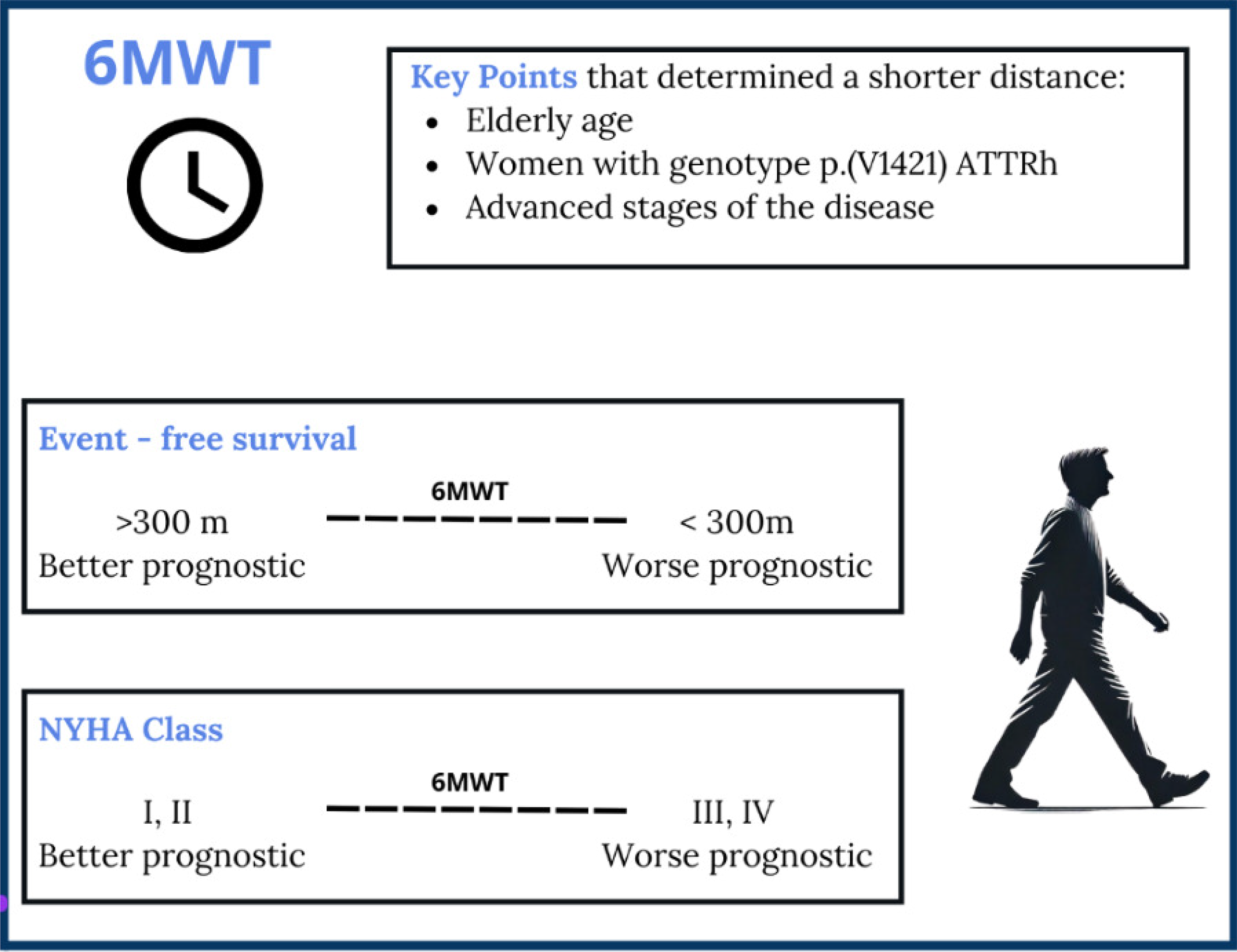
The distance in the 6MWT decreased significantly in patients with ATTR-CA, which was more evident in older individuals, women with the p.(V142I) genotype, and those in advanced stages of the disease.
The 6MWT distance at the beginning of the investigation evidenced an autonomous relationship with mortality.
An absolute (greater than 35 m) and relative (exceeding 5%) decrease in the 6MWT distance after one year also had an independent relationship with mortality.
An impairment in the 6MWT combined with measures of disease progression may improve risk prediction and stratification of disease progression.5
Romero et al.,5 in a recent article, described the role of the 6MWT in the evaluation of the functional status and prognosis of patients with CA, with particular attention to the different types of ATTR-CM (h- hereditary and wt-wild type) and the influence they have on the walk test, giving us a broad overview of them.5 The results obtained in their study, conducted in a referral center in São Paulo, Brazil, had a prognostic value for event-free survival. The 6MWT test was performed in 32 patients diagnosed with ATTR-CA, and it was demonstrated that event-free survival was lower when the distance traveled in the test was <300 m.5
The patients who underwent the test belonged to both groups (ATTRh and ATTRwt); the difference in distance walked was not statistically significant when comparing both groups.5 However, the distance walked was shorter as the functional capacity was impaired, especially in patients with established heart failure. The NYHA II and III groups walked a shorter distance than those with NYHA I.
Although there were no significant differences in the results of the 6MWT according to the type of CA (hereditary vs wild type), there is no doubt that those patients who walked a distance less than 300 m had lower hospitalization-free survival. This indicates that the 6MWT has a high prognostic value in patients with a diagnosis of ATTR-CA and demonstrates the need for further studies on its use, considering all the factors that could influence its results (Figure 1).
References
-
1 Banydeen R, Monfort A, Inamo J, Neviere R. Diagnostic and Prognostic Values of Cardiopulmonary Exercise Testing in Cardiac Amyloidosis. Front Cardiovasc Med. 2022;9:898033. doi: 10.3389/fcvm.2022.898033.
» https://doi.org/10.3389/fcvm.2022.898033 -
2 Ioannou A, Fumagalli C, Razvi Y, Porcari A, Rauf MU, Martinez-Naharro A, et al. Prognostic Value of a 6-Minute Walk Test in Patients with Transthyretin Cardiac Amyloidosis. J Am Coll Cardiol. 2024;84(1):43-58. doi: 10.1016/j.jacc.2024.04.011.
» https://doi.org/10.1016/j.jacc.2024.04.011 -
3 Nativi-Nicolau J, Yilmaz A, Dasgupta N, Macey R, Cochrane J, Peatman J, et al. Six-Minute Walk Test as Clinical end Point in Cardiomyopathy Clinical Trials, Including ATTR-CM: A Systematic Literature Review. J Comp Eff Res. 2024;13(7):e230158. doi: 10.57264/cer-2023-0158.
» https://doi.org/10.57264/cer-2023-0158 - 4 Cohen OC, Sathyanath A, Petrie A, Ravichandran S, Law S, Manwani R, et al. Prognostic Importance of the 6 Min Walk Test in Light Chain (AL) Amyloidosis. Heart. 2022;108(20):1616-22.
-
5 Romero CE, Pereira NM, Luzuriaga GDCJ, Bueno BVK, Carvalhal S, Borges T, et al. Prognostic Value of the 6-Minute Walk Test and Clinical Characteristics of Patients With Transthyretin Amyloid Cardiomyopathy. Int J Cardiovasc Sci. 2024; 37:e20240091. doi: 10.36660/ijcs.20240091.
» https://doi.org/10.36660/ijcs.20240091
-
Short Editorial referring to the article: Prognostic Value of the 6-Minute Walk Test and Clinical Characteristics of Patients With Transthyretin Amyloid Cardiomyopathy

 6MWT: six-minute walk test; ATTRh: Transthyretin amyloidosis hereditary.