person Letícia Alves Martins de Carvalho
Conceptualization (Equal) · Investigation (Equal) · Methodology (Equal) · Writing – original draft (Equal) · Writing – review & editing (Equal) · *These authors contributed equally.
schoolUniversidade Estadual de Campinas, Instituto de Biologia, Departamento de Biologia Estrutural e Funcional, Campinas, SP, Brasil.Universidade Estadual de CampinasBrasilCampinas, SP, BrasilUniversidade Estadual de Campinas, Instituto de Biologia, Departamento de Biologia Estrutural e Funcional, Campinas, SP, Brasil.
person Vitor de Toledo Stuani
Data curation (Supporting) · Methodology (Equal) · Visualization (Supporting) · Writing – review & editing (Supporting)
schoolUniversidade de São Paulo, Faculdade de Odontologia de Bauru, Departamento de Dentística, Endodontia e Materiais Odontológicos, Bauru, SP, Brasil.Universidade de São PauloBrasilBauru, SP, BrasilUniversidade de São Paulo, Faculdade de Odontologia de Bauru, Departamento de Dentística, Endodontia e Materiais Odontológicos, Bauru, SP, Brasil.
person Isabela Sanches Pompeo da Silva
Data curation (Supporting) · Methodology (Equal) · Visualization (Supporting) · Writing – review & editing (Equal)
schoolUniversidade de São Paulo, Faculdade de Odontologia de Bauru, Departamento de Dentística, Endodontia e Materiais Odontológicos, Bauru, SP, Brasil.Universidade de São PauloBrasilBauru, SP, BrasilUniversidade de São Paulo, Faculdade de Odontologia de Bauru, Departamento de Dentística, Endodontia e Materiais Odontológicos, Bauru, SP, Brasil.
person Thayná Souza Berteli
Investigation (Supporting) · Visualization (Equal) · Writing – review & editing (Equal)
schoolUniversidade de São Paulo, Faculdade de Odontologia de Ribeirão Preto, Departamento de Materiais Dentários e Prótese, Ribeirão Preto, SP, Brasil.Universidade de São PauloBrasilRibeirão Preto, SP, BrasilUniversidade de São Paulo, Faculdade de Odontologia de Ribeirão Preto, Departamento de Materiais Dentários e Prótese, Ribeirão Preto, SP, Brasil.
person Nicoly Gabriely Gonçalves
Investigation (Supporting) · Visualization (Equal) · Writing – review & editing (Equal)
schoolUniversidade de São Paulo, Faculdade de Odontologia de Ribeirão Preto, Departamento de Materiais Dentários e Prótese, Ribeirão Preto, SP, Brasil.Universidade de São PauloBrasilRibeirão Preto, SP, BrasilUniversidade de São Paulo, Faculdade de Odontologia de Ribeirão Preto, Departamento de Materiais Dentários e Prótese, Ribeirão Preto, SP, Brasil.
person Diana Gabriela Soares
Funding acquisition (Lead) · Project administration (Lead) · Supervision (Lead) · Visualization (Equal) · Writing – review & editing (Supporting)
schoolUniversidade de São Paulo, Faculdade de Odontologia de Bauru, Departamento de Dentística, Endodontia e Materiais Odontológicos, Bauru, SP, Brasil.Universidade de São PauloBrasilBauru, SP, BrasilUniversidade de São Paulo, Faculdade de Odontologia de Bauru, Departamento de Dentística, Endodontia e Materiais Odontológicos, Bauru, SP, Brasil.
person Ester Alves Ferreira Bordini
Conceptualization (Lead) · Data curation (Equal) · Formal analysis (Equal) · Investigation (Equal) · Methodology (Equal) · Supervision (Lead) · Visualization (Equal) · Writing – original draft (Equal) · Writing – review & editing (Equal) · *These authors contributed equally
schoolUniversidade de São Paulo, Faculdade de Odontologia de Ribeirão Preto, Departamento de Materiais Dentários e Prótese, Ribeirão Preto, SP, Brasil.Universidade de São PauloBrasilRibeirão Preto, SP, BrasilUniversidade de São Paulo, Faculdade de Odontologia de Ribeirão Preto, Departamento de Materiais Dentários e Prótese, Ribeirão Preto, SP, Brasil.
personCorrespondence: Ester Alves Ferreira Bordini - Universidade de São Paulo, Faculdade de Odontologia de Ribeirão Preto, Departamento de Materiais Dentários e Prótese, Av. do Café - Subsetor Oeste - 11 (N-11) - 14040-904 - Ribeirão Preto - SP - Brasil. Phone: +55 (16) 3315-0277 e-mail: esterbordini@usp.br
Associate Editor:
Rolando Vernal Astudillo
Conflict of interest:
The authors declare no conflict of interest.

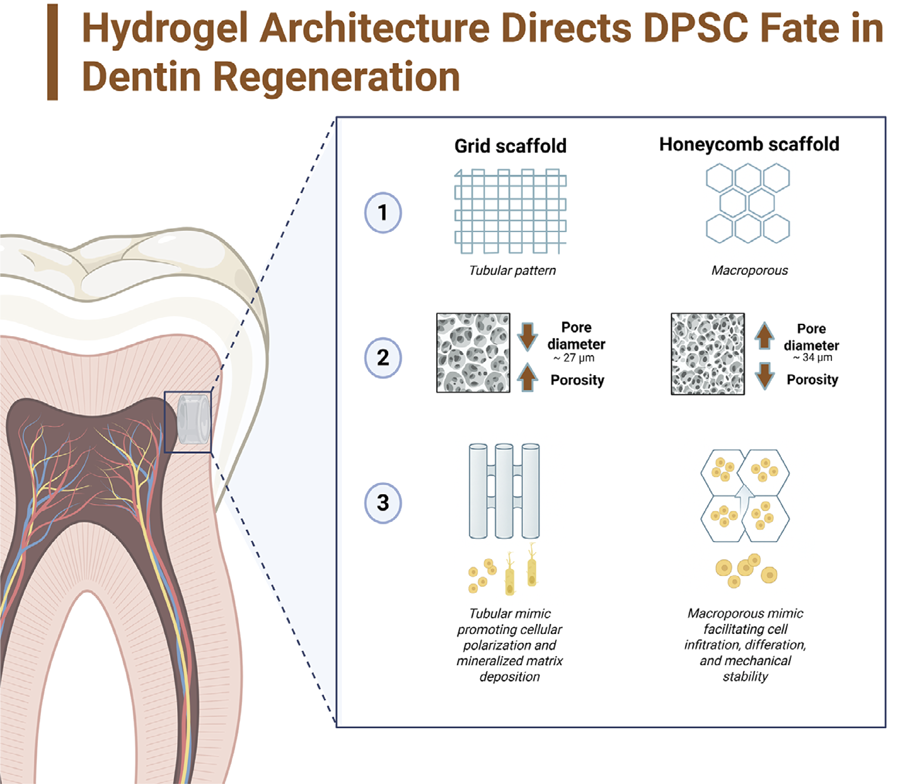
 Hydrogel microarchitecture as a regulatory cue for in vitro odontogenic differentiation
 Thumbnail
 Thumbnail
 Thumbnail
 Thumbnail