 Chemical Compounds from Ocotea neesiana (Miq.) Kosterm Demolition Wood and Their Effect on the Growth of Xanthomonas citri subsp. citri
Abstract
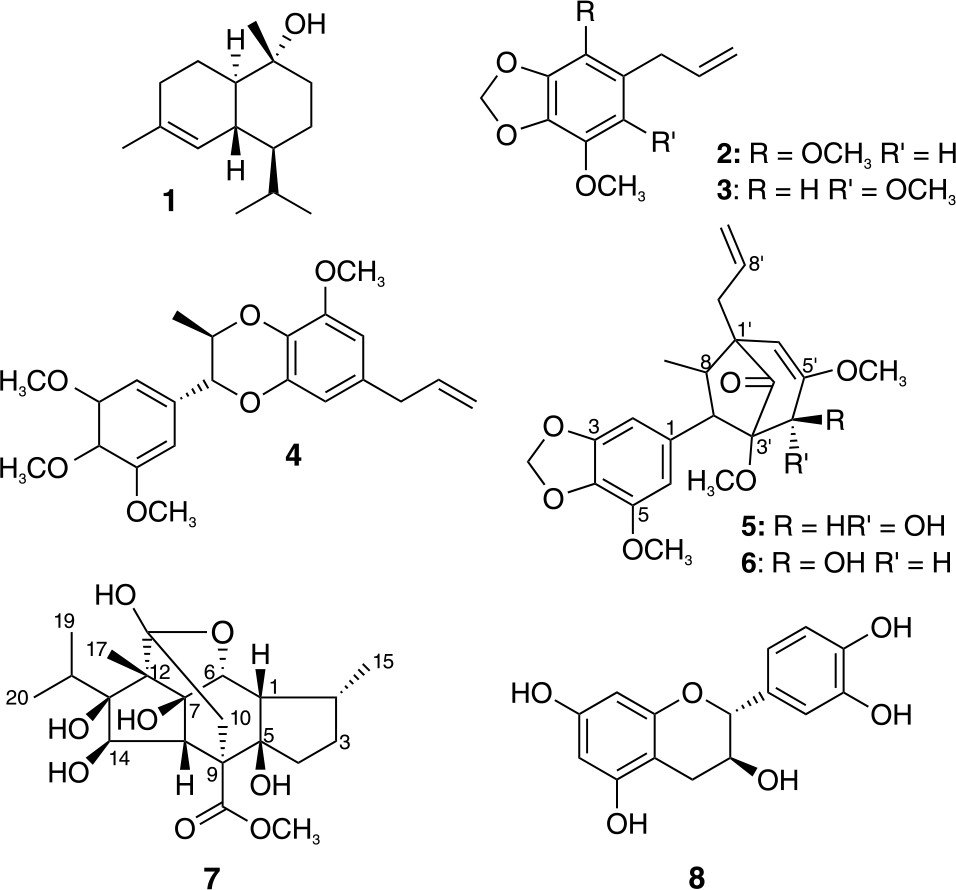
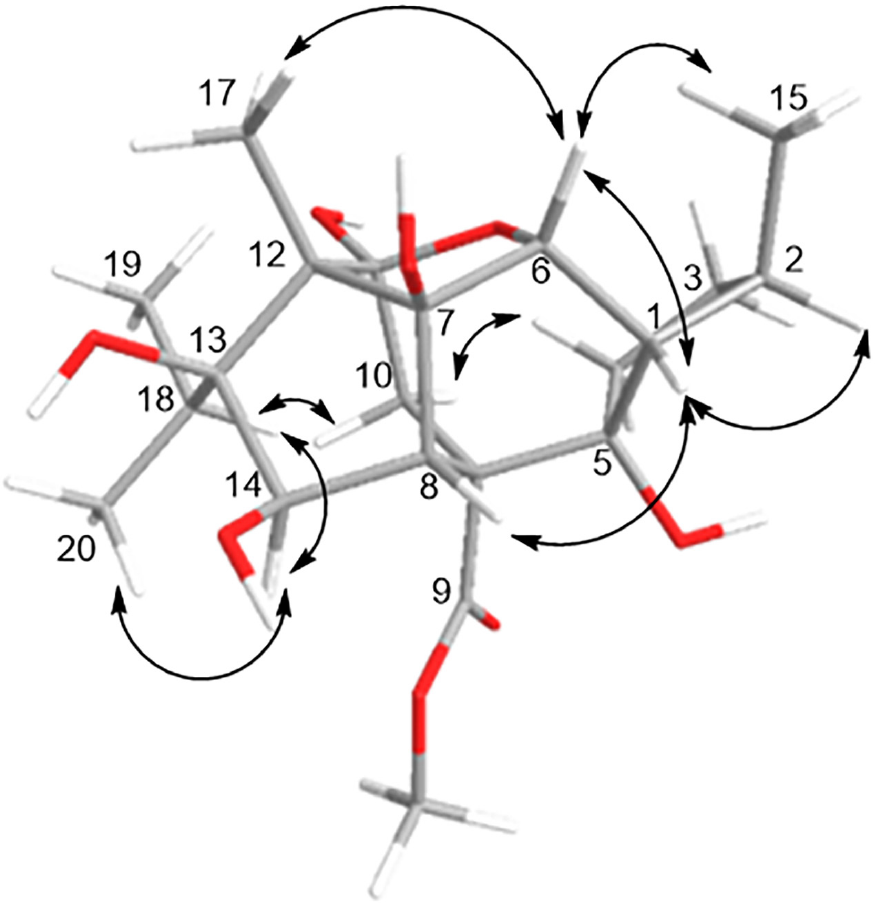
Citrus canker is a bacterial disease that is caused by Xanthomonas citri subsp. citri (Xcc) and affects all commercially important Citrus species. In this paper, we report a phytochemical study of Ocotea neesiana demolition wood, and the antibacterial potential of its compounds against Xcc. Chromatographic fractionation of the methanolic extract led to the purification of the compounds α-cadinol (1), apiol (2) and dillapiole (3) mixture, eusiderin A (4), rel-(7S,8R,l’R,3’S,4’S)-4’-hydroxy-5,3’,5’-trimethoxy-3,4-methylenedioxy-2’-oxo-D1,3,5,5’,8’-8.1’,7.3’-neolignan (5), rel-(7S,8R,l’R,3’S,4’R)-4’-hydroxy-5,3’,5’-trimethoxy-3,4-methylenedioxy-2’-oxo-D1,3,5,5’,8’-8.1’,7.3’ neolignan (6), 16-methylesteritol A (7) and catechin (8). Compounds 6 and 7 are reported for the first time. The sesquiterpene α-cadinol and the diterpene 16-methylesteritol A exhibited antibacterial potential against Xanthomonas citri subsp. citri. Minimum inhibitory concentration (MIC) and minimum bactericidal concentration (MBC) of 50 and 250 µg mL-1, respectively, were obtained. The results generate knowledge about the chemical and biological potential of Ocotea neesiana and add value to demolition wood residues.
Keywords:
Lauraceae; “louro-aritu”; sesquiterpene; neolignan; isoryanodane diterpene
 Thumbnail
 Thumbnail