 Multiresidue Method for Quantification of Nitroimidazoles, Anthelmintics, Amphenicols, and Dyes in Meat, Shrimp, and Fish by Using a Modified QuEChERS-type Extraction and Isotope Dilution Ultra-High Performance Liquid Chromatography-Tandem Mass Spectrometry
Abstract
This paper presents an analytical multiresidue method for the quantification of 7 nitroimidazoles, 19 anthelmintics, 3 amphenicols, and 4 dyes in poultry, pork, beef, horse, shrimp, and fish samples by isotope dilution ultra-high performance liquid chromatography coupled with tandem mass spectrometry (UHPLC-MS/MS) in a single 6 min run. Samples were prepared using a modified quick, easy, cheap, effective, rugged and safe (QuEChERS)-type extraction with ethyl acetate and Na2SO4-NaCl (2:1), concentration into dimethyl sulfoxide (DMSO), and defatting by liquid-liquid extraction (LLE) with n-hexane. No clean-up using solid-phase extraction (SPE) cartridges or dispersive solid-phase extraction (DSPE) was necessary. The linearity ranges (in μg kg-1) were 0.10-0.60 for chloramphenicol, 0.50-3.0 for dyes, 1.5-9.0 for nitroimidazoles, and 5.0-30.0 for the other drugs. The limits of quantitation (LOQ) were established at the lowest calibration curve levels. Except for chloramphenicol in the horse matrix, analyte recovery and reproducibility were satisfactory (recovery (fREC): 75.0 to 116.6%; coefficient of variation (CV): 1.2 to 29.9%). For the unapproved substances and the substances with a maximum residue level (MRL), respectively, the decision limits (CCα) were 0.14-4.10 and 5.28-1003.60 μg kg-1, while the detection capabilities (CCβ) were 0.13-3.33 and 5.46-11.56 μg kg-1.
Keywords:
nitroimidazoles; anthelmintics; amphenicols; dyes; ultra-high performance liquid chromatography-tandem mass spectrometry (UHPLC-MS/MS)
Introduction
Nitroimidazoles, benzimidazoles, imidazothiazoles, salicylanilides, amphenicols, and dyes are drugs whose residues must be investigated in foodstuffs, such as meat, shrimp, and fish, to ensure that their residual concentrations are below the maximum residue levels (MRL) or the unapproved use levels in the case of banned substances in food-producing animals (e.g., 5-nitroimidazoles, chloramphenicol, and dyes).
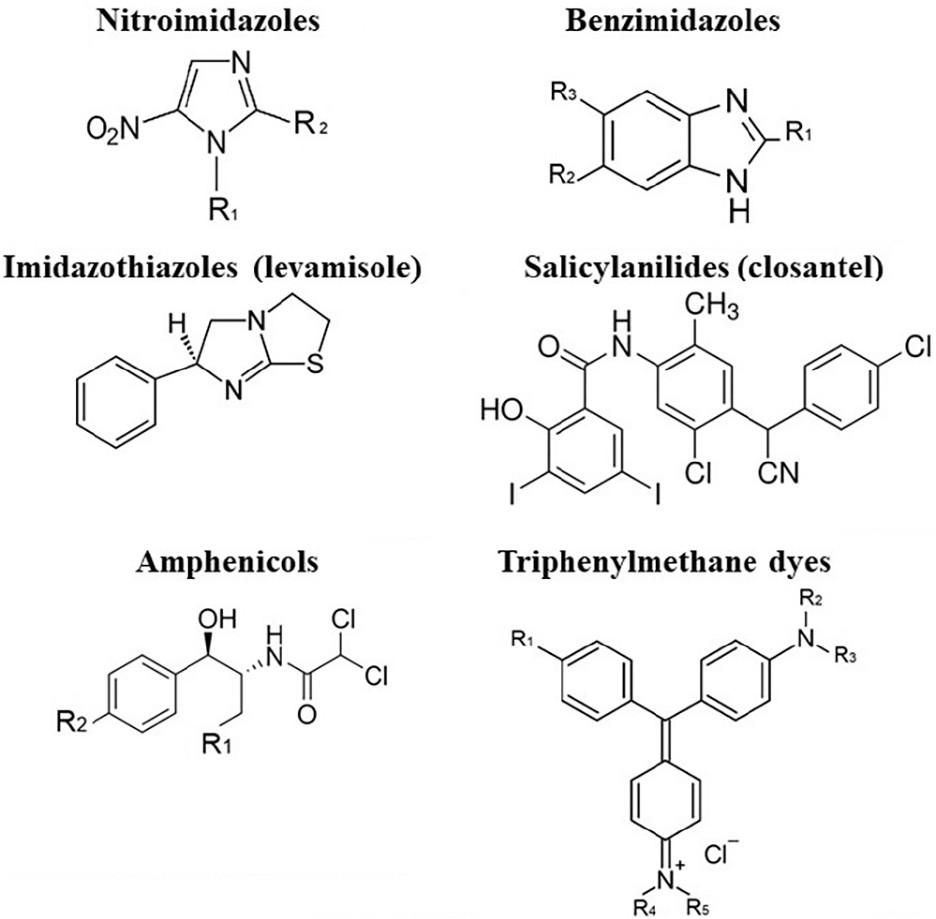
Figure 1 shows the chemical structures of the investigated drug classes. 5-Nitroimidazoles are imidazoles that contain a NO2 group on the 5-ring position and are active against anaerobic bacteria and protozoa. They are banned due to possible carcinogenicity and mutagenicity in humans and are rapidly metabolized in beef, porcine, and avian species, forming hydroxyl metabolites in the C-2 position, which should also be investigated.1 Benzimidazoles, imidazothiazoles, and salicylanilides are used as anthelmintic agents in the control of parasitic infections in livestock animals. Amphenicols are efficient antibiotics, but chloramphenicol is a banned drug in food-producing animals due to its serious adverse effects on human health, including aplastic anemia.2 Finally, triphenylmethane dyes like crystal violet and malachite green have an effect on fungus and protozoa, which would make them useful in fish and shrimp farms, mainly due to their low costs.3,4 However, their use in food for human consumption was banned because, once absorbed, they are quickly reduced to leuco crystal violet and leuco malachite green, which have negative side effects on human health,5 including carcinogenicity, teratogenicity, and mutagenicity.4
Table 1 summarizes the limits for the investigated drugs adopted in our validation studies, which are based on the Brazilian Health Regulatory Agency (ANVISA),6 the MMPR - EURL guidance 2022,7 and the European Commission Regulation 37/2010/EU.8 Whenever a limit was not established, it was assumed to be 5 μg kg-1 for validation purposes.
In Brazil, the Ministry of Agriculture, Livestock, and Food Supply (MAPA) is responsible for monitoring the quality of foodstuffs, livestock feed, fertilizers, and vaccines, among others. As part of the National Control Plan for Residues and Contaminants (PNCRC),9,10 several foodstuff matrices are investigated for the presence of different classes of residues. Therefore, selective, sensitive, and high-throughput multiresidue analytical methods, which allow the quantification of a broad range of trace contaminants in the same sample and using a single chromatographic run, contribute to saving time and money and optimizing resources.
Several methods based on QuEChERS-type (quick, easy, cheap, effective, rugged and safe) extractions coupled with high-performance liquid chromatography-tandem mass spectrometry (HPLC-MS/MS) were described in the literature for the quantification of nitroimidazoles,1,11-15 anthelmintics,11,12,16-23 amphenicols,11-13,15 or dyes.3-5,24 However, to our knowledge, no previous method performed the simultaneous quantification of all four drug classes, in six food matrices (poultry, pork, beef, horse, shrimp, and fish), in a single chromatographic run.
In this work, we present a multiresidue analytical method based on a modified QuEChERS-type extraction with ethylacetate and Na2SO4-NaCl (2:1), concentration into dimethyl sulfoxide (DMSO), defatting by liquid-liquid extraction (LLE) with n-hexane, followed by ultra-high performance liquid chromatography-tandem mass spectrometry (UHPLC-MS/MS), with MS polarity switching to detect both positively and negatively charged ions in a single 6-min run. The method was optimized and validated for the simultaneous identification, confirmation, and quantification of 7 nitroimidazoles, 19 anthelmintics, 3 amphenicols, and 4 dyes in meat, shrimp, and fish samples.
Experimental
Instruments and apparatus
The chromatographic analysis was performed in a Waters UHPLC-MS/MS (Waters Technologies, São Paulo, Brazil) system, consisting of an Acquity i-class UHPLC chromatograph with autosampler, interfaced to a XeVo TQS triple quadrupole mass spectrometer, equipped with an electrospray ionization (ESI) source in both positive and negative ion-switching and multiple reaction monitoring (MRM) modes. A Waters Acquity UPLC C18 column (BEH-C18, 50 × 2.1 mm internal diameter (i.d.), 1.7 µm) (Waters Technologies, São Paulo, Brazil) was used for chromatographic separation. Data treatment was achieved using the software MassLynxTM 1.4 Workstation and TargetLynxTM (Waters Technologies, São Paulo, Brazil).
Reagents and chemicals
Anhydrous sodium sulfate (JTBaker, Phillipsburg, USA), sodium chloride (Lioserum, São Paulo, Brazil), ethyl acetate (Fischer Scientific, Hampton, USA), n-hexane (Honeywell, São Paulo, Brazil), dimethyl sulfoxide (Scharlab, Taboão da Serra, Brazil), formic acid (PanReac, Barcelona, Spain), ammonium formate (Sigma-Aldrich, Cotia, Brazil), and N,N-dimethylformamide (Fischer Scientific, Waltham, USA) were of analytical grade. LC MS grade methanol and acetonitrile (Supelco, Darmstadt, Germany) were used for the preparation of standard solutions and mobile phase, respectively.
Standard solutions
Individual standard stock solutions containing 200 μg mL-1 of individual drugs and internal standards (IS) were prepared and stored at -10 °C for up to 1 year (except for solutions of dyes, which were stored for up to 6 months). Acetonitrile (ACN) was used for the dissolution of dyes, while methanol was used for the other drugs (this is valid for intermediate and working solutions). Whenever necessary, some drops of N,N-dimethylformamide were added to completely dissolve the standard material. The following analytical standards were from Dr. Ehrenstorfer GmbH (Augsburg, Germany): dimetridazole, ronidazole, metronidazole, metronidazole hydroxide, ipronidazole, albendazole 2-amino sulfone, triclabendazole, triclabendazole sulfone, chloramphenicol, florfenicol, thiamphenicol, closantel, leuco crystal violet, dimetridazole hydroxide-d3, metronidazole-d4, metronidazole hydroxide-d2, ipronidazole-d3, chloramphenicol-d5, crystal violet-d6, and leuco crystal violet-d6. Dimetridazole hydroxide was from LGC Standards (Teddington, UK). Ipronidazole hydroxide, albendazole, albendazole sulfone, albendazole sulfoxide, febantel, aminoflubendazole, thiabendazole, 5-hydroxy-thiabendazole, levamisole hydrochloride, malachite green, dimetridazole-d3, ronidazole-d3, ipronidazole hydroxide-d3, albendazole sulfoxide-methyl-d3, oxfendazole-d3, fenbendazole-d3, febantel-d6, flubendazole-d3, thiabendazole-d6, mebendazole-d3, malachite green-d5, and leuco malachite green-d6 were purchased from Sigma-Aldrich (Barueri, Brazil). Fenbendazole, fenbendazole sulfone, oxfendazole, oxibendazole, flubendazole, mebendazole, leuco malachite green, and crystal violet was obtained from CPA Chem (Bogomilovo, Bulgaria). Ketotriclabendazole was from NMI (West Lindfield, Australia), whereas albendazole-d7 was purchased from TRC (Toronto, Canada).
Intermediate solutions were prepared as follows, and stored at -10 °C for up to 1 year (except for solutions of dyes, which were stored for up to 1 month): (i) 10 μg mL-1 of nitroimidazoles, (ii) 10 μg mL-1 of nitroimidazoles IS, (iii) 10 μg mL-1 of chloramphenicol, (iv) 10 μg mL-1 of chloramphenicol IS, (v) 5 μg mL-1 of dyes, and (vi) 5 μg mL-1 of dyes IS. For the other drugs, no intermediate solutions were necessary.
Working solutions were prepared from the intermediate solutions (if available) or stock solutions, as follows, and stored at -10 °C for up to 6 months (except for solutions of dyes, which were stored for up to 1 day): (i) nitroimidazoles (0.15 μg mL-1) plus chloramphenicol (0.010 μg mL-1), (ii) nitroimidazoles IS (0.15 μg mL-1) plus chloramphenicol IS (0.015 μg mL-1), (iii) dyes (0.05 μg mL-1), (iv) dyes IS (0.15 μg mL-1), (v) remaining drugs (0.50 μg mL-1 each), (vi) IS of the remaining drugs (0.50 μg mL-1 each).
Precaution for dyes
Whenever dyes were investigated, the labeling of tubes and flasks was preferably made using pencils instead of pens, to avoid ink contamination, and the exposure to light was minimized, as previously described.3 Although crystal violet and leuco crystal violet in fortified fish/shrimp matrices were stable for at least 23 days when kept at -20 °C, malachite green was unstable in shrimp, and leuco malachite green was unstable in fish. Therefore, the extraction and UHPLC-MS/MS analysis were carried out on the same day.
Modified QuEChERS-type sample extraction
Muscle samples were cut into small pieces and weighed into 50-mL polypropylene centrifuge tubes (5 ± 0.05 g). The remaining muscle samples were stored in plastic bags at temperatures below -10 °C. Samples were spiked with 100 µL of IS working solutions (approximately 2 times the MRL, the minimum method performance requirement (MMPR), or the report action level (RPA)) and left to sit for 5 min. Then, a 10 mL aliquot of ethyl acetate was added and the tubes were mixed at 1500 rpm for 1 min using a 2010 Geno/Grinder tissue homogenizer (Spex Sampleprep, Metuhen, USA) and sonicated at 37 kHz for 5 min. Subsequently, the tubes received 6 g of a salting-out mixture (anhydrous Na2SO4:NaCl 2:1) and were again homogenized. After centrifugation at 4 °C for 10 min at 4000 rpm, the tubes were held in an ultra-freezer at a temperature below -60 °C for 10 min. The supernatants were transferred into 10-mL glass tubes containing 1 mL DMSO and evaporated in a water bath or solvent evaporating unit at 45 to 50 °C under air stream until the ethyl acetate was eliminated. Thereafter, 1 mL n-hexane was added to the tubes with DMSO, and the mixtures were vortexed, transferred into Eppendorf tubes, and centrifuged for 10 min at 4 °C and 14000 rpm. The fat-containing n-hexane upper layers were removed using vacuum and discharged, while the lower DMSO layers were filtered through 0.22 µm hydrophilic nylon syringe filters (Analítica, São Paulo, Brazil), transferred to vials, and injected onto the UHPLC-MS/MS system.
Sample preparation for method validation
The method validation was performed based on the procedures of the European Commission Decision 2002/657/EC.25 Linearity range, limit of quantitation (LOQ), recovery, repeatability, within-laboratory reproducibility, selectivity, robustness, measurement uncertainty (U), decision limit for confirmation (CCα), and detection capability for screening (CCβ) were evaluated. The general procedure for fortification during validation was the following: matrix blanks (5 ± 0.05 g) were weighed into polypropylene centrifuge tubes, spiked with 100 μL of IS working solutions, fortified with working standard solutions at the required concentration levels, left to sit for 5 min, and then extracted as previously described.
Matrix-fortified calibration curves consisted of fortified matrix blanks prepared in the following concentration ranges: (i) nitroimidazoles: 1.5 to 9.0 μg kg-1, 6 levels; (ii) chloramphenicol: 0.10 to 0.60 μg kg-1, 6 levels; (iii) benzimidazoles, levamisole, closantel, florfenicol, thiamphenicol, and closantel: 5.0 to 30 μg kg-1 (poultry, pork, beef, horse), 6 levels, or 2.50 to 30 μg kg-1 (shrimp and fish), 7 levels; and (iv) dyes: 0.50 to 3.0 μg kg-1 (only shrimp and fish), 6 levels. At least 12 fortified matrix blanks were prepared at the concentration of the first level of the calibration curves, which were initially considered to be the LOQs, to verify satisfactory recovery and reproducibility.
For the evaluation of poultry recovery and within-laboratory reproducibility, 6 replicates of fortified matrix blanks were prepared on 3 different days by 2 different analysts (a total of 18). For the other matrices, two sets of 10 fortified matrix blanks were prepared on 2 different days by 2 different analysts. The fortifications were done at the MRL, MRPL, RPA, or LOQ. For poultry, two other fortification levels were added (results not shown). Whenever the MRL exceeded the calibration curve range, additional curve calibration levels were added.
For poultry, CCα and CCβ were estimated using the ISO 1184326 approach, based on the calibration curves prepared on three different days. For the other matrices, CCα and CCβ were estimated from the standard measurement uncertainty results of 20 fortified matrix blanks, according to the Commission Implementing Regulation 2021/808.27
Isotope dilution UHPLC-MS/MS analysis
The UHPLC-MS/MS experimental conditions are shown in Table 2. The MS/MS conditions were optimized via infusion injection or taken from the literature. A precursor ion (parent mass) and two product ions (base and secondary fragments) were monitored for each analyte (Table 3). Analyte identity confirmation was based on retention time and area ratio between quantification and confirmation ions (ion ratio). The ion ratio of the analyte shall correspond to those of the standards, within a ± 40% relative deviation.27 Analyte quantification was calculated from the equipment response (area ratio between quantification product ion and IS, multiplied by the IS concentration), except in the case of closantel, for which the peak area was used since no IS was added. At the beginning of each analysis, a reference solution (50 μL of each standard working solution and 100 μL of each IS working solution, which were evaporated and reconstituted in 1 mL DMSO) was injected into the system to check if the peaks of all investigated analytes were present and to adjust the detection windows, if necessary.
Measurement uncertainties, decision limit (CCα), and detection capability (CCβ) calculations
Expanded measurement uncertainties (U) were estimated using a “top-down” approach based on the within-laboratory reproducibility standard deviation. The calculations of CCα and CCβ were based on the Commission Implementing Regulation 2021/808.27 The value of CCα for banned substances was calculated from equation 1, while equation 2 was used to calculate CCα for substances with an MRL. CCβ was calculated from equation 3.
where CCα: decision limit, CCβ: detection capability, LOQ: limit of quantitation, MRL: maximum residue level, uc: combined measurement uncertainty (uc = U/k), U: expanded measurement uncertainty, k: coverage factor.
Results and Discussion
Modified QuEChERS-type extraction
Previously, two other methods were validated in our laboratories.3,28 The first method28 was used for the quantification of nitroimidazoles, benzimidazoles, and avermectins in beef muscle and was based on the extraction of 5 g samples (2 replicates) with acetic acid-ACN (2:98, v/v) and Na2SO4-NaCl 2:1, clean-up of supernatants by dispersive solid-phase extraction (DSPE) with C18 MgSO4, and evaporation until dryness. The first replicate was dissolved in 0.1% formic acid in ACN-water (95:5, v/v) (for analysis of triclabendazole, closantel, and avermectins), while the second one was dissolved in 0.1% formic acid in 5 mmol L-1 ammonium formate (for the analysis of nitroimidazoles and benzimidazoles). The replicates were analyzed by independent UHPLC-MS/MS runs, using polarity switching to detect positively and negatively charged ions. The second method3 was developed to quantify dyes in shrimp and fish and consisted of the extraction of 2 g samples with formic acid-acetonitrile (1:99, v/v) and MgSO4, evaporation of the supernatants, dilution in ACN-water (1:1, v/v), clean-up by DSPE with C18-MgSO4, followed by a single UHPLC-MS/MS run (no negatively charged ions were investigated).
In this study, a multiresidue method was developed and validated to quantify nitroimidazoles, anthelmintics (benzimidazoles, imidazothiazoles, and salicylanilides), amphenicols, and dyes in meat (poultry, pork, beef, and horse), shrimp, and fish. First, the solvent was changed from acidified ACN to ethyl acetate, based on the work of Xia et al.,11 and Na2SO4-NaCl 2:1 was used as a salting-out mixture to induce liquid-liquid partitioning. The extraction with ethyl acetate improved signal intensity and reduced noise for several analytes, mainly nitroimidazoles. Second, the clean-up was improved by adding a freezing step below -60 °C after extraction, which removes the water trapped in the frozen lower layer and facilitates transferring the ethyl acetate supernatant to new tubes containing DMSO. Third, the ethyl acetate extract was evaporated into DMSO, instead of evaporating and dissolving the residue in aqueous solutions. DMSO was chosen because it is an aprotic polar solvent able to dissolve both polar and non-polar compounds and also helps to keep analytes in solution instead of binding to proteins, as described by Whelan et al.16 and Cooper et al.17 Finally, an n-hexane LLE step was used for defatting, since the DSPE step with C18 resulted in lower recovery for three analytes: ipronidazole, ipronidazole hydroxide, and albendazole sulfoxide (it may be possible that they were trapped into the DSPE phase together with the removed fat).
Although the complexity of tissue matrices in terms of content and analyte-tissue interactions must be considered in the development and optimization of methods for the analysis of veterinary drug residues,29 the optimized and validated extraction procedure has fewer steps and complexity than those currently available for the studied groups of compounds.
Chromatographic conditions
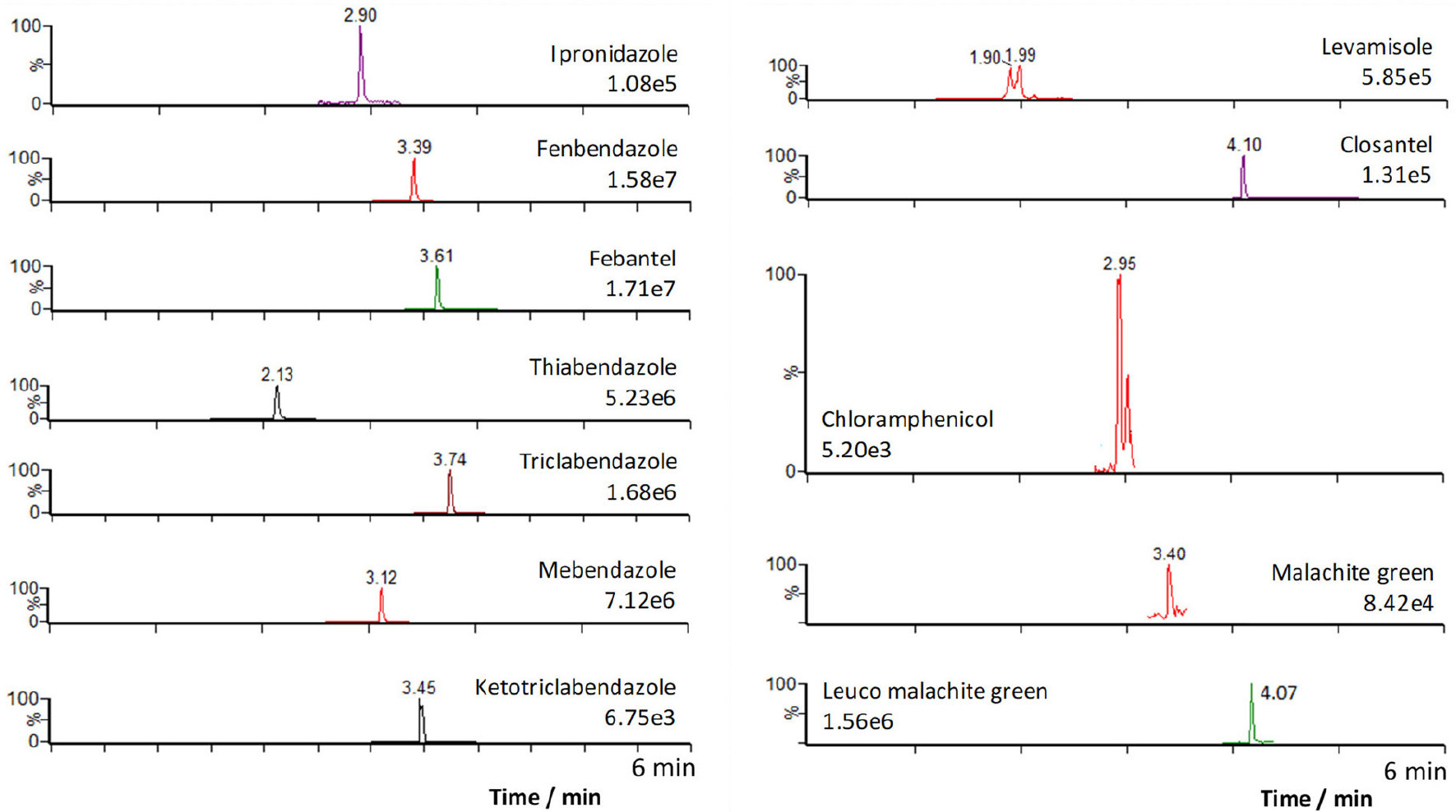
The chromatographic mobile phases were the same used in our laboratories for the analysis of nitroimidazoles and benzimidazoles, as described by Silva et al.,28 and the necessary adjustments were made in the gradient elution. The peaks of some analytes showed splitting, mainly levamisole (pKa = 6.98) at the retention times of 1.90 and 1.99 min, as well as chloramphenicol (pKa = 5.5) at 2.95 and 3.00 min. The pH of the mobile phase A (0.1% formic acid in 5 mmol L-1 ammonium formate) is close to 3, therefore both levamisole and chloramphenicol are fully protonated in the mobile phase, and the pH may not be responsible for peak splitting. A possible reason could be the formation of isomers or the quick elution of levamisole in acidic pH. Some authors19,20 pointed out that a higher recovery of levamisole can be obtained at neutral or even basic pH values.
Isotope dilution UHPLC-MS/MS method
The selectivity of the method was ensured by spiking the samples with marked isotope IS of each analyte (or similar analytes) (Table 3), except in the case of closantel. Since DMSO was the diluent injected into the UHPLC MS/MS, the autosampler temperature was kept at 18 °C to ensure appropriate fluidity and prevent clogging of the autosampler needle or the UHPLC-MS/MS tubing. The risk of clogging was real when the autosampler temperature was set to 15 °C and the room temperature dropped overnight to around 10 °C since our laboratories generally do not require the control of low room temperatures. There was no evidence that DMSO interfered with the ionization of analytes. However, if it happened, it was minimized by spiking the samples with IS (if analytes ionized less, the same occurred with the IS) and by the high sensitivity of the MS/MS system (injection volumes of 5 μL were sufficient to produce good response intensities).
By using rapid polarity switching between positive and negative modes, it was possible to detect both positively and negatively charged ions in a single run that took only 6 min. The majority of compounds were detected in positive ionization mode [M + H]+, except for amphenicols15 and triclabendazole-like molecules, which were detected in negative ionization mode [M - H]- (Table 3). Aiming to reduce the negative effect of interferents carried from the extraction into the DMSO diluent, the diverter valve was kept on from 0 to 1 min and from 5 to 6 min (Table 2), and the MRM window was restricted to the peak elution time window to maximize the ESI+ and ESI- responses of the analytes. The co-elution or the difficult separations between peaks represented no problem due to different precursor and product ions (Table 2). Figure 2 shows examples of UHPLC-MS/MS total ion chromatograms (TIC) of a fish matrix blank fortified at the LOQ with the investigated analytes (Figures S1 to S6, Supplementary Information (SI) section).

Examples of UHPLC-MS/MS TIC of a fish matrix blank fortified at the LOQ with nitroimidazoles, benzimidazoles, levamisole, closantel, amphenicols, and dyes. Experimental conditions: see Experimental section.
Validation results - linear ranges and limit of quantitation (LOQ)
The linear ranges (in μg kg-1) were 0.10 to 0.60 for chloramphenicol, 0.50 to 3.0 for dyes, 1.5 to 9.0 for nitroimidazoles, and 5.0 to 30.0 for the other drugs. Determination coefficients of at least 0.9052 were obtained and complied with the acceptance criteria of R2 ≥ 0.90. The first calibration curve levels were set as the LOQ, since the recovery of fortified matrix blanks at this level, as well as the coefficient of variation (CV%) of recovery results complied with the acceptance criteria.27 The allowed recovery (fREC) ranges according to concentration (c) were: (i) c ≤ 1 µg kg 1, 50% ≤ fREC ≤ 120%; (ii) 1 µg kg-1 < c < 10 µg kg-1, 70% ≤ fREC ≤ 120%; (iii) c > 10 µg kg-1, 80% ≤ fREC ≤ 120%, whereas the allowed reproducibility (CV) ranges were: (i) c < 10 µg kg-1, CV% ≤ 30%; (ii) c > 10 µg kg-1, CV ≤ 25%27 (Tables S1 and S2, SI section).
Accuracy and within-laboratory reproducibility
Analyte recovery and reproducibility were satisfactory (fREC: 75.0 to 116.6%; CV: 1.2 to 29.9%), except for chloramphenicol in the horse matrix (acceptance criteria27 were summarized above), Tables S3 and S4 (SI section).
The accuracy of results was demonstrated by satisfactory performance in proficiency testing, (|z score| ≤ 2), as follows: (i) Progetto Trieste Veterinary Drug Residues 2022 May, M1110A bovine muscle: dimetridazole, fREC 92.25%, z-score -0.2; ronidazole, fREC 97.93%, z-score -0.09; metronidazole, fREC 98.45%, z-score -0.07; (ii) CFIA Proficiency Test 2021 November, T10372 bovine muscle: chloramphenicol, fREC 93.33, 91.43, 76.00, and 120.00%, z-score -0.30, -0.39, -0.23, and -0.18; and (iii) FAPAS Food Chemistry Proficiency Test, 2020 September, T02406 eggs: dimetridazole, fREC 109.22%, z-score 0.40; ronidazole, fREC 109.21%, z-score 0.40.
Robustness and selectivity
The robustness of the method was assessed by using the fractional factorial design proposed by Youden and Steiner30 and focused on three analytical parameters: amount of salt mixture (A: 6 g; a: 5 g), type of homogenizer (B: 2010 Geno/Grinder tissue homogenizer; b: E6003 Eberbach shaker), and ethyl acetate evaporation temperature (C: 45 °C; c: 50 °C). The capital letters (A, B, and C) denote the nominal values, while the lowercase letters (a, b, and c) stand for the alternative values. The method was considered not robust for variations in the amount of salt mixture and type of homogenizer, especially for dimetridazole hydroxide, fenbendazole, fenbendazole sulfone, oxibendazole, and albendazole. Therefore, the method shall be executed as described in the Experimental section. Considering the possible instability of dyes,28 mainly malachite green, the extraction and UHPLC/MS-MS analysis were carried out on the same day, using freshly prepared working standard solutions. No significant evidence of degradation was observed.
For method selectivity evaluation, the analysis of representative blank samples did not show any interferences of signals, peaks, or ion traces at the retention times of the analytes. Furthermore, the addition of tetracyclines and macrolides to fortified matrix blanks did not interfere with the recovery of the investigated based on the t-test at 95% significance. It was assumed that matrix effects could occur based on previous studies.28 Therefore, matrix-fortified calibration curves were used and all extracts were spiked with IS. Special attention was paid to the negative signal suppression of chloramphenicol when positively charged ions co-eluted with it. Usually, the chloramphenicol response was improved by adjusting the SRM windows in the Waters XeVo MS/MS method to the smallest window possible.
Measurement uncertainties, decision limit (CCα), and detection capability (CCβ)
The decision limit (CCα) is the limit at and above which it can be concluded with a probability of α (1% for banned substances and 5% for substances with an MRL) that a sample is non-compliant, while the detection capability (CCβ) is the smallest content of the substance that may be detected, identified and/or quantified in a sample with an error probability of β (5% for banned or with an MRL substances).25Table 4 shows the results for expanded measurement uncertainties (U), CCα, and CCβ. Nitroimidazoles, chloramphenicol, and dyes are prohibited or unauthorized pharmacologically active substances; therefore, CCα and CCβ shall be as low as reasonably achievable. For authorized substances, CCα shall be higher than the MRL, but as close as possible to it, and CCβ shall be lower than the MRL.27 As shown in Table 4, these criteria were fulfilled.
Expanded measurement uncertainties (U), decision limits (CCα), and detection capabilities (CCβ) determined from fortified matrix blanks with nitroimidazoles, benzimidazoles, levamisole, closantel, amphenicols, and dyes
Method application and future perspectives
The method started to be used in the laboratory routine in 2020 after it was validated for nitroimidazoles and benzimidazoles in poultry. The other matrices were included in the validated method thereafter. In 2022 and 2023, the method scope was extended to new analytes (e.g., amphenicols, dyes). In the last four years, around 2400 samples were analyzed at the Laboratório Federal de Defesa Agropecuária de Minas Gerais (LFDA-MG) using the method as part of the MAPA PNCRC program.9Figure 3 shows examples of UHPLC-MS/MS TIC of albendazole for routine samples of poultry (Figure 3a), pork (Figure 3b), beef (Figure 3c), and shrimp (Figure 3d), which were spiked with the IS working solutions before extraction. The albendazole amounts in these samples were below the LOQ: the albendazole peak intensities of the quantification transition (266.1 to 191.1) at the retention time (tR) 3.2 min are in the order of 103, while the signal intensities in the fortified P1 (first calibration curve level, equivalent to the LOQ) are in the order of 106. The second transition (266.1 to 234.1) was used for confirmation. Albendazole-d7 signal intensity was used to estimate analyte responses and to quantify albendazole in the samples from the matrix-fortified calibration curves.
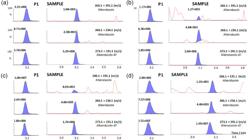
Examples of UHPLC-MS/MS TIC of albendazole for poultry (a), pork (b), beef (c), and shrimp (d) routine samples, compared to fortified blanks of the same matrices at the LOQ. Albendazole-d7 was the IS. Experimental conditions: see Experimental section.
A method scope extension for nitroimidazoles in eggs has started to be validated, and good z-scores in proficiency testing were already obtained. The applicability of the method for macrocyclic lactones (e.g., avermectins) is also promising, but further studies are necessary.
Conclusions
A multiresidue UHPLC-MS/MS method, based on a modified QuEChERS-type extraction was successfully developed for the quantification of 33 drugs (nitroimidazoles, anthelmintics, amphenicols, and dyes). The residual concentrations of these drugs in foodstuffs have to be determined, either because they are banned (5-nitroimidazoles, chloramphenicol, and dyes) or have an MRL. The validation parameters were satisfactory for six different matrices (poultry, pork, beef, horse, shrimp, and fish muscle), except for chloramphenicol in the horse matrix (unsatisfactory recovery and reproducibility). Therefore, taking this exception into account, the method is suitable for the confirmation and quantification of the investigated drug residues, in compliance with the National Control Plan for Residues and Contaminants (PNCRC) of the Brazilian Ministry of Agriculture, Livestock, and Food Supply (MAPA). The main advantages of using the method are the easy extraction procedure and the fast and accurate quantification of all drugs in a single UHPLC-MS/MS run. This represents significant time and financial savings for routine analysis laboratories.
Supplementary Information
Supplementary data (Figures S1 to S6 present the UHPLC-MS/MS TIC of fish matrix blanks fortified at the LOQ with all the investigated analytes and their corresponding IS, Tables S1 and S2 show the LOQ, linear ranges, and determination coefficients for the matrix-fortified calibration curves, while Tables S3 and S4 show the results of analyte recovery (fREC) and within-laboratory reproducibility (CV%) determined from fortified matrix blanks with nitroimidazoles, benzimidazoles, levamisole, closantel, amphenicols, and dyes) are available free of charge at http://jbcs.sbq.org.br as PDF file.
Acknowledgments
The LFDA-MG is grateful to the other five National Agricultural Defense Laboratories (LFDA) for sharing information and resources.
References
-
1 Cronly, M.; Behan, P.; Foley, B.; Danaher, M.; Malone, E.; Regan, L.; Food Addit. Contam.: Part B 2011, 4, 79. [Crossref]
» Crossref -
2 Guidi, L. R.; Tette, P. A. S.; Fernandes, C.; Silva, L. H. M.; Gloria, M. B. A.; Talanta 2017, 162, 324. [Crossref]
» Crossref -
3 Rocha, D. G.; Souza, L. F.; Lana, M. A. G.; da Silva, T. M. L.; de Assis, D. C. S.; J. Braz. Chem. Soc. 2021, 32, 722. [Crossref]
» Crossref -
4 Tkaczyk-Wlizlo, A.; Mitrowska, K.; Bladek, T.; Heliyon 2022, 8, e09331. [Crossref]
» Crossref -
5 Hartaud-Pessel, D.; Couëdor, P.; Verdon, E.; J. AOAC Int. 2013, 96, 1152. [Crossref]
» Crossref -
6 Agência Nacional de Vigilância Sanitária (ANVISA); Instrução Normativa No. 162, de 01 de julho de 2022, Estabelece a Ingestão Diária Aceitável (IDA), a Dose de Referência Aguda (DRfA) e os Limites Máximos de Resíduos (LMR) para Insumos Farmacêuticos Ativos (IFA) de Medicamentos Veterinários em Alimentos de Origem Animal; Diário Oficial da União (DOU), Brasília, No. 126, de 06/07/2022, p. 238. [Link] accessed in June 2024
» Link -
7 MMPR - EURL Guidance on Minimum Method Performance Requirements (MMPRs) for Specific Pharmacologically Active Substances in Specific Animal Matrices; https://sitesv2.anses.fr/en/system/files/EURL_MMPR_guidance_endorsed_v2_June2022.pdf, accessed in June 2024.
» https://sitesv2.anses.fr/en/system/files/EURL_MMPR_guidance_endorsed_v2_June2022.pdf -
8 European Commission (EC); 37/2010/EU: Commission Regulation on 22 December 2009 on Pharmacologically Active Substances and their Classification Regarding Maximum Residue Limits in Foodstuffs of Animal Origin; Official Journal of the European Union, 2010, L 15, p. 1. [Link] accessed in June 2024
» Link -
9 Ministério da Agricultura, Pecuária e Abastecimento (MAPA); Secretaria de Defesa Agropecuária (SDA); Instrução Normativa No. 42, de 20 de dezembro de 1999, Altera o Plano Nacional de Controle de Resíduos em Produtos de Origem Animal - PNCRC e os Programas de Controle de Resíduos em Carne - PCRC, Mel - PCRM, Leite - PCRL e Pescado - PCRP; Diário Oficial da União (DOU), Brasília, No. 244, de 22/12/1999, p. 213. [Link] accessed in June 2024
» Link -
10 Ministério da Agricultura, Pecuária e Abastecimento (MAPA); Secretaria de Defesa Agropecuária (SDA); Instrução Normativa No. 5, de 23 de abril de 2019, Aprova o Plano de Amostragem e os Limites de Referência para o Plano Nacional de Controle de Resíduos e Contaminantes em Produtos de Origem Animal - PNCRC para as Cadeias de Carnes Bovina, Suína, Caprina, Ovina, Equina, de Coelho, de Aves e de Avestruz, de Leite, Pescado, Mel e Ovos; Diário Oficial da União (DOU), Brasília, No. 79, de 25/04/2019, p. 4. [Link] accessed in June 2024
» Link -
11 Xia, X.; Wang, Y.; Wang, X.; Li, Y.; Zhong, F.; Li, X.; Huang, Y.; Ding, S.; Shen, J.; J. Chromatogr. A 2013, 1292, 96. [Crossref]
» Crossref -
12 Wang, Y.; Li, X.; Zhang, Z.; Ding, S.; Jiang, H.; Li, J.; Shen, J.; Xia, X.; Food Chem 2016, 192, 280. [Crossref]
» Crossref -
13 León, N.; Pastor, A.; Yusà, V.; Talanta 2016, 149, 43. [Crossref]
» Crossref -
14 Chen, D.; Delmas, J.; Hurtaud-Pessel, D.; Verdon, E.; Food Chem. 2020, 311, 125924. [Crossref]
» Crossref -
15 Melekhin, A. O.; Tolmacheva, V. V.; Goncharov, N. O.; Apyari, V. V.; Parfenov, M. Y.; Bulkatov, D. P.; Dmitrienko, S. G.; Zolotov, Y. A.; J. Pharm. Biomed. Anal. 2024, 237, 115764. [Crossref]
» Crossref -
16 Whelan, M.; Kinsella, B.; Furey, A.; Moloney, M.; Cantwell, H.; Lehotay, S. J.; Danaher, M.; J. Chromatogr. A 2010, 1217, 4612. [Crossref]
» Crossref -
17 Cooper, K. M.; Whelan, M.; Kennedy, D. G.; Trigueros, G.; Cannavan, A.; Boon, P. E.; Wapperom, D.; Danaher, M.; Food Addit. Contam.: Part A 2012, 29, 746. [Crossref]
» Crossref -
18 Kang, J.; Fan, C. L.; Chang, Q. Y.; Bu, M. N.; Zhao, Z. Y.; Wang, W.; Pang, G. F.; Anal. Methods 2014, 6, 6285. [Crossref]
» Crossref -
19 Zrncic, M.; Gros, M.; Babic, S.; Kastelan-Macan, M.; Barcelo, D.; Petrovic, M.; Chemosphere 2014, 99, 224. [Crossref]
» Crossref -
20 Mooney, D.; Coxon, C.; Richards, K. G.; Gill, L.; Mellander, P.; Danaher, M.; Molecules 2019, 24, 1978. [Crossref]
» Crossref -
21 Li, Y.; Gan, Z.; Liu, Y.; Chen, S.; Su, S.; Ding, S.; Tran, N. H.; Chen, X.; Long, Z.; Sci. Total Environ. 2020, 719, 137516. [Crossref]
» Crossref -
22 Kim, E.; Park, S.; Park, H.; Choi, J.; Yoon, H. J.; Kim, J.; Molecules 2021, 26, 2575. [Crossref]
» Crossref -
23 Yoo, K.-H.; Park, D.-H.; El-Aty, A. M. A.; Kim, S.-K.; Jung, H.-N.; Jeong, D.-H.; Cho, H.-J.; Hacimüftüo, A.; Shim, J.-H.; Jeong, J.; Shin, H.; J. Pharm. Anal. 2021, 11, 68. [Crossref]
» Crossref -
24 Storeya, J. M.; Clark, S. B., Johnson A. S.; Andersen, W. C.; Turnipseeda, S. B.; Lohnea, J. J.; Burgerb, R. J.; Ayres, P. R.; Carr, J. R.; Madson, M. R.; J. Chromatogr. B 2014, 972, 38. [Crossref]
» Crossref -
25 European Commission; 2002/657/EC: Commission Decision of 12 August 2002 Implementing Council Directive 96/23/EC Concerning the Performance of Analytical Methods and the Interpretation of Results; Official Journal of the European Communities, 2002, L 221, p. 8. [Link] accessed in June 2024
» Link -
26 ISO 11843-2:2000: Capability of Detection Part 2: Methodology in the Linear Calibration Case, ISO: Geneva, 2000. [Link] accessed in June 2024
» Link -
27 Commission Implementing Regulation (EU); 2021/808 of 22 March 2021 on the Performance of Analytical Methods for Residues of Pharmacologically Active Substances Used in Food-Producing Animals and on the Interpretation of Results as well as on the Methods to be Used for Sampling and Repealing Decisions 2002/657/EC and 98/179/EC; Official Journal of the European Union, 2021, L 180, p. 84. [Link] accessed in June 2024
» Link -
28 da Silva, G. R.; Lima, J. A.; de Souza, L. F.; Santos, F. A.; Lana, M. A. G.; de Assis, D. C. S.; Cançado, S. V.; Talanta 2017, 171, 307. [Crossref]
» Crossref -
29 Rezende, C. P.; Souza L. F.; Almeida, M. P.; Dias, P. G.; Diniz, M. H.; Garcia, J. C.; Food Addit. Contam.: Part A 2012, 29, 587. [Crossref]
» Crossref - 30 Youden, W. J.; Steiner, E. H.; Statistical Manual of the AOAC; Association of Official Analytical Chemists: Washington, DC, 1975.
Edited by
-
Editor handled this article:
Eduardo Carasek