 Soil Macrofauna and its Relationship with Trace Metals under Different Cacao Cultivation Management Systems in the Central Rainforest Region of Peru
Abstract
Few studies in the Peruvian Amazon have jointly evaluated soil macrofauna and heavy metal contamination in cacao agroecosystems. This study integrated ICP-MS (inductively coupled plasma mass spectrometer) multielement analysis, soil macrofauna assessment, and multivariate statistics in five cacao plots (113-1,102 m above sea level) under monoculture and diversified management with varying fertilization and pesticide inputs. Twelve elements were quantified in 25 composite soil samples, and macrofauna were collected from 25 soil monoliths (25 cm × 25 cm × 20 cm), yielding eight taxa. As, Cd, and Pb ranged from 1.74-8.42, 0.139-0.964, and 8.21-53.9 ppm, respectively, with peak concentrations in plot P05. Plot P02, under diversified management, showed the greatest macrofaunal diversity (S = 4.6 (species richness); H = 1.15 (Shannon diversity index). Hymenoptera (1,060 individuals) and Oligochaeta (257 individuals) dominated the community, while Coleoptera, Isopoda, and Blattodea were scarce. Most metal-macrofauna correlations were weak; however, significant positive associations were detected between sulfur and Helicidae (ρ = 0.401 (Spearman rank correlation coefficient), p < 0.05) and chromium and Coleoptera (ρ = 0.465, p < 0.05). These findings suggest that soil mineral composition and management practices, beyond toxic-metal loads alone, jointly shape macrofaunal structure, underscoring the need for sustainable soil monitoring in the Central Rainforest Region of Peru.
Keywords:
ICP-MS; soil biodiversity; cacao management; tropical agroecosystems; trace elements; Chanchamayo
Introduction
Soil macrofauna, composed of invertebrates larger than 2 mm, play an essential role in regulating soil properties and serve as a sensitive indicator of contamination by heavy metals such as Cd, Pb, Cu, and Hg.1-3 These heavy metals have no metabolic function in soil organisms,4 and their mobility depends on the physical, chemical, and biological characteristics of the soil.5,6 Globally, agricultural soils face sustainability challenges derived from inadequate farming practices, such as the indiscriminate use of agrochemicals and synthetic fertilizers, and insufficient soil monitoring.7-10 Among these challenges, the accumulation of heavy metals is of particular concern because their chemical speciation determines their toxicity and behavior within the rhizosphere. Addressing this problem requires integrated analytical approaches. While broad frameworks such as omics and data-analysis tools can improve understanding of metal-soil-plant interactions, environmental monitoring studies also depend on the combined use of sensitive elemental techniques, biological indicators, and multivariate statistics.11,12 Modern approaches for heavy-metal determination in soils include plasma-based and laser-based techniques.13 Laser-induced breakdown spectroscopy (LIBS) has gained attention because it enables rapid and non-invasive elemental analysis; however, it is commonly used as a qualitative or semi-quantitative technique, and reliable quantification generally requires calibration procedures to reduce the effects of sample matrix and measurement conditions.14 Although optimized LIBS systems can reach low detection limits, such as 131 ppb for Cu in water, the present study required precise multielement quantification in acid-digested soil samples from cacao plots. Accordingly, inductively coupled plasma mass spectrometer (ICP-MS), combined with soil macrofauna assessment and multivariate statistical analyses, was considered the most appropriate approach for evaluating the relationship between soil chemistry and macrofaunal composition.15,16
Peru, as a center of cacao diversity, has experienced significant growth in this sector in recent years, ranking as the eighth-largest exporter of the world, with 70% of its exports directed to Europe.17 In the Central Rainforest Region of Peru, particularly in San Juan de Tulumayo, San Ramón District (Chanchamayo Province), cacao production is an important economic activity and is strongly influenced by soil quality and management. However, local farmers often rely on empirical agricultural practices, such as excessive use of fertilizers and pesticides, which increase heavy metal levels and negatively affect both soil biodiversity and agricultural productivity.18,19 The presence of cadmium (Cd) and other metals in soils limits access to international markets.17 Therefore, the use of bioindicator and bioaccumulator organisms is necessary to monitor environmental changes resulting from toxic contamination in affected areas, particularly regarding heavy metals that chronically pollute the food chain.17 Although soil macrofauna, particularly earthworms and some arthropods, are increasingly recognized as bioindicators of soil quality and, in some taxa, as bioaccumulators of heavy metals, the available evidence remains uneven across organism groups and environmental settings.18 Recent studies have highlighted the value of soil macrofauna for assessing soil quality and management effects, whereas the strongest evidence for heavy-metal bioaccumulation has been reported mainly for earthworms.18,19 However, field-based studies linking multiple macrofaunal groups with trace-metal patterns in tropical cacao agroecosystems remain limited.12 In this context, the objective of the present study is to evaluate the relationship between soil macrofauna and heavy metal contamination in cacao agricultural soils within a production area of the Central Rainforest Region of Peru. This approach is crucial for developing sustainable soil management strategies, enabling the identification of the degree of macrofaunal disturbance caused by contamination, and providing a basis for new proposals for more efficient agricultural practices that mitigate environmental impacts and optimize cacao productivity in the region.20,21 ICP-MS was selected over LIBS due to its superior analytical sensitivity and lower detection limits, ensuring the precise ultra-trace quantification necessary for assessing soil heavy metal contamination.
Experimental
Study area
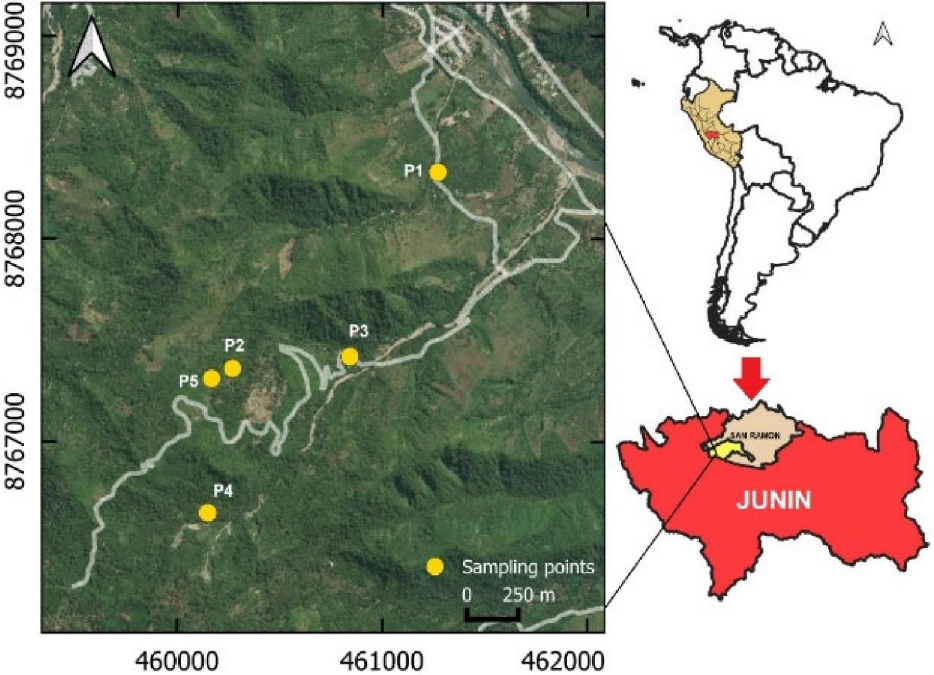
The study was conducted in San Juan de Tulumayo, a zone located southwest of the San Ramón District, Chanchamayo Province (11º03’00’’ S, 75º18’15’’ W), in the Amazonian part of the Junín Department (Figure 1). This area belongs to the high rainforest (selva alta) region, characterized by rugged topography and a mean annual temperature of 23.1 °C, with minimum values of 16.7 °C in July and maximum values of 30.1 °C in October-November. The average annual precipitation is 2000 mm, with a low-rainfall season between June and August, reaching a minimum of 75 mm in July.22

Location of the cacao cultivation plots in San Ramón District, Chanchamayo Province, Peru. Source: Google Maps (2024).
The study area is dedicated to the cultivation of crops for both local consumption and commercial production, among which cacao, banana, and coffee stand out, with cacao being the predominant crop.
A total of five cacao plots were established, located at altitudes ranging from 113 to 1,102 m above sea level.23 The criteria used for plot selection included the type of crop management (monoculture or diversified farming) as well as the use of fertilizers and pesticides (Table 1).
Location and description of sampling sites under different cacao cultivation management systems in San Ramón District, Chanchamayo Province, Peru
Currently, much of the area adjacent to the study site remains covered by primary Amazonian forest, with tree species such as walnut (Juglans sp.) and bolaina (Guazuma crinita), fruit trees such as mango (Mangifera indica), papaya (Carica papaya), and carambola (Averrhoa carambola), as well as local fauna including cupte, squirrels, and black vultures. Residential houses are also found along the margins of the road and near small streams that flow into the Tulumayo River. Fieldwork was carried out at the end of July and during August 2023, in the winter season, when rainfall was scarce.
Sampling and metal analysis
In each plot, five composite soil samples were collected, each composed of a mixture of four subsamples, following the recommendations of the national soil sampling protocol established by the Ministry of the Environment (MINAM). The subsamples were extracted using augers from a depth of 0 to 30 cm. In total, 25 composite samples of approximately 1 kg were obtained. In the laboratory, soil samples were manually cleaned to remove plant residues and stones. Subsequently, they were oven-dried at 65 °C, ground, homogenized, sieved (approximately 50 mesh), and stored in Falcon tubes. Approximately 200 ± 3 mg of each sample were weighed in triplicate and submitted for chemical decomposition and subsequent analysis. Chemical decomposition was performed using 3.0 mL of 65% HNO3 and 0.1 mL of HF at 200 °C in a Savillex Teflon bottle for 4 h on a hot plate. After digestion, the samples were diluted to achieve a 2% HNO3 concentration and analyzed using an ICP-MS (Elan DRC II, PerkinElmer SCIEX, Norwalk, CT, USA). The quantified toxic metals were As, Cd, and Pb. The essential trace elements analyzed included Fe, Mg, Al, P, S, K, Cr, Cu, and Mn.
The analytical performance of the ICP-MS method was validated through the determination of the limit of detection (LOD) and limit of quantification (LOQ) for each analyzed element. As shown in Table 2, the LOD values ranged from 0.002 to 3.711 ppm, ensuring that even the trace concentrations of toxic elements, such as As, Cd and Pb were accurately detected within the studied cacao plots.
Limits of detection (LOD) and of quantification (LOQ) by ICP-MS and concentrations of certified reference material (CRM) of Buffalo River Sediment (NIST SRM 2704) used to evaluate the extraction efficiencies
Method accuracy was further assessed using the certified reference material (CRM) NIST SRM 2704 Buffalo River Sediment (National Institute of Standards and Technology Standard Reference Material 2704). Recovery rates for target toxic metals and essential trace elements (Cd, Pb, Fe, Cu, and Mn) showed high efficiency, ranging from 80.6 to 111.4%. While a lower recovery was observed for refractory lithogenic elements (Al, K, and Mg), this is attributed to the partial digestion of the silicate mineral lattice. The HNO3-HF ratio employed was optimized to prioritize the acid-leachable fraction, which represents the potentially bioavailable pool rather than the inert mineral core sequestered within the crystalline structure.
Sampling and identification of soil macrofauna
Five soil monoliths were collected from each plot using a 25 cm × 25 cm × 20 cm quadrat, following the method recommended by Anderson and Ingram.24 A total of 25 monoliths were extracted, placed in high-density polyethylene bags, labeled, and transported to the laboratory. In the laboratory of the Environmental Engineering Program at the National Intercultural University of the Central Jungle Juan Santos Atahualpa, soil macrofauna individuals were separated, counted, and classified. Subsequently, they were preserved in glass jars containing 70% ethanol. Identification was carried out to the lowest possible taxonomic level, given the limited availability of specialized reference literature.
Data analysis
Comparisons of metal concentrations among plots were performed using the Kruskal-Wallis test (p < 0.05), since the data were not normally distributed (p < 0.05). Chemical data were square-root transformed prior to multivariate classification and clustering analysis. The dendrogram was constructed based on Euclidean distance and complemented with the SIMPROF test (p < 0.05).25 Principal component analysis (PCA) was applied to simplify the variables.
The abundance data of the identified taxa were square-root transformed for multivariate classification (dendrogram) and ordination (principal components) analyses, in order to infer the relationships between the most important parameters and the presence of soil invertebrate taxa. Sampling representativeness was evaluated using a species accumulation curve.26 Finally, non-parametric correlations (Spearman rank correlation coefficient (ρ), p < 0.05) were performed between the percentages of taxa and metal concentrations. All analyses were conducted using the Vegan27 and FactoMineR packages of the R software (R Core Team, version 3.5.1, 2015).28
Results and Discussion
Metal concentrations in soil
The results obtained (Table 3) show the concentrations of metals and metalloids in soils under different cacao cultivation management systems. Among the evaluated elements, Al and Fe were the most abundant, a characteristic feature of tropical soils, followed by Mg, S, K, and P, which are essential elements for soil fertility. No significant differences were observed for Mg, Al, P, and Cu, suggesting a homogeneous distribution of these elements. This indicates that their variability may not be directly related to the cultivation management system, but rather to the mineralogical composition of the parent soil. Mn and Fe showed significant differences (p < 0.05), both exhibiting a marked increase in P5. This pattern could be associated with the inherent mineralogical composition of the soil in this area or with accumulation processes induced by agricultural management. Regarding K, a significant increase was also observed in P5 (up to 3370 ppm, p = 0.049), possibly linked to the type of fertilization applied under this management system. Similarly, As, Cd, and Pb-classified as toxic elements-showed statistically significant differences (p < 0.05). The highest As concentrations (6.72 8.42 ppm) were recorded in P5, as well as Cd concentrations ranging from 0.139 to 0.964 ppm, and Pb levels, suggesting possible accumulation from anthropogenic sources such as phosphate fertilizer application or contamination through leaching processes. Glyphosate-based herbicides were applied twice a year for weed control in plot P4, while organic amendments in P5 consisted of guano from islands (rich in P and N).
Concentrations of metals (mean ± standard deviation) in soils under different cacao cultivation management systems in San Ramón District, Chanchamayo Province, Peru
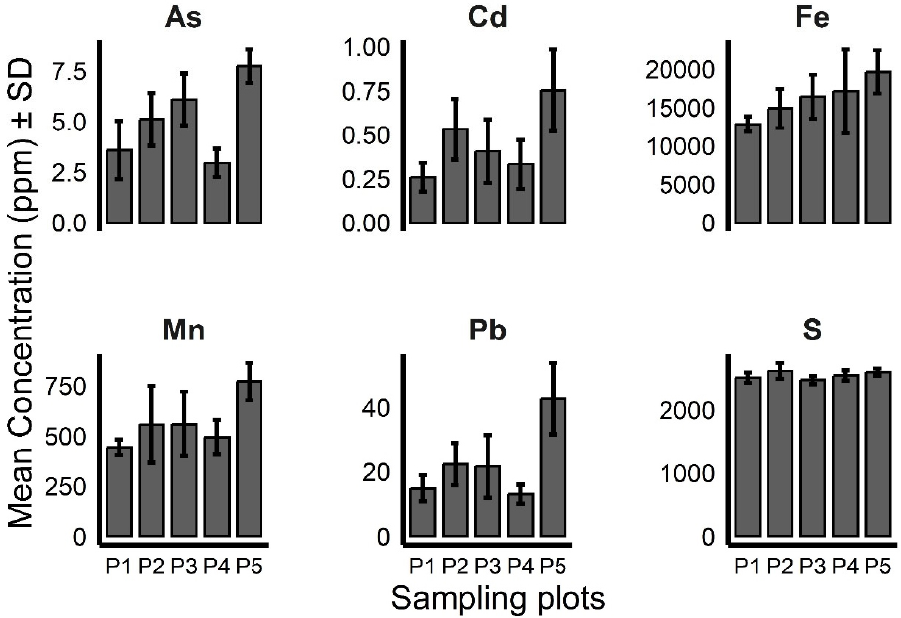
The spatial distribution of mean elemental concentrations across the five management systems (P1-P5) is illustrated in Figure 2. The histograms reveal a clear trend of higher accumulation for specific metals in monoculture systems compared to diversified agroforestry plots. Notably, the bars for As, Cd and Pb show significant variability between sites, with error bars (standard deviation) indicating the heterogeneity of metal distribution within the topsoil of different management regimes.
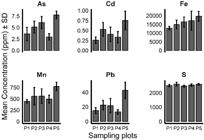
Mean concentrations of trace metals across sampling plots (P1-P5). Error bars represent the standard deviation (n = 5).
Overall, these results indicate that agricultural management systems have a differentiated impact on the accumulation and distribution of metals in the soil. This has important implications for the sustainability of cacao production and ecosystem health, highlighting the need to monitor toxic metal levels in agricultural soils of this region.
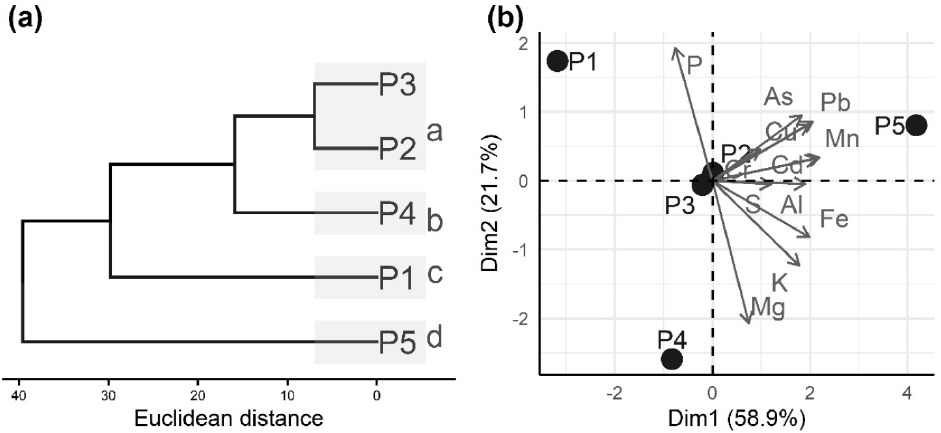
The classification and ordination analyses of the chemical element concentrations among the plots revealed four significantly different groups (p < 0.05) (Figure 3a). Group a (P2 and P3) corresponds to plots fertilized with urea and mulch; group b (P4) is characterized by the use of mulch, guinea pig manure, and cacao residues, with weed control through glyphosate herbicide; group c (P1) includes the plot fertilized exclusively with mulch; and group d (P5) corresponds to the plot managed with urea, mulch, and seabird guano. The significant differences among these groups suggest that specific inputs, such as seabird guano or glyphosate, may have differential effects on nutrient availability and trace element dynamics. In the PCA biplot (Figure 3b), which illustrates the relationship between chemical elements and sampling plots, the first two components explained more than 80% of the total variability results consistent with the clustering analysis. Plot P5 was associated with most of the analyzed elements (As, Cu, Pb, Mn, Cd, S, Al), recording the highest concentrations. Conversely, plots P1 and P4 were located in the opposite plane, showing the lowest values, except for P and Mg, respectively.

(a) Cluster dendrogram of the five cacao cultivation plots based on the evaluated metals; (b) principal component analysis (PCA) biplot of trace metals by sampling plot in cacao-cultivated soils plots in San Ramón District, Chanchamayo Province, Peru.
Composition of the soil macrofauna community
The rarefaction curve (Figure 4) showed only a slight increase in taxon richness after the first nine samples, indicating that most of the macrofaunal richness was captured within the plots analyzed in this study.

Species accumulation curve according to the number of samples collected in cacao-cultivated soils in plots in San Ramón District, Chanchamayo Province, Peru.
The taxonomic composition and total abundance of soil macrofauna in the cacao cultivation plots are presented in Table 4. A total of eight taxa were identified, revealing that the class Clitellata (family Lumbricidae) was the most abundant, with a total of 257 individuals distributed among the five plots. Their consistent presence across the sampling sites suggests a stable occurrence of this group in cacao-cultivated soils. In contrast, Blattodea (family Blaberidae) was very scarce, with only two individuals recorded in plot P5.
Taxonomic composition and total abundance of soil macrofauna recorded in cacao-cultivated soils in San Ramón District, Chanchamayo Province, Peru
Among arachnids, the family Araneae was notable, with a total of 148 individuals, being most abundant in plot P4 (121 individuals), suggesting that these species may be taking advantage of prey availability in the soil environment. Regarding insects, Hymenoptera (undetermined family) showed the highest abundance, with a total of 1,060 individuals, and were most numerous in plot P5 (432 individuals). These taxa likely play key ecological roles in pollination, pest control, and soil aeration. Coleoptera, with a total of 38 individuals, exhibited low abundance, particularly in plot P2, where no individuals were recorded. This, together with the scarcity of Blattodea, may reflect a reduction in organic matter decomposition, soil aeration, and biological control processes. Conversely, Diplopoda (family Scolopendrellidae), Gastropoda (Helicidae), and Malacostraca (isopods) were more common in plot P2, possibly associated with the specific humidity and temperature conditions of this site.
Differences in macrofaunal composition among plots could therefore be related to variations in cultivation management, soil conditions, and organic resource availability.
The mean alpha diversity of soil macrofauna varied among the evaluated plots (Table 5). Plot P2 showed the highest species richness (S = 4.6), evenness (E = 0.59 (Simpson evenness index)), and diversity (H = 1.15 (Shannon diversity index)), indicating that diversified management increases soil biodiversity by generating a wider variety of microhabitats and resources, thus favoring soil macrofaunal activity. This enhances key ecosystem processes such as decomposition, nutrient cycling, natural pest control, and improvements in soil structure and fertility, contributing to its resilience and sustainability. In contrast, plot P5 recorded the highest abundance (102.8 individuals) and dominance (Simpson’s dominance index, D = 0.71), indicating that a few species predominate within the soil community. The lowest diversity was observed in plot P1, with H = 0.60 and higher dominance (D = 0.67), suggesting that homogeneous cropping systems reduce the diversity of soil organisms.
Mean alpha diversity of soil macrofauna recorded in cacao-cultivated soils in San Ramón District, Chanchamayo Province, Peru
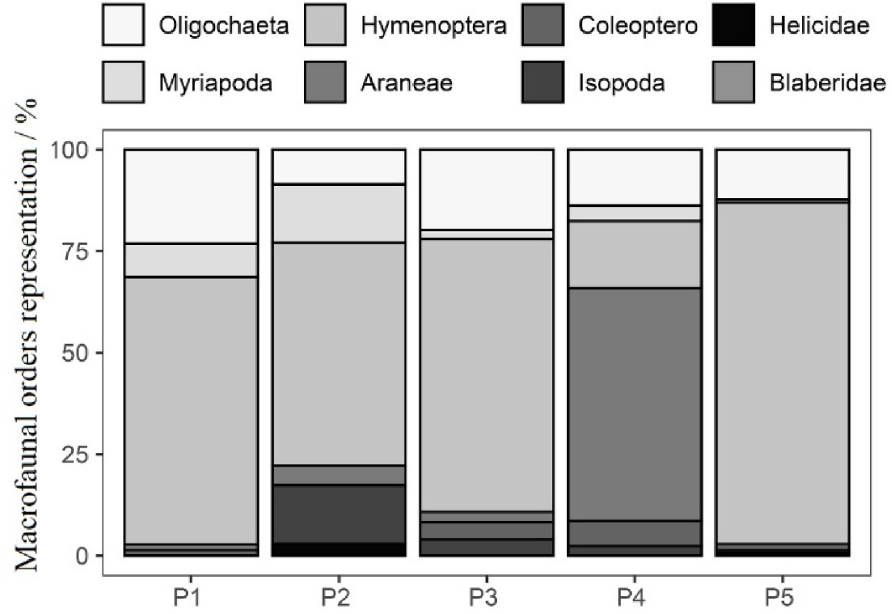
In the cacao plots, Hymenoptera predominated, particularly in P5 (84%) and in P1 and P3 (over 65%). Oligochaeta were more abundant in P1 (23%) and P3 (20%), while Araneae dominated in P04 (57%). Orders such as Myriapoda reached notable values in P2 (14.38%), whereas Coleoptera and Isopoda showed low representation across all plots (Figure 5). Helicidae and Blaberidae were restricted to P2 and P5, respectively. These variations reflect differences in the composition and dominance of soil macrofauna associated with agricultural management practices and soil conditions.
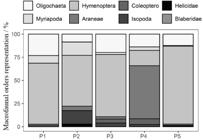
Percentage of Macrofaunal orders recorded in cacao-cultivated soils in plots in San Ramón District, Chanchamayo Province, Peru.
Relationship between trace metals and soil macrofauna
Table 6 presents the Spearman correlation coefficients between metals and soil macrofauna orders. A positive and significant correlation (p < 0.05) was observed between sulfur (S) and the order Helicidae (ρ = 0.4), suggesting a possible affinity between the presence of this element and the distribution of mollusks in the studied soils, likely related to biomineralization and diagenetic processes.29 Likewise, chromium (Cr) showed a positive correlation with Coleoptera (ρ = 0.465), indicating a relationship between this metal and the abundance of this group, possibly associated with metabolic processes.30 On the other hand, most correlations between chemical elements and macrofaunal taxa were weak and not significant, indicating low levels of association. Elements such as Mg, Al, and P exhibited negative correlations with several orders, including Oligochaeta and Araneae, suggesting that the presence of these elements may influence the distribution of certain organisms. These results highlight the complex interactions between soil chemical elements and soil macrofauna, which may be related to multiple interacting factors such as contaminant bioavailability, absorption pathways, exposure duration, and soil characteristics. Populations of different species respond differently to metal exposure, thereby altering community structure and ecosystem functioning.31,32
Spearman correlation coefficients (ρ) between metals and soil macrofaunal orders recorded in cacao-cultivated soils in San Ramón District, Chanchamayo Province, Peru
The differences observed in soil macrofaunal composition among plots cannot be attributed exclusively to heavy metals, since additional factors such as soil moisture, temperature, and the availability of organic resources also play fundamental roles in organism distribution. These variables may interact in complex ways, influencing the presence and abundance of species in cacao agricultural soils. Moreover, the analysis of soil metal concentrations did not account for the temporal variability of contamination, which limits the interpretation of results concerning dynamic fluctuations in metal accumulation across seasons or crop cycles. This temporal omission may lead to a static view of the relationship between macrofauna and contaminants, without considering the fluctuations that could affect biomineralization processes and the long-term ecological health of soil systems.
Despite the relevance of our findings, certain limitations must be acknowledged. First, while we established significant correlations between metal concentrations and macrofauna, additional soil physicochemical parameters such as pH, moisture, and organic matter content were not determined. These variables are known to influence metal bioavailability and edaphic community structure. Second, the sampling was restricted to the dry season; future research should incorporate multi-temporal data to assess the seasonal dynamics of metal leaching and macrofauna migration.
It is important to note that the Chanchamayo Province is a long-established agricultural frontier where primary forests are fragmented and often inaccessible. Therefore, this study adopted a comparative internal control design, utilizing plot P2 (diversified agroforestry system) as the ecological baseline. This approach allowed us to evaluate the impact of management intensification by comparing complex, high-diversity systems against simplified monocultures (P1 and P4), which more accurately reflects the current land-use transitions and practical management challenges in the Peruvian Central Rainforest Region.
Conclusions
This study shows that soil macrofauna in cacao agroecosystems of the Central Rainforest of Peru is shaped not only by toxic-metal loads, but also by agricultural management and overall soil chemical composition. Plot P5, which concentrated the highest levels of several elements, including As, Cd, and Pb, was characterized by high dominance, whereas P02, under diversified management, showed the greatest macrofaunal richness and diversity. These patterns suggest that diversified cacao management can favor a more balanced soil community, probably by increasing habitat heterogeneity and organic resource availability, while managements associated with higher elemental accumulation may simplify community structure. The significant associations detected for sulfur-Helicidae and chromium-Coleoptera indicate that some soil organisms may respond to specific chemical conditions, although most relationships were weak and should be interpreted within a broader ecological context.
From a practical perspective, these findings support the promotion of diversified cacao systems in Chanchamayo, together with more careful use of fertilizers and other external inputs, periodic monitoring of As, Cd, and Pb in soil, and the incorporation of soil macrofauna as a complementary bioindicator of soil health. In particular, the biological pattern observed in P2 may serve as a local reference for management practices aimed at improving soil biodiversity and resilience. More broadly, the integrated use of elemental analysis and macrofaunal assessment provides a useful framework for environmental monitoring and could support the development of soil-quality surveillance strategies and evidence-based agricultural policies in Peru, especially in cacao-producing areas exposed to metal accumulation.
These findings have practical implications for sustainable cacao farming in the Central Rainforest Region of Peru. Specifically, we recommend an annual monitoring of Cd and Pb levels to ensure compliance with international market standards
Acknowledgments
The authors thank the National Intercultural University of the Central Jungle Juan Santos Atahualpa (UNISCJSA) for funding this study and Prof. Dr. Adriana Gioda (PUC-Rio, Brazil) for facilitating the sample analyses. They also thank the anonymous reviewers and editors for their valuable comments. This research was funded by the Vice Presidency for Research of UNISCJSA under the project “Heavy Metals and Soil Macrofauna in Cacao (Theobroma cacao) Crops, San Ramón, 2023” (contract No. 007-2022-VPI/UNISCJSA).
Data Availability Statement
The raw data supporting the conclusions of this article will be made available by the authors upon reasonable request.
References
-
1 Huauya, M.; Huamaní, H.; The Biologist 2014, 12, 45. [Link] accessed in June 2026
» Link -
2 Li, J.; Hong, M.; Yin, X.; Liu, J.; J. Rare Earths 2010, 28, 957. [Crossref]
» Crossref -
3 Cabrera Dávila, G. C.; Sánchez Rendón, J. A.; de León Lima, D. P.; Acta Bot. Cubana 2022, 221, 1. [Link] accessed in June 2026
» Link -
4 García, I.; Dorronsoro, C.; Soil Technology, Topic 15: Heavy Metal Pollution; Oficina de Estudios y Políticas Agrarias (ODEPA), Clile, 2013. [Link] accessed in June 2026
» Link -
5 Huang, B.; Yuan, Z.; Li, D.; Zheng, M.; Nie, X.; Liao, Y.; Environ. Sci.: Process Impacts 2020, 22, 1596. [Crossref]
» Crossref -
6 Pikuła, D.; Stępień, W.; Agronomy 2021, 11, 878. [Crossref]
» Crossref -
7 Cartes, S. G.; Degradación de Suelos Agrícolas y el SIRSD-S; Oficina de Estudios y Políticas Agrarias (ODEPA), Clile, 2013. [Link] accessed in June 2026
» Link -
8 Mendoza-Escalona, B.; Torres-Rodríguez, D.; Marcó, L. M.; Gómez, C.; Estanga-Barrios, M.; García-Orellana, Y.; TecnoLógicas 2021, 24, e1738. [Crossref]
» Crossref -
9 Boros, A.; Szólik, E.; Desalegn, G.; Tőzsér, D.; Agronomy 2025, 15, 76. [Crossref]
» Crossref -
10 Bajpai, S.; Anil, E.; Dixit, P. R.; Pandey, N.; Int. J. Environ. Sci. 2025, 11, 3691. [Crossref]
» Crossref -
11 Uchimiya, M.; Bannon, D.; Nakanishi, H.; McBride, M. B.; Williams, M. A.; Yoshihara, T.; J. Agric. Food Chem. 2020, 68, 12856. [Crossref]
» Crossref -
12 Abd-El-Hady, A. M.; Abdelaty, E. F.; Egypt. J. Soil Sci. 2022, 62, 19. [Crossref]
» Crossref -
13 Fayek, N.; Tawfik, W.; Fikry, M.; IOP Conf. Ser.: Mater. Sci. Eng. 2021, 1171, 012001. [Crossref]
» Crossref -
14 Fayek, N.; Tawfik, W.; Khalafallah, A.; Hamed, S.; Mousa, W.; Fikry, M.; Minerals 2023, 13, 1300. [Crossref]
» Crossref -
15 Tawfik, W.; Sawaf, S.; Proc. SPIE Int. Soc. Opt. Eng. 2014, 9101, 91010L. [Crossref]
» Crossref -
16 Shaheen, M. E.; Tawfik, W.; Mankola, A. F.; Gagnon, J. E.; Fryer, B. J.; El-Mekawy, F. M.; Soil Sediment Contam. 2023, 32, 665. [Crossref]
» Crossref -
17 Thomas, E.; Atkinson, R.; Zavaleta, D.; Rodriguez, C.; Lastra, S.; Yovera, F.; Arango, K.; Pezo, A.; Aguilar, J.; Tames, M.; Ramos, A.; Cruz, W.; Cosme, R.; Espinoza, E.; Chavez, C. R.; Ladd, B.; Sci. Total Environ. 2023, 881, 163372. [Crossref]
» Crossref -
18 Bennett, S.; Phillips, H. R. P.; Dalziel, A. C.; Manzer, L. R.; Cameron, E. K.; Eur. J. Soil Biol. 2024, 120, 103590. [Crossref]
» Crossref -
19 Mamabolo, E.; Pryke, J. S.; Gaigher, R.; Ecol. Indic. 2024, 167, 112723. [Crossref]
» Crossref -
20 Ministry of the Environment (MINAM); Memoria Descriptiva. Zonificación Ecológica y Económica del Departamento de Junín a Nivel Meso y Escala 1:100,000; National Environmental Information System (SINIA), Lima, Peru, 2014. [Link] accessed in June 2026
» Link -
21 Cabrera Dávila, G. C.; Evaluation of Edaphic Macrofauna as a Bioindicator of the Impact of Land Use and Soil Quality in Western Cuba; PhD Thesis, University of Alicante, Alicante, Spain, 2019. [Link] accessed in June 2026
» Link -
22 Palacios, S.; Reynel, C.; Herbarium of the Faculty of Forest Sciences, National Agrarian University La Molina; CED-FDA and APRODES: Peru, 2011. [Link] accessed in June 2026
» Link -
23 Provincial Municipality of Chanchamayo; Mayor Resolution No. 372-2022-MPCHYO; Chanchamayo, Peru, 2022. [Link] accessed in June 2026
» Link -
24 Anderson, J. M.; Ingram, J. S. I.; J. Ecol. 1990, 78, 547. [Crossref]
» Crossref -
25 Oyanedel, A.; Valdovinos, C.; Azocar, M.; Moya, C.; Mancilla, G.; Pedreros, P.; Figueroa, R.; Gayana 2008, 72, 241. [Crossref]
» Crossref -
26 Jiménez-Valverde, A.; Hortal, J.; Rev. Iber. Aracnol. 2003, 8, 151. [Link] accessed in June 2026
» Link -
27 Oksanen, J.; Blanchet, F. G.; Kindt, R.; Legendre, P.; Minchin, P. R.; O’Hara, R. B.; Simpson, G. L.; Solymos, P.; Stevens, M. H. H.; Wagner, H.; Vegan: Community Ecology Package, version 2.3-1; R Foundation for Statistical Computing, Austria, 2015. [Link] accessed in November 2025
» Link -
28 Lê, S.; Josse, J.; Husson, F.; J. Stat. Software 2008, 25, 1. [Crossref]
» Crossref -
29 Dauphin, Y.; Cuif, J.-P.; Salomé, M.; Susini, J.; Am. Mineral. 2005, 90, 1748. [Crossref]
» Crossref -
30 Jensen, P.; Trumble, J. T.; Recent Res. Dev. Entomol. 2003, 42, 1. [Link] accessed in January 2026
» Link -
31 Hodson, M. E. In Heavy Metals in Soils; Alloway, B., ed.; Springer: Dordrecht, Netherlands, 2013, ch. 5. [Crossref]
» Crossref -
32 Chrzan, A.; Pol. J. Soil Sci. 2018, 50, 291. [Crossref]
» Crossref
Edited by
-
Editor handled this article:
César Ricardo Teixeira Tarley (Associate)