 Efficient Preparation of High-Purity Cembratrien-diol: Extraction from Tobacco Inflorescences Using Deep Eutectic Solvent and Recovery by Liquid-Liquid Extraction
Abstract
Cembratrien-diol is an important precursor of cigarette aroma, but the preparation of high-purity cembratrien-diol is still difficult. In this experiment, deep eutectic solvents were used to extract cembratrien-diol from tobacco inflorescences, and then cembratrien-diol was recovered from the deep eutectic solvent extracts by liquid-liquid extraction. The best deep eutectic solvent was synthesized to extract cembratrien-diol from tobacco inflorescence by mixing choline chloride as hydrogen bond acceptor with 1,2-propanediol as hydrogen bond donor in a molar ratio of 1:4 and with water content of 20% (v:v). The optimal liquid-liquid extraction process conditions were solid-liquid ratio of 1:30, extraction time of 24 h, petroleum ether as solvent for liquid-liquid extraction, volume of petroleum ether of 100 mL, and liquid-liquid extraction time of 6 h. The highest extraction yield of cembratrien-diol was 4.41 mg g-1, and the highest purity of cembratrien-diol was 82.3%. α-Cembratrien-diol and β-cembratrien-diol were separated and purified by semi-preparative high-performance liquid chromatography, and the purity of both cembratrien-diol exceeded 95%. In this study, deep eutectic solvents were combined with liquid-liquid extraction technique to extract and separate cembratrien-diol. This method can effectively separate and purify high-purity cembratrien-diol from tobacco inflorescences and also could be expected to be applied to the high-purity preparation of other compounds.
Keywords:
deep eutectic solvent; cembratrien-diol; tobacco inflorescence; extraction; high-purity
Introduction
Currently, most tobacco inflorescences are discarded, resulting in waste of resources.1,2 How to develop and utilize these tobacco inflorescences is receiving more and more attention. Extraction of natural compounds from tobacco inflorescences as by-products is a new direction to reuse waste resources. Tobacco inflorescences contain a large number of natural products, such as alkaloids (nicotine and nornicotin),3 polyphenols (chlorogenic acids and rutin),4 and terpenoids (solanesol and cembratrien-diol).5,6 Among them, cembratrien-diol (CBD) is a natural diterpene consisting of four isoprene units in a 14-carbon macrocyclic skeleton.7,8 There are two kinds of CBD in tobacco, namely 4S-cembranoid (1S,2E,4S,6R,7E,11E) cembra-2,7,11 triene-4,6-diol (α-CBD) and its 4R epimer (β-CBD).9 It has been proven that CBD in tobacco can be degraded to produce flavor components such as solanone, solanifuran, and ketamine, which are key contributors to the aroma of tobacco.10 Besides, CBD has a variety of biological activities such as antifungal,11 antiviral,7 inhibition of nicotine perception, and neuroprotective agents.9 The separation and purification of CBD from tobacco inflorescences can meet the growing market demand for tobacco flavoring and fragrance ingredients.12 Therefore, an efficient separation and purification method of CBD has become a key issue.
To date, conventional organic solvents such as dichloromethane,13 acetone,14 and chloroform15 are still the most commonly used solvents for the extraction and separation of bioactive compounds from plant materials. However, some organic solvents have obvious disadvantages, such as low extraction efficiency and high residue levels. Meanwhile, the separation and purification of CBD from tobacco inflorescences is mainly carried out by dichloromethane extraction followed by silica gel column separation.7 The disadvantages of this method are time-consuming and energy-consuming. Therefore, there is a need to develop an efficient technique for the extraction and purification of CBD from tobacco inflorescences.
Deep eutectic solvent (DES) has received extensive attention in various chemical fields in recent years due to its easy synthesis, high stability and excellent solubility for a wide range of compounds.16 Most DES typically consist of two or more compounds acting as either hydrogen bond donor (HBD) or hydrogen bond acceptor (HBA), which, when the components are mixed in a certain ratio, establish strong hydrogen bonding interactions and form a homogeneous and stable liquid.17 In recent years, deep eutectic solvents have been applied to extract phenolic compounds,18 flavonoids,19 and polysaccharides,20,21 among others. However, a potential disadvantage of DES is its low volatility, which makes DES removal difficult and leads to a difficult recovery and purification process for the extracted products. Currently, adsorbent resins, liquid-liquid extraction, and anti-solvent extraction are the most commonly used methods to remove DES solvents and recover analytes.22 However, adsorption resins and liquid-liquid extraction usually require the use of organic solvents,23,24 which may cause health and environmental problems. The application of the anti-solvent method can avoid problems caused by the use of organic solvents, but the recovery is usually insufficient.22
In this study, four different types of DES were synthesized and their effects on extracting CBD from tobacco inflorescences were compared. At the same time, liquid-liquid extraction was used to recover CBD from the DES. Purification and separation of the two isomers of CBD was carried out using semi-preparative high performance liquid chromatography to prepare high purity CBD. The optimal extraction and recovery process was determined by optimizing the factors affecting the extraction yield and purity of CBD. Besides, liquid chromatography-mass spectrometry (LC-MS) and H-1 nuclear magnetic resonance (1H NMR) were employed to characterize CBD. In summary, DES and liquid-liquid extraction were combined to extract and separate high-purity CBD from tobacco inflorescences.
Experimental
Materials and reagents
Tobacco inflorescences were provided by Hefei, China and stored at 25 °C. Choline chloride (ChCl, > 98%), 1,4-butanediol (> 98%), glycerin (Gly, > 99%), 1,2-propanediol (> 99%), and acetonitrile (≥ 99.9%) were purchased from Shanghai, China. Petroleum ether and urea (≥ 99%) were bought by Shanghai, China. The purified water was offered by Hangzhou, China.
Screening of DES
Screening of HBD
The physicochemical properties of DES, such as polarity, solubility, and viscosity, affect its application.25 Therefore, it is crucial to select the appropriate DES according to different compounds in the extraction process of natural compounds.26 Four types of DES (in sequence: DES-1, DES-2, DES-3 and DES-4) were synthesized as extractants by mixing choline chloride as HBA with four different types of HBD (glycerin, 1,2-propanediol, 1,4-butanediol, and urea, respectively) in a molar ratio of 1:3 and with a water content of 15%.
The resulting mixture was soaked in a water bath at 60 °C for 1 h to obtain a stable, uniform and transparent liquid. All synthesized DES were cooled at 25 °C.22 After that, 1.5 g of tobacco inflorescence was poured into a 200 mL conical flask, and 45 mL of 20% (v:v) DES in water were added. Dichloromethane and ethanol were used as controls. The conical flasks were placed in a shaker at 40 °C for 24 h for extraction. After the extraction, the sample was filtered and 1 mL of the filtrate was passed through a 0.45 μm filter membrane for high performance liquid chromatography (HPLC) analysis.
Determination of the DES molar ratio
DES with different HBA/HBD molar ratios showed great differences in viscosity, surface tension, and polarity, thus affecting the extraction yield.27 Four types of DES were synthesized as extractants by mixing choline chloride as HBA with 1,2-propanediol as HBD in the molar ratios of 1:1, 1:2, 1:3, 1:4, and 1:5, respectively, and with a water content of 15% (v:v). The subsequent steps were the same as those in “Screening of HBD” sub-section.
Determination of the DES water content
Four types of DES were synthesized as extractants by mixing choline chloride as HBA with 1,2-propanediol as HBD in a molar ratio of 1:4 and with the water content of 0, 10, 20, 30, 40% (v:v). The subsequent steps were the same as those in “Screening of HBD” sub-section.
Extraction of CBD from tobacco inflorescences
The optimal DES selected from the screening process was synthesized. Then, it was cooled at room temperature and placed in a sealed container for storage for subsequent experiments.
Determination of the solid-liquid ratio
The solid-liquid ratio affects the diffusion of solutes into the solvent. A moderate solid-liquid ratio can increase the extraction yield of target compounds, but too much solvent increases the cost and wastes the solvent.21 Five 1.5 g samples of tobacco inflorescence were accurately weighed and then poured into conical flasks. Then, 15, 30, 45, 60 and 75 mL of the optimal DES were added respectively into the conical flasks. Dichloromethane and ethanol were used as controls. The conical flasks were placed in a shaker at 40 °C for 24 h for extraction. After the extraction, the sample was filtered and 1 mL of the filtrate was passed through a 0.45 μm filter membrane for HPLC analysis.
Determination of the extraction time
Five 1.5 g samples of tobacco inflorescence were accurately weighed and then poured into conical flasks. Then, 45 mL of the optimal DES were added into the conical flasks. Dichloromethane and ethanol were used as controls. The conical flasks were placed in a shaker at 40 °C for 6, 12, 18, 24 and 30 h respectively for extraction. After the extraction, the sample was filtered and 1 mL of the filtrate was passed through a 0.45 μm filter membrane for HPLC analysis.
Recovery of CBD from DES extract
Screening of the extraction solvent
The selection of the immiscible solvent with the DES solution is the critical step,24 and different extraction solvents have different extraction effects on different compounds.28 Three samples of DES extract which extracted CBD from tobacco inflorescence were taken. 100 mL of three different organic solvents (ethyl acetate, dichloromethane, and petroleum ether) were added separately to each sample and then liquid-liquid extractions were carried out. The mixed solution was subjected to liquid-liquid extraction in a shaker at 40 °C for 5 h. The solution was poured into a separatory funnel to separate DES and organic solvent. The organic phase layer was distilled under reduced pressure at 45 °C, concentrated to dryness. 1.5 mL of acetonitrile was added and passed through a 0.45 μm filter membrane for HPLC analysis.
Determination of the extraction volume
The amount of petroleum ether was an important parameter in extraction and an important factor affecting the extraction of cembratrien-diols.25 Five samples of DES extract which extracted CBD from tobacco inflorescence were taken. 40, 60, 80, 100 and 120 mL of petroleum ether were added to each extract and then liquid-liquid extractions were carried out. The mixed solution was subjected to liquid-liquid extraction in a shaker at 40 °C for 5 h. The solution was poured into a separatory funnel to separate DES and organic solvent. The petroleum ether layer was distilled under reduced pressure at 45 °C, concentrated to dryness. 1.5 mL of acetonitrile was added and passed through a 0.45 μm filter membrane for HPLC analysis.
Determination of extraction time
Five samples of DES extract which extracted CBD from tobacco inflorescence were taken. 100 mL of petroleum ether were added to each sample and then liquid-liquid extractions were carried out. The mixed solution was subjected to liquid-liquid extraction in a shaker at 40 °C for 2, 4, 6, 8 and 10 h. The solution was poured into a separatory funnel to separate DES and organic solvent. The petroleum ether layer was distilled under reduced pressure at 45 °C, concentrated to dryness. 1.5 mL of acetonitrile was added and passed through a 0.45 μm filter membrane for HPLC analysis.
Determination of the number of extractions
The DES extract, which was used to extract CBD from tobacco inflorescence, was used. 100 mL of petroleum ether were added and then liquid-liquid extractions were carried out. The mixed solution was subjected to liquid-liquid extraction in a shaker at 40 °C for 6 h. The solution was poured into a separatory funnel to separate DES and organic solvent. Subsequently, 100 mL of the new petroleum ether were added to the DES phase for a second extraction. The above extraction operation was repeated 5 times. All the petroleum ether layers were distilled under reduced pressure at 45 °C, concentrated to dryness. 1.5 mL of acetonitrile was added and passed through a 0.45 μm filter membrane for HPLC analysis.
Quantification of CBD
1 mg of α-CBD and β-CBD were accurately weighted and placed into the test tubes. 1 mL of acetonitrile was added to each tube as the mother liquor. The mother liquor was used to prepare standard solutions of α-CBD and β-CBD at concentrations of 0.75, 0.5, 0.25, 0.1, 0.05, and 0.01 mg mL-1. 20 µL of standard solutions of α-CBD and β-CBD at each concentration were, respectively taken for HPLC analysis to determine their peak areas. The standard curves of α-CBD and β-CBD were plotted with concentration on the x-axis and peak area on the y-axis respectively. The purity of the compound was determined by the normalization method of peak area in HPLC.29
Both the standard curve and the quantification of CBD was performed by HPLC equipped with a UV detector. Chromatographic separation was carried out on an C18 reversed-phase column (250 mm × 4.6 mm, 5 μm particle size). Acetonitrile and water (60:40, v/v) were used as mobile phases at a flow rate of 1.0 mL min-1. The column temperature was set at 30 °C and the detection was performed at a wavelength of 210 nm. The injection volume was 20 μL.
The least-square method was used for linear regression because the calculated regression equation had a good linear range. The results showed that the linear relationship for α-CBD was y = 59.222 + 22,204x with a coefficient of determination (r2) of 0.9992 over the experimental concentration range. β-CBD showed a linear relationship of y = -75.992 + 13,646x with a coefficient of determination (r2) of 0.9992. x was the concentration of analyte (mg mL-1) and y was the relative peak area.
Purification of CBD
Semi-preparative HPLC is a classic chromatographic method extensively used for the separation and purification of natural products.30 It has been used for the separation of flavonoids, and it was found to be a highly efficient and low-cost approach to separate bioactive compounds from the crude extracts of Stellera chamaejasme,31 indicating that it is widely used in some industries.
The two isomers of CBD were separated by semi-preparative HPLC. The resulting two peaks were collected as a streaming fraction of the compound. According to Yan’s method,7 the colorless compound 1 from the first peak was condensed to dryness and dissolved at 55 °C in N-pentane. The solution of compound 1 was held at 25 °C and was slowly transformed into the crystals. Compound 2 from the second peak was white and concentrated to dryness and dissolved in N-pentane at 55 °C. The solution of compound 2 was kept at -5 °C, and was slowly transformed into the crystals. Chromatographic separation was carried out on an C18 reversed-phase column (250 mm × 21.2 mm, 5 μm particle size). Acetonitrile and water (80:20, v/v) were used as mobile phases at a flow rate of 5.0 mL min-1. The column temperature was set at 30 ℃ and the detection was performed at a wavelength of 210 nm. The injection volume was 3 mL.
Characterization of CBD
In order to confirm that the two compounds obtained through semi-preparative HPLC were α-CBD and β-CBD, LC-MS was carried to determine the molecular weight while 1H NMR was employed to analyze the structure.
Compounds 1 and 2 (1 mg each) were dissolved in 1 mL of chromatographic grade methanol and passed through a 0.45 μm organic membrane for LC-MS identification. The chromatographic column was equipped with Exend-C18. The column temperature was set at 30 °C and the flow rate was set to 0.4 mL min-1. The injection volume was 3 μL. The mass spectrometry condition was the positive ion mode in the electrospray ion source.
Compounds 1 and 2 were respectively dissolved in 3 mL of chloroform. Subsequently, a vacuum distillation was carried out at 45 °C until the solution was completely concentrated to dryness. This process was repeated three times to ensure that the non-volatile components in the sample were fully purified. Finally, the concentrated samples were dissolved in 2 mL of deuterated chloroform for 1H NMR identification.
Statistical analysis
All analyses were performed at least three times. Results were presented as the mean ± standard deviations. All experimental data were analyzed using Origin (Northampton, USA, 2022).
Results and Discussion
Effects of factors on the purity and extraction rate of target compounds during the extraction process
Effect of the DES type
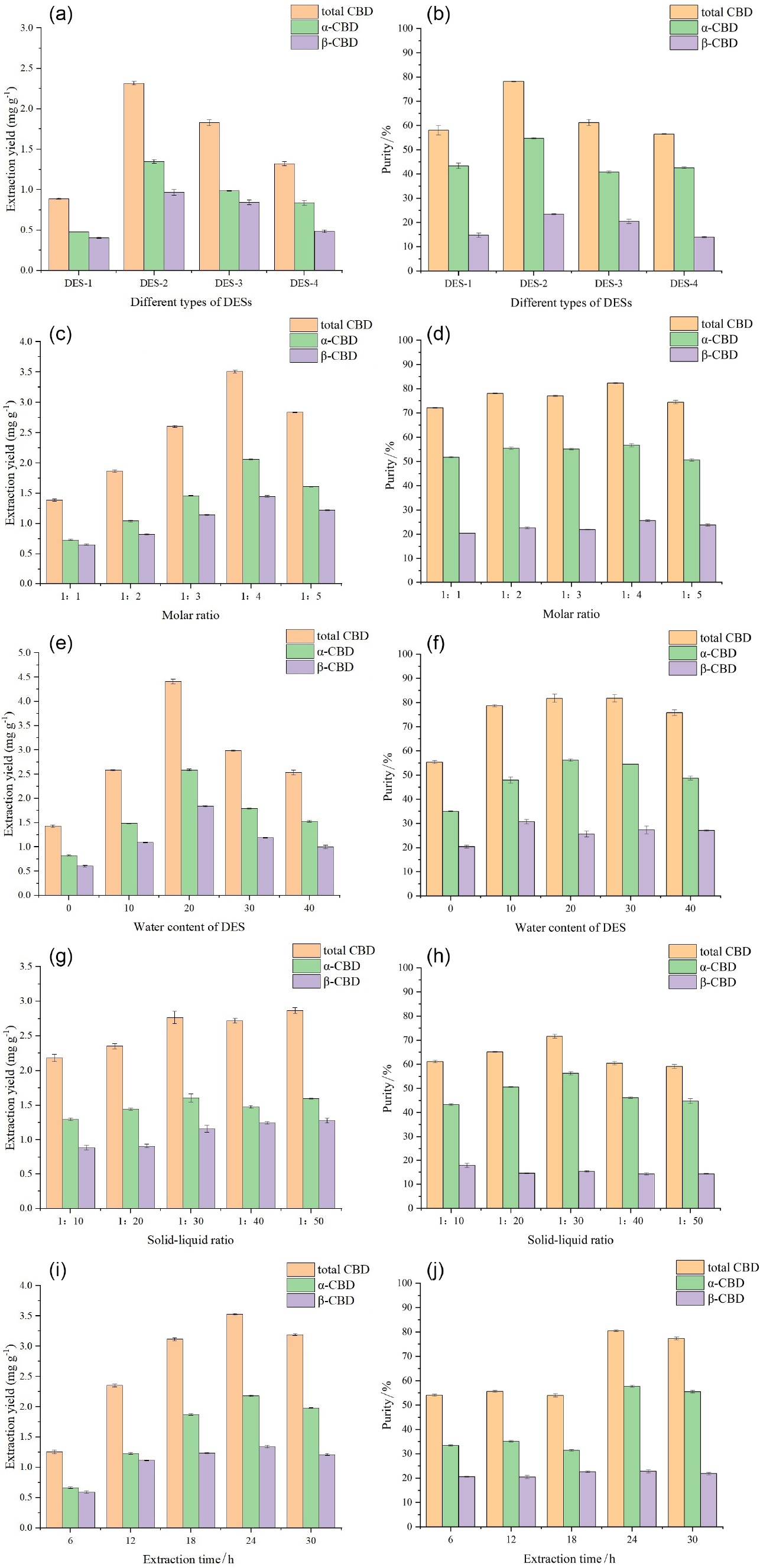
The effects of different types of DES on the purity and extraction rate of the target compounds were shown in Figures 1a and 1b. The extraction yield of DES-2 on CBD was the highest, which was up to 2.3 mg g-1. The purity of the liquid-liquid extraction was also the highest, which was up to 78.2%, in which α-CBD accounted for 54.7% and β-CBD accounted for 23.4%. The reason for the high extraction yield of CBD by DES-2 was that DES-2 dissolved fibers and promoted the destruction of plant cells more than the other three DES.32 At the same time, the extraction yield was also closely related to the interaction between DES and CBD. The structure of CBD was similar to that of 1,2-propanediol as both contained two hydroxyl groups, leading to enhanced hydrogen bonding and van der Waals force interactions between CBD and DES-2.33 The two hydroxyl groups of 1,4-butanediol were far apart, resulting in a relatively weak hydrogen bonding interaction. Therefore, DES-2 was selected as the solvent for the extraction of CBD.
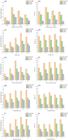
Effects of (a) and (b): different types of DES, (c) and (d): different molar ratio, (e) and (f): different water addition, (g) and (h): different solid-liquid ratio, (i) and (j): different extraction time on extraction yield and purity of CBD from tobacco inflorescence.
Effect of the HBA/HBD molar ratio
The effects of different HBA/HBD molar ratios on the purity and extraction rate of the target compounds were shown in Figures 1c and 1d. As the ratio of choline chloride to 1,2-propanediol was reduced from 1:1 to 1:4, the extraction yield of the target compounds increased rapidly. This was attributed to the fact that the moderate amount of 1,2-propanediol could reduce the viscosity and surface tension of the DES system.34 On the other hand, the extraction yield of the target compounds decreased as the molar ratio of choline chloride and 1,2-propanediol reduced from 1:4 to 1:5. Another issue that should be considered was that the target compounds contain hydroxy groups, which can be regarded as HBD. Therefore, an excess of 1,2-propanediol may lead to stronger spatial site resistance, thus weakening the interaction between the target compounds and the chloride anion.35 The highest extraction yield of 3.51 mg g-1 was obtained at a molar ratio of choline chloride to 1,2-propanediol of 1:4, with 2.06 mg g-1 for α-CBD and 1.45 mg g-1 for β-CBD. At this time, the purity of CBD was also the highest, reaching 82.3%, in which α-CBD accounted for 56.7% and β-CBD accounted for 25.6%. Therefore, 1:4 was chosen as the optimal molar ratio of solvents for the extraction of CBD.
Effect of the DES water content
The effects of different DES water contents on the purity and extraction rate of the target compounds were shown in Figures 1e and 1f. The purity of CBD was above 75% except at 0% water content which was only 55.3%. However, the extraction yield of CBD increased with the increase of water content from 0 to 20%. The highest extraction yield of CBD was 4.41 mg g-1, in which α-CBD accounted for 2.58 mg g-1 and β-CBD accounted for 1.83 mg g-1 at a water content of 20%. This was due to the fact that DES was normally more viscous than conventional organic solvents, which hindered the mass transfer between DES and the sample matrix.36 Adding water to DES reduced its viscosity, which improved mass transfer and increased extraction yield. A further increase in water content (from 20 to 40%) did not further increase the extraction yield because an excessive increase in water content broke the hydrogen bonds between DES.22 Based on the results of the study, a water content of 20% was chosen as a further optimization method.
Effect of solid-liquid ratio
The effects of different solid-liquid ratios on the purity and extraction rate of the target compounds were shown in Figures 1g and 1h. It can be seen that when the solid-liquid ratio was gradually decreased from 1:10 to 1:30, the extraction yield of CBD increased, due to the incomplete solid-liquid mixing when the solvent amount was small, the incomplete extraction of the target compounds, and the high residual rate. When the solid-liquid ratio was gradually reduced from 1:30 to 1:50, the extraction rate began to decline. This was because when the solvent was already sufficient or even excessive, the CBD concentration difference inside and outside the tobacco inflorescence cells significantly decreased, resulting in a weakened diffusion driving force.37 After that, when too much solvent was added, the extraction rate no longer increased. At the same time, it can be seen from the results in the Figure 1h that CBD in liquid-liquid extraction had the highest purity when solid-liquid ratio was 1:30. Therefore, in order to reduce the solvent waste and ensure the highest extraction yield, 1:30 was chosen as the solid-liquid ratio for the subsequent experiments in this study.
Effect of extraction time
The effects of different extraction times on the purity and extraction rate of the target compounds were shown in Figures 1i and 1j. In the time range of 6-24 h, the extraction yield of CBD showed an increasing trend and reached the maximum value at 24 h. At this point, the extraction of CBD was complete, the interaction between sample and solvent was sufficient. The osmotic pressure of the whole solution system was in equilibrium, and the mass transfer between DES and tobacco inflorescences was in equilibrium.38 Subsequently, it was possible that the degradation or re-adsorption of CBD led to a decrease in the extraction rate as the extraction time increased. The extension of the extraction time might lead to the structural damage of CBD. Meanwhile, the lower purity of CBD in the liquid-liquid extraction solution in the range of 6-18 h could be attributed to the lower content of CBD. Therefore, 24 h was chosen as the optimal extraction time for further study.
Effect of factors on the purity of target compounds during the liquid-liquid extraction process
Effect of different extraction solvents
The effects of different extraction solvents on the purity of the target compounds were shown in Figure 2a. The purity of CBD in the solvent after extraction with ethyl acetate was only 21.1%, the purity of CBD in the solution after extraction with dichloromethane was 44.6%, and the purity of CBD after extraction with petroleum ether could be as high as 80.9%, due to the high solubility of CBD in petroleum ether.39 Therefore, petroleum ether was selected as the extraction solvent for the recovery of CBD from DES.
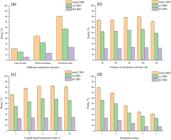
Effects of (a) different extraction solvents, (b) different extraction volumes, (c) different extraction time and (d) number of extractions on the purity of CBD recovered from the DES extract.
Effect of different extraction volumes
The effects of different extraction volumes on the purity of the target compounds were shown in Figure 2b. As the volume of petroleum ether increased from 40 to 100 mL, the purity of CBD gradually increased, indicating that the transfer of the target compounds from DES to petroleum ether gradually increased. A peak of 79.6% was reached at 100 mL. Subsequently, as the volume increased, the solubility of CBD reached saturation. The excess petroleum ether dissolved other polar-like impurities, resulting in a decrease in the purity of CBD. Therefore, 100 mL of petroleum ether were chosen as the optimal volume for subsequent experiments.
Effect of extraction time
The effects of different extraction time on the purity of the target compounds were shown in Figure 2c. With the increase in extraction time from 2 to 6 h, the purity of CBD gradually increased from 66.3% and reached a peak value of 82.2% at 6 h, in which α-CBD accounted for 58.7% and β-CBD accounted for 23.5%. When the extraction time increased to 8 h, the purity only increased by 0.3%, and the purity was slightly decreased when the extraction time was further increased to 10 h. It might be due to the fact that the extraction time was too long, which led to an increase in the extracted impurities. Therefore, 6 h was chosen as the optimal extraction time for the subsequent experiments.
Effect of number of extractions
The effects of the number of extractions on the purity of the target compounds were shown in Figure 2d. The purity of CBD was 79.7% after the first extraction and 69.4% after the second extraction. With the increase in extraction times, the purity of CBD gradually decreased, and the purity of CBD was only 30.8% after the fifth extraction. Considering that high-purity CBD was more difficult to obtain by preparation,23 therefore, in order to facilitate the further purification of CBD in the subsequent experiments, one extraction was chosen as the number of times of CBD extraction.
Separation and purification of CBD
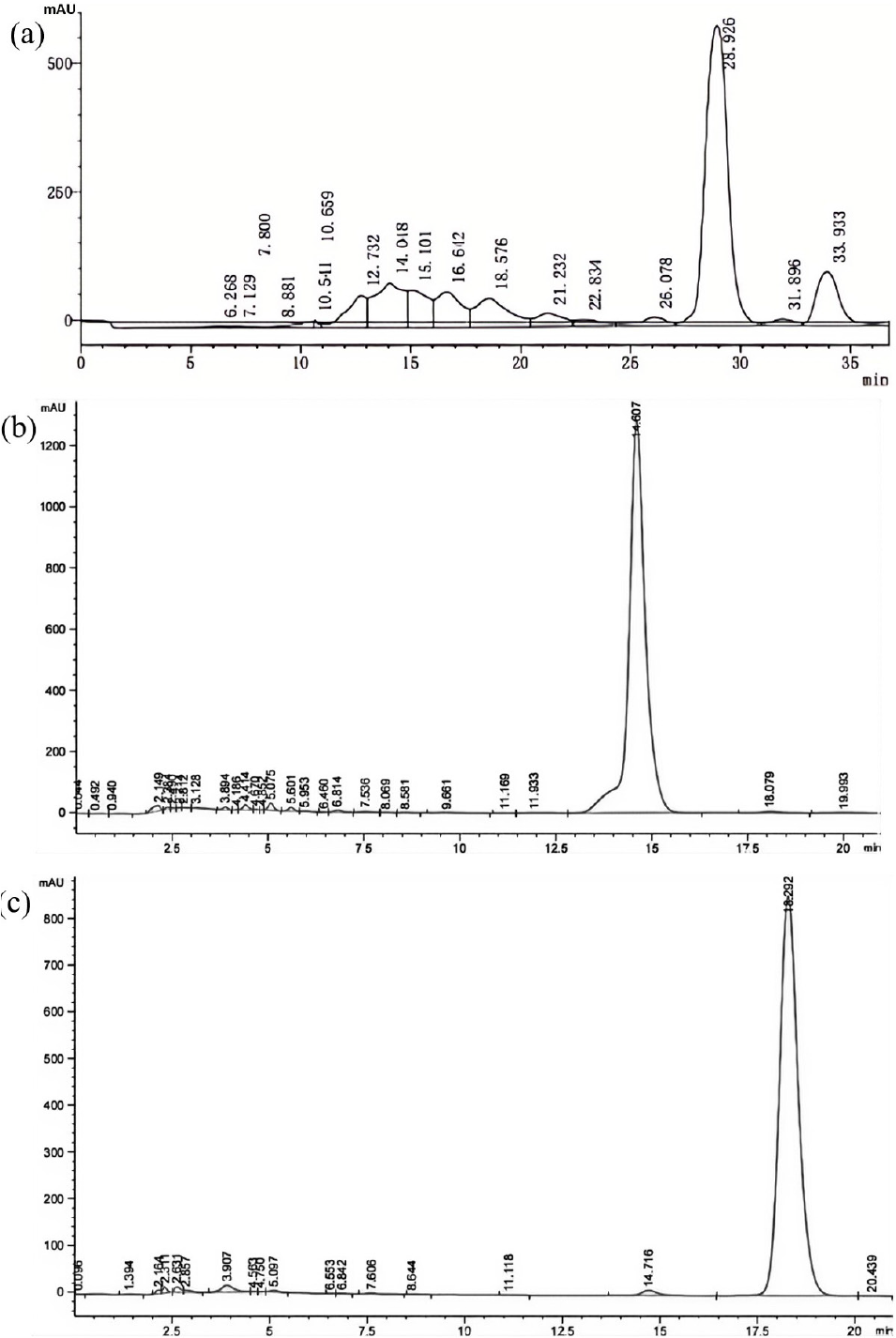
The chromatogram of semi-preparative HPLC was shown in Figure 3a. The flow rate, injection volume, and mobile phase ratio of semi-preparative HPLC all affected the peak retention time of the target compounds. When the flow rate was less than 5 mL min-1, α-CBD and β-CBD were better separated, but the preparation time and mobile phase consumption increased accordingly. The increase in flow rate advanced the retention times of α-CBD and β-CBD, but the short difference between the retention time of α-CBD and β-CBD reduced the separation effect of α-CBD and β-CBD. When the injection volume was greater than 3 mL, the peaks exhibited asymmetry, indicating that the sample had reached its maximum loading capacity and the purity of CBD began to decline. Therefore, an injection volume of 3 mL were selected for subsequent analysis. When the ratio of acetonitrile to water in the mobile phase was 60:40, the retention time increased significantly, resulting in waste of the mobile phase. When the ratio of acetonitrile and water was 80:20, the retention time was shortened and the separation of α-CBD and β-CBD was better.
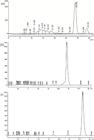
(a) The chromatogram of semi-preparative HPLC for purifying CBD, the chromatogram of (b) compound 1 and (c) compound 2 determined by HPLC.
Compounds 1 and 2 obtained by semi-preparative HPLC were tested for purity by HPLC. The purity of compound 1 was 95.7% shown in Figure 3b, and the purity of compound 2 was 95.9% shown in Figure 3c. In Figure 3b, a small peak that was not completely separated was observed at the leading edge of the main peak. This phenomenon was most consistent with the co-elution of impurities with polarity and structure similar to the target substance with the main component. Meanwhile, the main peak and this abnormal part at the leading edge were effectively separated in the calculation of the purity of the target compound.
Structural characterization of CBD
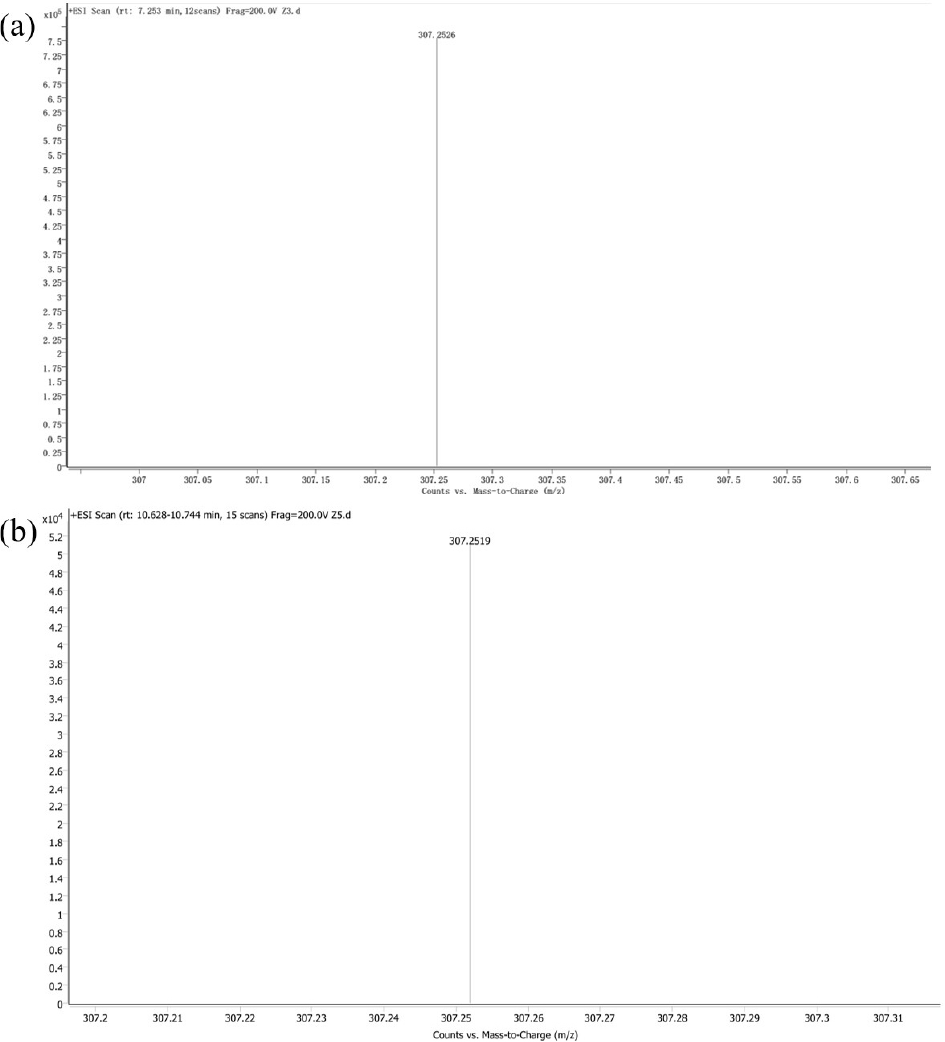
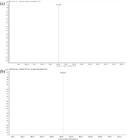
The mass-to-charge ratios in Figures 4a and 4b were both 307.25. Since the mass-to-charge ratio detected by LC-MS in the positive ion mode was usually the molecular weight plus one, indicating that the relative molecular mass of the two compounds was 306.25. The chemical formula of CBD is C20H34O2, and the relative molecular mass is 306.26. This was consistent with the findings of Yan et al.7 Therefore, the two compounds obtained through separation and purification were speculated to be α-CBD and β-CBD respectively.
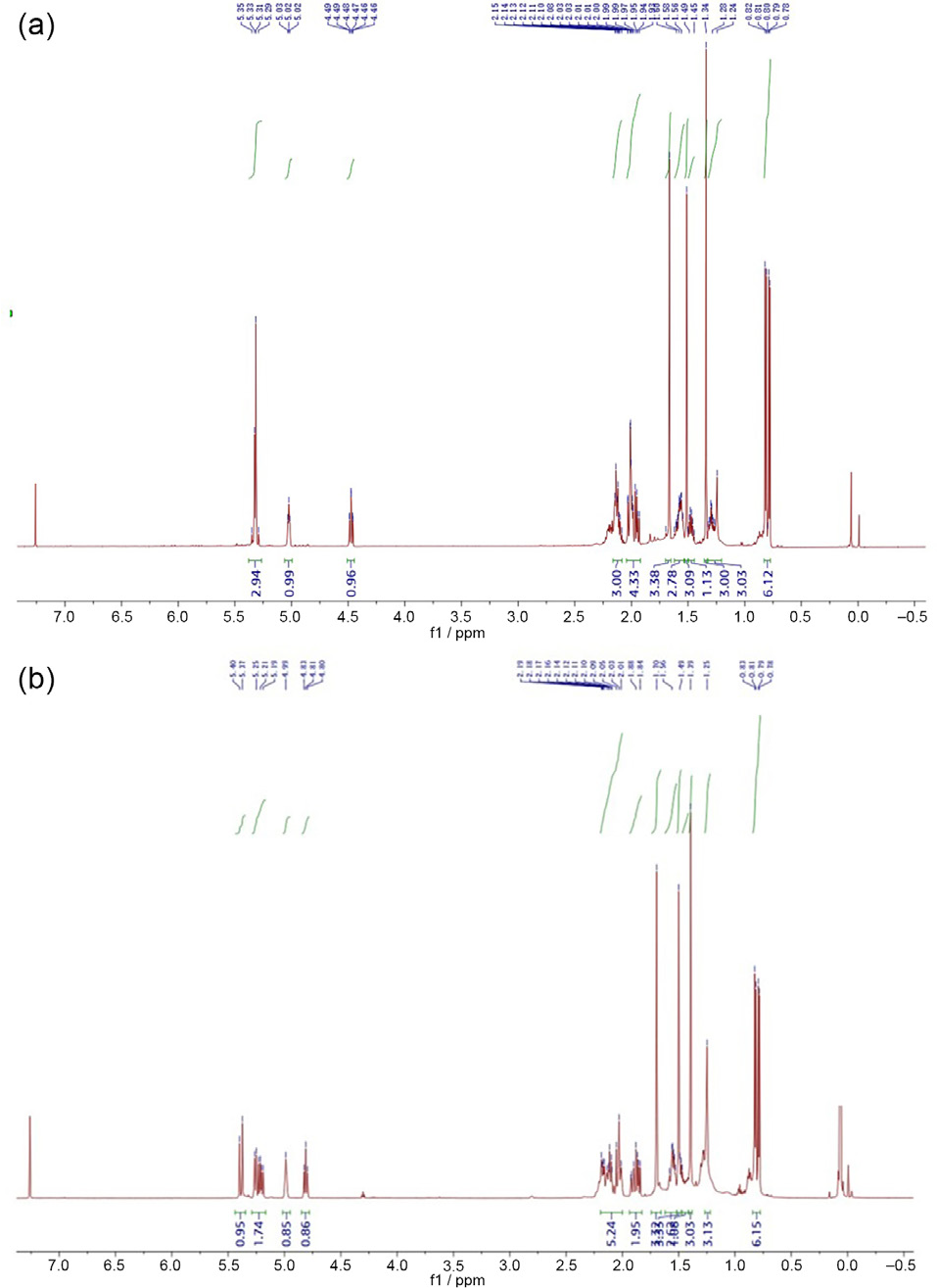
The results of the 1H NMR analysis were shown in Figure 5. Compound 1 (Figure 5a): 1H NMR (600 MHz, CDCl3) d 5.38-5.26 (m, 3H), 5.02 (t, J 5.3 Hz, 1H), 4.47 (td, J 9.0, 1.6 Hz, 1H), 2.16-2.08 (m, 3H), 2.04-1.92 (m, 4H), 1.68 (d, J 18.2 Hz, 3H), 1.62-1.53 (m, 3H), 1.51 (d, J 6.7 Hz, 3H), 1.47 (dt, J 13.5, 6.8 Hz, 1H), 1.34 (s, 3H), 1.32-1.20 (m, 3H), 0.83-0.77 (m, 6H). Compound 2 (Figure 5b) 1H NMR (600 MHz, CDCl3) d 5.37 (d, J 15.6 Hz, 1H), 5.28-5.15 (m, 2H), 4.97 (s, 1H), 4.79 (t, J 9.2 Hz, 1H), 2.18-1.99 (m, 5H), 1.92-1.81 (m, 2H), 1.66 (d, J 15.8 Hz, 3H), 1.63-1.50 (m, 3H), 1.48 (d, J 6.8 Hz, 3H), 1.46-1.42 (m, 1H), 1.38 (s, 3H), 1.23 (s, 3H), 0.79 (dd, J 18.8, 6.7 Hz, 6H).
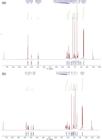
The number of hydrogen atoms in both compounds was 34, which was the same as that of CBD. The main difference between α-CBD and β-CBD lay in the configuration of the double bond and the position of the hydroxyl group. The chemical shift and coupling constant of the olefin protons in compound 1 indicated that the double bond configuration was mainly cis. The double peak with J = 15.6 Hz in compound 2 indicated that the double bond configuration was mainly trans, which was an important basis for distinguishing α-CBD from β-CBD. The proton chemical shifts adjacent to the hydroxyl group in samples 1 and 2 were slightly different, indicating that the position of the hydroxyl group in the molecule might be different. This was consistent with the structural characteristics of α-CBD and β-CBD. Through nuclear magnetic resonance hydrogen spectroscopy analysis, it was identified that compound 1 was α-CBD and compound 2 was β-CBD.
Conclusions
In order to extract and separate high-purity CBD from tobacco inflorescences, an efficient extraction and purification method was proposed. In this study, DES-2 consisting of choline chloride and 1,2-propanediol in a molar ratio of 1:4 with 20% water content (v:v) was preferred as the optimum extraction solvent and petroleum ether as the optimum liquid-liquid extraction solvent. The optimum process conditions were a solid-liquid ratio of 1:30, extraction time of 24 h, petroleum ether volume of 100 mL, and liquid-liquid extraction time of 6 h. Under the optimal process conditions, the extraction yield of CBD could reach 4.41 mg g-1, in which α-CBD accounted for 2.58 mg g-1 and β-CBD accounted for 1.83 mg g-1, and the purity of CBD could reach 82.5%, in which α-CBD accounted for 58.1% and β-CBD accounted for 24.4%. After semi-preparative HPLC separation, the purity of α-CBD was up to 95.7%, and the purity of β-CBD was up to 95.9%. The method established in this study was suitable for the efficient extraction and separation of high-purity CBD from tobacco inflorescence.
Acknowledgments
We gratefully acknowledge the software DeepL (V 25.31) for proofreading the manuscript.
Data Availability Statement
All the experimental data of this study are mostly presented in the article. Any relevant data can be requested from the corresponding author upon reasonable request.
References
-
1 Tuzzin, G.; Godinho, M.; Dettmer, A.; Zattera, A. J.; Carbohyd. Polym. 2016, 148, 69. [Crossref]
» Crossref -
2 Banožić, M.; Babić, J.; Jokić, S.; Ind. Crops Prod. 2020, 144, 112009. [Crossref]
» Crossref -
3 Popova, V.; Ivanova, T.; Stoyanova, A.; Nikolova, V.; Hristeva, T.; Zheljazkov, V. D.; Molecules 2020, 25, 2617. [Crossref]
» Crossref -
4 Zou, X. D.; BK, A.; Rauf, A.; Saeed, M.; Al-Awthan, Y. S.; Al-Duais, M. A.; Bahattab, O.; Khan, M. H.; Suleria, H. A. R.; ACS Omega 2021, 6, 25361. [Crossref]
» Crossref -
5 Yan, N.; Du, Y.; Liu, X.; Zhang, H.; Liu, Y.; Zhang, Z.; Biomolecules 2019, 9, 30. [Crossref]
» Crossref -
6 Xu, M.; Du, Y.; Hou, X.; Zhang, Z.; Yan, N.; Phytochemistry 2024, 223, 114117. [Crossref]
» Crossref -
7 Yan, B.; Jia, H.; Wei, J.; Huang, C.; Huang, B.; Mao, D.; Wang, J.; Wang, J.; Huang, S.; Ind. Crops Prod. 2021, 174, 114197. [Crossref]
» Crossref -
8 Liu, X.; Zhang, J.; Liu, Q.; Tang, G.; Wang, H.; Fan, C.; Yin, S.; Molecules 2015, 20, 13324. [Crossref]
» Crossref -
9 Sui, J.; Wang, C.; Liu, X.; Fang, N.; Liu, Y.; Wang, W.; Yan, N.; Zhang, H.-B.; Du, Y.; Liu, X.; Lu, T.; Zhang, Z.; Zhang, H.; Molecules 2018, 23, 2511. [Crossref]
» Crossref -
10 Yu, T.; Yang, L.; Shang, X.; Bian, S.; Molecules 2024, 29, 1563. [Crossref]
» Crossref -
11 Yang, Q.; Wang, J.; Zhang, P.; Xie, S.; Yuan, X.; Hou, X.; Yan, N.; Fang, Y.; Du, Y.; Ind. Crops Prod. 2020, 154, 112745. [Crossref]
» Crossref -
12 Faustino, M.; Veiga, M.; Sousa, P.; Costa, E. M.; Silva, S.; Pintado, M.; Molecules 2019, 24, 1056. [Crossref]
» Crossref -
13 Mahajan, N.; Koul, B.; Kaur, J.; Bishnoi, M.; Gupta, P.; Kumar, A.; Shah, B. A.; Mubeen, I.; Rai, A. K.; Prasad, R.; Singh, J.; Shahat, A.; BioMed. Res. Int. 2022, 2022, 9504787.[Crossref]
» Crossref -
14 Jayesh, K.; Helen, L. R.; Vysakh, A.; Binil, E.; Latha, M. S.; Regul. Toxicol. Pharmacol. 2017, 86, 349. [Crossref]
» Crossref -
15 Althurwi, H. N.; Salkini, M. A. A.; Soliman, G. A.; Ansari, M. N.; Ibnouf, E. O.; Abdel-Kader, M. S.; Separations 2022, 9, 254. [Crossref]
» Crossref -
16 Gurkan, B.; Squire, H.; Pentzer, E.; J. Phys. Chem. Lett. 2019, 10, 7956. [Crossref]
» Crossref -
17 Alrugaibah, M.; Yagiz, Y.; Gu, L.; Food Bioprod. Process. 2023, 138, 198. [Crossref]
» Crossref -
18 Luo, Q.; Zhang, J.-R.; Li, H.-B.; Wu, D.-T.; Geng, F.; Corke, H.; Wei, X.-L.; Gan, R.-Y.; Antioxidants 2020, 9, 785. [Crossref]
» Crossref -
19 Wang, Z.; Wang, D.; Fang, J.; Song, Z.; Geng, J.; Zhao, J.; Fang, Y.; Wang, C.; Li, M.; Food Chem. 2024, 452, 139508. [Crossref]
» Crossref -
20 Luo, L.; Fan, W.; Qin, J.; Guo, S.; Xiao, H.; Tang, Z.; Molecules 2023, 28, 5538. [Crossref]
» Crossref -
21 Zhou, R.-R.; Huang, J.-H.; He, D.; Yi, Z.-Y.; Zhao, D.; Liu, Z.; Zhang, S.-H.; Huang, L.-Q.; Molecules 2022, 27, 3132. [Crossref]
» Crossref -
22 Liu, Y.-J.; Lou, L.; Huang, Q.; Xu, W.; Li, H.; Ultrason. Sonochem. 2023, 99, 106560. [Crossref]
» Crossref -
23 Rico, X.; Gullón, B.; Yáñez, R.; Food Bioprocess Tech. 2022, 15, 1406. [Crossref]
» Crossref -
24 Xu, M.; Ran, L.; Chen, N.; Fan, X.; Ren, D.; Yi, L.; Food Chem. 2019, 297, 124970. [Crossref]
» Crossref -
25 Hong, J.; Deng, M.; Zhao, L.; Ind. Crops Prod. 2022, 187, 115355. [Crossref]
» Crossref -
26 Zhou, P.; Wang, X.; Liu, P.; Huang, J.; Wang, C.; Pan, M.; Kuang, Z.; Ind. Crops Prod. 2018, 120, 147. [Crossref]
» Crossref -
27 Dai, Y.; Spronsen, J. V.; Witkamp, G.-J.; Verpoorte, R.; Choi, Y. H.; Anal. Chim. Acta 2013, 766, 61. [Crossref]
» Crossref -
28 Tan, Z.; Yi, Y.; Wang, H.; Zhou, W.; Wang, C.; Molecules 2016, 21, 262. [Crossref]
» Crossref -
29 Hou, J.-J.; Wu, W.-Y.; Da, J.; Yao, S.; Long, H.-L.; Yang, Z.; Cai, L.-Y.; Yang, M.; Liu, X.; Jiang, B.-H.; Guo, D.-A.; J. Chromatogr. A 2011, 1218, 5618. [Crossref]
» Crossref -
30 Hou, W.; Xia, J.; Liu, C.; Li, S.; Wu, T.; Huang, Y.; J. Sep. Sci. 2019, 42, 3421. [Crossref]
» Crossref -
31 Cao, L.; Zhang, H.; Zhang, H.; Yang, L.; Wu, M.; Zhou, P.; Huang, Q.; Molecules 2018, 23, 531. [Crossref]
» Crossref -
32 Sun, B.; Zheng, Y.-L.; Yang, S.-K.; Zhang, J.-R.; Cheng, X.-Y.; Ghiladi, R.; Ma, Z.; Wang, J.; Deng, W.-W.; Food Chem. 2021, 343, 128498. [Crossref]
» Crossref -
33 Pan, Z.; Bo, Y.; Liang, Y.; Lu, B.; Zhan, J.; Zhang, J.; Zhang, J.; J. Mol. Liq. 2021, 326, 115283. [Crossref]
» Crossref -
34 Cao, J.; Yang, M.; Cao, F.; Wang, J.; Su, E.; ACS Sustainable Chem. Eng. 2017, 5, 3270. [Crossref]
» Crossref -
35 Khezeli, T.; Daneshfar, A.; Sahraei, R.; Talanta 2016, 150, 577. [Crossref]
» Crossref -
36 Gao, M.-Z.; Cui, Q.; Wang, L.-T.; Meng, Y.; Yu, L.; Li, Y.-Y.; Fu, Y.-J.; Microchem. J. 2020, 154, 104598. [Crossref]
» Crossref -
37 Shang, A.; Gan, R.-Y.; Zhang, J.-R.; Xu, X.-Y.; Luo, M.; Liu, H.-Y.; Li, H.-B.; Molecules 2020, 25, 3213. [Crossref]
» Crossref -
38 Gao, Z.; Zha, F.; Zhang, J.; Zhong, Q.; Tian, H.; Guo, X.; J. Mol. Liq. 2024, 396, 123977. [Crossref]
» Crossref -
39 Shoshtari-Yeganeh, B.; Giesy, J. P.; Yeganeh, M. Sh.; Badibostan, H.; Microchem. J. 2024, 201, 110699. [Crossref]
» Crossref
Edited by
-
Editor handled this article:
Andrea R. Chaves (Executive)