 Amino-Functionalized MOFs for Immobilizing Amino-Acid Ionic Liquids and Their Selective Adsorption of CO2
Abstract
By comparing the carbon dioxide (CO2) absorption performance of 1-butyl-3-methylimidazolium tetrafluoroborate ([BMIm]BF4), 1-propynyl-3-butylimidazolium tetrafluoroborate ([APMIm]BF4), and 1-butyl-3-methylimidazole lysine ([BMIm]Lys), [BMIm]Lys exhibits a markedly higher CO2 uptake over the range of 1-10 bar. After CO2 absorption, both [BMIm]Lys and [APMIm]BF4 display a characteristic carbamate band at 1692 cm-1 in their Fourier transform infrared spectroscopy (FTIR), indicating the involvement of chemisorption. Subsequently, zirconium 1,4-dicarboxybenzene metal-organic framework (UiO-66(Zr)) and zirconium aminobenzenedicarboxylate metal-organic framework (NH2-UiO-66(Zr)) were used as supports to immobilize [BMIm]Lys via impregnation, producing [BMIm]Lys@UiO-66(Zr) and [BMIm]Lys@NH2-UiO-66(Zr) for CO2 capture/separation. X-ray diffraction (XRD) confirms that the crystalline framework is preserved after immobilization, while Brunauer-Emmett-Teller (BET) analysis suggests partial occupation of the pore structure. NH2 functionalization increases the CO2 capacity by factors of 1.73 and 1.51 at 0.2 and 0.8 bar, respectively, and [BMIm]Lys immobilization further strengthens the low-pressure affinity for CO2. Notably, [BMIm]Lys@NH2-UiO-66(Zr) achieves a CO2 uptake of 5.18 mmol g-1 at 0.8 bar and 30 °C, accompanied by an exothermic adsorption feature. Moreover, the CO2/N2 selectivity of [BMIm]Lys@NH2-UiO-66(Zr) reaches 468.2 at 0.1 bar and 158.4 at 0.8 bar. After seven adsorption-desorption cycles, [BMIm]Lys@NH2-UiO-66(Zr) retains 94.98% of its initial CO2 capacity, demonstrating promising regenerability for practical applications.
Keywords:
ionic liquid; absorption; amino-functionalized; MOFs; immobilization; adsorption
Introduction
The continued rise in carbon dioxide (CO2) emissions has become one of the central environmental concerns in the context of global climate change and the ongoing energy transition.1 For end-of-pipe mitigation in major emitting sectors-such as coal-fired power plants, iron and steel production, and cement manufacturing-carbon capture and separation (CCS/CCUS) is widely regarded as a key route that can reconcile the near-term reliance on existing fossil-energy infrastructure with emission-reduction targets.2 Among the available capture technologies, aqueous amine absorption is technologically mature and typically offers high capture efficiency.3,4 However, it is often constrained by solvent volatility and corrosiveness,5 high regeneration energy demand,6 limited thermal stability,7 and consequently elevated long-term operating costs.8,9 By contrast, adsorption/separations using porous solids offer lower energy requirements, enable modular process design, and allow materials to be engineered in a highly tunable manner.10,11 These advantages make such approaches particularly attractive for CO2 enrichment and CO2/N2 separation under low-partial-pressure conditions.
Metal-organic frameworks (MOFs) have been extensively investigated for gas adsorption and separation12 owing to their exceptionally high surface areas, tunable pore architectures, and amenability to post-synthetic functionalization.13 Among them, the Zr-based MOF, zirconium 1,4-dicarboxybenzene MOF (UiO-66(Zr)), built from hexazirconium hydroxide cluster (Zr6O4(OH)4) clusters as inorganic nodes, exhibits excellent thermal and chemical stability and therefore provides an attractive platform for functional tailoring and composite construction.14,15 Further introduction of -NH2 groups can create additional sites for hydrogen bonding and Lewis’s acid-base interactions, increasing the Henry’s constant and the initial uptake slope of CO2 in the low-pressure regime.16 This translates into stronger affinity at low partial pressures and improved separation selectivity. In contrast, N2 is comparatively inert and interacts only weakly with -NH2 functionalities; consequently, the adsorption contrast between CO2 and N2 is amplified. Beyond porous solids, ionic liquids (ILs) have emerged as promising absorbents because of their negligible vapor pressure, structural tunability, and relatively high capacity for CO2 dissolution and/or reaction.17,18 In particular, ILs bearing amine functionalities or amino-acid anions can achieve chemical absorption through carbamate formation, which mechanistically enhances CO2 capture in the low-partial-pressure region.19,20 Nevertheless, liquid ILs often undergo a pronounced viscosity increase upon CO2 uptake, which introduces substantial mass-transfer resistance and compromises absorption kinetics as well as the achievable effective capacity. The model constructed by Matsuoka et al.21 simulated the absorption of CO2 by amino acid ionic liquid (AAIL) under different CO2 partial pressures and temperatures to estimate the CO2 absorption capacity and viscosity of AAIL, and found that the viscosity of AAIL increases with the absorption of CO2. Recker et al.22 and Bera et al.23 further confirmed this conclusion by measuring the changes in viscosity of amino acid ionic liquids before and after CO2 absorption. Accordingly, immobilizing ILs onto solid supports-to combine reactive chemisorption sites with the favorable transport characteristics of porous frameworks-has become an increasingly important strategy for improving performance and process applicability. MOFs, with their appreciable pore volume and tunable interfacial chemistry, can provide confined environments that accommodate ILs while suppressing leaching.24 Moreover, IL confined within the pores can establish highly CO2 affinitive/reactive sites that are preferentially occupied under low-pressure conditions,25,26 which are beneficial for their adsorption of CO2.
Accordingly, this work comparatively investigates the CO2 absorption behaviors of a conventional IL, 1-butyl-3-methylimidazolium tetrafluoroborate ([BMIm]BF4), an amine-cation-based IL, namely 1-propynyl-3 butylimidazolium tetrafluoroborate ([APMIm]BF4), and an amino-acid-anion IL, namely 1-butyl-3-methylimidazole lysine ([BMIm]Lys), and identifies [BMIm]Lys-showing stronger chemical uptake of CO2-as the immobilized component. UiO-66(Zr) and NH2-UiO-66(Zr) were selected as supports, and composite sorbents with a loading of 15 wt.% were prepared via an impregnation approach. The resulting materials were then applied to CO2 capture at low partial pressures and to enhancing CO2/N2 separation performance. This strategy is designed to exploit the synergy between -NH2 sites and the hydrogen-bonding/ionic interaction network of the AAIL to strengthen interfacial binding and CO2 affinity, while the MOF pore environment is expected to reduce N2 accessibility and diffusion, thereby further improving separation. For performance evaluation, particular emphasis is placed on adsorption capacity and CO2/N2 selectivity under low-pressure conditions (0-0.8 bar), with attention to how amination and AAIL immobilization modify the initial region of the adsorption isotherms. In addition, repeated adsorption-desorption cycling tests were conducted to assess practical regenerability. Through a composite design that integrates an amine-functionalized UiO-66 framework with an immobilized AAIL, this study seeks to achieve higher CO2 affinity and superior CO2/N2 separation in the low-pressure regime. Complementary characterizations, including Fourier-transformed infrared spectroscopy (FTIR), are further employed to elucidate the roles of chemisorption and confinement effects. Overall, the findings provide a feasible materials-design route and mechanistic basis for developing solid adsorbents that combine high selectivity with stability and regenerability.
Experimental
Materials and reagents
3-Bromopropylamine, N-methylimidazole, sodium tetrafluoroborate (NaBF4), 1-butyl-3-methylimidazolium bromide ([BMIm]Br), phosphorus pentoxide (P2O5), and zirconium(IV) chloride (ZrCl4) were purchased from Shanghai Aladdin Bio-Chem Technology Co., Ltd. L-Lysine, terephthalic acid (H2BDC), and 2-aminoterephthalic acid (NH2-BDC) were obtained from Sigma-Aldrich (Shanghai) Trading Co., Ltd. Methanol, acetonitrile, N,N dimethylformamide (DMF), and glacial acetic acid were supplied by Beijing Chemical Works.
Synthesis of ionic liquid
3-Bromopropylamine and N-methylimidazole were reacted at 80 °C for 24 h. After completion, the resulting mixture was added to methanol and heated until the solid fully dissolved. The solution was then cooled to induce crystallization, where gentle stirring during cooling was applied to facilitate crystal formation. The obtained intermediate was purified by recrystallization and subsequently subjected to an anion-exchange (metathesis) reaction with NaBF4. After recrystallization and extraction, the solvent was removed to afford [APMIm]BF4.
A given amount of [BMIm]Br was dissolved in 100 mL of deionized water and hydrolyzed to obtain an intermediate. The intermediate was titrated with 0.1 mol L-1 HCl to determine its molar concentration. A lysine (Lys) solution was then added dropwise at a molar ratio of 1:1.7 (intermediate: Lys). After addition, the mixture was stirred continuously on a magnetic stirrer for 50 h. Water was removed under reduced pressure, followed by washing with a methanol (60 mL)/acetonitrile (20 mL) mixture. The suspension was stirred for 50 min and then kept sealed for 5 h, after which the solvents were removed by vacuum distillation. This washing procedure was repeated three times to improve purity. The sample was stored under vacuum in a desiccator containing P2O5, and residual trace water in the target IL was further eliminated by vacuum distillation. The final product, a pale-yellow transparent liquid, was obtained as the amino-functionalized ionic liquid, namely [BMIm]Lys.
The chemical structure of ILs was characterized by 1H and 13C nuclear magnetic resonance (NMR, Bruker Avance III HD 500 MHz, Germany) spectroscopy and Fourier Transform Infrared Spectrometer (FTIR, Thermo Scientific Nicolet iS20, America).
Synthesis of MOFs
UiO-66(Zr) was synthesized as follows. Briefly, ZrCl4 (0.95 mmol, 0.255 g) and terephthalic acid (H2BDC; 0.95 mmol, 0.180 g) were dissolved in DMF (30 mL) under magnetic stirring until a homogeneous solution was obtained. Glacial acetic acid (1.87 mL) was then added as a modulator, and the mixture was further ultrasonicated for 20 min. The resulting precursor solution was transferred into a 50 mL Teflon-lined stainless-steel autoclave and heated at 120 °C for 24 h. After cooling, a milky suspension was obtained and centrifuged at 8000 rpm for 10 min. The collected solid was washed three times with excess ethanol and DMF to remove unreacted species and residual impurities. Finally, the product was dried at 60 °C for 24 h to afford UiO-66(Zr) as a white powder.
ZrCl4 (0.240 g) and 2-aminoterephthalic acid (0.186 g) were dispersed in DMF (60 mL) and stirred thoroughly in a 100 mL Teflon-lined hydrothermal autoclave. The sealed reactor was maintained at 393 K for 24 h. After the reaction, the solid was washed repeatedly with DMF to remove unreacted precursors, followed by solvent exchange with methanol to replace residual DMF. The resulting material was then dried in a vacuum oven at 373 K to remove guest molecules from the pores, affording NH2-UiO-66(Zr).
Preparation of ionic-liquid-immobilized composites
IL-immobilized composites, namely [BMIm]Lys@NH2-UiO-66(Zr) and [BMIm]Lys@UiO-66(Zr), were prepared via an impregnation method. Prior to immobilization, the supports were pretreated by calcination in a muffle furnace at 823 K for 10 h to remove residual moisture and impurities. To obtain composites with an IL loading of 15 wt.%, 0.15 g of IL was first dissolved in 10 mL of ethanol and stirred at 298 K for 2 h. Subsequently, 1.0 g of the support (UiO-66(Zr) or NH2-UiO-66(Zr)) was added, and the suspension was stirred for at least 12 h. Ethanol was then removed using a rotary evaporator. After standing for 5 h, the resulting paste was dried under vacuum at 333 K for no less than 48 h until completely dry. The prepared IL-immobilized materials were stored in a desiccator prior to use.
Characterization
FTIR spectra of ILs and IL-immobilized composites were recorded using an FTIR spectrometer (Thermo Scientific Nicolet iS20, America) over the range of 4000 400 cm-1. Powder X-ray diffraction (XRD) patterns of the pristine supports (UiO-66(Zr) and NH2-UiO-66(Zr)) and the IL-immobilized composites were collected on a Rigaku SmartLab SE diffractometer (Japan). Data were acquired from 5° to 90° (2Θ) with a step size of 0.01°. The micro-morphology of the composites was examined by scanning electron microscopy (SEM) using a ZEISS GeminiSEM 300 (Germany) operated at an accelerating voltage of 5 kV. The testing mode used is secondary electronics. Specific surface areas of the supports and IL-immobilized composites were determined by N2 adsorption-desorption measurements using an automated surface area and porosity analyzer (Micromeritics ASAP 2460, America). The adsorbed gas was N2 (conventional, 77 K), the desorption temperature was 393 K, and the desorption time was 8 h.
Absorption experiment
Approximately 1.0 g of a pre-dried IL was placed into a glass vial (inner diameter: 1.0 cm) equipped with a magnetic stir bar and a gas-inlet needle. The mass of IL was recorded as m1, and its molar mass as M1. The absorption setup was then positioned on an analytical balance (± 0.1 mg), and the combined mass of IL and the apparatus was recorded as m2. Subsequently, the vial was placed in a thermostated heating mantle, where the target temperature and stirring speed were set. High-purity CO2 was introduced into IL by bubbling at a controlled flow rate of 60 mL min-1 (molar mass of CO2 is 44 g mol-1). During CO2 uptake, the total mass was measured at fixed intervals (e.g., every 2 min), and the recorded mass at each time point was denoted as m3. Measurements were continued until no further mass increase was observed over successive intervals, indicating that absorption equilibrium had been reached. The molar and gravimetric CO2 uptake of IL were calculated according to equations 1 and 2, respectively.
Adsorption experiment
Prior to gas adsorption measurements, the adsorbents were degassed to remove residual moisture and volatile species. CO2 adsorption isotherms of the hierarchical porous IL composites were measured using an automated physisorption analyzer (Quantachrome Autosorb iQ MP/XR). Isotherms were collected over a pressure range of 0.1 0.8 bar and a temperature range of 10-50 °C. CO2 desorption was carried out by heating the CO2-saturated composites to 100 °C in the degassing station. All cycling tests were performed under dry CO2 conditions without the presence of water vapor.
The CO2/N2 selectivity reported in this work was calculated based on the ratio of single-component adsorption capacities (S) measured at identical partial pressures and temperature, according to equation 3.
whereand are the equilibrium adsorption capacities (mmol g-1) of pure CO2 and pure N2, respectively, measured at the same pressure and temperature.
This approach assumes idealized independent adsorption of single gases and does not account for competitive adsorption effects as described by Ideal Adsorbed Solution Theory (IAST). Therefore, the reported selectivities represent intrinsic material preference under pure-component conditions rather than mixed-gas separation performance.
Results and Discussion
Characterization
The NMR spectra of [APMIm]BF4 and [BMIm]Lys are shown in Figure 1, which is very consistent with respective chemical structures. The purity of [APMIm]BF4 and [BMIm]Lys (> 98%) was characterized by the 1H NMR spectrum.

(a) 1H NMR spectra and (b) 13C NMR spectra (500 MHz, DMSO-d6) of [APMIm]BF4; (c) 1H NMR spectra and (d) 13C NMR spectra (500 MHz, DMSO-d6) of [BMIm]Lys.
FTIR spectroscopy was employed to examine the characteristic functional-group vibrations of UiO-66(Zr), NH2-UiO-66(Zr), as well as [BMIm]Lys@UiO-66(Zr) and [BMIm]Lys@NH2-UiO-66(Zr), as shown in Figure 2. For UiO-66(Zr) (Figure 2a), a broad band at 3483 cm-1 can be attributed to surface -OH groups and/or adsorbed water, including μ3-OH species on the Zr6 clusters and hydrogen-bonded water within the pores. The bands at 1662 and 1592 cm-1 correspond to the asymmetric stretching vibration of coordinated COO- groups and the skeletal C=C vibration of the aromatic ring, respectively. A strong band at 1406 cm-1 is assigned to the symmetric stretching of COO- and is widely regarded as a signature feature of UiO-66. The bands in the 1250-1100 cm-1 region arise from C-O vibrations of the linker and in-plane vibrations of the aromatic ring. The peak at 743 cm-1 is attributed to out-of-plane C-H bending of the para-substituted benzene ring, while the band at 657 cm-1 originates from framework vibrations of the inorganic Zr-O and Zr-O-Zr units.

For NH2-UiO-66(Zr), most of the framework-related bands characteristic of UiO-66 are retained. In addition, a broad N-H stretching band assigned to the -NH2 group appears in the 3500-3300 cm-1 region. A new band at 1570 cm-1 is observed, corresponding to the scissoring (bending) vibration of -NH2. Moreover, the band at 1264 cm-1 can be attributed to the C-N stretching vibration of the aromatic amine, which is commonly regarded as a diagnostic fingerprint feature of NH2-UiO-66.
For [BMIm]Lys@UiO-66(Zr) (Figure 2b), the characteristic bands of the UiO-66 framework remain evident, while additional features associated with the immobilized amino-acid ionic liquid appear. Specifically, the band at 3157 cm-1 is assigned to the =C-H stretching vibration on the imidazolium ring. The bands in the 2964 2878 cm-1 region correspond to the stretching vibrations of -CH3/-CH2- groups and represent the most direct new signals after IL loading. The band at 1569 cm-1 arises from C=N/C=C skeletal vibrations of the imidazolium ring; it partially overlaps with the UiO-66 band near 1592 cm-1, giving rise to a shoulder feature. The peaks at 1439 and 1387 cm-1 can be attributed to the overlap between alkyl d(CH2/CH3) bending vibrations and the symmetric stretching region of COO- from the amino-acid anion. In addition, the band at 1169 cm-1 is associated with C-N/C-C vibrations of the AAIL. Taken together, successful IL immobilization is supported by (i) the clear emergence of new bands in the 2960-2870 cm-1 range and (ii) subtle band shifts and/or broadening around 1569 cm-1 and in the COO--related region near 1387 cm-1, suggesting hydrogen-bonding and/or electrostatic interactions between the IL and the framework or Zr-cluster -OH groups.
For [BMIm]Lys@NH2-UiO-66(Zr), noticeable band shifts are observed in the -NH2-related regions (3500-3300 cm-1 and ca. 1620 cm-1), which can be attributed to the formation of a stronger hydrogen-bonding network involving the amino groups, the Lys anion, Zr-cluster -OH species, and confined pore water. The alkyl C-H stretching bands at 2964-2878 cm-1 are more distinct than those of the unloaded support, supporting the incorporation of the IL onto the MOF surface and/or within its pores. Bands in the 1569 and ca. 1387 cm-1 regions are associated with COO- vibrations and imidazolium-ring skeletal modes. Because multiple contributions overlap in this spectral window-including linker COO- vibrations from UiO-66, COO- groups from Lys, -NH2 bending, and imidazolium-ring modes-the feature often evolves from a single sharp peak into a broadened band with shoulder(s) and redistributed intensity. This region therefore serves as a diagnostic indicator that specific interactions occur between NH2-UiO-66(Zr) and [BMIm]Lys, rather than the two components being simply physically mixed.
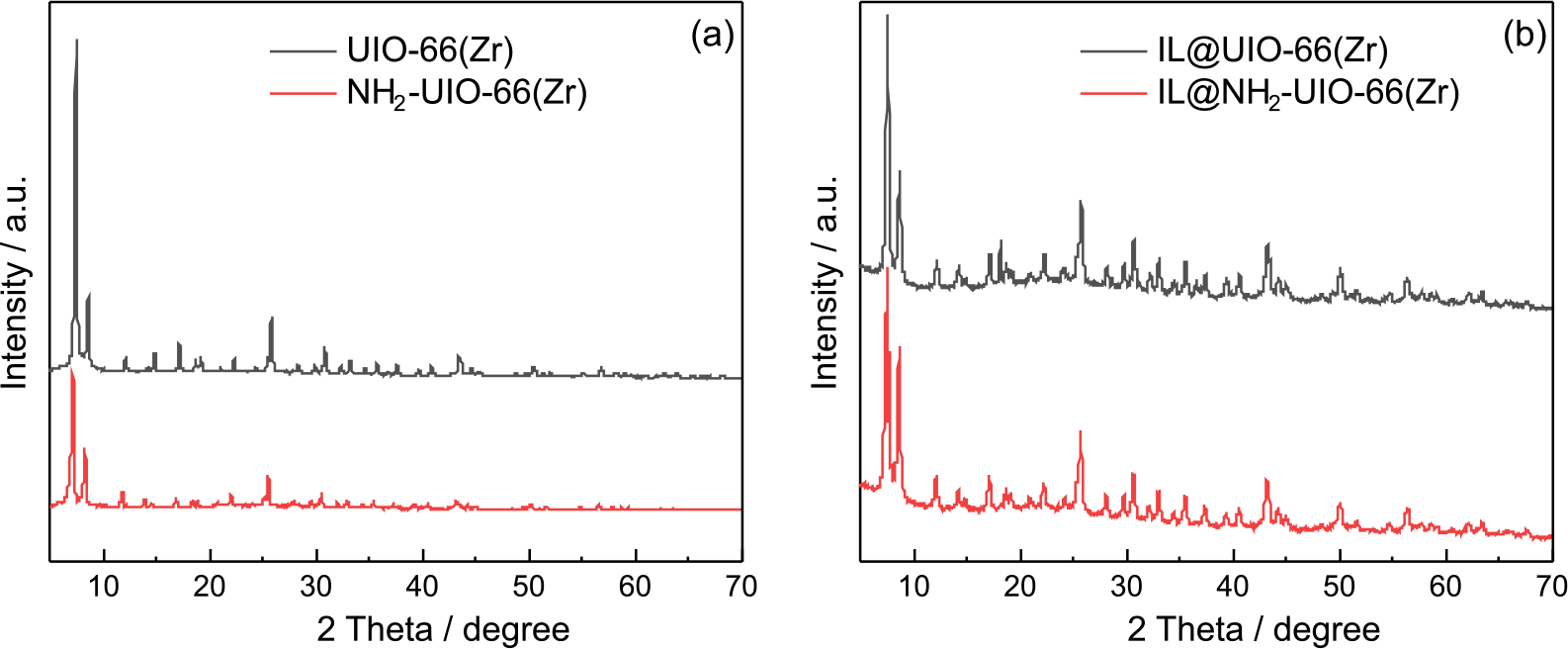
The XRD patterns of the four as-prepared materials are shown in Figure 3. UiO-66(Zr) and NH2-UiO-66(Zr) exhibit nearly identical peak positions (Figure 3a), indicating that amine incorporation primarily modifies the linker functionality without altering the framework topology or crystalline phase. Both materials therefore retain the UiO-66 fcu topology. In the low-angle region, characteristic reflections appear at 7.2° and 8.2°, which are widely regarded as the most diagnostic “fingerprint” peaks of UiO-66. A series of additional reflections is also observed in the medium-to-high 2Θ range (11.8°, 14.8°, 17.1°, and 25.7°).

After loading [BMIm]Lys, the diffraction peak positions of [BMIm]Lys@UiO-66 and [BMIm]Lys@NH2-UiO-66 (Figure 3b) remain consistent with those of their parent frameworks (UiO-66 or NH2-UiO-66), indicating that the crystalline phase is preserved upon immobilization. This suggests that the pores and/or external surfaces are occupied by the IL without framework collapse. Nevertheless, IL incorporation leads to an overall decrease in peak intensity, an elevated background, and slight peak broadening. These changes are mainly attributed to reduced X-ray scattering contrast due to pore filling, together with the largely amorphous (or poorly crystalline) nature of the IL, which increases diffuse scattering. In addition, the impregnation process may introduce a certain degree of defects or microstrain. At the same nominal loading, the intensity attenuation is more pronounced for IL@NH2-UiO-66, which is likely related to stronger interfacial interactions and a higher degree of structural disorder. Moreover, small peak shifts are more discernible for IL@NH2-UiO-66, plausibly because stronger hydrogen-bonding and ionic interactions between the amine groups and the IL induce local strain variations within the framework.
The surface morphology of nanomaterials can affect their specific surface area and, consequently, their CO2 adsorption performance. The morphologies of the as prepared samples were examined by SEM (Figure 4). UiO 66(Zr) consists of well-defined polyhedral crystallites with sharp edges, a relatively uniform particle size distribution, and comparatively smooth surfaces, with no obvious agglomeration. After amine functionalization, NH2 UiO-66(Zr) largely retains the crystalline shape; however, particle agglomeration becomes more pronounced, likely due to enhanced hydrogen bonding and increased surface polarity that promote interparticle adhesion. In addition, the surface appears rougher with slightly blunted boundaries, and the particle size is larger than that of UiO-66(Zr). Upon IL loading, [BMIm]Lys@UiO-66(Zr) shows obvious edge rounding and blurred facet boundaries, suggesting that the crystal surfaces are partially covered by an organic phase. Bridging/adhesion between particles becomes apparent, leading to more evident agglomerates, and the surface exhibits a coatingor film-like texture, confirming successful incorporation of the IL. For [BMIm]Lys@NH2-UiO-66(Zr), agglomeration is further intensified. The surface becomes rougher and appears more heavily coated, with interparticle “adhesive bridges” occurring more frequently. Overall, the -NH2 groups on NH2-UiO-66(Zr) provide additional interaction sites-including hydrogen bonding, electrostatic interactions, and acid-base interactions-thereby facilitating IL enrichment on the MOF surface.

SEM images of (a) UiO-66(Zr), (b) NH2-UiO-66(Zr), (c) [BMIm]Lys@UiO-66(Zr), and (d) [BMIm]Lys@NH2-UiO-66(Zr).
The N2 adsorption-desorption isotherms and pore-size distributions of the four materials were evaluated by N2 physisorption (Brunauer-Emmett-Teller (BET)) analysis, as summarized in Figure 5. UiO-66(Zr) exhibits a type-I isotherm,27 characteristic of predominantly microporous materials, with a BET surface area of 1208.3 m2 g-1 and a micropore volume of 0.57 cm3 g-1. Its pore-size distribution is dominated by a micropore-related peak with a relatively narrow spread, centered at ca. 2.87 nm (Figure 5b). After amine functionalization, the BET surface area of NH2 UiO 66(Zr) decreases slightly to 1074.2 m2 g-1 (a reduction of ca. 11%), which can be attributed to partial pore occupation by -NH2 groups and strengthened host-guest interactions. The main pore-size feature is largely retained, but the peak intensity is reduced, consistent with a decrease in effective pore volume.

(a) N2 adsorption-desorption isotherms at 77 K and (b) pore size distribution of the prepared materials.
After IL immobilization, the composites show a pronounced reduction in BET surface area. The BET surface areas of [BMIm]Lys@UiO-66(Zr) and [BMIm]Lys@NH2-UiO-66(Zr) decrease to 213.6 and 177.5 m2 g-1. In parallel, the micropore volume decreases (ca. 0.19 cm3 g-1) and the micropore-related peak is markedly attenuated, which can be attributed to partial pore blocking caused by IL coverage within the pore channels. Compared with [BMIm]Lys@UiO-66(Zr), [BMIm]Lys@NH2-UiO-66(Zr) displays a more substantial loss of surface area and micropore volume. This is plausibly because the -NH2 groups provide additional interaction sites that anchor the IL at pore walls and pore entrances, thereby strengthening the occupancy and pore-blocking effects. These quantitative results clearly confirm that IL incorporation leads to partial pore blocking and occupation of internal pore space.
CO2 uptake by liquid ILs
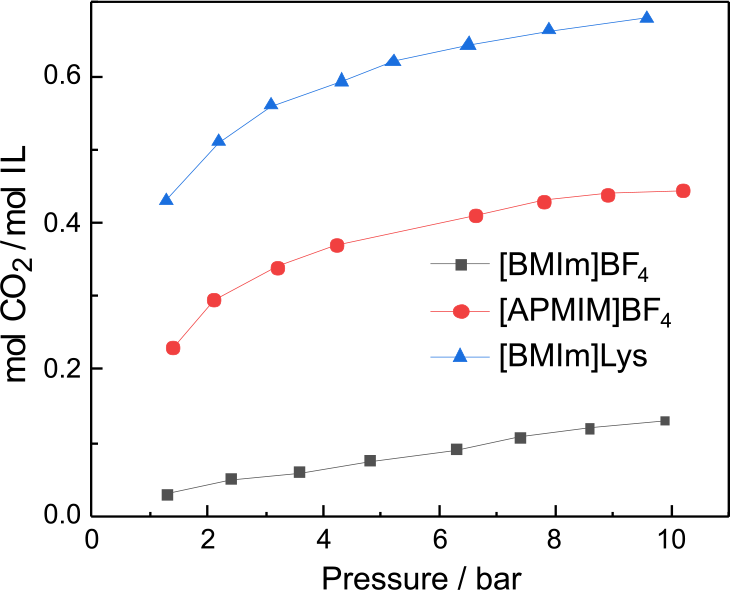
To elucidate how amine functionalities in ionic liquids affect CO2 absorption, the CO2 uptake capacities of [BMIm]BF4, [APMIm]BF4, and [BMIm]Lys were measured over the pressure range of 1.3-10.2 bar. The results are shown in Figure 6. Overall, [BMIm]BF4 exhibits a relatively low CO2 uptake, increasing slowly and approximately linearly with pressure, which is indicative of predominantly physical dissolution. In contrast, [APMIm]BF4 shows a rapid increase in uptake at low pressures followed by an evident plateau at higher pressures, displaying a saturation-type (“fast-then-slow”) behavior. Among the three, [BMIm]Lys consistently delivers the highest CO2 uptake, with a particularly pronounced advantage in the low pressure region, and gradually approaches a plateau as the pressure increases.

CO2 molar uptake of [BMIm]BF4, [APMIm]BF4, and [BMIm]Lys over the pressure range of 1.3-10.2 bar.
Under low-pressure conditions (ca. 1.3-1.4 bar), the CO2 absorption capacities of [BMIm]BF4, [APMIm]BF4, and [BMIm]Lys were 0.03, 0.24, and 0.42 mol CO2 per mol IL, respectively; thus, [APMIm]BF4 and [BMIm]Lys exhibited ca. 8.0-fold and ca. 14.0-fold higher uptake than [BMIm]BF4. At intermediate pressures (ca. 4.2 4.8 bar), the corresponding capacities increased to 0.076, 0.37, and 0.59 mol CO2 per mol IL. The substantial performance gap therefore persists in this regime, with [BMIm]Lys remaining the most effective absorbent, followed by [APMIm]BF4. At high pressures (ca. 9.6 10.2 bar), the CO2 capacities reached 0.13, 0.45, and 0.68 mol CO2 per mol IL for [BMIm]BF4, [APMIm]BF4, and [BMIm]Lys, respectively. This confirms that the ranking is unchanged at ca. 10 bar, although the relative differences narrow compared with the low-pressure region: [BMIm]Lys is approximately 5.2 times that of [BMIm]BF4, and [APMIm]BF4 is about 3.5 times that of [BMIm]BF4.
Overall, across the 1-10 bar range, the CO2 absorption capacities of the three ionic liquids consistently follow the order [BMIm]Lys > [APMIm]BF4> [BMIm]BF4. In particular, [BMIm]BF4 exhibits a low uptake that increases nearly linearly with pressure, consistent with predominantly physical dissolution. By contrast, the amine-/amino-acid-functionalized systems ([APMIm]BF4 and [BMIm]Lys) show much stronger uptake in the low-pressure region and then gradually approach a plateau, reflecting the contribution of higher-affinity and/or reactive sites toward CO2.
The time-dependent CO2 absorption behaviors of [BMIm]BF4, [APMIm]BF4, and [BMIm]Lys are presented in Figure 7. After 65 min of absorption, the CO2 uptake follows the order [BMIm]Lys > [APMIm]BF4 > [BMIm]BF4. Specifically, the CO2 capacities of [BMIm]Lys and [APMIm]BF4 are 5.91 and 3.83 times that of [BMIm]BF4, respectively. Over the 65 min period, all three ionic liquids exhibit a similar kinetic trend-rapid uptake at the initial stage followed by a slower approach to equilibrium-with an apparent plateau reached after approximately 30 min.

FTIR was used to probe the reaction pathways of CO2 uptake by [APMIm]BF4 and [BMIm]Lys, as shown in Figure 8. For [APMIm]BF4 (Figure 8a), the amine group is located on the cationic side chain, giving rise to an -NH2-related band at 2972 cm-1. After exposure to CO2, characteristic bands attributable to carbamate species (NCOO-/COO-) emerge. In particular, a new band at 1692 cm-1-assigned to a C=O-related asymmetric stretching mode-provides strong evidence for carbamate (or closely related) formation. An additional band appears at ca. 1576 cm-1, corresponding to the asymmetric stretching of COO-, which partially overlaps with vibrations from the imidazolium ring. The symmetric stretching band of COO- is observed at ca. 1386 cm-1. Meanwhile, protonation of the amine and/or development of an extended hydrogen-bonding network upon CO2 uptake leads to band broadening and slight shifts: the Ν(N-H) envelope in the ca. 3300 3500 cm-1 region becomes broader and shifts in position, and the NH2 scissoring mode near ca. 1600 cm-1 weakens or is masked by newly formed bands. Notably, the B-F vibration of BF4- remains essentially unchanged at 1036 cm-1 before and after CO2 absorption, indicating that the anion does not directly participate in the reaction. For [BMIm]Lys (Figure 8b), the amine functionality resides on the lysinate anion. Upon CO2 uptake, carbamate-related COO- bands are superimposed on the original carboxylate signals of the amino-acid anion. The intrinsic COO- bands of lysinate remain visible, including the asymmetric stretching band at 1570 cm-1 and the symmetric stretching band at 1401 cm-1. In addition, newly formed carbamate COO- features overlap with these regions, manifested as a shoulder near ca. 1668 cm-1 and an increase in intensity accompanied by band-shape changes in the ca. 1300 1400 cm-1 window. Furthermore, a very broad O-H band spanning 3000 3500 cm-1 is observed, suggesting the presence of carbamic acid and/or strong hydrogen-bonded association.

Accordingly, both [APMIm]BF4 and [BMIm]Lys exhibit clear FTIR changes after contact with CO2, and the appearance of these new functional-group signatures supports CO2 chemisorption by the amine-functionalized ionic liquids. Nevertheless, the two systems differ fundamentally in the origin and spectral manifestation of the carbamate species. The characteristic peak intensity of the carbamate group in [APMIm]BF4-CO2 is weak, and the attenuation of the amino peak at 3200-3500 cm-1 is small, indicating that the cationic side-chain amino groups are restricted by the steric hindrance of BF4- and strong hydrogen bonding effects, unable to fully contact and react with CO2, resulting in limited contribution to chemical absorption. Meanwhile, the physical absorption sites are single, leading to a low total adsorption capacity. For [BMIm]Lys-CO2, a significantly higher intensity of the carbamate peak at 1668 cm-1 compared to [APMIm]BF4, and a greater attenuation of the N-H peak at 3200-3500 cm-1, proving that the -NH2 and -COOH groups of lysine anion form a cooperative hydrogen bonding network, capable of simultaneously absorbing multiple CO2 molecules. With a large number of absorption sites and strong interaction strength, the total adsorption capacity is higher. This is consistent with the results of CO2 absorption experiments. Therefore, [BMIm]Lys is selected for immobilization.
CO2 adsorption on IL-immobilized composites
Upon CO2 uptake, ionic liquids typically undergo a viscosity increase,28,29 which imposes a larger diffusion and mass-transfer resistance for CO2 in the liquid phase and thus hampers further improvements in uptake. To address this limitation, the ionic liquid was immobilized onto MOF supports and evaluated for CO2 adsorption. As demonstrated above, both [APMIm]BF4 and [BMIm]Lys exhibit chemisorption toward CO2 and deliver substantially higher uptake than [BMIm]BF4, which is dominated by physical absorption. Moreover, [BMIm]Lys shows a higher CO2 capacity than [APMIm]BF4. Therefore, [BMIm]Lys was selected for immobilization, and UiO-66(Zr) and NH2-UiO-66(Zr) were employed as supports to prepare IL-immobilized composites for CO2 adsorption, with particular attention to the synergistic effects between the amine-functionalized framework and the ionic liquid. As shown in Figure 9, across the entire pressure range of 0-0.8 bar, the CO2 uptake consistently follows the order: [BMIm]Lys@NH2-UiO-66(Zr) > [BMIm]Lys@UiO 66(Zr) > NH2 -UiO-66(Zr) > UiO-66(Zr).
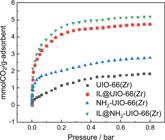
For the pristine supports (UiO-66(Zr) and NH2 UiO 66(Zr)), at 0.008 bar the CO2 uptake of NH2 UiO 66(Zr) is 3.72 times that of UiO-66(Zr) (i.e., a +269.7% increase). As the pressure increases to 0.2 and 0.8 bar, the CO2 uptake of NH2-UiO-66(Zr) remains higher, reaching 1.73-fold (+73.4%) and 1.51-fold (+50.9%) of that of UiO-66(Zr), respectively. These results indicate that introducing -NH2 groups enhances the CO2 affinity of the framework, with the effect being most pronounced in the low-pressure region.
After AAIL immobilization, both [BMIm]Lys@UiO-66(Zr) and [BMIm]Lys@NH2-UiO-66(Zr) exhibit substantially higher CO2 uptakes than their corresponding pristine supports. For [BMIm]Lys@UiO-66(Zr), the CO2 capacities at 0.008, 0.2, and 0.8 bar are 6.64-fold (+563.7%), 3.58 fold (+258.5%), and 2.59-fold (+158.6%) of that of UiO-66(Zr), respectively, demonstrating a pronounced enhancement particularly in the low-pressure regime. For [BMIm]Lys@NH2-UiO-66(Zr), the uptake at 0.008, 0.2, and 0.8 bar reaches 4.35-fold (+214.3%), 2.27-fold (+127.1%), and 1.86-fold (+86.3%) of NH2-UiO-66(Zr), respectively. Collectively, these results indicate that the capacity gain introduced by AAIL immobilization is markedly larger than that achieved by -NH2 functionalization alone, with the advantage being most prominent at very low pressure (0.008 bar).
In addition, the ratios of the CO2 uptakes at 0.2 bar to those at 0.8 bar for UiO-66(Zr), NH2-UiO-66(Zr), [BMIm]Lys@UiO-66(Zr), and [BMIm]Lys@NH2-UiO-66(Zr) are 62.9, 72.3, 87.2, and 88.0%, respectively. This indicates that [BMIm]Lys@MOF materials deliver most of their total capacity already at relatively low partial pressures (with 0.2 bar approaching a plateau), which is consistent with adsorption dominated by stronger interaction sites and higher CO2 affinity.
In addition, the CO2 adsorption capacity of [BMIm]Lys@NH2-UiO-66(Zr) was evaluated as a function of CO2 partial pressure (0-0.8 bar) at different temperatures (10, 20, 30, 40, and 50 °C), as shown in Figure 10. Over the 0-0.8 bar range, the CO2 uptake at each temperature increases with increasing partial pressure, exhibiting a typical Langmuir-type growth profile. This suggests that adsorption sites are not yet saturated in the low-pressure regime and that the uptake behavior is predominantly governed by physisorption.

At a given partial pressure, the CO2 uptake first increases and then decreases with rising temperature, indicative of an overall exothermic adsorption process. At 0.8 bar, the CO2 capacities of [BMIm]Lys@NH2-UiO-66(Zr) at 10, 20, 30, 40, and 50 °C are 3.72, 4.63, 5.18, 4.48, and 3.56 mmol g-1, respectively. The uptake reaches a maximum at 30 °C and then declines slightly, suggesting a competitive interplay between adsorption and desorption in the intermediate temperature range. At lower temperatures (10-20 °C), CO2 molecules possess lower kinetic energy and diffuse more slowly, which limits the adsorption rate. As the temperature increases to 30 °C, enhanced diffusion and increased interfacial mobility of the ionic liquid enable more active sites to participate in adsorption. When the temperature is further raised (> 40 °C), intensified thermal motion promotes desorption of previously adsorbed CO2, resulting in a decrease in uptake. Therefore, [BMIm]Lys@NH2-UiO-66(Zr) exhibits optimal CO2 adsorption performance at around 30 °C, where kinetic and thermodynamic effects are better balanced.
The observed temperature dependence indicates that CO2 uptake on this material is predominantly an exothermic process. This behavior can be rationalized by the synergistic combination of an amine-functionalized UiO-66 framework and an AAIL. Specifically, NH2-UiO-66(Zr) introduces Lewis-basic sites that strengthen the (primarily weak) interactions with CO2. In addition, the amino and carboxyl groups in the AAIL can participate in chemisorption of CO2, forming carbonate and/or carbamate species.30,31 At elevated temperatures, these weak chemical bonds are more readily disrupted, which accounts for the decrease in adsorption capacity.
The temperature dependence of CO2 uptake indicates an overall exothermic adsorption process. According to adsorption thermodynamics, the equilibrium constant (K) is related to temperature by the van’t Hoff equation.
where ∆H represents the apparent enthalpy of adsorption, T is the temperature, C is constant and R universal gas constant. The observed decrease in CO2 uptake above 30 °C is consistent with a negative adsorption enthalpy, indicating that adsorption is thermodynamically favored at moderate temperatures but progressively suppressed at higher temperatures.
The presence of both physisorption (framework-CO2 interactions) and weak chemisorption (AAIL-CO2 interactions) suggests that the overall heat of adsorption likely lies in an intermediate range between typical physical adsorption (ca. 20-40 kJ mol-1) and strong chemisorption (> 60 kJ mol-1).
Overall, the CO2 uptake of [BMIm]Lys@NH2-UiO-66(Zr) increases with increasing CO2 partial pressure. The adsorption is strongly temperature-dependent: the capacity reaches a maximum at 30 °C (5.18 mmol g-1) and then gradually decreases as the temperature is further raised. These results suggest that CO2 adsorption on [BMIm]Lys@NH2-UiO-66(Zr) proceeds via a physisorption-chemisorption coupled mechanism that is predominantly governed by an exothermic adsorption process.
At 20 °C, the pressure dependence of CO2/N2 selectivity was examined for the four materials (Figure 11). As can be seen, the selectivity decreases with increasing pressure for all samples. Specifically, the CO2/N2 selectivity of UiO 66(Zr) decreases from 16.6 at 0.1 bar to 14.3 at 0.8 bar, corresponding to a 13.9% reduction. Similarly, NH2 UiO 66(Zr) decreases from 28.3 to 23.5 (-17.0%). A much larger decline is observed for the IL-immobilized composites: [BMIm]Lys@UiO-66(Zr) drops from 423.5 to 114.6 (-72.9%), and [BMIm]Lys@NH2-UiO-66(Zr) decreases from 468.2 to 158.4 (-66.2%). After AAIL immobilization, highly CO2-affinitive and/or reactive sites are preferentially occupied in the low-pressure regime, leading to a marked amplification of selectivity. As the pressure increases, these strong sites progressively approach saturation, and additional adsorption increasingly occurs on comparatively less selective pore sites, resulting in a more pronounced selectivity decay with pressure.

CO2/N2 selectivity for (a) pristine UiO-66(Zr) and NH2-UiO-66(Zr), (b) [BMIm]Lys@UiO-66(Zr) and [BMIm]Lys@NH2-UiO-66(Zr).
Moreover, throughout the entire 0.1-0.8 bar range, the CO2/N2 selectivity consistently follows the order: [BMIm]Lys@NH2-UiO-66(Zr) > [BMIm]Lys@UiO-66(Zr) >> NH2 UiO 66(Zr) > UiO-66(Zr). Specifically, at 0.1 bar, the CO2/N2 selectivities of UiO-66(Zr), NH2-UiO-66(Zr), [BMIm]Lys@UiO-66(Zr), and [BMIm]Lys@NH2-UiO-66(Zr) are 16.6, 28.3, 423.5, and 468.2, respectively. Relative to UiO-66(Zr), the selectivities of NH2-UiO-66(Zr), [BMIm]Lys@UiO-66(Zr), and [BMIm]Lys@NH2-UiO-66(Zr) are higher by factors of 1.70, 25.5, and 28.2, respectively. At 0.8 bar, the corresponding selectivities are 14.3, 23.5, 114.6, and 158.4; notably, [BMIm]Lys@NH2-UiO-66(Zr) remains ca. 38.2% higher than [BMIm]Lys@UiO-66(Zr).
For the pristine supports, NH2 functionalization increases the CO2/N2 selectivity by a relatively stable factor of ca. 1.64 1.73 across the entire pressure range. This trend is consistent with stronger interactions between -NH2 groups and CO2 (e.g., dipole interactions, hydrogen bonding, and acid-base interactions), which promote preferential CO2 adsorption. For the AAIL-loaded composites, the selectivity under low-pressure conditions rises sharply to the 102-103 level, indicating that the AAIL introduces highly CO2-philic capture sites-with a stronger contribution from chemical interactions-thereby greatly suppressing the relative uptake of N2. Notably, [BMIm]Lys@NH2-UiO-66(Zr) consistently delivers the highest CO2/N2 selectivity throughout the examined pressure range. This suggests an additive effect of NH2 functionality and AAIL/CO2 interactions, and further implies that, once the strongest sites progressively approach saturation, the NH2 groups provide a more pronounced “follow-up” contribution that helps sustain the selectivity advantage.
NH2-UiO-66 shows higher selectivity than UiO-66 because CO2 possesses a relatively large quadrupole moment and can readily interact with -NH2 sites through hydrogen bonding and Lewis acid-base interactions.32 As a result, NH2-UiO-66 exhibits a higher Henry’s constant and a steeper initial uptake slope in the low-pressure regime, whereas N2 is comparatively inert; consequently, the CO2/N2 separation performance is improved. After AAIL immobilization, the affinity toward CO2 is further strengthened and N2 uptake is more strongly suppressed, leading to a pronounced increase in selectivity. The AAIL-through its amino-acid anion and amine-associated hydrogen-bonding network-provides stronger CO2-binding sites, which is particularly effective at low CO2 partial pressures; therefore, the selectivity decreases as the pressure increases. In addition, the AAIL partially occupies the pore space (as evidenced by the pore-size distribution in Figure 5), which can reduce N2 accessibility and diffusion, thereby further enhancing the CO2/N2 selectivity.
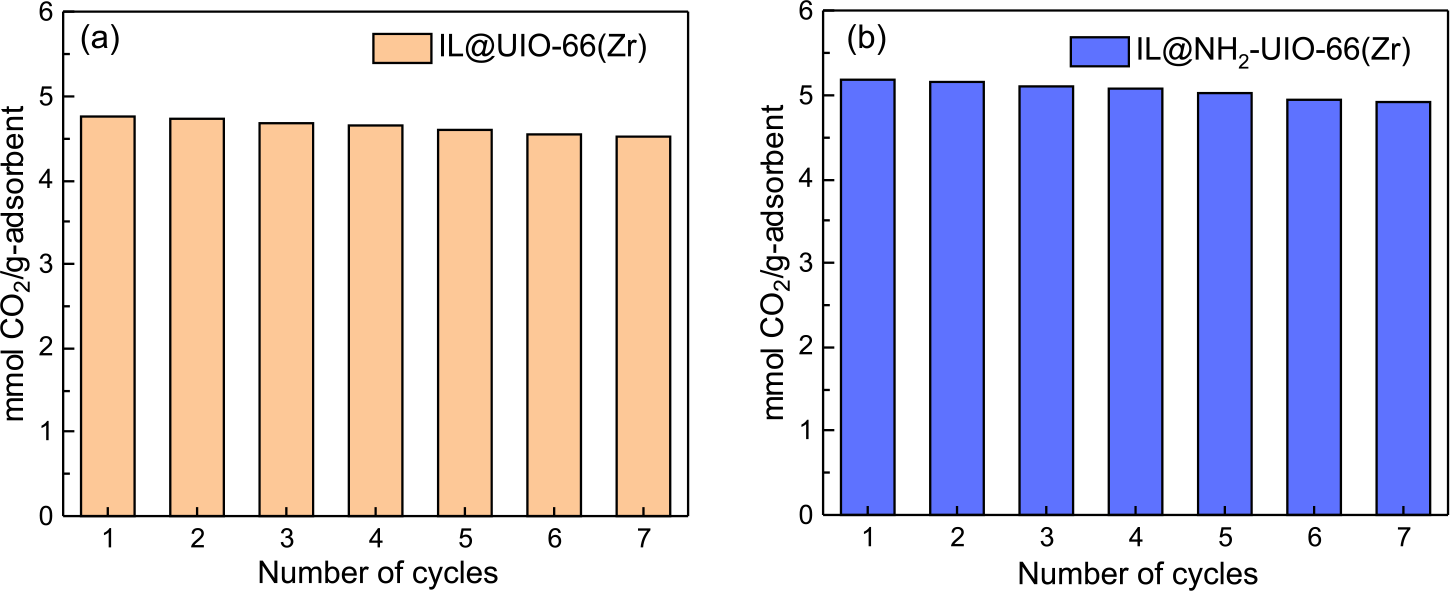
The cyclic adsorption performance of [BMIm]Lys@UiO-66(Zr) and AAIL@NH2-UiO-66(Zr) was evaluated over seven adsorption-desorption cycles at 20 °C and 0.8 bar, as shown in Figure 12. For [BMIm]Lys@UiO 66(Zr), the CO2 uptake decreases from 4.76 mmol g-1 in the first cycle to 4.52 mmol g-1 in the seventh cycle, corresponding to a retention of 94.96%. The gradual, nearly linear decline suggests that the framework and active sites remain largely stable during repeated cycling. Similarly, [BMIm]Lys@NH2-UiO-66(Zr) retains 94.98% of its initial capacity after seven cycles, indicating comparably good recyclability.

To evaluate structural stability and possible IL leaching, FTIR and XRD analyses were conducted after the seventh adsorption-desorption cycle (Figure 13). The characteristic IL-related bands remain clearly visible, with no detectable attenuation. Similarly, the XRD patterns retain the characteristic reflections of the UiO-66 framework without peak shifts or emergence of new crystalline phases. These results indicate that the ionic liquid remains effectively immobilized within the pore structure during cycling. Under the present dry-gas experimental conditions, no evidence of IL volatilization or framework degradation was observed. The strong hydrogen-bonding and electrostatic interactions between -NH2 groups and the AAIL likely contribute to enhanced immobilization stability.

(a) FTIR and (b) XRD spectra of [BMIm]Lys@NH2-UiO-66(Zr) before and after seventh adsorption-desorption cycle.
Conclusions
In this study, UiO-66(Zr) and its amine-functionalized derivative NH2-UiO-66(Zr) were employed as supports to construct AAIL immobilized composites ([BMIm]Lys@UiO-66 and [BMIm]Lys@NH2-UiO-66) via an impregnation strategy, and their CO2 capture and separation performances were systematically evaluated. FTIR, XRD, SEM, and BET analyses collectively demonstrate that amine functionalization does not alter the crystalline phase of the UiO-66 framework. After AAIL incorporation, the framework remains intact, whereas the diffraction intensities decrease and both pore volume and specific surface area are reduced, indicating that the ionic liquid occupies the pore space and forms a coating layer on the surface. Moreover, the NH2 functionalities can establish stronger hydrogen-bonding/electrostatic networks with the AAIL, thereby enhancing immobilization stability and interfacial interactions. In terms of absorption performance, amine-/amino-acid-functionalized ionic liquids exhibit markedly higher CO2 uptake over 1-10 bar ([BMIm]Lys > [APMIm]BF4 > [BMIm]BF4), highlighting the contribution from chemisorption. After immobilization, the CO2 adsorption capacities in the 0-0.8 bar range consistently follow the order [BMIm]Lys@NH2-UiO-66 > [BMIm]Lys@UiO-66 > NH2-UiO-66 > UiO-66, and [BMIm]Lys@NH2-UiO-66 reaches 5.18 mmol g-1 at 30 °C and 0.8 bar. Regarding separation, AAIL loading boosts the CO2/N2 selectivity to the 102 level under low-pressure conditions, with [BMIm]Lys@NH2-UiO-66 achieving 468.2 at 0.1 bar. After seven adsorption-desorption cycles, the capacity retention remains ca. 95%, indicating good regenerability and promising potential for practical applications. It should be emphasized that the present adsorption and cycling experiments were conducted under model conditions using dry single-component gases and a limited number of adsorption-desorption cycles. Mixed-gas separation performance and long-term stability under humid flue-gas conditions require further investigation.
Data Availability Statement
Data supporting the findings of this study are mostly presented in the article. Any further relevant data are available from the corresponding author upon reasonable request.
References
-
1 Kabir, M.; Habiba, U. E.; Khan, W.; Shah, A.; Rahim, S.; Rios Escalante, P. R. D.; Farooqi, Z. U. R.; Ali, L.; Shafiq, M.; J. King Saud Univ. Sci. 2023, 35, 102693. [Crossref]
» Crossref -
2 Mammadov, O.; Mahmoud, A. A.; Al-Yaseri, A.; Al Ramadan, M.; ACS Omega 2025, 10, 28515. [Crossref]
» Crossref -
3 Zhu, B.; Liu, Q.; Zhou, Q.; Yang, J.; Ding, J.; Wen, J.; Chem. Eng. Technol 2014, 37, 635. [Crossref]
» Crossref -
4 Kim, Y. E.; Lim, J. A.; Jeong, S. K.; Yoon, Y. I.; Bae, S. T.; Nam, S. C.; B. Korean Chem. Soc. 2013, 34, 783. [Crossref]
» Crossref -
5 Ooi, Z.; Tan, P.; Tan, L.; Yeap, S.; Chinese J. Chem. Eng. 2020, 28, 1357. [Crossref]
» Crossref -
6 Li, G.; Shen, X.; Jiao, X.; Xie, F.; Hua, J.; Lin, H.; Yan, F.; Wu, H.; Zhang, Z.; Chem. Eng. J. 2024, 493, 152699. [Crossref]
» Crossref -
7 Ochedi, F. O.; Yu, J.; Yu, H.; Liu, Y.; Hussain, A.; Environ. Chem. Lett. 2021, 19, 77. [Crossref]
» Crossref -
8 Guo, R.; Li, G.; Liu, Y.; Pan, W.; Energy Fuels 2023, 37, 15429. [Crossref]
» Crossref -
9 Chai, S. Y. W.; Ngu, L. H.; How, B. S.; Greenhouse Gases 2022, 12, 394. [Crossref]
» Crossref -
10 Nugent, P.; Belmabkhout, Y.; Burd, S. D.; Cairns, A. J.; Luebke, R.; Forrest, K.; Pham, T.; Ma, S. Q.; Space, B.; Wojtas, L.; Eddaoudi, M.; Zaworotko, M. J.; Nature 2013, 495, 80. [Crossref]
» Crossref -
11 Siegelman R. L.; Kim E. J.; Long J. R.; Nat. Mater. 2021, 20, 1060. [Crossref]
» Crossref -
12 Usman, M.; Iqbal, N.; Noor, T.; Zaman, N.; Asghar, A.; Abdelnaby, M. M.; Galadima, A.; Helal, A.; Chem. Rec. 2022, 22, e202100230. [Crossref]
» Crossref -
13 Song, Y.; Ma, S.; Chem. Sci. 2025, 16, 11740. [Crossref]
» Crossref -
14 Yang, T.; Gao, Y.; He, Q.; Chai, Y.; Qin, P.; Wu, Z.; Liu, C.; Gong, X.; Liang, Y.; Chem. Eng. J. 2024, 486, 149971. [Crossref]
» Crossref -
15 Muhammad, Y. A.; Sajid, M.; Umar, A.; Khan, N. A.; Abdulazeez, I.; Salhi, B.; Baig, N.; Falath, W.; Desalination 2025, 615, 119222. [Crossref]
» Crossref -
16 Duflot, M.; Marchal, C.; Artero, V.; Christoforidis, K. C.; Keller, V.; Adv. Energy Mater. 2025, 15, 2500104. [Crossref]
» Crossref -
17 Xing, H.; Yu, F.; Li, X.; Bao, Y.; Ye, W.; Li, C.; Zheng, S.; Huang, M.; Sep. Purif. Technol. 2025, 360, 130981. [Crossref]
» Crossref -
18 Zhao, Y.; Wang, X.; Li, Z.; Wang, H.; Zhao, Y.; Qiu, J.; J. Phys. Chem. B 2024, 128, 1079. [Crossref]
» Crossref -
19 Wu, H.; Wen, S.; Zhang, X.; Zhang, S.; Guo, X.; Wu, Y.; Chem. Eng. J. 2024, 488, 150771. [Crossref]
» Crossref -
20 Wen, S.; Wu, H.; Zhang, X.; Wang, T.; Xu, W.; Wu, Y.; Chem. Eng. Sci. 2024, 284, 119530. [Crossref]
» Crossref -
21 Matsuoka, A.; Otani, A.; Kamio, E.; Matsuyama, H.; Sep. Purif. Technol. 2022, 280, 119847. [Crossref]
» Crossref -
22 Recker, E. A.; Green, M.; Soltani, M.; Paull, D. H.; McManus, G. J.; Davis, J. H.; Mirjafari, A.; ACS Sustainable Chem. Eng. 2022, 10, 11885. [Crossref]
» Crossref -
23 Bera, N.; Sardar, P.; Hazra, R.; Samanta, A. N.; Sarkar, N.; ACS Sustainable Chem. Eng. 2024, 12, 14288. [Crossref]
» Crossref -
24 Li, X.; Chen, K.; Guo, R.; Wei, Z.; Chem. Rev. 2023, 123, 10432. [Crossref]
» Crossref -
25 Bao, W.; Kuai, J.; Gao, H.; Zheng, M.; Sun, Z.; He, M.; Chen, Q.; Zhang, Z.; Dalton Trans. 2024, 53, 6215. [Crossref]
» Crossref -
26 Zhao, M.; Ban, Y.; Yang, W.; Chem. Eng. J. 2022, 439, 135650. [Crossref]
» Crossref -
27 Hu, Z.; Faucher, S.; Zhuo, Y.; Sun, Y.; Wang, S.; Zhao, D.; Chem.-Eur. J. 2015, 21, 17246. [Crossref]
» Crossref -
28 Makino, T.; Kanakubo, M.; Masuda, Y.; Umecky, T.; Suzuki, A.; Fluid Phase Equilib. 2014, 362, 300. [Crossref]
» Crossref -
29 Mao, J.; Ci, Y.; Liu, J.; Li, C.; Yang, W.; Yun, Y.; Liu, G.; Li, M.; Wang, M.; Chem. Eng. J. 2024, 491, 151991. [Crossref]
» Crossref -
30 Yoon, B.; Chen, S.; Voth, G. A.; J. Am. Chem. Soc. 2024, 146, 1612. [Crossref]
» Crossref -
31 Sheikh, M. S.; Sui, J.; Wang, B.; Wang, X.; Adv. Sustainable Syst. 2025, 9, e01422. [Crossref]
» Crossref -
32 Chetty, N.; Couling, V. W.; Mol. Phys. 2011, 109, 666. [Crossref]
» Crossref
Edited by
-
Editor handled this article:
Juliano Alves Bonacin (Associate)