 Doehlert Design Optimization of Ultrasound-Assisted Tetramethylammonium Hydroxide Dissolution of Soy Milk for Fe, Mn, and Zn Determination
Abstract
In this study, a methodology was developed to determine Fe, Mn and Zn by flame atomic absorption spectrometry (FAAS) in soy milk samples. Samples were treated by dissolution with tetramethylammonium hydroxide (TMAH) using ultrasound energy. Doehlert design was applied in the multivariate optimization of the following variables: sonication time, TMAH volume and temperature during dissolution. The desirability function was used to find the optimum region. The methodology presented limits of quantification of 14.2, 4.7, and 0.73 mg kg-1, precision, expressed as repeatability (relative standard deviation (RSD), 2.0 mg L-1, n = 10), of 1.5, 1.3, and 0.95%, respectively, for Fe, Mn, and Zn. Accuracy was assessed by addition/recovery tests (recoveries in the range of 93 and 105%), comparison with another method adopted as a standard (acid digestion in a digester block), and analysis of a certified reference material (powdered skimmed milk, ERM-BD150). The method presented adequate accuracy for determining the elements studied in soy milk samples.
Keywords:
soy milk; metals; multivariate optimization; TMAH; ultrasound energy; FAAS
Introduction
Soy milk is a functional and convenient food alternative developed to meet the nutritional needs of specific population groups, including individuals of different age ranges, lifestyle profiles, and those with food intolerance. It is recommended for body fat reduction, for athletes requiring plant-based protein sources, and for individuals following vegan diets. Additionally, soy milk is widely consumed by those seeking to control serum cholesterol levels, and by individuals allergic or intolerant to components of cow’s milk.1-4
It is a beverage produced using soybeans (Glycine max) through their grinding in the presence of water, obtaining a colloidal suspension. This process preserves most of the soluble carbohydrates, proteins, fats, vitamins, and minerals naturally present in the grains. Nutrients, stabilizers, flavorings, and preservatives may also be added to the final product. Another way of marketing the product is in powdered form (known as isolated soy protein, extracted from defatted flour), which must be prepared by dissolving it in warm water. It offers similar amounts of protein per serving compared to ready-to-drink beverages.2,3
Food is the primary source of essential mineral elements required for the nutrition of living organisms. However, the beneficial effect on metabolism and human health depends on the element, and the amount ingested. Micronutrients such as Fe, Mn and Zn are required in much smaller quantities, in the order of milligrams or micrograms. The ingestion of insufficient amounts of micronutrients is responsible for problems resulting from malnutrition, such as anemia (iron deficiency), dermatitis, low immunity, dry skin, hair loss (Zn deficiency). Mn deficiency is rare and, when it occurs, it is associated with restrictive diets, which can impair fat and carbohydrate metabolism, bone formation, and wound healing. Soy milk is a natural source of Fe, Mn, and Zn. They are essential micronutrients, indispensable for life, playing a fundamental role in metabolism. Their quantification in soy milk is important for nutritional reasons, ensuring product quality and food safety for the population that consumes it.5-7
Mineral elements do not exist free in the ingested food. Some organic species bind to ions and form complexes of different degrees of stability and availability to the body. The presence of these elements in food may come from farming (type of soil, use of fertilizers and agricultural pesticides, water used for irrigation, etc.) and from the handling and processing of this food, which may include the addition from external sources through contamination or the use of additives to enrich the food. The determination of mineral elements and their compounds in food is a current demand from a society increasingly concerned about life quality and health preservation.8,9
Decomposition in an acidic medium by heating meets several necessary requirements in terms of figures of merit necessary for the analysis and reliability in the results generated. However, in some cases, it is time-consuming and requires the use of large quantities of reagents and drastic conditions to degrade the sample and release the elements into the solution to be analyzed. Thus, the development of new analytical methodologies that are faster, economical, and more reliable and that use small quantities of reagents (and, therefore, more in tune with the principles of green chemistry) is necessary.10,11
Sample treatment with tetramethylammonium hydroxide (TMAH) has advantages, such as the use of a small amount of reagent (in the order of a few tens or hundreds of microliters), mild sample attack conditions and operational simplicity. The disadvantages are: the specific use of the reagent for protein samples and the possibility of element precipitation in the form of hydroxide due to the strongly alkaline environment (which deserves a careful study on the influence of this phenomenon on the results).12,13 TMAH has already been applied to decompose food samples in different studies: developing a method for dissolving cow’s milk samples for the determination of Ca, Fe, Mg, and Zn by flame atomic absorption spectrometry (FAAS),3 optimizing a method for determining Ca, Cu, Fe, K, Mg, Na, and Zn in goat meat samples by FAAS,5 preparing samples for determining Cr, Cu, Fe, K, Mg, Mn, and Zn in shrimp and crab by microwave inductively plasma optical emission spectrometry (MIP OES),14 CrVI speciation in rice samples by inductively coupled plasma mass spectrometry (ICP-MS) after chromatographic separation,15 determining Ca, Fe, Mg, and Zn in fish fillet samples by FAAS,16 using ultrasound energy to extract Pb, Cd, Cr, Mn, Fe, Cu, and Zn in edible oils for determination by graphite furnace atomic absorption spectrometry (GFAAS),17 solubilizing chicken tissues monitored by Raman spectroscopy followed by Pb determination by GFAAS,18 extraction and determination of iodine in fruits, vegetables, cereals, meats, milk, and seafood by ICP-MS,19 development of a rapid method for the simultaneous determination of monomethyl mercury and inorganic mercury in rice and aquatic plant samples by gas chromatography coupled to atomic fluorescence spectrometry,20 determination of Ag nanoparticles in fish samples using single-particle ICP-MS,21 extraction and quantification of Ag, Au, and Ti nanoparticles in marine biota by single-particle ICP-MS,22 among other studies.
In this research, multivariate optimization (Doehlert experimental design) and desirability function were applied in the development of a methodology for the preparation of soy milk samples by dissolution in TMAH medium aiming at the determination of nutrients (Fe, Zn and Mn) by FAAS.
Experimental
Instrumentation
The analytes were determined in soybean milk samples using a PerkinElmer flame atomic absorption spectrometer (Analyst 200, Norwalk, CT, USA). The influence of background radiation was corrected from the absorbance measurements by a deuterium lamp. Hollow cathode lamps, operated according to the recommendations of the manufacturer, were used as the radiation source for metal determination. Thus, the wavelengths (248.3, 279.5, and 213.9 nm), slit width (0.2, 0.2, and 0.7 nm), and lamp current (30, 20, and 15 mA) were adopted for Fe, Mn, and Zn, respectively. Acetylene gas (flow rate: 2.0 L min-1) and atmospheric air supplied by a compression equipment (flow rate: 13.5 L min-1) were used to maintain the flame, and the suction flow rate of the solutions was 5.0 mL min-1.
An ultrasonic bath equipment (Cristofoli, Campo Mourão, Brazil) was used to assist sample treatment with TMAH. The samples were digested in acidic medium by a digestion block (Tecnal, Piracicaba, São Paulo) equipped with digestion tubes and “cold finger” condensers. A Sartorius balance (BLD105, Göttingen, Germany) was used to determine sample mass.
Reagents and solutions
Tetramethylammonium hydroxide (25% m v-1, purity grade: 97%) was obtained from Sigma-Aldrich (Darmstadt, Germany). In the preparation of the standard solutions of the metals and in the spike tests (Fe, Zn and Mn), stock solutions of Fe, Mn and Zn, (Specsol, Jacareí, São Paulo), 1000 mg L-1 preserved in 1% (v v-1) HCl were used. In the total decomposition of the soy milk samples in the digestion block, concentrated nitric acid (F. Maia, Cotia, São Paulo) and 30% (v v-1) hydrogen peroxide (Êxodo Científica, Hortolândia, São Paulo) were used. A Permution system (Labnorte, Salvador, Bahia) was used to obtain deionized water. The glassware used was decontaminated by contact with a 5% (v v-1) HNO3 solution for at least 12 h, followed by rinsing with deionized water and drying in a dust-free environment.
Sample acquisition
The samples of liquid (ready-to-drink) or powdered soy milk were purchased from supermarkets and health food stores in the city of Jequié (Bahia, Brazil). The samples were stored protected from light and humidity, without the need for refrigeration. The packages were opened only when the samples were prepared. The solid product is already sold in the form of a very fine powder, dispensing with comminution, only requiring sieving in a 300 µm mesh.
Optimization procedure
Doehlert design was the multivariate tool applied to optimize the procedure for dissolving soy milk samples in TMAH medium using ultrasound energy. This experimental design was applied to model the data and find the optimal experimental conditions using the Statistica software 7.0 (StatSoft, UEA, Tulsa, Oklahoma, 2005). The variables sonication time and TMAH volume were studied at five levels. Temperature was studied at three levels. For the simultaneous optimization of the three responses (absorbance of Fe, Zn and Mn), a desirability function was used in the data set in order to maximize the responses.
Procedure for obtaining a suspension in TMAH after optimization
The optimized procedure were as follows: (i) approximately 0.25 g of the powdered soybean extract sample was weighed in a glass centrifuge tube with a conical bottom; (ii) 5 mL aliquot of deionized water were added and the tube were shook to form the sample suspension; (iii) 700 µL aliquot of 25% TMAH (v v-1) were added and the mixture were subjected to an ultrasonic bath for 15 min at room temperature; (iv) after sonication, the sample were diluted to 20 mL with deionized water and (v) transferred to a polyethylene bottle and stored in a refrigerator until metal determination by FAAS. For liquid samples, 5 mL of the sample were transferred to the tube; water was not added and the same procedure as for the solid sample from items (iii) to (v) were followed. At the end of the analyses, a solution of 1% v v-1 Triton X-100 was aspirated to help clean the nebulization system. Although clogging problems did not occur, a centrifugation step (5 min, 3000 rpm) can be alternatively included in the procedure to avoid introducing the fine suspension into the equipment.
Acid decomposition of soy milk samples
To perform the acid decomposition, 0.25 g of the solid sample was weighed and transferred to the digestion tube. The sample should be moistened with 5 mL of deionized water and stirred to prevent a crust from forming that keeps it stuck to the bottom of the tube. Subsequently, 3 mL of concentrated nitric acid were added and the cold finger attached. The tube is taken to the digestion block and heated to 110 °C. The heating was kept until the digested material stops releasing brown fumes corresponding to nitrogen oxide. 2 mL of 30% (v v-1) hydrogen peroxide were added to the sample and continue heating until it has completely decomposed and the volume reaches almost dryness. The digested material was transferred to a Falcon tube and diluted with deionized water to 20 mL. To decompose the liquid samples, 5 mL of milk were transferred to the digestion tube after homogenization by simply shaking the packaging and proceeding, as was done for the solid sample, eliminating the water addition step. The digests were kept refrigerated until metal determination.
Results and Discussion
Multivariate optimization
The treatment of soymilk samples using TMAH and ultrasound energy was optimized using a multivariate approach. The Doehlert design matrix was used in the definition of the experiments performed and the desirability function was applied in simultaneous response optimization. Table 1 presents the experiments corresponding to the Doehlert matrix and the responses obtained (analyte absorbances and overall desirability).
Doehlert design matrix and responses obtained in the optimization of the procedure for treating soy milk samples with TMAH and ultrasound energy
Tests performed with solutions of the studied metals (1 mg L-1) with TMAH volumes ranging from 200 to 1000 microliters, aspirated at a rate of 5 mg L-1 in the nebulizer, showed that the absorbance signals did not present statistically significant differences at a 95% confidence level. Therefore, there was no need to correct the absorbance signs for the experiments in Table 1.
To allow the simultaneous optimization of the three obtained responses (absorbances of Fe, Mn and Zn), a desirability function was used. This approach requires that the individual desirability (di) of each set of responses be first calculated. In this research, this calculation was simplified by the equation 1:
where yi is a value of the observed response for a metal in a given experiment, ymin and ymax are, respectively, the minimum and maximum response values observed for a given metal. With the individual desirability values, they are combined in the form of global desirability, according to the equation 2:
where D is the overall desirability.
Using the least squares fitting technique to the data in Table 1, the functions that describe the response behavior (overall desirability) were generated. The linear function (equation 3) presented coefficient of determination (R2) and adjusted R2 values of 0.2525 and 0.09231, respectively.
where D is the response (overall desirability), x is TMAH volume, y is sonication time, and z is temperature. The Shapiro-Wilk test revealed that the residuals of the fitted model followed a normal distribution at the 95% confidence level (p-value = 0.677 > 0.05), showing that the null hypothesis was accepted, that is, the residuals left follow a normal distribution.
The quadratic function presented R2 and adjusted R2 values of 0.8574 and 0.6970, respectively. The equation 4 presents the quadratic model.
where D is the response (overall desirability), x is TMAH volume, y is sonication time, and z is temperature. The Shapiro-Wilk test revealed that the residuals of the fitted quadratic model followed a normal distribution at the 95% confidence level (p-value = 0.736 > 0.05), showing that the null hypothesis was accepted, that is, the residuals left also follow a normal distribution. The Breusch-Pagan test is used to detect heteroscedasticity in linear regression models. Rejection of the null hypothesis (p-value < 0.05) indicates the presence of heteroscedasticity. Both the linear (p = 0.935) and quadratic (p = 0.128) models showed no evidence of heteroscedasticity.
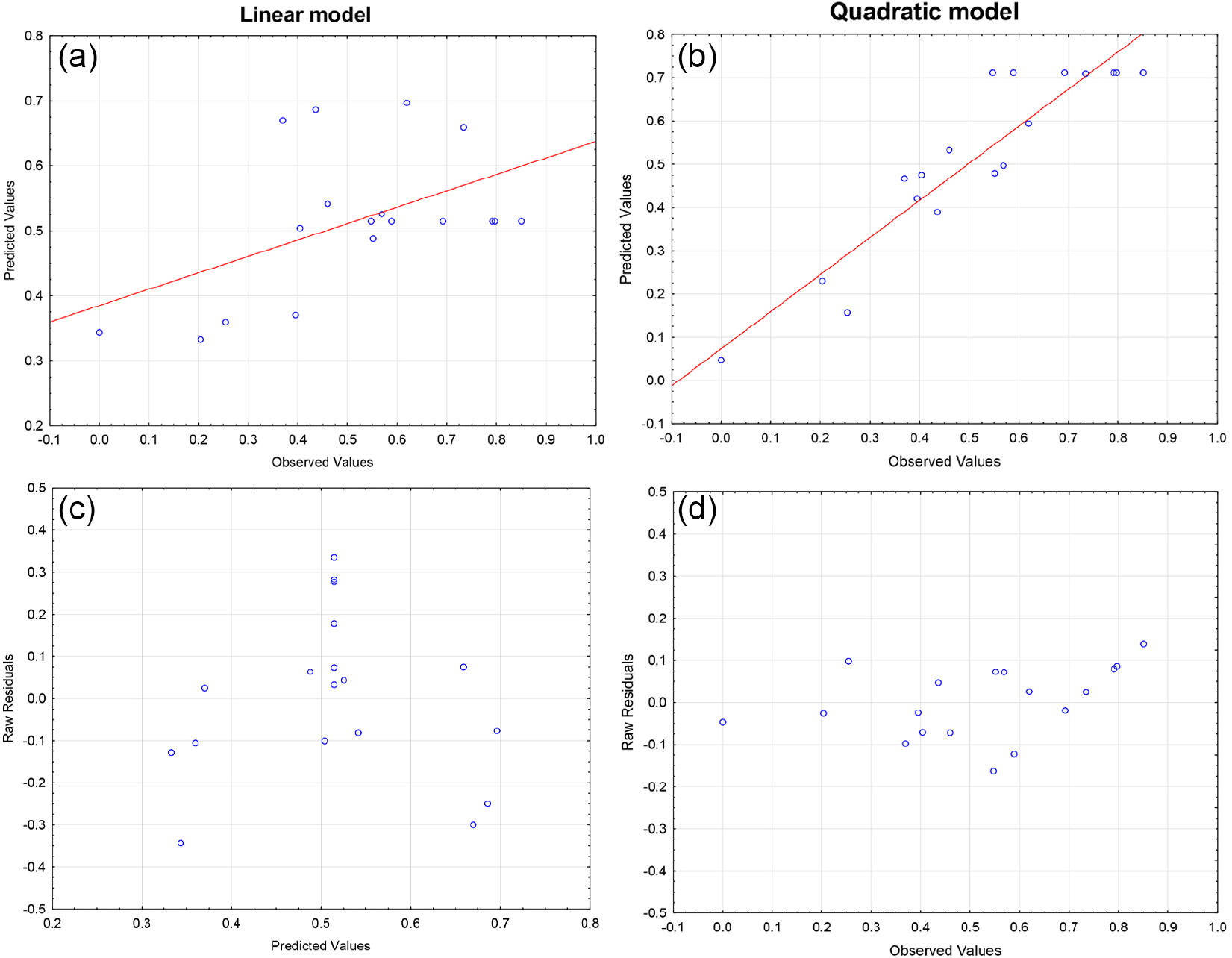
Neither function showed a lack-of-fit, presenting p-values of 0.4507 and 0.5323 for the linear and quadratic models, respectively. The evaluated parameters show that the quadratic model better describes data behavior, as also can be seen in the graphs of predicted values versus observed values and in the residual graphs (Figure 1).

Predicted versus observed values plots (a) and (b) and residual plots (c) and (d) the linear and quadratic model fitted to overall desirability.
The quadratic model presents a better correlation between the values predicted by the mathematical model and the values obtained experimentally, demonstrating its superiority over the linear model. The residual graphs also reinforce the decision to choose the quadratic model. It can be observed that the linear model leaves very large residuals in relation to the central axis of the graph. In addition, the residuals left by the linear model show trends indicating its inadequacy. Thus, the linear model was discarded and the quadratic model was used to determine the optimal experimental conditions.
The quadratic model describes partial surfaces characterized as maximum, shown in Figure 2. The maximum global desirability value reached is approximately 0.76. The closer this value is to unity, the more likely there is an intersection region between the optimal values of each response considered.

Partial response surfaces (a) sonication time × TMAH volume, (b) temperature × TMAH volume, and (c) temperature × sonication time obtained after fitting a quadratic function to the overall desirability values.
The maximum possible response is obtained by carrying out the procedure under the following experimental conditions: TMAH volume between 600 and 800 µL (700 µL was adopted) with a sonication time between 20 and 30 min (26 min was adopted). The temperature did not have a significant effect on the response within the experimental domain evaluated. Therefore, room temperature was adopted to perform the dissolutions. At this temperature, no variation was observed in the response obtained.
The software used for data processing provided the optimal conditions for processing the soy milk samples. Using overall desirability as a response, the optimal values found for TMAH volume, sonication time, and temperature were 700 µL, 27 min, and 40 ºC, respectively.
Sample mass study
The influence of sample mass in the nebulization system clogging and analytical signals was investigated for solid pulverized samples. Sample mass was studied in the range of 0.05 to 0.3 g. In this research, the increase in the analytical signal of the three metals studied and the dissolution of the sample (absence of particulate matter) were evaluated. It is noted that, within the mass values studied for Mn and Zn, the absorbance signal tends to increase as the mass increases. This behavior was not observed for Fe in the extreme values of the mass range studied. It was also observed that using a mass of 0.3 g resulted in a higher clogging frequency of the FAAS pneumatic nebulization. Thus, the mass of 0.25 g was chosen for future experiments.
Evaluation of the existence of matrix effects
Sample treatment with tetramethylammonium hydroxide generates a very alkaline final solution (or suspension) that can modify the determination conditions of the analytes studied. Most metal hydroxides have very low solubility and are converted into a colloid that remains suspended in the aqueous phase. This means that the analytes may present atomization efficiencies that are different from those they present in acidified aqueous solution, interfering in the determination due to the matrix effect. Transport interferences, such as those related to the generation of aerosols for sample nebulization in FAAS, are corrected by the matrix matching between calibration standards and samples (matrix matched) or by applying the standard addition method to the sample itself.
To evaluate the matrix effect, the slopes of analytical curves constructed in TMAH medium (700 µL) and the analytical curves constructed by the standard addition of the studied metals (Fe, Mn and Zn) in the sample itself after treatment with TMAH and sonication under optimized conditions were compared (Table 2). The absence of a significant matrix effect was confirmed, as the 95% confidence intervals of the calibration curve slopes overlapped, indicating no statistical difference. Accordingly, external calibration using standards prepared in TMAH medium was appropriate.
Parameters of the analytical curves for Fe, Mn and Zn obtained in aqueous TMAH solution and by standard addition to soy milk suspensions in TMAH
Analytical characteristics and application of the method
The analytical characteristics of the method based on sample dissolution in TMAH were obtained using the optimized experimental conditions. The limits of detection (LOD) and quantification (LOQ) were calculated based on the sample standard deviation of ten measurements of the blank solution of the analytical curve by dividing the result by the slope of the same curve and multiplying by 3 and 10, respectively. The LODs found, in mg L-1, were 0.053; 0.018 and 0.0028 and, in mg kg-1, they were 4.3; 1.4 and 0.22. The LOQs, in mg L-1, were 0.18; 0.061 and 0.0092 and, in mg kg-1, they were 14.2; 4.7 and 0.73 for Fe, Mn and Zn, respectively.
In terms of repeatability, precision was calculated based on ten measurements of the standard solutions of the studied metals at 0.5 and 2.0 mg L-1 and expressed as percentage of relative standard deviation (RSD). The values found were 5.3; 2.3 and 1.3% for 0.5 mg L-1 and 1.5; 1.3 and 0.95% for 2.0 mg L-1 for Fe, Mn, and Zn, respectively. Analytical sensitivity was calculated through the angular coefficient, finding the following values: 0.0211, 0.0605 and 0.187 Abs L mg-1, respectively.
Three techniques were used to assess accuracy: (i) addition/recovery tests (spike tests), (ii) comparison of the results obtained by the proposed method with a standard method (decomposition in acid medium using a digestion block) and (iii) analysis of a certified sample.
The results of the spike tests are presented in Table 3. Recoveries ranged from 92 to 104%. These results indicate that the developed method provides satisfactory accuracy for the determination of the studied metals.
Comparison of the results obtained with dissolution in TMAH and with sample digestion in an acidic medium are shown in Table 4 for two liquid samples of soy milk and in Table 5 for two solid samples (soy extract). Applying the paired t-test, t values were obtained as 1.52 and 0.340, respectively. Since the modules of these values are below the critical value (2.57, adopting a 95% confidence level), the results generated by the two methodologies are not statistically different and, therefore, accuracy is considered adequate.
Results (mean ± standard deviation) for the determination of Fe, Mn and Zn (n = 3) in liquid soy milk samples using two methodologies
Results (mean ± standard deviation) for the determination of Fe, Mn and Zn (n = 3) in pulverized soybean extract samples using two methodologies
A certified reference material sample of skimmed milk powder (Trace Elements in Skimmed Powered Milk, ERM-BD150) was analyzed and the results for Fe and Mn are presented in Table 6. The values found by analyzing the milk sample are very close to those reported in its certificate.
Determination (mean ± standard deviation) of Fe and Mn (n = 3) in a sample of certified skimmed milk powder reference material (ERM-BD150)
The results presented in Table 4 for the soy beverage samples show that the average concentrations for Fe, Zn, and Mn were 10.1, 6.15, and 1.40 mg L-1, respectively. Metal concentrations in soy milk can vary significantly depending on whether the product is fortified or not, generally ranging between 4 and 15 mg L-1 (Fe); 2.5 and 3.8 mg L-1 (Zn); and 0.5 to 5.0 mg L-1 (Mn).23,24 In the research carried out by Ribeiro et al.,25 the concentration levels of some metals, including Mn, in cow and soybeans milk were evaluated. The concentrations in the analyzed samples ranged from 0.86 to 1.3 mg L-1.
The results for the dry and powdered soy extract samples show that the average concentrations found were 2.08, 2.10, and 5.27 mg per 100 g for Fe, Mn, and Zn, respectively. The following average values were found in the literature: 7.0 mg per 100 g (Fe), 2.7 mg per 100 g (Mn), and 5.8 mg per 100 g.26 The concentration values found in the soy extract samples were very close to, or, as was the case with Fe, within the same order of magnitude as the values indicated in the consulted nutritional table.
Fe, Mn and Zn concentrations found in this study are consistent with data available in the literature, confirming that soy products are relevant sources of these metals in the diet. The Food and Nutrition Board, Institute of Medicine, National Academies, Washington, DC, USA,27 defined Recommended Dietary Intake (RDI) values for some elements such as Mn, 5 mg daily, and Fe and Zn, both 15 mg. In resolution-RDC No. 269, the Agência Nacional de Vigilância Sanitária (Anvisa) recommends a daily manganese intake of 2.3 mg, iron 14 mg, and zinc 7 mg.28
Conclusions
The application of Doehlert design combined with multiresponse optimization by desirability function allowed the efficient, fast and low-cost development of a procedure for treating soymilk samples using TMAH and ultrasound energy. The developed procedure allows the determination of Fe, Mn and Zn in soymilk samples and soybean extract using FAAS with limits of quantification of 0.18; 0.061 and 0.0092 mg L-1, precision (as repeatability, RSD) of 5.3; 2.3 and 1.3%. The evaluation of accuracy by three different techniques demonstrated satisfactory analytical performance under the evaluated conditions. The occurrence of matrix effects, assessed by comparing the slopes of the analytical curves, was not statistically significant, showing that external standardization, which is faster and more practical for laboratory routines, can be adopted without determined errors. The average concentrations in the soy milk samples were 10.1, 6.15, and 1.40 mg L-1 and, in the powdered soy extract samples, they were 2.08, 2.10, and 5.27 mg per 100 g for Fe, Mn, and Zn, respectively. These results were consistent with values found in the literature.
Acknowledgments
The authors are grateful to CNPq (grant number 310949/2021-1), FAPESB (INCITE No. PIE0006/2022), and CAPES - Finance Code 001. The graphical abstract figure was generated by artificial intelligence using Gemini 1.5 Pro.
Data Availability Statement
All data are available in the text.
References
-
1 Casé, F.; Deliza, R.; Rosenthal, A.; Mantovani, D.; Felberg, I.; Ciênc. Tecnol. Aliment. 2005, 25, 86. [Crossref]
» Crossref -
2 Capriotti, A. L.; Caruso, G.; Cavaliere, C.; Samperi, R.; Laganà, A.; J. Agric. Food Chem. 2014, 62, 10280. [Crossref]
» Crossref -
3 Alves, J. P. S.; Cerqueira, M. F. M.; Novaes, C. G.; Barreto, J. A.; Trindade, J. S.; Araújo, S. A.; Bezerra, M. A.; Food Chem. 2020, 334, 127559. [Crossref]
» Crossref -
4 Alves, J. P. S.; Cerqueira, U. M. F. M.; Novaes, C. G.; dos Santos, W. N. L.; Araújo, S. A.; Bezerra, M. A.; Food Chem. 2021, 362, 130176. [Crossref]
» Crossref -
5 Rai, P. K.; Lee, S. S.; Zhang, M.; Tsang, Y. F.; Kim, K. H.; Environ. Int. 2019, 125, 365. [Crossref]
» Crossref -
6 Fowler, B. A.; Alexander, J.; Oskarsson, A. In Handbook on the Toxicology of Metals, vol. 1, 4th ed.; Academic Press: San Diego, California, USA, 2015, 123, ch. 6. [Crossref]
» Crossref -
7 Lee, J.-G.; Hwang, J.-Y.; Lee, H.-E.; Kim, T.-H.; Choi, J.-D.; Gang, G.-J.; Appl. Biol. Chem. 2019, 62, 64. [Crossref]
» Crossref -
8 Guo, Z.; Chen, P.; Yosri, N.; Chen, Q.; Elseedi, H. R.; Zou, X.; Yang, H.; Food Rev. Int. 2021, 39, 1440. [Crossref]
» Crossref -
9 Khan, A.; Khan, S.; Khan, M. A.; Qamar, Z.; Waqas, M.; Environ. Sci. Pollut. Res. 2015, 22, 13772. [Crossref]
» Crossref -
10 Assis, R. S.; Silva, U. N.; Cerqueira, U. M. F.; Santos Alves, J. P.; Microchem. J. 2024, 174, 110059. [Crossref]
» Crossref -
11 Matusiewicz, H.; Phys. Sci. Rev. 2017, 2, 20178001. [Crossref]
» Crossref -
12 Cerqueira, U. M. F. M.; Alves, J. P. S.; Santos, W. N. L.; Pita, B. S.; Novaes, C. G.; Araújo, S. A.; Bezerra, M. A.; Adv. Sample Prep. 2024, 13, 100104. [Crossref]
» Crossref - 13 Krug, F. J.; Rocha, F. R. P.; Métodos de Preparo de Amostras para Análise Elementar, 2nd ed.; EditSBQ: São Paulo, 2019.
-
14 Lemos, M. S.; Cruz, A. S.; Dantas, K. G. F.; J. Braz. Chem. Soc. 2021, 32, 455. [Crossref]
» Crossref -
15 Chen, B.-H.; Jiang, S.-J.; Sahayam, A.-C.; Food Chem. 2020, 324, 126698. [Crossref]
» Crossref -
16 Silva, D. S.; Santos, C. S.; Pando, L. A.; Gomes, M. S. R.; Novaes, C. G.; Santos, W. N. L.; Bezerra, M. A.; Food Chem. 2019, 273, 71. [Crossref]
» Crossref -
17 Manjusha, R.; Shekhar, R.; Kumar, S. J.; Food Chem. 2019, 294, 384. [Crossref]
» Crossref -
18 Campos, N. S.; de Oliveira, M. A. L.; Izumi, C. M. S.; de Sousa, R. A.; J. Braz. Chem. Soc. 2018, 29, 353. [Crossref]
» Crossref -
19 Hwang, J.; Park, J. Y.; Kim, S. Y.; Song, N. E.; Yoo, M.; Choi, Y.; Nam, J. S.; Seo, D.; J. Anal. Chem. 2020, 75, 1399. [Crossref]
» Crossref -
20 Jiménez-Moreno, M.; Lominchar, M. A.; Sierra, M. J.; Millán, R.; Martín-Doimeadios, R. C. R.; Talanta 2018, 176, 102. [Crossref]
» Crossref -
21 Clark, N. J.; Clough, R.; Boyle, D.; Handy, R. D.; Environ. Sci.: Nano 2019, 6, 3388. [Crossref]
» Crossref -
22 Sun, Y.; Yang, Y.; Tou, F. Y.; Niu, Z. S.; Guo, X. P.; Liu, C.; Yan, J.; Wu, J. Y.; Xu, M.; Hou, L. J.; Liu, M.; J. Hazard. Mater 2022, 424, 127383. [Crossref]
» Crossref -
23 Morelli, L. L. L,; Godoy, A. T.; Pallone, J. A. L.; Public Health Frontier 2012, 1, 53. [Link] accessed in May 2026
» Link -
24 Cockell, K. A.; Bonacci, G.; Belonje, B. J.; J. Am. Coll. Nutr. 2004, 23, 124. [Crossref]
» Crossref -
25 Ribeiro, I. J.: Avaliação das Concentrações dos Metais Chumbo, Manganês e Cádmio em Leite de Vaca e Bebidas de Soja Existentes no Mercado Português; MSc Dissertation, Universidade de Lisboa, 2020. [Link] accessed in March 2026
» Link -
26 Tabela Nutricional, Nutrição, saúde e bem estar. [Link] accessed in March 2026
» Link -
27 National Institute of Health; Nutrient Recommendations and Databases [Link] accessed in May 2026
» Link -
28 Agência Nacional de Vigilância Sanitária (ANVISA); Instrução Normativa ANVISA/DC No. 269 de 22/09/2005 [Link] accessed in May 2026
» Link
Edited by
-
Editor handled this article:
Hector Henrique F. Koolen (Associate)